Showing posts with label Victorian. Show all posts

Friday, 26 April 2024

To Tate Britain - and Ellen Terry’s Dress. By Penny Dolan

The iconic portrait of Ellen Terry as Lady Macbeth in her beetle-wing dress has been a favourite painting of mine for many, many years.


I am not alone in my enthusiasm as, with the detachment of someone who had been on stage almost all her life, the actress herself commented:

“The picture of me is nearly finished and I think it magnificent. The green and the blue of the dress is splendid, and I think the expression as Lady Macbeth holds the crown over her head quite wonderful.”

A while ago, studying Victorian theatre for my children’s novel, I learned that the beetle-wing dress still existed, and was kept as part of Terry’s costume archive at her last home, Smallhythe Place.

The property, a small half-timbered cottage with a tiny theatre, is deep in the Kent countryside, between Tenterden and Rye and now owned by the National Trust. However, the opening hours and parking were limited and Kent is a long way from my home in Yorkshire.

                     Visiting Smallhythe Place's garden | Kent | National Trust

Later, when I was passing through Kent for work, the website informed me that the Trust was now focused on a nearby archaeological site, that Smallhythe Place itself was under renovation and Terry’s dress away for conservation. Ah well, so be it, I thought. By then, my novel A Boy Called M.O.U.S.E was out into the world, other things were happening, and life moved on.

However, about fortnight ago, Ellen Terry came back into my mind. In ‘The Motive and The Clue’, Jack Thorne’s play about the tensions between ageing Sir John Gielgud and young hellraiser, Richard Burton, who wants direction as Hamlet. In response to Burton’s tirade about life as a miners son, Gielgud - most wonderfully played by Mark Gattis - says in a hollow, lonely voice something like “What else could I be, coming from a theatrical family like mine?” Which is when I remembered that Gielgud’s family tree included great-aunt Ellen Terry of the beetle-wing dress. 

Almost on the same day, in a series of tweets by fashion historian Dr Kate Strasdin, I read that, right now, both the Lady Macbeth portrait and that famous dress are on display in Tate Britain, which has prompted this History Girls post today.

The Dress

In 1888, John Singer Sargent, an American-born, European artist, and the leading portrait painter of his generation, attended the opening of Henry Irving’s production of Macbeth. Seeing Terry as Lady Macbeth, he immediately asked to paint her but, as he wrote to his wealthy American patron, Terry delayed until the reviews of the play were in. She “had not yet made up her mind to let me paint her in one of the dresses until she is convinced she is a success. From the pictorial point of view, there can be no doubt about it – magenta hair!”

The blue-green dress was designed by Alice Comyns Carr who made many of Terry’s costumes. The dress ‘shone with a strange metallic lustre’. And had a hint of soft chain mail about it. Carr recorded that her “fine needlewoman” Adaline Cort Nettleship, had “bought this fine yarn for me in Bohemia . . a twist of soft green silk and blue tinsel, and wanted ‘something that would give the appearance of the scales of a serpent”. Photographs, rather than the a painting, show that ‘Mrs Nettles’, as Terry called her, used crotchet work to create the effect.

The design was chosen to invoke fear. Not only was green a dangerously sinister hue but the dress was covered in a thousand glittering scales: the shining wing-cases or ‘elytra’ of the green jewel beetle, which were harvested when the farmed insects had died, which meant little in an era of feathers and furs.

Beetle-wing embroidery originally came from Mughal India, where small sequin-like pieces of ‘elytra’ were traditionally added to decorative and household fabrics and to clothing and accessories for all genders and ages. In the eighteenth century, English women living in India wore soft white dresses embroidered with small green elytra motifs.

However, during the nineteenth century, elytra and elytra fabric were imported to Britain. The fabrics were of lesser quality, but the hard wing cases that glittered in gas or candle-light, were ideal for evening dresses. Terry’s dress, however, was so well-made that it was re-used many times and went on tour to America, before becoming part of her costume archive.

Continuing to describe Lady Macbeth’s costume, Carr noted that: “When the straight thirteenth-century dress with sweeping sleeves was finished it hung most beautifully, but we did not think it was brilliant enough, so it was sewn all over with the real green beetlewings, and a narrow border of celtic designs worked out in rubies and diamonds, hemmed all the edges. To this was added a cloak of shot velvet in heather tones, upon which great griffons were embroidered with flame-coloured tinsel . . . two long plaits twisted with gold hung to her knees.

Note that cloak: though the cloak in the description above is described as “heather”, Carr had also designed a bright scarlet cloak for Terry’s appearance after the Macbeth murder scene. The second cloak offers an interesting view of Terry and Irving’s relationship: although Irving praised the look of the cloak when Terry wore it on the first night, by the second performance, Irving appeared with the cloak thrown around his own shoulders, aware that the splash of the blood-red focused the audience’s eyes on him, on Macbeth. Terry, I assume, shrugged her shoulders.

This action was not necessarily as harsh as it seems. Irving must have felt that, on stage, the cloak would look better on Macbeth as the central character. Irving was always aware of the quality of the acting, but he was also conscious of the picture the scene was creating. He was particular, not only of the positioning and gestures of the actors but also the quality of the painted scenery and the drama added by all the lighting effects. Irving’s intention was that his audience would see each scene as a beautiful, carefully constructed painting: as an example of theatre as high art, not common music-hall entertainment. Ellen Terry, appearing in her green dress, helped to fulfil to his purpose.

The Painting.

Dressed in costume and wearing her long dark-red theatrical wig, Terry took her carriage to Sargent’s studio in Tite Street, London each day for a couple of weeks. She noted that during that time, her “face’s appearance”, as she put it, earned her no fee. Ellen, who loved luxury, was also aware of poverty.

Oscar Wilde, who lived nearby, watched her daily arrival. A Terry fan, he wrote “The street that on a wet dreary morning has vouchsafed the vision of Lady Macbeth in full regalia . . . can never again be as other streets: it must always be full of wonderful possibilities.”

                                     File:Sargent, John SInger (1856-1925) - Self-Portrait 1907 b.jpg ...

John Singer Sargent, although his image indirectly promoted Irving’s play, did not choose a scene from the production. Originally he started work on a series of grisaille sketches, showing Lady Macbeth leaving the castle keep, surrounded by flares and bowing court ladies. 
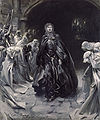
                                     Drawing by Sargent for Terry's golden jubilee programme, 1906

However, Singer was keen to use the richness of oil paints to show the “stained glass effects” that he had observed on the Lyceum stage, so he chose to paint a solitary Lady Macbeth, holding Duncan’s crown above her head, a queen from the Celtic twilight.

In the picture, Terry gazes up at the crown with an extraordinary, enigmatic expression. She saw Lady Macbeth as a woman who, because of love, was as one with her husband and his ambition: “a woman of highest nervous organisation, with a passionate intensity of purpose.” Terry loved the work, describing her look as apprehension, and said that the portrait felt “more like me than any other”.

Jonathan Jones, art critic of the Guardian, writing about twenty years ago, suggested that she looks like a sacred figure from an ancient temple. He also criticised the work, pointing out thatthis is not a real moment of self-loss. It is a painting of what theatre meant to the people at the time, an evocation of Terry’s power to inspire fantasy in her public.”

Sargent may have decorated the frame with Celtic motifs, ready for the portrait's first public viewing, which took place in 1889, at the New Gallery in Regent Street’s  owned by Alice’s Comyns Carr’s husband Joseph. The work became a great attraction. Terry reported it as “the sensation of the year . . . There are dense crowds round it day after day . . . but opinions differ about it.” Though some critics loved Sargent's painting, others did not, and The Saturday Review declared it “the best hated picture of the year.”

Sir Henry Irving bought the painting and hung it at The Lyceum Theatre, where he hosted the all-male Beefsteak dining club and eventually celebrated the hundredth performance of 'The Merchant of Venice'. The painting was also exhibited in Europe and South America, until finally being auctioned off and bought for the Tate by a wealthy donor in 1906.

The Actress

Ellen Terry (1847-1928) was born into a large theatrical family. As an infant, her cot would have been an open chest of drawers in that production’s lodgings. As a young child, she grew up reading the works of Shakespeare with her siblings. Terry grew up as familiar with the hardships of the touring life as with the glamour of life on stage.

Her father, Ben, was the business man, the one who found work with the actor-manager Charles Keans’ company. Sarah, Terry’s mother, who taught the child actress about performance and the importance of being ‘useful’ on stage to the leading actors. Aged five, Terry appeared as Prince Arthur in King John and other young roles in Kean’s productions. At eleven, she took the role of Puck in his A Midsummer Nights Dream, and also appeared in a genteel Shakespearian Entertainment attended by Queen Victoria.

Terry’s lively manner, burnished gold hair and Pre-Raphaelite beauty brought her to the attention of wealthy artistic circles, and her life was not without notoriety. At sixteen she retired from the stage to become the wife of the renowned painter G. F. Watts. Already in his mid-forties, Watts was unsure whether he should adopt his model or marry her.

Watts painted The Sisters, a double portrait of Ellen Terry and her older sister Kate, he also painted her alone: in his work ‘Choosing’, she appears as a young girl, caught between the attraction of a scarlet, scentless camellia and the humble, maidenly sweetness of a bunch of violets. Knowing the circumstances and the outcome, this is a rather unsettling image.

Terry also modelled for the pioneer photographer, Julia Margaret Cameron, who was related to Mrs Princeps, Watt’s too-dominant patron. Terry appears as a simple young girl in classical dress, her eyes closed and her head resting in an innocent dreamlike pose. Sadly, as Watts’ spirited wife, Terry found no role in his already well-organised home and was shunned by his reverential circle of admirers. The marriage was not a success, and Terry returned to her parents. 

                                       Wikipedia:Featured picture candidates/Ellen Terry - Wikipedia 

After some brief appearances on stage, Terry fell deeply in love with the designer and architect Edwin Godwin. She ran away from her parents and the public to live with him in rural Hertfordshire, and was soon the mother of two adored children. With Goodwin often away and Terry cut off from society, the relationship was strained, and their mutual love of art and luxury soon brought financial problems.

Then, in 1874, when Terry’s pony-cart lost a wheel on a country lane, Charles Reade a passing horseman, recognised her. He was a playwright and an old theatrical friend who helped her and persuaded her to return to the stage in one of his own plays. With the bailiffs at the door, and Reade’s money on offer, Terry accepted and found that her audiences welcomed her back warmly, both in London and on tour.

Terry’s true ascent to theatrical stardom came not long after. Squire Bancroft, the renowned theatre manager, cast her as Portia in his 1875 production of The Merchant of Venice. Her appearance, first in a china-blue and white gown designed by Alice Comyns Carr and then in black velvet as lawyer, stole the eye. According to the artist Graham Robertson, she was “the painter’s actress” appealing to the eye and ear, “her gestures and pose being elegance itself; her charm held everyone but predominantly those who loved pictures.” Though the actor playing Shylock did not live up to the role, Terry herself, and the production, shone.

Though Godwin’s stage sets, based on his visits to Venice, were praised, Terry’s trust had gone and the relationship broke down. Before long, now formally separated from Watts, she married the actor Charles Wardell Kelly whom she knew on tour. Marriage brought her respectability and her mother and family, who had disowned her, happily accept their daughter again. Kelly, though, was not happy to accept roles of lesser stature than his wife and so, as Terry’s theatrical reputation rose higher, envy and jealousy blighted the marriage.

Besides, Ellen Terry, at that point, was beginning the most important professional relationship of her life. Henry Irving, the leading stage manager and actor of the Victorian age invited her to play Ophelia to his Hamlet at his Lyceum Theatre. She became his stage partner, establishing a theatrical marriage that continued for twenty-four years. Their personalities on stage were complementary and were once described as “the flower and the tree”. Terry’s warmth, womanliness and lightness contrasted with Irving’s serious attitude and sometimes stiff manner. For her part, she was content to use her famed femininity as a foil to his dominant roles.

                                            File:Henry Irving portrait.jpg - Wikipedia

Irving, in his turn, gave Terry the chance to star in all the female Shakespearean roles: Ophelia, Desdemona, Portia, Juliet, Viola, Beatrice, Lady Macbeth, Cordelia, Imogen, Volumnia and Queen Katherine, for his theatre and she was dubbed, by Oscar Wilde, “Our Lady of the Lyceum.”

And the ‘Missing’ Dress . . .?

I had long given up thoughts of seeing the dress itself, and I did not see the painting when I visited Tate Britain last year, after the great rehang. However, Dr Kate Stradin’s tweet sent me searching online, and there was an answer to the missing garment.

Around the millenium, the National Trust had found that Terry’s archive at Smallhythe Place needed serious attention. There was particular concern about the presence of 'wooly bear moths' within the house and the fabric collection. Consequently, twelve years ago, Zenze Tinka Conservation starting major preservation work on the beetle-wing dress, which was in preparation for the “Sargent and Fashion” exhibition to be held at the Boston Museum of Fine Art in 2023. Reading on, I discovered that the whole exhibition was due to transfer to Tate Britain, in London, in 2024. 

It is 2024 now, and Ellen Terry's famous costume is right here, on display. For the first time since 1889, her green beetle-wing dress, the heather-coloured cloak and Sargent’s portrait will be together in the same place. 

 And on the day this History Girls post appears, I will be down at Tate Britain, meeting and greeting Ellen Terry’s famous green beetle-wing dress at last.

 Maybe, over the summer, I might even take a look at Smallhythe Place again, and see how the conservation work is getting on.

Penny Dolan

PS. After being disappointed by Jonathan Jones’ rather dismissive Guardian review of the Sargent and Fashion exhibition recently, I was hugely cheered to see, on the Letters page, a spirited response from Cally Blackman, asserting the importance of fashion and frocks.

https://www.theguardian.com/fashion/2024/feb/23/throw-off-the-cloak-of-snobbery-and-treat-fashion-as-a-serious-art-form

She writes

Whatever the distress caused to Jones by the lighting, wall colours and glass cases in wrong places, it is a very rare thing indeed to see garments displayed next to the paintings in which they are depicted, and a special joy to see these same garments interpreted on the canvas with Sargent’s consummate skill and aesthetic judgment. Some of the gowns on display are by Charles Worth, the most prestigious couturier in Paris (not “designer” – the word had not been invented then).” 

 Then came Blackman’s warning:

Compared with these, Ellen Terry’s beetle-wing-embellished Lady Macbeth stage costume (“costume” is the term for clothing worn for performance, not for garments worn in everyday life) looked dull and lifeless, yet scintillated in radiant, glowing colour from Sargent’s portrait, a testament to his quality as an artist.”  

I am still looking forward to seeing the dress, and the whole exhibition, tremendously. It has been a long time.


Further information:

Ellen Terry by Joy Melville.

Sir Henry Irving: A Victorian Actor and His World by Jeffrey Richards.

A Strange Eventful History: The Dramatic Lives of Ellen Terry, Henry Irving and their Remarkable Families by Michael Holroyd

https://www.nationaltrust.org.uk/visit/kent/smallhythe-place

Tom Gurney: HistoryofArt.org

https://www.theguardian.com/education/2002/jan/12/arts.highereducation

A Boy Called M.O.U.S.E by Penny Dolan

and 

Dr Kate Strasdin @kateStrasdin The Dress Diary of Mrs Anne Sykes

                    16 stunning Victorian textiles from The Dress Diary of Mrs Anne Sykes
Friday, 10 December 2021

The Finger in the Fly Trap - Barbara Kingsolver's 'Unsheltered'. By Judith Allnatt

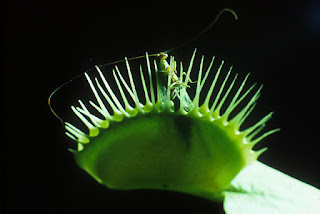
Barbara Kingsolver’s most recent novel, ‘Unsheltered’ explores the acrimonious debate between evolutionists and creationists in the 1870s, alongside a contemporary ‘state of the nation’ narrative  revolving around a downwardly mobile family living in a collapsing house. The historical story, which I found fascinating, features the renowned female biologist, Mary Treat, whose dedication to scientific observation extended to holding her own finger in a Venus flytrap for hours to test the strength of its insect-dissolving juices.


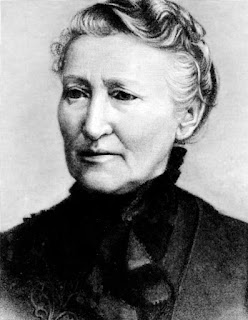
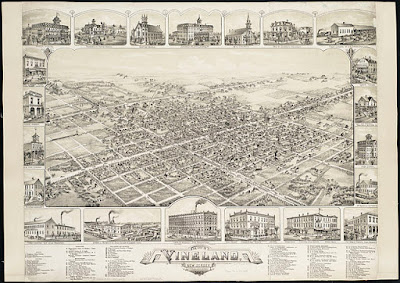
Mary Treat corresponded with Charles Darwin, providing him with observations of American plants from the Pine Barrens, an area of virgin woodland near her home in Vineland, New Jersey. Although she had little formal education she studied, observed and experimented, becoming an expert in her field. No doubt, given the usual lot of women at the time this was only made possible by the absence of her husband, from whom she was separated, and by the happy chance of being a woman of independent means.


In ‘Unsheltered’, Kingsolver invents a neighbour for Mary: Thatcher Greenwood, who on his first visit discovers Mary surrounded by glass jars full of flowers. Closer inspection reveals that each contains a cobweb built in the shape of a tower . . . and the tarantula that built it. Mary has used the flowers as a disguise to avoid alarming the ladies who visit her, who would disapprove of her interest.  

Thatcher also has to resort to subterfuge in his work as a biology teacher at the local school, trying to circumvent the strictures of his headmaster, Cutler, who abhors the new theory of evolution and is prejudiced against both scientific method and rational argument. 
The ‘utopian’ town of Vineland was the brainchild of the historical figure, Charles Landis. He is presented as an authoritarian figure who uses his wealth and power to further his own ends. This seems a fair assessment of his character given his history. His arrogant sense of entitlement was such that criticism in a local newspaper led him to shoot the editor in the head, a case that came to be referred to as the murder on Main Street and for which Landis was excused on the trumped up grounds of ‘temporary insanity’. Cutler has the support of this city father and attempts to frustrate and humiliate Thatcher at every turn. 

Kingsolver brings the fictional characters Greenwood and Cutler together head- to-head in a public debate on evolution versus creationism, which is chaired by Landis. Through this climactic scene she explores some of the responses to evolution of the time: ranging from reluctance to consider it, to a ‘flat earth’ fervour to discredit it. 

In the face of Cutler’s bluster and the audience’s scepticism, Thatcher illustrates his argument for genetic modification by using examples of natural selection in a wolf pack and of the whitening of the coat of the Arctic hare, over time.

The debate is entertaining, with a fine sense of the ridiculous. Cutler brings the Bible to his aid but is unable to explain how, if Noah took only one pair of each kind of animal onto the ark and then burnt some of them on the Lord’s alter, the species could have reproduced. He then claims that the development of varied species on different landmasses despite all creatures having been brought to Mount Ararat,  occurred through God parting the seas to allow creatures to cross to other continents. Thatcher points out that for a prairie hen, walking at four miles an hour, even the leg of the journey from Europe to America would take two years – quite a time for the ocean to be parted.

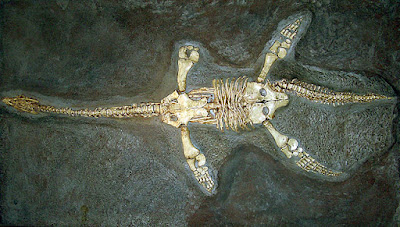
Thatcher cites Occam’s Razor which contends that a simple explanation (ergo evolution in this case) is more likely to be correct.He moves the debate to  Mary Anning’s fossil record, showing that beasts such as the plesiosaur have existed and no longer do so. Cutler is willing to discount the evidence of his own eyes, dismissing the fossils as a hoax. He believes that God creates only perfection so He cannot have made a creature for it to be extinguished. ‘God doesn’t make mistakes!’ he roars. 


As well as claiming that Man is above the animal world and not part of it, Cutler muddles society and science, drawing extensively on the notion of order, creating his own version of the medieval ‘chain of being’ which he perceives as threatened by the notion of racial equality, or even women wearing trousers, which he rates as ‘turning against God’s domestic harmony'. The strongest driver for sticking to the status quo of belief in a Divine order is revealed to be vested interest in the existing societal power structure.

In choosing the title ‘Unsheltered’, Kingsolver refers not only to the imminent collapse of the decaying house in the modern story but to the choice to forego comforting beliefs and instead consider experiment, evidence, rationality, enlightenment. The crumbling house becomes a metaphor for, among other things,  old beliefs being stripped away. Kingsolver has her character, Mary Treat, identify a silver lining of clearer vision saying : ‘Without shelter, we stand in daylight’. In 'Unsheltered' Barbara Kingsolver has   transformed her historical research into a compelling and thought provoking novel. 


Friday, 10 January 2020

Felicia Skene: writer & philanthropist by Janie Hampton

Felicia Skene, left, with her niece Zoe Thomson, wife of the Archbishop of York,
and her brother William Forbes Skene, Historiographer Royal of Scotland, in 1892.

When I first moved to Oxford I rather disapproved of the hostel next door, with its Victorian attitude to young, single mothers. I was not surprised when our local vicar told me that it was run by the ‘Skene Moral Welfare Association’. I then learned that the Skene in question was Felicia Mary Frances Skene, one of the most radical women in nineteenth century Oxford. I was even more amazed to discover that she was my grandfather’s great aunt, known in the family as ‘Fifi’. I wanted to know more.
Felicia Mary Frances Skene as a young woman

Her father James, was a wealthy Scottish lawyer and amateur artist whose engravings illustrated Walter Scott’s novels. Born in 1821, Fifi comforted Scott with fairy stories the night in 1825 when he lost everything. Roused by her cheerful spirit, he decided to fight bankruptcy and work through his debts. Scott wrote that Fifi’s parents ‘bring so much old-fashioned kindness and good humour with them that they must be always welcome guests.’ They were also enterprising and resourceful.
James Skene believed that travel was the best form of education, and so led his family on a grand tour around Europe. Fifi was taught the piano in France by Liszt, whom she described as ‘a wild-looking, long-haired excitable man’. Between 1838 and 1845 the family lived in Athens where Fifi sang with the Greek royal family. During an expedition on horseback across the Marathon plain, she spent the night in a shack with Albanian peasants and their pigs. At the age of twenty-four she brought her young nieces aged ten and eleven (one of them my great grandmother Janie) home from Athens by ship and train via Constantinople. Arriving in England she wrote her first book Wayfaring Sketches among the Turks and Christians, first in French and then in English. Her observations of conditions in slave markets, galley- ships and an Ottoman Pasha’s harem made it a bestseller.

Fifi’s father James Skene of Rubsilaw, 1775–1864,
 with two of his grandchildren.
The Skene method of education obviously worked. Her older brother James Henry married Rhalou, a Greek aristocrat and became a British Consul to Aleppo. Fifi’s brother George was Professor of Law at the University of Edinburgh and Sheriff of Glasgow. Another brother William became the Historiographer Royal of Scotland, writing the first academic history from Scotland’s point of view. One of her sisters married the Swedish ambassador to Washington, Berlin and Paris, and the other married a Greek archaeologist– the brother of her sister-in-law.
Fifi settled in Oxford, where her social views were considered overly progressive, especially for a woman. Her 1866 novel Hidden Depths was an exposure of prostitution in Oxford inspired by the injustices she had witnessed in the prison and women’s reformatories. The Athenaeum criticised her writing as ‘unrepresentative of society’, The London Review disapproved of the message and Mudie’s Library considered the subject-matter altogether too provocative. The Lesters: A Family Record warned readers of the dangers of alcohol but was denounced by Saturday Review as being ‘cheap melodramatic horror’ and ‘almost beneath criticism’ while Academy dismissed the novel as 'dull and destined for failure'.
Despite many offers, the auburn-haired and boisterous Fifi was far too busy to bother with marriage. She preferred to carve out her own life as a writer and philanthropist than belong to a man. Fluent in both French and Greek, and possessing a photographic memory, she published more than twenty books under the pseudonyms of Oxonesis, Francis Scougal and Erskine Moir. Her interest in the high-church ‘Oxford Movement’, inspired a theological work The Divine Master, which ran to eleven editions. She wrote for Blackwood’s, Cornhill and Macmillan's Magazines, Quiver, Temple Bar and Good Words, which had a circulation of 100,000 and featured contributions by Thomas Hardy and Anthony Trollope.
Fifi’s 1865 anonymous pamphlet, ‘Penitentiaries and Reformatories’ on the humiliation of ‘fallen women’ whom society ‘sought to hide its blackest curse under a veil of mock prudery. . . because their sin was unfit to be named in the polite society that received with open arms the very men on whom they sinned’. (University of Indiana's Victorian Women Writers Project)
Fifi was a deeply religious and principled woman and used the income from her books and articles to finance her philanthropic work. Her biographer, Edith Rickards, wrote in 1902 that ‘it was her rule throughout her long life never to spend on herself what she gained from her writings, partly from her natural love of giving, partly from an old-fashioned idea that it was an undignified thing for a lady to earn money for her own personal advantage.’

'The Skene Arms', left, in St Michael’s Street, Oxford.

For most of her life, Fifi lived in St Michael’s Street in the centre of Oxford. It’s nickname was ‘The Street of Seven Deadly Sins’. Her home was known as ‘The Skene Arms’, because it was always open to beggars, clergymen, prostitutes, politicians and students. In her Cornhill Magazine article ‘Ethics of the Tramp’ she wrote that like her parrots, men of the road should roam free and never be incarcerated. She braved the wrath of local pimps and drunken husbands by finding refuge for women fleeing prostitution and domestic violence.
Fifi, Tatters and Rev. Algernon Barrington Simeon,
the first Warden of St Edward’s School,
whom she nursed though diphtheria, 1875.
After years of impromptu visits to Oxford Prison accompanied by Tatters, her Skye terrier, Fifi became England’s first official female Prison Visitor. She insisted on complete confidentiality and demanded that male and female prisoners be housed separately, for the protection of the women. On their release, she gave prisoners a hearty breakfast and a reference for employment. She even organised marriages to legitimatize the children of ‘fallen women’. Independently of any political movement, she fought for prisons to be used for rehabilitation; for the abolition of capital punishment; and for the decriminalization of suicide. She also campaigned against female inequality, animal vivisection and religious intolerance. When the Prime Minister, W.E. Gladstone, asked her advice on the new theory of evolution, she told him that Darwin’s discovery was true, and compatible with Christianity. 
Fifi helped found St Edward’s School for the sons of poor clergymen and dug the first sod of earth for its new buildings in North Oxford. With Dr Henry Acland, Fifi trained nurses to deal with cholera and smallpox outbreaks in Oxford. But when she offered her nurses to Florence Nightingale for the war in the Crimea, all but three were turned down for being ‘too working class.’

Fifi, 1821-1899, in old age.


Fifi died of bronchitis in 1899 and was buried in St Thomas Church, near Oxford railway station. A century later the assets of the Skene Moral Welfare Association were redistributed among Oxford’s social housing associations. In old age, Fifi had said of herself, ‘I am like the Martyr’s Memorial – everybody knows me and no-one is interested me.’ Beyond Oxford, she has largely been forgotten, but in 2002 a blue plaque was erected outside her home, now a hostel for single men. The plaque describes Fifi as ‘Prison reformer and friend of the poor’ but there is no mention of her literary achievements.
At times I have felt that my own career, which is split between writing popular history books and international development, confuses people. Great Aunt Fifi demonstrated that a woman can have as many different careers as she likes.
 Some of her titles: Wayfaring sketches among the Greeks and Turks, and on the shores of the Danube by a seven years resident in Greece, 1849. The Isles of Greece, and other poems, 1843. Use and Abuse,  a tale, 1849. The Inheritance of Evil or, The Consequence of marrying a deceased wife’s sister, 1849. The Tutor's Ward, 1851.  The Divine Master, 1852. S. Alban’s, or, the Prisoners of Hope, 1853.  Hidden Depths ,1866. Still and Deep, 1875. Memoir of Alexander, Bishop of Brechin, 1876. Raymond, 1876.  Life of Alexander Lycurgus: archbishop of the Cyclades, 1877. More than Conqueror , 1878. The Shadow of the Holy Week, 1883. A Strange Inheritance, 1886. The Lesters: a Family Record, 1887. Through the Shadows: a Test of the Truth, 1888. Awakened. A tale in nine chapters, 1888. Dewdrops: selections from writings of the saints,1888. Scenes from a Silent World, or, Prisons and their Inmates, 1889.

Sunday, 23 June 2019

A Victorian Scandal: The Peer and the Dancer by Judith Allnatt

In 1851, the Spanish dancer Josefa Duran, known as ‘Pepita’ caught the eye of Lionel Sackville-West, a member of the British aristocracy (2nd Baron Sackville). She was slim and beautiful and was known for the airiness of her dancing, for her luxuriant, waist-length dark hair and for the kiss curls she wore on each cheek. She had what we would now call ‘celebrity status’ and young men were said to have plucked flowers from their own wives’ hair to cast them at her feet on the stage. 

Born in a Málaga slum to a barber father and a clothes-seller mother, Pepita’s background couldn’t be further from that of Lionel’s family, who owned Knole, one of the largest and most important of Britain’s Great Country Houses. They met a week or so after Lionel had seen her at the theatre; Lionel visited and they soon became ‘intimate’. A further obstacle to the lovers, beyond the chasm between their social classes, was that Pepita had in fact married another dancer, Juan Antonio de Oliva, only the previous year. They had separated swiftly in circumstances that Oliva maintained were ‘not honourable’ to Pepita and she had left Spain to tour abroad.
The Cartoon Gallery, Knole
Their relationship was intermittent in nature. As first attaché in Berlin, Lionel was able to visit Pepita in the cities and towns in which she was dancing but there were inevitably spells when they were apart. Pepita was certainly no angel; she appears to have had other liaisons with Prince Youssoupoff in Munich and Duke Maximilian Joseph in Bavaria. After Lionel and Pepita’s daughter Victoria was born, they separated for two years but Lionel returned to her after hearing that she was desperately ill. She had lost a baby and refused to say who the father was, but nonetheless they were reconciled.

In 1866, having given up dancing, Pepita had luxurious clothes, beautiful jewels and a house bought for her by Lionel in the French coastal town of Arcachon. Nonetheless, she was isolated by her situation. Unaccepted by society because she and Lionel were not married, she was unable to mix socially in Lionel’s circle. When they stayed in Paris, Pepita was reduced to tears because she was unable to go with Lionel to a fete in the Tuileries that he was visiting. His colleagues at the Foreign Office knew nothing of his liaison or the fact that he had children. He had never mentioned that part of his life. Now at Arcachon, her children were short of playmates as the children in the neighbouring villa had been told by their parents not to play with them. When entertaining, it was reported that no ‘ladies’ ever attended, that her guests were young men and that she drank. 

At Arcachon, the house was named ‘Villa Pepa’: a name that may show Pepita’s egocentricity or may reflect a sense of defiance at her exclusion and the desire to make a world separate from the stresses of the ‘society’ around her. The desire to create another ‘world’, is perhaps echoed later in the haven from the public sphere made by her grand daughter Vita Sackville-West and her husband, Sir Harold Nicolson, in their gardens at Sissinghurst.

What was the truth about Lionel and Pepita’s relationship? Were they ever married? It became important decades later because of question over who should inherit Knole. For years Lionel was steadfast in putting up objections to signing the register of his children’s births. Later, when pressed to do so by Pepita for the sake of her reputation, he signed for two of his children but later claimed that he had no memory of doing so. One of these was Pepita’s youngest living child – Henry – who was later to feel therefore that he had a claim to be Lionel’s true heir.

In Arcachon society there was gossip that her children had several different fathers including the Prince of Bavaria and Count Henri de Béon, alongside Lionel. One can see how these rumours might arise as Pepita appointed Henri de Béon as her superintendant at the villa and gave him a bedroom next to hers. Lionel seemed to know about Béon living there but didn’t send him packing. Whether this was because he held no suspicions or because he was extremely tolerant of his mistress’s amours is not clear.

At forty, Pepita gave birth to another son, Frederic, but both mother and baby survived only a few days. According to Vita’s account in her book ‘Pepita’, Lionel broke down at seeing Pepita and the baby laid out together. He blamed himself for her death, sobbing that he had killed her, presumably because he had fathered the child when Pepita was an older mother. As if fuelled by guilt, from that point on Lionel seemed to refer freely and publicly to Pepita as his wife; she is named as such in the funeral invitations, letters and in the notices in the local paper. Ironically, only in death did Pepita receive the acknowledgement of their relationship that she had craved through their many years together. She was buried, as Lionel’s wife, in the municipal cemetery above the town. Béon and his mother took care of the five children, supported financially by Lionel, who referred to him at the time as a ‘dear friend’.

The consequences of Lionel and Pepita’s unconventional liaison rumbled on decades after Pepita’s death. Lionel’s nephew (confusingly another Lionel) had inherited Knole in the absence of a ‘legitimate’ son. Henry brought a case that sought to prove that Pepita had been secretly married to Lionel, that he, Henry, had been registered as Lionel’s child and that he was therefore the male heir. The scandal caught the public imagination to the extent that a drama was shown, catchily named ‘The Marriages of Mayfair’ that was a thinly veiled reference to the Sackville-West affair. For Henry and the court case however, it was impossible to cast doubt on the legality of Pepita’s marriage to De Oliva, that had in fact continued throughout Pepita and Lionel’s affair. Henry lost the case and Knole continued in the hands of the accepted line of Sackville-Wests.

To find out more about the Sackville-Wests:  'The Disinherited' by Robert Sackville-West
 'Vita - the Life of Vita Sackville -West' by Victoria Glendinning

 Visit Knowle (National Trust)
 Visit beautiful Sissinghurst (National Trust)