Showing posts with label Essie Fox. Show all posts

Sunday, 24 February 2013

THE MAHARAJAH DULEEP SINGH

BY ESSIE FOX


Sadly, I'm going to have to leave The History Girls, for a while at least. The reason for this is that I need to write a new novel by June of this year - and as that novel is now consuming my every waking (and sleeping) hour it seems appropriate to use this final blogpost to talk about one of that book's inspirations.


Here he is - and how beautiful! This is the Maharajah Duleep Singh who became the Sikh ruler of the Punjab when he was no more than a child. But with family intrigues and treachery never being far behind (not to mention the fact that the Punjab was such a valuable territory, dividing India from Afghanistan - the passage through which the Russians might threaten to enter India and therefore endanger the British rule) in due course the Punjab was annexed at the end of the second Anglo Sikh war. 


In 1849, when that short war ended, the boy maharajah gave up this throne to be raised by a British army officer, in whose care he eventually converted to Christianity - after which he was sent to England and raised as a gentleman aristocrat, well away from those who might have sought to use him as a political pawn. 


He became a very great favourite of Prince Albert and Queen Victoria. The portrait of Duleep above was painted by Victoria who called the prince her 'beautiful boy' and who often had him accompany her own family on holidays spent in the Isle of Wight.


This glorious painting by Winterhalter, one of Victoria's favourite artists, shows Duleep in all his princely robes with a backdrop of a palace in Lahore. 


But, something else was brought from Lahore when Duleep was to lose his throne - and that is shown above in the illustration by Tavernier - the precious diamond, the Koh-i-nor, which was taken from Duleep as ransom, with all too little consideration that the stone was not only the Punjab's sovereign symbol but also that it was  revered as being a sacred Indian stone.

The diamond was exhibited in 1851 at The Great Exhibition in London after which it was cut down from what had been its original size to be made into a brooch - commissioned by Prince Albert and then presented to his wife. 

However, at the time when Duleep was posing for Winterhalter in the White Room at Buckingham Palace, the Queen - perhaps in a moment of guilt, or perhaps as a test of his loyalty - presented the seventeen year old boy with the diamond that he had once owned. It has been documented by those who were present at the time that Duleep appeared to be confused, but then perhaps he realised that this was a test that he must pass, after which he offered it back to the Queen and said, 'It is to me, Ma'am, the greatest pleasure thus to have the opportunity, as a loyal subject, of myself tendering to my sovereign, the Koh-i-nor.'


Duleep went on to grow up in England and lived in great splendour at Elvedon Hall. When he married  ( a girl met in Egypt) the couple had several children and Prince Victor, the second, but first to live, was christened at Windsor Castle, with the Queen standing as god-mother, after which she wrote in her diaries,  'I never beheld a lovelier child, a plump little darling with the most splendid dark eyes, but not very dark skin.'

But, his father's skin remained dark and beneath it his soul remained Indian. In later years Duleep was to be influenced by Russian and Irish dissidents. Reminded of all that he had lost, the prince was increasingly dissatisfied, often writing to Victoria and requesting the return of the Koh-i-nor, complaining that the East India Company failed to make sufficient recompense for the loss of his wealth and sovereignty. In time he renounced his Christian faith, re-embracing his native Sikh beliefs. He plotted a 'holy rebellion', intending to lead an army into India by route of Russia and Afghanistan.

However, all such efforts were doomed to nothing but failure. Duleep's intentions were exposed resulting in his exile from the shores of England, and India. With his wife and their children remaining in England, the prince and his London mistress lived upon the continent - where they suffered levels of poverty that Duleep had never known before.


But, before his premature death from a stroke at the age of fifty-six, he met with Victoria again when she visited the French town of Grasse. There, and quite against the wishes of her advisers, she privately pardoned the bloated bald prince who had once been her cherished beautiful boy. And soon after that, when she heard of his death, she had his remains brought back 'home' where she gave him a Christian burial. In death, she reclaimed her prodigal son.


And, as to the Koh-i-nor, to this day the diamond remains among the crown jewels in the Tower of London. But there are many stories told about its mystical properties - and some even say that it is cursed.


Queen Alexandra wearing the Koh-i-nor in her coronation crown


One myth surrounding the stone was that if it was ever returned to its homeland all foreign invaders would be cast out - which was why Duleep wanted to have it back when plotting to reclaim his throne. Another says that only a queen may ever safely hold the stone. And that is somewhat ironic, for, having placed the diamond directly into Duleep's hands, it is almost as if Victoria ensured the fate of the prophecy, that any man who touches it will be doomed to see his family line 'disappear from the light'. Despite Duleep fathering several children, every one of them died without progeny.

And as to the legend that any queen who possessed diamond would rule the world, it was certainly true for Victoria - the queen who commanded an Empire and was later crowned Empress of India.


Essie Fox writes Victorian gothic novels. There are extracts, images and information on her website: essiefox.com.

Thursday, 24 January 2013

HANS CHRISTIAN ANDERSEN AND THE LITTLE MERMAID

BY ESSIE FOX


Dulac's illustration to show the little mermaid meeting the prince.


Hans Christian Andersen was the Danish author of many classic fairy tales such as The Snow Queen, ThumbelinaThe Little Match GirlThe Ugly Duckling and The Little Mermaid.

Hans Christian Andersen 1805-1875

As the child of a washerwoman and shoe maker, Andersen’s childhood in Odense was one of poverty. His grandfather was said to be mad. His grandmother worked in a lunatic asylum. An aunt ran a brothel, and a half-sister was a prostitute who, in later life, attempted to blackmail her brother. His father  also used to claim that his son was in some unspoken way related to Danish royalty, though no proof of this connection has ever been found.

When Andersen’s father died, the somewhat prudish and self-obsessed son who used to play with dolls in the street while singing in a high tenor voice, left his home town for Copenhagen where he studied at the university and hoped to pursue a career on the stage. However, that dream failed to materialise, so he worked on his writing skills instead – producing novels, travelogues and poetry – and, in due course, creating the fairy tales that would lead to the fame he always craved –

‘My name is gradually beginning to shine, and that is the only thing I live for...I covet honour in the same way a miser covets gold.’

A recent Danish stamp in honour of Hans Christian Andersen

By the end of his life, the Danish government proclaimed him a national treasure with designs for a statue being made long before his actual death. He was feted by such luminaries as Balzac, Robert and Elizabeth Browning, Dumas, Victor Hugo, Ibsen, Wagner and Liszt. Charles Dickens welcomed him into his home for a visit that lasted as long as five weeks, though such a duration became a great strain. Kate Dickens called him a ‘bony bore’ and when Andersen finally left the house her husband pinned a note to the wall in the room where Andersen had slept which said: ‘Hans Anderson slept in this room for five weeks – which seemed to the family AGES.’

When it came to his love life, the lanky, gauche and effeminate writer had very little luck. He felt himself to be an outsider, and his grief for the lack of a sexual ‘companion’ is shown in this diary entry –

‘Almighty God, thee only have I; thou steerest my fate, I must give myself up to thee! Give me a livelihood! Give me a bride! My blood wants love, as my heart does!’

What he desired remained unrequited, for Andersen cultured strange ‘love triangles’ where his wooing of a sister often hid the lust for the brother. Such was the case with Riborg Voigt – a letter from whom was found in a pouch that hung around Andersen’s chest when he died. 

Jenny Lind in 1850

A courtship of the singer Jenny Lind for whom he wrote The Nightingale led on to her being nicknamed the Swedish nightingale. But again, the ‘affair’ was unconsummated, and while the two ‘friends’ were residing in Weimer as guests of the Duke, Carl Alexander, Anderson proved to be more entranced with their host. The two men were often seen holding hands, sobbing over their mutual adoration of the singer, and eventually such passion led to Andersen's confession that the duke - 

‘... told me he loved me and pressed his cheek to mine...received me in his shirt with only a gown around...pressed me to his breast, we kissed...’  

However, it was Andersen’s life-long love for a man called Edvard Collins (whose sister he also courted) that inspired many intimate letters and the tale of The Little Mermaid – a story of obsessive longing and pain, and the desire to be ‘transformed’, as expressed in another letter –

‘I languish for you as for a pretty Calabrian wench...my sentiments for you are those of a woman. The femininity of my nature and our friendship must remain a mystery.

That mystery led to great yearning. It also led to the creation of a beautiful and tragic tale - a story far darker and twisted than the Disney film version dares to show. And now that story has gone on to inspire my own imagination, with themes from The Little Mermaid occurring in my Victorian gothic novel, which is called Elijah's Mermaid


Monday, 24 December 2012

A MERRY CHRISTMAS, ONE AND ALL!

BY ESSIE FOX 


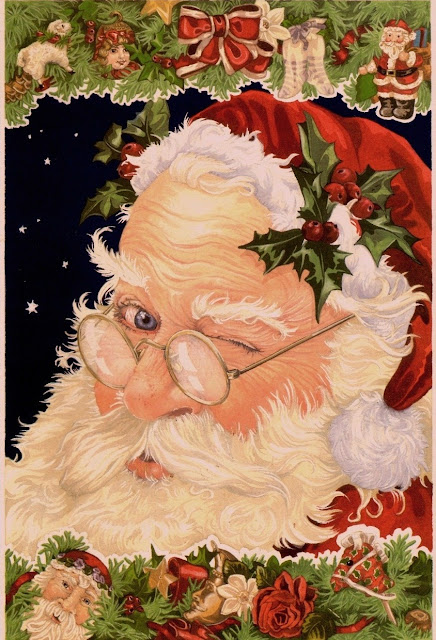
Santa Claus by Essie Fox


Before taking up writing novels I worked as a commercial illustrator, often selling to greetings cards companies, and the Santa Claus shown above was one of my favourite Christmas designs.


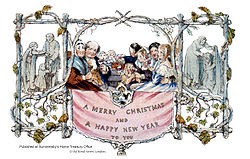
Even in those days I took inspiration from the Victorians - such as in the use of a border of 'scraps'. However, before Queen Victoria's reign there were no commercial Christmas cards – that tradition only really beginning after the introduction of the Penny Post, when Sir Henry Cole had the bright idea of printing up thousands of images which were sold in his London art shop and priced at one shilling each. What an industry that enterprise began!


Sir Henry Cole's first commercial Christmas card


As far as my own jolly gentleman would have been concerned, well, hardly anyone in England then would even have known his name. And yet by 1870 almost every child would recognise the sleigh that was drawn by reindeer, and the stockings full of precious gifts - if only an orange or apple to eat - as a present from Father Christmas.

Illustration by John Leech from Dickens' A Christmas Carol


The two names - Santa Claus and Father Christmas - have now become interchangeable, but their origins are quite different. Father Christmas, on whom Dickens based his Christmas Present was derived from an old English midwinter festival when Sir Christmas, Old Father Christmas, or Old Winter was depicted as wearing green; a sign of fertility and the coming spring. Hence homes were often decorated with mistletoe, holly and ivy. But this visitor did not bring his hosts gifts or climb down their narrow chimneys. He wandered about from home to home, feasting with the families and bringing everyone good cheer; as celebrated in this medieval carol:-


'Goday, goday, my lord Sire Christemas, goday!
Goday, Sire Christemas, our king,
For ev’ry man, both old and ying,
Is glad and blithe of your coming;
Goday!' 


The image of Christmas Present with which we are more familiar now is that of Santa Claus or Saint Nicholas, who 'arrived' in America in the seventeenth century when Dutch settlers imported their own Sinter Klass. And it was in America, in 1822, that Clement Clare Moore wrote a poem for his children which went on to have such a remarkable and enduring influence:-


'He was dressed all in fur from his head to his foot,
And his clothes were all tarnished with ashes and soot;
A bundle of toys he had flung on his back,
And he looked like a peddler just opening his sack.
His eyes how they twinkled! His dimpled how merry!
His cheeks were like roses, his nose like a cherry;
His droll little mouth was drawn up in a bow,
And the beard on his chin was as white as the snow.
The stump of a pipe he held tight in his teeth,
And the smoke it encircled his head like a wreath.
He had a broad face, and a little round belly
That shook when he laughed like a bowl fully of jelly.
He was chubby and plump, - a right jolly old elf –
And I laughed when I saw him, in spite of myself.'


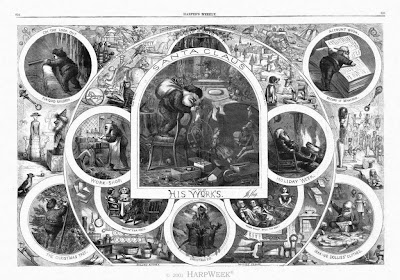
A Visit from Saint Nicholas (now more popularly known as The Night Before Christmas) described the old man’s appearance in detail - and this is what children today will know. His image and 'traditions' are beautifully illustrated in the woodblock print below. Published in 1866 in Harper’s Weekly magazine, it was created by Thomas Nast, and based on personal memories from his own happy childhood in Germany.

Santa and His Works by Thomas Nast


MERRY CHRISTMAS!

Saturday, 24 November 2012

ON WRITING VICTORIAN FICTION

BY ESSIE FOX

Charles Dickens working at his desk


The past is foreign country: they do things differently there.” So reads the opening lines of L.P Hartley’s The Go Between.


Any writer of historical fiction almost needs to become a time-traveller, to ‘go native’ and familiarise themselves with the cultural workings of the place in which their story will be set - to draw their reader into that world without qualms as to authenticity regarding the characters, settings or themes that, if placed in a contemporary tale, might seem entirely alien.

A good starting point for this cultural immersion is to read the work of established authors; those from the nineteenth century, and the best of the Neo-Victorians now. That way an author’s ear can attune to the nuances, rhythm and tone of the ‘foreign’ language used back then. My Victorian favourites are Wilkie Collins, the Brontes, and Thomas Hardy; each one offering a unique style to define the age they represent.

However, of all Victorian writers Charles Dickens is widely considered the master, his work rising above mere plot and offering social commentary on almost every aspect of the world that he inhabited. But here, a word of warning: attempts to emulate his work may result in clichéd parody. A writer should never be afraid to develop their own personal style, even when following the ‘rules’ or restrictions within the chosen genre. 

Not all nineteenth century literature adhered to Dickens' formal tone. Moby Dick, written in 1851, begins with these strikingly ‘modern’ lines – “Call me Ishmael. Some years ago – never mind how long precisely – having little or no money in my purse, and nothing particular to interest me on shore, I thought I would sail about a little and see the watery part of the world. It is a way I have of driving off the spleen, and regulating the circulation…especially when my hypos get such an upper hand of me, that it requires a strong moral principle to prevent me from deliberately stepping into the street, and methodically knocking people’s hats off…”

We still have the formal Victorian phrasing to anchor us in the era, as exhibited in the phrase: ‘requires a high moral principle’. But, at the same time, Melville creates a very strong vernacular; a tone entirely original; a real, living character’s voice, who could belong to any age, who draws us straight into his world.

However, it must be admitted that Melville was American. Many writers prefer to emulate the more English tradition of ‘Victoriana’ – that which has been so well observed by the modern-day author Charles Palliser whose The Quincunx, according to many reviews, out Dickensed’ Dickens himself.  Most ‘Sensation’ themes are covered, with lost or stolen inheritances, laudanum-addicted governesses, dens of thieves, and asylums, along with doomed affairs of the heart. The narrator is called John Huffam, the middle names of Charles Dickens. An audacious decision, but justified, because Palliser’s writing is superb.
Sarah Waters, who also excels in the genre, uses a spare and lyrical prose, rarely florid or overblown, as illustrated in these lines taken from the start of Fingersmith – “My name, in those days, was Susan Trinder. People called me Sue. I know the year I was born in, but for many years I did not know the date, and took my birthday at Christmas. I believe I am an orphan. My mother I know is dead. But I never saw her, she was nothing to me.”
The reader is immediately told that the narrator has been orphaned – a common Victorian theme around which secrets and mysteries can be woven into complex plots. Similarly, clues are laid in The Meaning of Night by Michael Cox, another stunning ‘Victorian’ novel which begins – “After killing the red-haired man, I took myself off to Quinn’s for an oyster supper. It had been surprisingly – almost laughably – easy. I had followed him for some distance, after first observing him in Threadneedle-street. I cannot say why I decided it should be him, and not one of the others on whom my searching eye had alighted that evening.”
Oyster Shop by Boz
The novel is ‘placed’ immediately by the archaic use of ‘Threadneedle-street’ – and the fact of the oyster supper: a common meal in Victorian times and not the luxury food of today. The language has a formality with words such as ‘had alighted’, all of which leaves the reader in no doubt that the genre is Victorian.

The writer of historical fiction must also ensure accurate scene descriptions, considering the houses, shops, theatres and bars from which many settings can be derived, not to mention the streets through which their characters walk or drive. There would be the creaking of carriages, the jangling of reins, the clopping of hooves. And then, there would be the railways with the rhythmic chugging beat of the trains exuding their clouds of steam. 


The expansion of the railways was of huge significance. For the very first time this transport means enabled a mass mobility, even though, as depicted in one of my novels, the less adventurous came to fear that “the motion and velocity might cause such a pressure inside our brains as to risk a fatal injury – a nose bleed at the very least.” Still, many did travel to London which, to this very day, has a wealth of preserved Victorian settings.


18 Stafford Terrace in Kensington remains just as it would have been with Chinese ceramics and Turkey rugs, Morris wallpapers and stained glass windows – not to mention the letters, the diaries and bills that provide an accurate insight into the running of the house. For those unable to visit, there are countless images in books, or via a search on the Internet. The nineteenth century saw the dawn of the science of photography and that is why Victorian scholars have a distinct advantage over those of earlier centuries. What better way to get a sense of interior or exterior scenes, or to study the fashions that were worn, or to catch the glint of life in an eye than by looking at a photograph. I can only agree with Henry Fox Talbot, one of the pioneers of the art, who described the photographic art as ‘the genius of Alladin’s Lamp…a little bit of magic realised.’

As to the day to day running of any Victorian residence, the relentless slog of housework would have lacked any magic at all. But do not take my word for it. Why not read Judith Flanders’ The Victorian House, or go to an original source in Mrs Beeton’s Household Management. In fact, Mrs Beeton offers advice on almost any subject, from cooking, to fashion, to medicine - and her words occur in The Somnambulist; my fiction being melded with fact when the narrator quotes the book as a means of objecting to the clothes she wears – 

I was looking through Mrs Beeton’s book, and she wrote several chapter on fashion, and with regard to a young woman’s dress her advice is very specific indeed. She says that” – and I had this memorized for such a moment of revolt – “its colour harmonise with her complexion, and its size and pattern with her figure, that its tint allow of its being worn with the other garments she possesses.”

Other contemporary factual works are still available today. Henry Mayhew’s London Labour and the London Poor is surprisingly readable while giving a detailed insight into grim social realities. Very useful indeed when researching the Victorian demi-monde was My Secret Life by Walter - Walter being the most shocking libertine whose pursuit of physical gratification led to many a melodramatic encounter, and the exploration of a world that could not be any more different to what is generally perceived as a moral, upstanding society. 

I feel quite sure that Walter would have visited Wilton’s (a music hall setting in both of my novels) with all of its night-time clatter and bang, where prostitutes called from the balcony to those who sat at tables below, with the glisten of the lime lights glancing off the brass of the barley twists posts around. No doubt he would have loved Cremorne – the Chelsea pleasure gardens described in Elijah's Mermaid; that resort finally being closed down for ‘lewd and raucous behaviour’, of which nothing now remains intact but a pair of ornate iron gates.

The  Dancing Platform at Cremorne by Phoebus Levin 1864


Unable to visit the actual place I read articles in Victorian newspapers (the archives available online). I looked at paintings and adverts to gradually built a vivid scene of lush lawns with statues and fountains, a banqueting hall, and a hot air balloon, and regular theatrical displays – such as the infamous Beckwith Frog who, along with several fish, performed in a great glass aquarium. Freak shows were a popular, if not sordid, entertainment form - though the mermaid display in my novel is purely the product of imagination. Even so, that image was inspired when reading about Feejee Mermaids; the hideous monstrosities created by grafting a monkey’s remains onto the body of a fish. Imagine the smell of that! 

And thinking about aromas, here is another writing prop to create a complete Victorian world; albeit one invisible. It may well be a cliché when describing nineteenth century scenes to allude to the stench of filthy streets. But it would be wrong to ignore the fact of the constant odour of rotting food, or the effluence from horses who drew the carriages and carts, or the noxious stink from factories exuding acrid yellow smoke. A skilful writer might convey the intensity of common smells without a descent into parody, but also to think ‘outside the box’, revealing less obvious fragrances, which, in the case of The Somnambulist, happened to be a perfume that came to have great significance within the novel’s plot. For this I employed the Internet, seeking out aromas that a Victorian gentleman might use and finding Penhaligon’s Hammam Bouquet, first produced in 1872, and described by the manufacturers as ‘animalic and golden…warm and mature, redolent of old books, powdered resins and ancient rooms. At its heart is the dusky Turkish rose, with jasmine, woods, musk and powdery orris.’

Quite a vivid description I’m sure you’ll agree. And quite a serendipity, because, after the book’s publication I realised that Hammam Bouquet is still in production today. I couldn’t wait to buy some, to lift out the bottle’s stopper and breathe in the vivid scent that, until then, I had only thought about – to close my eyes and step right back into a lost Victorian world. 


This article was originally published in Writing Magazine to coincide with the publication of Essie Fox's new novel, Elijah's Mermaid.


Wednesday, 24 October 2012

EFFIE GRAY'S REVENGE ON JOHN RUSKIN.

BY ESSIE FOX


John Ruskin (1819-1900)

Following on from my previous post, I'm returning this month with more gossip regarding the personal affairs of John Ruskin - the celebrated artist, writer and critic whose ardent support for the Pre-Raphaelites helped to establish their good reputation, achieving the fame they so desperately sought.

But the passion expressed for the world of art was not transferred to the marriage bed, even when Ruskin came to wed Effie Gray - the attractive and lively young woman whose charms had inspired several offers of marriage, and led to more than one broken heart.

The couple first met when Effie was a child, their parents being acquainted and often sharing each other's company. Ruskin, who was older, soon became very fond of the little girl, so much so that when he was was twenty-one and Effie only twelve years old, she inspired him to write a fairytale. The King of Golden River was published in 1851 and became a Victorian classic.


John Ruskin as a child


However, there is some evidence that much like his friend Lewis Carroll, Ruskin felt far more at ease in the innocent company of the young, perhaps reliving through imagination his own happy childhood memories.


 Ruskin's portrait of Rose la Touche

Following the annulment of his marriage to the needy and womanly Effie, it was a girl called Rose La Touche who eventually won John Ruskin's heart. They met when she was nine years old, when her family engaged him to tutor the girl - about which Ruskin was to write, "...in the eventful year of 1858, a lady wrote to me from - somewhere near Green Street, W., - saying, as people sometimes did, in those days, that she saw I was the only sound teacher in Art...that she wanted her children - two boys and a girl - taught the beginnings of Art rightly; especially the younger girl, in whom she thought I might find some power worth developing."

Ruskin and Rose became very close. When not together they often wrote, her letters addressed to St Crumpet. He proposed in 1868, by which time he was almost fifty years old and Rose was just eighteen. But her family were greatly concerned regarding Rose's happiness, so much so that they wrote to Effie (now the respectable wife of Millais) to enquire about what had really occurred surrounding the scandal of her divorce.

Effie's response was to suggest that a marriage to Ruskin should not go ahead and, whether it was this influence or other religious differences, Rose la Touche turned her suitor down.


Rose la Touche on her deathbed by Ruskin


The result was enormous unhappiness. Rose died when twenty-seven years old, by then being placed in a nursing home when her parents feared their daughter mad. The tragedy of her premature death led to Ruskin's great despair, employing spiritualist mediums to try and contact Rose's soul, and then becoming quite convinced that the Renaissance artist, Carpaccio, had included Rose's portrait in his paintings of Saint Ursula. 

Whatever the misery and pain that had been suffered by Effie Gray during her marriage to Ruskin, it would seem that he paid the heaviest price. Effie's revenge was a dish served cold - but a dish of the utmost potency.


Essie Fox new novel, Elijah's Mermaid, is a Victorian psychological drama concerning an artist's doomed affairs, and the tragic results for the women who are chosen to be his muse. 


Monday, 24 September 2012

A VICTORIAN LOVE TRIANGLE

BY ESSIE FOX


Autumn Leaves by Millais


A few days ago, I went to Tate Britain to view the latest 'blockbuster' exhibition: Pre-Raphaelites: Victorian Avant-garde.

Today, I'm still musing on my reaction to the show, which was more muted than I would have expected, considering my love for the era and art. I found many paintings to be somewhat insipid, even to the point of twee. I found that in life, just as in reproduction, the busy and florid canvasses produced by Holman Hunt are likely to fill me with stark irritation, hardly able to look at one more of his pompous, overblown scenes by the time I'd reached the exit door.

But, what is without doubt in my mind is the fact that, of this group of artists, there are some who really shine for me, and of these my favourites have to be Millais, Burne-Jones and Rossetti; every one of them standing out as great masters above the general throng. And as fascinating as the art are the stories that lie behind their scenes - stories that are, more often than not, linked with the women who they loved; who acted as muses for their art.

Effie Gray in her youth - painted by Thomas Richmond


Many of Millais' paintings are modelled on the figure of Effie Gray, the woman who became his wife but who, at the start of his career, was married to John Ruskin, the influential critic and patron without whose support the Pre-Raphaelites may never have achieved quite the same success.


Millais' portrait of Ruskin, produced while he shared a holiday in Scotland with his patron


Millais was often invited to spend time with his patron and admirer. While on a visit to Scotland, both Mr and Mrs Ruskin posed as models for his work. By day the young artist painted. By night he lay in a room in a lodge, only separated from his hosts by a thin partition wall. He could hear every movement and breath of the woman with whom he'd become obsessed - and no doubt he also realised the lack of physical intimacy occurring in the marital bed.


The Order of Release by Millais, with Effie Ruskin modelling as the wife - currently on show at Tate Britain.


Millais' passion for Ruskin's wife led to the three of them being involved in one of Victorian England's most celebrated scandals. Very soon after that holiday Effie left her husband and faced public disgrace when petitioning for a divorce. During the ensuing court case Ruskin was shown to be a man who was cold and detached from reality, who rejected his young wife's amorous requests and left her plagued by nervous distress - the fact of which was illustrated in this letter to her father:

"He alleged various reasons, hatred to children, religious motives, a desire to preserve my beauty, and finally this last year he told me his true reason...that he imagined that women were quite different to what he saw I was, and that the reason he did not make me his Wife was because he was disgusted with my person..."

Much speculation was to arise when these facts were presented in the court as to whether Ruskin's disgust had been at the sight of female public hair or a woman's menstruation. But the fire of gossip was eventually doused. Effie was granted her divorce on the grounds of non-consummation - although only after medical examinations that proved she was a virgin still - after which she and Millais were free to wed. Society re-embraced them and they lived a fulfilled domestic life, during which period Millais produced many more great paintings.

One such painting is Autumn Leaves - an apt image for this time of year when the leaves are beginning to fall from trees and the air will soon be fogged and tinged with nostalgic scents of bonfire smoke. In this scene his wife's younger sister, Sophie, is posed as the girl who is just about to throw more leaves onto the burning pyre. The picture is full of symbolism. The fires of passion about to light in this prepubescent girl. The death of youth and innocence. And what is that questioning in Sophie's eyes as they stare right out of the painting's frame? By contrast, the other girls' expressions seem to be very much 'simpler'. All are engrossed in the pile of leaves rather than who might be watching them.


Effie in middle age


Could there have been yet another love triangle affecting Effie's marital life - Effie, who by now had grown older and been worn down by regular childbirths, whose husband was increasingly drawn to paint his younger sister-in-law?


Portrait for a girl (Sophie Gray)


Through other canvasses produced, the viewer is able to view Sophie's transition from a child on the cusp of adulthood to the alluring vision of sensuality where the flushed face is all too knowing, where the red of the lips simply begs to be kissed, and the heart on the front of the model's gown is a blatant statement of growing affection between the artist and his muse.

Whatever happened, or did not, there was talk of Effie being upset and arguments breaking out in the house. The result was that Sophie was asked to leave and, at the age of twenty-four, she suffered a nervous breakdown, going on to exhibit all the signs of what we now call anorexia.

Was that condition caused by Sophie's broken heart? Did the young woman simply wish to retain the form that beguiled her brother-in-law? We shall never know the truth. This affair did not reach the law courts and its intimate details were never exposed as in the case of Ruskin v Gray.


For more on Essie Fox, please see www.essiefox.com


Friday, 24 August 2012

THE SCANDAL OF MADAME X

By Essie Fox


Sargent with his painting of 'Madame X'

Virginie Gautreau was an American woman who married a wealthy French banker, living with him in Paris where her glamour and beauty were so renowned that the artist, John Singer Sargent, wrote a letter to one of his friends in which he expressed, “...a great desire to paint her portrait and have reason to think she would allow it and is waiting for someone to propose this homage to her beauty. If you are ‘bien avec elle’ and will see her in Paris, you might tell her I am a man of prodigious talent.”


In the June of 1883, the prodigiously talented young man was invited to visit with Virginie at her family's estate in Brittany. There, sketches were made for a final portrait where Sargent worked on a canvas that was almost seven feet (2 meters) in height, hoping that way to ensure the greatest attention when it was presented in Paris at the Salon of 1884. 

But whereas the model agreed with the artist that his painting was a masterpiece, Virginie's own mother was scandalised, demanding the portrait never be shown. The Salon members were just as outraged, and all because of the fact that a strap on Virginie’s gown had been depicted as fallen away from her shoulder, suggesting an air of decadence and sexual availability.
Sargent repainted his model’s gown with the strap restored to its rightful position, but the damage was already done. Reviews were disappointing. Madame Gautreau's reputation was lost, and even though Sargent withdrew the work and subsequently named it as Madame X, such was the affect upon his career that the artist left Paris in ignominy to set up a studio in London.

In England Sargent achieved great success, but he never lost faith in 'Madame X', even going so far as to write, “I suppose it is the best thing that I have ever done.” 

He refused to hide the work away and the painting was regularly displayed in various exhibitions until it was eventually sold it to the American Metropolitan Museum of Art for the sum of $1000. 

Goodness knows what it would be worth today.


A full-sized sketch of 'Madame X' remains on display in London's Tate Britain, where one of the straps on Virginie’s gown is still 'salaciously' removed.


Essie Fox's new novel, Elijah's Mermaid (to be published in November 2012) revolves around the work of a Victorian artist - some of his paintings being viewed as controversial and decadent, though later generations will consider them to be masterpieces.

www.essiefox.com