Showing posts with label Cranky Ladies of History. Show all posts

Tuesday, 18 March 2014

Fight for the Right - Emily Davison and the Internet - Celia Rees

Bossy Girls, Cranky Ladies, Daughters of Time? The History Girls have blogged about them all. We now have our own anthology, no news to anybody, and I can't resist a bit of a trumpet. I have to admit that when the anthology was first mooted by Mary Hoffman, I couldn't immediately think of any one woman to write about. It was not until later that day, when I was talking to my daughter, Catrin, that an idea began to form. We were talking about suitable candidates and she suggested Emily Wilding Davison, the suffragette who threw herself under the King's horse on Derby Day, 1913. She mentioned the return ticket to Epsom that Emily had about her person and suddenly a story began to form.


The actual ticket is in the collection of the Women's Library which was in the process of moving from its historic home in Aldgate to LSE amid some controversy Future of Women's Library but I did not have to visit it to view the historic ticket. It was there for me to see - on the internet. I'm a fiction writer, and although historical accuracy is vital and I'm meticulous in checking my facts I'm not necessarily looking for the same information as a writer of non fiction. I do visit libraries to consult books and archives on occasion but it is not always necessary for me to do so. In this case, I just wanted to see the ticket. And there it was.

Emily Wilding Davison's dramatic intervention in the 1913 Derby was recorded by newspaper photographers there to report on the race and also by a novel form of news reporting: the pathe newsreel.


The cameras were there to record Derby Day, Emily Davison's intervention in the race was recorded by accident. The viewing is chilling. The short clip shows the build up to the race, crowds arriving, the race course itself, the runners, the start of the race, but all the time the viewer knows what's coming. I viewed the footage over and over again, not just to see frame by frame what happened, but to see everything else: the people, the vehicles, the course, the stands, the horses; details that add to my palette, help to give the scene immediacy, make it convincing and vivid and add that trace of deja vu dread, of disaster about to happen. Without the internet, I doubt that I'd have been able to see the film, or the dramatic newspaper coverage, so describing it convincingly and with accuracy would have been that much more difficult.

Not everything you find makes its way into a story. Emily Wilding Davison also hid in a broom cupboard in the House of Commons during the night of the 1911 Census. An event recorded on this plaque by Tony Benn M.P.


He said:  'I have put up several plaques—quite illegally, without permission; I screwed them up myself. One was in the broom cupboard to commemorate Emily Wilding Davison, and another celebrated the people who fought for democracy and those who run the House. If one walks around this place, one sees statues of people, not one of whom believed in democracy, votes for women or anything else. We have to be sure that we are a workshop and not a museum.'

Tony Benn died last week and with his passing, we have lost a man of great principle, one who did not forget the sacrifice of others and carried on the fight for the rights of all. 

Read Return to Victoria

Interview in the Overflowing Library

www.celiarees.com

Monday, 17 March 2014

THE BOOK OF BOSSY GIRLS? By Penny Dolan.


Recently my interest was caught a media discussion: the kind where X says this, so Y spouts up with that, often through tweets and social network sites, and giving both X & Y & also Z material for an article or two.
This controversy was about the use of the word bossy to describe girls. It does come across as a word drenched in negativity and rejection. For one thing, bossy is what girls aren’t supposed to be, but it is hard to refute without sounding – er, bossy.  

Last year, researching Mary Wollstonecraft for a short story, I read Clare Tomalin’s excellent biography. By the end, I had decided that Mary, though hugely admirable, was probably not a very comfortable person to be around for long. 

Mary had opinions she wanted to share, better beliefs she thought herself- and others - should live by, and much to feel angry about, at both a personal and general level. She organised her family and friends, who were not always grateful or glad, and she spoke and wrote against what she saw as injustice and inequality. In other words, Mary was probably a bit difficult and, yes, sometimes bossy. 
 
 Do women ever get anything done without being accused of being bossy, I wonder?
What about the women in the past who fought alongside men – Boudicca and her daughters, or maybe Alfred’s daughter Aethefled? Or Mary Seacole, caring for her soldiers even if Florence Nightingale’s hospital rejected her?
What about the girls and women who negotiated their roles among the dangerous men of power: Lady Jane Grey, Elizabeth Stuart, or the remarkable Eleanor of Aquitaine?  
Or women like anchorite Julian of Norwich, playwright Aphra Ben, or even my Mary – women whose writing explains how they see life and their world? Isn’t writing, as authors and journalists know, a way of raising your voice?
Speaking out has often been seen – or heard – as a problem, the ultimate demonstration of bossiness: the women protestors at Greenham Common became the stereo-types of stridency. In contrast, Emily Davison, facing the king’s horse, used her own body as a way of “speaking“ when people in power wouldn’t listen. 
What about those who persisted in their own paths? There is Mary Anning, the self-taught fossil-hunter whose discoveries were subsumed into the collections and reputations of wealthy and aristocratic palaeontologists? Or what about the persistence needed to be Amy Johnson, the first woman to fly solo from Britain to Australia, and who may have been a British spy?  Amazing women, all.


As I’m typing this, Woman’s Weekend Hour is airing an item about female “Game Changers” as part of their Power List 2014 campaign:
 
Rachel Short, an organisational psychologist says that the key aspects of “game changers” were their intellectual independence, the fact that they were socially eclectic and that their motivation was guided by initiative, resilience and deep-rooted self-belief. 

Unsurprisingly, the words “difficult” and “bossy” came up again. (Not the word "cranky", though that might fit too.) It seems that bossy girls and women – and you will have your own favourite heroines – are often those who make things happen, however subtly or noticeably they manage it. Perhaps “bossy” is a kind of compliment, after all?

You can read fictional tales about all these historical heroines now in the BOOK OF BOSSY GIRLS - more properly and correctly known as the DAUGHTERS OF TIME anthology, edited by Mary Hoffman. (Templar)


Penny Dolan


Wednesday, 5 March 2014

Mary Anning in My Mind - Joan Lennon

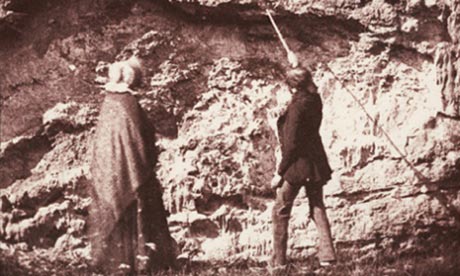
Mary Anning (1799-1847) was a fossil finder along England's Jurassic Coast, during the earliest days of the new science of paleontology. The theme on History Girls this month is Cranky Ladies in History, and Mary certainly had plenty of reasons to be unhappy, fed-up, angry, obstreperous, or, indeed, eccentric. (Tricky, these transatlantic translations ...) She had money worries, serious health problems, and more than her fair share of griefs, and she was under-valued by a scientific community made up largely of rich guys with beards. There are very few contemporary images of her other than the ones below:

sketch of Mary Anning by Henry De la Beche


painting by B.J. Donne (Mary is meant to be pointing at a fossil, not telling her dog Tray to stay)

Salt print photograph by William Henry Fox Talbot ("The Geologists" 1843) which may or may not include Mary Anning as the lump on the left (see Suzanne Pilaar Birch's article in the Guardian here.)

But the thing is, none of these images is a bit like the one of her I have in my mind.  I've been crazy for fossils for as long as I can remember, and I've had a soft spot for Mary Anning for about as long.  Which is why, when the chance to write a story about her in the History Girls' anthology Daughters of Time came along, I jumped at it.  I did my research.  I found out things I hadn't known before.  I felt sorry for all her troubles and trials and frustrations.  I was in awe of her (self)learning and meticulous skill in separating her fossils from the surrounding rock and her revolutionary understanding of their meanings.  But still that was not what I saw in my mind.  For me, Mary Anning will always be a figure running along a shingly beach, with a hammer in her hand and a dog at her side and the next amazing discovery waiting for her in the rocks just ahead.  The girl who could see things that other folk couldn't - exciting things - wonderful things ...  So that's how I wrote her.


Mary Anning:  Best After Storms


Joan Lennon's website.
Joan Lennon's blog.


P.S.  Back in 2010, the first Slightly Jones Mystery was published, all about the theft of the astonishing (and sadly fictional) dragonfish fossil from the then-new Natural History Museum in London - and this is the dedication:

Everybody's heard of Florence Nightingale 
and David Livingstone.  These books are dedicated 
to the Victorian heroes and heroines 
who aren't quite so famous!

This one's for 
Mary Anning, Fossil Finder


Prescient, eh?

Saturday, 1 March 2014

Cranky Ladies of History

Sometimes we have a theme running through our posts for a month. Since this March, International Women's History Month celebrates Women of Character, Courage, and Commitment, and March 8th, International Women's Day, has the theme Inspiring Change, we are linking to a site that is attempting to crowdsource a book on Cranky Ladies of History. The editor of the book will post about it here on 22nd March.*

Not all our posts will be about this and we have had some discussion about what "cranky" means and interpreted it in our own way.

It links in well with our launch of Daughters of Time, which I wrote about on the first day of the year. That contains thirteen stories by members of the blog suitable for young readers of nine years and upwards, about women in English history, some whom might have been considered "cranky" in their time according to one or other definition.

My own choice, Lady Jane Grey, was not, in my opinion the helpless pawn of ambitious men and their political manoeuvrings. She was stubborn as a mule. After all, she could have saved her life by converting to Mary Tudor's religion but refused to - a rejection of clemency which saw her executed in the Tower of London.

Other contributors will write about their own "daughter of time" this month and next.


And four of us will be appearing at the Oxford Literary Festival to talk about the women in our stories, including Mary Wollstonecraft, Emily Davison and the protesters in the Peace Camp at Greenham Common. If you're in the area, do make a date for 2pm on Sunday 30th March.

Here I am putting flowers on the grave of Aphra Behn, who features in the book in a story by Marie-Louise Jensen:
We did this a few days ago in Westminster Abbey, following Virginia Woolf's advice:

“All women together ought to let flowers fall upon the tomb of Aphra Behn, for it was she who earned them the right to speak their minds.” (A Room of one's own) Seven History Girls came here with our publishers from Templar Books, who had organised the bouquet.

And we are pretty good at speaking our minds.

Eva Reckitt


But here I'd like to write about my own "cranky lady'" Eva Reckitt, in whose house I lived for four and a half years and who was a very influential person in my life. Obviously in that time I got to know her quite well, although she was eighty when I met her and I was twenty-five. But when I searched the Net for her there was only one rather unflattering photograph taken in her youth and some stern reports on how her phones were tapped and an official eye kept on her in the '20s because of her political affiliation.

For Eva was that oddity: a communist and a wealthy woman. Her fortune came from the family firm that made Reckitt's Blue - a phenomenally successful wash day aid used in lots of homes. Her older brother Maurice was an Anglo-Catholic writer and croquet player; her younger brother Geoffrey, known as "Bunny", was I think already dead when I met Eva.

She was born in 1890 and never married, though she spoke very warmly of the Socialist and academic G.D.H. Cole. Cole was married and indeed co-wrote many detective novels with his wife, Margaret Postgate. But I think Eva carried a bit of a torch for him.

Her main claim to fame, apart from generous donations to the Communist Party, was setting up the Collet's Book Shop in Charing Cross Road:


She was also on the executive of the LRD (Labour Research Department) and she was still going to meetings there when I knew her in the '70s. Her great friend was Olive Parsons and they shared a weekend cottage in Sussex. Olive, another committed communist and by then a widow, had also come under surveillance.

Olive's daughter-in-law was the poet Patricia Beer, whom I met in Eva's house and liked very much. (I remember staying up all one night in Eva's house to read Mrs Beer's House, Patricia's account of her childhood in a family of Plymouth Brethren, which antedates Oranges are not the Only Fruit by seventeen years).

So what was I doing in Eva Reckitt's house? I suppose I was her Companion. I got a free almost self-contained flat at the top of the house, in return for walking her cavalier King Charles spaniel night and morning and doing some gardening (always also rewarded with a curry lunch) and generally helping out.

We had breakfast together every morning, sitting under her painting by Roger Fry of Mediterranean rooftops. after I had taken the dog for a walk on Hampstead Heath. Later my husband-to-be also moved in and we were married from there, Eva coming to our very small wedding in Cambridge in a cold and frosty December.

I wrote my first book in her house. She taught me to have friends of all ages, so that one wouldn't outlive them all (Eva was 86 when she died, Olive 104). She introduced me to the Bookseller, a journal I still take every week, the Wine Society, William Morris - oh. so many things! Many a night she would invite me - later both of us - down to her living-room to watch a TV programme - a drama or an Arts documentary - while sharing a bottle of claret with her.

We still use some of her phrases and made-up words (she always went to the "hairmonger" for instance). She was both a thorn in the side of the British establishment and the most wonderful friend and companion. When she died, she left me a bowl by Lalique, a walnut bureau and a marble tiger, given her on a trip to China. To my husband she left her Nonesuch Shakespeare in seven volumes.

I loved her like a grandmother (I never knew a grandmother) and treasure her memory. So she is my "cranky lady," my woman of character, courage and commitment and one who inspired much change and development in me.

* Pozible Campaign
Roundup page on FableCroft


This post is written as part of the Women's History Month Cranky Ladies of History blog tour. If you would like to read more about cranky ladies from the past, you might like to support the FableCroft Publishing Pozible campaign, crowd-funding an anthology of short stories about Cranky Ladies of History from all over the world.