Showing posts with label archaeology. Show all posts

Friday, 30 January 2026

Egyptomania by Rachel Louise Driscoll


When we think of the rise of Egyptology, I think our minds often turn to the Art Deco Egyptian Revival of the early 20th century with Carter and Carnarvon’s hunt for King Tutankhamun’s tomb.  In truth, however, Egyptomania – the fascination for all things Ancient Egypt – actually goes back further than that to the 19th century and beyond.  This was a time when the Rosetta Stone arrived at the British Museum, the hieroglyphs were deciphered in a race between Britain and France, Amelia Edwards published her travelogue about her journey through Egypt and Nubia entitled A Thousand Miles up the Nile, and characters like “Mummy” Pettigrew hosted their infamous ‘mummy unwrapping parties’.


Thomas Pettigrew, known by the sobriquet “Mummy” Pettigrew, was a 19th century surgeon and antiquarian.  A founding member of the British Archaeological Association, he had a particular interest in mummies.  In fact, upon the association’s first meeting in 1844, he apparently unwrapped a mummy in front of his rapt audience.  At such events, Pettigrew was known to not only unroll the layers of cerement from the preserved corpse, but to also perform an autopsy.  His knowledge of Egyptian mummies was so vast that in 1834 he wrote a book called A History of Egyptian Mummies.  This work explored the ancient funerary rites of the Ancient Egyptians, including how sacred animals were worshipped and embalmed. 


Animals such as cats, dogs, ibises, crocodiles, and birds of prey were amongst the varieties of species that the Egyptians would embalm, usually through a connection to a deity.  For instance, Bast or Bastet had the head of a cat, and so cats were seen to be linked to the goddess.  Ibises were sacred and Thoth, the god of wisdom and writing, was often depicted with the head of an ibis.  Many of the Ancient Egyptian gods and goddesses had heads of animals, or were said to be able to change their form into animals – like Isis and Nephthys, the sister goddesses who could shapeshift into kites.  Mummified animals would often be buried at the sites that held particular worship for the deity that was associated with that animal, such as the many cats buried at Bubastis, the centre of Bast’s cult.


The term Egyptomania, from the Greek ‘Egypto’ for Egypt and ‘mania’ for madness, came into existence around the end of the 18th and start of the 19th century, and this was really when we see the increased interest in this ancient land and its rich history.  Napoleon’s Egyptian campaign helped Egyptomania take flight, inspiring the hunger for antiquities.  There was such a cry for mummies and relics when travellers came to Egypt, that supply could not meet demand, and mummy snatchers and forgers became commonplace.  New laws arose to halt illegal digs and export, but the black market of antiquities continued as more travellers sought to own their piece of history, and the mummy unwrapping parties continued.


Despite this, there were many who came to Egypt with permits for legal digs, amongst them the Scottish archaeologist Alexander Rhind, and Margaret Benson, the first woman to be granted a permit by the Egyptian Department of Antiquities.  In cases such as these, when the excavations were carried out in accordance with local law and with historical insight, provenance was not lost and knowledge increased.


I’m not sure that Egyptomania has waned so very much over the years.  Even today in the 21st century, Egypt is consistently ranked as a top tourist holiday destination, the Egyptian exhibits are often the busiest in museums, and we still feel a thrill of excitement over the mysterious hieroglyphs on obelisks and papyri.  The age of Egyptomania is far from over, although I’m glad to say we no longer host mummy unwrapping parties or have powdered mummy in our paints like the Pre-Raphaelites did. 


If you’d like to read more about the 19th century fascination for Ancient Egypt, then I highly recommend Amelia Edwards’ book A Thousand Miles up the Nile.  For fictional writings from the era, you might like Lost in a Pyramid; or, The Mummy’s Curse by Louisa May Alcott (quite a different read from her more famous Little Women series) and Some Words with a Mummy by Edgar Allan Poe.  And to investigate these themes further, especially those of mummy unwrapping parties and the preservation of Egyptian history, you might enjoy my debut novel Nephthys which explores the 19th century fascination for Ancient Egypt in a gothic tale of adventure, mythology, and mystery.  Nephthys is available in hardback, with the paperback out with Vintage in February 2026, and you can purchase your copy here.  If you’re in the US, it is published by Penguin Random House under the title The House of Two Sisters, and is available here.


Instagram: @rachel.louise.driscoll


Friday, 11 April 2025

The Golden Hour by Kate Lord Brown


Reviewed by Stephanie Williams

I must have been about thirteen when my imagination was first captured by Akhenaten, the legendary pharaoh who brought the revolutionary idea of one god to Egypt in the fourteenth century BCE.   His wife, rumoured to be his sister, was even more romantic:  the beautiful, powerful and mysterious Nefertiti.  


Bust of Nefertiti, Nofretete Neues Museum

My source was a wonderful historical novel by someone like Mary Renault, who I was devouring at the time — but it wasn’t … whatever the book was, it is long gone, leaving me with an enduring fascination with Egypt.  Last year, I was lucky enough to float down the Nile to see the Valley of the Kings and the temple of Karnak at Luxor — where, in the days when it was ancient Thebes, Nefertiti may once have walked.


‘Fair of face, great of charm,’ Nefertiti represented the female element of creation, while her husband was a living god — their source, the sun, worshipped by holding up a disc to the sun.  Through your prayers to them, you would have access to the true god. Together Akhenaten and Nefertiti overhauled the state’s religion, based on a pantheon of gods and their henchmen.  The king’s feet never touched the earth, their whole life, from daily worship, to the marital bed was a religious act. 


A house altar showing Akhenaten, Nefertiti and three of their daughters. 18th dynasty, reign of Akhenaten

After 17 years, Akhenaten died. What happened to Nefertiti afterwards is a matter of dispute.  Did Nefertiti rule briefly as a female pharaoh? Oversee the kingdom as regent? Akenhaten’s son – DNA testing suggest Nefertiti was not his mother -- was the legendary child pharaoh, Tutankhamun, whose golden sarcophagus has entranced millions around the globe.  He repudiated his father’s sun worship, and reinstated the old gods.  


When did she die?  One thing is certain, despite generations of strenuous efforts, her tomb has never been found.  


The quest to find Nefertiti’s tomb is the inspiration behind Kate Lord Brown’s new novel, The Golden Hour. 


Archaeologist Dr Lucie Fitzgerald has travelled to the Lebanon in March 1975, to visit her dying mother, Polly.  Beirut is emptying; it is the eve of the civil war. Polly, whose life has been consumed breeding Arabian horses on a farm west of Cairo, and after the war, outside Beirut, knows that it is time to tell her daughter the truth about her close friendship with Lucie’s godmother, Juno Munro.


The narrative weaves back and forth between 1975 Beirut and 1939 Cairo and the Valley of the Kings where Juno, an archaeologist, is part of a team searching for the tomb of Nefertiti.  Juno has a particular gift for recording hieroglyphs and scenes from the walls of the tombs they uncover. Disaster intervenes, war descends on Egypt, the dig is closed.  Thirty-five years later, Lucie too is on the track of Nefertiti’s tomb. Professor Brandt, who oversaw Juno’s dig, turns up at Lucie’s lecture on the myth of Osiris in London on the eve of her departure for Cairo.  And we wonder...


But the centre of the action is Egypt, and the louche life of the European communities in Cairo at the outbreak of the Second World War.  It is a period which Olivia Manning brought so vividly to life in The Levant Trilogy, later turned into The Fortunes of War, a BBC series from 1987, starring Kenneth Branagh and Emma Thompson – still out there on DVD.


Manning, of course, had lived what she wrote.  Kate Lord Brown has absorbed Egypt. The details of how you run a dig.  That as a pre-war archaeologist you draw, not trace hieroglyphs.  The scent of rosewater, sandalwood, men smoking shisha, coloured glass, carab rings, the golden light at sunset.  Dust. She’s good on horses, the backstreets of Cairo, the old clubs and the Mena House and the vanished quarter of Ezbekiyya.  But I wished for more of a sense of war-time tension. 


This is a quick fun read, full of romance, the friendship of women, mysteries and tragedies.  Love and desire:  Polly and Fitz, Juno and Max, Lucie and her handsome Australian, David.  At its heart is the secret on which Lucie’s life turns.    


Take it on holiday and enjoy.


Stephanie Williams is the author of Olga’s Story,  and Running the Show, The extraordinary stories of the men who governed the British Empire.  Her latest book, The Education of Girls, will be published in the US on 23 May and in the UK later this year.  For more see www.stephanie-williams.com and https://stephaniewilliamswrites.substack.com/


Friday, 17 March 2023

‘Digging for Lullingstone’ – Dr Anne Thick shares her memories of the excavations of Lullingstone Roman Villa over 60 years ago. By Caroline K. Mackenzie.

Dr Anne Thick spoke to Caroline K. Mackenzie about her life-changing experience as a teenager working on the original excavations of Lullingstone Roman Villa, the kindness of the custodians of the site, and the ‘golden days’ of being part of discovering such an important archaeological and historical site. It led to lifelong friendships, a rewarding career and a legacy which we can all enjoy today.

How old were you when you were involved in the dig at Lullingstone?

I was 14 and 15 as it was in 1959 and 1960. I was born in 1944 and am 78 now.

I love the photo of you on the dig!

Thank you. The story behind that is that the Daily Mail (I think) came down to do an article on the dig. I never actually saw the published article. After they had been and taken their photographs, Lieutenant-Colonel Meates, leader of the excavations at that time, gave me that photo so I assume it wasn't used in the article but they had distributed photographs that they had taken.

 Anne excavating the well at Lullingstone Roman Villa in 1959, aged 14. 

What I really like about it is that you have a pen and notebook in your pocket!

Yes I did, although I had forgotten that until you pointed it out! I have looked at that photograph a number of times. I am not sure what I was putting in the notebook, mind you!

You don’t happen still to have the notebook, do you?

Not that I know of, no. All I have dating from that time is my trowel. I used it on every subsequent dig that I went on. When I was accepted onto the Lullingstone dig, my Dad bought a trowel from a local ironmongers but it was too big so he had to cut it down for me to make it the right size for me to use on the dig. I know that I still have it somewhere!

Perhaps you should frame it! That’s a lovely story about your Dad. What did your parents make of your fascination with the dig? Were they interested in Roman things at all?

Absolutely. My Mum didn’t have any formal education over the age of about 14 but she was interested in lots of things and history was certainly one of them. I can’t remember a time when (well, we didn’t have a car when I was very little but, as soon as we were mobile) we weren’t going to places like Lullingstone. My Dad just went along with it! He did the driving and he was funny because he would go to these places and then pretend to do the guided tour afterwards - he was quite hilarious. But anyway, my Mum and Dad were totally happy about me being involved in the dig - otherwise they wouldn’t have kept taking me each week.

They must have been quite tickled because I think it is brilliant that you did it at that age. You have described the time you spent on the dig as a teenager as the ‘golden days’. My equivalent would be my teenage years spent at Greek summer school! But I would also have loved to have gone on a Roman dig! It is so hard to capture that feeling again.

Absolutely. It is part of being young. Your teenage years are quite formative in some ways (I don’t think you really know where you are going at that age) and so to go to Lullingstone and be involved was for me an amazing thing. For me it has always been that contact with original sources and, of course, in the end I went into archives (although that was partly because there weren’t at that time many jobs for archaeologists) and archivists were slightly better paid! The parallel is that if you are on a dig and handling artefacts, or handling documents as an archivist, you are in direct physical contact almost with those people who created either the artefacts or the documents and that means a very real connection with the past. That was very important to me.

Would you be able to tell me a bit about your career as an archivist and how it all started? You were doing your O’ Levels when you were involved with the dig.

Yes. I remember that when I passed my O’ Levels I was given a jewellery box as a well done present from Mr and Mrs Rook who were the custodians of the site at the time. I still have that jewellery box and I definitely know where that is as I take it every time we go on holiday. The Rooks were a lovely couple and I have strong memories of them - they were very nice, kind people and that’s what counts.

Mr and Mrs Rook, the first custodians of Lullingstone Roman Villa. 
© Dr Anne Thick.

Absolutely. And how kind of them to realise that, at your age then, passing your O’ Levels was such a milestone for you and they wanted to mark that.

After O’ Levels I did A’ Levels in History, French and Latin. I then went to the University of Cardiff (which was then part of the University of Wales) to study History and Archaeology. In the first year we had to do three subjects so I did Latin but I very quickly gave up the Latin as it was beyond me! My Latin was never very good.

I am sure you are just being modest!

The funny thing was (my Latin mistress could not really get over this) that after I started digging at Lullingstone suddenly my Latin got an awful lot better. I am not sure I would have even passed my Latin had I not been on the dig, but suddenly I seemed to connect with Latin.

I love that you were inspired by Lullingstone and that you somehow channelled the Latin which you saw at the Villa. [Lullingstone Roman Villa boasts a beautiful mosaic which is accompanied by a Latin inscription –  See earlier blog on Lullingstone .] I wonder if, even subconsciously, it spurred you on!

Europa mosaic, with Latin inscription (see further below). c. AD 330-60.
© Historic England Archive.

I think again it was that real connection because Latin was the language spoken by the people (or at least some of the people) who lived there.

At University after I gave up Latin I did Ancient History instead which is a lovely subject to do. In the second year I did Archaeology and History as I was studying for what was known as a ‘Mains degree’ and for that we focused on two subjects and I had already decided by then to go into archives.

I had met Frances Neale while on the dig and she was on the archive course at London University and she went on to a job at Bristol City Archives and so I had that at the back of my mind. Getting a job in archaeology was quite difficult in those days (mid 1960s) - there were slightly better prospects in archives. So I then did a diploma in archive administration at Liverpool University and got my first job at Berkshire Record Office in 1966, in Reading. I was there until 1971 by which time my husband and I had got married (in 1969) and then we went to get a job in Southampton and I got a temporary job in Hampshire Record Office. They created a job for me later which was very nice so I was an archivist there until the end of 1974. I then was away for 11 years when I had my children. I then had a short stint at Southampton archives then back to Hampshire Record Office in 1987. I was in post there until 2010 when I retired. So that is my career. But most of my work when I returned to the record office was business archives. It had a lot of interesting facets to it. It was the time in the 1990s when a lot of businesses were collapsing and so there was a lot of work to rescue archives in that period, talking to people whose situations had completely changed, due to privatisation and so on. It was very interesting to hear what people had to say about the situation.

So it was living history at that time, in a way.

Yes, almost. I started my PhD in 1994 - I was 50 when I started it - and I finished it in 1997. It was based on Southampton archives and medieval stewards’ accounts. The reason I started it sounds crazy! I did a university course in the history of science and technology - not that I am at all scientific or technological! It was just for interest.

That’s a good enough reason!

One of the things we had to do was a dissertation and mine was on whether Roman garden design had continued through to the medieval Roman period or if it had just been rediscovered. I had done some previous work using the medieval stewards’ accounts which were the financial records for the city and what it could tell me about the dockside cranes there. Southampton was a very important port in the fifteenth century - more important than London - mainly because it had trade coming in from the continent, especially Venetian ships. The two cranes there were town property used for unloading, and the stewards’ accounts record the expenditure of the town on repair and build. So I wondered what we could learn about their structure from references to repairs and rebuilding. There are very few cranes which survive from that period, none in this country at all. Germany has a few, the best known one being at Trier. The cranes in the end contributed a chapter to my thesis which was based on using the stewards’ accounts to say that Southampton contributed to its own success by managing its finances so well. Whereas the received thought is that Southampton just got jolly lucky. But they did things themselves like improving the financial system and maintaining and increasing their property so they could maximise income.

And you mentioned Roman gardens?

The book I used extensively on this topic was about the gardens of Pompeii by Wilhelmina Jashemski. The inspiration in this country came from Fishbourne Roman Palace because we have the plan of where the hedging had been planted and it was preserved in the ground there so they were able to replant where the hedges originally had been. There is some evidence of Roman gardens in this country but not very much.

Reconstruction drawing of Great Witcombe Roman Villa, with garden, in the fourth century AD (illustration by Ivan Lapper). © Historic England Archive.

On the subject of gardens, do you recall if there was any sign of a garden at Lullingstone? Do you remember it being discussed?

No, not at all. Although it wasn’t something I was even thinking about at that stage, or I would have asked the question. It will mainly depend, of course, on the soil and whether you find evidence of holes where shrubs might have been or trenches dug. That could easily be destroyed by later ploughing, etc.

Lullingstone Villa in its landscape, with imagined garden, in the later fourth century AD
(illustration by Peter Urmston). © Historic England Archive.
 
I know they found various fruit tree pips and seeds in the kitchen area. I am sure there would have been some sort of garden but it is unlikely to have been quite as grand as Fishbourne!

As you know, it also depends on whether they are looking for it.

How lovely that a fellow digger, Frances, inspired you. It sounds like she was a great role model.

Definitely. She was always very good to me - I think she took me under her wing! Just like Mrs Rook did, which was rather nice. It’s been a lifelong friendship.

Frances Neale, Anne's mentor and lifelong friend, on site at Lullingstone Roman Villa.
© Dr Anne Thick.

Frances was known as ‘Pixie’ on the dig and I asked her why and I think it was because she used to wear a hood and so that was what Mr Rook called her. She did a lot of sketches of us all while on the dig. Her sketchbook resurfaced in 2019 at the 70 year reunion of the diggers and she was really pleased to see it again.

Frances Neale's sketch of Anne busy at work during the excavations. 
© Dr Anne Thick.

Who else do you remember from the dig? For example, what was Lieutenant-Colonel Meates (‘Meates’) like?

I didn’t have a lot to do with him personally but of course he was around. My memory was that he was the sort of man who was quite polite to the women but might have told the boys what to do. He looked like a military man with his moustache and so on and his bearing. But I always got the impression that, although he wasn’t a trained archaeologist, he did the job well. I don’t know if there has ever been any criticism of him in his recording or his publishing. My impression at the time was that he knew what he was doing and he kept quite a well-run dig as far as I could tell. There was no messing about!

I think he lived in the Gatehouse at Lullingstone Castle at the time of the dig?

I think that is correct, just as Mr and Mrs Rook lived in some part of Lullingstone Castle too, although I don’t remember which part. I remember visiting them there with my Mum and Dad and I think it was a flat.

Mr and Mrs Rook were custodians of the site - how did that differ from what Meates was doing? Did they organise visits to the site, for example?

They were doing what the Ministry of Works did when they had a custodian on site – e.g. take the money from people coming in, give them some information about what was happening there and so on. I can’t remember when the Ministry of Works became involved but I do have a memory of Mr Rook wearing a uniform.

Lullingstone Roman Villa during excavations, with viewing platform for visitors.
© Dr Anne Thick.
 
I read that you wrote to Meates and had a lovely reply from him. How did you first find about out him and the dig?

I went with Mum and Dad as a visitor as the dig was already happening. I probably spoke to Mr or Mrs Rook and asked if it was possible to join (I saw other young people there) and they probably said just write to Col Meates. I am sure that somewhere I have either a draft of my letter to him or his reply to me. At the moment I can’t find them but I am sure I will come across them again at some point!

I love the photos of Mr and Mrs Rook- and it is interesting how smartly everyone is dressed - quite different attire from a dig today! You also mentioned Jim and Hilda?

Jim used to smoke a pipe. He and Hilda were probably in their 40s.

Tony and Evelyn were the same sort of age as Frances who was about 5 years older than me. Evelyn was about 10 years older than him. I didn’t know them well but I remember them being there.

             Lullingstone Roman Villa during excavations.
© Dr Anne Thick.

Were you supervised or just given a job to do?

I was just given a job to do. The one where the photo was taken was in the well, just starting it off in fact. I am sure someone came along and said what I should do but I don’t remember anyone in particular supervising me but that is not to say that someone wasn’t! I am sure they would not have just let me loose!

Perhaps they thought you were so efficient with your notepad and pen that you would be fine! I like your recollection of seeing Mrs Rook washing the mosaics and the mosaics coming alive.

Yes, as you know the site is on a slope, so we would be above and could look down and see her with her mop and the colours really came out brilliantly then. I don’t know if they would do that now but it worked at the time!

Apparently if you wet mosaics it’s a real trick to bringing the colours out.

Mrs Rook washed the mosaics periodically so that they looked nice for visitors - housework, if you like!

The mosaics are one of the things that many visitors get most excited about. As you may know, one of the four seasons is unfortunately missing. Do you remember that being discussed or when they uncovered the bit that was damaged?

That was all before my time.

Bellerophon on Pegasus, spearing the Chimaera, surrounded by the four seasons. c. AD 330-60.
© Historic England Archive.

One of my personal favourites in the Villa is the wall-painting of the water nymphs. These are in a cult room (also known as the Deep Room) which was created c. AD 180, around the same time as the baths in the Villa and demonstrate the Villa owner’s reverence for water. The niche which housed the wall-painting was later covered up with plaster and could have escaped the excavators’ notice but, in a twist of fate, the site flooded mid-excavations and dislodged the plaster concealing the water nymphs. Do you remember anything about this?

I heard about that from Frances and, if I remember rightly, it was Mr Rook who discovered the water nymphs but I didn’t know the preamble to the discovery.

Reconstruction of ‘Deep Room’ shown at underground level, c. AD 380
(illustration by Peter Dunn/Richard Lea). © Historic England Archive.

It was a fortuitous discovery and one which I think was rather magical, given it was a cult room to the water nymphs, and it was water that revealed them again. I think the Lullingstone owner would have loved that.

Yes, it was water ‘wot dunnit it’!

Have you been back to Lullingstone often since the dig?

Whenever we have had a holiday in Kent we have gone back – so a handful of times. The last time was in 2019 but, of course, we have had the pandemic since then. If we are in the area, I always want to go back and see it!

Does it look different? Does it bring all the memories back?

What is very different is that when we were digging there was no cover over it and when, many years ago that cover was put on, that was the biggest surprise and change that I had seen. When I was on the dig and we broke for lunchtime for our sandwiches, etc. we would sit at the top of the bank and you could look right down on the site so you could see all of it and then the river beyond it. Of course, you couldn’t do that now with the cover on but that was part of the magic of it – being there and being able to look down over the site and it was so beautiful to my mind – it was just something we did. I think it was just seeing the whole thing and just soaking it up – it was very atmospheric. I thought the cover was a brilliant thing to do because it preserved it. I also think it is a good exhibition inside – it gets the right balance between explaining to people who perhaps don’t know a lot about Roman archaeology but then also has panels which expand if you want a bit more information so it is well set out. It is a very good idea that it has been covered like that as that will preserve it and virtually the whole Villa is inside the cover.

             Lullingstone Roman Villa during excavations.
© Dr Anne Thick.

Yes, it does almost feel like you are walking round someone’s home. With a bit of imagination, you feel like you are going round all the different rooms and I like the fact you can go upstairs to a first floor gallery and look down on the Villa.

Getting that view from above is very important to understand a place like that. We went to Vindolanda when we were at Hadrian’s Wall recently and I have been there before but to try and get a sense of the buildings when you are there and you are only on the same level as the foundations, I find incredibly difficult. Some buildings I could identify as a granary, etc. but on Countryfile recently they did a little bit on Vindolanda and they showed it from above, the aerial view, and then of course it makes so much more sense. You can see the road going into the fort and then its regular shape and the shapes of the buildings inside it but you don’t get that sense if you don’t see it from above.

I agree, and because a lot of the time it is just the foundations that are there, it makes it even harder, as you almost have to create a 3D image in your mind. You mentioned a granary, which reminds me to ask if you saw any of the Lullingstone granary when you were digging?

I don’t remember that - I wasn’t involved in that. I have seen that there was a granary from later reconstructions but I don’t remember the excavations of it.

If you had to choose your best memory of the whole experience, what would that be?

That’s a difficult one! I have no memory of any specific thing in terms of finding anything particular. I dug up some pottery but you can’t dig a Roman site and not turn up some pottery! I think what I remember was just that sense of being there and that connection – that was the main thing that I brought away, but it was my first dig so it reinforced the love that I have had of Roman archaeology ever since. I did excavations while at University – I was at Corbridge for a couple of weeks and for two years running I was on at the excavation at Winchester Cathedral on the Cathedral Green site with Martin Biddle. Then I was on an Iron Age dig at Oxford – we actually found an Iron Age skeleton which was very unusual, I believe. I was also involved with an Iron Age hillfort in Shropshire.

So Lullingstone was just the beginning!

That’s right – that was my real introduction so it has to be my favourite!

Which site in Roman Britain would be your second favourite?

That would have to be Fishbourne. We are Friends of Fishbourne Roman Palace and we do like going there very much, it is a great site.

This may sound like an odd question but one of the things I think about a lot at Lullingstone is who might have lived there. We don’t know for sure who lived there although we can speculate about the sort of person he or she was, whether the owner or inhabitant. Whoever that person (or family) was, someone did live there as their home and that is one of the things I love about the Villa most. Whenever I visit, I feel as if I am there as a guest, just like I might go to a friend’s house today, so there is an imaginary host there. Assuming that, if you could speak to that person what would you say to him/her?

That’s a very difficult question! It’s not one I have ever considered.

I wondered if you had imagined it as a 14 year old when you were there. It is something I think about a lot although I am not sure what I would say to them! I would have lots of questions for them, such as why they put the inscription on the mosaic and would just like them to talk to me about why they had done certain things.

Or perhaps you have some thoughts generally about the possible owner of the Villa?


It would be very interesting to know what sort of person was there. Obviously, they had enough depth of learning that they could put that inscription on that mosaic and also I am interested in the significance of the images on the mosaic. Presumably also the marble busts that they found in the Deep Room suggests that they were a bit more than your average family. Of course, we don’t know what the continuity of the family there was, or whether several families lived there. The fact that Christianity was introduced there is another factor again – does that represent a change of family? Or just a change of belief? There was also the temple-mausoleum at the top of the slope behind the Villa (which I was not involved in during the dig), although it is not visible to visitors today.

 Lullingstone Villa with temple-mausoleum behind, in the late third century AD
(illustration by Peter Urmston). © Historic England Archive

The skeleton of the man (but not the woman) who was discovered in the temple-mausoleum is on display in the Villa.

Were those people connected with the busts in the Deep Room? There are lots of questions it would be lovely to have the answers to about who lived there.

Wouldn’t it be brilliant to know who lived there! Although maybe that is also part of the appeal of the Villa: the mystery surrounding it.

I would also love to hear whoever lived at the Villa speaking Latin! Latin spoken by a Roman!

Absolutely! And did they pronounce their ‘v’ like a ‘v’ or a ‘w’?

Exactly! There has been so much written about that by people who think they know in subsequent centuries but nobody knows for sure, unless they have a recording.

There is something else that I have been trying to find an answer to in my research: whether the Villa owner/inhabitant actually composed the two lines of the inscription himself. There is a popular view that he did and I tend to subscribe to that, because we haven’t found those two lines anywhere else, they fit with the mosaic so he could have chosen the image and then written something specifically to accompany it. It is obviously someone who has had a Classical education, given the lines appear to have been inspired by Ovid and Virgil. It’s intriguing. I also love the way the lines are a bit wonky – they don’t look as if they have come from a pattern book, as the letters have been squashed in to fit. It’s amazing and the inscription still gets so much of coverage in academic papers and books, which is great.

Europa mosaic (detail of inscription). c. AD 330-60. © Historic England Archive.

We are also lucky that the mosaicist was literate or careful enough that when he put in the inscription he got it right as there are examples where the mosaicist didn’t have the skill to put down what he was given to do and has got it quite wrong.

Quite. In some ways it is probably best that it is that part of the mosaic that was undamaged. It is, of course, a shame that we lost one of the four seasons but we can quite easily imagine what would have been there whereas who could have guessed the inscription? I am so intrigued by the whole site and I am always dabbling a bit and updating my research into it so it has been fascinating to hear first-hand a bit more about the dig and I am really grateful to you. I also wanted to say thank you for taking part in the dig because, although you said you didn’t find anything specific, you excavated part of the Well, and you contributed in so many other ways too. For people like me researching the site, we couldn’t have done any of that if it wasn’t for you and all the volunteers and your hard work all those years ago so I think you are all owed a huge thank you.

Well, it was fun! I wouldn’t have done it if it hadn’t been fun!

Illustration of the baths, including the well (far left) which Anne excavated, at Lullingstone Roman Villa, Kent as they may have appeared in the late third century AD. (Illustration by Peter Dunn/Richard Lea.) © Historic England Archive.

It’s wonderful that you had such a lovely time, it’s given you a lifelong friendship with Frances, and it inspired you in your work. Lullingstone is hopefully going to be looked after forever so it is an amazing legacy that you have been part of it.

I hope so. It deserves it – it’s a great site.

It is amazing. A lot of school children still visit – they can dress up in Roman outfits and play Roman games, which always goes down a real treat!

Finally, is there anything we haven’t discussed that you would like to talk about?


I don’t think so. I am surprised how much we have discussed as I didn’t think our conversation would take very long! It has been nice talking about it, it has certainly made me think about it a lot more. I have very fond memories of my time there. I think it is also nice that the staff at Lullingstone value that as well – the fact they organised the reunion for the diggers in 2019 was a very nice tribute.

They definitely value what you all did. Part of what they are doing is carrying on looking after what you brought to light and discovered. Maybe there will be another reunion in 2024, which would be 75 years since the commencement of the excavations. That might be a good excuse to have a bit of a party at the Villa!

We’ll have to suggest it to them!

At the end of each season, Lieutenant-Colonel Meates used to host some sort of party. I don’t remember them at all, I would have been too young. Frances went to some of the parties but when it got to the stage where a bit too much drink was flowing, her parents collected her and took her home!

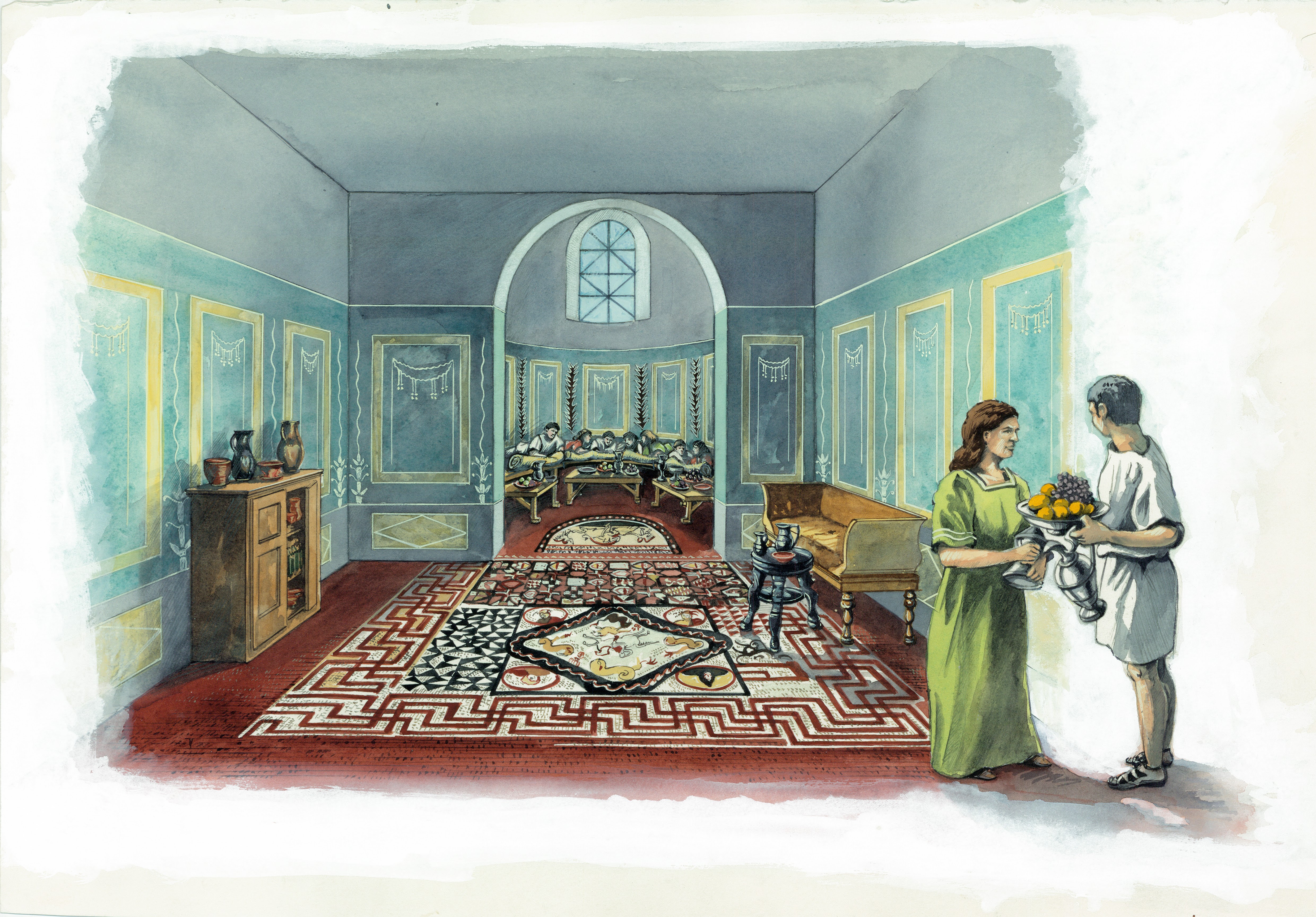
Party time! Reconstruction of the dining and reception area at Lullingstone Roman Villa c. AD 330-60. (See earlier blog on Lullingstone.) (Illustration by Peter Dunn.) © Historic England Archive.

Thank you to Dr Anne Thick for kindly giving the interview to the History Girls and for permission to use her photographs of the dig. Thank you also to Mr Gordon Thick, and to Emma Freeman, Site Manager at Lullingstone Roman Villa.
Thank you to Historic England Archive for permission to use the images of Lullingstone Roman Villa.


 @carolinetutor
Website: www.carolinetutor.co.uk
LinkedIn: Caroline K. Mackenzie

Friday, 3 February 2023

HAMILTON'S TREASURES ... by Susan Stokes-Chapman

Thankfully the ship rests in the shallows. He has not used this apparatus before and will not venture any deeper than he must. Twenty feet below the surface. No danger there, he tells himself. And he knows exactly where to look. Under careful instruction the object he seeks was safely hidden within the starboard bow, away from the other shipments tightly packed in the hold, but the ship broke apart in the storm; he hopes his luck stays true, that the crate has not strayed too far along the seabed, that no one else has managed to retrieve it ... ~ Extract from: Pandora


In the harsh winter of 1798, the Royal Navy’s formidable warship, HMS Colossus, met a tragic fate off the treacherous coast of the Scilly Isles, succumbing to a fierce and unforgiving storm. Hidden deep within its hull was the prized collection of Greek antiquities belonging to the British diplomat William Hamilton. With Napoleon’s forces poised to invade Naples, Hamilton had wisely chosen to send his treasured artifacts back to England for safekeeping. Yet, in a cruel twist of fate, these invaluable relics were lost beneath the waves, swallowed by the very sea meant to protect them.


William Hamilton harboured a profound passion for Greek vases, amassing an impressive collection during his 35 years residing in Naples. Serving as British Ambassador to King Ferdinand from 1764 to 1799, Hamilton’s official duties provided the perfect backdrop for his intellectual and cultural pursuits to flourish. He became deeply engrossed in antiquities, acquiring Greek vases from private collectors, sponsoring archaeological excavations, and even opening ancient tombs. What began as a scholarly interest quickly blossomed into a full-fledged obsession; by 1766, he had amassed a remarkable collection of over two hundred individual pieces.

For his own scholarly satisfaction — and perhaps to share his passion with the wider world — in 1766–67 Hamilton published a lavish four-volume set of engravings showcasing his treasures, entitled Collection of Etruscan, Greek, and Roman Antiquities from the Cabinet of the Honble. Wm. Hamilton, His Britannick Maiesty's Envoy Extraordinary at the Court of Naples.


Hamilton’s first collection of antiquities was sold to the British Museum in 1772 for the substantial sum of £8,410, where many of the pieces remain on display today. Among them is the celebrated red-figure volute crater famously known as the 'Hamilton Vase'. Yet, scarcely had he parted with this treasured assemblage — perhaps with some seller’s remorse — before Hamilton resumed his collecting with renewed zeal. He went on to publish a second catalogue, titled Collection of Engravings from Ancient Vases Mostly of Pure Greek Workmanship Discovered in Sepulchres in the Kingdom of the Two Sicilies but Chiefly in the Neighbourhood of Naples During the Course of the Years MDCCLXXXIX and MDCCLXXXX.

What makes this particular collection especially poignant is that it was among these very vases, immortalised in the engravings, that were tragically lost aboard HMS Colossus.


He was, understandably, devastated. In a letter he wrote to his nephew Charles Greville in 1799, he said of his vases 

“they had better be in Paris than at the bottom of the sea; have you no good news of them? they were excellently packed up, & the cases will not easily go to pieces, & the sea water will not hurt the vases. All the cream of my collection were in those eight cases on board the Colossus, & I can't bear to look at some remaining cases here in which I know there are only black vases without figures.”

Regrettably, only a handful of items from Hamilton’s lost collection were recovered during his lifetime. It was not until 1974 that a dedicated recovery team succeeded in raising some of the salvaged fragments from the depths. These damaged yet invaluable pieces now reside within the British Museum’s esteemed collection.

Despite this tragic loss, William Hamilton’s legacy endures. His meticulously published volumes became essential references for artists and craftsmen, notably influencing figures like Josiah Wedgwood. One of Wedgwood’s most celebrated creations is his exquisite reproduction of the famed ‘Portland Vase,’ pictured below—a testament to the lasting impact of Hamilton’s passion for antiquity.


~~~~~~

My debut novel Pandora opens with the recovery of an ancient vase from the shipwreck of HMS Colossus, and features William Hamilton quite prominently as a key character. To read all about it you can order by clicking the image below:

Instagram: @SStokesChapman

Friday, 18 March 2022

Rutland Roman Villa - the story of a remarkable discovery. By Caroline K. Mackenzie.

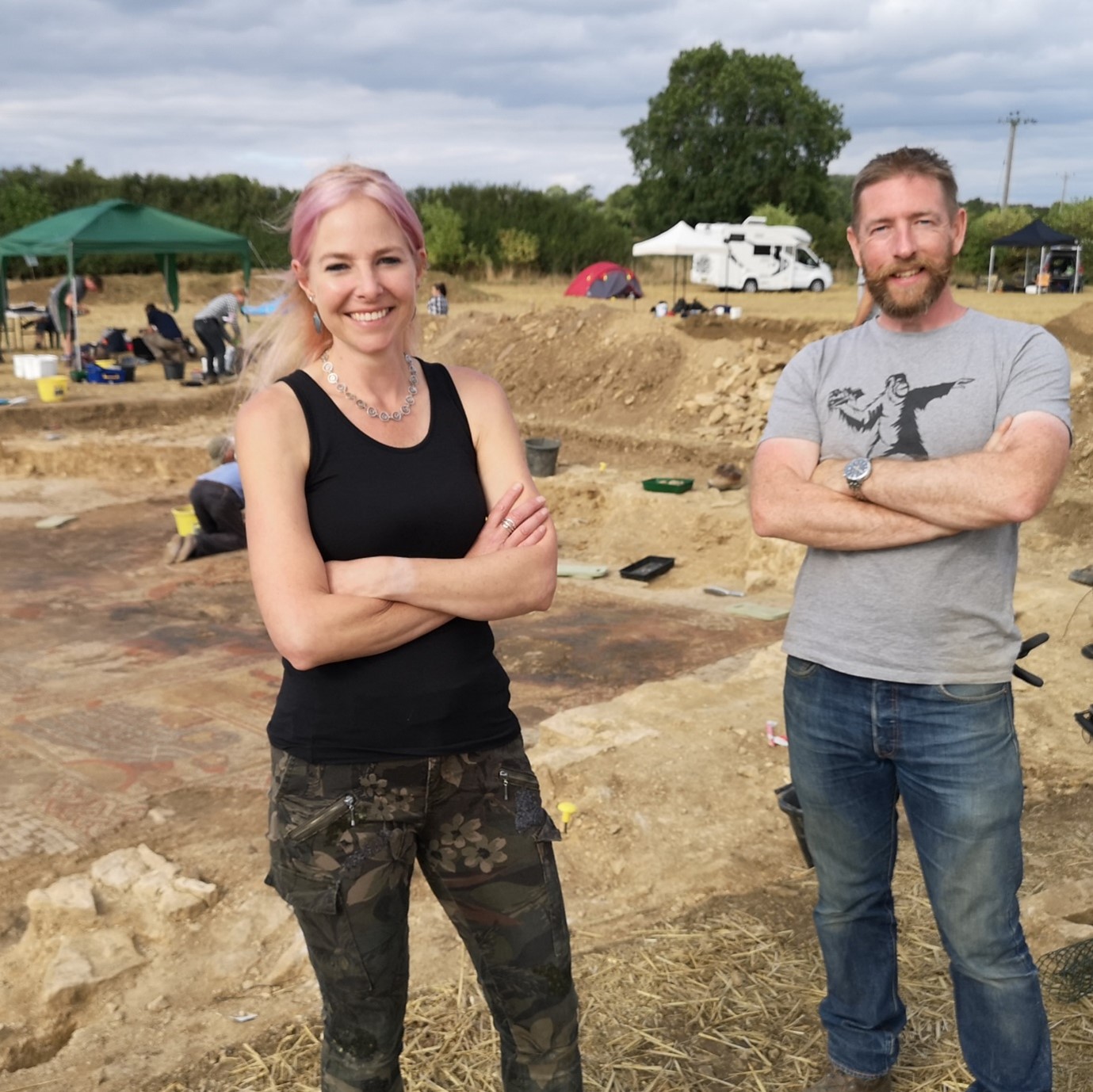
Professor Alice Roberts from BBC Two's 'Digging for Britain' and Jim Irvine, who discovered the Roman Villa and its mosaics. © Jim Irvine.

A chance discovery during a walk in the fields during lockdown became breaking news in late November 2021. Jim Irvine, engineer and son of a farmer, realised that he had stumbled across a Roman Villa, complete with stunning mosaics which have been hailed as ‘the find of the century’. The Villa complex is believed to have been occupied between the 3rd and 4th century AD, probably by a wealthy individual with a knowledge of classical Greek and Roman literature.

The remains of the mosaic measure 11m by almost 7m and it is thought to have been the floor of a large dining or entertaining area where it would have been designed to impress visitors to the Villa. Three panels tell the story (almost like a cartoon strip) of Achilles’ battle with Hector at the conclusion of the Trojan War. Mosaics appeared in private and public buildings across the Roman Empire, and often depicted characters from mythology and history. However, the Rutland mosaic is so far unique in the UK (and one of only a few across Europe) in showing scenes from Homer’s Iliad. Homer’s epic poem, based on events in the Trojan War, was composed in the 8th or early 7th century BC. The mosaic also depicts Hector's body being ransomed for gold, a scene not in Homer's Iliad but in a lost version of the Trojan War by the Greek playwright Aeschylus (who lived in the 6th to 5th century BC).

Caroline K. Mackenzie spoke with Jim Irvine about the story behind the headlines, the serendipity of a swarm of bees, and the thrill of being part of BBC Two’s ‘Digging for Britain’ with Professor Alice Roberts.

Reconstruction of the dining and reception area at Lullingstone Roman Villa c. AD 330-60. (See earlier blog on Lullingstone.) The mosaic at Rutland Roman Villa may have been designed for a similar setting. (Illustration by Peter Dunn.) © Historic England Archive.

Please could you tell me a little bit about yourself and how long you and your family have been farming the land?

My Dad’s family own the farm. He and his brother own the land between them and my Dad is the tenant farmer. I have been working on the farm since I was a kid and I have walked in the field where the Roman Villa is for over 30 years.

I am an engineering director of a company in the hydrogen production business. So my actual farming activities are really limited now to evenings during harvest and/or weekends when my Dad needs me to chainsaw up a tree or fix a broken combine harvester!

Please could you tell me the story of how you first discovered the initial signs of a Roman site?

It was a bit of an adventure! During lockdown when six people were allowed to get together, my wife and I and our two daughters saw quite a lot of my parents as they live only a few miles away. One sunny day in the summer of 2020, during that particularly dry period, we decided to go and lark about in the river. As we were going down to the river we had a bit of a run-in with some local bees which the local beekeeper has there and we all got stung. My wife tumbled onto the ground and I had to pull the bees out of her plaits - it was all quite disconcerting.

After we had played in the river, we decided we probably should not go back past the bees again. We decided to walk around the bottom of the field on the other side. The crop had not grown by the river because in the winter of the previous year there had been some flooding. There was about 10m of bare soil which we were trudging along. This is where I spotted a few bits and pieces which were the sorts of things you might see in a local museum: a piece of pottery, part of a hypocaust [a system of central heating in a building that produces and circulates hot air below the floor of a room], and even some oyster shells. Although I could reconcile the piece of pottery with some building rubble from the Victorian house across the river, I couldn’t reconcile the oyster shells as I was pretty sure they had never grown in Rutland!

The orange bits of tile were the first bits that jumped out at me because the rest of the ground is brown with bits of limestone strewn across it from the subsoil. As soon as we started looking closely at the ground, we started noticing more bits. If you walk across the field today, even in the stubble, you can’t really go five paces without spotting some broken bit of building material, or a bit of pot, or a tessera [a small block of stone, tile, glass, or other material used in the construction of a mosaic]. In retrospect I am slightly annoyed at myself as I consider myself to be quite an observant person - how did I not notice this before?!

The field is used for cereal - it gets cultivated, it grows, is harvested, and is re-cultivated. Usually, the best time to discover any hidden artefacts in a field is just after the field has been ploughed and after some heavy rain which washes all the soil off anything like pottery, stone and glass. But in this instance, it was the specific conditions on that small patch of field where the flood had not allowed the crop to grow that led to the discovery. The combination of lockdown, the bees, and the right conditions all conspired to illuminate this find to me. And I have some lovely honey in the cupboard so I forgive the bees for stinging us!

Jim digging in the field under the watchful eye of one of his daughters. © Jim Irvine.

What happened next?

I brought a few bits home and photographed them. I did a lot of work to find out why they might be there. I looked at LiDAR [a detection system which works on the principle of radar], old maps, and the thing that really illuminated it was the overhead Google maps photo which revealed a very obvious crop mark along the outline of the building - you couldn’t miss it! This was also a fluke as the photo was from June 2018, which was when we had a long, hot summer so the crop mark was clearly evident. I looked back at the historical imagery right back to the 1990s, taken at all different times of the year, and there was no evidence of any crop marks at all.

I texted my Dad to ask if he had ever noticed any big bits of stone in the field while ploughing it and he said he had seen a couple of bits. So I sent him the picture!

I then went to where I thought the crop mark was in the field and looked around to see what the topology was like. I walked around the tramlines and looked in the gaps where there were no crops. I found a few more oyster shells on the surface in the mixed-up plough soil. I even dug a small trench along one of the tramlines but didn’t really find anything. At this point the crops were about one month off being harvested, which distorts the heights and makes it hard to see the ground levels.

I kept badgering my Dad to get on with harvesting the wheat! It was towards the end of lockdown and one day we decided that instead of going to the beach we would go to the field. We took the kids and went with some folding chairs, a sunshade, and a picnic. I worked out where I thought the wall would be, based on the crop mark, the GPS on my phone and the position of features like the tram lines in the field, the trees and hedges.

I have always been interested in archaeology generally, but I have never studied it. I had a rough idea of what I thought a Roman Villa might look like, with a courtyard surrounded by buildings with covered areas. But because the crop marks indicated a building with apses, I was thinking more of a medieval building or a church. I had never seen an apse on a Roman Villa, but I had never really looked that closely.

This time when I dug a trench, I found some small tiles at the bottom of the hole - they were tesserae measuring around an inch square. I still didn’t consider it was Roman. I had in my mind it was medieval as there are so many medieval buildings here in Lincolnshire and Staffordshire.

In a portion of the trench I dug, the soil changed to a lighter colour - more like mortar. The soil is quite loamy - limestone mixed with soil - so is easy to dig when it is dry. I dug a couple of feet down making a hole not quite a foot square and there were about 30 tiles at the bottom. I had thought I would find a wall but instead it appeared to be a path around the outside of the building. My Dad came with a pickaxe and some brushes, and we expanded outwards until we reached a number of small tesserae joined together and a pattern started to emerge. We were pretty shocked.

This was the guilloche [a pattern of interwoven strands, resembling rope, often used as a border in Roman mosaics] around the outside of the figured mosaic. We went a bit further and exposed what transpired to be a depiction of a foot and so worked upwards to reveal more of the figure. I should add that we were exceptionally careful as we worked. We only uncovered the bit that was easy to uncover. The Romans did a spectacular job of creating a level floor. I put my mobile phone on it with a Level App and it was completely level in both directions. This made it very easy to dig because you knew what level to put in your spade without digging into the floor. We uncovered quite a bit of the mosaic but stopped where the mosaic had clearly been damaged by something or other - it was sinking down a bit.

As the mosaic was uncovered, the depiction of a face appeared. © Jim Irvine.

When did you realise you needed to call in some archaeologists?

Having discovered some of the mosaic panels, we decided we needed to tell someone about it. After various initial phone calls, such as to the museum in Peterborough, I ascertained that I needed to report it to the Leicestershire Historic Environment Record Officer, Helen Wells. I put a presentation together outlining all the above with photos, and we talked through it all on a video call. Interestingly, someone else had spotted the crop mark and recorded it about a month before I had. Helen suggested we arrange a field walk.

A couple of days later, Peter Liddell, the former county archaeologist, came to the site together with John Thomas and Dr Jen Browning, both from ULAS (University of Leicester Archaeological Services). I remember the four of us peering into the hole that I had dug.

How long did the excavations take and what were the most exciting discoveries?

In the summer of 2020, they secured funding which accommodated some geophysics and an archaeological dig with the help of some volunteers. David Neal, a mosaics expert, came and sketched the portion of the mosaic that was uncovered. I was fortunate enough to be able to help out and was asked to drive the digger. What is great is that they have kept me involved throughout. My Dad doesn’t like reading emails so I am the point of communication for everybody - a bit like the PR guy! It has certainly kept me busy.

I have learned so much having been actively involved in excavation in both years, 2020 and 2021. I have a trowel and I now know how to clean a mosaic and how to record it, having worked with the archaeologists.

There was also the involvement from the BBC Two ‘Digging for Britain’ team led by Professor Alice Roberts. John Thomas at ULAS has worked with them before so the producers contacted him to ask if he had anything going on at that moment. He said “Actually, yes!”. I had the opportunity to work with the Digging for Britain team throughout and we were fortunate that they gave the discovery a lot of airtime - almost half a show was dedicated to it.

David Neal drawing and recording the mosaic. © Jim Irvine.

I gather you had to keep it all secret - that must have been hard!

It was probably the worst kept secret in the area! A lot of my friends knew it was going on and we did have a number of visitors to the site but they all had to keep quiet about it. We were fortunate in that it is quite an inaccessible area so people probably wouldn’t notice it just driving past. Now of course the mosaic has been reburied for its ongoing preservation.

In the first year of excavations it was only open for four or five weeks. The archaeologists came back later to do some further excavation on the other areas of interest such as parallel ditches - a lot of the artefacts were at the bottom of the ditches.

We had uncovered about one third of the room with the mosaic in 2020. In 2021, the plan was to dig a much bigger trench over the whole area. That was when the rest of the room was uncovered and it transpired that the mosaic was about 11m by 7m.

Reconstruction of the dining and reception area at Lullingstone Roman Villa c. AD 330-60. (See earlier blog on Lullingstone.) The mosaic at Rutland Roman Villa may have been designed for a similar setting. (Illustration by Peter Dunn.) © Historic England Archive.

The mosaic itself is a remarkable discovery. Although there are other Roman mosaics in Britain, this is the only one we know of so far depicting scenes from the Trojan War. The three panels show Achilles and Hector fighting from their chariots, Achilles dragging Hector’s corpse around the walls of Troy and finally Hector’s father Priam ransoming his son’s body for gold. Do you recall the moment when the scenes were identified and their significance was realised?

I had a long call from the Leicestershire county archaeologist, Richard Clark. After we had revealed the three panels which each showed a portion of the story, they were able to figure out what it was because of the various details such as the horses, and Priam’s Phrygian cap [an attribute often used in classical Greek iconography to identify Trojans as non-Greek]. Richard explained it to me really clearly and I thought “Wow - that is amazing” because this is a story that has endured from Greek times, through Roman times right up until the present day - you can even watch Brad Pitt in a film about Troy!

This part of the mosaic depicts the ransoming of Hector's body for gold by his father Priam, identifiable by his (red) Phrygian cap. Priam is second from the right in this image. © Jim Irvine.

Was this your first introduction to Homer and his stories of the Trojan war? If so, has it inspired you to learn more about the Classical world and/or Roman Britain?

Being an engineer, I don’t have time to read stories. But I had seen the film about Troy! However, my Classical education is limited. When I was a kid I used to read factual books rather than any mythology books. It is only as I have got older that I have been more interested in History and this discovery is a really good focal point for me. I think Homer’s Iliad is a massive volume and probably beyond my capability to read.

[CKM interrupts to say that a good translation is accessible to anyone - it is quite simply a great story. CKM enthusiastically waves a copy of Homer's Iliad at her computer screen and urges Jim to read it.]

OK - I’ll do that! I don’t feel like I am doing my job properly unless I read it!

My interest in this is really what does this tell us about the Roman people at the time and how they interpreted the Iliad. Did they get this from a pattern book and tell the mosaicist that they wanted these three pictures? Or was it someone who knew about the Iliad and had it written down somewhere and said, “I want you to represent that story for me”? For me, the people aspect is thrilling.

Absolutely. I have been reading Homer's Iliad with my online Classics Club reading group throughout lockdown (see earlier blog on Classics Club) and it is amazing to think that people in Roman Britain may have been reading and enjoying the same story as we are today. Although I haven’t gone as far as commissioning a mosaic floor, one member of the reading group who is an artist created a lovely painting for me depicting, guess what, Hector and Achilles in battle, with the Trojan horse in the background. It seems our desire to have images in our homes of the stories we love has not changed in 1600 years!

Looking forward, are you able to tell me about the future plans for further excavations?

It will depend on funding of course. Historic England and ULAS are co-ordinating some more excavation this year but the plan is not yet formalised. I understand they are expecting to uncover a lot more in terms of square metres than previously.

The whole site has phases of archaeology across it. There are potentially some roundhouses, rectangular buildings, a bath house, and aisled buildings, etc.

Illustration of the baths at Lullingstone Roman Villa, Kent as they may have appeared in the late third century AD. (Illustration by Peter Dunn/Richard Lea.) © Historic England Archive.
Rutland Roman Villa may also have had baths. 

What would be your dream discovery on your land?

Gold. (Only joking!)

For me, my main interest is what is the state of preservation of the other parts. I am thinking from an engineering point of view here. Next to the field is an area of unfarmed land of about one acre which is just left wild as it is completely inaccessible - it has not been farmed since big machinery came along. It has trees and brambles on it and is in a horrendous mess - anything underneath it will have roots through it. I am fascinated to learn more about the history of the site from the time when whoever owned it with the mosaic ceased to occupy the site and how it has been maintained as it is today.

My personal view is that for the preservation of things like the mosaic, which is only two foot deep and well within root damage depth, for it not to have been damaged and the walls still to be there must mean it has been continuously inhabited or maintained as farmland since it had a building on it. That is the only way it wouldn’t get destroyed by vegetation over time. We have literally just shaved the top of everything through farming but everything else is pretty much as it was when it fell down. I can’t wait to see it all.

At the end of the last excavation, we discovered another mosaic in an adjoining room to the main mosaic room, and we just exposed the corner of it. There also appears to be a tiled corridor which may be the next part of the building which was in great condition

Is there any chance the mosaic of Hector and Achilles will be uncovered again?

It is well preserved. The first year it was covered in a special washed sand, then a membrane and soil on top of that. When [Professor] Alice [Roberts] brushed off the sand it was exactly as we had covered it up before. I was really emotional about that as I had been thinking about it the whole time, for a whole year, and I hadn’t seen it except for the picture on my phone which I look at every day. So seeing it come back again was a moment of “Wow, this is really great.” We cleaned it last year and it looked amazing. When the sand came off, as you can see in the footage, it looked spectacular and that was really what it looked like. Preservation in situ is the best way to look after these things - it’s not going anywhere. The cost of putting a building over it and having tourist access would be millions of pounds. It is well recorded with photos and David Neal’s drawings. Also, the local museum is going to have a virtual exhibit.

Professor Alice Roberts cleaning the sand from the mosaic. © Jim Irvine.

What was the most exciting part for you of it all?

Driving the digger. (Only joking - again!)

It was great to do the TV and to meet the professionals, [Professor] Alice [Roberts] is really nice, and she knows her stuff about bones! I had the chance to work with her while she was on site and it was very interesting as I had never worked on anything like that before.

The thing that has been most interesting is to have been asked to be involved in the excavations and fieldwork with bio-archaeologists. How many people get to excavate and clean a Roman mosaic? I am quite privileged. I think more people have been on TV or driven diggers than have excavated mosaics!

I would love to do more because you have to really think about what you are doing and understand what you are poking your trowel around to make sure you don’t damage anything. I am pretty careful when it comes to working with small things like this but I can also tell when something is robust and is made to be strong. Working in the field and working directly on the mosaic was great - I was there whenever I got the chance. I cleaned Hector’s face and Priam’s feet goodness knows how many times - not many people can say that!

It must have been an amazing discovery for your daughters as well! Has it inspired either of them to become archaeologists?

My youngest daughter wants to become a palaeontologist but for them it has been rather matter of fact. She is at primary school and her class are learning about the Romans and mosaics. They all wrote to me asking me to tell them something about my experience, which was really nice. This is why I like doing talks about the Villa as I love to tell people about the discovery and to get people interested. It is something that I never thought I would be interested in and I think everyone should have the opportunity to engage in this sort of history.

We have a lot to thank you for, not only for discovering the Villa, but also for being so enthusiastic and keen to share the discovery.

The news broke on the Thursday and the following day when I went to work in my garden shed/home office, I telephoned my boss to ask if I could have half a day off as I had to meet ITN and BBC in a field to do an interview. It was then non-stop for a week. It was great and another new experience for me. As well as learning about history and being involved in an archaeological dig, I was then doing media stuff which I had never done before. The last two years have been a massive thrill for me.

It’s amazing to think that the Roman Villa and its incredible mosaic have been under our feet for a long time and we had not noticed the signs until recently. But my interest and awareness have significantly improved and changed such that I look at every piece of farmland slightly differently now.

*****************************************************

Post script: While writing up this interview, I reflected on the circumstances that led to this remarkable discovery, and the serendipity of the swarm of bees. Stories of bees seemed strangely familiar. I then remembered that in Book 2 of the Iliad, Homer describes the Greeks gathering for a council as resembling a mass of bees ‘swarming out from a hollow in the rock in a never-ending stream’. Later, in Book 12, a Trojan warrior describes two Greek warriors defending the entrance to their fortifications as fierce insects defending their nests: ‘But now, like… bees who have made their houses by a rocky path, and will not leave their hollow home, but face the men who come to hunt them and fight to defend their babies, so these men… will not give way from the gates’. [Translations: Hammond, Penguin Classics.]

What a lovely twist of fate, therefore, that bees played a part in the discovery of the Rutland Roman Villa and its stunning mosaic of Hector and Achilles in battle. Homer’s comparisons of the Greeks with bees and the bees’ role in leading Jim Irvine to the mosaic of Achilles (perhaps the most famous Greek warrior of all) provides yet another link between the stories of 8th century BC Greece, the inhabitants of the Roman Villa in Britain in the 4th century AD, and the family who own the land today.


Many thanks to Jim Irvine for kindly giving the interview to the History Girls and for permission to use his photographs of the dig.
Thank you also to Historic England Archive for permission to use the images of Lullingstone Roman Villa.

@carolinetutor
LinkedIn: Caroline K. Mackenzie