Showing posts with label Earl of Essex. Show all posts

Tuesday, 29 May 2018

The King, his lover and his lover's wife by Elizabeth Fremantle

Our guest for May is Liz Fremantle who used to be a full-time History Girl. Here she talks about her latest novel.

E. C. Fremantle has a BA in English and an MA in Creative Writing from Birkbeck. As Elizabeth Fremantle she is the critically acclaimed author of four Tudor historical novels: Queen’s Gambit, Sisters of Treason, Watch the Lady and The Girl in the Glass Tower and has contributed to various publications, including The Sunday Times, Vogue, Vanity Fair, The FT and The Wall Street Journal. She lives in London and Norfolk. 
www.elizabethfremantle.com

Author photo: JP Masclet
On New Years’ Day 1606 a couple were married at King James’s court, in an ostentatious ceremony as close to a royal wedding as it was possible to get, without any of the parties actually being royal. The young pair were at the pinnacle of the aristocracy, both from powerful families. He was the Earl of Essex, son of an infamous father who had been executed for his ill-starred rebellion against Queen Elizabeth. She was Lady Frances Howard, daughter of the Earl of Suffolk, a family with close historical links to the Tudor throne – Howard women were sought-after brides.

This was no Harry and Megan love match. As was the norm for aristocrats in Early Modern England, it was a dynastic marriage, but unusual in that it was designed to unite two opposing political factions. The Howards had long been a powerful force and were shown great favour by the new King James when he came to the throne. They publically held the same religiously tolerant political position as the King and were keen to strike treaties with old Catholic enemies like Spain. The Essex faction, back in favour having helped James to the English throne, supported a hard-line Protestant agenda and were more inclined to war than ‘jaw’. Consequently, the wedding, as a catalyst for peace between warring parties, heralded an air of optimism and unity in the early Stuart court.

The Earl of Essex
The pair were young, she fourteen and he still thirteen, which was unremarkable for such marriages of the period. But the risks of childbirth for a girl so young were great, so Essex was sent to Europe for a time to be reunited with his wife a few years later. There was little love lost between the couple when they finally came together. But more significantly, during Essex’s absence the power balance at court had shifted and the deep-rooted differences between the Howards and the Essex faction had once more begun to crystallise. The optimism of 1606 was a distant memory by 1612; the Essex faction was losing their influence, so the marriage was no longer serving its purpose and the Howards were keen to extract Frances. They were forming other plans for her.

There was a new star at court. Robert Carr had attracted the attention of the King, who had a penchant for beautiful young men, and had consequently risen to a position of power as the royal favourite. Carr, in the market for a wife, was taken with Frances, and her family saw an opportunity to consolidate their close ties to the King. Their intention was to extract Frances from her marriage with Essex, whose star was on the wane, and hitch her to Carr, whose star was rising. But, even with the backing of the King, who could refuse his favourite nothing, this would not be easy.

Robert Carr, later Earl of Somerset
 In 1613 an annulment was proposed to a church commission. This was audacious, to say the least, given that the couple had lived together for some three years. But annulment was crucial, as divorce meant neither party could remarry in the lifetime of their former spouse. Both parties claimed the marriage hadn’t been consummated. But they were treading a fine line. For Essex to be publically deemed impotent would not only incur ridicule but spoil his future potential in the marriage market.

His friends testified that though he was unable to perform with his wife, he was certainly capable with other women – they had seen it for themselves. One can only imagine the atmosphere in court while the discussion of the young man’s erection took place before the bishops. Frances bore the brunt of the public shaming, being labelled a whore and a witch who had made her husband impotent by nefarious means. She was charged to undergo an inspection, which involved several respectable matrons and midwives all having a prod around her nether regions to see if she remained virgo intacta.
Frances Howard
A scandal of vast proportions blew up with ribald news-sheets having the kind of field day the red-tops have when a footballer beds a woman who is not his wife. It was generally believed that Frances must have been substituted by another, purer, woman for the purposes of hoodwinking the respectable matrons. A contemporary rhyme put it thus: "this dame was inspected but fraud interjected/ A maid of more perfection. "

The church commission deliberated for months and proceedings were further delayed by an old friend of Carr’s, Sir Thomas Overbury, who was vehemently opposed to the plan, threatening to prevent the annulment. He was thrown into the Tower on orders of the King, where he died. Eventually the King, who was keen to see his favourite married for reasons of his own, intervened by appointing two further bishops to push the decision in his favour. The annulment was eventually granted. The favourite, now the Earl of Somerset, was married to Frances Howard by the same bishop who performed her first marriage and in equal splendour. An entire week of court celebrations marked the nuptials.

The new Earl and Countess were riding high with the King’s favour – the ‘it’ couple of the Jacobean court. However, their troubles were only in temporary abeyance. When the Essex crowd saw a way to gain back their influence, the couple were to find themselves in extremely treacherous waters. The ensuing scandal would rock the court to its foundations and come perilously close to the King himself, forming the first dent in the Stuart monarchy, which would topple some two decades later.

It is these murky and murderous events around the glamorous Somersets that formed the basis of my novel The Poison Bed.

Saturday, 20 February 2016

Two Families in the 1640s - by Ann Swinfen

I have written three novels about two families, set in the seventeenth century. All have their roots in true events. Like most people, I suspect, I’m heartily thankful I did not live in that tempestuous period, yet it is endlessly fascinating. Social and religious pressures had been building up over the preceding hundred years or so, and in the seventeenth century – in England as elsewhere – they exploded. Ordinary men and women were better informed, even more literate, than before. Developments in printing and the foundation of many grammar schools had contributed to educating a population which was prepared to question the traditional religious establishment and the social hierarchy. The dictatorial stance of the early Stuart monarchs, especially Charles I, was the final spark which lit this particular powder keg.

Charles I

It is little wonder that the times gave rise to the revolutionary ideas of Levellers and Diggers, to confrontation between an elected Parliament and an anointed king, to clashes between Puritans and traditionalists. Opportunist land-grabbers fought with rural communities. Soldiers mutinied. Portents were observed. And innocent people – often old and poor – were sentenced to death for witchcraft.

The first of my novels set in this period, Flood, arose from my reading about how unscrupulous speculators seized the communally-held lands of East Anglia and undertook illegal drainage schemes with often disastrous results. The local people fought back, and amongst their leaders were women, many of whom were injured or imprisoned, some of whom died.
h


To compound the horrors of the situation, this was also the time of ‘licensed’ iconoclasts who smashed up parish churches, and of the monstrous career of Matthew Hopkins, Witchfinder General, whose fanatical search for victims ranged over the same area. 
Matthew Hopkins

I chose as my protagonist in Flood Mercy Bennington, the daughter of a yeoman farmer, who becomes one of the women leaders of the fenlanders, fighting for her family and village, trying to save their lands and livelihood. The second novel in the Fenland series takes the story further; Mercy continues the struggle in the country while her brother Tom travels to the Inns of Court in London, in search of the fenlanders’ charter granting their lands.

So how did I come across the account of this struggle in the first place? It was during my research into events in England in the mid seventeenth century for quite a different book. As part of the general research, it never became an element in that book but remained filed away in my memory, to emerge again later as the story of Flood.

And what was the other book? This Rough Ocean.

I suppose I’m like most writers: some ideas come swiftly and are written at once, others stay with you for a long time, quietly maturing, like a fine wine.

We need to backtrack many years here. My father-in-law had done some research into the Swinfen family of Swinfen in Staffordshire, partly spurred on by another descendent who worked for Burke’s Peerage. It emerged that the family was very well documented. A Norman knight, shortly after the Conquest, had married the heiress to the Swinfen estates and taken the name Swinfen in place of his own (de Auste). As landed armigerous gentry, they were well covered in the historical record and early genealogies. Like most families of their class, they carried out their duties as substantial landowners over the centuries – not aristocracy but holding an important position in their own shire.

Also like other gentry families, they began to rise under the Tudors and came to real prominence in the seventeenth century. An interesting link with my own Christoval Alvarez series of novels is John Swinfen (c.1560-1632), grandfather of one of the protagonists of This Rough Ocean. When Robert Devereux, Earl of Essex, was executed for treason in 1601, his widow, Frances Walsingham, daughter of Sir Francis Walsingham (Christoval’s employer), was deprived of her lands and her son of his inheritance. John Swinfen helped her to recover them from James I. He also christened one of his sons Deveroxe just after Essex’s execution, which must have taken some courage.

Earl of Essex

However, it was this John’s grandson, John Swinfen or Swynfen (1613-1694) who is the most interesting. He attended Cambridge and Grey’s Inn, then became a Member of Parliament at a young age. He was therefore at the centre of the most dramatic events of the seventeenth century – born while Shakespeare was still alive, he lived through the reigns of James I, Charles I, the Protectorate, Charles II, James II and into that of William and Mary, and also through the Plague and Fire of London. Caught up in the struggles between Parliament and the king, he was imprisoned twice – once by Cromwell for opposing the killing of the king, once by James II on a trumped-up accusation of being involved in Monmouth’s rebellion. Ah, the dangers of being a Moderate! Both extremes hate you! He lived long enough to be one of the founders of the Whig (Liberal) Party.

Oliver Cromwell


James II

I found this entire career fascinating, and my husband plans to write the definitive biography, but I wanted to capture some of this rich life in a novel. Clearly the whole life was far too large a subject, so I decided to concentrate on the period immediately following Pride’s Purge. John and his Moderate colleagues had persuaded Parliament to vote to treat with the king on the basis of an agreement whereby most of the powers of government would be handed over from the king to Parliament. The Moderates rejoiced. An end to the Civil War at last, on terms favourable to Parliament.

Pride's Purge
The next morning, all those MPs who had supported the treaty were driven away from Parliament by armed soldiers of Cromwell’s army, commanded by Colonel Pride. The most important, including John, were imprisoned. The MPs not excluded were believed to be favourable to Cromwell and his supporters, but many soon followed their consciences and withdrew, leaving the mockery of the ‘Rump Parliament’.

My novel, This Rough Ocean, tells the story of the imprisoned John and of his wife Anne, who makes a dangerous winter journey home to Staffordshire with her young children. Once there she finds the estate and its people on the brink of collapse into ruin and starvation. She alone must take on her husband’s role, running the large estate and averting disaster. The two stories are intertwined, as husband and wife each fight for survival.

I have always been intrigued by the lives of ordinary people in the past. We hear much about great rulers and men of power, but dig a little deeper and there is a great deal to be discovered about everyone else, the poor, the quiet farmers, the craftsmen, the minor players in the large events. In Flood, Betrayal and This Rough Ocean I’ve sought to tell the stories of those turbulent years of the seventeenth century, based on two families – a yeoman family and a gentry family – ordinary people caught up in extraordinary events.

Ann Swinfen
http://www.annswinfen.com


Saturday, 13 June 2015

A FAIR WOMAN WITH A BLACK SOUL – Elizabeth Fremantle


'Stella, star of heavenly fire
Stella, lodestar of desire.'
Sir Philip Sidney – Astrophil and Stella


When the Earl of Devonshire married the divorced Penelope Devereux, James I is said to have told him he’d ‘bought himself a fair woman with a black soul.’ It marked the end of an illustrious court career for Penelope and her fall from grace was to be devastating.

For many years Penelope had transgressed expected early modern codes of female behaviour, by ‘living in sin’ with Devonshire and bearing his children. It was an open secret, which Elizabeth I and to an extent her successor James I appeared to overlook. Elizabeth’s reputation for the excessively harsh treatment of any sexual transgression in the women of her household was renowned and it is testimony to Penelope’s strength of character and ability to command respect that both monarchs turned a blind eye to her affair.

Penelope had arrived at court in 1581 aged eighteen and was soon reluctantly married off to the fantastically wealthy, and aptly named, Lord Rich as a means to replenish the empty Devereux coffers. Her brother the young Earl of Essex was dubbed the ‘poorest earl in England,’ a humiliation that was to have far reaching consequences for the Devereux family.

Penelope’s beauty was legendary and in her early days at court she caught the eye of Sir Philip Sidney, inspiring his angst-ridden sonnet cycle Astrophil and Stella. It is possible that they had a love affair, though this is unproven but the sonnets offer an understanding of the profundity of Sidney’s feelings for her and his extreme jealousy of Lord Rich. Whether their relationship was consummated or not has been the subject of much speculation and it is impossible to know the truth, but it is undeniable that there was something significant between them.
The marriage of Lord and Lady Rich was not a happy one; why this was is not known and the lasting mystery at its heart is that Rich inexplicably turned a blind eye to his wife’s infidelity. It was after Sidney’s tragic death on the battlefield that Penelope encountered Devonshire, then plain Charles Blount, a man on the rise it the Elizabethan court. The couple began an adulterous relationship that would last until Blount’s death, having a number of children together but somehow her reputation remained intact until, somewhat ironically, the couple married.

But Penelope was not simply a woman interested in getting away with adultery, she had a hand in the politics of the Tudor succession, writing secret and treasonous letters of allegiance with James VI in Scotland and supporting him for the English throne after Elizabeth. This was a dangerous game. Penelope’s brother the Earl of Essex had risen spectacularly in Elizabeth’s favour but as was often the case in the Tudor court, his was to be an Icarus story and his fall was equally dramatic. The coup he launched against Elizabeth’s regime was to be the end of him but Penelope, who was inextricably involved in his insurrection, was not only the sole woman one on the list of perpetrators, but the only one who was not tried for her involvement. She was back in favour at court almost before her brother’s body was cold, raising questions about how she achieved this.

When James VI came to the throne as James I of England, Penelope’s secret allegiance would pay off, ensuring her a position of favour in the new court, which she enjoyed for some time with Blount, newly made Earl of Devonshire for his military success in Ireland at her side. As a Jacobean power-couple, she and Devonshire wrongly believed their favour with the new King was insurmountable when, shortly after her divorce from Rich, they married in contravention to James’s specific order that she not remarry during her husband’s lifetime. It was Penelope rather than Devonshire who would feel the full force of James’s wrath when she was banished from court and publically disgraced.

Her amorous links with two great Protestant heroes, Sidney and Devonshire, made her an embarrassment in the context of a po-faced Protestant history and meant her story was swept under the carpet, for fear of sullying the upright reputations of the men who loved her. But hers is the intriguing tale of a woman who deliberately contravened the rigid codes of female modesty, who commanded respect, made secret alliances and had the courage to march to the beat of her own drum against all odds, at a time when women were required to be silent and meek. And so her story merits dusting off and celebrating by a new generation who choose to see the full historical picture rather than the edited male highlights.


Elizabeth Fremantle’s novel about Penelope Devereux WATCH THE LADY will be published by Penguin on June 18th and Simon&Schuster (USA) on June 9th.


'A pacy, powerful narrative that kept this reader riveted throughout.' Jane Thynne

Wednesday, 20 May 2015

The Counter Armada and Historical Forgetfulness - by Ann Swinfen

Why do we remember certain episodes in our history and teach them in our schools, while we conveniently forget others?

When I was a graduate student, I shared a room in the university with a French girl from Poitiers, also studying for a postgraduate degree. We became good friends, and one day I asked her (tactfully!) if there was any archaeological evidence remaining of the Battle of Poitiers. She looked at me in total mystification.


It seems that schoolchildren in Poitiers are taught nothing about the Battle of Poitiers.

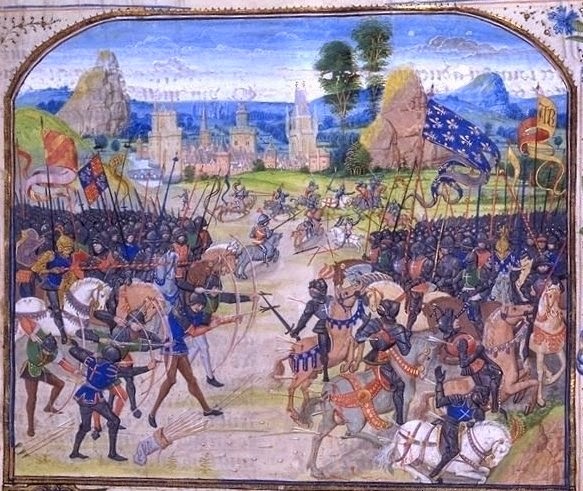
For those who aren’t familiar with this bit of the Hundred Years War, the Battle of Poitiers took place on 19 September, 1356, and was one of a series of victories by Edward the Black Prince over the French. An English army of approximately 6,000 inflicted a massive defeat on a French army of approximately 11,000 – in other words, nearly double their number. There were a few hundred English casualties. The French suffered around 2,500 killed and wounded and 2,000 prisoners. Poitiers schoolchildren, it seems, are not encouraged to remember the battle.


A short walk from our home stands Broughty Castle, guarding the mouth of the river Tay and thus a major ancient naval route from the North Sea to Dundee, Perth and the heart of Scotland. In the mid sixteenth century the merchant communities of Scotland’s east coast had important trading links with the Low Countries and the German states. Like them, this part of Scotland had become Protestant. The government of Scotland, however, was in the hands of the Regent, Mary of Guise (French and Catholic), during the minority of her daughter Mary Queen of Scots.

England proposed a marriage between Henry VIII’s young son Edward and the child queen Mary, and sent a mission, backed by a strong navy, which came to be known as ‘the Rough Wooing’. Such marriages were not unknown, the most recent having been that of Henry’s sister Margaret to James IV of Scotland. (English Margaret was thus the child queen’s grandmother.)

Now, at this present time of rampant Scottish nationalism, it may be dangerous to mention something which – like the Battle of Poitiers – tends to be conveniently forgotten. The fact is, the English were welcomed along this Protestant east coast with open arms. Broughty Castle was handed over to the English in the autumn of 1547 without a shot being fired. Sir Andrew Dudley, brother of the Duke of Northumberland, took charge of the English garrison, and sent for a supply of Tyndale’s Bible, eagerly sought by the locals. All the area, including the city of Dundee, joined an alliance with the English and supported the marriage.

Mary of Guise and her French Catholic party, however, had other ideas. They shipped the child queen off to be reared up in the French court (where French became her mother tongue), betrothing her to the heir to the French throne. It was part of the power game being played by the Guise family.

I doubt whether many in this eastern half of Scotland choose to remember that warm alliance with England together with the opposition to the Scottish government and the attempted French take-over of Scotland (for that is what lay behind the French marriage). Another case of selective forgetfulness.

France and Scotland are hardly alone in forgetting inconvenient past events. Few in England have heard of the Counter Armada. (Even my husband, a professor of history, though not a specialist in the Tudor period, admits to not having heard of it until I wrote about it.) Of course, every English schoolchild knows about the glorious defeat of the Spanish Armada in 1588, and the (possibly apocryphal) story of Sir Francis Drake finishing his game of bowls before embarking. What they are unlikely to know about is the misconduct of Drake during the battle, which went on for several days. During the darkness of one night, Drake was supposed to be leading the fleet with a lantern in the stern of his ship. Instead, he slipped away on a little looting expedition of his own, which might have had serious consequences.

However, the great Spanish fleet was defeated by a combination of English seamanship and fighting skills, the incompetence of the Spanish commanders, and weather which favoured the English. The winds which blew the Armada out of the Channel into the North Sea also prevented the launching of the barges which were to carry the experienced Spanish army, then fighting in the Low Countries, across the Channel to invade England by land and march on London. A tactic to be adopted in the opposite direction nearly 400 years later with the D-Day landings in Normandy.


The Armada, a glorious, resounding, never-to-be-forgotten victory!

To understand what happened in the period of euphoria afterwards, we need to remember events over the previous decade or so in Portugal. In 1580, Spain invaded Portugal and drove out the king, Dom Antonio of the House of Aviz. Dom Antonio was now living in England as a guest of Her Majesty, who was always on the lookout for useful tools in her on-going struggle with Spain. For some years many from the Portuguese Marrano community had been fleeing to England. Jews forced to convert to Christianity, they were persecuted by the Inquisition even before the Spanish invasion. It grew much worse afterwards.

With much of the Spanish fleet destroyed, a number of interests came together to propose a ‘Counter Armada’. Elizabeth and many of her advisers saw it as an opportunity to destroy the rest of the fleet before Spain could rebuild. Dom Antonio saw it as the chance to regain his throne. Leaders of the Marrano community in London – including notably the queen’s personal physician Rodrigo Lopez – dreamt of regaining their homeland and rising to positions of importance in the new government. Drake, of course, saw it as an opportunity for his favourite pastime: looting Spanish treasure ships.

Coat-of-Arms of the Aviz family

Funds were raised from the queen, from London merchants, from the Marrano community. The queen, however, tied up her support with such conditions to Dom Antonio and his future government that Portugal would have been financially crippled and effectively a colony of England.

Early in the spring of 1589 the English fleet gathered at Plymouth. A call had gone out for soldiers to join the expedition and a ragtag crowd assembled there. These men had no military training whatsoever. Supplies for the expedition were bought and stored in warehouses in the town. Then everyone waited. A contingent of trained and experienced soldiers was to be shipped over from the Low Countries, where they had been helping the Dutch fight the Spanish invaders. Once again, the winds were unfavourable. Days passed. Weeks passed. The restless recruits broke into the warehouses and stole the food and drink. Some simply went home. Eventually the experienced men arrived and the expedition set sail, with Sir Francis Drake in command of the fleet and Sir John Norreys in command of the army.

There is no room here to tell the full story, which is the subject of my third Christoval Alvarez novel, The Portuguese Affair, but here is the bare outline.


The intention was to sail straight to Lisbon and restore Dom Antonio. His supporters would flock to join the English, and by acting quickly the Spanish could be defeated before they could move more of their army into Portugal. On the way to Lisbon or afterwards, as many Spanish ships as possible would be destroyed. A third objective was to conclude the expedition by driving the Spanish out of the Azores. However, before the English ships could reach Portugal, they had run out of food, owing to the raids in Plymouth. The decision was therefore made to attack Coruña on the north coast of Spain, seize provisions and carry on.

Here was the next blunder. The undisciplined soldiers went berserk in Coruña, and the leaders decided to stay and attack the garrison there. Several fruitless weeks were wasted, while news reached Spain of the expedition and every Portuguese believed to support Dom Antonio was executed.

Eventually the expedition moved on down the coast of Portugal, where they were joined by the queen’s favourite, the Earl of Essex. He had been expressly forbidden by her to join the expedition, but slipped away, with his usual pig-headed arrogance believing he could pacify her and win glory for himself.


Next blunder: the fleet put in at Peniche, where the gallant Essex leapt out of the ship into deep water, causing many of his followers to drown. The local people welcomed Dom Antonio warmly, but soon grew tired of providing for the English army and fleet. At this point the leaders made their fatal mistake – the army and the fleet would part company. Drake would sail the fleet down the coast to Cascais, then up the river Tejo to Lisbon. Norreys would lead the army by land to Lisbon, about forty miles across unforgiving countryside with no provisions, unless they could be begged from the locals.

The English army on  more successful campaign

It was a disaster. The men died like flies, of starvation, heat exhaustion, thirst. When the ragged remnants of the army reached Lisbon, there was no sign of Drake, who was busy looting treasure ships on the coast. No supporters of Dom Antonio joined the English, even if any were still alive. Essex shouted a challenge at the gates of Lisbon – let anyone meet him in single combat for the honour of Queen Elizabeth. Laughter from within. The desperate and dying soldiers made one last march of nearly twenty miles to meet Drake and the fleet.

As for Drake’s final betrayal . . . well, you’ll need to read the full story!

It is not known just how many men died on the expedition, but estimates are that something like 15,000 to 20,000 perished, possibly more, mainly on the march from Peniche to Lisbon. The whole expedition was a shameful failure, due to appalling leadership.


Is it surprising that we remember the Armada, but the Counter Armada is conveniently forgotten?

Ann Swinfen
http://www.annswinfen.com