Showing posts with label Mary Queen of Scots. Show all posts

Friday, 3 July 2026

Cardinal Beaton: Villain or Statesman? by V.E.H. Masters

 A day out in Edinburgh recently and walking through the Cowgate, I passed this sign.


Few figures in sixteenth-century Scotland aroused stronger opinions than Cardinal David Beaton. To his supporters he was a skilled diplomat and defender of Scotland’s independence and Catholic faith. To his enemies he was a corrupt churchman whose death marked the beginning of the Scottish Reformation.

Born around 1494 into the powerful Beaton family of Fife, David Beaton rose rapidly through the Church and royal administration. Educated at St Andrews University and in France, he became an accomplished diplomat, serving James V before being appointed Cardinal in 1538, making him Scotland’s most influential churchman - and a very wealthy man. The house referred to above was only one amongst many which he owned.


Beaton was also Archbishop of St Andrews and it was as such that we were told about him in primary school – for I grew up in St Andrews, Scotland. His Bishop's palace was St Andrews Castle, the ruins of which were very exciting to visit especially because of its long siege tunnel.

                                           St Andrews Castle

Beaton was a determined opponent of Protestant reform and a staunch defender of Scotland’s alliance with France. These policies brought him into direct conflict with Henry VIII, who had broken with Rome and sought to dominate Scotland through the proposed marriage of his son Edward to the infant Mary, Queen of Scots – both of whom were only small children at the time.

Henry regarded Beaton as one of his greatest obstacles. English agents closely followed the Cardinal’s activities, and the English government viewed him as the chief architect of resistance to English influence in Scotland.


                                                       King Henry VIII

Determined that the marriage would happen, Henry conducted a campaign of raids into Scotland known as the Rough Wooing. He also had a number of Scottish supporters, referred to as his 'pensioners' who he paid for their backing.

Cardinal Beaton, as he moved around his domain, was aware of how vulnerable he was. Here's an exert from my novel, The Castilians which explains more fully.

Out Bethia goes into the twilight in time to see Cardinal Beaton’s entourage returning to St Andrews. He’s not there, no doubt ridden ahead with his guard of soldiers tight about him, the townsfolk made to line the streets and bow as he passes. The baggage train, although well guarded, will travel too slow for his safety. She’d heard it was recently attacked but, not finding the Cardinal, the ruffians indulged in a spot of thievery, stealing a chest full of gold coin.

A small crowd is still there. They’ve seen it many times, for the Cardinal never travels lightly, but the wonder of the long line of carts carrying food, fine wine, bedding, clothing, silver plates, fuel, a hundred servants both French and Scots, and the final crowning glory, his four- poster bed perched upon a broad cart, never fails to entertain – although she can hear angry muttering too. She turns to leave, after the passing of the bed, and finds the lanky figure of her brother behind her, his face dark with anger.

‘You know it is his fault.’

‘What is?’ she says, wearily. She’s cold, and in no mood to stand listening to another of Will’s rants, as well as fearful someone might overhear him.

‘Come, let me show you.’

He turns and marches for home and she trails behind. Waving her to wait, he disappears up the spiral to the attics. She stands warming herself, her back to the fire, longing for the unseasonably wintry May to pass. She can hear Will rummaging in the room above, boards creaking, and then he’s thundering back down the stairs, bursting into the room waving a paper.

He kicks the door shut, flapping it in front of her face. 

It’s a notice. She can see the hole where it was once pinned to a church door or a tree, or, most likely, a Mercat cross. She tilts it, trying to read in the firelight.

‘You may thank your Cardinal for this...’ it begins.

She looks at Will questioningly.

‘When Henry Tudor’s troops sacked Haddington and all the other towns, and even burnt the kirk at St Monans, over the past two years, they left a notice each time with these words,’ he explains.

She feels the fear, like a punch to her belly. ‘And how is it that the King of England invades our country and it becomes the fault of our Cardinal, who has been the great defender of Scotland? Take care, Will, this is anglophile talk, and treason forby.’

‘It was us who broke the treaty promising our infant queen in matrimony to King Henry’s son,’ he mumbles, looking down at his feet.

‘It is a too rough wooing of our wee Queen Mary,’ she says angrily.

‘Why can’t you understand Bethia – we must have reform of the church, and Cardinal Beaton blocks it. And he’s all about supporting French interests, for they align with his own.’

She reaches up and touches his face. ‘Will, please don’t listen to those lairds. Father says they are not good men.’

He knocks her hand away and leaves the room, slamming the heavy door behind him. 


Cardinal Beaton is most widely remembered for ordering the execution of the reformer George Wishart for heresy.  Wishart was burned outside the walls of St Andrews Castle in March 1546. According to some accounts, Beaton watched the execution from a castle window, wrapped against the cold. Yet he did order that Wishart, once he was tied at the stake, be draped in gunpowder so when the fire caught it would explode and Wishart's torment would be over swiftly.


                                                      George Wishart

One of the reasons Beaton had Wishart killed was Wishart's advocacy, amongst other ecclesiastical reforms, for the right of clergy to marry. The Cardinal staunchly defended the principle of clerical celibacy and yet had a long term relationship with Marion Ogilvy with whom he had eight children.

Increasingly fearful for his life, Cardinal Beaton ordered the strengthening of St Andrew's Castle defences. In late May 1546, barely three months after Wishart's death, a group of Protestant lairds, taking advantage of the work being carried out, disguised themselves as stone masons and entered the castle in the early morning. 

Taken unawares, Beaton was stabbed to death in his chamber and his naked body hung from the ramparts so that all would know that these men were now in control. They called themselves The Castilians, as in holders of the castle – hence the title of my book.

                                            Geddy Map of St Andrews, 1580


In school, we were always told the men who took the castle were the good guys because they were the Protestants. But many were in the pay of Henry VIII and they ran amok in St Andrews during the fourteen months in which they held the castle.

These dramatic events form the backdrop to my novel The Castilians, which follows ordinary men and women of St Andrews caught up in the chain of events that led to Beaton's assassination and the long siege which followed. 

To Protestant reformers, Beaton was a symbol of corruption and tyranny. Modern historians tend to see a more complex figure: an able diplomat, a determined statesman, a flawed churchman and a man attempting to preserve a political and religious order that was already beginning to collapse.

Nearly five centuries after his death, Cardinal Beaton remains one of the most fascinating and controversial figures of the Scottish Reformation.


References:

Sanderson, Margaret H. B, Cardinal of Scotland: David Beaton c.1494–1546.

Dawson, Jane E. A., Scotland Re-Formed, 1488–1587

Donaldson, Gordon, The Scottish Reformation

Knox, John, History of the Reformation in Scotland.


Author Bio

V.E.H. Masters is the best selling author of the award winning Seton Chronicles, which follows a Scottish family caught up in the religious and political upheavals of sixteenth century Europe. She grew up on a farm near St Andrews and drew on her own experience of farming life when writing her most recent, and contemporary, novel Keeping Distance. She lives in the Scottish Borders with her husband and two cats.


For three free short stories which tell more of the Seton Family visit www.vehmasters.com and pick up your copies of A Bonny Lass, Sounds of Silence and A Long Wait. 


Friday, 2 January 2026

Murder at the Palace by V.E.H. Masters

Sited at the other end of the Royal Mile to Edinburgh Castle stands Holyrood Palace. It's built on what remains of an Augustinian Priory and was the site of one of the most grim events of Mary Queen of Scots brief reign as queen of Scotland.


                                       Section of Holyrood Palace where Mary Queen of Scots lived

In the 1500s, which is when my series The Seton Chronicles is set, the palace stood outside the city walls. Inevitably it has been extended and 'modernised' over the centuries and is now considerably larger than it was in Mary's time.

In 1548 the five year old Mary was betrothed to the Dauphin of France and left for there soon after, evading a most determined effort by the English Crown to marry her to Prince Edward, son of Henry VIII.

It was a miracle that Mary arrived in France safely for the ship was beset by storms, with weather in August worthy of the worst of January, and a voyage which would normally have taken five days took fifteen. Scotland didn't want to let her queen go was the prevailing opinion.


In my book The Conversos I tell the story of this journey from the perspective of my character Will who, alongside John Knox, was a galley slave for nearly two years in punishment for their part in the siege of St Andrews Castle _ which is the subject of my first book The Castilians.

Here's an extract that gives a flavour of the journey – and they really did have to replace the rudder during a storm. 

The weather holds and they make good progress over the next few days. Ireland is behind them and they are off the Cape of Cornwall when the wind again strengthens and the sea makes a final attempt to hold them. Worse, they see ships appear – and soon it is shouted that English ships are giving chase. Will rows, looking out each time he’s in a standing position when the ship crests a wave. He feels a knot tight in his chest, knows he doesn’t want that bonnie wee lassie caught by English corsairs – even if it means he’s freed. Bung between his teeth, he pulls as hard as he can, and there’s no need for the sous-comite to ply his whip.

Another shout goes up after what feels like hours, but it is no more than one bell. The English are turning back. Will’s heart lifts, but only until he realises why... the wind is howling across the bare masts. Soon he is so lashed by the waves it’s as though he stands beneath a waterfall. Night falls and the seas rise higher and higher.

All around him men cry and shiver with fear as white spumes rush towards them out of the darkness.

The man at the wheel is roped on, so difficult is it to stay in place. Then there’s a thump and the ship shudders from stem to stern. They cease to make any headway and lie wallowing. The lamps from the escorting galleys disappear into the darkness and the stars are blacked out by the clouds.

A drag anchor is flung out to keep them pointing into wind, while the rumours run up and down the ship: they have hit a whale; they have holed on a reef; the ship is sinking. But then it transpires the rudder is broken and they cannot steer. The wind dies suddenly; they must be in the eye of the storm. It is eerily still, as the unquiet ghosts, who follow them, dance around in the darkness.

Men are hung over the lee side – Will cannot imagine anything more terrifying – and remarkably are able to replace the rudder.

This is the last attempt by God, or Satan, to prevent Mary reaching France. A few days later, after some easy sailing, they are moored off a town with a tall cathedral, a bishop’s palace, and a sandy beach. The wee queen disembarks with her coterie of small maids and ladies-in-waiting around her. She is a remarkable child, Will thinks. Not only pretty with her smooth skin and dainty manners but also a child of great courage and steadfastness. He fears she will need it in this precarious life and prays she will be safe and happy in France. He knows John Knox would not approve of Will’s sentiments but this is his queen and he owes her his allegiance, whatever her religion. 


Mary had a happy life in France. King Henri II was fond of her and she in turn of the royal family of which she was part. She returned to Scotland in 1561 aged nineteen dressed in white – the shade of mourning – because her husband, father-in-law and mother had all died within a year of one another. And she came from the warmth and luxury of Renaissance France to a bleak and chilly Scotland, which was experiencing a little ice age.

The chambers of Holyrood Palace were dull, dreary and comfortless but Mary didn't travel light. She brought with her forty five beds, five canopies, twenty coverings and twenty bolts of tapestry, plus paintings, jewellery and other furnishings. All of this was taken south by her son, James VI, when he became king of England, Ireland and Wales after Elizabeth I died.

Mary made the best of things which wasn't easy as a Catholic in a now Protestant Scotland. She was naturally drawn to people who shared her faith and love of music. David Rizzio, an Italian, became her secretary and close companion. 

Starved of entertainment in an austere Reformation Scotland where singing (apart from psalms), dancing and theatre were all disapproved of she, supported by Rizzio, provided it all within her court – for which the reformer John Knox openly castigated her, even having her in tears one day.

Rizzio (pictured below) was deeply unpopular with the Scottish courtiers who surrounded Mary, including her husband Lord Darnley. There were even rumours that Rizzio was the father of her unborn child. 


One night when she was having supper in the small room off her bed chamber with Rizzio and her ladies, a large group of men burst in including Darnley. Mary was six months pregnant at the time but they pushed her out of the way and grabbed Rizzio. He was dragged into the bedchamber where he was butchered in front of her. 

David Rizzio was stabbed fifty four times with Lord Darnley taking a lead in the attack. His blood stains the floor still – although I suspect it may have been occasionally re-reddenned over the subsequent centuries because it looked remarkably bright when I recently visited Holyrood Palace.

            Murder of David Rizzio by William Adams - painted significantly later in 1833

Mary gave birth a few months later in a small chamber in Edinburgh Castle with a number of men watching to verify the birth of the future monarch. Darnley was called to see his new son, who would become James VI, and gazed down as Mary held the babe in her arms.

'My Lord,' she said, 'God has given me a son begotten by none other than you.'

Darnley blushed, one would hope shamed by the accusation he'd made of Mary's adultery, and bent to kiss his son. She never forgave Darnley for Rizzio's murder and when Darnley in turn was murdered a few months later she was held partly responsible. He was a vile man and here's the re-telling of a quarrel had with Mary over dinner during a stay at Traquair House a few months after their son's birth and as reported by its owner.

Mary, who was feeling unwell, whispered in her husband's ear that she thought she may be with child again and could she be excused from the stag hunt on the morrow. 
Darnley replied, 'Never mind, if we lose this one we can make another.
The laird rebuked him sharply, saying he did not speak like a christian whereupon Darnley replied,
'What! Ought we not to work a mare when she is with foal?'

Holyrood Palace fell into disuse once Mary's son became king of England and removed there. By the 1800s, with the popularity of Sir Walter Scott's novels, Scotland became a place for those of romantic sensibilities to visit and the story of Mary Queen of Scots and Rizzio's murder drew visitors especially to Holyrood.


In the first year it opened there were over 67,000 visitors and they had to fence off her bed to stop people touching it. But of course it wasn't her actual bed and when Sir Walter Scott stage managed George IV's successful visit to Scotland the dilapidated bed was replaced by one of red damask. Indeed there is nothing much left of Mary's time beyond the audience room ceiling (pictured above) which was commissioned by Mary's mother, Mary of Guise, to celebrate Mary's betrothal… and, of course, Rizzio's blood stains are also to be found. 


V.E.H.Masters is the award wining and best selling author of The Seton Chronicles. She lives with her husband, and two cats, in the Scottish Borders.  You can find out more on her website here: https://vehmasters.com/, And there's also some short stories available there - free to download.


References

Mary Queen of Scots Bedchamber - a talk given at Holyrood Palace

Visit to Traquair House

Rizzio is the Scottish spelling of the Italian pronunciation. His name was actually spelt Riccio.


Friday, 6 January 2023

Speaking Scottish by V E H (Vicki) Masters

'Speak properly,' my mother was forever reminding me as a child. By which, of course, she meant don't use Scots - either the words or the grammar. Fortunately my dad did use it, so I know and understand the language of my country. How much richer is Haud yer wheesht than Be quiet.

On one memorable occasion, when Dad came to pick me up from university I introduced him to some American exchange student friends. His greeting was, ‘Aye, and it’s a gey dreich day the day is it no.’ Blank looks all around – although he was right. It was a damp, dreary day.

Because of the general injunction to speak properly I always thought Scots was a form of corrupted, and inferior, English. When I came to write my first book The Castilians, which is set in St Andrews, Scotland, one of the many things that exercised my mind was what would be considered ‘correct’ speak in 1546.

I soon discovered that Scots is a language in its own right. It seems both Scots and English, are descended from the same Germanic language — Anglo-Saxon, although Scots also contains words from and Old Norse, like bairn and kilt, and Dutch, like haar (a sea mist). From the early 1400s it began to replace Latin in formal documents and statutes. Court poets, playwrights and story tellers also started to write in Scots.

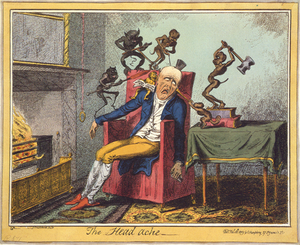
Here’s William Dunbar (1490s) complaining about having a migraine or, as we’d say in Scots, ‘a verrie sair heid.’

Cartoon by George Cruikshank


My heid did yak yester nicht,
This day to mak that I na micht.
So sair the magryme dois me menyie,
Perseing my brow as ony ganyie,
That scant I luik may on the licht

My head did ache last night
And today I could not write.
So sore does the migraine hurt me
Piercing my brow like an arrow
That I can scarce look at the light

(Any errors in translation are entirely mine – and my Scots dictionary)

When Mary Queen of Scots returned to Scotland in 1561 she could barely remember her country’s language after living in France from when she was a small child. French was spoken amongst the nobles but Scots was the principle language and so Queen Mary learned to speak it rather than English.

John Knox, on the other hand, returning to Scotland just in time to make life difficult for Mary, had slipped into speaking English. He’d lived in Geneva for a number of years, where he led an English congregation and also wrote his many works in English, including The First Blast of the Trumpet against the Monstrous Regiment of Women. 

John Knox in full counterblast


There were two main reasons that contributed to Scots ultimately being considered as not ‘proper’ speak.

After the Union of the Crowns in 1603, when James VI of Scotland departed with all possible speed to wealthy London his language, certainly in papers and letters, becomes anglicised.

James VI and I

Here’s an extract from his Counterblast Against Tobacco… A custome lothsome to the eye, hatefull to the Nose, harmefull to the braine, dangerous to the Lungs…  Translated into Scots – ‘smokin’ is verra bad fur ye’. Perhaps a pity he didn’t use his kingly prerogative and ban tobacco at the time, but in any case he increasingly spoke English (no doubt with a good Scottish accent), so the upper classes did, and it rapidly became a sign of wealth, and standing, to speak English – and still is.

Scotland turned Protestant in 1560. A core component of Protestantism was that everyone should learn to read the Bible themselves rather than having the Latin version interpreted by the church. This meant that we needed bibles, and lots of them, quickly. Initially the Geneva version, which was written in English and published in 1557, was adopted. This was closely followed by the King James (sixth and first) version in 1611, also in English. Scotland soon had one of the highest literacy rates in the world – but everyone was learning to read in English, and not the Scots they spoke at home. And surely, the language you are communing with the Lord in must be the correct one to speak…

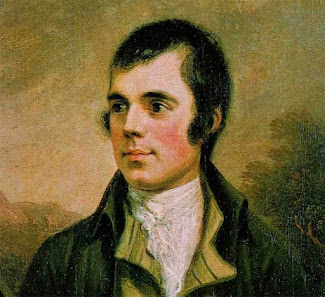
We did see a revival in the use of Scots in the 18th century, most famously exemplified by that charming philanderer Rabbie Burns, but it was more an entertaining curiosity for the wealthy than any genuine resurgence. Nevertheless Burns saved lots of songs in the vernacular which would likely have disappeared if he hadn’t written them down. 

Robert Burns

He’s probably most famous world wide for Auld Lang Syne (Old Times Past) sung at countless Hogmanay celebrations and then there’s Burns Night on the 25 January every year when the haggis is stabbed with gusto whilst being addressed in good Scots. 

In writing The Castilians I took the decision, since Bethia’s Mother had lived in England, that Bethia would speak an anglicised Scots although I do have some characters who use Scottish words, (I provide a glossary). Initially, I had far more Scots in it, but I did want the book to be read, and understood, widely. It’s always a balance…

Scots is the language of the Lowlands, Orkney and Shetland, and Northern Ireland (Ulster Scots) and even within that there’s much variation. The accent and some of the words used are quite different between say Fife and the Doric of the North East and then again Orcadian. 

But at least Scottish-speaking children didn’t suffer the fate of their Gaelic counterparts (Gaelic was never the language of Lowland Scotland). In the last century, children in the Highland and Islands were often beaten if they spoke Gaelic in school. I was fourteen before I first heard it, on holiday in the Western Isles. Thankfully Gaelic was saved in the nick of time, and is now more widely spoken. And as for Scots, well we’ve hung on tae it despite aywis being telt tae speak properly.

crabbit; scunnersome; drookit; gowk; oxters; guddle; midden; glaikit; besom

For more information on Scots see https://www.scotslanguage.com and also the Scottish Language Bill which the Scottish government is currently consulting on. 
.


Friday, 22 February 2019

How Fictional is your History? by Catherine Hokin

We're having something of a surge in historical fiction films at the moment. You can lose yourself in the politics of medieval or Tudor Scotland with Outlaw King and Mary Queen of Scots, or the excesses of the eighteenth court with The Favourite. If the racial-tensions of 1960s America are more your thing, there's Green Book or you can loop back round to politics with Vice - which I'm including here as it covers Dick Cheney's early life and therefore slips in past the 30 year HNS rule for classifying a work as historical fiction. A little tenuous perhaps but that is rather my point...

 Robert the Bruce - Chris Pine would be preferable but
not Netflix's wrath
What the above films share is the accusation that they all play fast and loose with the facts, and are guilty of providing what Simon Jenkins in the Guardian called “fake instant history.” Screen outings that, in other words, become received wisdom - what I am re-christening Braveheart moments in honour of  the film dubbed the most historically inaccurate movie ever made. I'm not going to list all its errors here - there is a whole industry devoted to logging them - start with the small point that William Wallace was never called Braveheart (that was Bruce, and not in his lifetime) and the whole timeline is about 20 years out which really messes up a lot of marriages and deaths and you'll get the idea. Does it matter? Well yes - the last time I was at the Wallace memorial there was a full-size (thankfully cardboard) Mel Gibson waiting to greet the hoardes of visitors. To my mind this not only gives the film a legitimacy it doesn't deserve, it also necessitates a whole lot of de-bunking I'm not sure was widely available.

As I said in my review of Outlaw King (Historia Magazine, it's a bit ranty) I don’t mind a bit of cinematic embellishment if it enriches the story. Queen Anne didn't keep 17 bunnies in her bedroom to replace her lost children (rabbits being eaten not petted at the time) but that worked for me in The Favourite as a good visual shorthand for the depths of her loss. And no major historical events were harmed by their use. The Favourite does what many historical writers do - it found a story lurking round the facts (the competition between the two female favourites, the allegations around Anne of 'unnatural' preferences) and it wove something bigger. As Lucy Worsley said in the Guardian: "people at the time thought that Queen Anne and the Duchess of Marlborough were [lovers] and this was a line of attack that was used by their political enemies, so that’s one thing...Another thing is that people were very much sharing beds the whole time; that was a standard way of sleeping. So who knows when they were and when they weren’t having sex? It’s all very difficult to define, isn’t it?” So difficult to define but plausible, not jaw-dropping in the way of Outlaw King (read the review) and not down-right dishonest as in the case of Mary Queen of Scots. 

Personally I don't mind about the accents in this film or others set in periods where dialect and accent are hard to be purist about. Whether it was French or Scottish or some hybrid, we don't really know which one Mary had and we don't know what either of those accents actually sounded like at the time. But I'm with Simon Schama regarding the two women meeting - “the whole drama of Elizabeth and Mary lay in the fact they never did meet”. Like Outlaw King, one of the key words you hit when you google this film is true. It's not: the two women meeting is a major distortion I've already had to explain to more people than I wanted to (or who wanted to hear it). To coin an overused and too-needed phrase: it's fake news. 

The criticisms over the other films mentioned above are different - perhaps because those portrayed in them or their families are still alive. Green Book has been condemned by the family of African American pianist Donald Shirley for what they see as a completely false portrayal ("a symphony of lies") and for them not being consulted, precisely for that reason. Vice has been accused of being misleading, of fabricating events, of being shallow and being evasive with the truth over Cheney's portrayal - including by a large number of people with no reason to defend him at all.

 Kirsten Dunst as Marie Antoinette
Things that were never historically done/said becoming not only popular belief but often the main thing we 'know' about a time/character is nothing new. The phrase let them eat cake was attached to a number of insensitive royals before it stuck to Marie-Antoinette and there's no contemporary account proving the accuracy/existence of Elizabeth I's famous Tilbury speech, although we're pretty sure Mary wasn't there. It is, however, a truism, if an annoying one that many people get their understanding of history from television and films, and likely also from novels. So where does a creative's responsibility lie?


Clearly no one wants to impose some kind of Stalinist censorship on film-makers or writers, who are also not exempt from these charges of being elastic with the truth. The recent condemnation of Heather Morris's best-seller The Tattooist of Auschwitz by the Auschwitz Memorial Research Centre as being a book which "contains numerous errors and information inconsistent with the facts, as well as exaggerations, misinterpretations and understatements” has not made comfortable reading. Or stopped it getting a sequel. Film-makers insist they are not reporting history but a version of it. As writers we are all looking for the story in the gap, and we are also not historians: we are writing fiction. We do, however, live in a time when real and fake news seem to blend seamlessly together and there are concerns about the level of critical thinking many people are exposed to. What then, if any, is our responsibility when we take readers into the past? Is it to make it clear (through notes or end-pieces) how much of a novel has been invented as Kate Atkinson does in Transcriptioncommenting that she has made one thing up for everything true? She then does then go on to prove how rooted in fact all the made-up stuff is and how it never distorts the truth it's based in. Or perhaps it's Stephanie Merritt's (who writes as SJ Parris) advice that holds true: "if you are going to play fast and loose with historical fact for the sake of a good story, you'd better have done your research thoroughly if you want readers to take you seriously; only then will you have the authority to depart from those facts."

For me, I like things simple and to do as I would be done by. Let writers and film-makers turn Jane Austen into a zombie slayer if they want, as long as they call it fantasy. Let them bring bunnies or tigers or whatever they like into the nursery, as long as its clearly a metaphor. But please don't mess with timelines or bring in ridiculously anachronistic behaviour or change the nature of history. That's a different kind of fiction entirely.

Thursday, 1 November 2018

Four Queens and a Countess - Review by Mary Hoffman

How to upstage a queen

Jill Armitage's previous book was about Arbella Stuart, a possible claimant to the throne of England when Elizabeth l died, and she does make a cameo appearance here. But the star of the show - and the "Countess" of the title is Bess of Hardwick, who was Arbella's grandmother.


I don't know if it's just that we know so much already about the Tudor queens and the Scottish thorn in Elizabeth's side but Bess would be a remarkable woman in any age. She was born in humble circumstances, the third child of a second son, a gentleman but only of minor gentry.

Elizabeth was always known as Bess, fortunately for us, or there would be two Elizabeths as well as two Marys in this book. Her first marriage was as a teenager, to a boy younger than herself, who died the following year. She never lived with Robert Barlow and is likely to have been a virgin widow. Nevertheless she had some claim on his property and spent a long time at law, trying to get anything out of his family.

Three years after Robert's death, Bess, still only around twenty years old, married Sir William Cavendish. They were married for ten years, until his death, during which time she bore him eight children, six of whom lived to be adults - a good record for the 16th century. Sir William had property in Derbyshire, including the Chatsworth Estates. (His heirs became the Dukes of Devonshire, who still own Chatsworth House. Andrew Cavendish was married to the famous "Debo," née Mitford, who made Chatsworth House what it is today. I think Bess would have approved of her.)

Bess of Hardwick in later life
When Sir William died, after ten years of marriage, Bess was responsible for his two surviving daughters from an earlier marriage as well as her own six children. By now Lady Cavendish was still only around thirty years old and good-looking and she attracted many suitors. So a couple of years later she married, for the third time, to Sir William St. Loe. He had two daughters by a previous marriage too but at his death, six years later, he left everything to Bess, cutting out his own children and his younger brother, who might well have poisoned him.

Bess was now a very wealthy woman, with an annual income worth millions in today's terms. She soon attracted another husband, her fourth and last, George Talbot, the Earl of Shrewsbury. Countess Shrewsbury's vast income was appropriated by her husband in the custom of the time. But she was now a significant person at court, being one of Queen Elizabeth's Ladies of the Bedchamber.

The Earl had seven children already and two of his sons married two of Bess's young daughters in the year of their parents' marriage. Whether the Earl and Countess's marriage would have been happy in the long term, we can't know but Jill Armitage makes it clear that it didn't stand a chance once they had visited on them a Royal house guest.

Mary, known as Queen of Scots, was billeted on them by her cousin Queen Elizabeth shortly after their marriage and remained with them, under virtual house arrest, for the next fifteen years. But they didn't stay in one place: they were constantly on the move from one of their homes to another. And Mary had an extensive entourage and was expensive to keep. And of course there were constant plots to release her, to topple or assassinate Elizabeth and put a Catholic queen on the throne again.

Mary, Queen of Scots
I have never understood the fascination with this Mary. At least, I do understand it but don't share it. She is supposed to have been very charismatic and charming but her actions are quite repellent. She and Bess, who would have been ten years or more older, a mature female confidante, who treated the imprisoned queen with kindness, used to sit together doing embroidery to pass the long days of Mary's imprisonment.

It would have been natural for the two women to have chatted and gossiped, to have exchanged confidences, as women friends do. But, according to Jill Armitage,  Mary used the rumours Bess unwisely passed on about the English queen's love life, to get her into trouble and put her out of favour.

And it seems she also used her charms on the ageing Earl, flirting with him and alienating him from his wife. Whether this is true or not, the Shrewsburys' marriage was on the rocks and they lived virtually apart for the ten years before his death. That was three years after Mary's execution at Fotheringhay Castle.

The Earl's death left Bess as Dowager Duchess of Shrewsbury and mother-in-law to the new Earl, Gilbert, who was married to her daughter, Mary. She was free to do as she liked for the first time for decades and what she liked was building projects. She was a shrewd business woman and always fought for her rights, from the day of her first husband's death. She was the second richest woman in England after the queen, enjoying income from the Barlow, Cavendish and St. Loe estates and a third of that from the Shresbury estates.

She also had a life interest in several properties, including land near her birthplace in Hardwick, where she set about building the new, now famous, Hardwick Hall. It had an unusual amount of glass for a late 16th century manor house and was much admired. Bess moved into Hardwick Hall around her seventieth birthday. She ordered a grand funeral monument for herself but lived until she was 81 in 1608, outliving Elizabeth and the other queens in this book.

Before Elizabeth, there was Lady Jane Grey, the "nine days queen" and then Mary Tudor, the first Monarch of England in her own right.

Lady Jane Grey - the Streatham portrait
 In any other context, Lady Jane would have been the heroine of this narrative. As I wrote in my story "Learn to Die" in the History Girls' anthology Daughters of Time (Templar 2014), she was not the helpless pawn she has sometimes been portrayed as, but a young woman of steely determination and unshakable Protestant faith. Bess of Hardwick was a friend of the family and Lady Jane was godmother to her second child, a daughter called Temperance, who sadly died in infancy.

Four years after this Lady Jane Grey was named as Edward Vl's heir and embarked on the disastrous course that led to her execution.

Because the people rejected her claim, albeit one sanctioned by the late boy king, and preferred Henry Vlll's daughter Mary.

This was a tricky time for Bess and her husband of the time, William Cavendish, who were both Protestants. But Queen Mary became godmother to their fifth child, a son called Charles. A shrewd choice in the circumstances.

Bess of Hardwick remains the real star of this book and I'd love to read a book just about her. She was one of the most remarkable women to emerge in Renaissance England and lived a life as eventful as any queen's.

Jill Armitage, author of Four Queens and a Countess


Tuesday, 20 December 2016

The Rough Wooing - by Ann Swinfen

It must have seemed the perfect solution. Marry Edward, the boy heir to the throne of England to Mary, the child queen of the Scots, and you would have peace and prosperity between the two countries. It would not be the first marriage between the two royal families.
Margaret Tudor

Most recently Margaret Tudor, daughter of King Henry VII of England and sister of King Henry VIII, had married King James IV of Scotland in 1503. This meant that Margaret Tudor was the grandmother of Mary Queen of Scots and aunt of Prince Edward, making Mary and Edward first cousins once removed, a relationship too close for marriage in the eyes of the Church. However, the Church could grant a dispensation, and there would be no trouble in gaining one from the English Church. No need to bother with the Pope, not since King Henry had severed all links with Rome.
 
Marie of Guise
There was just one fly in the ointment. Marie of Guise, mother of Scotland’s child queen. Marie was determinedly French, fanatically Catholic, and vituperatively anti-English. Part of the powerful French family of Guise, she was loyal not to Scotland, nor to England, but to France. She already had four French sons by a previous marriage, little Mary’s half-brothers. The Guises had their eyes fixed on a further rise to power, and Mary would be a useful pawn in the long game they were playing. She would be shipped away to France, brought up French speaking and Catholic, and married to the heir to the French – not the English – throne. In the meantime, her mother would rule Scotland and see to it that it remained Catholic and an ally of France against England.

Two mutually antagonistic plans, bound on a collision course.

Let us backtrack briefly.
 
James V of Scotland
The child queen Mary was born on 8 December 1542. Six days later, her father, King James V of Scotland, died of a fever, about three weeks after the Battle of Solway Moss, in which the Scots suffered a terrible defeat by the English army, a disaster which probably hastened his death. James was only 30, and his sole legitimate child was Mary. The Stuart kings had a distressing habit of dying young, leaving very young heirs. James himself had become king at under two. It made for trouble, as those around the infant monarch struggled for power.
 
Earl of Arran
If the infant Mary did not survive, the next heir to the Scottish throne (though somewhat distant) was the Earl of Arran, who became Regent (or Governor). At this point Arran was a Protestant and favoured an alliance with England. In the early part of 1543, he was involved in negotiations with England for this marriage of the two children, although Henry VIII did not altogether trust him and wanted him replaced. Even so, the Treaty of Greenwich, made on 1 July 1543, agreed that Mary would be married to Edward when she was ten.
Prince Edward at the time of the Rough Wooing

As early as March that year, George Douglas, brother of the Earl of Angus, warned Ralph Sadler, the English ambassador: 'if there be any motion now to take the Governor from his state, and to bring the government of this realm to the king of England, I assure you it is impossible to be done at this time. For, there is not so little a boy but that he will hurl stones against it, and the women will handle their distaffs, and the commons universally will rather die in it, yea, and many noblemen and all the clergy be fully against it.'

(If you have read Wolf Hall you will have met the young Ralph Sadler.)

Henry’s suspicions proved to be well founded. One of the most powerful men in Scotland at the time was Cardinal Beaton, more politician than man of God (who was later, May 1546, to meet an unpleasant end at the hands of Scottish Protestants in St Andrews). In September 1543, the Earl of Arran left pro-English Edinburgh secretly, in order to meet Cardinal Beaton, whereupon he converted to Catholicism, to the pro-French party, and to support for the marriage of Mary to the Dauphin of France. Oh, and incidentally, in pure gratitude for this change of heart the French bestowed upon him the dukedom of Châtelherault.

Now the Queen Mother, the Cardinal, and the Regent were in alliance, and opposed to the strong Protestant, pro-English party, mostly based in the east of Scotland. On 20 December 1543, war was declared between England and Scotland, a war which was to last for seven years and came to be known as the ‘Rough Wooing’. Everything hinged on whether a marriage alliance would be made between the child Mary and one young boy (Edward of England) or the other (Francis of France).
 
Mary Queen of Scots age c.16
In April 1544, King Henry, outraged at the Scottish alliance with France, ordered Edward Seymour, Earl of Hertford, (brother of Jane Seymour, and so the prince’s uncle) to attack and ravage Scotland. Seymour carried out his instructions with savage enthusiasm, a measure not likely to endear the pro-French party to England.
 
Prince Edward c.1546
King Henry VIII died on 28 January, 1547, and his son Edward became king at the age of nine. England was ruled by a body of Councillors, amongst them Seymour, who continued to wage war against Scotland. After the murder of Cardinal Beaton in 1546, the Protestant faction in the east of Scotland hoped for alliance with England, but were attacked by a French naval force, in alliance with the Earl of Arran and Marie of Guise.

The ins and outs of the struggle are too complex to detail here, but the English won a decisive victory at Pinkie Cleugh on 10 September 1547, causing panic amongst the pro-French party. And during all this fighting the child Mary was moved from one place of safety to another.

The area where I live became involved after the victory at Pinkie, when the English fleet sailed into the Tay estuary. The mouth of the Tay was guarded (and is still guarded) by Broughty Castle. The garrison there, being Protestant and pro-English, handed over the castle without a shot being fired.
Broughty Castle

The English forces also built a fort on the hill overlooking the harbour at Broughty, yards from where I live. It must have been a fairly temporary structure, as nothing now remains of it, except the name Fort Hill. The city of Dundee, also primarily Protestant, agreed to resist Governor Arran and ally itself with England.

The man established as governor of Broughty Castle, Sir Andrew Dudley, sent word to the English government that what he needed was not more troops, but good Bibles (Tyndale’s Bible), with which to convert any remaining Catholics to the Protestant faith. What he got instead was military reinforcements, who sailed up the Tay to Perth, burning Balmerino Abbey on the southern (Fife) shore, on Christmas Day 1547. On 29 December, they seized and burned the nunnery at Elcho, taking prisoner the nuns and the girls at school there, and holding them to ransom. As both nuns and schoolgirls came from good families, this would have proved quite profitable. (The nuns later returned and rebuilt their priory.)
 
Inchmahome Priory
Alarmed by the English successes in the east of Scotland, the pro-French party moved four-year-old Mary west to safety at Inchmahome Priory on an island in the Lake of Mentieth, where she remained for a few months. On 7 August 1548, Mary was smuggled away from Dumbarton Castle on a French ship and taken away to be reared in the French court. In 1554, Marie of Guise became Regent of Scotland in succession to the Earl of Arran, four years after the ‘Rough Wooing’ was abandoned, as now pointless.
 
King Edward VI c.1550
By then young King Edward was dead, on 6 July 1553, at the age of fifteen.


Francis, Dauphin of France

The French marriage went ahead, but only after Mary had secretly signed an agreement on 4 April 1558, bequeathing Scotland and her claim to the crown of England to the crown of France, should she die childless. On 24 April, she was married to Francis, Dauphin of France, at Notre Dame de Paris. She was 15, he was 14, and through this marriage became king consort of Scotland.
Henry II of France

Just over a year later, on 10 July 1559, King Henry II of France died after a jousting accident and the young couple became the rulers of both France and Scotland. The Guises were now in control of France, although Marie of Guise could only maintain her position in Scotland against the rise of the Protestant lords by the use of French troops.
 
Francis (15) & Mary (16) - King & Queen of Scotland & France
The reign of the young couple in France was not to last long. Francis died on 5 December 1560 at the age of sixteen. He was succeeded by his ten-year-old brother, and Mary was now surplus to requirements. She returned to Scotland.

So what did the Rough Wooing accomplish? As for its professed aims – nothing. What it did do was help to harden the lines between Catholic and Protestant Scots. It turned the young queen pro-French and anti-English, which would have a long term effect on her life and her relationship with her cousin Elizabeth I of England.

None of those manipulating Mary’s marriage chose well, both boys dying in their mid teens. It is interesting to speculate, however. What if Mary had married Edward? By all accounts he was a highly gifted and intelligent boy. If he had lived long enough and managed to father a child before his death, how different the rest of the sixteenth century in England and Scotland would have been!

Ann Swinfen
http://www.annswinfen.com