Showing posts with label Florence. Show all posts

Friday, 26 May 2023

The Marriage Portrait by Maggie O'Farrell, reviewed by Judith Allnatt.

Shortlisted for the Women's Prize for Fiction 2023, the novel opens with a gripping scenario. Sixteen year-old Lucrezia,  bride of less than a year, is taken to a hunting lodge deep in the country by her husband Alfonso 11 d'Este, Duke of Ferrara, and while they dine together she realises that he plans to kill her. I was instantly hooked, not only by the classic 'woman in jeopardy' situation but by the fairy-tale resonance of the setting. The high walled, star-shaped fortress in a wintry forest made me think of both Rapunzel and the Sleeping Beauty. Set in the mid sixteenth century in the Duchy of Ferrara, the world described has both strangeness and a fairy-tale familiarity: there are white ponies, cloaks and squirrel-lined gloves, wax seals, daggers and sleeping draughts. Furthermore, as the story unfolds, fairy tale elements of manipulation by an older generation, imprisonment, love and attempts at rescue are crucial parts of the story.

Allori_Agnolo_Detto_Bronzino_(bottega)_-_Lucrezia
_de_Medici_-_Galleria_Palatina


The narrative switches between Lucrezia's present jeopardy and her backstory, tracing her history from birth through a childhood in which she is marked out as unbiddable, clever and artistic, to an early arranged marriage. The author has a free hand with Lucrezia's  fictional persona but draws on the facts of her situation: she is parted from her family and sent from Florence to Ferrara, a naieve and lonely teenager with a husband 11 years older whose political future depends on producing an heir. Lucrezia did not promptly get pregnant and in less then a year she was was dead. The cause of death given at the time was 'putrid fever', (modern historians consider this to have been a reference to pulmonary TB) but after her death it was rumoured that she had been poisoned - done away with by her husband. 

Browning's poem,'My Last Duchess' a dramatic monologue in the voice of Alfonso draws on this chilling scenario and, as the title implies,  Lucrezia was one in a series. Alfonso married three times and all three marriages were without issue. Browning's poem presents a sinister portrait of the Duke and focuses on his obsessive and unwarranted jealousy. Maggie O'Farrell's presentation of the character is terrifyingly changeable, a sociopath who is ice-cold and manipulative. To both versions of Alfonso, cruelty is simply a means to their own ends.

At her marriage, Lucrezia was caught between two powerful men: her father, Cosimo, Grand Duke of Tuscany and her would-be husband, and had no choice in the matter. Her father's power is brought home to the reader from the outset. In the basement of the Palazzo Vecchio in Florence, he keeps Big Cats: exotic beasts often collected by rulers or accepted as gifts betokening status and reflecting power and strength. (The street at the  back of the palazzo is still called Via dei Leoni). Lucrezia, as a child, witnesses the arrival of a tiger and is desperate to see it.  O'Farrell uses Lucrezia's visit to the tiger, in which she touches its fur without fearsome consequence, to show us her daring and to suggest that something of the creature's power lies within her character, despite her weak position in the hierarchy. At the same time, this strength at her core marks her as different from her siblings and the suggestion that she must have enchanted the beast demonstrates the wariness of others. The motif of the tiger is woven through the novel in connection with the power within Lucrezia that is her selfhood. O'Farrell also makes figurative use of the lions. She recounts that the interconnecting door between the tiger's and the lions' enclosures are accidentally left open and that the lions attack and kill the tiger. Later in the novel we meet Alfonso's right-hand man, Baldassare, who is unscrupulous, devious and brutal. O'Farrell gives him the first name Leonello and both Lucrezia and the reader instantly identify him as a dangerous enemy.

A_Lion_and_Tiger_in_Combat'_by_Johann_Wenzel_Peter

In a world where she and her sisters are not allowed to leave their rooms without permission, Lucrezia finds self expression through art. Fittingly, the author describes the colours, textures and detail around her with a painter's eye, bringing the Renaissance world vividly to life through close observation and imagery. We feel the touch of Lucrezia's  ankle length hair that she can wear 'around herself like a shroud' and  a candle makes 'a trembling circle of waxy light (that) pushes at the blackness'. In the gown she must wear for her marriage portrait with its huge skirt and ballooning sleeves 'her hands appear like the pale and ineffectual paws of a mouse, peeping out of frilled and ornate cuffs'.

As I hope you'll read and enjoy the novel, I won't comment on the conclusion of the narrative other than to say that the use of Lucrezia's paintings, executed on small pieces of wood and then overpainted with pictures of birds and beasts, provide an apt imagery. The final picture one is left with is not that of the marriage portrait, depicting Lucrezia as a powerless, jewelled, static status symbol. O'Farrell's final image of  her protagonist has stayed with me and will continue to do so. 


Friday, 1 May 2015

The Michelangelo Trail by Mary Hoffman

The History Girls blog began nearly four years ago, on 1st July 2011, and had its origin in a desire on my part to let the world know I had written a novel about Michelangelo's sculpture of David. The sitehas grown to be so much more than that but it is quite satisfying to come full circle and write about the new suite of educational materials, based on that novel, that I am going to write for an innovative new company called Time Traveler Tours & Tales.

Photo credit: Jorg Bittner Unner, Creative Commons

The book was a historical novelist's joy to write because it offered the perfect opportunity for fiction. So much was known about this famous figure: we have the contract the sculptor was given, the date he made the first chisel cut, the minutes of the committee meeting to decide where the sculpture was to be displayed (where Leonardo da Vinci was present).

And in the middle a great big hole. Who was the model for this, probably the most famous sculpture in the world? Or was there even a model at all? Maybe this David sprang from the imagination of the sculptor, who, it is worth remembering, was twenty-six years old when he asked the Operai del Duomo for the old block of Carrara marble that two previous artists had abandoned and which just lay about for forty years  in a building behind the Duomo in Florence for people to trip over.

My first visit to Florence was at the end of my first year at university, when I spent a month there. It was probably the most influential four weeks of my life, directing my interests and enthusiasms from then on. I already knew I preferred Michelangelo to Leonardo but this sojourn, in a pensione overlooking Piazza San Lorenzo, confirmed it.

In my new project I'll be devising an app to take readers on a tour of the city visiting "hotspots" connected with the sculpture and the sculptor. And it occurred to me that readers of the History Girls blog might like an expanded version of my list - a sort of "print out and keep" guide to which works of art by Michelangelo you can see in the city I have now visited so many times I have  lost count.

Bronze of Michelangelo's head by Daniele di Volterra


• Casa Buonarroti Michelangelo never lived here but it houses two early works: the bas reliefs of The Madonna of the Stairs and The Battle of the Centaurs and Lapiths.

• The area behind Brunelleschi’s Dome on the Duomo (now the Museo dell'Opera del Duomo). This is where the workshop was where Michelangelo made the David statue. On the day it was moved from there to the Piazza della Signoria the doorway had to be broken down to allow the giant statue to be trundled out. It took three days to move it to its final position.

• Santa Croce church. Michelangelo is buried there (under a hideous tomb by Vasari) and lived near there. His mother is also buried there.

• Brancacci Chapel in Santa Maria del Carmine (Oltr’arno). The frescoes by Masaccio (Big Tom). It was here that Michelangelo’s nose was broken by Pietro Torrigiani when they were both teenagers and protégés of Lorenzo de’ Medici and were sent there to sketch the frescoes. (You can see the broken nose quite clearly in Volterra's bronze above.)

• Piazza della Signoria The David statue was here for hundreds of years. Also this is where Savonarola had his Bonfires of the Vanities and where he was executed.Michelangelo and several of his brothers were followers of Savonarola.

• San Marco convent Michelangelo’s older brother Lionardo was a friar there, as was Savonarola. It houses great art by Fra Angelico, Ghirlandaio etc.

• The Bargello for Davids by Donatello and Verocchio (Leonardo’s teacher) and Michelangelo’s Pitti Tondo, Brutus, Bacchus etc.

Brutus

• Palazzo Medici Riccardi Where Michelangelo lived with Lorenzo de’ Medici.
 
• Santo Spirito, Oltr’arno. Where Michelangelo dissected bodies. His wooden crucifix (the earliest recorded work) is in the Sacristy.

• Piazza Santa Trinita Where Michelangelo had his very public argument with Leonardo. 

• The Medici Chapels behind San Lorenzo church. Michelangelo designed the tombs for two of the de' Medici family. His statues of them are flanked by Dawn and Dusk, Night and Day.

• The Laurentian Library at San Lorenzo. This and the magnificent staircase to it were designed by Michelangelo.

• The Uffizi houses the Sacred Family painting by Michelangelo.

• And of course. The Accademia where the original David now stands. But don't neglect to look at the slaves/prisoners and St. Matthew who line the gallery leading up to David.

Photo credit: Jorg Bittner Unner, Creative Commons

On my first visit to Florence, I and some other students, none of us studying Art, managed to blag our way into the Casa Buonarroti, which was in restauro at the time and saw the two reliefs and the very touching little wooden crucifix, now in Santo Spirito, which was waiting to be authenticated. None of us was in any doubt.

On my last visit, a year ago, Sarah Towle of Time Traveler Tours and Tales and I went to the Medici Chapels at San Lorenzo and looked through the door leading to the underground hiding place that the sculptor used on a visit to the city, long after he had made the David. It is not open to the public but the whitewashed walls are covered with his drawings.

Michelangelo's relationship with Florence was fraught. As a protegé of Lorenzo de' Medici (the "Magnificent"), he was loyal to the family, but after Lorenzo's death became a Republican. Florence itself had an on/off love affair with the powerful de' Medici family, expelling them and welcoming them back more than once.

My relationship with Florence and Michelangelo has undergone no such upheavals. I can't wait to work with Sarah Towle to bring this Renaissance sculpture to life for 21st century children and teenagers. You can read more about the project below.

But in the meantime, if you are going to Florence this summer, do follow the Michelangelo Trail. I'm only sorry I won't be doing it with you!


Time Traveler Tours & Tales Campaign

Thursday, 1 May 2014

Marbling in Florence by Mary Hoffman

This could so easily degenerate into a post about writers and stationery lust. How many of us own something like the above - a delicious notebook bound in "Carta Marmorizzata," marbled paper, just waiting for the "right" or at least "good enough" ideas for a perfect book?

Marbled paper is a rather generic term: there are examples that look far more like actual marble but it's the "peacock feather" design, as above, that always attracts me.

If you'd asked me, I would have said that the technique of marbling paper had been born in Florence, or at least Tuscany. But it turns out to have come from the country we now call Turkey and also Persia and India. And this year for the first time I watched some being made.

I was in Florence in April, teaching on Julie Foster Hedlund's Writer's Renaissance programme, which I've written about elsewhere. Julie had arranged to visit a shop called Alberto Cozzi, now run by Riccardo Luci, who was going to make some marbled paper on a Saturday afternoon. She kindly invited me to join her and we then watched a demonstration of a technique that goes back some four hundred years. Riccardo is the fourth generation in his family to carry it out and he does it expertly.

These images of marblers and their equipment date from 18th century France, by which time the art had been well established for over a hundred years. And nothing much has changed in the centuries since.

You start with a shallow tray filled with liquid; these days it is usually a size made from algae or some other form of seaweed - enough to make it a viscous carrier for the paint. Using a paintbrush to flick it, our marbler Riccardo dotted many colours on to the size.

He had a vast range of colours laid out and prepared on the bench to his right. How he chooses what to use and in what order comes from long experience and - who knows? - perhaps something in his DNA.

At this stage, I couldn't tell how this seemingly random collection of blobs could turn into the exquisite marbled paper we are familiar with. Riccardo added more sparingly smaller blobs of gold and silver.

Only when he was satisfied with the arrangement of colours did he drag first a stylus and then a comb through them and I could see some sort of pattern emerge. But there was another pass to come. I don't know what the technical term is but Julie and I decided that the side-to-side motion with the comb must be "wiggling."

And there they were! The characteristic peacock feathering of the classic Florentine marbled paper.


Now he was ready for the paper.

It takes a very steady hand and a cool head to do this bit!

And here is the end result. All shiny and wet. It will need to be pegged on a line to dry but here it is lying on a board.

You can see all the different colours and possibly even pick out the odd splashes of silver and gold.

It takes hours for the paper to dry and then it is stored flat in some narrow wooden shelves. I went back the next day to collect this piece, which had been made specially for Julie, and to buy a piece for myself. Each one is a unique work of art.

All the colours have to be swept out of the tray with another device to clean the size before another set can be applied. One mixture of size will produce up to twenty-five sheets of marbled paper.

The whole experience got me thinking about the traditional arts and crafts that have been handed down through the generations. I've recently been making things for my new granddaughter by knitting and crochet, both of which I must have learned how to do from my mother, though I have no recollections of any formal lessons. Knitting has a very long history, dating back to the first millennium in Egypt but crochet is a bit of a upstart, found only in the 19th century in Europe.

Some of the same skills are involved: choosing colours, using traditional designs and patterns.

How every stitch - as with every blob of paint above - carries forward a little bit of history!

Do you have a story about traditional crafts handed down through the generations?

And here is a video of Riccardo doing the marbling, made by Julie Foster Hedlund.


Friday, 1 March 2013

Two memorials

Piazza della Signoria, Florence. Photo credit: Saliko

I first set foot in this (normally much more crowded) square when I was twenty, on the month in Florence that has shaped so much of my adult life and sensibility. I wasn't much less innocent than Lucy Honeychurch but fortunately witnessed no stabbing.

However, a violent death is commemorated in the Piazza della Signoria and tourists walk over the spot where it happened every day; not all of them stop and read the words on the memorial.


"Here, where with his fellow friars Brother Domenico Buonvicini and Brother Silvestro Maruffi, on the 23rd May, 1498, because of an unjust judgment, was hanged and burned Brother Girolamo Savonarola, was placed this memorial after four hundred years."

Although he was hanged before being burned, Savonarola (and his fellow friars) were still alive when dropped into the flames. As well as the ropes that hanged them, the friars hands were bound; the flames burned through the rope round Savonarola's right wrist and his hand appeared to rise in blessing.*

The three died convicted of heresy, Savonarola having been excommunicated by the Pope the year before. But his teachings have not died out and he has even been considered for Beatification by the Roman Catholic Church.


This is an almost contemporary painting of what many consider the martyrdom of Savonarola and his fellow-friars in the Piazza della Signoria, where the circular plaque above now sits.


Less than sixty years later, three more martyrs were burned for heresy and a memorial placed hundreds of years later. It happened in Oxford, my nearest city, and the victims this time were Protestants, tortured and executed by "Bloody" Mary Tudor.


This humble cross of stones marks the spot in Broad Street near enough to where first Hugh Latimer and Nicholas Ridley and, five months later, Thomas Cranmer, Archbishop of Canterbury, were burned for their faith in 1555 and 1556. It was not until the 19th century that the Gothic Spire of the Martyrs' Memorial in St. Giles was raised.


It was recorded in John Foxe's Book of Martyrs (2nd edition 1563) that Hugh Latimer said as he burned, "Play the man, Master Ridley; we shall this day light such a candle, by God's grace, in England, as I trust shall never be put out." It sounds remarkably well-composed for someone dying in agony.

The burning of Latimer and Ridley from Foxe's Book of Martyrs

Oxford is full of memorials to the three martyrs for Anglicanism. The tower you can see in the top right corner of Foxe's engraving is that of St. Michael at the Northgate in Cornmarket, where the door of the cell that housed all three men before their trials and death is said to be displayed. I must go and see it. Likewise this stained glass window:

It is in Christchurch Cathedral and commemorates all three martyrs, even though it is known as the Cranmer Window. They didn't die together but they are remembered together, unlike Savonarola's fellow-victims, whose names are not as well-known as those of Latimer and Ridley.

I never go to Florence, where I shall next be in April, without visiting Savonarola's plaque. I disagree with him about a lot of things, including Lorenzo de' Medici, the Bonfire of the Vanities etc. But his torture and death still move me and he must have been a powerfully charismatic figure. (I wrote about his followers in David, 2011).

The Martyrs' Memorial in St Giles leaves me cold but I do try to visit the little cross in the ground in the Broad as often as I am in central Oxford - I find it intensely moving.

*This information was provided by self-confessed "Savonarola-nerd" Anne Rooney.


Tuesday, 23 October 2012

They Dog Our Footsteps, by Leslie Wilson


When I was in Florence recently - oh, the bliss! and doing the gallery-crawl, as you do! I bought a lovely little book called Dogs In Galleries. I think what sold it to me was the humour of the jacket  - but it did get me looking at representations of dogs in art. The day after I bought the book, I took my husband to Pisa, to see the Campo dei Miracoli, because as far as I am concerned, the Baptistery there is the most beautiful building in the world. But there, as well as a sublime simplicity and beauty of proportion that goes straight to my heart -


I found dogs. More than I expected, too, There was one in a stained-glass window in the Baptistery - here it is -
and even before we had entered the Baptistery, we had found dogs acting as gutter-spouts on the outside of the Cathedral. In the course of the day, we found rather a lot of dogs, and not just hunting dogs, either, as you might expect, but also dogs living indoors with sculpted families, and little lap-dogs too.

This dog - in the cloister - is beneath the table where Tobias, I think, from the Book of Tobit, is restoring his sight to his aged father. There was no label on the bas-relief, but I'm sure I'm right.  There's the Angel on the right. Beneath a table is just where the dog would be, hoping, no doubt, that someone would shortly put something out to eat, and then a bit of it might drop down. People will sometimes tell you that dogs always used to live in kennels outside, but in medieval times,  I was taught at school, they were there, waiting to get the bones people threw down after they'd finished gnawing them for themselves. In other words, they were waste disposal operatives, just as my own dog is, and very useful when there is spilled food to mop up, or when my twin grandsons are eating finger food in their high chairs.
But look at this dog, on one of the doors of Pisa Cathedral. 


It's a scene of the Adoration of the Magi and the dog is looking straight at Jesus, as if the artist, in contradiction to the official doctrine of the Church, had given him a soul. The dog knows that this baby is special, quite different from any other baby, and is gazing at him with joy. I'm not being sentimental here, just considering the import of that fixed canine gaze.

After all, dogs have evolved into a special relationship with us that is perhaps unparalleled in the natural world. They are descendants of wolves, and share, I think 98% of their genetic material with the wolf - but they aren't wolves. 


A wolf may be raised by humans, it may even  become very friendly with humans, but it won't have that instinctive desire to please humans that a puppy has. It remains a wild animal. I recently read a very interesting book by John Bradshaw called In Defence of Dogs. I discovered that studies have been done of feral dog populations that show that dog behaviour is essentially different from wolf behaviour, even if the dogs don't live with humans. The wolves who became dogs, even, Bradshaw says, were probably different from today's wolves, who bitter experience has taught to be extremely shy of human beings. But at some stage - no-one knows exactly when - somewhere - grey wolves approached human camp fires and became hangers-on of the human race.

I watched a television programme once that suggested the socialisation was initially done by children. Having raised one puppy with kids at home, and the second one, our current dog, without resident young of our own, I think this is extremely likely. It is much harder work to bring a puppy up if you don't have children around to help. Admittedly, my young, when the first dog came among us, were over ten, not tinies. However, our current dog, Matilda, adores our young grandsons, and is staggeringly tolerant of crawling babies doing things to her that she would object to, strongly, from adults. We have to keep a sharp eye out, not so that she doesn't hurt the babies (they are twins, a double hazard!) but so that the twins don't hurt her.

But leaving the personal anecdotes aside; dogs must have revolutionised human society, in their many helpful roles as herders, hunting dogs, and guard dogs. If the agricultural revolution led to population explosions, what was the contribution to our ability to feed ourselves of dogs who applied their lupine skills to helping the hunt, and guarded sheep, cows, and goats from their wild cousins? 


When I walk with my own dog, Matilda, I often have the feeling that I have been walking thus, with a dog companion, for thousands of years. There is an antiquity in the relationship that is no sentimentality. And those of us who feel more truly themselves with a dog friend, are surely inheritors of a symbiotic relationship that is part of our humanity. Even those who don't want to have dogs - like my mother-in-law - have china dog ornaments or pictures of dogs on their walls.


Dogs have been buried with their masters and mistresses, mummified - in the Museum in Cairo I saw a mummified Saluki dog, quite recognisable as the kind that run round in the streets of Cairo nowadays. A beloved and skilled hunting dog, maybe. It's amazing to see it.

I leave you with another image from Pisa, of a spaniel doing what spaniels do, wriggling into the undergrowth to come out, covered in grass-seeds, bits of twig and goose-grass no doubt, to flush the game for its master. The posture and activity are so accurately-observed, you can almost hear the dog panting and barking, maybe, and see the tail furiously wagging, because for this animal, business and pleasure are one and the same thing.


All photos by Leslie or David Wilson.


Tuesday, 17 April 2012

Moving along the Timeline by Penny Dolan.


I have just come back from Florence. Although I had an image in my head of that great dome, my pre-trip study barely allowed time to note our hotel was near the Ponte Vecchio. I decided Florence could create its own surprise, and went clutching my Rough Guide’s densely packed pages and a variety of maps, some deocrative, some useful. Wonderful it was - and perhaps because the visit was so dominated by architecture, my History Girl thoughts are about one of the ways we arrange history.

 
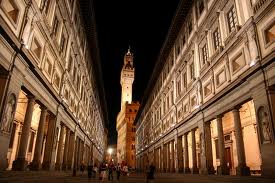
As I left the Uffizi Gallery, slightly stunned by all the acres of art, I felt that at last I had understood something about the development of Italian art history. I could see it as I hadn’t when visiting London's clustered galleries. I decided it was because of the shape of the Uffizi building itself.


Architecturally, the gallery is set out like, as a friend said, “a tuning fork”. It consists of two long, thin corridors (with small rooms off) that link at a midway point facing the River Arno. 


The linear procession of the rooms and paintings had somehow helped me to see the pattern of those Italian centuries, whether the changes came from Constantinople, the Low Countries, Austria or elsewhere, or in the dreadful guise of  personalities like Savanarola, Napoleon, Hitler or Mussolini. All that day I was walking through a timeline and I came out a little wiser.

I have liked timelines ever since seeing one in my own children’s encyclopaedia. They are such a useful way of gathering and displaying historical information even though they need to be approached with caution. They can be annoyingly simplistic, lacking the kind of precise detail one wants and are almost by definition heavily biased. I always peer into my copy of a strongly American timeline book with a suspicious English eye. Just who invented what, where and when, sir?

Timelines are ever popular educational devices. Most primary school classrooms display history timelines, usually just below the ceiling where they can’t be touched or followed with the finger. (Surely that's one of the pleasures of the timeline?) 

Then, only last weekend, at the Federation of Children’s Books Annual Conference, I met a man totally devoted to a timeline. Christopher Lloyd was talking about his pictorial timeline book “What on Earth?”with extreme enthusiasm. 


A gigantic version of Christopher Lloyd’s timeline was displayed on the South Bank by County Hall about a year ago and a new one will be posted in the same position in a few weeks called, unsurprisingly, The History of Sport.  

Making one's own timeline can be a useful task. Writers, especially historical novelists, often put together some form of timeline to ponder about how a story works and/or to check a fictional plot against the pattern of real world events.  In fact, that is what I iam about to do.

Meanwhile, before I leave Florence, I must add that by mid-afternoon at the Uffizi I was starting to wonder just what ailments each Madonnas or Bambino was suffering from, or imagining dialogues along the lines of “Try that again, sonny boy, and you’ll be sorry!” or “Do I have to?” or “Seen one magus, you’ve sent them all.”

The Uffizi  painting that charmed me most was a small, dark painting by Fra Angelico called The Thebiad. It showed a landscape filled with tiny images of the Thirteen Hermits who lived around Thebes. If you squint enough, you can see them all doing wondrous or saintly things, This painting has no logical time-line at all and the events are happening almost higgledy-piggledy at the same time as if Thebes was a vibrant, holy theme park. Here's a small section.


I recall another painting too: the face of a saintly nun, probably by Andrea Della Robbia, inside the new Museo Nationale Alinari Fotografia, which is opposite the Church of St Maria Novelli. We called in there late one afternoon to see an exhibition of photographs by Duffy, one of the Sixties street-kids-with-cameras gang that included David Bailey and Don McLean. 

The wall painting was set above an arch, over the intersection between two areas of the gallery display space. As I recall, the nun's calm saintly gaze looked down on black and white portraits of a young Michael Caine, a boldly naked model and Reggie Kray play-boxing with his grandfather in a cramped East End living room. They seemed strange company for such a person, but then this peaceful nun was used to very odd company. 

For centuries, the place had been the Dominican hospital of St Paolo, caring for the sick and destitute and following the 1780 Suppression, became a home for poor girls and unmarried women. When World War II arrived, the Fascists emptied out the orphans and turned it into a prison where state suspects were detained.  Despite that lovely peaceful face, I felt a shiver reading that fact.  

Meanwhile, back to the big sheets of paper and pencils and my own struggling tome. Just where should I begin my timeline?

Penny’s most recent children’s novel is A BOY CALLED M.O.U.S.E, published by Bloomsbury.

I have just finished reading “Long Lankin” by Lindsey Barraclough, copy and recommendation from HG Catherine Johnson, and “Gillespie and I” by Jane Harris, recommended to me by Adele Geras. Two novels that offer more shivers.