
Showing posts with label JOHN SINGER SARGENT. Show all posts

Friday, 26 April 2024

To Tate Britain - and Ellen Terry’s Dress. By Penny Dolan

The iconic portrait of Ellen Terry as Lady Macbeth in her beetle-wing dress has been a favourite painting of mine for many, many years.


I am not alone in my enthusiasm as, with the detachment of someone who had been on stage almost all her life, the actress herself commented:

“The picture of me is nearly finished and I think it magnificent. The green and the blue of the dress is splendid, and I think the expression as Lady Macbeth holds the crown over her head quite wonderful.”

A while ago, studying Victorian theatre for my children’s novel, I learned that the beetle-wing dress still existed, and was kept as part of Terry’s costume archive at her last home, Smallhythe Place.

The property, a small half-timbered cottage with a tiny theatre, is deep in the Kent countryside, between Tenterden and Rye and now owned by the National Trust. However, the opening hours and parking were limited and Kent is a long way from my home in Yorkshire.

                     Visiting Smallhythe Place's garden | Kent | National Trust

Later, when I was passing through Kent for work, the website informed me that the Trust was now focused on a nearby archaeological site, that Smallhythe Place itself was under renovation and Terry’s dress away for conservation. Ah well, so be it, I thought. By then, my novel A Boy Called M.O.U.S.E was out into the world, other things were happening, and life moved on.

However, about fortnight ago, Ellen Terry came back into my mind. In ‘The Motive and The Clue’, Jack Thorne’s play about the tensions between ageing Sir John Gielgud and young hellraiser, Richard Burton, who wants direction as Hamlet. In response to Burton’s tirade about life as a miners son, Gielgud - most wonderfully played by Mark Gattis - says in a hollow, lonely voice something like “What else could I be, coming from a theatrical family like mine?” Which is when I remembered that Gielgud’s family tree included great-aunt Ellen Terry of the beetle-wing dress. 

Almost on the same day, in a series of tweets by fashion historian Dr Kate Strasdin, I read that, right now, both the Lady Macbeth portrait and that famous dress are on display in Tate Britain, which has prompted this History Girls post today.

The Dress

In 1888, John Singer Sargent, an American-born, European artist, and the leading portrait painter of his generation, attended the opening of Henry Irving’s production of Macbeth. Seeing Terry as Lady Macbeth, he immediately asked to paint her but, as he wrote to his wealthy American patron, Terry delayed until the reviews of the play were in. She “had not yet made up her mind to let me paint her in one of the dresses until she is convinced she is a success. From the pictorial point of view, there can be no doubt about it – magenta hair!”

The blue-green dress was designed by Alice Comyns Carr who made many of Terry’s costumes. The dress ‘shone with a strange metallic lustre’. And had a hint of soft chain mail about it. Carr recorded that her “fine needlewoman” Adaline Cort Nettleship, had “bought this fine yarn for me in Bohemia . . a twist of soft green silk and blue tinsel, and wanted ‘something that would give the appearance of the scales of a serpent”. Photographs, rather than the a painting, show that ‘Mrs Nettles’, as Terry called her, used crotchet work to create the effect.

The design was chosen to invoke fear. Not only was green a dangerously sinister hue but the dress was covered in a thousand glittering scales: the shining wing-cases or ‘elytra’ of the green jewel beetle, which were harvested when the farmed insects had died, which meant little in an era of feathers and furs.

Beetle-wing embroidery originally came from Mughal India, where small sequin-like pieces of ‘elytra’ were traditionally added to decorative and household fabrics and to clothing and accessories for all genders and ages. In the eighteenth century, English women living in India wore soft white dresses embroidered with small green elytra motifs.

However, during the nineteenth century, elytra and elytra fabric were imported to Britain. The fabrics were of lesser quality, but the hard wing cases that glittered in gas or candle-light, were ideal for evening dresses. Terry’s dress, however, was so well-made that it was re-used many times and went on tour to America, before becoming part of her costume archive.

Continuing to describe Lady Macbeth’s costume, Carr noted that: “When the straight thirteenth-century dress with sweeping sleeves was finished it hung most beautifully, but we did not think it was brilliant enough, so it was sewn all over with the real green beetlewings, and a narrow border of celtic designs worked out in rubies and diamonds, hemmed all the edges. To this was added a cloak of shot velvet in heather tones, upon which great griffons were embroidered with flame-coloured tinsel . . . two long plaits twisted with gold hung to her knees.

Note that cloak: though the cloak in the description above is described as “heather”, Carr had also designed a bright scarlet cloak for Terry’s appearance after the Macbeth murder scene. The second cloak offers an interesting view of Terry and Irving’s relationship: although Irving praised the look of the cloak when Terry wore it on the first night, by the second performance, Irving appeared with the cloak thrown around his own shoulders, aware that the splash of the blood-red focused the audience’s eyes on him, on Macbeth. Terry, I assume, shrugged her shoulders.

This action was not necessarily as harsh as it seems. Irving must have felt that, on stage, the cloak would look better on Macbeth as the central character. Irving was always aware of the quality of the acting, but he was also conscious of the picture the scene was creating. He was particular, not only of the positioning and gestures of the actors but also the quality of the painted scenery and the drama added by all the lighting effects. Irving’s intention was that his audience would see each scene as a beautiful, carefully constructed painting: as an example of theatre as high art, not common music-hall entertainment. Ellen Terry, appearing in her green dress, helped to fulfil to his purpose.

The Painting.

Dressed in costume and wearing her long dark-red theatrical wig, Terry took her carriage to Sargent’s studio in Tite Street, London each day for a couple of weeks. She noted that during that time, her “face’s appearance”, as she put it, earned her no fee. Ellen, who loved luxury, was also aware of poverty.

Oscar Wilde, who lived nearby, watched her daily arrival. A Terry fan, he wrote “The street that on a wet dreary morning has vouchsafed the vision of Lady Macbeth in full regalia . . . can never again be as other streets: it must always be full of wonderful possibilities.”

                                     File:Sargent, John SInger (1856-1925) - Self-Portrait 1907 b.jpg ...

John Singer Sargent, although his image indirectly promoted Irving’s play, did not choose a scene from the production. Originally he started work on a series of grisaille sketches, showing Lady Macbeth leaving the castle keep, surrounded by flares and bowing court ladies. 
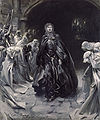
                                     Drawing by Sargent for Terry's golden jubilee programme, 1906

However, Singer was keen to use the richness of oil paints to show the “stained glass effects” that he had observed on the Lyceum stage, so he chose to paint a solitary Lady Macbeth, holding Duncan’s crown above her head, a queen from the Celtic twilight.

In the picture, Terry gazes up at the crown with an extraordinary, enigmatic expression. She saw Lady Macbeth as a woman who, because of love, was as one with her husband and his ambition: “a woman of highest nervous organisation, with a passionate intensity of purpose.” Terry loved the work, describing her look as apprehension, and said that the portrait felt “more like me than any other”.

Jonathan Jones, art critic of the Guardian, writing about twenty years ago, suggested that she looks like a sacred figure from an ancient temple. He also criticised the work, pointing out thatthis is not a real moment of self-loss. It is a painting of what theatre meant to the people at the time, an evocation of Terry’s power to inspire fantasy in her public.”

Sargent may have decorated the frame with Celtic motifs, ready for the portrait's first public viewing, which took place in 1889, at the New Gallery in Regent Street’s  owned by Alice’s Comyns Carr’s husband Joseph. The work became a great attraction. Terry reported it as “the sensation of the year . . . There are dense crowds round it day after day . . . but opinions differ about it.” Though some critics loved Sargent's painting, others did not, and The Saturday Review declared it “the best hated picture of the year.”

Sir Henry Irving bought the painting and hung it at The Lyceum Theatre, where he hosted the all-male Beefsteak dining club and eventually celebrated the hundredth performance of 'The Merchant of Venice'. The painting was also exhibited in Europe and South America, until finally being auctioned off and bought for the Tate by a wealthy donor in 1906.

The Actress

Ellen Terry (1847-1928) was born into a large theatrical family. As an infant, her cot would have been an open chest of drawers in that production’s lodgings. As a young child, she grew up reading the works of Shakespeare with her siblings. Terry grew up as familiar with the hardships of the touring life as with the glamour of life on stage.

Her father, Ben, was the business man, the one who found work with the actor-manager Charles Keans’ company. Sarah, Terry’s mother, who taught the child actress about performance and the importance of being ‘useful’ on stage to the leading actors. Aged five, Terry appeared as Prince Arthur in King John and other young roles in Kean’s productions. At eleven, she took the role of Puck in his A Midsummer Nights Dream, and also appeared in a genteel Shakespearian Entertainment attended by Queen Victoria.

Terry’s lively manner, burnished gold hair and Pre-Raphaelite beauty brought her to the attention of wealthy artistic circles, and her life was not without notoriety. At sixteen she retired from the stage to become the wife of the renowned painter G. F. Watts. Already in his mid-forties, Watts was unsure whether he should adopt his model or marry her.

Watts painted The Sisters, a double portrait of Ellen Terry and her older sister Kate, he also painted her alone: in his work ‘Choosing’, she appears as a young girl, caught between the attraction of a scarlet, scentless camellia and the humble, maidenly sweetness of a bunch of violets. Knowing the circumstances and the outcome, this is a rather unsettling image.

Terry also modelled for the pioneer photographer, Julia Margaret Cameron, who was related to Mrs Princeps, Watt’s too-dominant patron. Terry appears as a simple young girl in classical dress, her eyes closed and her head resting in an innocent dreamlike pose. Sadly, as Watts’ spirited wife, Terry found no role in his already well-organised home and was shunned by his reverential circle of admirers. The marriage was not a success, and Terry returned to her parents. 

                                       Wikipedia:Featured picture candidates/Ellen Terry - Wikipedia 

After some brief appearances on stage, Terry fell deeply in love with the designer and architect Edwin Godwin. She ran away from her parents and the public to live with him in rural Hertfordshire, and was soon the mother of two adored children. With Goodwin often away and Terry cut off from society, the relationship was strained, and their mutual love of art and luxury soon brought financial problems.

Then, in 1874, when Terry’s pony-cart lost a wheel on a country lane, Charles Reade a passing horseman, recognised her. He was a playwright and an old theatrical friend who helped her and persuaded her to return to the stage in one of his own plays. With the bailiffs at the door, and Reade’s money on offer, Terry accepted and found that her audiences welcomed her back warmly, both in London and on tour.

Terry’s true ascent to theatrical stardom came not long after. Squire Bancroft, the renowned theatre manager, cast her as Portia in his 1875 production of The Merchant of Venice. Her appearance, first in a china-blue and white gown designed by Alice Comyns Carr and then in black velvet as lawyer, stole the eye. According to the artist Graham Robertson, she was “the painter’s actress” appealing to the eye and ear, “her gestures and pose being elegance itself; her charm held everyone but predominantly those who loved pictures.” Though the actor playing Shylock did not live up to the role, Terry herself, and the production, shone.

Though Godwin’s stage sets, based on his visits to Venice, were praised, Terry’s trust had gone and the relationship broke down. Before long, now formally separated from Watts, she married the actor Charles Wardell Kelly whom she knew on tour. Marriage brought her respectability and her mother and family, who had disowned her, happily accept their daughter again. Kelly, though, was not happy to accept roles of lesser stature than his wife and so, as Terry’s theatrical reputation rose higher, envy and jealousy blighted the marriage.

Besides, Ellen Terry, at that point, was beginning the most important professional relationship of her life. Henry Irving, the leading stage manager and actor of the Victorian age invited her to play Ophelia to his Hamlet at his Lyceum Theatre. She became his stage partner, establishing a theatrical marriage that continued for twenty-four years. Their personalities on stage were complementary and were once described as “the flower and the tree”. Terry’s warmth, womanliness and lightness contrasted with Irving’s serious attitude and sometimes stiff manner. For her part, she was content to use her famed femininity as a foil to his dominant roles.

                                            File:Henry Irving portrait.jpg - Wikipedia

Irving, in his turn, gave Terry the chance to star in all the female Shakespearean roles: Ophelia, Desdemona, Portia, Juliet, Viola, Beatrice, Lady Macbeth, Cordelia, Imogen, Volumnia and Queen Katherine, for his theatre and she was dubbed, by Oscar Wilde, “Our Lady of the Lyceum.”

And the ‘Missing’ Dress . . .?

I had long given up thoughts of seeing the dress itself, and I did not see the painting when I visited Tate Britain last year, after the great rehang. However, Dr Kate Stradin’s tweet sent me searching online, and there was an answer to the missing garment.

Around the millenium, the National Trust had found that Terry’s archive at Smallhythe Place needed serious attention. There was particular concern about the presence of 'wooly bear moths' within the house and the fabric collection. Consequently, twelve years ago, Zenze Tinka Conservation starting major preservation work on the beetle-wing dress, which was in preparation for the “Sargent and Fashion” exhibition to be held at the Boston Museum of Fine Art in 2023. Reading on, I discovered that the whole exhibition was due to transfer to Tate Britain, in London, in 2024. 

It is 2024 now, and Ellen Terry's famous costume is right here, on display. For the first time since 1889, her green beetle-wing dress, the heather-coloured cloak and Sargent’s portrait will be together in the same place. 

 And on the day this History Girls post appears, I will be down at Tate Britain, meeting and greeting Ellen Terry’s famous green beetle-wing dress at last.

 Maybe, over the summer, I might even take a look at Smallhythe Place again, and see how the conservation work is getting on.

Penny Dolan

PS. After being disappointed by Jonathan Jones’ rather dismissive Guardian review of the Sargent and Fashion exhibition recently, I was hugely cheered to see, on the Letters page, a spirited response from Cally Blackman, asserting the importance of fashion and frocks.

https://www.theguardian.com/fashion/2024/feb/23/throw-off-the-cloak-of-snobbery-and-treat-fashion-as-a-serious-art-form

She writes

Whatever the distress caused to Jones by the lighting, wall colours and glass cases in wrong places, it is a very rare thing indeed to see garments displayed next to the paintings in which they are depicted, and a special joy to see these same garments interpreted on the canvas with Sargent’s consummate skill and aesthetic judgment. Some of the gowns on display are by Charles Worth, the most prestigious couturier in Paris (not “designer” – the word had not been invented then).” 

 Then came Blackman’s warning:

Compared with these, Ellen Terry’s beetle-wing-embellished Lady Macbeth stage costume (“costume” is the term for clothing worn for performance, not for garments worn in everyday life) looked dull and lifeless, yet scintillated in radiant, glowing colour from Sargent’s portrait, a testament to his quality as an artist.”  

I am still looking forward to seeing the dress, and the whole exhibition, tremendously. It has been a long time.


Further information:

Ellen Terry by Joy Melville.

Sir Henry Irving: A Victorian Actor and His World by Jeffrey Richards.

A Strange Eventful History: The Dramatic Lives of Ellen Terry, Henry Irving and their Remarkable Families by Michael Holroyd

https://www.nationaltrust.org.uk/visit/kent/smallhythe-place

Tom Gurney: HistoryofArt.org

https://www.theguardian.com/education/2002/jan/12/arts.highereducation

A Boy Called M.O.U.S.E by Penny Dolan

and 

Dr Kate Strasdin @kateStrasdin The Dress Diary of Mrs Anne Sykes

                    16 stunning Victorian textiles from The Dress Diary of Mrs Anne Sykes

Tuesday, 13 June 2017

ON THE SHIFTING IMAGERY OF WAR – Elizabeth Fremantle


A visit to the Paul Nash exhibition at the Sainsbury Centre in Norwich the other day got me thinking about how the way we represent war culturally has changed over the last two hundred years and how this relates to our attitudes to conflict.


The Ypres Salient at Night (1918) confronted me as I descended the stairs. I was captivated by its obvious echo of representations of the magi following the Star of Bethlehem. But in this case the three figures are hunched together in terrified awe in the face of an exploding shell in the night sky. The irony is cutting. This is a wasteland bereft of hope or redemption, in the gloom everything is dead and the light from the shell casts sharp light over the angular shadows of the trenches. This depicts a post-Neitzschean world abandoned by God.

I was reminded of an earlier painting: Arthur William Devis's depiction of Nelson's deathbed. Similarly it references religious iconography, the supine figure of Nelson at the centre is lit like a Christ figure. But in this case it is a straightforward application of symbolism to glorify the sacrifice Nelson has made for his country. There is no irony here. Indeed most nineteenth century war painting seeks to emphasise courage, strength and patriotism. Take Elizabeth Butler's charging cavalrymen, full of glorious bluster and bravery at Waterloo, in Scotland Forever! (1881) as an example. In it the Scot's Greys gallop at full tilt when it is known that in reality in the deep mud they could barely make a canter. Butler has manipulated, sanitised if you like, the notion of battle, leaving no place for death in this image in which everything is bursting with life. Of course death looms and perhaps there is a hint of it in the exclamation mark of the title but the artist seems to refuse to face it head on.


It is only with the First World War that artists begin to show the feebleness of man in the face of war, the terrible waste and suffering, the pointlessness, the death. John singer Seargent articulates this vividly in Gassed (1919). There is no sense of glory in this desolate line of broken men walking amongst their dying comrades. It is an image of utter despair and of course brings to mind Wilfred Owen's brutally ironic and devastating poem Dulce et Decorum Est


By the Second World War Nash's work became increasingly symbolic, reaching its apotheosis in Totes Meer – Dead Sea (1941). In it he depicts the sea of destroyed fuselage from the crashed aeroplanes of the Battle of Britain. The mess of twisted metal lies in peaks and troughs like a stormy ocean, a kind of nightmare landscape in which nothing is quite what it appears to be. There is no death here unless it is in the absence of life, just at the centre a wing with a cross on its tip that resembles a coffin. Yet death infuses the canvas and though it is day the moon hangs in the sky in place of the sun.


It is cinema that is the medium that best depicts modern warfare. The brilliant war films, The Hurt Locker, Apocalypse Now, The Killing Fields are those that immediately spring to mind, amongst many. There are few contemporary artists who tackle the subject but Bran Symondson, who has served in Afghanistan, has. His work is a critique of modern warfare that doesn't depict scenes of battle or destruction but drills down with powerful imagery into the causes of war. He takes the deadly paraphernalia of conflict and presents it in such a way – a grenade wrapped in dollar bills, and AK47 covered in red, white and blue butterflies – that his message is crystal clear and coldly symbolic. It seems to me to reflect exactly the feelings we have about war now, our cynicism about those who pull the strings of modern conflict, so very far removed from that nineteenth century sense of glory and courage.


Elizabeth Fremantle's latest novel, The Girl in the Glass Tower, is published by Penguin.


Tuesday, 7 March 2017

Portrait of a Lady . A guest post by Philip Stott. Introduced by Adèle Geras

For some years now, the Stotts, (Philip and Anne) have been good friends of mine. The friendship began when Philip emailed my late husband,  Norman Geras, on  his blog (normblog).  Norm very quickly discovered that Anne Stott knew a great deal about many things, not least Jane Austen, and he often asked Anne to write for the blog, which she did with great style and erudition.  I'm hoping to ask her to contribute to the History Girls in the fullness of time but meanwhile, her husband, Philip Stott, is writing here about a forthcoming exhibition at Ightham Mote.

It's thanks to the Stotts that I have such a good working knowledge of National Trust Scones. I have visited NT properties mainly with them and what they don't know about almost everything isn't worth knowing. They're the best of guides and now Philip has found his true métier as a Volunteer at Ightham Mote. He's writing here about something I hope many History Girls and also many readers of this blog might find interesting.


“She had an immense curiosity about life, and was constantly staring and wondering.”


The story of Elsie Palmer, and of her spirited mother, is worthy of a Henry James novel.


In April 1887, a still-young American woman, Mary Lincoln Mellen Palmer, Queen, brought her three daughters, Elsie, Dorothy (‘Dos’), and Marjory, to live at the late-Medieval moated manor house of Ightham Mote in Kent, England [https://www.nationaltrust.org.uk/ightham-mote]. The family were to stay at the Mote until March 1890. Their father, William Jackson Palmer, the founder of Colorado Springs, a famous railroad engineer, Union Army General, and recipient of the Medal of Honor, would visit them from time to time, as work permitted, most notably for Christmas, 1887.

During her residence at the Mote, Queen, who had received her universally-used nickname from her maternal grandmother, entertained many distinguished people in the world of the arts. Her fascination with the Aesthetic Movement was why she had chosen to rent an English moated manor house in the first instance, and she soon began to turn it into a rural ‘salon’ visited by such luminaries as the great American writer, Henry James.


[This photo was taken in1889 and shows Queen Mellen Palmer with her eldest daughter, Elsie, and the family dog, in the north-eastern corner of the Medieval courtyard at Ightham Mote, Kent. Ightham Mote Archives.] 


page1image14624
These notable Americans were joined by some of the leading lights of the English Aesthetic Movement, including:
the painter Edward Coley Burne-Jones; the doyen of the Arts and Craft movement, William Morris; the novelist and poet, George Meredith; the actress, Ellen Terry; and the costume designer, Alice Strettell (Mrs J. Comyns Carr).
Most important of all, however, Queen commissioned the controversial American portraitist, John Singer Sargent, to paint her eldest daughter, Elsie, against the antique linen-fold panelling of the Mote. This portrait is now regarded as one of Sargent’s masterpieces. It is known as A Young Lady in White, and it normally hangs at the Colorado Springs Fine Arts Center in the beautiful mountain resort established by her father.
However, from March 4 until 23 December, 2017, this stunning work has returned to the old house in which it was painted, where it will be displayed on a special stage in a room close to where Elsie took up her pose, and where it forms the centre piece of a major Exhibition entitled The Queen of Ightham Mote - an American Interlude: Queen Palmer, John Singer Sargent and their Circle.
1

[Miss Else Palmer, aged 17, A Young Lady in White, by John Singer Sargent, 1889-90, Colorado Springs Fine Art Center]

John Singer Sargent’s powerful portrait of Elsie Palmer [oil on canvas; 190.5 x 114.3 cm] was mainly painted when she was aged 17. Over the years, it has been given a number of titles, including A Young Lady in White, Portrait of a Girl in White, and Portrait of Miss Elsie Palmer. For the portrait, Sargent made a range of pen-and-ink/oil sketches of Elsie, including an exquisite full-length oil sketch of her wearing the same dress in the late-Medieval Great Hall of Ightham Mote [exhibited in the Oriel Room]. The final portrait is inscribed, lower right, ‘John S. Sargent 1890’, and it was first shown at Joseph Comyns Carr’s New Gallery, Regent Street, London, in 1891.

The family owned the picture until the mid-1920s, when it was purchased by a family friend, Col. Charles Clifton, and presented to the Albright [-Knox] Art Gallery, Buffalo, N.Y. It was finally acquired in 1969 by the Colorado Springs Fine Arts Center with funds collected through public subscription. In 1998/99, it formed part of the important Sargent at the Tate exhibition in London.


Richard Ormond, Sargent’s great nephew and a world authority on the artist notes that:
 “.. the portrait remains one of Sargent's most compelling and original characterisations."
 He observes: “Elsie appears hauntingly beautiful, dressed in a costume that is both picturesquely antique and stylishly modern.
 The linen-fold panelling behind her plays up the feeling of past times and historical associations.  Because she has not ‘come of age’, she wears her hair long, and her dress, as we can tell from a preliminary study, is ankle-length, another sign of her youth.” He further adds that the “... frontal and symmetrical pose is often to be found in pictures of the Madonna by Renaissance masters.”


The Exhibition also features many other items relating to the Palmer family’s stay at Ightham Mote, including replicas of Elsie’s dress and of Ellen Terry’s famous beetle- wing costume in which she played Lady Macbeth in 1888/89. But most importantly, there is a second major work by Sargent. While he was engaged on the great portrait of Elsie, he also produced a large canvas of bowls being played on the North, or ‘Bowling Green’, Lawn. This is a classic conversation piece distinguished by the portrayal of a group of people engaged in civilized conversation and genteel activity out of doors. 


[A Game of Bowls, Ightham Mote, Kent by John Singer Sargent, 1889. Sotheby's New York]


Typically, the  group comprises membersof the family (Queen and Elsie), with close friends (Alma Strettell; Violet, Sargent’s sister; and the Jamesons). Amusingly, it has often been taken to be a comment on English weather. The Hon. Sir Evan Charteris wrote of the scene in 1927: “Here he has caught English scenery, not at its best by any means, but in a grave and dreary mood, low in key and tone, but not lacking in truth either of colour or general effect. Moreover, the game goes forward as though the players themselves were affected by the opacity of the atmosphere.” Elsie recalled later that the ladies were all expected to wear hats. A Game of Bowls has been generously loaned to Ightham Mote for the Exhibition by Sotheby’s, New York, with the option to buy this fine work permanently for the house. An appeal has been launched to raise the necessary funds. 
It would be wonderful if some of the History Girls were able to come to see Elsie and the Exhibition during the year, especially as Adèle Geras will be assisting Helen Craig, the creator of Angelina Ballerina, in an Angelina Ballerina and Henry workshop and trail. Helen is the great granddaughter of Ellen Terry, the fond friend of both Queen and Elsie, while her grandfather, Edward Gordon Craig, the famous theatre designer, was the childhood playmate of the three Palmer sisters during their stay at Ightham Mote.


[ from The Gardeners’ Chronicle, Saturday, February 2, 1889, pp.135-136]


Ightham Mote is open daily throughout the Exhibition. See here for full details: https://www.nationaltrust.org.uk/ightham-mote/openingtimes.


page3image15120
Philip Stott is Emeritus Professor in the University of London, where he taught at SOAS. Since his retirement, he has been a volunteer room guide and researcher at National Trust Ightham Mote. He has a long-term interest in early music and art. He is married to the historian and biographer, Anne Stott.

Sunday, 17 April 2016

STEALING A SHAKESPEAREAN DRESS by Penny Dolan


Dear Reader, I once stole a famous Shakespearean costume, although the crime is hard to detect. This is how my theft began:

Much of my middle-grade children’s novel, A Boy Called Mouse, is set in the world of the late Victorian theatre. My reading and researching was inspired by three overlapping interests: the working conditions of the theatre children before Fawcett and others campaigned for their safety and education; the role of the actor-managers like Irving who made theatre-going respectable for the middle-classes, and the use of Shakespeare as a vehicle for spectacle and dramatic effects.

I’d like to pretend that this work was seriously-organised study but now suspect that much of the reading was random, seeing-where-it-led pursuit with my main worry being “getting the whole thing written”, a state I’m very much in at the moment.
 

However, my searches introduced me to a particularly beautiful garment: the dress  worn by the actress Ellen Terry when she played opposite Sir Henry Irving in his 1888 production of Macbeth. Descriptions of this or that famous actor’s costumes or props, and the cost, had long been an important part of the publicity for the production, drawing in an audience as keen to see the dresses as to see the play.
This was true of Ellen Terry’s dress. Styled like a medieval robe, it created the most spectacular sensation: this Lady Macbeth was not dressed in sultry black silk or blood red velvet but in a gown of glittering emerald-green, an effect created by the hundreds of beetle-wings stitched to the background fabric, creating a stunningly jewelled contrast to Ellen Terry’s clouds of red-gold hair. 

She was delighted by the success of the gown, particularly as it was comfortable on stage, saying that It is so easy, and one does not have to wear corsets!”

Glamorous the dress might be, but the “easy” costume had to deal with a long hard-working life, facing many hasty and less-than-careful backstage changes. Not only did Irving’s 1888 production of Macbeth run for six months, but the beetle-wing dress went travelling for tours and productions, both in Britain and across to North America.
 
Ellen Terry appeared in this most favourite costume personally and when John Singer Sargent painted her iconic portrait, he chose to show her wearing her famous green dress. He posed her with arms upraised, drawing attention to the long folds of the sleeves, suggesting the robe of a medieval knight. Despite the painted stance, Terry never appeared in such a pose on stage during Irving’s “Macbeth”.

I could not help falling in love with this thought of this dress, although knowing Terry’s diminutive stature knew the thing would never have fitted me. So I borrowed the fame and mood of it to inspire a stage costume in Mouse, converting the beetle wings into peacock feathers for a different Shakespeare play. Here it is, in its new guise, mentioned as part of the great actor-manager Hugo Adnam’s Press Conference on his forthcoming “Midsummer Night’s Dream”:
Newspaper men in crumpled tweed jackets visited the Albion Theatre. Supping ale and oysters, they scribbled down Adnam’s description of  the forthcoming play. The ladies magazines published illustrations of Bellina Lander as Titania, trailing the iridescent cloak of peacock feathers she would wear on stage, a garment that had cost over a thousand guineas without its silk lining. Just seeing that cloak, in all its coloured glory, would be well worth the price of a good seat. The opening night had sold out already.

Or here:
"Now the hungry lion roars!" Puck began "and the wolf be-howls the moon." 
Adnam and Bellina entered for their final speeches. The peacock cloak swirled out under the lights, and Adnam's deep and wondrous tones resounded magnificently. 

Looking back through the pages of A Boy Called Mouse, I am now surprised how briefly Terry’s faux dress appears, given how largely the real dress still features in my sense of the history and visual memory of that period while I was working on the manuscript.

The brief entry may be because, while writing, I chose to make my fictional actress Bellinda Lander as unlike the real Ellen Terry as possible. Terry with her red-gold hair, seems to have been as warm and loveable in private as she was scandalously popular in public, with her three marriages and rumours of numerous affairs, while my dark-haired Lander is definitely not a loveable woman. 

Besides, by this part in the plot, I had plenty of dramatic deception, untangling and adventure going on backstage for my hero Mouse and his friend Kitty. Maybe that is why the ghost of Terry's wonderful beetle-wing dress just whispers by on the pages?

The good news is that while I may have down-played Terry’s inspiring dress, it still exists and can be seen. Back in 2011, after long and expensive renovation and the re-stitching of many beetle-wings, the dress went on display among the collection of theatrical memorabilia at Smallhythe Place in Kent, Ellen Terry’s most favourite home, where she died in 1928. The property is now owned by the National Trust.

Penny Dolan