Showing posts with label Maggie Butt. Show all posts

Friday, 17 January 2025

January Floods by Maggie Brookes

On Boxing Day it was 20 years since the terrible tsunami in the Indian ocean. Remembering our shock on hearing about that disaster, which killed 230,000 people, started me thinking about floods which have happened nearer to home, all of which occurred in January. 


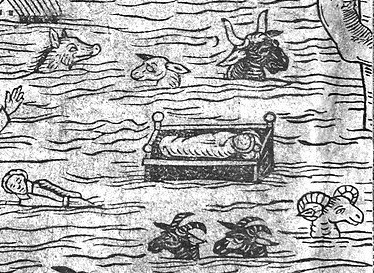
'A true report of certaine wonderfull ouerflowings of waters, now lately in Summerset-shire, Norfolke, and other places of England : destroying many thousands of men, women, and children, ouerthrowing and bearing downe whole townes and villages, and drowning infinite numbers of sheepe and other cattle' William Jaggard, 1607.

It was hardly an exaggeration. The great flood of the 20th Jan 1606 (or 30th January 1607 using the modern calendar) is thought by some to have been a tsunami, though others argue that it was a storm surge. At mid-day, a 'massive hill of sea'  swept up the Bristol channel and poured into the low-lying farmland of Somerset and Wales, killing an estimated 2,000 people. About 200 square miles of farmland were destroyed. Whole villages and much livestock (perhaps 'infinite numbers!') were swept away. Puritan pamphleteer William Jones described the scene:  'so violent and swift were the outragiouse waves, that ... in lesse then five houres ... many hundreds of people both men women, and children were then quite devoured.'  


Where they could, people climbed trees, ' Many there were which fled into the tops of high trees, and there were inforced to abide some three daies, some more, and some lesse, without any victuals at all, there suffring much colde besides many other calamities, and...through ever much hunger and cold, some of them fell down againe out of the Trees, and so were like to perish for want of succour...'


 '... Othersame, sate in the tops of high Trees as aforesaid, beholding their wives, children, and servants, swimming (remediles of all succour) in the Waters. Other some sitting in the tops of Trees might behold their houses overflowne with the waters. some their houses caryed quite away: and no signe or token left there of them.'

Plaque in Kingston Seamore Church, Somerset.

William Jones was certain that the flood was God's warning to his people of England to mend their ways, but the flood which carried away the Devon village of Hallsands on January 26th 1917 was a wholly man-made disaster.

Hallsands in 1885, before the flood

In the 1890's dredging for gravel and sand began off-shore to provide building materials for a new naval dockyard in Plymouth. By 1900 the level of the beach had fallen considerably, and the villagers petitioned their MP to get the dredging stopped. But the damage had been done, and when a great storm raged on the night of January 26th. Waves broke through doors and windows, waking the inhabitants. Imagine their terror as they leapt from their beds, gathered up their children, and set out to climb the cliffs behind the village in pitch darkness.

The remains of Hallsands village

Four houses had been swallowed by the sea by midnight. And the next day brought no respite, as another high tide washed away a further 25 houses, leaving only one standing. Nobody died, but 128 villagers were left homeless and without means of earning a living. Their claim for compensation took seven years.

The ruined village of Hallsands (sea level) 

It isn't only rural and coastal areas which have suffered from January floods. On 7 January 1928, thousands were made homeless when the Thames flooded in central London, pouring over the embankments, flooding the city from Greenwich and Woolwich right up to Hammersmith and Putney. This was caused by a mixture of nature and man-made interventions: a sudden thaw, a high spring tide, a storm surge and heavy rain all combined with dredging which had been carried out to deepen the Thames which created a funnel effect for the surging tide.

Tide level at Tate gallery.

Tube stations along the river filled up with water, the House of Commons was flooded, Turner paintings were damaged at the Tate gallery and the Tower of London moat filled up with water. 4,000 people were made homeless, though only 14 died. In a typically British way, mobile animal hospitals were set up for pets which had been injured in the floods. The slums and warehouses of Millbank were worst hit, and many were demolished and later replaced by office blocks.

Mobile animal hospital.

The worst January flood of modern times happened during the night of the 31st of January 1953 when the north sea storm tide killed more than 300 people down the East coast of England and Scotland, plus 224 lost at sea. This terrifying night-time flood was caused by a combination of a high tide with a storm, said to be the worst storm to hit Scotland for 500 years. It hit between Orkney and Shetland, then surged south, flowing over sea walls in 1,200 places, forcing 30,000 people from their homes. 58 people died when Canvey Island in Essex was flooded, 37 died at the seaside village of Jaywick, and 41 more at Felixstowe in Suffolk, where wooden prefab homes were washed away. As the tide overspilled the Royal Docks in London's East End, 200 people were made homeless and sheltered in Canning Town Town hall.


Part of the problem was a lack of communication. When a high tide occurred at Kings Lynn, killing 36 people, it was assumed to be a local event, and no warnings were issued down the coast and more than 60 people died some hours later on Canvey Island. If they'd been warned, there would have been enough time to evacuate them. More than 900 miles of coastline were damaged at a total cost estimated at £50 million. But there was incredible bravery too. Four men were given the George medal for their courage in wading into the waters and rescuing people.


Following the 1953 storm, coastal defences were improved right along our North Sea coasts and a Storm Tide Warning service was created. But some people remained homeless for a long time. In March 1953 108 families were moved into these caravans in Harwich, where they lived until December 1954.


Floods have already happened this January around the country, and no doubt there will be more, partly because of human-caused global warming, and building on river flood-plains, but also just because it's winter. Let's hope we get adequate warning.


Maggie Brookes, novelist and poet. Author of  historical novels The Prisoner's Wife and Acts of Love and War. As Maggie Brookes-Butt: Wish, New and Selected Poems, published January 27th 2025.

Instagram: Maggie __Brookes 
Facebook: Maggie Brookes-Butt

Friday, 19 July 2024

Casting my vote by Maggie Brookes


Whenever I cast my vote I feel I can hear the cheers of all the women suffragists and suffragettes who worked so hard to win that right for me, but when I was posting my ballot paper this time, I wondered how many countries in the world still don't give women the right to vote. 


I was amazed and pleased to discover that technically it's only one. In Vatican City elections only cardinals of the Catholic Church (all men) are allowed to vote for a new pope. However, in looking this up, I discovered that the right to vote and the experience on election day can be two different matters. For example in Kenya, a 2019 United Nations report registered concern about harassment or violence against female voters. Voting can also involve a long and sometimes dangerous walk to a polling station, and in some areas it's culturally unacceptable for pregnant women to be seen out in public, which obviously limits voting.


At the recent UK election, voters were asked to present ID at the polling station for the first time. This seems sensible, but in some countries it can work against women. A report from the Borgen Project said that in Egypt women are less likely than men to have an ID card, and even if they do, their husbands often 'look after them' and simply refuse to hand them over, preventing them from voting. Also, having to reveal their faces in public can also put women off voting if they normally wear a niqab. Not to mention the attitudes of the men. In Nigeria in 2016 President Muhammadu Buhari said, 'I don’t know exactly what party my wife belongs to. Actually she belongs in the kitchen, the living room and the other rooms in my house.'

President Muhammadu Buhari

Of course there are countries where there is no suffrage at all. Brunei hasn't held a national election since 1962, there haven't been elections in Eritrea since its independence in 1993, and a recent election in the United Arab Emirates granted suffrage to only 12% of all men and women.

But hang on. I've disappeared down a research rabbit-hole (this happens all the time to us novelists) and this is supposed to be a history blog, so when did women first get the vote? I've always assumed it was after the first world war, but I realise I'm looking back through a Western, patriarchal lens.

In 1639, a young nun called Marie Guyart (later known as Marie of the Incarnation) set sail for Quebec in 'New France' where she was keen to convert the 'savages.' 

Marie of the Incarnation

Working with the Iroquois women, she discovered, 'These female chieftains are women of standing amongst the savages, and they have a deciding vote in the councils. They make decisions there like their male counterparts, and it is they who even delegated as first ambassadors to discuss peace.' It turned out that many First Nations peoples of North America had a matrilineal system, where belongings and wealth were passed down from mother to daughter and yes, they even had voting rights. Unfortunately, the settlers did not adopt this system, and when women were given the vote in Canada in 1917 that did not even include First Nation people, who weren't allowed to vote until 1960. Canadian First Nation people did not win the vote until 1960.

Back in the Old World, I've always thought of Mary Wollstonecraft's A Vindication of the Rights of Woman, published in 1792, as being the very first call for equality for women, but a limited form of women's suffrage had already been introduced in Sweden during Age of Liberty (1718–1772) and also in the Corsican Republic in 1755. 

Mary Wollstonecraft

Sometimes women were given the vote by accident: in a new British Colony called Sierra Leone, all heads of households were given the vote in the 1792 elections because nobody expected a third of them to be African women!  In a similar way in New England in 1756, Lydia Taft became the first legal woman voter when her husband Josiah died, leaving her as the largest landowner in Uxbridge, Massachusetts. In a community calling for 'no taxation without representation,' they had no option but to allow her to vote in local town meetings, 164 years before women were enfranchised in the USA.

Uxbridge, Mass.

Coming into the 19th century, there are odd instances of female suffrage on small islands and territories. The Pitcairn islanders who were the European descendants of the mutineers of HMS Bounty were allowed to vote from 1838 – including the women – and some women on the Isle of Man had the vote from 1881. In the United States in 1869 the Territory of Wyoming decided to try to attract new settlers by giving women the vote. It's not clear whether that was a success!

A little later, in 1893, the British colony of New Zealand became the first country in the world in which all women had the right to vote in parliamentary elections, though they were not allowed to stand for election. In the following year, South Australia allowed women both to stand for election and to vote.

But of-course it took women's huge contribution to national life during the First World War, before the UK Parliament finally passed the 1918 Parliament (Qualification of Women) Act. It was only one page long and gave women the vote if they were over the age of 30 or property owners or UK university graduates. (At a time when most universities did not confer degrees on women, no matter how brilliant!) Unfortunately, although my own grandmothers were working, married women, they were not yet 30 in December 1918 and very far from being property owners or graduates, and so would not be able to vote for another ten years.

It took some other countries a lot longer to give women the vote, the most surprising laggard being Switzerland. It took till 1991 for The Swiss canton of Appenzell Innerrhoden to give women the vote, and women as a whole in Switzerland only gained the right to vote at federal level in 1971.

In the UK the 1918 Act also gave women to right to stand for Parliament and seventeen women took up the opportunity, though only one was elected: the Sinn Fein candidate Countess Constance Markievicz, who never took up her seat. The first woman to actually take her seat was the American Nancy Astor after a by-election in December 1919. Two years later Margaret Wintringham joined her in the House of Commons.

Margaret Wintringham MP

I wish I'd talked to my grandmothers about how this huge change seemed to them. I do remember my maternal grandmother's excitement when Margaret Thatcher was elected as our first female Prime Minister in 1979. I wasn't aware at the time that the first ever female PM in the world had been elected almost twenty years before! Sirimavo Bandaranaike had become Prime Minister in Sri Lanka (then Ceylon) in July 1960 after the assassination of her husband.

Sirimavo Bandara

 Then the first woman was elected president of a country in 1980. Vigdís Finnbogadóttir of Iceland won the 1980 presidential election as well as three subsequent elections, remaining in office for 16 years.

A quick look at the number of women in government in any given country gives a clue to the levels of equality and the likelihood of women exercising their right to vote, though the countries with biggest percentages of women in parliament might be surprising. The Interparliamentary Union report of 2019 cites Rwanda ahead of the front runners with 63%, and Cuba and Bolivia not too far behind with 53%. The UK came in with 32% at the time. Down at the bottom of the league table were Solomon Islands with 2%, Oman with 1%, Yemen with 0.3% (one woman - go you!) and Micronesia and Papua New Guinea with none.

Chile's first female president Michelle Bachelet has observed, 'When one woman is a leader, it changes her. When more women are leaders, it changes politics and policies.'

Michelle Bachelet

In June 2024, there were 27 countries with women as Heads of State and/or Government. However, UNwomen.org points out this means that 'at the current rate, gender equality in the highest positions of power will not be reached for another 130 years.' It also notes that the 'five most commonly held portfolios by women cabinet ministers are Women and gender equality, followed by Family and children affairs, Social inclusion and development, Social protection and social security, and Indigenous and minority affairs.'   So, we still have a way to go.

However, the good news is that following the UK election two weeks ago in July 2024, 263 women were elected to the British parliament, representing taking  40.5% of the total seats, including 50 black and minoritised women MPs. I can hear those cheering suffragettes now!


Maggie Brookes. Novelist and poet. Author of Acts of Love and War and The Prisoner's Wife.
Instagram Maggie__Brookes  Facebook: Maggie Brookes-Butt


Friday, 19 January 2024

Ally Pally Prison Camp by Maggie Brookes


Growing up in North London, Alexandra Palace has always been on my skyline. The first palace opened on Queen Victoria's 54th birthday, burning down 16 days later, but being immediately rebuilt.

When I was young, I would confuse the radio mast on top of one of its towers with the Eiffel tower. In my teens it was the place we went roller skating, fulfilling its original purpose as the 'People's Pleasure Palace'. As I grew up and went to work for the BBC, I equated it with the birthplace of television and a major TV production centre. It wasn't till much later that I read a paragraph in a local history book which told me it had been a civilian internment camp during the first world war. I immediately became interested, and my research was eventually published in a book which combined extracts of memoirs and letters with photographs, paintings and my own poems.


I discovered that at the beginning of the war it had been kitted out as a temporary home for the thousands of Belgian refugees who were flooding into Britain as the Germans over-ran their homeland. Then in 1915, after the sinking of the Lusitania, when anti-German riots broke out, about 42,000 German, Austrian and Hungarian men between the ages of 17 and 55 were rounded up and taken to internment camps, also known as concentration camps. 3,000 civilian men were imprisoned at Alexandra Palace in North London. The artist George Kenner was one of them, and this blog features his wonderful paintings.


Many of the men who were taken to Ally Pally in 1915 had left Germany as children, many owned business in England. Most lived in London and had English wives and children. They were the lucky ones. The unlucky ones were taken to a camp at Stratford, run by a sadistic commandant.

They were marched up the hill where they were registered, queuing in the rain and having all their belongings examined. They were rich and poor, bankers and barbers, waiters and stockbrokers. The prisoners were divided up into three battalions, and because this was England, the divisions were based on their social class.


The skating rink was for Battalion C, the business and professional men like George Kenner. The Great Hall (now used as a vast exhibition space) was the sleeping quarters for Battalion B, the working class, and a thousand men slept there. Their beds were within an arms length of each other and there was no privacy. They kept their few belongings under their beds.

One of the men who slept in the Great Hall with the labouring classes was a Hungarian tailor called Benny Cseh, whose pitiful letters to his wife Mabel are in the Imperial War Museum. Much of their correspondence concerns a 2s 6d postal order which went missing, and the fact that she sent him pears which became squashed. He described his day: 'We get up at 6am, breakfast at 7am, go outside till 12. Dinner at 1, go out till 7, out till 9, bed at 10pm. Every morning, running round the horse race track.'

Another man whose letters are in the Imperial War Museum was the young RH Sauter, the nephew of John Galsworthy, and a Harrow educated aspiring artist. He lived in one of the towers with the upper classes, in far superior conditions.

The men occupied themselves according to their status and experience, running a post office, laundry, carpenter’s workshop, tailor's shop and barber's shop. Many were employed in the kitchens, where the great organ bellows powered the ovens. In 1915 the menu was reasonably good, including stewed meat, goulash, corned beef and herrings. Those with money could buy cakes, cheese, butter and jam.


The men could receive letters and parcels and were allowed a weekly visit, which seemed to range in time from 15 minutes for labouring men, to 2 hours for the upper classes. Benny Cseh describes the agony of the short visit: 'I was very much disappointed with your visit. Not with you my dear, but with the time, as I did not know how to divide that 15 minutes between you and Ilona. I have been told she was crying for me when you left.'

Paul Stoffa's memoir details the visits: 'It was pathetic to watch the painful excitement of the men whose visitors were due that afternoon. Long before three o’clock they assembled with their little bundles of flowers and toys for the children.' The visitors were 'elegant young women with engagement rings on their fingers, poor working women with a bevy of half starved children… None of the women visitors came empty handed: but their parcels had to pass the censor first. Whilst some of the well-to-do men received huge parcels containing all manners of expensive delicacies, the small packets containing perhaps only a pinch of tea and a diminutive piece of butter, bore eloquent testimony to the self-sacrificing affection in which these poor women held their husbands.'

As well as finding work to occupy themselves the men gave lectures, calling themselves the 'University on the Hill.' They used the theatre for Sunday services, started an orchestra and had a weekly cinema. Their favourite was Charlie Chaplin. In the summer they sailed boats which they’d made themselves, on the boating pond. One man, called Otto Weiss, was allowed to keep canaries in cages.


As the war drew on, the civilian internees where joined by prisoners of war billeted at Ally Pally on their way to other camps and even a group of missionaries, captured in West Africa. But not all the prisoners were what they seemed. One man had been taken from a German ship and was classed as an enemy alien, until someone realised that the language he was speaking was Welsh! There were even reports of an escape, during an Zeppelin air raid, though this is impossible to verify.

As time went on, conditions at Ally Pally grew more harsh, and the diet became 'rice, rice, rice, three times a day with swedes and turnips and salt herrings.' They were served biscuits which were broken and full of worms and maggots. They sent some for analysis but the report said the worms were harmless and they should eat them. More fights erupted over food than any other cause.


Two camp heroes emerged from adversity: the deputy commander, Major Mott, and one of the prisoners, the anarchist / socialist Rudolf Rocker. He managed to get many important concessions for the prisoners but became very ill during the harsh winter of 1917 when the heating in the Great Hall wasn't working and everyone froze. 'It was terrible at night; the coughing and groaning kept us all awake.'

The food and physical conditions became worse and worse, but there were things which caused more mental anguish. There was no welfare state of course, and the men had no means of supporting their wives and children. The Society of Friends, the Quakers, sold the toys the prisoners made and took food parcels and clothing to the wives and families.

The constant noise, and constantly being surrounded by so many people caused many men to have nervous breakdowns. So many in fact that a Swiss doctor studied the condition which he called ’Barbed Wire Disease.'

Throughout the war, the YMCA ran classes, Rudolf Rocker gave lectures about art and literature, and the men found something to do according to their class and habit. 400 allotments were cordoned off on the slopes of Ally Pally, and of all the ways of passing the time, this seemed to have the most positive effect.

Finally, the end of the war drew near, and the men spent the morning of November 11th 1918 in great nervous excitement, until, at 11am guns were fired, to mark the end of the war.

A little later, newspapers arrived, which set out the armistice conditions. RH Sauter wrote this in a letter on Armistice Day: 'I have just read the armistice conditions and now I see the real ideals for which the money-grubbing lawyers of the 23 nations have been fighting. Here one is living among the defeated … it is upon their fathers, their mothers, their relatives and friends that these conditions of slavery have been imposed. The whole of Germany, one great internment camp. I see the child of this very day, like a ghost, haunting the future, another war.'


When I first read that, I was so shocked and appalled that even on armistice day it would seem obvious to an ordinary young man that another war was inevitable, that I decided to end my book at that point. But for the men at Ally Pally, life went on. Slowly, slowly they were called to hearings, to decide who could stay in Britain. Many were deported back to Germany. Rudolf Rocker was deported, but was refused entry by Germany. George Kenner, the artist whose paintings feature in this article returned to Germany where two of his children died in the great depression, before he eventually went to America.

And the century rolled on, towards another war …


Huge thanks to Christa Bedford for permission to use the wonderful paintings by her father George Kenner.