Showing posts with label National Trust. Show all posts

Thursday, 16 May 2019

Miss Rosalie Chichester of Arlington Court: Sue Purkiss

At the end of April, we had a few days down on Exmoor, venturing just over the border from Somerset into Devon. Unfortunately, a heavy bank of rain (closely followed by Storm Hannah) was paying a visit at the same time - but in fact that turned out to be a Good Thing, because it led us a National Trust house nearby called Arlington Court. We'd never heard of it, but were delighted to have come across it.

Arlington Court: photo from the National Trust.
(All other photos are mine.)

Relatively speaking, the house isn't huge - but it's packed full of interesting things. The last owner, Miss Rosalie Chichester, was a great collector, and she left everything to the Trust.

Her father, Sir Bruce, died when she was only 15. Until he became ill, he had lived lavishly, spending money he didn't have on the estate and on entertaining - so that Rosalie inherited a hefty burden of debt, as well as the house and its acres of parkland. There's a room upstairs which is furnished to reflect her personality and interests at this point. She had her two pet mice stuffed when she died, and there they are, encased in small glass cases on the mantelpiece. There are books, toys, drawings and pictures; it's a comfortable, slightly shabby room, and you get the impression of an eager, enthusiastic personality, a girl who loved her home but was also curious about the world beyond.

As the owner of an estate which was saddled with heavy debt, she was never going to attract swarms of suitors, and she never did marry. But it doesn't seem to have bothered her: she certainly didn't become a reclusive, quiet spinster. She was careful with the estate, cancelling her father's extravagant plans for expansion, and over a number of years she managed to pay off the money owed. In any case, she had her own ideas about what she wanted to do with the grounds in particular.

For a start, very unusually for this part of the world, she was adamantly against hunting. So she had an iron fence erected round the park: it was to be a safe haven for deer and any other animals which chose to seek refuge at Arlington. In order to study the natural world which she loved, she had an observatory built. She was also a keen photographer, and some of her pictures form a slideshow of the estate as it was at the beginning of the 20th century

As time went on and the debts began to clear, she used the extra money she now had at her disposal to  travel widely with a paid companion. You can see at the house some of the journals she wrote; there is one of New Zealand illustrated with lots of sketches of the people, places and things that she saw.

She was a keen collector, and she used one room in her house as a museum for all the curiosities she ammassed. Its glass display cases are crammed with pewter mugs, pretty china, masses of exquisite shells - and model ships. Her grandfather had been a sailor, and her nephew, Sir Francis Chichester, was to become famous for being the first man to circumnavigate the world by himself. For her part, she expressed her interest in matters maritime by collecting the most beautiful models of ships of all kinds, and they are to be seen all over the house. This one is made out of spun glass: another was made by French prisoners of some war or other - the ropes are made of tightly woven human hair.


A conch - shades of 'Lord of the Flies'!

Pewter and china in the museum

More model ships

A scrapbook, with a page of jokes

The house, bright and comfortable, full of what some might call clutter, surely reflects its last owner's personality: lively, interested in everything, cheerful and creative. I suspect she would have been great company.

There's also a lovely little garden (which naturally needed to be walled because of all the animals), which at the time we were there was splashed with vivid pink and crimson azaleas. In the wider parkland there were lovely drifts of pale blue camassias.


The National Trust has its carriage museum there too - so if you ever want to know exactly what a brougham, a phaeton, a gig or a mail coach looked like, this is the place to go. The centrepiece of the collection, which is the only thing one is not allowed to photograph, is the Speaker's Coach, a vision in gold, extraordinarily ornate, straight out of a fairytale. The last speaker to have used it was George Thomas, later Lord Tonypandy - a lad from the Welsh valleys, who must surely have reflected, as he rode in it, how very unexpected and various life can turn out to be.

Wednesday, 13 March 2019

A Cumbrian Castle with hidden Jacobite history

by Deborah Swift

I'm really lucky in that I live close to many old houses and castles. One very close to my house is Sizergh Castle which has a fabulous tea room and lovely gardens.

The name Sizergh dates from the 9th century and was originally spelled sigaritherge, meaning Sigarith's pasture (sigarith is a female name.)

The castle has been home to the Strickland family for nearly 800 years, beginning in the 12th century, and is still lived in by them today. So well-connected were the family, that a Strickland was chosen to carry the English banner at Agincourt. During the Wars of the Roses the family were Yorkists, and in the succeeding generation were linked with the Parres of Kendal - the family of Catherine Parr, wife of Henry VIII.

The original medieval Great Chamber, now the dining room, contains portraits from when Lady Strickland acted as governess to James Stuart, 'The Old Pretender' in exile in Paris. There is one of the young James, and also a bust of Bonnie Prince Charlie (his son). For the first time this weekend a relic of this time, the glorious bedspread of James II will be on show at Sizergh. The bedspread, made in Goa India, is sumptuously embroidered with gold thread and portrays mythical birds and beasts, and was given to Strickland family by the King as a thank you for their loyalty. If you visit Sizergh in the next few weeks you can see it on display, and also hear the conservator talk about the conservation of rare textiles.
Read more here

But the Strickland family's support for the Jacobite cause led to a decline in their fortunes, and the castle could no longer be updated to current fashions.  Because of this, its core remains largely untouched, and we are able to stretch back in history all those years to see the original Elizabethan Manor House flanking the 14th Century hall and pele tower.


The photo below is from an article on the castle by Matthew Penmott, and I can heartily recommend his site on the Castles of Cumbria.
The Strickland Arms in the Parish Church, Kendal
The original Pele tower gave protection against scottish raiders. On the courtyard front is the Strickland Coat of Arms. The main entrance leads today into a Tudor Great Hall, which has since been adapted by different generations of the family into a series of smaller rooms. An Elizabethan corner block and wings enclose a courtyard, and on three sides of the castle the remains of a moat is visible even today.

Hard Times
In 1891 the ornate panelling from the Inlaid Chamber, along with various furnishings, was sold to the V& A for a thousand pounds, to raise cash to keep the house maintained. What a decision to make!


But now, after more than a century, and thanks to the Victorian and Albert Museum, the original panelling and stained glass which was tailor-made for the room at Sizergh, has now been returned home to the castle on permanent loan. (Pictures from The Guardian) The beautifully wrought panels were inlaid with English Poplar and “Bog” Oak to create a three dimensional effect of geometric and strapwork motifs.

Ghost of the Starved Lady

In the Pele tower, ghostly sobs denote the presence of a lady whose husband, before a raid by the Scots, locked her away in a room with an impregnable door - presumably to keep her safe. But her husband died and the terrified servants abandoned the place. The poor wife starved, and as she tried to claw her way out she went slowly mad. Her screams supposedly still haunt Sizergh on dark and spooky nights......

Apart from the attraction of the ghost, Sizergh Castle is managed by the National Trust and is well worth a visit - beautiful grounds and gardens too, along with more than a thousand years of history! If you go along in the next few weeks you will also be able to view some 17th Century Flemish tapestries, rare examples featuring stories from Plutarch, including the tale of Anthony and Cleopatra.

As many of you know, I have a keen interest in the 17th Century, and you can find my novels set in this era here, or on my website www.deborahswift.com

Friday, 7 September 2018

Sibylle Kreutzberger - a life in gardening, by Linda Newbery (guest)


Mention Sissinghurst to anyone remotely interested in gardening and the name Vita Sackville-West will come to mind. Visitors admiring the White Garden, the Nuttery, the Lime Walk and other famous Sissinghurst features may not realise, though, how much this world-renowned garden owes to two other significant plantswomen, Sibylle Kreutzberger and Pamela Schwerdt, joint head gardeners there from 1959 to 1990.

The pair became friends while training at Waterperry Horticultural School in Oxfordshire towards the end of the war, under the tutorship of another notable woman gardener, Beatrix Havergal, who was principal there. Having done some gardening work at her boarding school, Sibylle had been thinking of enrolling for a horticultural diploma at Studley when a family friend enthused about Miss Havergal. Waterperry was not at that time open to the public, but Beatrix Havergal occasionally gave demonstrations on topics such as pruning and how to make the best of a kitchen garden. For Sibylle, one of the attractions was that the clothes list for the course included two pairs of gumboots and a mackintosh - not a cap and gown, as at Studley: “It sounded like my kind of place.”

Beatrix Havergal at Waterperry, photographed by Cecil Beaton
In the late forties, with rationing still in force, growing fruit and vegetables at home was still important and the emphasis at Waterperry was on practicalities and produce, students there learning mainly through experience. Fruit and vegetables, as well as feeding the residents, were sold weekly at Oxford’s Covered Market. Fruit bushes and trees were sold in their thousands, packaged in straw and sent by road and rail. After completing her diploma, Sibylle stayed on, by request, for another eighteen months in the small scale vegetable department. After briefly working at Reading University in the Agricultural Botany department and then at an alpine nursery, she returned to Waterperry to do some lecturing to students and to run the Herbaceous Nursery.

By 1959, she and Pamela Schwerdt, who had stayed on as teacher during Sibylle's absence, were planning a project together. Feeling that life at Waterperry was “like being at school forever”, they aimed to establish their own nursery, but with no money or land their first challenge was to find a suitable and affordable site. They placed an advertisement in The Times personal column, asking if anyone might lease or lend them a plot of two acres or so. At the same time Pam wrote to Vita Sackville-West, who was at that time the Observer’s gardening correspondent. Vita replied suggesting that they try Wye College, in Kent, also mentioning that she needed a head gardener for Sissinghurst. Pam said firmly that there were two of them, and Vita invited them to visit.

Vita Sackville-West, painted in 1918 by William Strang

As it wasn’t what they were looking for, Pam and Sibylle didn’t immediately jump at the chance; in fact Sibylle says now that she wasn’t sure who was interviewing who. But replies to their Times advertisement hadn’t produced any suitable offers, and they decided to accept. Vita, Sibylle says, was ‘rather tickled’ by the idea of employing two young women at a time when female gardeners were rare. Sibylle recalls that in those early days visitors would stare at them in astonishment.

They lived on site in a cottage opposite the oasthouses and worked immensely long hours, returning to the garden or to paperwork after their evening meal. The garden was labour-intensive, on heavy Wealden clay where all the digging and cultivation was done by hand; there were no machines other than mowers. Later, these were supplemented by a small tractor, electric sprayers and hedge-cutters. The appointment of Pam and Sibylle brought the number of gardeners up to six; as time went by these were generally college-trained, and among those beginning their careers at Sissinghurst were several who went on to become head gardeners at National Trust properties.

Sibylle at work

Pam and Sibylle rarely took days off, their weekends being taken up with glasshouse duties and displaying plants for sale outside the gate. For this they used a yellow cart painted with pictures of Sissinghurst, formerly pulled by the resident donkey, Abdul. Fish boxes, painted yellow to match the cart, were used as staging for a pyramid of plants arranged to tempt visitors.

At the time they took up their employment, Vita Sackville-West (known to Sibylle and Pam as Lady Nicholson) was 67, and in variable health. She was often in the tower room she used for writing: “even the family weren’t allowed in there.” Thursdays would be “Observer day”, when she would shut herself away to write her gardening column. It’s rather unfair, Sibylle considers, that Vita generally receives sole credit for Sissinghurst. In the early days her husband Harold was fully involved with the planning; though at home only at weekends he attended RHS shows in London, bought plants and contributed ideas. He and Vita wrote letters to each other every day to discuss progress and planting.

The garden had already been open to the public for twenty years, but in a low-key way – from dawn to dusk, visitors could put their shilling in an honesty box. Vita’s style of gardening was romantic and blowsy but not aimed at providing interest throughout the season, and like many gardens Sissinghurst’s main period of flowering was in late spring and early summer, with not much of interest after July. Among the changes made by Pam and Sibylle was the extension of interest well into late summer and autumn, through the use of later-flowering perennials not hardy in this country but treated here as annuals and biennials: diascias, argyranthemum, penstemons and tender salvias. Besides that, the ever-increasing numbers of visitors – especially after Vita’s death and the taking over of the garden by National Trust – imposed its own pressures. Paths were subject to heavy wear and lawns damaged by tramping feet. Measures taken included the placing of prickly plants at the junctions of paths, to deter visitors from cutting corners and walking on the beds.

But Sibylle and Pam were doing far more than simply maintaining the work done by Vita. Their dedication, flair and skill were rewarded by the Royal Horticultural Society in 1980 when they were made Associates of Honour, and in 2006 they were given the society's highest honour, the Victoria Medal. “I can’t think what we did to deserve it,” Sibylle says now. Others disagree. The designer, plantsman and writer Dan Pearson is among those who give them a large part of the credit for Sissinghurst’s enduring status as an iconic garden:

“When the National Trust took over in 1967, five years after Vita’s death, an inevitable tightening up eventually saw the garden reach extraordinary horticultural heights in the hands of Pam Schwerdt and Sibylle Kreutzberger who worked with Vita from 1959 until she died, but went on to make the garden their own during their 30 year tenure as joint head gardeners. Pam and Sibylle’s prowess with plants was a large part of what brought visitors to Sissinghurst in their droves in the 1970’s and ’80’s, securing its place as one of the most influential gardens in the world.” (Dig Delve, Dan Pearson’s weekly blog.)

Sibylle (left) and Pam in their own Gloucestershire garden

In 1990 Pam and Sibylle left Sissinghurst to buy a home and make a garden of their own, settling near Stow-on-the-Wold in a new wing of a 17th century farmhouse with a three-quarter acre plot that had been a field. Pam died in 2009, and the house and garden were sold to appreciative new owners who welcome visitors under the National Gardens Scheme. Still fit and active at 87, Sibylle now lives in an Oxfordshire retirement village where most of the residents are unaware of her achievements and the high regard in which she’s held in the gardening world. They may, however, see her wielding a spade and fork in the community plot where she grows flowers and herbs.

The current head gardener at Sissinghurst, Troy Scott-Smith, has embarked with the National Trust – and Dan Pearson as consultant - on a project to revitalize (or reVita-lise) the garden from its present formality to something more like Vita’s vision. It is, Dan Pearson writes, “a means of recapturing the potent sense of place that Vita Sackville-West celebrated in her writing … a garden inextricably linked to the buildings it surrounded and, in turn, the Kentish farmland and countryside that swept up to its walls.” Sibylle was invited to an initial meeting, and as she’s the only person to have worked directly with Vita Sackville-West her contribution must have been invaluable. 

When I asked Sibylle what had been most satisfying about her work at Sissinghurst, I expected her to refer to a particularly impressive planting or the opportunity to make her mark on a world-famous garden. Her reply was far simpler:

“I like being outside by myself. And I like digging.”


Linda Newbery is the author of  Set in Stone, The Shell House, Lob and many other titles. The Key to Flambards will be published in October.

Friday, 30 March 2018

Cabinet of Curiosities by Charlotte Wightwick - Fashionable Fruit: the craze for pineapples

Pineapples are having a fashion moment. Everywhere I look, I seem to see them: on clothes, jewellery and homewares, from shoes to jumpers, necklaces to candle-holders, pots and knick-knacks. It isn’t hard to see why. They are immediately recognisable, brightly coloured and – at this drab end of winter - evoke tropical sunshine and exotic locations. As a design feature, what’s not to love?

It isn’t the first time the pineapple has been at the centre of fashion. In the eighteenth and nineteenth century there was a craze for the ‘king of fruits’ – and the reasons for it were very different from today.

Dunmore Pineapple
Source: Wikimedia Commons
Pineapples originated in South America. They were cultivated very early, due to the fact that in the right conditions they will fruit all year around. Early western explorers brought them back to Europe – and across to other tropical regions, where they quickly spread - as an example of the abundance and exciting discoveries of the New World. During the seventeenth century, such was their rarity that they were given to royalty as gifts. The symbolism around them – as the king or queen of fruits, as a representation of a new Eden, or of a new tempting ‘apple’, even associations in Catholic countries with the Virgin Mary – quickly grew, as did their reputation as the most delicious of all fruits.

By the early eighteenth century, the quest was on to grow pineapples in Europe. This was difficult – they need a constant tropical air and soil temperature to thrive, and the technology was not initially available. This changed with the development of hothouses, initially in the Netherlands. These swiftly spread across Europe and by the middle of the eighteenth century, it was fashionable for rich aristocrats to have their own ‘pinery’.

C18th Wedgewood tea canister, pineapple design.
Source: Victoria and Albert Museum, London
No-where, it seems, was this trend more pronounced than in England. A movement towards conspicuous consumption meant that pineapples became the ultimate in luxury. Hothouses were incredibly expensive to build and expert gardeners were needed to nurture the delicate plants over the two-three years it took for them to fruit. In the eighteenth century, it was estimated that the “the average total cost of the cultivation of just one pineapple was about £80 (nearly £5000 today) – about the cost of a new coach.”*

Pineapples became a necessity at the grandest dinner parties and country-house gatherings, crowning a pyramid of fruit as a mighty centrepiece. But such was their expense that they were often left intact, not eaten, and re-used over several weeks until they started to rot. In some places, it was even possible to hire a pineapple if you wanted to impress your guests, although of course it was much better if you could take them on a genteel tour of your very own hothouse.

The craze for pineapples went further than just for the fruit itself. They swiftly became used in all sorts of places, on items as diverse as clothing, reticules (small handbags), snuffboxes, wallpaper and crockery. Having your portrait painted with a pineapple also seems to have been a popular choice, as the example below from the Cwmmau Farmhouse, owned by the National Trust, shows.


Gentleman proudly holding his pineapple,
Cwmmau Farmhouse, National Trust.
Photo: author's own
The motif became embedded into architecture, with stone pineapples often decorating the tops of pillars and gates, especially at the entrances to grand stately homes. No-where is this shown more clearly than in the mighty Dunmore Pineapple (which can now be rented as a holiday cottage from the Landmark Trust!) This has led to the supposition that the pineapple was seen as a symbol of hospitality, although Fran Beauman convincingly argues in her 2005 book ‘The Pineapple: King of Fruits’ that for many it was much more about asserting status and conspicuous consumption than hospitality per se.

By the mid-nineteenth century, the first imported pineapples started to appear, at much lower prices than the home-grown version. Although this meant that a taste of the fruit was within the reach of a middle-class household for the first time, the fruit was often in poor condition and English pineapples remained a true luxury item for the time being. The advent of refrigerated shipping and improved canning methods towards the end of the century and in the early years of the twentieth, however, spelled the end for the pineapple as a symbol of social cachet.


* Fran Beauman, The Pineapple: King of Fruits (2005, Vintage)

Tuesday, 7 March 2017

Portrait of a Lady . A guest post by Philip Stott. Introduced by Adèle Geras

For some years now, the Stotts, (Philip and Anne) have been good friends of mine. The friendship began when Philip emailed my late husband,  Norman Geras, on  his blog (normblog).  Norm very quickly discovered that Anne Stott knew a great deal about many things, not least Jane Austen, and he often asked Anne to write for the blog, which she did with great style and erudition.  I'm hoping to ask her to contribute to the History Girls in the fullness of time but meanwhile, her husband, Philip Stott, is writing here about a forthcoming exhibition at Ightham Mote.

It's thanks to the Stotts that I have such a good working knowledge of National Trust Scones. I have visited NT properties mainly with them and what they don't know about almost everything isn't worth knowing. They're the best of guides and now Philip has found his true métier as a Volunteer at Ightham Mote. He's writing here about something I hope many History Girls and also many readers of this blog might find interesting.


“She had an immense curiosity about life, and was constantly staring and wondering.”


The story of Elsie Palmer, and of her spirited mother, is worthy of a Henry James novel.


In April 1887, a still-young American woman, Mary Lincoln Mellen Palmer, Queen, brought her three daughters, Elsie, Dorothy (‘Dos’), and Marjory, to live at the late-Medieval moated manor house of Ightham Mote in Kent, England [https://www.nationaltrust.org.uk/ightham-mote]. The family were to stay at the Mote until March 1890. Their father, William Jackson Palmer, the founder of Colorado Springs, a famous railroad engineer, Union Army General, and recipient of the Medal of Honor, would visit them from time to time, as work permitted, most notably for Christmas, 1887.

During her residence at the Mote, Queen, who had received her universally-used nickname from her maternal grandmother, entertained many distinguished people in the world of the arts. Her fascination with the Aesthetic Movement was why she had chosen to rent an English moated manor house in the first instance, and she soon began to turn it into a rural ‘salon’ visited by such luminaries as the great American writer, Henry James.


[This photo was taken in1889 and shows Queen Mellen Palmer with her eldest daughter, Elsie, and the family dog, in the north-eastern corner of the Medieval courtyard at Ightham Mote, Kent. Ightham Mote Archives.] 


page1image14624
These notable Americans were joined by some of the leading lights of the English Aesthetic Movement, including:
the painter Edward Coley Burne-Jones; the doyen of the Arts and Craft movement, William Morris; the novelist and poet, George Meredith; the actress, Ellen Terry; and the costume designer, Alice Strettell (Mrs J. Comyns Carr).
Most important of all, however, Queen commissioned the controversial American portraitist, John Singer Sargent, to paint her eldest daughter, Elsie, against the antique linen-fold panelling of the Mote. This portrait is now regarded as one of Sargent’s masterpieces. It is known as A Young Lady in White, and it normally hangs at the Colorado Springs Fine Arts Center in the beautiful mountain resort established by her father.
However, from March 4 until 23 December, 2017, this stunning work has returned to the old house in which it was painted, where it will be displayed on a special stage in a room close to where Elsie took up her pose, and where it forms the centre piece of a major Exhibition entitled The Queen of Ightham Mote - an American Interlude: Queen Palmer, John Singer Sargent and their Circle.
1

[Miss Else Palmer, aged 17, A Young Lady in White, by John Singer Sargent, 1889-90, Colorado Springs Fine Art Center]

John Singer Sargent’s powerful portrait of Elsie Palmer [oil on canvas; 190.5 x 114.3 cm] was mainly painted when she was aged 17. Over the years, it has been given a number of titles, including A Young Lady in White, Portrait of a Girl in White, and Portrait of Miss Elsie Palmer. For the portrait, Sargent made a range of pen-and-ink/oil sketches of Elsie, including an exquisite full-length oil sketch of her wearing the same dress in the late-Medieval Great Hall of Ightham Mote [exhibited in the Oriel Room]. The final portrait is inscribed, lower right, ‘John S. Sargent 1890’, and it was first shown at Joseph Comyns Carr’s New Gallery, Regent Street, London, in 1891.

The family owned the picture until the mid-1920s, when it was purchased by a family friend, Col. Charles Clifton, and presented to the Albright [-Knox] Art Gallery, Buffalo, N.Y. It was finally acquired in 1969 by the Colorado Springs Fine Arts Center with funds collected through public subscription. In 1998/99, it formed part of the important Sargent at the Tate exhibition in London.


Richard Ormond, Sargent’s great nephew and a world authority on the artist notes that:
 “.. the portrait remains one of Sargent's most compelling and original characterisations."
 He observes: “Elsie appears hauntingly beautiful, dressed in a costume that is both picturesquely antique and stylishly modern.
 The linen-fold panelling behind her plays up the feeling of past times and historical associations.  Because she has not ‘come of age’, she wears her hair long, and her dress, as we can tell from a preliminary study, is ankle-length, another sign of her youth.” He further adds that the “... frontal and symmetrical pose is often to be found in pictures of the Madonna by Renaissance masters.”


The Exhibition also features many other items relating to the Palmer family’s stay at Ightham Mote, including replicas of Elsie’s dress and of Ellen Terry’s famous beetle- wing costume in which she played Lady Macbeth in 1888/89. But most importantly, there is a second major work by Sargent. While he was engaged on the great portrait of Elsie, he also produced a large canvas of bowls being played on the North, or ‘Bowling Green’, Lawn. This is a classic conversation piece distinguished by the portrayal of a group of people engaged in civilized conversation and genteel activity out of doors. 


[A Game of Bowls, Ightham Mote, Kent by John Singer Sargent, 1889. Sotheby's New York]


Typically, the  group comprises membersof the family (Queen and Elsie), with close friends (Alma Strettell; Violet, Sargent’s sister; and the Jamesons). Amusingly, it has often been taken to be a comment on English weather. The Hon. Sir Evan Charteris wrote of the scene in 1927: “Here he has caught English scenery, not at its best by any means, but in a grave and dreary mood, low in key and tone, but not lacking in truth either of colour or general effect. Moreover, the game goes forward as though the players themselves were affected by the opacity of the atmosphere.” Elsie recalled later that the ladies were all expected to wear hats. A Game of Bowls has been generously loaned to Ightham Mote for the Exhibition by Sotheby’s, New York, with the option to buy this fine work permanently for the house. An appeal has been launched to raise the necessary funds. 
It would be wonderful if some of the History Girls were able to come to see Elsie and the Exhibition during the year, especially as Adèle Geras will be assisting Helen Craig, the creator of Angelina Ballerina, in an Angelina Ballerina and Henry workshop and trail. Helen is the great granddaughter of Ellen Terry, the fond friend of both Queen and Elsie, while her grandfather, Edward Gordon Craig, the famous theatre designer, was the childhood playmate of the three Palmer sisters during their stay at Ightham Mote.


[ from The Gardeners’ Chronicle, Saturday, February 2, 1889, pp.135-136]


Ightham Mote is open daily throughout the Exhibition. See here for full details: https://www.nationaltrust.org.uk/ightham-mote/openingtimes.


page3image15120
Philip Stott is Emeritus Professor in the University of London, where he taught at SOAS. Since his retirement, he has been a volunteer room guide and researcher at National Trust Ightham Mote. He has a long-term interest in early music and art. He is married to the historian and biographer, Anne Stott.

Friday, 16 December 2016

'The secret ministry of frost'... Coleridge and Nether Stowey: by Sue Purkiss

A couple of weeks ago, while the weather was still sharp and bright and frosty (as opposed to dim and damp and dismal, as it is now), we went down to Nether Stowey, which nestles at the foot of the Quantocks, not far from the West Somerset coastline. It's a beautiful spot. Close by is the house where William Wordsworth came to stay in 1797, Alfoxden. He came there in part to recover his equilibrium after a turbulent few years in which he first became inspired by the ideals of the French Revolution (and fell in love with a French girl, Annette Vallon, who had his child), only later to be horrified by its excesses.

A particular reason for choosing this area was that his friend, Samuel Taylor Coleridge, was living in a cottage in Nether Stowey with his wife Sara and their baby, Hartley. They were very close at this time, and were collaborating on a book of poems which they were to call Lyrical Ballads - which was to create a colossal shift in the language of poetry, and in the kinds of subjects which inspired it. The two poets wanted to move away from the elegant, mannered artificiality of the Georgian Age, in favour of something they saw as much closer to life and to nature and to a deeper reality, something fresh and new and exciting.
Alfoxden is the white house near the centre of the picture.

Alfoxden is a large white house which looks out towards the sea; Wordsworth was able to afford it because he'd recently been left a generous legacy by a friend. Coleridge's cottage, which has just been restored by the National Trust, is small and must have been very cramped for a family. After its recent refurbishment, it looks charming. But when the Coleridges first rented it, the house was suffering from damp and neglect. Samuel and Sara worked hard to make it more habitable; Sara sewed curtains and I expect they white-washed the walls; regular fires dried it out - and friends, particularly Wordsworth, dropped in regularly. The conversation must have effervesced - it was such an exciting time, with new developments in astronomy, ballooning, exploring and science: a time when there wasn't the division between art and science that there is now, a time when anything seemed possible. These men were close to the centre of it all. So was Dorothy, Wordsworth's sister. But Sara? Well, probably not so much. Sara did not,have an easy time of it. There was a story we were told at the cottage: that one morning, Sara was warming milk for the baby on the fire. She accidentally spilled some of it on Samuel's foot, scalding it so that he was unable to go on the walk he was planning with a couple of friends.

He was disappointed and cross and very sorry for himself, and he limped off outside to sit under a lime tree and gaze out in the direction his friends had gone. And according to the story, this was the starting place for his poem, The Lime-Tree Bower. It's an eloquent, passionate poem, full of awareness of loss, the passing of time and separation from friends.

Well, they are gone, and here must I remain,
This lime-tree bower my prison! I have lost
Beauties and feelings, such as would have been
Most sweet to my remembrance even when age
Had dimm'd mine eyes to blindness! They, meanwhile,
Friends, whom I never more may meet again,
On springy heath, along the hill-top edge,
Wander in gladness, and wind down, perchance,
To that still roaring dell, of which I told
But I have to say - I feel sorry for Sara. It was hardly the end of the world. She didn't mean to spill the milk. And if he'd been helping her, instead of sitting around planning his walk with his pals, perhaps she wouldn't have been in such a fluster and it would never have happened. But that was the way it was with them: the marriage wasn't to last.


The Trust has done a brilliant job with the cottage. At the moment, it has been decorated as it might have been in Georgian times; there is a Christmas tree, but it's decorated with dried slices of orange and (perhaps?) little bunches of cinnamon sticks. (I had always thought Christmas trees were a Victorian invention, but apparently this is not so: Queen Charlotte is thought to have introduced them, in the 1780s.) There's a scent of cloves and other spices, and woodsmoke from the fire. The volunteers are dressed in clothes of the time, and they're knowledgeable and very welcoming; you're encouraged to touch things and try clothes on, to sit down at a desk and write a message with a quill pen dipped in ink - not easy! - to read from the extensive collection of books that line the walls of the reading room.

And that morning, someone sat by the fire in the tiny parlour and read some of the poems that were well-known at the time - including The Night Before Christmas, which was popular then in America. But most memorably, he read an excerpt from Coleridge's own Frost at Midnight. At his feet was a wooden cradle, and he rocked it gently with his foot. The firelight flickered on the walls, and when he began - very beautifully - to read, it was as if we were actually there, with Coleridge himself, in the middle of the night, with nothing stirring except a candle flame and the occasional mouse.

The Frost performs its secret ministry,
Unhelped by any wind. The owlet's cry
Came loud—and hark, again! loud as before.
The inmates of my cottage, all at rest,
Have left me to that solitude, which suits
Abstruser musings: save that at my side
My cradled infant slumbers peacefully.

The parlour. It's much smaller than it looks in this picture.

I did English at Durham, and I remember a good many lectures on the Romantic poets and the significance of Lyrical Ballads. But I think I learned more about Coleridge and Wordsworth and what they were trying to do in one hour in Nether Stowey than I did in many hours in lecture rooms and libraries. A sense of place - such a powerful force, and here so skilfully mediated.

Afterwards, we went down to the coast at East Quantoxhead. The rock formations there are quite extraordinary: I wonder what those late 18th century visitors to Coleridge, intensely curious and observant, made of them?


Saturday, 7 May 2016

Me and The National Trust by Adèle Geras


Recently, I visited Wimpole Hall in Cambridgeshire with Helen Craig (illustrator of the Angelina Ballerina books) and our friends, Anne and Philip Stott. The Stotts will be known to readers of my posts because ever since I began to write for The History Girls, they've taken me to wonderful stately homes and delightful parts of the country which  I've longed to visit and which would have been impossible for me to reach without a car of my own.


Wimpole Hall is a delightful place to visit.  It's the largest house in Cambridgshire. There's a farm and a garden  and very beautiful house to look round. The  Chichely family, the Harley family and the Bambridges have lived here. Captain George Bambridge was married to Elsie, the daughter of Rudyard Kipling. They were tenants to begin with, in 1922 but in 1938, they bought the house  with money Elsie inherited from her father. Royalties from Kipling's books paid for the refurbishment of the house. Over the centuries, other famous architects, such as Flitcroft and  Sir John Soane also added to the beauty of the house. 


When we visited in late April, the statues outside the front of the house were still shrouded for winter. The covers come off at the beginning of May, but I liked the look of them in their wrappings.


The entrance hall has a Latin greeting for  visitors, which would have pleased Caroline Lawrence and which pleased me, too. And it's this welcome which leads me to my real subject, which is the National Trust. 


The National Trust is an organisation I love. I enjoy going to visit their properties. I'm a fan of  their gift shops, and have bought lots of pretty postcards and fridge magnets and other assorted delights from them. At Greenway, in Devon, (Agatha Christie's house) I bought a straw sunhat. At Ickworth, I bought a metal duck made from old oil drums from Zimbabwe.  I am a student of their scones and I do a  'compare and contrast' exercise every time I order one: is it better than the last NT scone? I follow someone on Twitter called @NTScones, so I'm not alone in my interest.


(The View from one of the windows of Wimpole Hall)

But there's one thing I would like to moan about a little. It's not a serious moan...more of a niggle... and it's not enough to make me contact anyone at the National Trust. Also, before I begin moaning, I do know that the lovely people who welcome you to each place are instructed to go through the routine but nevertheless, it's wearing when they persist in trying to persuade you to become a member. 

(cushions provided for children to flop on. A very imaginative idea which is frowned upon by some  members of the NT, I believe. )

I explain that no, I do not belong to the NT because I don't drive. I have no car. I have never had a car,  and apart from visits with the Stotts or the Borsleys (friends  who are also kind enough to take me to splendid places) I never visit NT properties.


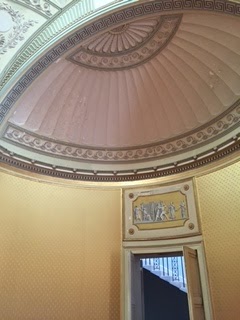
(I  love the colours of this room with its pink cupola)

And that ought to be the end of the matter, right? But it never is. They begin to produce more and more arguments in favour of joining: special discount prices, different benefits you get from membership etc.  I explain all over again that I'm quite happy to pay to get in to each house as I come to it ("But it's so much cheaper if you're a member...it all adds up!") but that does not deter them. They try again. Sometimes you have to go through about five whole minutes of near-argument before they will take your money and give you a visitor's ticket. So what I'd like to say to the  National Trust is: Ask people ONCE and then leave it. Don't try and pressure anyone. And please don't persist when it's clear that someone has no intention of joining the organisation. 

Now that I've moaned, I can add photos of  some more treasures from Wimpole Hall. When we were there, the very  new lambs were gambolling about and we had a smashing time.  I have not posted photos of my scone,  but anyone who wants to can find it on my Twitter feed.  


(Raised silver embroidery on the Chancellor's Purse)

(A china tulip.)


(Staffordshire dogs of a spotty kind)


(Rudyard Kipling's daughter Elsie and Captain George Bambridge)  


And finally, the façade of Wimpole Hall.  Thank you,  National Trust, for looking after these beautiful properties in a way which lets us all enjoy them. 

Friday, 15 May 2015

Settings

by Marie-Louise Jensen

I love having a real place to set my books. It helps me see the story playing out if I know the place. I used real settings which I named in my first two books. A little tricky, because I was then bound to the real history of the place. I made freer with my Icelandic books. I knew the places, but I didn't name them. So I was free to visualise the bay and hillsides, but could play a little with them.

In Runaway, I needed a big stately home for my setting. I chose Dyrham Park, which was just the right era, built in the early Georgian period, but wary of my experience of using Farleigh Castle, I renamed it Deerhurst Park. Now I had all the freedom I could want, to explore the beautiful setting on visits and imagine it, but without tying myself to its actual history and the people who lived there.


I could imagine the horses and carriages travelling down the wide sweep of the carriageway into the picturesque park. I could place characters at the lodge house (now a ticket office). I could describe negotiating a team of horses through the sharp turn into the gates and the archway into the stableyard:
I even knew what the stable yard was like - though it's now a tea room and a shop; as mentioned in an earlier post:
Here, I was able to imagine tethering and grooming the horses, harnessing them, riding them in and out, even walking them when they had colic. And I could imagine and describe all the daily coming and going of a busy stable yard and the people who once worked there.
I even felt familiar with the gardens and the view of the back of the house, which the servants would have crossed to go to church on Sundays:

An image of Dyrham Park even made the back cover of the paperback. So it's an open secret, but I still got to invent my own people and story for the place. 
I'm sure other authors can successfully use imagined settings, but I definitely find real ones easier and more vivid. And it gives me an excuse to post all these lovely pictures. Perhaps the real secret is that when I visit these incredible places, I love to imagine what it must have been like to live there. I suspect that might be the basis of a lot of our historical fiction.
Follow me on twitter: @jensen_ml