Showing posts with label history of fashion. Show all posts

Monday, 22 July 2019

An Appearance of Serenity: Christian Dior & Fashion in WW2 by Catherine Hokin

 V&A Museum: Wikimedia Comons
London’s V&A is currently hosting one of its most sumptuous exhibitions, Christian Dior: Designer of Dreams. It features clothes from the design house’s founding to the present day and, for anyone with even the slightest interest in fashion who can bag one of the gold dust tickets, it is a visual feast.

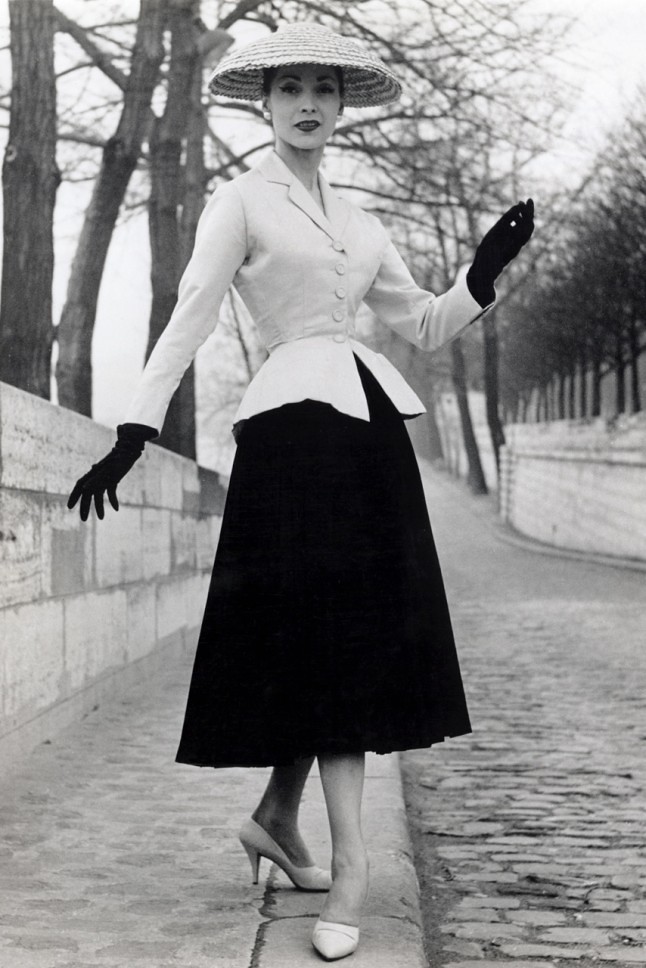
Christian Dior is synonymous with the full skirted, nipped-in-waist fashion revolution launched in 1947 and christened the New Look by American journalist Carmel Snow. At a time when fabric was severely rationed and clothes were plain to the point of austere, his billowing skirts took up to 17 yards of material, required taffeta linings to create their shape and made (in Dior’s words) “flower women” out of the “square-shouldered boxers” uniforms and wartime restrictions had created. Nancy Mitford described the “magic potion” effect of these dresses which were constructed with padding and false hips to give women made thin by rationing the required hourglass shape. Vivien Leigh, Olivia de Havilland and Rita Hayworth were devotees and Dior hosted a private showing of the seminal 1947 collection for the Queen Mother and Princess Margaret. The iconic dress he designed for the Princess’s 21st birthday is part of the current exhibition.

 Carmel evening gown, Andrew Stawarz, Flikr
Dior saw himself as a magician, one of the guardians who would return “French couture … to its traditions of great luxury.” His ethereal creations, in the words of his biographer Marie France Pochna, “brought dreams, drapes and romance back…onto the streets.” The New Look, however, was not universally applauded. One of the criticisms of the current exhibition is that, to quote Rachel Cooke’s Guardian review, “it exists in a bubble”, without context. There were protests in America against styles which were seen as a reversal of the freedoms women had won during the war, under the slogan (coined by the Little-Below-The-Knee Group) “We abhor dresses to the floor!” Closer to home, a 1948 photo shoot in Montmartre’s Rue Lepic led to a model’s dress being torn off by a shortage-hampered public furious at the excess. In Britain, Alison Settle, the editor of British Vogue, was forbidden to even mention Dior by a Board of Trade fearing a run on the country’s restricted fabric supplies. None of this features in the exhibition. Neither does the wider context from which Dior emerged: the fashion industry of occupied Paris.

 Hitler in Paris
An appearance of serenity is a quote from Lucien Lelong, one of pre-war Paris’s leading couturiers, Dior’s mentor (he worked for Lelong from 1941-46) and the man credited for saving the French fashion industry during the German occupation. As with all aspects of the occupation, the story of the fashion industry’s survival is a complex one. The history of WW2 is littered with ruined cities: in May 1940 with the Wehrmacht closing in, Paris could have expected to become the next Warsaw or Rotterdam. Hitler, however, viewed Paris as the model for the Berlin he planned to build. Protecting its culture heritage, albeit stamped with a German ideology, would show the world the National Socialists’ civilised face, and a key part of this culture was the fashion industry.

Germany’s desire to supplant France as the world’s fashion leaders pre-dated WWI. The fall of France in 1940 was seen as the perfect opportunity for this ambition to be finally made good: the first edition of Die Mode, published in January 1941, stated that “the German victory over France has an incisive meaning for fashion.” Other articles continued this theme: the trade publication Manufaktur was quite clear that “the fashion of the past was Paris – the fashion of the future lies with Greater Germany.” The Nazis’ plan, to be put into immediate operation in 1940, was to merge the French couture industry into the German one by physically relocating its ateliers and workers to Berlin and Vienna. Lucien Lelong, in his role as head of the Chambre Syndicale de la Haute Couture (the industry’s official body) was informed of both this and its alternative: the total suppression of the industry. Lelong, argued, and kept arguing, that the industry’s 20,000 workers and fragmented supply chain could not be uprooted and transported and survive. For whatever reason – whether (as he claimed) it was Lelong’s persuasive skills or the pressures of the Battle of Britain and the opening Russian Front – the Nazis dropped their demands and the French fashion industry was left to be just that.

 Dior's New Look Paris 1947
Haute Couture survived in Paris, albeit with mixed fortunes. Lelong continued to show collections as did Jacques Fath, Marcel Rochas and Nina Ricci. Coco Chanel became a supporter of the Vichy. Other designers, including Mainbocher, left. By 1944, 12,000 people still worked in the industry and over 60 salons remained open. The question of collaboration remains a thorny and nuanced one. Lelong remained vocal in his view of fashion’s importance in giving “France an appearance of serenity…the more elegant French women are…the more our country will show…it does not fear the future.” Schiaperelli likened fashion to resistance: every hat that used up material was “a slap in the face of the Nazis.” Berlin appeared to view occupied Paris as a fashion bread-basket: over 200 Nazi wives acquired special permission cards to buy fashion from its salons. Lelong was tried for collaboration at the end of the war but acquitted, ruled to have only co-operated minimally to save jobs and France’s cultural heritage. He stayed in Paris long enough to celebrate his protégé Dior’s 1947 collection but then retired due to ill health.

It is not surprising that Dior, the dreamer and magician, would launch a collection with such a romantic view of the world; it is not surprising a glamour-deprived world, largely, fell in love with it. It is the V&A’s choice to stage an exhibition where context is outside the remit. But it’s a shame. Fashion doesn’t exist in a bubble: from dandies to punks it reflects the world it comes out of and its story runs deeper than simply paying homage, no matter how beautiful the dresses might be. For anyone wanting to read wider than the skirts, can I recommend Nazi Chic by Irene Guenther which tells the story of both Germany and Paris and makes fascinating reading.

Friday, 30 March 2018

Cabinet of Curiosities by Charlotte Wightwick - Fashionable Fruit: the craze for pineapples

Pineapples are having a fashion moment. Everywhere I look, I seem to see them: on clothes, jewellery and homewares, from shoes to jumpers, necklaces to candle-holders, pots and knick-knacks. It isn’t hard to see why. They are immediately recognisable, brightly coloured and – at this drab end of winter - evoke tropical sunshine and exotic locations. As a design feature, what’s not to love?

It isn’t the first time the pineapple has been at the centre of fashion. In the eighteenth and nineteenth century there was a craze for the ‘king of fruits’ – and the reasons for it were very different from today.

Dunmore Pineapple
Source: Wikimedia Commons
Pineapples originated in South America. They were cultivated very early, due to the fact that in the right conditions they will fruit all year around. Early western explorers brought them back to Europe – and across to other tropical regions, where they quickly spread - as an example of the abundance and exciting discoveries of the New World. During the seventeenth century, such was their rarity that they were given to royalty as gifts. The symbolism around them – as the king or queen of fruits, as a representation of a new Eden, or of a new tempting ‘apple’, even associations in Catholic countries with the Virgin Mary – quickly grew, as did their reputation as the most delicious of all fruits.

By the early eighteenth century, the quest was on to grow pineapples in Europe. This was difficult – they need a constant tropical air and soil temperature to thrive, and the technology was not initially available. This changed with the development of hothouses, initially in the Netherlands. These swiftly spread across Europe and by the middle of the eighteenth century, it was fashionable for rich aristocrats to have their own ‘pinery’.

C18th Wedgewood tea canister, pineapple design.
Source: Victoria and Albert Museum, London
No-where, it seems, was this trend more pronounced than in England. A movement towards conspicuous consumption meant that pineapples became the ultimate in luxury. Hothouses were incredibly expensive to build and expert gardeners were needed to nurture the delicate plants over the two-three years it took for them to fruit. In the eighteenth century, it was estimated that the “the average total cost of the cultivation of just one pineapple was about £80 (nearly £5000 today) – about the cost of a new coach.”*

Pineapples became a necessity at the grandest dinner parties and country-house gatherings, crowning a pyramid of fruit as a mighty centrepiece. But such was their expense that they were often left intact, not eaten, and re-used over several weeks until they started to rot. In some places, it was even possible to hire a pineapple if you wanted to impress your guests, although of course it was much better if you could take them on a genteel tour of your very own hothouse.

The craze for pineapples went further than just for the fruit itself. They swiftly became used in all sorts of places, on items as diverse as clothing, reticules (small handbags), snuffboxes, wallpaper and crockery. Having your portrait painted with a pineapple also seems to have been a popular choice, as the example below from the Cwmmau Farmhouse, owned by the National Trust, shows.


Gentleman proudly holding his pineapple,
Cwmmau Farmhouse, National Trust.
Photo: author's own
The motif became embedded into architecture, with stone pineapples often decorating the tops of pillars and gates, especially at the entrances to grand stately homes. No-where is this shown more clearly than in the mighty Dunmore Pineapple (which can now be rented as a holiday cottage from the Landmark Trust!) This has led to the supposition that the pineapple was seen as a symbol of hospitality, although Fran Beauman convincingly argues in her 2005 book ‘The Pineapple: King of Fruits’ that for many it was much more about asserting status and conspicuous consumption than hospitality per se.

By the mid-nineteenth century, the first imported pineapples started to appear, at much lower prices than the home-grown version. Although this meant that a taste of the fruit was within the reach of a middle-class household for the first time, the fruit was often in poor condition and English pineapples remained a true luxury item for the time being. The advent of refrigerated shipping and improved canning methods towards the end of the century and in the early years of the twentieth, however, spelled the end for the pineapple as a symbol of social cachet.


* Fran Beauman, The Pineapple: King of Fruits (2005, Vintage)

Wednesday, 23 December 2015

Did they really have platform soles in the 1940s? And other Recency Illusions by Leslie Wilson

French fashion, 1941
My lovely editor for Saving Rafael at one stage asked me: 'Did they have platform soles in the Forties? Well, yes, they did, and here's a picture of them. In fact, I can remember my mother groaning: 'Oh, not again!' when they came in thirty years later.

This is a nice example of what I saw described in the New Scientist as 'the Recency Illusion,. ie, the idea that certain innovations, technology, slang, fashion, language etc are far more recent than they in fact are. I find myself caught up in it myself, quite often. For example,would you believe that in 1880s Hong Kong, there was a telephone installed at Government House? There was, though (I was startled to learn, when writing The Mountain of Immoderate Desires), and it communicated with the second Government House on the Peak, demolished later by a typhoon, and, when we were in Hong Kong, nothing but a cement platform overgrown by morning glories.

I remember the late and lovely PD James falling prey to it when she told an interviewer that thank heavens, when she was a child, the word 'kid' was only applied to baby goats. However, I have to respectfully contradict her here: E. Nesbit uses the word 'kids' (See: 'The Wouldbegoods' (published 1901, nine years before PD James was born), and also I have an obscure novel called 'The Quaker Bonnet', published in 1913, where a maidservant describes the heroine as 'the weirdest kid that ever I had to do with.' Once again, I suspect that if I put that in a book set at that period, several people would object to my use of 'modern' language.

A copy-editor objected to my use of the word 'cool' in Last Train from Kummersdorf, saying that the word in its current meaning dated from the 1990s. It was, of course, used in my youth, quite a bit before the 1990s, but I had also (being that kind of author) double-checked that the word was used in the sense I was using it in the 40s, using a Louis Armstrong lyric for validation. I suppose it's not surprising that a younger person should find it hard to believe their 'own' slang has such a long white beard on.

One of the oddest ideas I have often encountered is that people didn't use contractions in speech in the past. I mean, don't, shan't, she's, etc. A student on a creative writing course I tutored told me in all seriousness that in the past (in this case the early 20th century) people never used these forms, even in speech. I referred him to Jane Austen, but he was still sceptical. But here is Squire Bramble, in Smollett's Humphrey Clinker, first published in 1771. 'I an't married to Tabby, thank Heaven' and: 'Not that she's a fool.' Or: 'I dare say you won't wonder at the progress the writer had made in the heart of a simple girl.' People also abbreviated names, such as Tom, Tab, etc.You, gentle readers, all know this, but this person didn't, and doubtless he's not alone.
The balloon races


Also, I was reading about the balloon races from the Vincennes site of the 1900 Paris Exhibition in a book I picked up in Paris once, and came across the expression 'le recordman.' It being self-explanatory, I had no need for any translation, but this was a 1900 account. If I were to write a novel about the period and put that very modern-sounding expression in, I'd bet a huge amount of people would regard it as an anachronism (and pick me up on it.)

Then there was the person who wrote to me and complained that I had a character called Marlene in between-the-wars Weimar Germany (in my first, not very wonderful novel). This lady seemed to have a kind of proprietorial passion for Marlene Dietrich, and she had been led astray by the story (presumably related by the lovely Marlene to her daughter and recorded in said daughter's biography of her mother) that Dietrich had run Maria Magdalene together to invent the name of Marlene. In fact there was a character called Marlene in one of my mother's German children's books, first published in 1913, which was why I chose the name. Dietrich was admittedly twelve in 1913, but it's unlikely that she had both invented the name for the first time and got it into universal currency by that time. In fact German names are often telescoped like this 'Annelie' for 'Anne Liese' for example, or 'Annegret' for 'Anna Margarethe'.

Another lady recently wrote to the Guardian style editor objecting to the use of the word 'freighted'. It was not a verb, she said, and she couldn't find it in her Oxford dictionary. However, the Guardian found it, as an archaic usage, in their Collins dictionary (it’s in my Chambers, too). I am quite certain I have read 'freighted' in some poem or book, but the source escapes my mind. Anyone know? Incidentally, 'miffed' was a word I only knew through the pages of Georgette Heyer, till it returned to common usage in the latter part of the 20th century.

Something that fascinated me was finding, in the diaries of Thomas Creevey, a noted Regency Whig, 11th May: 'A telegraphic dispatch announces that Lord Whitworth (Ambassador to France) has left Paris.' This was the ending of the Peace of Amiens, and the telegraphic message was in fact sent by semaphore, the real-life source of Terry Pratchett's Clacks Towers (or is it Clax?). However, when, in 'Our Mutual Friend', (1865), telegrams are sent by Mr Veneering's supporters, when he's purchasing his seat in Parliament, they really were sending electrical telegrams as I remember them before the invention of the fax, the email, and the SMS text. The first commercial telegraphy service in Britain, according to Wikipedia, was installed on the Great Western Railway system, between Paddington and West Drayton in 1838.

Diagram of a Prussian semaphore tower.


Any other contributions to this litany of things more ancient than we think they are?

Meanwhile:  
A VERY HAPPY CHRISTMAS TO ALL OUR READERS!!