
'Speak properly,' my mother was forever reminding me as a child. By which, of course, she meant don't use Scots - either the words or the grammar. Fortunately my dad did use it, so I know and understand the language of my country. How much richer is Haud yer wheesht than Be quiet.
On one memorable occasion, when Dad came to pick me up from university I introduced him to some American exchange student friends. His greeting was, ‘Aye, and it’s a gey dreich day the day is it no.’ Blank looks all around – although he was right. It was a damp, dreary day.
Because of the general injunction to speak properly I always thought Scots was a form of corrupted, and inferior, English. When I came to write my first book The Castilians, which is set in St Andrews, Scotland, one of the many things that exercised my mind was what would be considered ‘correct’ speak in 1546.
I soon discovered that Scots is a language in its own right. It seems both Scots and English, are descended from the same Germanic language — Anglo-Saxon, although Scots also contains words from and Old Norse, like bairn and kilt, and Dutch, like haar (a sea mist). From the early 1400s it began to replace Latin in formal documents and statutes. Court poets, playwrights and story tellers also started to write in Scots.
Here’s William Dunbar (1490s) complaining about having a migraine or, as we’d say in Scots, ‘a verrie sair heid.’
Here’s William Dunbar (1490s) complaining about having a migraine or, as we’d say in Scots, ‘a verrie sair heid.’
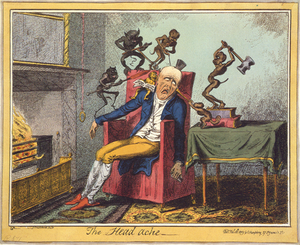
Cartoon by George Cruikshank
My heid did yak yester nicht,
This day to mak that I na micht.
So sair the magryme dois me menyie,
Perseing my brow as ony ganyie,
That scant I luik may on the licht
My head did ache last night
And today I could not write.
So sore does the migraine hurt me
Piercing my brow like an arrow
That I can scarce look at the light
(Any errors in translation are entirely mine – and my Scots dictionary)
When Mary Queen of Scots returned to Scotland in 1561 she could barely remember her country’s language after living in France from when she was a small child. French was spoken amongst the nobles but Scots was the principle language and so Queen Mary learned to speak it rather than English.
John Knox, on the other hand, returning to Scotland just in time to make life difficult for Mary, had slipped into speaking English. He’d lived in Geneva for a number of years, where he led an English congregation and also wrote his many works in English, including The First Blast of the Trumpet against the Monstrous Regiment of Women.

There were two main reasons that contributed to Scots ultimately being considered as not ‘proper’ speak.
After the Union of the Crowns in 1603, when James VI of Scotland departed with all possible speed to wealthy London his language, certainly in papers and letters, becomes anglicised.
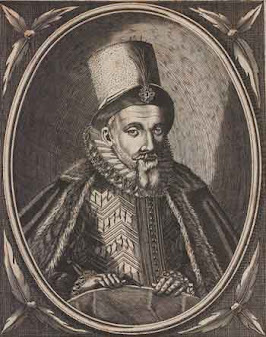
James VI and I
Here’s an extract from his Counterblast Against Tobacco… A custome lothsome to the eye, hatefull to the Nose, harmefull to the braine, dangerous to the Lungs… Translated into Scots – ‘smokin’ is verra bad fur ye’. Perhaps a pity he didn’t use his kingly prerogative and ban tobacco at the time, but in any case he increasingly spoke English (no doubt with a good Scottish accent), so the upper classes did, and it rapidly became a sign of wealth, and standing, to speak English – and still is.
Scotland turned Protestant in 1560. A core component of Protestantism was that everyone should learn to read the Bible themselves rather than having the Latin version interpreted by the church. This meant that we needed bibles, and lots of them, quickly. Initially the Geneva version, which was written in English and published in 1557, was adopted. This was closely followed by the King James (sixth and first) version in 1611, also in English. Scotland soon had one of the highest literacy rates in the world – but everyone was learning to read in English, and not the Scots they spoke at home. And surely, the language you are communing with the Lord in must be the correct one to speak…
We did see a revival in the use of Scots in the 18th century, most famously exemplified by that charming philanderer Rabbie Burns, but it was more an entertaining curiosity for the wealthy than any genuine resurgence. Nevertheless Burns saved lots of songs in the vernacular which would likely have disappeared if he hadn’t written them down.
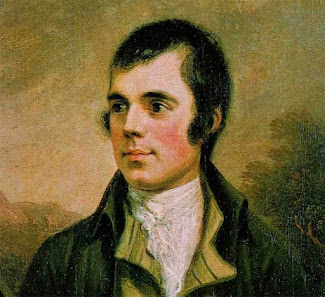
Robert Burns
He’s probably most famous world wide for Auld Lang Syne (Old Times Past) sung at countless Hogmanay celebrations and then there’s Burns Night on the 25 January every year when the haggis is stabbed with gusto whilst being addressed in good Scots.
In writing The Castilians I took the decision, since Bethia’s Mother had lived in England, that Bethia would speak an anglicised Scots although I do have some characters who use Scottish words, (I provide a glossary). Initially, I had far more Scots in it, but I did want the book to be read, and understood, widely. It’s always a balance…
Scots is the language of the Lowlands, Orkney and Shetland, and Northern Ireland (Ulster Scots) and even within that there’s much variation. The accent and some of the words used are quite different between say Fife and the Doric of the North East and then again Orcadian.
But at least Scottish-speaking children didn’t suffer the fate of their Gaelic counterparts (Gaelic was never the language of Lowland Scotland). In the last century, children in the Highland and Islands were often beaten if they spoke Gaelic in school. I was fourteen before I first heard it, on holiday in the Western Isles. Thankfully Gaelic was saved in the nick of time, and is now more widely spoken. And as for Scots, well we’ve hung on tae it despite aywis being telt tae speak properly.
crabbit; scunnersome; drookit; gowk; oxters; guddle; midden; glaikit; besom
For more information on Scots see https://www.scotslanguage.com and also the Scottish Language Bill which the Scottish government is currently consulting on.
.


