Showing posts with label Silesia. Show all posts

Saturday, 23 December 2017

Advent Calendar Door number 23, by Leslie Wilson


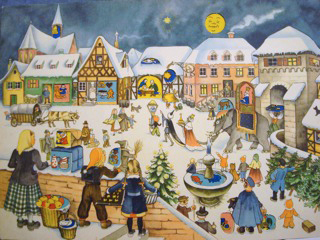
Here is a view of the Old Town in Mainz, which I visted in November. There wasn't any snow, but I did feel as if I'd been transported into my favourite Advent Calendar from childhood. It came from Germany, as all our Advent Calendars did, and it featured just such a picturesque old German town, but in the snow, with people buying presents and Christmas trees and pulling them home on sledges, and bakers' shops selling Christmas goodies. We used to keep Advent Calendars and re-use them, and I did so love that one, mending its doors with sellotape when they began to come away. The problem was that the doors didn't keep shut after a while, for all my pushing them and getting annoyed with them.
https://upload.wikimedia.org/wikipedia/commons/6/64/Marianne_Schneegans_Adventskalender.jpeg

This Advent Calendar, by Marianne Schneegans, is from the 1940s, but it gives the general idea. There is something Breughel-esque about the scene, which is probably not by chance, when I think about it.
So I thought I would open a door on an Advent Calendar for you, and find a picture of myself, at the age when I was opening Advent Calendars and yearning for Christmas to come soon - as opposed to adulthood, when one counts the days and hopes for more time..

What I find inside the door is not an orange, or a Christmas tree, or a picture of a present, but my childhood self at age 10, playing the piano on Christmas Eve in Kendal, and concentrating hard (for I'd only just started lessons), while my brother, who was and is far more musical than I am, played violin. On top of the piano you can see another Advent Calendar, shaped like a Christmas tree, which also came out every year.

That was 1962; the Berlin Wall had been built eighteen months earlier (I remember that, and the shock in our household), and John Kennedy was still alive, though it wasn't till June the following year that he visited the city and announced that he was 'ein Berliner.' The Berliners were more than pleased with his support, but characteristically amused that he'd announced that he was a doughnut. He would be assassinated in November the following year, something I also remember, though I have no idea where I was when I heard about it. I can remember the pictures in the paper, that's all, and looking at them as the papers lay on the sitting room floor. What I do have a vivid picture of in my mind is myself standing in the garden of my school, and another girl coming up to me and saying: 'We're waiting for the Americans to send their rockets to Russia, and the Russian rockets to come back, and that will be the end of the world.' That was the Cuban missile crisis, in October of that year. I knew about the bomb, and approved of the Aldermaston marches. I had even got hold of a CND badge from a young man in the youth club my parents ran at the YMCA.

I had gone to grammar school at just 10, something for which I was academically, but not emotionally ready. Quite a lot of my classmates were almost 12. The other girls asked me if I liked Cliff or Elvis, and I said 'neither', so they told me I was 'square.' I still don't like either, and at Christmas 1962 I didn't yet know that salvation from squareness was at hand. The Beatles had released 'Love Me Do', also in October, and I was going to really like the Beatles. I still do.

What were we playing that night? Probably 'Stille Nacht,' the haunting carol composed by Joseph Mohr, which for me epitomises Christmas. In my childish head, the beautiful simplicity of that melody rang out through a snowy mountain landscape, not in flat pre-Alpine Oberndorf, where it was first sung.

 My mother was born in Silesia, and she told me about spending Christmas in Giersdorf, now Podgorzyn, in the Riesengebirge/Karkonosce/Krkonosce mountains where my great-grandfather lived, where in winter the snow came up to the first floor windows and a tunnel had to be dug through it to get into the front door. So here is an Advent Calendar door in advance for Christmas Eve, with this 1930s postcard of a mountain hut now on the Czech side of the mountains (I had hot chocolate there a few years ago, in summer), and the snow making the trees into meringues. My great-grandfather did have to pull the Christmas tree back on a sledge. It must have taken quite a while to get the snow off it, mind, and it was decorated with handmade straw ornaments, my mother told me. On Christmas Eve there was carp (the area is full of carp ponds from old monasteries), and they'd have the bread and milk and ground poppyseed pudding which we shall eat tomorrow night, which is peculiar to that part of the world.


WISHING ALL HISTORY GIRLS READERS A BLESSED HOLIDAY AND A PEACEFUL NEW YEAR.

Tuesday, 23 July 2013

Great-grandparents, by Leslie Wilson

Eight people who I never knew, but they are crucial to me, and part of me; I carry bits of their bodies around with me. And there are other things I wouldn't know about; mannerisms, foibles - all part of the genetic heritage that was passed on to me through my ancestors.

I think ancestors must begin with great-grandparents, though perhaps not if you knew them. But all of these people died well before I was born; indeed, two of my great-grandmothers, I know, died before my mother was born.

The Bakers, my father's grandparents, are the ones I know least about, because my father never knew them. Great-Grandad Baker, I know from my aunt Mollie, was a coastguard at Gosport. The story she told me was that one day he came into the coastguard station and found his colleague hanging there, having committed suicide. The man had been an alcoholic, and my great-grandfather forthwith foreswore all alcohol. Whether he subsequently became a Methodist (my granddad Baker was) or whether he already was, or whether it was his son who joined that church, I do not know. Of Great-Grandma Baker, I know nothing at all.

My other paternal great-grandparents were Henry and Ellen Jacques. Here they are.

Ellen and Henry Jacques, date unknown

Henry Jacques was born in Liss, in Hampshire, in 1833.  Family tradition has it that he was of Huguenot descent. He began his working life as a porter, then became a maltster, which means that he treated barley with malt to brew beer. Later he became a signalman at Midhurst, Sussex, but three railway lines went through Midhurst, and I don't know which one he worked for. My father remembered him as a quiet, retiring man, and he died when Dad was still young, of dropsy - maybe heart failure? But his smile, and his stance on this photograph make me think of my father.

Ellen was twenty-five years younger, born as Ellen Norgate in the pretty village of East Meon in Hampshire in 1858.
street in East Meon


We visited East Meon the day after our daughter's wedding: curiously she chose to be married in Midhurst, in the Walled Garden, Cowdray, without any idea of the family connection with the place. When Ellen Jacques lived at 6 Station Road, Midhurst, Lady Cowdray used to graciously call on her - so maybe she was a tenant of the Cowdray Estate. Anyway, Ellen's mother, Ann Norgate, had a whole string of children, with nary a father listed for any of them. Whether this meant that the father had disappeared, or that they all had different fathers, or that they just didn't want to give the money to the parson, I have no idea. When my father was told this (as a result of my brother's family history research) he sat there gobsmacked, saying: 'But Grandma Jacques was always so respectable.) When she came to visit her daughter's family, she used to ask my father how much money he had in his money-box, and then double it, which was an incentive for him to save. Much later, when he was a young man and his father died (which he did when Dad was 17) my father cycled over to Midhurst from Bristol and stayed with his grandmother in her cottage. Ellen has passed on to me and to my brother her cheekbones, and also I think my eyebrows and eyes are like hers. There is also a look about her face that makes me think of my daughter Kathy, the one who was married in Midhurst. There she stands in her pre-World War One costume, decent black, with the little brooch at her neck. She lived to see that war, but not the Second World War, and was an old woman in the between-the-wars era we love so much to read about nowadays.
East Meon church
font, East Meon church
She and her husband were married in the impressive church at East Meon, and there, I guess, she was also baptised, in the wonderful font which was brought to England from Tournai, which is now in Belgium, in about 1130-40.
Here is the census entry for the family in Midhurst, in 1911. My great-aunt Nellie was then a 'Malta Lace Assistant' - she must have sold Maltese lace (fascinating that the shop sold enough for her to specialise); she later married a soldier, my father's Uncle Sam, who she reclaimed from 'a life of vice' though what that vice consisted of my father never managed to find out.
Helene, Maria, Erich, Gustav, Martin and Bernhard Roesel, Giersdorf im Riesengebirge, perhaps 1905?


So here are my Roesel great-grandparents. Gustav (who my mother said was a postman, but who appears on a census as a mason - but people in mountain areas often do several jobs) was born in 1866, eight years after Ellen Norgate, in Loewenberg in Silesia (now Lwówek Śląski, Poland). My mother remembers him as a forthright, rather crusty old man, who didn't like the Nazis. Maria Roesel was born in 1870, but where I do not know. I only know her birthdate because she appears on an application for a visa to transit Belgium on the way back from England to Germany, which my grandmother had to fill out in 1951. My mother kept it, probably because of the family data, and now I have it, though it is gradually separating into two halves. My great-grandfather moved at some stage to Giersdorf/Podgorzyn, where my grandfather was born. Maria died when my grandfather was quite young, of TB, but my mother was thought to resemble her. Luckily she didn't inherit the protruberant ears, which she passed on, as the photo shows, to Martin and my grandfather Bernhard. I do remember Opa's sticky-out ears. My mother didn't have the beetling brows either, but Maria may have looked a lot prettier when she wasn't having to sit still for ages for a photographer, with a wriggling baby on her lap. If my mother got her straight nose from Maria, that is where mine comes from, too. When we went to Podgorzyn (once Giersdorf) in 2010, I left some sweet rocket flowers for her in the flattened graveyard of the one-time Protestant church, where, presumably, her bones are laid. We also ate in the inn in Podgorzyn (sorry, there should be an accent on the second o, and I can't put it in here) beneath the nest of a stork whose ancestors may well have nested there when my great-grandparents were alive.

The land they lived in is now Poland, rather than Germany, and the people who came there were expelled from their own homes in the Polish Ukraine. Maria never experienced that upheaval, but Gustav was deported from Giersdorf after the Second World War, and my grandfather tried hard to persuade him to come to the Rhineland to join him. But he refused to come, because he didn't want to believe he wouldn't ever see his beloved mountains again, and he died in a displaced persons' camp in the Russian Zone. Just one of many such stories, as whole peoples were moved about after the war. It does make me sad.

landscape in Riesengebirge/Karkonosce
His life, however, was like something from Heidi. He was a mountain man; he bred Saint Bernard dogs, one of which was my mother's especial friend when she was small. It was quite normal in winter for the snow to engulf the ground floor of his house; my mother remembered going to visit him and exiting her bedroom window on skis. He kept goats (I have a photograph of my mother in a basket with a kid) and milked them - or maybe Maria did that. He'd have chopped huge woodpiles for the winter, as you can still see in Alpine villages, and she - or his second wife - would have put up fruit and vegetables in jars. When the Poles arrived after their horrific journey from the Ukraine, they were delighted to find all the preserves, and the houses so tidy and well-appointed. Though I gather, from what I was told when we went to Silesia, that it was hard for them to settle down; they always thought the Germans would come back, just like my great-grandfather. I think now their descendants feel more at home, and that is a good thing.

Here, from that same transit visa application, are the names and birthdates of the Kolodzej great-grandparents. Kolodzej is a common Polish name, incidentally, and means Wheelwright. Franziska, I see, was older than my great-grandfather Simon, and both were older than my mother's paternal grandparents. Franziska also died of TB, as did two of her daughters, my great-aunts.My grandmother was seven when she lost her mother. Simon and Franziska were both born in Cosel, now Koźle, near Opole in Upper Silesia and they were Catholics. I know nothing of Franziska beyond the fact of her death, but my mother remembered Simon as a gloomily religious man, pro-Nazi, antisemitic, and scary. He went to live in Zabrze, where my mother was born, and where he managed an iron-works. I think he had money, which he put into property because he was convinced that was safer than investing on the stock market. He was wrong, though his descendants put in an application, post-war, for restitution of at least one of the dwelling-houses he rented out. I guess they got it. I have the form, again, which has more family information on it. I don't know when Simon Kolodzej died, but I think it was before the end of the war. He remarried, after Franziska's death. His second wife had been sent as his housekeeper from a convent; she was no aristocrat, however, as in The Sound of Music, but a foundling who had been abandoned in a basket at birth, and it was considered a scandal that such a well-off man should marry someone with such a shady past. I have never found any record of her children, though, nor did my mother talk about them, so I guess the marriage was childless.

They lived in a world quite different from the one that we live in, and I sometimes wonder what any of them would have thought, if they had known how their genetic material would travel and mix up; it is a long way from Hampshire to Silesia. And in the next generation there came in Northern Irish protestant stock, from my husband David, and now my three grandsons descend on their father's side from Scots and East End Jews. One of my nieces has a British husband of Asian ethnicity. But that - as I said two months ago on this blog - is what being British is all about!

All colour photos by David Wilson.

Saturday, 23 March 2013

From Tyrol to Silesia; persecuted Protestants, by Leslie Wilson


If you go to the Polish village of Mysłakowice in Silesia, you might be rather surprised to find, among the other houses, some chalet-style houses that seem to belong rather to the Alps than to Poland. There are also some nearby, on the outskirts of the village of Sosnówka.


These houses were built by a group of Protestants who were expelled from Zillertal, Austria, in 1837, (hence the German name for the village: Zillertal-Erdmannsdorf) and according to my mother, we were descended from them via her grandfather, Gustav Rösel, who lived in Giersdorf, Silesia, nowadays Podgórzyn. Rösel is not one of the names of the emigrants, so if my mother's story is true, it may have been my great-great-grandmother who was one of this group. Frustratingly, I haven't managed to find out her maiden name: it's particularly difficult, since many of the records were destroyed at the end of World War II. I contacted the organisation of the Zillertal descendants, but they weren't able to help me.


The Zillertal people first came into contact with Protestantism during the seventeenth century in an atmosphere that linked religious radicalism with political ferment; the German peasants' revolts of the time, the sect of the anabaptists, and general discontent at social injustice. Catholicism, in Austria, was linked to authoritarianism and absolute monarchic rule. Reading the Bible, for yourself, coming to your own conclusions about what it meant, defied that authoritarianism.

 
Monument to the Zillertal Protestants outside the museum
to them in Mysłakowice

But the Zillertal Protestants didn't at first openly challenge the authorities; they quietly read the German Bibles they had bought on their travels into Protestant lands, selling leather goods,cattle, scythes, gloves, and so on. Some Zillertalers travelled as far as Hamburg and Amsterdam, where they set up small settlements. Without clergy, sharing the tasks of ministry among themselves, they lived as they thought was right. That isn't to say that there wasn't conflict in the valley. In many cases, family members disagreed about religion; some being Protestants, some Catholics and there could be tragic disagreements among them.


When Emperor Joseph the Second (the one who is caricatured in the film 'Amadeus') issued his 'Patent of Tolerance' which made it possible for many Protestant groups to practise their religion in Austria, it did the Zillertal group no good, because they didn't qualify for tolerance. They needed five hundred members, but only had four hundred or so. As a result, they were persecuted.


In the days before the Internet, the only information I could find out about them was in a book written by a Jesuit priest in the 1950s, which I read in the British Library. This Father was an excellent advocate for the Zillertal Protestants, because he was so biased against them. They 'disrupted the last rites for the dead,' he said. Sounds bad, doesn't it? This is the example the Jesuit gave. Dying Protestants had to put up with the priest coming and disturbing their last hours by telling them they were bound straight for Hell, and trying for a deathbed conversion. On one occasion, a man seemed to be giving way, whereupon his friend, who had managed to stay with him, said 'Sei Stad.' (Be firm). For this the friend was brutally whipped. This is the Jesuit Father's story, and he thought those two words counted as 'violent disruption.'

 They were not allowed to inherit land, or to rent it, and also their marriages were regarded as invalid, nor were they allowed to be buried in any kind of religious graveyard. Savage punishments for persisting in their faith were common, though at other time the priests tried to wheedle them into conversion. 

Tyrolean house outside Sosnówka: the guesthouse where
we had a lovely stay when we
visited the Karkonosce mountains
Eventually, they were given the choice: either renounce their faith, or be expelled as 'irreligious sectarians' (an ironic description, really.) They were forced first to be subjected to six weeks of Catholic religious teaching and a four-month 'cooling-off' period, before they could go. Only seven of the group were converted. The rest decided to go. This tore some families in half, and the decision must have been agony for many. Besides, they would be leaving their beloved mountains behind, and the way of life they knew so well.


To give the Austrian government their due, the Protestants were not simply expelled into the world with nowhere to go. The Emperor's minister Prince Metternich negotiated with the Prussian King to take them in, and they received the immigration permit on the twentieth of July 1937. The spokesman of the Protestants wrote to the King, very movingly, thanking him for his generosity, and asking him to settle them somewhere like their own mountain home, used as they were to agricultural work. In fact they were settled in Lower Silesia, in the foothills of the mountains the Germans call the Riesengebirge, and which are called the Karkonosce in Polish and Krkonosce in Czech.
The writing on the balcony says: God bless King Friedrich
Wilhelm. It is a replica: the original is in the museum


 It wasn't easy for them to make the long journey, nor was it easy for them to settle, once they arrived. In the first year, they couldn't get a harvest from their new farmsteads, nor did they have, in the first years, the right knowledge of the different conditions in the north. Disease cut some of them down, and some did actually return to Austria. Protestant aristocratic ladies made a charitable cause out of them at first, which annoyed the local farmers and labourers, many of whom were heavily taxed by their overlords in a near-feudal system and were not considered worthy objects of charity by the gentry. The aristocrats were later dismayed and annoyed when the incomers, instead of remaining eternally grateful, started to agitate against inequality as they had in their homeland 'they were never satisfied' my Jesuitical friend complained. My great-grandfather was a Social Democrat incidentally, as was my grandfather up till 1933 (but more of that next month).


After World War 2, the descendants of the Zillertal Protestants were of course expelled from Silesia along with almost all the German population, so their years in Silesia numbered little more than a hundred years.

Whether or not I ever find out which of the emigrant families we are descended from, the legacy of that family tradition has been very important to me; the idea of seeking out the truth for yourself, and not being bullied into believing what the authorities tell you you must believe. When I campaigned against nuclear weapons in the 1980s, even carrying out two acts of civil disobedience, for which I was prosecuted, I think the shadow of those 'stubborn' people were there, encouraging me. I would certainly think the tradition was part of what led me into the Society of Friends. I have good reason to salute them and to be grateful to them.

Thursday, 23 February 2012

German Silesia - from revolution to degermanisation, by Leslie Wilson

After the First World War, Poland, which had previously been split up between Germany, Austria and Russia, was now reinstated as a nation. At the same time, the future of Upper Silesia was in question. Naturally, both Germany Poland wanted this important mining and industrial area - and those members of the Allies - notably France - who desired above all the weakening of Germany were keen that Poland should have it. There was a plebiscite to decide which nation Upper Silesia should belong to.

There was apparently a suggestion, which wasn't taken on board, that the post-war settlement should allow Silesia to be an independent nation. That might well have satisfied the feelings of Silesians. But the plebiscite gave them the choice between becoming either 'Polish' or 'German.' The polls yielded a majority in favour of remaining German (59.6%). However, in the eastern parts of the region, the majority voted for Poland. Though Germany at first assumed that the poll result would give them the whole of Silesia, eventually it was decided that a segment (containing some of the richest industrial assets, such as Kattowice) was shaved off the east of Upper Silesia, and became part of Poland. During the campaign, there was brutality and intimidation from both nationalistic parties, and several Polish uprisings, culminating, post-referendum in 1921, in a bloody battle on the Annaberg. My grandfather, who was from Lower Silesia, fought there on the German side.

It's a line in his cv, a medal hanging next to his First World War medal. 'Für Schlesien,' it says. 'For Silesia.' He died in 1968, years before I got really interested in the topic. So I can't ask him about his motivation or his experiences. I do know that - as I've said in last month's blog - he was far more 'German' than my grandmother.


Anyway, the remainder of Silesia remained German, though the Silesian language was still spoken, that odd mixture of West-slav and German dialect; it continued to be spoken all the way till the end of the war, though the official language was German. Silesia, of course, went through the traumatic experiences of the rest of Germany during the next twelve years. First there was the horror of the Inflation period, then the gradual economic reconstruction, during which time my grandparents married and had one child - only one, because my grandfather said the times were too bad to have more children. But heavy unemployment and high child mortality persisted, even in Upper Silesia.

At this time my grandfather was studying hard for promotions in the police force. He was, like many of his colleagues, a Social Democrat. The SPD (Social Democratic Party) was the strongest party for many between-the wars years in the western parts of Silesia, while the Catholic Centre dominated in the east, unsurprisingly, given the largely Catholic character of that region.

There was an increase in violent anti-Semitism during those years, and in 1920, during the Kapp Putsch, six Jewish citizens of Breslau were murdered by the Freikorps (nationalistic extremists). Jews were discriminated against in their careers, and in public life. Nevertheless, the Nazis were for a long time a minority party, whose election percentages remained in single figures.

In 1929, the Wall Street Crash tolled the death-knell of Germany's fragile economic reconstruction, tossing millions into unemployment and poverty, and hugely boosting the popularity of both the Communist and the Nazi party. Their supporters formed paramilitary organisations who fought pitched battles in the streets - one of my mother's early memories was of mattresses being put in the windows to keep the bullets out of the houses. My grandfather, then stationed in Hindenburg/Zabrze, was out there, policing those battles, trying to keep his men from joining in, because - I have read - 'nowhere in Germany were the police harder on the Nazis than in Upper Silesia.'
In the 1932 elections, the Nazi upsurge amounted to 43.5% in the Breslau electoral division, 48% in Liegnitz - both in Lower Silesia - but only 29.2% in Upper Silesia, where the Catholic Centre remained strong. The Communists were also stronger in Upper Silesia than in Lower Silesia, though they only got 17% even there. As the world knows, in 1933, Paul von Hindenburg, the president after whom my mother's birthplace had been renamed, faced with the danger of civil war, decided to invite Adolf Hitler to become Chancellor. That was in January. On 27th February the Reichstag went up in flames, and the purge of the Left began. Communist and Social Democratic politicians were dragged off to 'wild' concentration camps, many of them murdered. Hermann Goering drafted a new law - to reform the civil service. The police came under this law, and my grandfather's career was severely threatened.

I've told the story, with very little alteration, in Last Train from Kummersdorf. He was accused of being a 'Leftist' - which he was - and saved because my grandmother went to 'a very important person' to plead for him But I shan't write at length about that today. In 1938, my grandfather was moved to Graz, in Austria, at the Anschluss, and never returned to work in Silesia, though there were many family visits.

In 1939, a faked 'Polish raid' on a radio transmittor in Gleiwitz was the excuse for a long-planned German invasion of Poland - and those parts of Silesia which had gone to Poland were returned to German rule. In an eastern corner of that section was a place called Auschwitz.

97% of the population of Kattowice/Kattowitz were frightened enough to claim that they were really Germans - but the Nazis ignored these assertions, and made their own division into Germans; ethnic Germans who hadn't asserted their German nationality before the invasion; persons of indeterminate origin, and Poles who hadn't been 'anti-German.' It was bad luck to be in the 'indeterminate' category. Worse luck to be Jewish, of course. But the horrors of the German occupation of Eastern Europe are well-known. Auschwitz moved into its dreadful place in history. There's something else, that I only found out recently, which is that throughout Silesia monuments and inscriptions that related to the Piast duchy of the past were erased during the Nazi period.

Silesia was a major location for munitions production during the war - but also a 'safe' area, supposed to be bomb-free. Towards the end of the war, there were almost half a million evacuees living there. But in 1944, the Americans, operating out of Italy, got their bombers as far as Upper Silesia. The end was coming.

On land, the Russians had already crossed the frontier into Poland. The rape and slaughter some members of the Red Army inflicted on civilian populations were useful propaganda to keep the Germans fighting to the bitter end. They weren't just 'atrocity stories,' though. Silesia suffered its share of this when the Soviet troops got there. And its Gauleiter, Hanke, decided to make a 'heroic' last stand in Breslau (now Wrocław). To which end he drove, old people, women and children out of the city, in temperatures of -15C. About 18,000 people of them died. Hanke didn't stay to the end, however. Like most of the Nazi leadership he ratted on the people, but not by committing suicide; he left by plane before the city fell, and was never heard of again. Breslau was left in ruins.


Many Silesians fled before the Red Army, and got a cold welcome further west; some refugee 'treks' like the ones I've described in Last Train from Kummersdorf were still wandering around a year later, unable to find anywhere to stay. The diarist Ruth Andreas-Friedrich described a barefoot Silesian child in one of these miserable processions who said: 'My feet hurt.' She lifted them up and they were raw and bleeding.

This time, the whole of Silesia was given to Poland. Churchill was against it, but Stalin insisted, because he wanted territory to resettle the Poles he intended to drive out of their own homes in the Polish Ukraine and Byelorussia. The official transports were formed in spring 1946, but even before that it was the turn of German Silesians to be driven from their home. Some were taken to prison camps, where many died.

One may say that this only mirrored the dreadful crimes Germany committed in Poland, but I think that's a cop-out, because those who suffered weren't necessarily the guilty parties. Neither the children who died in freezing cold railway carriages, or the little girl with the bleeding feet deserved what happened to them. Nor, I think, had my crusty old great-grandfather from the mountains, who hated the Nazis, and, having been deported at the age of ninety, died in a displaced persons' camp in the new East Germany, refusing all my grandfather's attempts to bring him to the west, because he couldn't believe he'd never see his home again.

In Upper Silesia, it was the middle classes who were deported. The working classes remained and were largely polonicised, which caused some suffering. They were to speak Polish, not Silesian, and all German-language inscriptions were now erased, just as the German government had tried to erase all trace of the Polish past. Even gravestones had the German writing hacked off. Here's one, in a churchyard in Zabrze.


In Lower Silesia the entire population was removed.Here's one of the deportation lists.


Meanwhile, new Silesians arrived, the people from the new Russian territories who were given the choice between becoming Russian or moving - or no choice at all. Traumatised and homesick, though these people were, glad to find themselves moving into the often comfortable homes the Germans had been expelled from - right down to furniture, crockery, and bottled fruit and jam- many of them never really settled down in Silesia, always afraid that the Germans would return and they would be be driven out again. The next generation, happily, is more settled.

And what does all this mean to me, personally? As a teenager, my school history books declared that Silesia, like Poland, had been invaded by Germany during the War, and that the Germans who were deported had been semi-criminal carpet-baggers. I knew this wasn't true. When I told people where my mother came from, people looked blank, so I gave up, and said my grandfather lived in the Rhineland.

But I can remember my grandmother weeping about family members 'driven out in the middle of the night, into the snow.' And I used to look at my toys and make mental lists of which ones I'd take, if we in our turn had to flee. That has given me, in adulthood, sympathy with the refugees and asylum-seekers so vilified in current society.

Many Germans, even, look askance at you if you say your family comes from Silesia - perhaps because of a pain they can't deal with. And I do wonder why people can't deal with what is, after all, simple historical truth? Silesia was my mother's birthplace, and my family's home. Now other people live there and it's their home. I totally accept that, but the country is nevertheless part of my identity. Why should I pretend otherwise?

In 2009, I finally visited Silesia, having wanted to for years. But I'll write about that next month, to stop this one getting as long as War and Peace.

At the moment, I'm reading Paul Berry and Mark Bostridge's biography of Vera Brittain; this is because I've just re-read Testament of Youth, and I wanted to know what someone else thought of her.

Monday, 23 January 2012

Silesia - the land between by Leslie Wilson

Although my mother was German, she only lived for a year of her life in what is now Germany. She was born in Hindenburg/Zabrze in Upper Silesia, and went to live in Graz when Germany annexed Austria in 1938. She was then thirteen. As a child I was confused about her pre-war nationality, because she talked about Austria so much I was sure she was Austrian. One day, however, she corrected me when I said she had been Austrian(she took British nationality when she married my father). And she told me that the part of Germany she'd been born in was now Poland. This is the house where she was born in 1925; it was then a block of police officers' flats


When I was a teenager, my brother began to learn Russian - and we were startled to hear my grandmother say - 'Oh, chleb for bread, that's the same as in Polish - and what's butter? Maslo? That's the same, too.' I'd never imagined that she spoke Polish - my mother certainly didn't. So I started to ask more questions. Where was she born? 'Zabrze,' she said. I thought: That's a Polish name. I asked her what her maiden name was, and she said what sounded like 'Kolotsi'. That sounded pretty Polish to me, too, and when I asked her to spell it, Kolodziej looked even more Polish. (In its Polish spelling, Kołodziej, it's a very common Polish name; I've been told it means 'Wheelwright.')

During my teen years, Omi (German for Granny) used to worry my mother very much by walking into Nottingham to attend the Polish mass in the Catholic cathedral, because it reminded her of home. My mother would drive into the city to try and pick her up, and once she asked me to join Omi there and come home on the bus with her. I can remember a general impression of candles and clouds of incense in the dark Victorian building, not at all like the airy spaces of the modern Catholic churches Omi attended in the suburbs. She was uncharacteristically annoyed to see me, and said quite shortly that she was quite able to come home on her own. It wasn't till recently, when I was reading about Silesia prior to finally visiting it for myself, that I discovered that Upper Silesians spoke a language called 'Schlesisch,' which was a dialect of Polish with German words fed through it. My brother said quite casually: 'Oh, yes, Omi told me she spoke Schlesisch, and played with Polish children when she was young.'


My grandmother never spoke English apart from a word or two - so when the liturgy of the Mass became English, the language was alien to her - but when she went to the Polish services, she must have understood everything, including the homily. No wonder she didn't want me arriving to take her away. Maybe she'd even made friends there and chatted to them in the language she hadn't been able to speak for so many years. I don't know.

Silesia has always been a place where peoples and ethnicities met. In early times, it was populated by Celts and Germanic Vandals (who left behind some very well-made artefacts, actually), before the Slavs arrived in the 6th century or so. Silesia then became a Polish dukedom; part of Bohemia; Polish again - then it reverted to Bohemia and came under Austrian rule when the Hapsburgs conquered Bohemia during the 30 Years' War. The eagle with the crescent moon and cross on the emblem, is the coat of arms of the Polish Piast dynasty, and I saw it in the St Vitus Cathedral in Prague, though nowadays only a sliver of Silesia remains in the Czech Republic.


Initially, it was a thinly-populated land, and the Krkonosce mountains
Riesengebirge in German) in particular, but Italian miners arrived to dig for the precious and semi-precious stones in the mountains' depths. The mosaics of Ravenna and Venice are made of stones mined in the Krkonosce. On the southern slopes of the mountains, Walloon miners came, felled trees for charcoal, and became part of a nascent and very important lead crystal production industry.

On the northern side of the mountains, Duke Henry 1st of Silesia encouraged German farmers, miners, and monastic orders to settle in the region. The farmers brought advanced agricultural technology to work on hitherto wildnerness areas. Löwenberg (now Lwówek Śląski), which was my great-grandfather's birthplace, was one of the new, German-worked precious metal mining towns. New towns sprang up, designed on Germanic plans and using German law. Breslau (Wrocław), the Ducal seat, became a Hanse town.

In the eighteenth century, Frederick II of Prussia defeated the forces of Maria Theresia, Empress of Austria, and the subsequent Peace of Dresden gave Silesia to Prussia. This brought more German settlers, especially to the smelteries, but also Protestant Bohemian settlers who became farmers. Mining and heavy industry flourished, especially in Upper Silesia. My mother's birthplace was a smelly, filthy place, where children were kept indoors for days on end, sometimes, because of the great flakes of soot that fell like black snow. But productive. Before World War 2, England was importing brown coal from Silesia.


My grandfather came from Giersdorf (now Podgorzyn) Lower Silesia, from the Riesengebirge. That state was by then predominantly Lutheran and German-speaking. Here's a photograph of the 'little lake' high up in the mountains, above my great-grandfather's home.


According to the Silesian-born writer, Horst Bienek, Upper Silesians were devout, extravagant if they could manage it, enjoyed life, loved celebrations and alcohol, and got into fights easily. They also liked to cry. Lower Silesians bit their lips bloody before they'd cry; they were thrifty, sometimes miserly. Both halves tended to be religious and mystical, but the religion of the Lower Silesians was 'light and rational' whereas that of the Upper Silesians was 'dark and melancholy.'

My grandfather- pictured below with his parents and sibling, the boy with the poodle-bow - wasn't a believer, and was quite happy to have his daughter grow up a Catholic, though he was descended from Zillertal Protestants, who came to Prussia to escape from persecution in the Tyrol (but more of that in a future blog). He certainly was reluctant to express his feelings, hiding them behind a harsh exterior. His commanding officer, during the war, praised his powers of endurance and 'strong will.'


My grandmother had what was described as religious mania, and when we had family rows she'd get down on her knees and pray for us all. I think my mother inherited Omi's disposition - though she hated drunkenness. She adored celebrations, was a real drama queen, and though she didn't fight physically, was really combative. In my childhood, my home was a war zone.

As for liking to cry - I cry easily, as did my mother and Omi. I'd always wondered why my temperament was different from English people, but also different from the Germans I knew. When I read Horst Bienek, I realised. I think the intensity is probably a Slav trait, and I have a hefty dollop of that in my make-up.


Upper Silesians tended to regard themselves as Silesian, rather than German, and even 'ethnic Germans', like my grandmother, spoke Schlesisch and had Polish names. But I'm running out of space, so I shall continue the story next month.

Friday, 23 December 2011

German Christmas


by Leslie Wilson

We had a half-German Christmas when I was a child and teenager; Christmas Eve was special, and the adults always had their presents then, after we'd had a simple meal with fish (always plaice) and sung Christmas carols and lit all the fat red candles on the Advent wreath. When my brother and I were small, we left out pillow-cases in our bedrooms for Father Christmas to fill, and it was only when we were older that we opted for the Christmas Eve Bescherung, or present-giving. On Christmas Day we went to church and sang English carols, and then we had Christmas dinner, with turkey and pudding. I still do a Christmas Eve meal, but my daughters like to have the presents on Christmas Day. But I love the tree, lit up against the nighttime, with all the presents beneath it, wrapped up, pregnant with possibility.

My mother always disapproved of the spindly 'English' Christmas tree we had and told me about the thick, bluish trees she had as a child, decorated with long strings of foil, 'lametta' and white candles. Her stories mixed themselves up with the scene on the Advent calender I had and adored so much I kept it through about six successive Christmases, of a black-and-white German town with a Christmas market and people bringing their Christmas trees and provisions home on sledges, through the thick snow. The first time I saw a Nordmann spruce on sale in this country I bought it at once, and got my mother round to show it to her, and she of course at once headed off and joyfully bought one in her turn.


In my mother's childhood - she's pictured below, when quite small - the snow was probably often grey with pollution from the heavy industry in the mucky Gleiwitz-Zabrze-Kattowitz area of Silesia, where she lived till she was thirteen, but she never talked about that. The fish they had then was carp - it was only when I wrote Saving Rafael and started to ask German friends about their Christmases that I realised how specific to extreme Eastern Germany the carp was, but it was OK for people in Berlin to have it; Berlin was full of Silesians in those days, and Raf's mother came from Breslau (now Wrocław). The carp had to swim in the bath for several days to clean the mud out of its system, and little Gerda felt so sorry for it. I had carp in my grandfather's birth-village of Podgorzyn (once Giersdorf) the summer before last, from the local pond; it was delicious, quite like trout.


The other thing that was definitely specific to Upper Silesia was something I will be making tomorrow night, Mohnklöße, which in my family was made from white rolls with the crusts cut off, covered in a mixture of ground poppy seeds, sultanas and icing sugar, and soaked in warm milk, then baked in the oven till it's fluffy. It's simple and utterly delicious.


For weeks beforehand, every time the sky was red in the evening, my grandmother told my mother - as she told me and my brother later on - that 'the angels are baking for Christmas.' I used to imagine them in their huge, celestial kitchen, making enormous trayfuls of Lebkuchen and putting them into a massive oven, with big white aprons over their robes, and their otherwise pale faces rosy with the heat. On Christmas Eve the Lebkuchen appeared, many more kinds than you can get in this country, but when I was small my grandfather sent them over, as well as wonderful Lübeck marzipan (like Niederegger).

Later on, the family moved to Graz in Austria, and there my mother, in her memoir, described walking home through walls of thick snow, past the scent of roasting chestnuts, apples, oranges and Lebkuchen, on Christmas Eve of 1939, and walking later to Midnight Mass under the stars, brilliant because the blackout had eliminated light pollution. She wrote; 'Uniforms are very much in evidence this year, but the joy is not yet muted as it will be in years to come.' After that, she stopped describing Christmases, except to say that in 1945, when she'd met my British father and become engaged to him, they spent Christmas apart (maybe he was on duty in the hospital?) But I have the card he sent her that Christmas, which I'm putting up here.


The following Christmas must have been dreadful; turnips for dinner and bread bulked up with sawdust, which blew her belly up horribly, but she ate it all the same. My grandfather was a prisoner - they had no idea where - and she and my grandmother lived in a room with no glass in the windows while outside the snow of that terrible '46-'47 winter landed on the war-destroyed buildings and a wild boar, desperate with hunger, came into Siegburg and chased my grandmother down the main street. Luckily, she got away.

'We look like rag-bags' she wrote in her memoir, 'as we trudge wearily through the snow and ice, with the endless east wind cutting through us like a knife.' People suffered all over Europe from that winter, and millions died of the cold.

By the time I was born, of course, Germany was prosperous again; the source of the wonderful Advent calendars - which nobody else had in those days - of delicious things to eat and wonderful decorations. The wax-headed angel on top of the Christmas tree, with her foil wings, cotton-wool body bound with gold foil, and drifting golden hair, will go on top of our tree when it gets decorated this afternoon. She came from Germany - I don't know when, but she has topped the tree for as long as I can remember. Here she is, looking rather resigned, having just emerged from almost a year's seclusion in a box.


My grandfather sent us a record of German Christmas carols, too, which began and ended with German churchbells, not mathematical and abstract like British peals, but bundles of sound, musical and mellow. My favourite carol was Süßer die Glocken nie Klingen, (Never do the bells ring sweeter than at Christmas) I had Jenny and Rafael, in Saving Rafael, listen to those bells, ringing out over the ruins of Berlin at midnight on Christmas Eve 1943. I can't paste sounds into this blog, but you can hear the bells at: http://www.youtube.com/watch?v=Z-eg1II_QZ0

Happy Christmas to you all! Frohe Weihnachten!