Showing posts with label Spanish Civil War. Show all posts

Thursday, 25 December 2025

The Song of the Birds, Carol Drinkwater


                                                        Pablo Casals in 1917 at Carnegie Hall.


If you are reading this on the day I am publishing, it is Saint Stephen's Day (Boxing Day). In many Catholic countries, Saint Stephen's Day is a public holiday. In Ireland, certainly. As well in Catalonia. I single out Catalonia because below is a link to a very beautiful Christmas carol and lullaby from Catalonia. 

A song for peace. Its title is The Song of the Birds, or in the Catalan tongue,  El cant dels ocells. It was made famous outside Catalonia by the remarkable Catalan cellist, Pablo Casals. Or Pau Casals in his native tongue. Casals was born on 29th December 1876 in Tarragona, northern Spain, also Catalonia. His father was the organist in a local church. Although he was already playing several other instruments, Casals junior did not begin his studies for the cello until he was eleven years old, which is remarkable given that he is considered one of the modern masters of the instrument.

Here are two recordings of Casals playing this exquisite piece of music.  Do listen, they really are very moving. Casals described El Cant dels Ocells as 'The Soul of My Country: Catalonia'.

He played this music for Peace.

https://www.thestrad.com/video/pablo-casals-performs-the-song-of-the-birds/10365.article

This second recording was performed at the United Nations after forty year's of silence, of  Casals not playing in public.  His gesture of silence was his protest against war and fascism. This recording was made when he was in his mid-nineties.  He died a year later.

https://www.youtube.com/watch?v=_T8DjwLt_c4&list=RD_T8DjwLt_c4&start_radio=1

When Casals was thirteen, in 1890, having already decided that he would dedicate his life to the cello, he was with his father in Barcelona. There,  in a second-hand music store, Pau made an extraordinary discovery. He found a tattered score copy of the Bach Cello Suites (composed between  1717 and 1723). The Suites were hardly known, infrequently performed, and might well have been lost forever had it not been for Casals. He spent eleven years practising the six suites before he felt ready to perform them in public in 1901. The music sheets he had unearthed had no phrase markings and, because this music was so rarely played, Casals had no references to fall back on or to help him discover how the music was intended to be interpreted.  He followed his own knowledge and instincts and the results are sublime.

Casals was the first cellist to record these suites, which he achieved in studios in Paris and London. In London at the Abbey Road studios, where decades later the Beatles recorded many of their timeless classics. Casals took three years from 1936 to 1939 to record all six of the Bach Cello suites.  It is entirely thanks to him that these instrumental pieces have been brought to the public's attention and are celebrated as part of Bach's immense legacy.

Here is a link to Casals playing the Cello Suites. (Beautifully remastered.)  I read that he practised at least one of these pieces every day throughout his long life.

https://www.radiofrance.fr/francemusique/podcasts/disques-de-legende/pablo-casals-joue-les-suites-pour-violoncelle-de-jean-sebastien-bach-2060270

Those three years, 1936 to 1939, were the years of the Spanish Civil War. 

During those three shockingly violent years, over one million Spanish lives were lost including one of my own favourite writers, the poet and playwright Federico Garcia Lorca who was shot in the back, murdered by Nationalist militia on 19th August 1936, probably on the road between Viznar and Alfacar. Lorca's remains have never been officially found but some claim that his family - in the dead of night - opened a public grave where many slaughtered Spaniards had been abandoned and took Lorca's body to a private family grave.

During my researches for my travel book The Olive Tree, I visited the site where it is believed Lorca was murdered. I stood alongside the olive tree that was possibly the murder spot. I also visited the Federico Garcia Lorca Park in Alfacar, Granada, inaugurated in 1986.


In 1939, after the Republicans had been defeated by the Nationalists and Franco took control of the country,  Casals became an exile in southern France. He swore he would not set foot again on his native soil until democracy had been restored. He settled in Prades, a small town in the Pyrénées-Orientales department of France, historically a Catalan region. Alas, Casals passed away on 22nd October 1973, two years before the end of Franco's's 36-year dictatorship. Franco died on 20th November 1975.

In that respect Casal's story is not dissimilar to another: the painter, titan of modern art, Pablo Picasso, who was originally from Malaga, down along the southern coast of Spain. Picasso vociferously denounced the Franco regime; he also had settled in France, spending his last years very close to where I live in Mougins. He died in Mougins at the age of 91  on 8th April 1973.

Franco outlived both these great artists. Tragically, neither Casals nor Picasso ever saw their mother country again.

Casals is remembered today not only as a consummate artist, for his extraordinary contribution to the world of music, but also for his voice as a pacifist, and his impassioned stand on human rights. He lived through two world wars as well as the Spanish Civil War. 

Should you ever find yourself in the small town of Prades, you might want to attend the Pablo Casals Festival. It was created by Casals in 1950 and is held annually from the end of July to mid-August. After the Spanish Civil War and the victory in Spain of fascism, Casals refused to play in public. It was his peace protest. In 1950, the bicentenary of the death of Johann Sebastian Bach, musicians from all over the world declared that if Casals would not play in public at concerts, they would come to him, to his village, his home. Thus was born the Festival pf Prades, now known as Festival Pablo Casals. It has drawn over the years the finest of the world's chamber musicians and audiences from everywhere.

I thought I would also mention, because for me it resonates after the preposterous renaming of the Kennedy Centre last week, that President John F Kennedy and his First Lady Jacqueline Kennedy invited Casals to play at the White House. He performed in the White House East Room on 13th November 1961.

I found this photo by Robert Knudsen on the internet. It was taken at the White House after Casal's concert. Thanks to the copyright owner.

I hope you have enjoyed a pleasant Christmas in the company of loved ones and that 2026 will bring peace to our deeply troubled world. I am writing this from Marseille where I am working on my next novel set predominantly during the Second World War. Marseille was a vital and vibrant hub for fugitives trying to escape Nazism. It was the last free port in France and became known as the Port of Exiles.

My most recent novel, (not a war story!), ONE SUMMER IN PROVENCE, is available as an e-book or paperback and can be found in all good bookshops. Here is a link to the Kindle edition:

https://www.amazon.co.uk/One-Summer-Provence-olives-Margolyes-ebook/dp/B0DQZS6ZCM/ref=tmm_kin_swatch_0

As well as offering the above links to the magnificent pieces of music played by Casals, I would like to include a quote from Lorca: 

"I will always be on the side of people who have nothing and who are not even allowed to enjoy the nothing they have in peace."

It rings very true for today, doesn't it? 

I pray that 2026 brings an end to the wars we are witnessing and that several western governments are supporting, and that we can find resolutions to the escalating world conflicts. Might I also dare to pray for the world to be blessed with leaders who have their people's health and welfare at the heart of their policies?

Art, the arts, artists and their voices for peace, are vital lifelines in times of conflict and dissension. It takes courage to take a stand. My huge respect for those who do.

Happy New Year to you all. Peace on Earth. 


www.caroldrinkwater.com


Friday, 21 July 2023


From Spanish Horror Into French Hell

Maggie Brookes


When one story ends, another begins. My novel Acts of Love and War finishes in 1939 as my protagonists leave war-torn Spain and cross into France. They have experienced the horrors of the brutal civil war, but also helped to save the lives of hundreds and thousands of children by joining the small band of humanitarian aid workers.


It is thought that by November 1938 there were more than a million refugees in Catalonia, escaping General Franco's army. They toiled up into the Pyrenees, often on foot, ill shod and not clothed warmly enough for winter in the mountains, knowing that Franco's fascists executed Republican sympathisers without mercy. The long column of fleeing refugees was strafed by Italian and Spanish planes. Thousands of people began to congregate in border towns like Puigcerda, and the relief organisations ran mobile canteens to feed them.

But reaching the French border was only the beginning of further trials to come. To begin with the French had closed the border, and no Spaniards were allowed to leave the country. The French government feared that the Spanish 'Reds' would spread communism into France, and didn't want to anger Franco's powerful fascist allies Hitler and Mussolini. However the Spanish - French border in the Pyrenees crosses open fields and rivers, and local people were able to direct refugees to un-manned crossing points. To the locals it was all Catalonia.


The refugees had been starving for months or even years, because the farmlands of Spain were in Franco's hands, and the only food was being supplied by foreign governments and charities. They hoped that when they crossed into France where food was plentiful, they would be treated with kindness, expecting a country of liberté, égalité, fraternité which respected human rights. A few were taken in by French Catalans, but for the majority, a new terror was beginning.

On January 26 Barcelona fell to General Franco, and on the 28th the French government opened the border, but only to women and children, splitting families. It is difficult to imagine the misery of these starving people crossing the border to escape bitter reprisals, and discovering that families could legally be torn apart. Women, children, the elderly and the infirm were sent to accommodation centres, not knowing when or if they would see their menfolk again. They were dispersed to nearly two thousand barracks, factories, fortresses and prisons, scattered all over France.

At every crossing point on the border, civilian refugees and soldiers were pushing to be let into France. Then, on February 5th, the French government opened the border but designated all Spanish asylum seekers as 'undesirables'. This label meant that they could be imprisoned without trial. The massive influx of half a million people into France which followed has been named La Retirada (Spanish for Retreat).

About 100,000 men were herded towards a so called 'internment camp' on the beach at Argeles-sur-Mer, and about 60,000 to Saint-Cyprien. No preparation had been made for them, except to enclose a section of treeless beach with barbed wire.


 This was early February and it was bitterly cold. There was no shelter, no means to build fires and the drinking water was salty. They dug holes in the sand to sleep in, though three feet down they hit water. For weeks there were no latrines. A similar internment camp soon followed at Le Bacares. It was a place of unspeakable squalor. Hundreds fell ill, or died of pneumonia, dysentery, typhoid or of gangrene in untended wounds. An estimated 15,000 died of dysentery and related diseases in the beach camps.


Quaker aid worker Dr Audrey Russell, said at the time, 'I have seen such awful things that I have no feeling left. There has never been anything so horrible as this since the Middle Ages. The French authorities refused all help at the beginning. They turned away the Swiss Red Cross vans that had come to save the wounded. They seized the Spanish ambulances, mobile operating theatre and hospital instruments and would not let them be used. And we were not allowed to help.'

As well as being imprisoned behind barbed wire, the prisoners were guarded by a special branch of the gendarmerie and Senegalese troops.  The photojournalist Robert Capa said 'for sport many mounted and armed French guards beat up dying men … One night in February seventeen died of exposure and were buried where they lay.' 
Prisoners who retaliated were perceived to be 'troublemakers' and sent to a punishment camp at Collioure.


Over the next weeks, the prisoners made shelters for themselves out of blankets, rags, bits of tent, corrugated iron, or by burrowing into the sand. One group of fishermen from Santander stole along the shore at night, gathered reeds and built a hut tall enough to stand up in. Seventeen men lived there. The French immediately installed guards to stop any other people gathering reeds.


 Just outside the main camp at Argeles-Sur-Mer two hundred women with a hundred and sixty children were living in le Arenes, a former bullring. Their husbands were in the camp and they had threatened to kill themselves if they were not allowed to be near them. The French had given in but said the women must all have their heads shaved or go to prison. The head shaving commenced but many women were crying so much that in the end the guards didn't have the hear to continue.

Inside the beach camps, the authorities set up huts they called hospitals, but there wasn't enough room in them for all the sick and wounded. The prisoners who were well enough tried to maintain their morale by forming choirs, playing sports, running adult classes and creating works of art.

In the spring of 1939 the beach camps were emptied out. The French authorities tried to recruit the prisoners to the Foreign Legion, but those who didn't want to go were moved to 'concentration camps' spread over the South of France where they were to be joined after the German occupation (from May 1940) by other 'undesirables' including Jews.


The camp of Gurs was a vast sea of huts on a flat plain a little north of the Pyrenees. In the winter it was a sea of mud, in the summer, parched and dry. There were many Basques in this camp, a large contingent of airmen, and a number of International Brigaders. They faced a future of slave labour in Nazi occupied France.

However, many Spaniards escaped and joined the French resistance and in 1944, they took part in the liberation of a number of French regions. The first armoured vehicle to enter Paris in August 1944 was driven by Spanish Republicans.

At the end of the second world war, around 150,000 Spaniards stayed in France. Others went to Mexico. They would have been killed by Franco's regime if they'd tried to return to their homes. Spain was not safe again for them until 1975 when Franco died.


Grateful thanks to P-O Life. Life in the Pyrénées-Orientales, for photographs 1, 2 and 4.


Friday, 10 June 2022

From the Nameless to the Nameless by Maggie Brookes

In 1947 the Nobel Peace Prize was awarded to the British and American Quakers for their "compassionate effort to relieve human suffering," which included their work during the Spanish Civil War. It was given for their "silent help from the nameless to the nameless."

Quaker Fundraising © Britain Yearly Meeting

But of course the volunteers were not nameless, and a small handful of extraordinary women laid the groundwork for the large and well organised charitable responses we see today.

By 1936 Edith Pye was president of the British Midwives Institute and also an experienced humanitarian worker. She had qualified as a midwife in 1906 and become a member of the pacifist Society of Friends (Quakers) in 1908. During the First World War she set up a maternity hospital in France, inside the war zone, and was one of very few women to be awarded the French Legion d'Honneur. 


Edith Pye © Creative Commons

When the Spanish Civil War broke out in 1936, refugees began to trek north, escaping the advance of Franco's fascist army and the worst fighting. Edith went to Barcelona to assess the needs of the children. Her report said,"food supplies are diminishing rapidly" and identified serious shortages of "milk, sugar, farinaceous foods and cod-liver oil."  Fundraising by the Society of Friends and Save the Children International followed.  Soon dried milk, plus donations of cocoa, biscuits and oats from Quaker companies, began to be shipped to Spain. 

Map 1937 © DKB Creative

As the war continued, Edith Pye was instrumental in setting up a fund for Spanish refugee children. She persuaded the British Foreign Office to pledge £10,000 if other governments would do the same.  Her efforts succeeded so well that by 1938 the International Commission for the Assistance of Child Refugees was based in Geneva and had money coming in from 24 governments. On the ground in war-torn Spain a team of British Quakers was put in charge of administering the distribution of thousands of tons of wheat and condensed milk and other goods which arrived in Barcelona. Two of the team were Francesca Wilson and Kanty Cooper.

Francesca, aged 49, was also a veteran of aid work. She'd studied history at Newnham College and became a teacher at Gravesend in Kent. At the start of the first world war she heard that Quaker Relief was helping civilians in France. She was interviewed by Ruth Fry at Friends House and stressed her fluent French and willingness to do any kind of work. But Ruth Fry turned her down, saying "You are engaged in useful work here. What is your motive for wanting to leave it? Is it a genuine concern for the relief of the unfortunate, or only love of excitement?" Despite this rejection, Francesca found a way to get to a POW camp on the Dutch island of Urk and from there to a refugee camp in Gouda, and later to work with refugees in France, Corsica, North Africa, Serbia, Austria and Russia.

Francesca Wilson © Britain Yearly Meeting

In 1937 the headmistress of her school gave her two months leave to go to Spain. She travelled south from Barcelona to Murcia, finding refugees suffering, "The greatest misery I've ever seen in my life." She swung into action, organising deliveries of food and serving breakfasts to the children and expectant and nursing mothers in the worst refugee night shelter, which housed 4,000 people who had escaped from Malaga. She saw children were dying  – there was a 50% infant mortality rate – and called on Sir George Young, who agreed to fund a children's hospital, which Francesca got equipped and running in just over a week.

On subsequent leave from her teaching, she set up a farm school to give teenage boys an occupation and stop them joining the army, and a holiday camp which became a full time "colony school" on the beach near Benidorm, to give refugee children a healthy break in the fresh air. She strode fearlessly into war zones and appalling situations, saying, "I have a species of arrogance that this is not my time to die... My insolent confidence protects me from fear."

Spanish civil war map 1938 © DKB Creative

For the Spanish-speaking English sculptor Kanty Cooper, who had studied under Henry Moore, the war was her first taste of relief work.  Her "indignation at the injustice of our non-intervention policy which crippled a socialist, democratically elected government fighting a right wing fascist revolt," led her to help out with the 4,000 Basque children who had been evacuated to Britain. Then she developed neuritis. "It was like arrows of fire down my arms at night." Her doctor told her she would have to stop sculpting for at least six months, so she decided to go to Spain.

Kanty Cooper © Len Lye Centre NZ  

In January 1938 she arrived in Barcelona and was immediately put in charge of three of the canteens being managed by the British Quakers. One of these alone fed 3,000 children a day. Thousands of refugees continued to pour into Barcelona and the city was under constant air attack from Franco's forces. After a "short apprenticeship" Kanty took over the running of all the Barcelona canteens and opened more until every district had its own. By September 1938 she was running 74 canteens feeding 15,164 children and by January 1939, 132 canteens served 27,532 every day. There were perhaps a million refugees in Catalonia, of whom many passed through Barcelona on their way north towards France. As Franco's forces closed in on the city, most of the foreign aid-workers left, but Kanty stayed in Spain for a further five weeks, distributing the last of the food stores.

Kanty Cooper's memoir The Uprooted. Author's photograph.

After the Spanish Civil War, these three women continued their life-saving humanitarian efforts. Francesca went on to support refugees in France and Hungary, while Kanty worked in Greece, Germany, Jordan and Amman. Both Kanty and Francesca wrote moving memoirs. During WW2 Edith Pye became a leading member of the Famine Relief Committee and worked in both France and Greece. She was awarded an OBE.

Francesca Wilson and Kanty Cooper both appear in Maggie Brookes' new novel Acts of Love and War published in June 2022 in the UK and August 2022 in North America. 


Saturday, 6 February 2016

PETALS AND BULLETS...A STORY OF 'ORGANISED ALTRUISM' by Lydia Syson


Dorothy Morris is sitting in the early morning sun with a very young patient on the roof of a children’s hospital in Murcia, Spain, in 1938, at a time when the refugee crisis caused by the Civil War was getting steadily more desperate.   A few months later she wrote home expressing her anger about ‘that wicked old devil of a Chamberlain’ and the British government which refused to help or sell arms to Republican Spain, yet turned a blind eye to the support given to Franco by Hitler and Mussolini:

‘This minute, we have here two children, most piteous little rascals of his ‘Non Intervention’.  They were bombed by huge ½ ton incendiary bombs dropped on them in Barcelona by his fellow fiends the Italians and Germans, and by ‘Non Intervention’, Spain can’t buy the means to defend them.  I don’t want to rant but you can imagine how I feel.’

You won’t have heard of Dorothy.  She died eighteen years ago, after a lifetime of looking after people at their wits' ends, of organising ways to provide hope and sustenance for the hopeless and hungry. In other words, she’s exactly the kind of person who usually sinks into oblivion.  Except now she won’t, because as you can see, there’s a book about her, Petals and Bullets by Mark Derby, and it’s exactly the kind of book which is meat and drink to the writer of historical fiction. 

Dorothy was born in New Zealand and when she first came to London, she lived at the Grosvenor Court Hotel, just round the corner from Selfridges, where she worked as private nurse to an elderly company director on his last legs. Everything changed in 1936 when she went to a rally in support of Republican Spain at the Albert Hall and wrote a note on the back of the cheque she donated to the funds:

‘she wished it could have been more but she was only a poor nurse from New Zealand on a working holiday in England.’

Poster from TUC archives
The message was read out from the stage, Dorothy was invited to volunteer, and before long she was on her way to southern Spain with Sir George Young’s Ambulance Unit.  Her instructions were to bring just one small suitcase and not tell her family she was leaving for fear of alerting Franco’s sympathisers in Britain to the Unit’s plans.  The first refugees she encountered were in flight from Malaga, ‘pathetic bundles on donkeys trailing along the dusty endless road that we were tearing down at 50 miles an hour’.  They made such easy targets for the machine-gun and bomb attacks of Nationalist aircraft that out of one group of 80 children evacuated from an orphanage, only ten survived. 

Posted to the southern frontline, Dorothy Morris worked in almost impossible conditions in mobile field hospitals in the mountains south of the Sierra Nevada. She and her medical colleagues cleared out hovels that had neither light, water nor sanitation, and managed to set up an operating theatre.  Men arrived, frostbitten, on mule litters.  The next move was to Cabeza del Buey in Extramadura,  (‘a wild, desolate area’), then to Belalcázar where they set up in vacated school buildings, before being stationed in the ‘high hills of the Sierra Morena’, from where they could see ‘the smoke, flashes and movements of the battle below’. 

When I first began to research the book which became A World Between Us, although I knew that advances in blood transfusion methods during the Spanish Civil War would be important as both theme and plot, in my ignorance I initially dismissed the idea of making my female lead a nurse.  What a cliché, I thought to myself.  It didn’t take long to change my mind, and six years later I’m all the more ashamed at the memory of my mistake as I read of Dorothy Morris’ experiences in Spain.

Three other NZ nurses, Renee Shadbolt, Isobel Maguire and Millicent Sharpes in Huete,
soon after their arrival in mid-1937.  Isobel Maguire tells her
story in this programme made by Radio New Zealand. 
In August 1937 Dorothy was transferred again, to the ‘abyss of misery’ which was Murcia, according to Quaker relief worker Francesca Wilson, whose book In the Margins of Chaos describes her own arrival as being a scene from a nightmare. As Málaga, Cadiz, Seville and other southern towns fell to Franco, almost 60,000 refugees poured in to the city: ‘They surged around us, telling their stories, clinging to us like people drowning in a bog.’ 

To her fury, Dorothy was sent back from Spain to England in February 1939, when the tragic outcome of the war was all too clear. She agreed to go only because her involvement with the International Brigades put her and her Quaker colleagues in danger. ‘As the German secret police – the Gestapo – are expected to start work right away on Nazi models, the Quakers became alarmed for my safety in case I should be arrested!  Imagine – for nursing sick men!’   But her work with Spanish refugees didn’t end there, for the Retirada (retreat) was in full swing.  After the fall of Barcelona, over 450,000 refugees crossed the border from Spain into France, only to be herded into camps on the beaches of Argelès, St Cyprien and Barcarés. (You can read more about their horrors in Rosemary Bailey’s brilliant Love and War in the Pyrenees.) 


Beach at Argelès-sur-mer today
By April, Dorothy was back in action, running the Perpignan office of the International Commission of Child Refugees in Spain. Since it's National Libraries Day today, I should mention that one of the first things she organised was books for the refugees. She was to spend most of the rest of her life working in humanitarian relief, joining UNRRA (newly formed) after the Second World War. 
From R to L: Dorothy Morris, Mary Elmes and
their delivery van driver Juan in Perpignan, 1939.
Unfortunately only a portion of Dorothy’s letters survive, and her biographer never knew her.  I’m not sure she comes alive in quite the same way as Patience Darton does in Angela Jackson’s biography in the same series. As Mark Derby admits, telling a story of ‘organised altruism’ is a considerable challenge. But the inspiration offered by early refugee workers like Dorothy (and her colleague Mary Elmes, pictured above), dealing for the first time with the effects of 'total' war on civilian populations, is needed now more than ever before.  And of course everything that adds to the visibility of women far too easily dismissed as ‘do-gooders', politically active women, women who could perhaps be difficult and abrasive but needed a very particular kind of heroism to cope with the challenges they tackled, is very much to be welcomed.  So too is the growing body of literature on the medical advances made in the Spanish Civil War, and I only wish (selfishly!) that more of both had been published while I was working on A World Between Us.

The other good news is that women are the focus of this year’s Len Crome Memorial Conference on March 12th in Manchester, an annual event held by the International Brigade Memorial Trust which is always fascinating.  There’ll be talks about La Pasionaria, the Spanish politician whose farewell speech to the departing Brigaders is impossible to read without tears, Aileen Palmer, the Australian activist and poet who worked as a Medical administrator in Spain, Fernanda Jacobson of the Scottish Ambulance Unit (‘Samaritan or Spy?’), and also the Barcelona photographs of Austrian-born Margaret Michaelis. You can book here. 
Margaret Michaelis
No title (Doctor and child) c.1936
gelatine silver photograph
National Gallery of Australia, Canberra
Gift of the estate of Margaret Michaelis-Sacs 1986
If you’d like to read more fiction about the women of the Spanish Civil War, you’ll be pleased to hear that a novel by pioneering historian Angela Jackson, series editor for Petals and Bullets, is now available as an ebook. Warm Earth can be downloaded free in the week following the conference.
  
       'Spain veined with blood and metals, blue and victorious,
       proletariat of petals and bullets,
       alone, alive, somnolent, resounding.'
                                   From 'What Spain was like', Spain in my Heart (1938), Pablo Neruda

Mark Derby, Petal and Bullets: Dorothy Morris, New Zealand Nurse in the Spanish Civil War (Cañada Blanch/Sussex Academic Studies on Contemporary Spain, 2015)

www.lydiasyson.com


Friday, 6 March 2015

'Intervene in the field of the imagination' by Lydia Syson

The idea that the Spanish Civil War was primarily a ‘poets’ war’, as Stephen Spender suggested, has often been questioned in the 75 years since it ended.  In terms of numbers, it was a workers’ war.  Now a remarkable exhibition and book explore for the first time the many different ways in which it was also an artists’ war.  In the process, Conscience and Conflict: British Artists and the Spanish Civil War, powerfully demonstrates that this is because it was, in fact, everybody’s war. 


The juxtaposition of images in the first few pages of Simon Martin’s accompanying book makes this point particularly well. First there’s a semi-abstract Henry Moore lithograph of 1939 called ‘Spanish Prisoner’ - eyes, bars, barbed wire, monumental despair – which was imprisoned itself in Camberwell School of Art when WW2 broke out, so couldn’t be printed to raise funds for Spanish refugees in French detention camps as Moore intended.  Then this eye-catching and anonymous poster in yellow, red and purple with the simple plea: ‘Help Spain’. 

Courtesy of the People's History Museum
Turning the page, I was struck by a 1936 photograph by Edith Tudor-Hart of the ‘Aid for Spain’ fundraiding shop in my own London Borough, Southwark, an image which documents the sheer scale of support for Republic Spain in Britain.  This shop was open till ten at night.  Its windows and door are plastered with exhortatory appeals: ‘Buy a tin of food! We will send it to Spain’, ‘Buy a milk token’, ‘Please step inside and see what Spain means to you’, and, in largest letters of all, ‘SPAIN IS FIGHTING FOR YOU’.

‘Unless he is prepared to see all thought pressed into one reactionary mould, by tyrannical dictatorships – to see the beginning of another set of dark ages – the artist is left with no choice but to help in the fight for the real establishment of Democracy against the menace of Dictatorships,’ wrote Moore, expressing the commitment of a generation.

Picasso’s Guernica, painted in the wake of the bombing of the Basque town in April 1937, has undoubtedly overshadowed the efforts of every other artist in this respect, including his own magnificent Weeping Woman, a highlight of this exhibition. But instead of attempting the impossible – unearthing British works of art to compete with Picasso’s – Conscience and Conflict takes a better path.  Both book and exhibition tell an exceptionally moving story of the vast, varied and often collective response both to events in Spain and to the arrival of the painting Guernica in Britain - it was seen by 3,000 people in the New Burlington Galleries and over 15,000 in Whitechapel. One of many sub-plots to this narrative is the democratising effect Spain had on British art in the 1930s.  
 
Artistic engagement in this war took multiple forms.  Some turned their talents to propaganda images, making banners, hoardings, cartoons, book covers, posters.  Others sold their work to raise money and awareness, largely through the Artists International Association, whose history is particularly well told, and later the Spanish Artists Refugee Committee.  And like writers, artists took sides, in similar proportions. Pro-Francoist and more ambivalent artists are represented here too – works by Edward Burra and Wyndham Lewis stand out.


Edward Burra, The Watcher, c. 1937,
Scottish National Gallery of Modern Art,
© Estate of the Artist, c/o Lefevre Fine Art, London
A few British artists chose to go to Spain to fight for the cause. Felicia Browne was the only British woman in combat, and the first British volunteer to die in battle. Her sketchbook, though not her body, was recovered and her work exhibited soon after her death to raise funds for the war effort.  I’ve never seen any work by sculptor Jason Gurney, whose posthumously published memoir Crusade in Spain was a very valuable source for A World Between Us: Gurney was wounded in the hand, and apparently unable to sculpt again.  Clive Branson returned, but only after imprisonment in the notorious Francoist camp of San Pedro de Cardeñ.  Branson’s colourful, realist paintings are well represented in this show, along with sketches he made in Spain of fellow prisoners. I thought of these when I was writing the Ebro scenes in my novel: Nat determines to take his drawings of his dead friend Bernie back to his wife in Mile End if he survives the battle. Branson was killed in action in Burma in 1944, where a disporportionate number of Communists and former International Brigaders seem to have been sent during World War Two. (My grandfather, a friend and comrade of Branson’s, broke his arm very badly in a training exercise the night before he was due to fly there himself, which probably saved his life.)
A photograph in the book from the International Brigade Archive at the Marx Memorial Library shows artist-turned-ambulance-driver Wogan Philips standing in front of the vehicle which inspired the opening of my chapter 10:

‘Felix stood on the dusty road, rereading the writing on the front of the ambulance and wishing she didn’t have to get back into it quite so soon.  She rolled the words round her tongue.
‘Medicamentos para los obreros de España.’
The letters were hand painted in white capitals, bold against dark green paintwork.  They got bigger and bigger until they reached the huge final ‘A’ of España. . .This was what she’d undertaken.  Medicine for the workers of Spain.’

Walter Nessler, Premonition, 1937
Courtesy of the Trustees of the Royal Air Force Museum, Hendon
Looking at Walter Nessler’s dark oil painting of London contorted by bombing, painted three years before the Blitz, I thought of Felix's letter home, defending her departure:

'We’re all involved.  We can’t let the Blackshirts win in England, and we can’t let the Nationalists force their way into power here either.  It’s a fight for the only things really worth fighting for – everything I always used to take for granted, I suppose…like freedom, and elections, and being able to say what you think.  I can’t just close my eyes and pretend it’s not happning.  Fighting here is the only thing we can do right now to stop Fascist bombers flying over Lawrie Park Road next year, or the year after.'

When I started writing A World Between Us, I hadn’t quite realised how heavily involved in the Aid Spain movement my grandparents and other relatives had been.  Soon familiar names cropped up everywhere I looked.  I discovered a portrait of my mother, aged four, by Edith Tudor-Hart, whose genius for photographing children can be seen in this exhibition in images of ‘los niños’ – the young Basque refugee children who came to Britain on the Habaña in 1937.  In her hands, a camera was a political weapon.  According to Tudor-Hart, photography had ‘ceased to be an instrument for recording events and became a means for influencing and stimulating events.’ I have another picture of my mother by Ramsey and Muspratt, who took the extraordinary picture of John Cornford (with Ray Peters), also in Conscience and Conflict, that led so many to describe him as the ‘poster-boy’ of the International Brigades.

For obvious reasons, I loved the posters in this exhibition, many of which I knew already, but even more I loved the surprises: the terrifying Neville Chamberlain mask worn by Roland Penrose and others at the May Day procession to Hyde Park in 1938, and a papier-mâché horse's head from the Surrealist float; the haunting ruins and empty streets painted by John Armstrong (see book cover), who went on to become an official war artist  – scraps of paper blowing in the wind mimic human beings swept from their homes by war.  Perhaps most startling of all is the astonishing series of pictures of refugees on the road by Ursula McCannell, which she started painting when she was only thirteen.  As the Daily Mail pronounced after her first solo show, they ‘seem to typify all suffering in Spain.’ 

Ursula McCannell (b. 1923)
Family of Beggars, 1939,
Marcus Rees Roberts
Conscience and Conflict, a Pallant House Gallery exhibition which ran in Chichester from 8 November 2014 to 15 February 2015, opens tomorrow at the Laing Art Gallery in Newcastle and runs until 7 June 2015.  Simon Martin’s book, published by Pallant House Gallery in association with Lund Humphries, is equally strongly recommended.

Lydia Syson's Liberty's Fire will be published on May 7th.  From October 2015, she will be an RLF Fellow at the Courtauld Institute of Art.  

Monday, 6 October 2014

Maximum meaning, minimum means by Lydia Syson

Sometimes it feels that a day doesn’t go by without another author penning another set of rules for writing.  But if I were ever to pin a maxim above my desk, it might not be a writer’s rules, but a graphic designer’s: Abram Games’ characteristically pithy definition of good design, ‘maximum meaning, minimum means’. 

                                                                                             
Who is Abram Games?  You may think you’ve never heard of him, but I’m sure you’ll recognise his posters.  He produced some of the most iconic images of the twentieth century, from the Festival of Britain logo to the controversial ‘blonde bombshell’ ATS recruiting poster.  


I was drawn to the centenary exhibition currently on at London’s Jewish Museum because he produced exactly the kind of war posters which influenced both the cover design and content of my last two books, ‘A World Between Us’ and ‘That Burning Summer’, and also because I saw parallels between Games and the life I imagined for my fictional hero, Nat Kaplan.  I discovered at the museum a remarkable man who, like so many of his generation and background, owed his greatness partly to his bloody-mindedness. 

He was determined individualist who believed firmly in ‘the people’.  Naomi Games, who last month gave a fascinating talk about her father, once asked him why the profiles he used in his posters always faced left.  He clearly thought the answer was obvious.  Games was a lifelong socialist, though never a member of any political party.  Like my Nat, the International Brigade volunteer in ‘A World Between Us’, he was born in Whitechapel with East European origins.  His photographer father was born in Latvia, while the family of his seamstress mother, who made his painting smocks, came from Łódź.   

Of course Games was at Cable Street on 4th October 1936, when the East End famously blocked Mosley’s Fascist march.  By 1939 he was producing posters for the Spanish War Relief Fund.


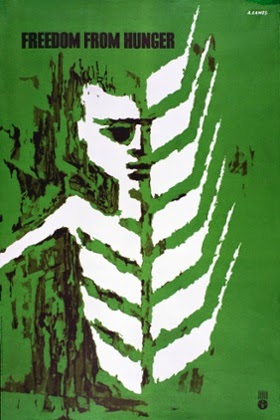
This Spanish Youthship Appeal, bearing the message ‘Send them milk’ shows his genius for visual pun – a white milk bottle perfectly echoes the shape of the black bomb, a light and smiling baby’s face gazing at one, a dark, crying infant terrified by the other.  Years later, in 1962, his ‘Freedom from Hunger’ poster series for the UN would turn ears of wheat into the ribs of a starving child, a juxtaposition of even greater and more startling economy. 


He used an airbrush for the Spanish poster  - an effect evoked by Jan Bielecki on my Hot Key book covers - and this remained his favoured technique until the late '50s.  He’d learned it in his father’s photography studio, where his job was to touch up photographs, adding colour tints and, well, ‘airbrushing’.  Apparently he was such a virtuoso with the tool he even used it to sign cheques. (His father’s 1918 airbrush pencil is in the exhibition, and there will be an airbrush demonstration at the museum on November 11th.) 

Naomi Games mentioned the influence of the 1936 Surrealist exhibition in London on her father and his contemporaries.  You can see it, for example, in the transformation of the Houses of Parliament into a writing hand casting a vote, in a wartime poster designed to encourage the armed services to perform their civic duties too: ‘Serve as a soldier, vote as a citizen.’  Hands and faces appear frequently in Games’ posters; they are, after all, invaluably expressive devices.  Call me monothematic, but it struck me that there was another obvious influence on Games - the poster art of the Spanish Civil War.  Designed for a largely illiterate population, these images also often feature hands and faces, and rely on the briefest of texts for their effect.  Their bright colours and modern graphic style had an enormous impact on British volunteers, including Orwell, who arrived in Barcelona in December 1936 and wrote in Homage to Catalonia of the revolutionary posters that ‘were everywhere, flaming from the walls in clean reds and blues that made the few remaining advertisements look like daubs of mud.’ There’s an excellent collection in the Imperial War Museum in London, which also houses some of Games’ best work, and you can see and find out about the Southworth Collection in this brilliant online exhibition, The Visual Front.  


This poster asks for donations to protect the orphaned children of anti-fascists, while below, a collage of fists, factory and fighter plane exhorts competitions at work to spur on industrial production to help the Republican war effort.


The only person in British army history ever to have the title ‘Official War Poster Artist’, Games' persuasive visual shorthand was exceptional.  He made over 100 posters, conveying exactly the kind of messages that make twelve-year-old Ernest so anxious in my novel, That Burning Summer. When Games began infantry service in 1940 he was horrified by the dull, monochrome and ineffectual information posters he saw plastered on the walls of army barracks.  Soon he was able to replace them with colourful, succinct, emotional appeals about health, cleanliness, pilfering, rumour and countless other aspects of wartime life.  


Several of Games’ designs were rejected for being ‘too Soviet’.  A few brought him into open clashes with the authorities. Bevin actually ripped one off the wall of a public exhibition. The text was patriotic enough: ‘Your Britain … fight for it now’.  But the image clearly stated that it was the new progressive Britain, embodied in modern public architecture, that was worth fighting for, not the old, socially divided nation, which Games represented by a child with rickets in a lightless city slum.  Churchill banned the poster, calling it a “Disgraceful libel on the conditions prevailing in Great Britain before the war… the soldiers know their homes aren’t like that”; his lack of recognition of the real conditions facing returning soldiers no doubt helped him lose the 1945 election.  Now malnutrition and poverty is bringing rickets back into Britain’s GP surgeries while the pioneering Lubetkin-designed Finsbury Health Centre shown in the poster has recently fought off demolition threats.  The image has acquired new resonance.


Games’ brain seemed to work in slogans; the texts he wrote himself were as minimalistic as his images.  ‘I am not an artist.  I am a graphic thinker,’ he said. ‘The harder I work, the simpler it looks.’  It was only when he began to work for London Transport that he realised his ambition of an entirely word-free poster.  But even so, as Naomi Games discovered when she began to scrutinize her father’s work with a magnifying glass, he managed to hide lettering in almost all his posters, quietly and lovingly scattering everywhere the initials of his wife, his children, and even his lover.

‘It is permissible to break all the rules…but only successfully.’  This statement from Over my shoulder, a book in which Games set out his professional philosophy, is reproduced on one of the museum’s walls.  Like so many of Games’ working rules, it has application far beyond the field of graphic design.  He always had to balance work for the causes in which he believed with work for commercial clients, like Guinness, the Financial Times, BOAC and the Jersey Tourist Board.  For this last commission he was asked if he could ‘do’ a girl in a bikini on a beach. Yes, he replied, and went away to produce his playful and prize-winning designs in which the letter ‘J’ is transformed into deckchairs, shells and sticks of rock.  ‘What happened to the girl in the bikini?’ they asked. ‘I said I could do it.  I didn’t say I would.’ 

I laughed when I saw his comment: ‘I do my best work for Jewish causes, and they give me most trouble.’  I wanted to cheer when I read, in Over My Shoulder, ‘We have seen the results of the sell-out to the client on a grand scale in Nazi Germany, in other dictatorships, and in Russia and the satellite countries, where designers are held under rigid control.  A designer must therefore be convinced that what he is doing is right, not only for himself but for his fellow men.’  (Some things are too important to reduce to a slogan.)  An autodidact whose old school report stated that he was ‘weak’ at drawing, Games didn’t believe in art schools.  Yet for seven years he taught one day a week at the Royal College of Art, where another set of initials provided another working maxim.  A designer has to work with the ‘three cs’ he told his students – Curiosity, Courage and Concentration.  But don’t forget the Cash and the Cheques, Games would add, ever the idealistic pragmatist.


   All Games posters © Estate of Abram Games