
Showing posts with label War posters. Show all posts

Monday, 6 October 2014

Maximum meaning, minimum means by Lydia Syson

Sometimes it feels that a day doesn’t go by without another author penning another set of rules for writing.  But if I were ever to pin a maxim above my desk, it might not be a writer’s rules, but a graphic designer’s: Abram Games’ characteristically pithy definition of good design, ‘maximum meaning, minimum means’. 

                                                                                             
Who is Abram Games?  You may think you’ve never heard of him, but I’m sure you’ll recognise his posters.  He produced some of the most iconic images of the twentieth century, from the Festival of Britain logo to the controversial ‘blonde bombshell’ ATS recruiting poster.  


I was drawn to the centenary exhibition currently on at London’s Jewish Museum because he produced exactly the kind of war posters which influenced both the cover design and content of my last two books, ‘A World Between Us’ and ‘That Burning Summer’, and also because I saw parallels between Games and the life I imagined for my fictional hero, Nat Kaplan.  I discovered at the museum a remarkable man who, like so many of his generation and background, owed his greatness partly to his bloody-mindedness. 

He was determined individualist who believed firmly in ‘the people’.  Naomi Games, who last month gave a fascinating talk about her father, once asked him why the profiles he used in his posters always faced left.  He clearly thought the answer was obvious.  Games was a lifelong socialist, though never a member of any political party.  Like my Nat, the International Brigade volunteer in ‘A World Between Us’, he was born in Whitechapel with East European origins.  His photographer father was born in Latvia, while the family of his seamstress mother, who made his painting smocks, came from Łódź.   

Of course Games was at Cable Street on 4th October 1936, when the East End famously blocked Mosley’s Fascist march.  By 1939 he was producing posters for the Spanish War Relief Fund.


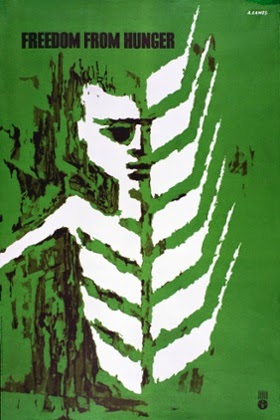
This Spanish Youthship Appeal, bearing the message ‘Send them milk’ shows his genius for visual pun – a white milk bottle perfectly echoes the shape of the black bomb, a light and smiling baby’s face gazing at one, a dark, crying infant terrified by the other.  Years later, in 1962, his ‘Freedom from Hunger’ poster series for the UN would turn ears of wheat into the ribs of a starving child, a juxtaposition of even greater and more startling economy. 


He used an airbrush for the Spanish poster  - an effect evoked by Jan Bielecki on my Hot Key book covers - and this remained his favoured technique until the late '50s.  He’d learned it in his father’s photography studio, where his job was to touch up photographs, adding colour tints and, well, ‘airbrushing’.  Apparently he was such a virtuoso with the tool he even used it to sign cheques. (His father’s 1918 airbrush pencil is in the exhibition, and there will be an airbrush demonstration at the museum on November 11th.) 

Naomi Games mentioned the influence of the 1936 Surrealist exhibition in London on her father and his contemporaries.  You can see it, for example, in the transformation of the Houses of Parliament into a writing hand casting a vote, in a wartime poster designed to encourage the armed services to perform their civic duties too: ‘Serve as a soldier, vote as a citizen.’  Hands and faces appear frequently in Games’ posters; they are, after all, invaluably expressive devices.  Call me monothematic, but it struck me that there was another obvious influence on Games - the poster art of the Spanish Civil War.  Designed for a largely illiterate population, these images also often feature hands and faces, and rely on the briefest of texts for their effect.  Their bright colours and modern graphic style had an enormous impact on British volunteers, including Orwell, who arrived in Barcelona in December 1936 and wrote in Homage to Catalonia of the revolutionary posters that ‘were everywhere, flaming from the walls in clean reds and blues that made the few remaining advertisements look like daubs of mud.’ There’s an excellent collection in the Imperial War Museum in London, which also houses some of Games’ best work, and you can see and find out about the Southworth Collection in this brilliant online exhibition, The Visual Front.  


This poster asks for donations to protect the orphaned children of anti-fascists, while below, a collage of fists, factory and fighter plane exhorts competitions at work to spur on industrial production to help the Republican war effort.


The only person in British army history ever to have the title ‘Official War Poster Artist’, Games' persuasive visual shorthand was exceptional.  He made over 100 posters, conveying exactly the kind of messages that make twelve-year-old Ernest so anxious in my novel, That Burning Summer. When Games began infantry service in 1940 he was horrified by the dull, monochrome and ineffectual information posters he saw plastered on the walls of army barracks.  Soon he was able to replace them with colourful, succinct, emotional appeals about health, cleanliness, pilfering, rumour and countless other aspects of wartime life.  


Several of Games’ designs were rejected for being ‘too Soviet’.  A few brought him into open clashes with the authorities. Bevin actually ripped one off the wall of a public exhibition. The text was patriotic enough: ‘Your Britain … fight for it now’.  But the image clearly stated that it was the new progressive Britain, embodied in modern public architecture, that was worth fighting for, not the old, socially divided nation, which Games represented by a child with rickets in a lightless city slum.  Churchill banned the poster, calling it a “Disgraceful libel on the conditions prevailing in Great Britain before the war… the soldiers know their homes aren’t like that”; his lack of recognition of the real conditions facing returning soldiers no doubt helped him lose the 1945 election.  Now malnutrition and poverty is bringing rickets back into Britain’s GP surgeries while the pioneering Lubetkin-designed Finsbury Health Centre shown in the poster has recently fought off demolition threats.  The image has acquired new resonance.


Games’ brain seemed to work in slogans; the texts he wrote himself were as minimalistic as his images.  ‘I am not an artist.  I am a graphic thinker,’ he said. ‘The harder I work, the simpler it looks.’  It was only when he began to work for London Transport that he realised his ambition of an entirely word-free poster.  But even so, as Naomi Games discovered when she began to scrutinize her father’s work with a magnifying glass, he managed to hide lettering in almost all his posters, quietly and lovingly scattering everywhere the initials of his wife, his children, and even his lover.

‘It is permissible to break all the rules…but only successfully.’  This statement from Over my shoulder, a book in which Games set out his professional philosophy, is reproduced on one of the museum’s walls.  Like so many of Games’ working rules, it has application far beyond the field of graphic design.  He always had to balance work for the causes in which he believed with work for commercial clients, like Guinness, the Financial Times, BOAC and the Jersey Tourist Board.  For this last commission he was asked if he could ‘do’ a girl in a bikini on a beach. Yes, he replied, and went away to produce his playful and prize-winning designs in which the letter ‘J’ is transformed into deckchairs, shells and sticks of rock.  ‘What happened to the girl in the bikini?’ they asked. ‘I said I could do it.  I didn’t say I would.’ 

I laughed when I saw his comment: ‘I do my best work for Jewish causes, and they give me most trouble.’  I wanted to cheer when I read, in Over My Shoulder, ‘We have seen the results of the sell-out to the client on a grand scale in Nazi Germany, in other dictatorships, and in Russia and the satellite countries, where designers are held under rigid control.  A designer must therefore be convinced that what he is doing is right, not only for himself but for his fellow men.’  (Some things are too important to reduce to a slogan.)  An autodidact whose old school report stated that he was ‘weak’ at drawing, Games didn’t believe in art schools.  Yet for seven years he taught one day a week at the Royal College of Art, where another set of initials provided another working maxim.  A designer has to work with the ‘three cs’ he told his students – Curiosity, Courage and Concentration.  But don’t forget the Cash and the Cheques, Games would add, ever the idealistic pragmatist.


   All Games posters © Estate of Abram Games

Friday, 29 November 2013

The Summer of 1940 by Lydia Syson

A big welcome to Lydia Syson, who is our guest for November. Appropiaitely enough in theis onth of Remembrance, she has written a novel set in 1940.

Photo: Sanne Vliegenthart

About Lydia: she is a fifth-generation North Londoner who now lives south of the river. Although writing a novel was a very early ambition, it took her rather a long time to get round to A World Between Us, set during the Spanish Civil War and published by Hot Key Books in 2012. In the meantime, she went from being a World Service radio listener in Botswana to a producer in London, leaving the BBC after her first child was born. Three more children later she wrote a biography of Britain’s first fertility guru, Doctor of Love: James Graham and his Celestial Bed, telling the full story of the charismatic eighteenth-century ‘electric’ doctor. Getting to Timbuktu is still on the ‘to do’ list – explorers, poets and Timbuktu fever were the subject of the PhD she finished in 2003 – but recent travels have been closer to home. Her new book, THAT BURNING SUMMER, is set in July 1940 as the Battle of Britain was raging over Kent. Sixteen-year old Peggy faces a test of love and loyalty when a young Polish pilot crash-lands near the family farm. 


“That Burning Summer” emerged, layer by layer, almost entirely from the place in which it’s set. Years of mooching around Romney Marsh (cycling between its pubs and churches, and walking, windswept, along that peculiar triangle of Kent coast which juts out towards Boulogne, made me see the summer of 1940 in an entirely new light. The more I dug, the more intrigued I became by the ‘underbelly’ of the Battle of Britain: all those elements of wartime life which the propaganda posters are precisely designed to cover up. The uncomfortable truths.


Posters like this have supplied our most enduring images of the era. Propaganda deals in myth of course, and wartime myths - invariably more palatable than the reality – quickly and powerfully come to dominate memory and imagination. So in my childhood, like most Britons, I’d absorbed a fairly standard narrative of World War II: ‘we’ won. It was the ‘good’ war, the ‘just’ war, unlike the futile one that preceded it, and “Britons never, never will be…”

And I here I stop. Because one subversive grandmother (London Granny) used to finish this song off with ‘marrai-ed to the mermai-eds at the bottom of the deep blue sea’ while the other (Country Granny) memorably brought me up short one day in conversation in her kitchen when I was about ten years old with the information that she and everyone else on the South coast of England were firmly convinced in 1940 that Hitler actually would invade. For the first time in my life, I learned that the prospect of losing the war was at one time extremely real. I was shocked. I’d really had no idea.

One half term, exploring a flooded pillbox on the Royal Military Canal (http://www.royalmilitarycanal.com/pages/index.asp) with my children, that conversation suddenly came back to me. The Canal, which curves efficiently from Hythe to Rye, was originally built to repel Napoleonic invaders, and also to control smugglers. It was the first effective line of defense in these parts in 1940, when German invaders were anticipated at every moment. What would it have been like, I wondered, to live on the Marsh then, between canal and coast, listening to the guns as France fell, knowing that your turn was coming next? I imagined the vast and beautiful skies above scribbled over with vapour trails left by dogfights. I pictured a parachute descending, a falling plane, an unknown airman…

These thoughts were mostly prompted by that fact that one of my children was deep in the grip of an obsession with flight, and World War Two with it. After several years of intense discussions of the relative merits of mangonels and trebuchets, we’d moved on to Merlin engines, Hawker Hurricanes and Heinkels. Words like ‘aileron’ had suddenly entered my vocabulary. Eventually, I took my place in the back of a frail 4-seater plane and my ten- year-old son flew me 2,000 feet over the Marsh: his tenth birthday present was a flying lesson. Seeing the Marsh from this height was, unsurprisingly, a revelation.

An even more significant revelation for That Burning Summer came from below the ground. In Brenzett Aeronautical Museum (http://www.brenzettaero.co.uk/Brenzett_Aeronautical_Museum_Trust/Home.html) I first encountered the discoveries of another generation of obsessives: the amateur aviation archaeologists of the 1970s and 80s. Unlike the RAF, they refused to give up their efforts to trace long-lost pilots and planes. In a slightly ramshackle building that once housed land girls, we peered at a scorched German parachute [IMAGE: ‘Remains of German parachute] treasured for years by the girl whose brother had rescued it from a tree, read stories of pilots who’d bailed out of burning planes only to be mistaken for the enemy, and were simply amazed at the sight of aircraft parts that had been buried in the Marsh for decades.


Hurricane cockpit
It seemed unbelievable. How could entire aircraft simply be swallowed up like that, invisible and untouched for decades?

Not just aircraft, but often their pilots too.

Arthur William Clarke, a Hurricane pilot in the Battle of Britain, was listed as ‘missing, presumed dead’ at the age of 20. In a letter to Arthur’s mother, grimly typed a week after his disappearance, his Squadron Leader strikes a weary note:

‘I am afraid that there is very little hope of hearing from him now. We were on Patrol over Kent, when we intercepted about 30 Enemy Bombers with Escort Fighters and attacked about 10 miles west of Folkestone, we went into attack three at a time and your son was in the second three to attack, nobody saw anything happen to him and after the attack we were split up and returned home separately as usually happens, as nobody saw anything one really cannot say what happened.

It is conceivably possible that he jumped out by Parachute and was carried by the wind out into the Channel where he might have been taken prisoner by a German Torpedo Boat, but I am afraid that is very unlikely…I am sorry I cannot tell you anything more than this, but nobody saw anything. I am afraid this is often the case in these Air Battles.’


Arthur Clarke’s Hurricane had come down unseen, to vanish immediately into Romney Marsh. Forty-six years later, the dogged work of a freelance aviation historian made it possible for his family to put up this memorial near this lonely spot not far from the tiny village of Newchurch. Like many families in the same position, they decided to leave his mortal remains in peace.

‘Nobody saw anything.’ That stuck with me. If a plane could just disappear like that, its pilot with it, and nobody see, what else could happen? What if you were a pilot who had got to a point that you actually wanted to disappear? What if you bailed out just in time, and realised that nothing, nothing on earth, could make you get back into a cockpit? Surely not every fighter pilot was as brave as the smiling young Englishmen celebrated in Churchill’s famous speech, with its electrifyingly Shakespearean echoes. What if you simply lost your nerve? What happened to the Unhappy Few?

Here’s another lonely memorial.


We came across it one day walking with friends at Dungeness, heading east into scrubland, lighthouse and power station at our backs.

“What’s that flag?” one of us wondered out loud.

“Poland,” came my son’s authoritative reply. (There was slightly more of the flag to go by five years ago than there is today.)

Bogusław Mierzwa was killed here on 16th April 1941, after having flown missions in combat against the Luftwaffe since September 1939. This tattered flag made me want to find out more about the Polish pilots who took to the skies over Britain in the summer of 1940. They’ve been described as the ‘forgotten few’. The stories I discovered made me ashamed to have known so little about them before.

When the men of the Polish air force arrived in Britain – over 8,000 were evacuated - they had already experienced multiple invasions. In the first month of the war, Poland was invaded twice: by Germany and then the Soviet Union. Contrary to the myth that their planes were destroyed on the ground in the first days of the war, these men fought bravely then, and many went on to make dangerous odysseys halfway round the world, spending time in virtual prison camps en route, and fighting in the Battle of France too before reaching ‘the Island of Last Hope’. Probably the best-trained pilots in the world at the time, they then had a struggle to convince the RAF to let them fly. Before long, Polish pilots had a reputation in Britain for almost insane courage: they fought with the desperation of the already occupied.

The story I had begun to hatch about a pilot in hiding became suddenly more interesting. I discovered a chilling term: ‘Lack of Moral Fibre’. LMF was hastily introduced in April 1940 to deter aircrew from refusing to fly. Effectively, you were branded a coward. Historians have found RAF medical records on psychological welfare suspiciously incomplete, so I don’t know if any Poles were officially ‘diagnosed’, but I had reached the point by then where imagination could take over. I couldn’t imagine anything more shameful for a Polish pilot than a failure of courage. The character of Henryk began to take shape.


Can anyone know how he or she will respond when truly tested? In June 1940, every household was issued with a leaflet: ‘If the invader comes: what to do and how to do it’. I imagined a child becoming obsessed with the confusing advice it contained. Rule 2 (‘Do not believe rumours and do not spread them’) included the worrying advice to keep your head. Common sense was apparently the best way to tell whether ‘a military officer is really British or only pretending to be so.’ All very well, but what if you were one of those people whose senses weren’t like everyone else’s? I’d recently been finding out about dyspraxia. For various reasons, multiple instructions, short-term memory and organisation can be incredibly difficult for people with dyspraxia. It’s little understood even now. In wartime Britain, any child like that would probably have been automatically dismissed as ‘stupid’ or ‘lazy’. So how terrifying such a set of instructions would have appeared to a boy like Ernest, in That Burning Summer, a quiet, bird-watching boy who’d never had to be ‘manly’ before.

Rumour and the control of information were issues of huge concern to the Government in the months before the ‘Blitz spirit’ emerged. Two weeks after Dunkirk and five days before the fall of France, the over-crowded troopship Lancastria was sunk off the French coast, and as many as 6,000 lives may have been lost. It was the worst disaster in British maritime history but the news was kept secret for fear of its impact on morale. I’d interviewed a number of Lancastria survivors for a radio documentary many years ago, and found the contradictions between the ‘official’ war narrative and their own stories both moving and fascinating.


By 1940, up and down the country, people were (overheard) complaining about the increasingly heavy hand of the state. The pro-democracy Mass-Observation movement had become a tool of the Ministry of Information and ‘Cooper’s Snoopers’ were quickly compared to the Gestapo. Meanwhile Mass-Observation diarists like Nella Last continued to record the kind of casual anti-Semitism we prefer to forget was rife in 1930s Britain, and Communist families on the South coast destroyed potentially incriminating papers in anticipation of invasion and imprisonment or worse. My London grandparents made preparations for a friend to look after my mother in case of their own arrest. Others stockpiled suicide medication and buried treasures of all kinds.

In this climate of mistrust, spyfever inevitably broke out. In playgrounds and post office queues, front parlours and cinemas, it was fed by radio programmes like ITMA and films like Contraband and The Spy in Black. On Romney Marsh itself, suspicions were confirmed by the appearance of four rather incompetent spies on the coast in early September.

But there was another secret threat: from Madrid, and the Spanish Civil War, came the fear of the Enemy Within – ‘The Fifth Column’, ready and waiting to support the invaders when they came. Oswald Mosley and 740 other active fascists were interned in May 1940, but that still left plenty of sympathisers at large to worry about.

Pacifists made easy targets. Orwell declared them pro-Fascist, the Daily Mail called for the Peace Pledge Union to be banned, and an article in the Sunday Pictorial soon after Dunkirk referred scathingly to our ‘national pansies’. Across the country, Conscientious Objectors were dismissed from teaching positions.

The more I read, the more torn I felt. I thoroughly admired the morality of their absolutist stand against war, and the complicated kind of courage it took to maintain. Yet the experience of writing A World Between Us, set among International Brigaders during the Spanish Civil War, had made me less sympathetic than ever with the disastrous policies of appeasement: the non-intervention agreement that turned a blind eye to Hitler and Mussolini’s support for Franco and enabled him to win the war was part of the same thinking. If I felt like this, now, how much harder must it have been to work out the right thing to do in the summer of 1940.


All these ideas kept swirling around my head as I wrote, and found their way into the isolated church on Romney Marsh where much of That Burning Summer is set, and some of it was actually written. You won’t find many direct references to them in the story that finally came out, the tale of ‘a girl, a boy and a crash-landing…’ - Peggy, Ernest and Henryk - but they’re there in the warp and weft of the novel. And I’ll never walk beside the ditches and across the fields of the Marsh and see them in quite the same way again.