Showing posts with label Venice. Show all posts

Thursday, 8 October 2026

Taking my hat off to millinery: when an historical novelist puts the art at the heart of her new book - Michelle Lovric

One of Casanova’s famous anecdotes dates to his time in Turin, where a milliner was fatally obsessed with her lover, the Comte de la Perouse. When she lay dying, the priest arrived to administer the last rites. Rather than take the Eucharist, the milliner swallowed a miniature of la Perouse. Casanova was inspired to write two poems about this gothic extravagance of romance.

I too wrote a poem about her. It was published in my first novel, Carnevale.

So, 25 years ago, I already earmarked milliners as women of interest.

I like a woman who can weaponize silk, art, gesture and love.

For the last few years I’ve been writing a milliner in early 19th century Venice. In doing so, I fell into my own obsession with hats and feathers. You won’t be beaten over the head with hats in my novel, The Puffin. But you won’t be able to finish the book without learning something about the historical millinery trade: its language, its tools, its colours, its creative and even military possibilities.

I have been lucky enough to have superb partner in this enterprise – Tina Giuntini, who is both a millinery historian and modern-day milliner. Tina and I met by chance – but meeting her changed my writing life. (Photo of Tina below right by Kelly Lemon). 

Where do I begin to thank her? For the lessons in millinery in person and in correspondence? For the antique and vintage millinery tools she lent me so I could feel their weight and simulate their work? For the lexicon of millinery – toliker, awl, egg iron and more.

Tina shared her image library and directed me to the books I needed to read. She has also made hats that substantiate the roles they play in my novel’s plot. She even created little hats for the puffin who is the catalyst of the story.  

She took a model puffin back to her studio in Seattle, where she photographed it with her historic forms and tools.

Forget AI; I had Tina in 3D. Best of all, I knew she was checking my invented milliner against her real self, and I felt that the works of my imagination were somehow verified.

In The Puffin, the hats, tools and feathers in the book are not just decorative; they are also plot mechanisms. They are used to thwart the vigilance of Venice’s Habsburg masters. My protagonist Alva is a brimstone milliner making combustible hats. But she can protect herself by trading on the notion that hats are the merest feminine frippery and that no one needs to give them a second glance – rather like milliners.  

POEMS FROM HATS AND TOWARDS HATS

I started work on this book by writing poems about hats, straw, feathers, feather-curlers (gleaned from their trade cards in the London Archives), female places of work, colour. I used poems to explore ideas about the language and geography of hats and about the women who created them. The character of Alva emerged from somewhere between the lines of this poetry. So did the excellence of her millinery. To protect her modesty, it became appropriate for the poet Tommaso to explain the enchantment cast by Alva’s hats. Here is one of his descriptions:

Poetry erupted out of Alva in hats. Her bonnets told stories and sang lyrics in an irresistible accent.        Like a storyteller, Alva threaded pace through image. Like a poet, she could evoke the mist around a     spice-ship’s mast, using just a coil of net. She could swoop joy into the contour of a brim. She’d     sometimes let me sit behind a screen in her studio to witness her recasting women’s biographies with her hats. Straw was the least thing Alva worked with. She worked with luminosity, awling holes through brims so light exploded like a blown dandelion on the skin. Like weather, she could make the air different under a hat. A writer and the weather must bend the knee to a milliner of Alva’s genius, for she also illustrated her tales in a whole lexicon of colours: Dust of Ruins, Pomona Green, Barbel Blue, Nankeen Yellow and a cavalcade of reds. She had texture. She had fantasy. What if everyone had their own flower? – that’s what Alva made happen: scooping worlds into a single face. Her hats could steal the breath of strangers. Isn’t that intimacy? Isn’t that poetry? Stolen, intaken breaths?

Alva has a more pragmatic view of her profession, partly because she has other things going on. She speaks thus of her studio in Cannaregio:

Once upon a time the Calle della Pegola was the street of the caulkers, the men who keep ships afloat, attending to the risk of leaks with tar and wooden pegs. When I was sixteen, it became my street, where I fashioned hats to set women at full sail, keeping them safe upon the salt-sweet sea of encroaching age and lovelessness that might otherwise engulf them.

So what else does Alva have going on apart from astonishing millinery? She is also a member of the sect of the Carbonari, a variant of freemasonry.  The Italian Carbonari plotted liberation from the Habsburg empire, which occupied Venice from the early 19th century until 1866.

Alva hosts the  secret ‘baracca’ of the Venetian Carbonari in her studio. She is more than their landlady. In fact Alva is the ‘Mother Tongue’, the musa ispiratrice of the Venetian movement. She makes hats for fashionable women who love to talk – and are happily indiscreet in front of a mere milliner, a tradeswoman, a person who is socially invisible. Information is life-and-death for an outlawed sect. So Alva makes sure her client include Austrians and aristocratic Venetians. 

Her least favourite client is Portia Saukalt, the daughter of an Austrian banker.

I came to know her face as well as my own. La Sau’s features were crude, like an imprint in a stale pillow. Her hair was dulled by thirty Habsburg winters. Her voice grated. Portia Saukalt’s enormous ears needed to be hidden inside bonnets and turbans of intricate inner construction. A small thorough blue eye she had, with a great appearance of stoniness about it. Missing: any trace of empathy. Yet I’ll never know anyone to match Portia Saukalt for seeking out your glance and forcing it to stay on her. She confused you with her singular intensity; your aesthetic sense was destabilized by her.

With her small head and lumpen shoulders, my newest client was a story even my hats struggled to tell gracefully. She was from the start a constant trial to me, not least because a woman who wore a hat of mine should look like a woman who deserved to wear that hat. And it was precisely for this reason that la Sau made me rise to the highest expression of my art, that is, of composing hats to make you forget an ugly face. More, Portia Saukalt needed hats to intimidate the enemy and everyone was the enemy. 

As a woman, laughably, she also hunted admiration and lovers. My hats expounded on the structural differences between men and women, each of whom naturally craves what he or she is not and has not. The more I succeeded with her millinery, the more heat Portia Saukalt knew she could raise in men who wouldn’t understand they were actually falling in love with a hat.

WOMEN’S WORK

Writing Alva gave me a chance to look at women’s work … how it is persistently undervalued even to the point of being unseen. No one thinks that Alva could be a member of the revolutionary Carbonari movement, because her work has the ephemerality and triviality of fashion, and because it is to do with women. The plot shows how women and women’s work are underestimated … and not just by men. Women also underestimate each other. By the end of the story this is going to prove deadly to one of them.

There was a real-life example from the period for me to follow. Alva takes as her model the Colombian seamstress Policarpa Salavarietta (image from Wikimedia Commons). Poli (as she is still known) spied on Spanish aristocrats of Bogota while sewing their clothes, gleaning information that was used to fuel the fight for independence. None of her chattering high-born ladies suspected that Policarpa was working to destroy the Spanish hold on her country. In my novel, Alva reaches out to her heroine. But Policarpa was betrayed and executed by the Spaniards. It’s only at the end of The Puffin that Alva finds out what happened to the letter she sent to her sister in needles and revolution.

FEATHERS  & EMPIRE

Alva works with feathers obtained by her merchant brother at the famous London auctions. Here Favaloro secures exotic sought-after feathers such Quetzal tails from South America, which was at that time rising up to throw off the shackles of Spanish domination. So hats also gave me a path into my other chief theme of Empire. Feathers also worked for me in the exploration of the predatory, wasteful, misconceived relationships between humans (the word ‘humanity’ doesn’t work here) and birds –  and indeed between humans and all too many animals.

The novel’s eponymous bird comes from Norway where it was and still sometimes is a perilous thing to be a puffin. Norwegians not only eat puffins but also use their feathers for soft furnishings, their leather for shoes and even burn their oil in lamps. And a raw fresh puffin heart is apparently still considered a delicacy in some parts of Scandinavia. 

In my novel, the way people react to the puffin serves as a useful index of their humanity. 

The villain captures the puffin, exploits it for commercial gain and even imagines the profit in a stuffed puffin as a hat ornament.

At a key point in the book, Alva has a close encounter with the puffin. Lost in his eyes, she has an epiphany about her own place in the complex international business of murdering birds.

I try to be less human, more bird.

  … And that’s how I fall. That’s how I know.

In the puffin’s eyes I see dying ranks of egrets, their heads and shoulders meat-raw to the bone from feathers ripped out. I hear the slow, hoarse screams of ostriches as their throats are cut by Tuareg horsemen. Until now, the birds died invisibly. If their dying moments had crossed my mind, it was quickly and silently. I bethink my own stake – as a milliner – in the life of birds. Literally it’s a stake in their hearts.

 … How many birds have died so I could give the illusion of lightness to a heavy piece of womanflesh? Many, many. To lure the Contessa, I knowingly used the Barbary plume of an ostrich that was murdered for it.

 I think about the puffin-bellies in which Favaloro has always hidden our carboneria before tucking it between cod flesh and its skin. I tell myself those puffins were dead anyway; this way they too made their sacrifice for Venetian liberty. Yet, looking at this living puffin, I fail to believe myself. I despise my own sophistry. Guilt grows worms in my gut.

Still, there’s a road to goodness.

Palabra, my word on it – from this day forth, no bird on this whole earth shall be killed again so I may decorate a hat. Not even for a precious Barbary plume will another ostrich be hunted on my account.

I shall keep faith with feathers. It’s fitting that I do.

Alva’s solution: she stops using feathers and instead makes flowers from fish skins. (Thank you, of course, to Tina for alerting me to this practice.)

MILLINERY IMAGERY

The Puffin is a book built out of hat imagery.


The humble egg iron of the millinery trade is the novel's most visible murder weapon and is used in other ways too, including an attempt to rescue the puffin from captivity.

Perhaps the chief totemic object is a Barbary Plume –  a miraculous ostrich feather –  with a biography that Alva recounts. Both one of the characters (an enslaved boy) and that plume are brought to Venice from one of the famous Livornese feather traders in Tripoli.

A hatbox hides the liberated puffin. Even the milliner’s etui, an ostrich shell holder for sewing implements, comes into play. 

A dragonfly ornament on a hat warns people of a woman who is dangerous, relating to the Venetian superstition that the breath of the insect is fatal to humans. 

Finally, hats are the heroes of a climactic scene towards the end of the book when Venetians gather to watch a poet and his poetry go to the scaffold.

A TALKING HEAD

Another key millinery element is Alva’s marotte or tête à chapeau. A milliner spends a lot of time alone. It seemed to me natural that Alva – who has a lot to say but few who want to listen –  would have an intense relationship with her marotte. I’ll let Alva explain …

When Favaloro was away, I practised the lingua franca on my têtes à chapeau, the life-size busts on which I, like all the sister hood of milliners, displayed my wares. The têtes were modelled in painted cartapesta stuffed with horsehair. Ranked on hollow tree trunks fluttering with silk shawls, these neat bodiless ladies were my own little army. I added one more tête with each year of success, ordering them from Brussels. I myself animated and made singular their bland faces with watercolours, adding highlights to their eyes and character to their eyebrows.

Tommaso once observed that my favourite tête looked like me, with her small mouth, light eyebrows and narrow cheeks. After that, I kept a sharp eye on her pretensions to beauty. Her eyes were equally intent upon me and were not uncritical. It was to this tête that I addressed my most extravagant flights of the lingua franca. I knew what she was thinking. She called me ‘Mistress Tongue’ or, in sarcastic mode after Tommaso visited, ‘Glass of milk-water’ and ‘Afraid-of-your-own-heart.

I have owned an early marotte ever since I became interested in millinery.  I have been known to address a few words to her. She sat on my desk keeping company with the model puffin (and yes, also the skeleton of a puffin) all through the writing of the novel. As a novelist, you need to know what lies beneath ...

Noble ladies in Venice had marottes made in their own likeness. I was delighted to discover one in the background of several Pietro Longhi paintings in Ca’ Rezzonico. The one below is called ‘la scuola di lavoro’ – see the marotte top right . (Image courtesy of Wikimedia Commons)


A HAT FOR A SHIPWRECKED MARRIAGE


Here is the exotic millinery that inspired my character Tommaso, the poet. He’s at the centre of two painful love triangles in the book. Although he is passionately loved by good people, he throws in his lot with one of the worst, a hypervigilant narcissist who reels him in and spits him out, as they do.

Tommaso becomes a beggar, a mendicant, in his relationship with his wife. She is deaf to his plea for heart-alms, so he wanders Venice by night with a crude model of ship on crammed on his head. He wants to show the world the shipwreck she has made of their marriage.

Tommaso, with his crutch and his ship, casts the shadow of a monster in the moonlight. In fact, there is a real monster on the  streets of Venice, an assassin called the Hyena. (The Hyena is my invention. Extrajudicial murders were not characteristic of the Habsburg regime, which was more focussed on order, censorship, paperwork and taxation).

For the image of the ship hat (courtesy of Wellcome Images)  I am indebted to a contemporary text, Vagabondiana of Anecdotes of Mendicant Wanderers through the Streets of London. Vagabondiana includes a beggar named Joseph Johnson, once a seaman, who in later life walked with a crutch and carried a model of the HMS Nelson on his head to signal his service to this country. Smith characterises Joe Johnson as a creative and ingenious beggar, who knows how to catch the imagination and engage the sympathies of those who behold him.

And that’s the poet’s playbook too, of course.

LANGUAGE OF COLOUR

The Puffin is a book about several different languages – even the puffin has his own lexicon. Alva is obsessed with the lingua franca, the language of the free world, as she sees it – the language of equals as opposed to the pidgin that infantilizes the subjects of empire. Alva smelts brief, shattering poems from the lingua franca. (Who is the better poet, Alva or Tommaso? – the reader will decide).

Alva’s work as a milliner gave me access to another language too, namely the fashionable colours of the day. Again, Tina made me a felt colour chart of the kind Alva would show her customers.


As all researchers of this period know, these hues are codified in a wonderful book Werner’s Nomenclature of Colours (1814) in which each fashionable Regency tint is aligned with incontrovertible values found in the colours of animals or minerals. To revivify those Regency colours in conjunction with the clothes that bore them, there’s Beatrice Knight’s Regency Color Compendium, a painstaking but joyful exercise in research.

I chose the colours in the book for their edible loveliness:

Pomona Green – apple & emerald with a touch of lemon

Drake’s Neck – a cerulean blue mixed with bottle green

Spanish Fly – a rich, blue-tinged green

Barbel Blue – the colour of a clement sky

Celestial Blue – an exalted cobalt

Maiden Blush – pale young flesh like the inside of a shell

Blossom or Rose Pompadour – a rosy pink

Aramanthine – a rich, purplish red

Pomegranate – a simmering terracotta

Coquelicot – poppy or puffin-beak red

Puce – a brownish purple made from blood-fed fleas

Parma Violet – a warm amethyst

Stifled Sigh – a faded despairing lavender

London Smoke – a pale choked grey

Skimmed Milk – the luminous white of the human eyeball

Isabelline – a dirtied cream

Oeil de Mouche – a slick sepia brown

Nankeen – a muddy wolfish yellow

Feuille Morte – a strident pumpkin-flesh amber

Orpiment – the orange of the neck ruff of the Golden Pheasant or the belly of the Warty Newt

Dust of Ruins (or camelopard) – a dull brassy gold

Jonquil – a fresh pure daffodil yellow

Habsburg Yellow – calamine and pus

REAL HATS FOR IMAGINED SCENES

Alva makes hats that carry secret maps and bullets in special compartments. She also makes the death caps for those who appear to have fallen foul of the Habsburgs: the anonymous drowned are rescued by the Company of Christ and the Good Death and given decent funerals. In the novel, the Company is part of the Carbonari conspiracy. 

While Alva is imagined, her most important client is a real woman who was implicated in the brief, disastrous Carbonari uprising that occurred on the Venetian mainland in 1818. Her name was Contessa Elena Cecilia Monti d’Arnaud. She was once lady-in-waiting to Marie-Louise, who was both Napoleon Bonaparte’s second wife and also the daughter of the Habsburg Emperor Francis. Contessa Monti was devoted to her mistress even after she ceased service, speaking of her constantly. Arrested by the Austrians after the uprising was betrayed and suppressed, she was sent into exile but was found dead in Bologna not long afterwards under unexplained circumstances. (For information about Cecilia Monti, I am indebted to Christian Rossi, for his transcription of her interrogation in his doctoral thesis, MAGISTRATURA E GIUSTIZIA PENALE NEL VENETO DELLA RESTAURAZIONE (1813-1819).

Tina recreated two hats for Cecilia Monti that are particularly important in the plot.


The first is this bergère, a flat-brimmed straw hat featuring a very shallow, low crown and usually ornamented with flowers and ribbons. It can be worn a number of ways but this tilted view is traditional and flattering. This hat is woven from dense Leghorn straw, which is what Alva uses. The rim is sewn with old French lace. This one has knots in the ribbon round the brim. A musket ball could be concealed in each of those knots. And a map or letter could be rolled up and slotted into each of the stretches of ribbon in between the knots. The flowers are hand-folded. As traditional, the decoration is mostly on the right, and in this case designed to distract from the ‘loaded’ sections of the hat. 

The second hat is a pliable Milan straw. Its brim could be tipped upwards at the back to create a secret compartment for revolutionary matériel. Tina built a secret code into this hat. The colours of the ornaments are those of the Carbonari.

HATS & PUBLICATION

Tina and I have been enjoying ourselves on Instagram, doing a series of stories about our collaboration. Meanwhile, I have also been enjoying contact with the modern community of hat creators in London. I am looking forward to attending a Discovery Event in October as a guest of the 422-year-old Worshipful Company of Feltmakers.

I shall myself be talking about hats, feathers, puffins and revolution at an event at Southwark Cathedral on October 26th:

Faith, Feathers & Human Skin: introducing The Puffin Tickets, Monday, October 26  •  6:30 PM - 8 PM | Eventbrite

See you there perhaps ...

Michelle Lovric’s website www.michellelovric.com

Instagram @apuffininvenice and @Bea-Evie

Other hattish links:

www.ballardmillinerystudio.com

Feltmakers Today & Our History – The Worshipful Company of Feltmakers of London

Thursday, 30 May 2024

Jesus-in-a-bottle - Michelle Lovric

I’m spending most of spring in Venice this year. For the first six weeks I carried the usual A6 spiral-bound notebook everywhere. I kept adding lines and stanzas to a long poem I was building inside it. Occasionally I thought of tearing out the pages to type them up for my poem larder. But I never quite did.

Instead, I left the notebook in my local supermarket and the staff were adamant that a cleaner must have thrown it out. 

I feel very edited.

Was the poem good? I can’t tell you. But the cleaner saved me the agonies of transcribing my terrible handwriting it, cutting the poem, rebuilding it, making it squirm into a fashionable form.  I never put that poem through a workshop, never heard the embarrassed silence when I finished reading it. I was never subtly or openly questioned for daring to create it or present it. I never had to struggle to justify its length or the extravagance of its language. I never had to hear someone suggest that I put it aside to work on something more lucrative.

On the whole, I am better off without that poem. Terminally edited, it cannot harm me anymore. Thank you to the cleaner at the supermarket. All power to his or her hardworking elbow.
 
It has been a spring like this. My plan was to spend time in the archives of the Scuola Dalmata, researching one Giovanni Lovric, perhaps even finding a connection between myself and this writer from Sinj who was in Venice in the 1770s. It was hard to get an answer from the scuola but they were obviously on my wavelength because the very morning I was choosing scholarly attire to front up in person, I finally received an email to say that they too are closed for restoration. (Picture of the Scuola Dalmata from Wikimedia Commons).

My two current novels for adults and children are also closed for restoration and I’d been hoping to find refreshment in Giovanni’s story. Instead, I have resorted to imagining him. I suspect the imagined Giovanni Lovric is having much more fun than his real inspiration, locked in the archives. For a start, he has a ferocious girlfriend with a bear who drinks beetroot beer.

I too have been closed for restoration after a couple of surgeries, with more to come. Some parts of me will never be restored. But I have found solace in a new collection of folk-art objects. 

I found these first two below at the mercatino in Venice’s Campo San Maurizio. As often happens, I then started to see them all over the place. And I have now acquired two more for my collection. (Picture by Déirdre Kelly, my fellow Companion of The Guild of St George).


By collecting, you learn: language, culture, folklore, faith.

So I have learned that people used to refer to a bottle like this as a ‘Bottiglia Mistica’ (‘Mystical Bottle’) or a bottle containing ‘Arma Christi’ (‘Christ’s Weapons’). It might also be called a ‘Bottiglia della Passione di Cristo’ or ‘Bottiglia della/di Pazienza’. A ‘pazienza’, I have read somewhere, can be a nun’s robe. And the bottles are sometimes described as ‘lavoro conventuale o monastico’ – convent or monastery work or ‘Klosterarbeit’ in German, where many of the bottles are for sale. So, like many articles now considered or sold as religious folk art, the bottles could have been put together by nuns or monks. (I have a collection of Christmas decorations hand-painted by Italian nuns and studded with coloured foil from chocolate wrappings). The description could also, of course, refer to the patience required to set up these little scenes, building them to be folded flat, inserting them in the bottle and then erecting them with threads pulled through the neck. 

I have also seen them called ‘Calvary Bottles’. Or ‘Impossible Bottles’ – though this title was also applied to the ships in bottles created by Venetian glass masters like Francesco Biondi in the early 19th century. I particularly like ‘God-in-a-Bottle’. And ‘Jesus-in-a-Bottle.’ (It sounds like a profane exclamation, doesn’t it? As in, ‘Jesus-in-a-bottle! I left my notebook in the supermarket and the cleaner threw it out!’)

The Bottles of Passion share many elements, most of which place them as folk-art objects. They use mixed media and sometimes found objects: carved wood, pre-made Victorian chromolithographs, fabric, bone, printed paper, even bread and rice. The bottles are often recycled: once used for common foodstuffs and even alcohol. Most date to the late 19th century or early 20th century when glass bottles became cheaply and commonly available.

They all show some combination of the symbols of Christ’s Passion:
  
- the whip and the whipping post

- the reed sceptre

- the crown of thorns

- the cross

- the dice with which the soldiers played for His robe

- the hammer that drove the nails into Christ’s hands and feet

- the ladder

- the shroud

- the cock that crowed

- the spear of Destiny

 - the sponge held up to His lips

- the pincers that removed the nails

 - the holy grail or chalice

- the sign INRI (Iesus Nazarenus Rex Iudaeorum: Jesus the Nazarene, King of the Jews)

Some bottles add angels, Mary and Mary Magdalen. One of mine has three Christs, or two particularly holy-looking thieves. (Picture at right by Deirdre Kelly)

These Instruments of Passion, inside a bottle, might be believed to create a spiritual tool-kit that can be used to defeat Satan. Some were sold at religious shrines, such as that of the Black Madonna of Liesse in France. Some were filled with holy water – a portable blessing.

My own thought on this is that the stations of the cross are a journey, and that these little bottles provided the comfort of a portable shrine for those undertaking their own pilgrimages in hazardous times or places.

It is also said that these bottles forfended against particular superstitions about places where waters and roads meet, as it was thought that evil spirits lurked there in wait for the innocent traveller; such places also presented risks in the form of cross-currents, ambush or the possibility of taking the wrong way, physically or metaphorically.

Some times things go the right way. 

To those of you who kindly kept up with the Oceandiva saga in my various posts here at the History Girls, the threat has gone away. Five years after we first discovered the ambition of Europe’s biggest party boat to come to the Thames, the owners have announced they were fed up with the ‘regulatory system’ in the UK and were consciously uncoupling from London and happily going back to EU waters. I would like to take this opportunity to thank my tireless, hilarious colleagues in the campaign, the odd bunch of Londoners who sacrificed so much time and energy to keep the Thames more safe, less commodified and less greenwashed. There's plenty more for us to do. The Oceandiva has proved to be only symptomatic of problems that need addressing on the River Thames. 

More detail about this on the River Residents Group website.

What else am I thinking about? One thing is the anniversary of the terror attack on my London village on June 3rd 2017, when eight young people were killed and another 48 injured by three terrorists using large kitchen knives. For many days afterwards, residents were locked up inside their homes or excluded from them by a police cordon around our neighbourhood, which had become a crime scene.

I’ve been thinking about my friends and neighbours who were caught up in the attack or who witnessed it. I worry that the memorializing of the attack has not always happened in ways that are appropriate or disinterested. Indeed, it sometimes feels appropriated. I wonder to what extent we community members will be included in memorials this year, if at all. We're going to try something do-it-yourself, but heartfelt, I hope, instead. I am not going to say more. The point is, to do it away from publicity and photo-shoots. 

And there is one more thing that concerns some of us: just a few hundred paces from the attacks, a kitchen shop has put up a huge display of knives that are not protected by a case. It gives me a shiver each time I pass. Over many  months, my neighbours and I have protested to the shop, to their landlords at Borough Yards and to the police. But the display is still there, still far too easily accessible to anyone with violent intentions or to someone whose judgement is blurred by the beer with which the area is awash, this being the most intensive conglomeration in Southwark of premises that sell alcohol. It is sobering that, as the seventh anniversary of the attack approaches, we still can’t find anyone to care enough about the potential danger of this knife display to do something about it. 

Instead, there are plans to close a road or two, potentially marooning hundreds of residents, but no desire, it seems, to remove the bars' pavement licences that narrow the streets, causing serious bottlenecks for hundreds of thousands of people crammed into the narrow canyon-like streets of the Borough Market. The topography eerily recalls the photos of Itaewon, in Seoul, where 160 died in a crowd crush of 100,000 visitors in October 2022. In Borough Market, in fact, the crowds can be 50 percent larger than Itaewon. And they have nowhere to go if something were to go wrong. 

Meanwhile, the fight against over-tourism goes on in Venice, with NoGrandiNavi unleashing a picturesque new protest against the latest moves to excavate the lagoon in order to speed the return of the monster ships to the Stazione Marittima in Venice. A demonstration took place at nearby Zattere, and I was there with some colleagues from our Thames River Residents Group to cheer them on. A few weeks earlier, several artist activists had crafted the banners you see below and created a marine creature to protect the lagoon - seen arriving below. 

You can hear NGN's Marta Sottoriva eloquently explaining the new battle and the locals' reaction to the tourist access tax in the first episode of BBC Radio 4's The Tourist Trap, an investigation into over-tourism all over the world. (You can listen again on BBC RADIO SOUNDS).


Banners created by artists for the demonstration

It took three boats to transport the symbolic creature 


Above, some if the River Residents Group contingent in Venice last weekend.

Michelle Lovric's website
River Residents Group websitewebsite 


Saturday, 30 September 2023

History keeps changing - writing The Fortune Keeper

 By Deborah Swift


I was really interested to read this week, that the coded letters of Mary Queen of Scots have just been deciphered by modern computer scientists and decoders. Undoubtedly this will give us hitherto unknown insights into what we know about her and her life. Historians and historical fiction authors may need to change their views depending on the new evidence.

A similar thing happened to me when was writing the last book in the trilogy of books about Giulia Tofana, a woman who was renowned for inventing the poison Aqua Tofana, and was supposed to have poisoned six hundred men in Renaissance Italy. (See my Aspects of History article Poison and Power) I had already uncovered through my research that Giulia Tofana was probably an amalgam of three women, and not the single entity of legend.


Three women, not one


The mother, Theofania d’Adamo was executed for the crime of poison on 12th June 1633, but her daughter, Giulia (known as Tofana) survived. The third person in this triumvirate of poisonous women was Giulia’s daughter, known as Girolama Spara. Until recently very little was known about the daughter so as historical novelists do, I fictionalised her birth, assuming she was a blood daughter of Giulia Tofana and her (also unknown) husband surnamed Spara. I wrote about this before for Aspects of History

About half way through writing the third novel in the series, from the point of view of the daughter, new evidence arose about the women in Giulia Tofana’s family. In an old library archive in Italy, an American academic had unearthed the real-time transcript of the murder trial of Giulia Tofana’s daughter, Girolama Spara, (also known as Gironima Spara) and published it. The document was originally kept under lock and key by the Pope at Rome’s Castel Sant’Angelo, and from there ended up in the State Archive where it lay uncatalogued and undiscovered for generations. You can find the document translated by Monson at the end of this article.

History evolves

Of course I trawled through the new information, discovering with growing concern that my fictional view of events differed widely from this new evidence. I was shocked to discover that Girolama Spara was a step-daughter, and not a blood daughter at all, and that Giulia Tofana had been married twice.

The ledger was in a poor state of repair, but Professor Craig A Monson had painstakingly resurrected it and translated it into modern English. The truth is less glamorous than the plot I had in mind for these characters, so what should I do? The past is both fixed and mutable. The two previous books were fixed, already out on shelves and readers were enjoying the story. The new information meant that I would need to be open to bending, or changing, the third book.

Would readers care? There are many schools of thought on this – on how accurate historical fiction should be, and it is debated endlessly by historians and novelists. From my point of view I was obligated to finish the story I had set up with the characters remaining consistent within the series, yet also to incorporate the new information. The rules I set for that world needed to remain in place so that the reader feels they are in a real and secure locale, no matter where the story went.

Whatever character I create can never be the real person. Anne Boleyn has had hundreds of interpretations of her character. The events I describe can never be ‘true’, just as contemporary witnesses to any crime will have different views. A novel can’t be ‘accurate’, just as someone trying to depict my life of yesterday could never be accurate, even with all the iphone technology and photography available now, and if my diaries were in front of them, because life is too complex to render completely. What I hope to achieve in my novels is a tantalising whisper of what it might have been like to inhabit another era.


History continues to fascinate

It is exciting that at last we know more about the actual trial and details of the life of Girolama. She is nicknamed Mia in my book, because having a similar name to her mother Giulia, she was often confused with her, and this led to many errors of attribution. Many of the crimes assigned to Giulia actually belonged to Girolama and vice-versa.

I used maps, academic articles and transcripts of primary sources to complete the book, as well as the translation of the trial documents by Professor Monson, and I like to include historical notes at the end of my books to make it clear where (for the moment) the historical evidence is pointing.

Is The Fortune Keeper a true re-telling of Girolama Spara’s life? Definitely not. Will it take you on a journey into the heart of a young woman in Renaissance Venice? I hope so. 

You may be interested in:

The Black Widows of the Eternal City: The True Story of Rome’s Most Infamous Poisoner by Craig A Monson

Coded Letters of Mary Queen of Scots https://www.bbc.co.uk/news/uk-scotland-64568222


THE FORTUNE KEEPER


Buy the Book – https://mybook.to/AquaTofana

#KindleUnlimited

Twitter https://twitter.com/swiftstory

Facebook: https://www.facebook.com/authordeborahswift/

Website www.deborahswift.com

Pictures of 17thC Venice, The Ridotto gambling hall, and the fight on the Bridge of St Barnaba in Venice, all from Wikipedia.

Friday, 31 March 2023

The wrong ship in the wrong place at the wrong time – Michelle Lovric


This beautiful photograph is by my colleague David Winston, of whom I’ve written previously. It’s part of his recent London exhibition, Mood Indigo.


The image shows a shoal of Venetian ferries, known as vaporetti, gliding down the Grand Canal with minimal wake, humble stature and self-effacing lines. The vaporetti know their place – it is to serve Venice: not to dominate her, not to reduce her to a backdrop, not to repurpose her as a place to maximize alcohol sales and not to do so at the cost of residents’ peaceful enjoyment of their homes nor at possible risk to human and marine life.


Everyone’s the same on a vaporetto. A vaporetto doesn’t care if you’re an influencer or a celebrity. And even if you are one of the latter, please note that Venetian courtesy still dictates that you give up your seat to an elderly person or a mother and baby.


The vaporetto is the right vessel in the right place. Just as the Grand Canal is the perfect waterway, protected from the commodification of greedy new skyscrapers and only occasionally subject to tasteless advertising on shrouded scaffolds while her ancient facades are restored.


If only the Thames were so lucky. London’s greatest public realm, our river has suffered successive attempts at commodification, like the Garden Bridge and the River Park. Now we have (arguably) grotesque sky-grabs along the Thames, with buildings like 72 Upper Ground agglomerating ungainly masses from small footprints. Residential communities are drained by successive campaigns against what is happening to the Thames, which has become, as journalist Rowan Moore describes in the linked article, ‘a gold-diggers’ gulch, a miles-long mine of real-estate value.’


Riparian development is controlled by land-based authorities, but the river is ruled by the Port of London Authority (PLA), operating on a 1909 charter and funded by the dues it extracts from its client-vessels and its River Works licences.


When something goes wrong on the river, however, it is not the PLA but the publicly funded emergency services that must deal with it, as well as the RNLI, a charity.


Sadly, things do go wrong on the Thames, especially given the swift 23ft tide and the intertwining of industrial, commuter and traffic on a river that snakes as much as it flows.


And when things do go wrong, they can go tragically wrong.


Most Londoners know about the 1989 Marchioness disaster, in which, at approximately 1.46am, the 262ft Bowbelle dredger ran down an 85.5 ft party boat near Southwark Bridge. The Marchioness sank in minutes. There were 51 casualties, most of them young. In subsequent hearings, safety, crew training and lookouts on both vessels were judged inadequate.


Grieving families and friends still gather in remembrance of the dead on the anniversary. Southwark Cathedral hosts a permanent memorial to those lost. The Marchioness has remained a household name for nearly thirty-five years.


But few people know about the Marine Accident Branch’s 2015 publication on the Marchioness disaster. Additional possible factors named in the report included: disco music so loud that the captain couldn’t hear the radio warnings about the Bowbelle; hydrodynamic interaction, by which two boats are drawn together, losing steerability, especially in shallow, winding waterways.


And even fewer people know about the river’s worst disaster so far, that of the Princess Alice. And that, historians have theorized, is because most of those who died were poor. They were ordinary Londoners, lacking celebrity except, briefly, for the hideous manner of their deaths.


Swan Lane Pier (background) circa 1850, engraving by John Wood,  Yale Center for British Art, Wikimedia Commons.


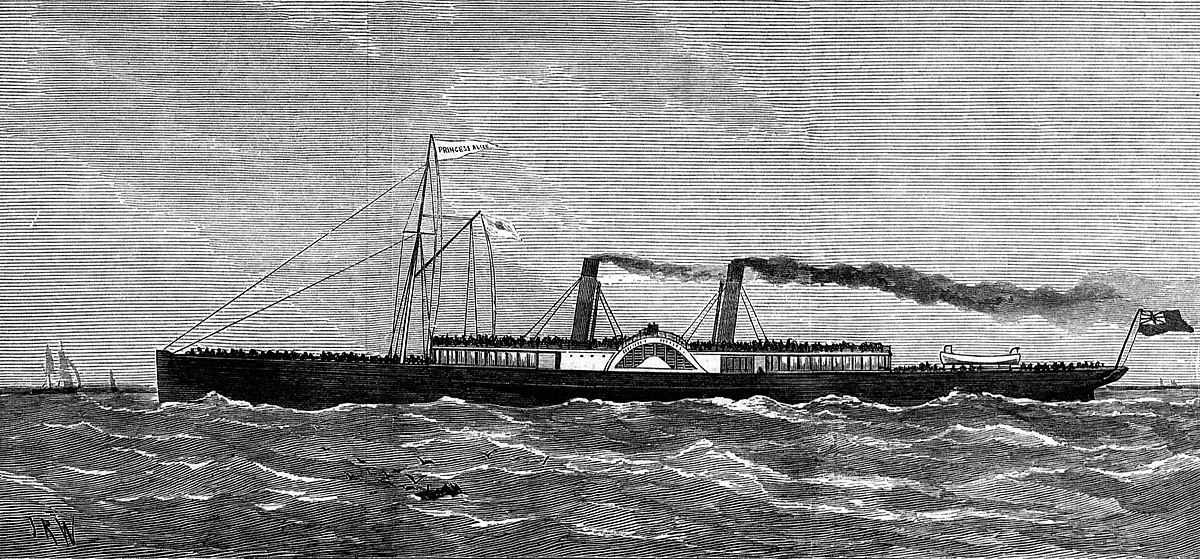
The PSS Princess Alice, a paddle steamer, left Swan Lane Pier – by the northern foot of London Bridge – in glorious sunshine on September 3rd, 1878. A long, low vessel, she bore a crowd of around 800 Londoners on a pleasure excursion to the Rosherville Pleasure Gardens at Northfleet, Gravesend and Sheerness. The Princess Alice’s owners, the London Steam Company, operated a kind of hop-on hop-off system with its other ships so no one knows how many passengers joined the vessel that evening for the ‘moonlight trip’ home.


Entertainment continued all the way back, with the band playing on deck. The sun had set and the moon was rising around 7.30pm when, near Gallions Reach, the Princess Alice (219ft) was rammed in the starboard side by the SS Bywell Castle, a cargo ship (254 ft).


The moment of impact – a chromolithographic cigarette card from around 1911.

In less than four minutes, the Princess Alice broke into three and sank. Her deck passengers were pitched into water horribly enriched by gallons of raw sewage. Those below decks were entombed inside the doomed vessel.


Nick Higham’s The Mercenary River explains how Joseph Bazalgette, for the Metropolitan Board of Works, had in the previous decades diverted the sewage of London to the eastern reaches of the city. In a vivid chapter, ‘Volcanoes of Filth’, Higham recounts how cost considerations stopped the sewage outfalls being sited far enough from the metropolis. At the time of the tragedy, two grand pumping stations churned out London’s waste twice a day at Barking and Crossness. The Princess Alice had come to grief at Tripcock Point, too close in time and place to the evening’s discharge of millions of gallons of untreated waste – not just human but also oil, petroleum and the liquids drained from abattoirs and factories.

In the minutes after impact, a few male passengers from the Princess Alice were able to climb up the Bywell’s ropes or use the life-buoys, chicken-coops and chairs thrown down to them. But, like the captain of the Bowbelle in 1989, the Bywell’s master chose not to stay long on the scene to help rescue victims. Instead, he steamed away. In the dark, in the foetid water, around 650 drowned. Few women made it to shore alive. Impeded by their long skirts, women were also far less likely than the male passengers to know how to swim. At the moment the Bywell struck, many women were below decks, tending to their children. The young fared badly too. Among the dead and missing were 95 children of twelve and under as well as 30 babies aged 15 months or less. A diver investigating the wreck a few days later found bodies packed, vertical, near the doors through which they were probably trying to escape.


Of the Princess Alice’s passengers, just 130 survived. More than a dozen of those died soon after, possibly from ingesting the foul water.


William Heysham Overend: “The Great Disaster on the Thames, recovering Bodies from the Wreck of the Princess Alice”. Illustrated London News. Wikimedia Commons.

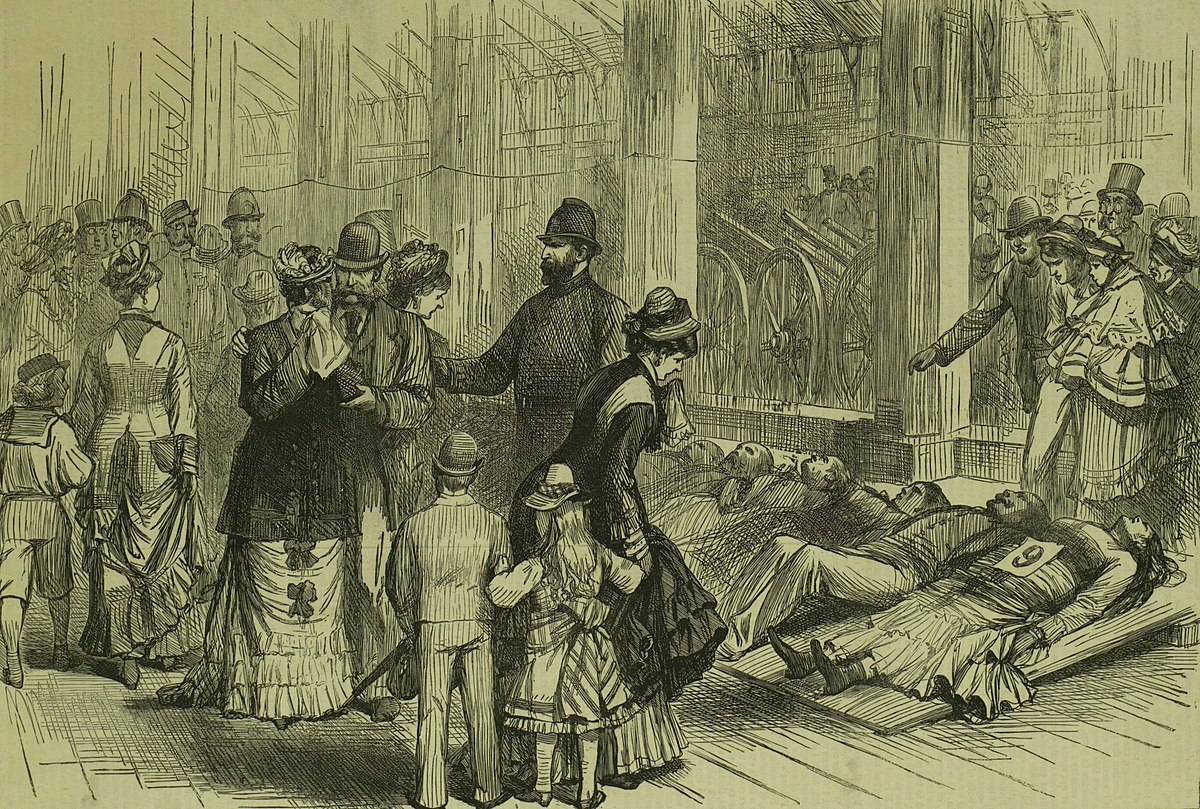
As the news seeped out, Londoners made the grim pilgrimage to Woolwich to claim their dead, who were now being washed up at different points along the Thames. The mourners were accompanied by journalists, newspaper artists (whose work you see here) and tragedy tourists, some of whom – in a queasy pre-echo of today’s clamorous social media – felt obliged to inundate the newspapers and the coroner’s post-box with ‘helpful’ letters about the best way to manage the gruesome situation.


Only gradually was a ghost passenger list compiled, never to this day completed. We know now that it included 46 out of 51 members of the Clerkenwell Mission Bible Class and eight pupils from the Queen’s College Institution for Young Ladies. The professions of the dead sketched their social classes: zinc plate worker, coach trimmer, caulker, commercial traveller, servant, nursemaid, tobacconist, greengrocer, ironmonger’s porter, pipe maker, sweet-seller, shoemaker, draper’s assistant, rising to solicitor’s clerk, organist and the mistress of Limehouse Industrial School.


Identifying the dead in Woolwich Dockyard, from "The Disaster on the Thames", Illustrated London News, 14 September 1878. Wikimedia Commons.

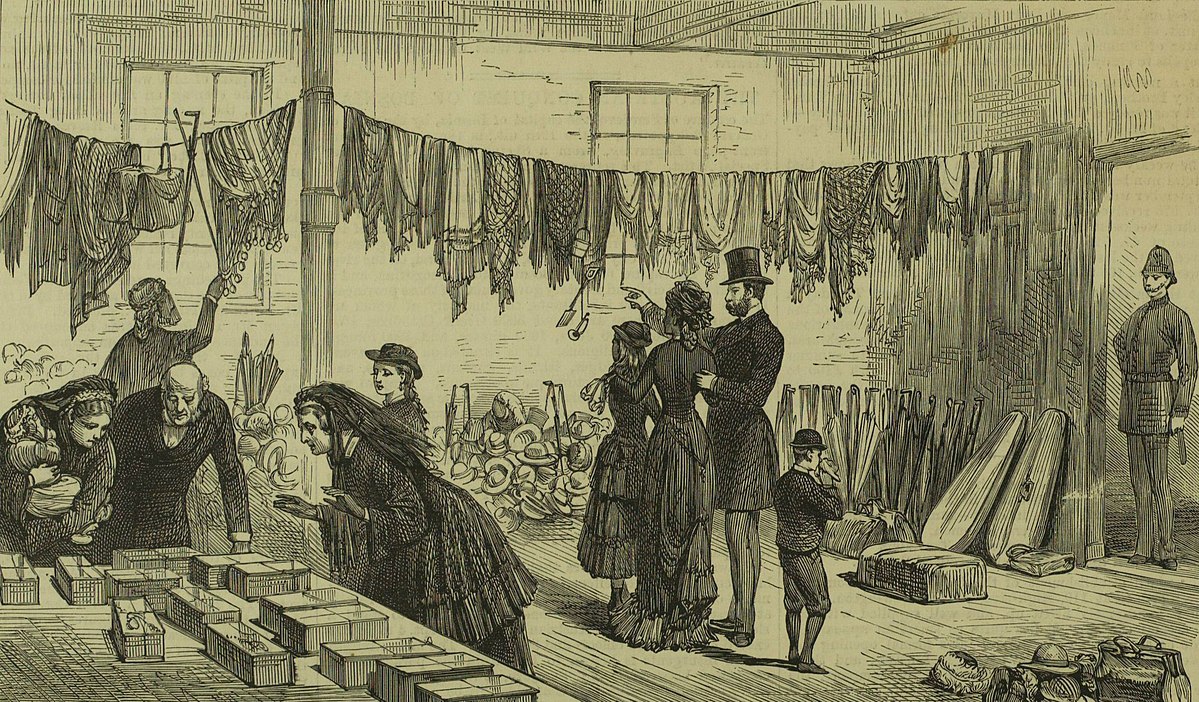
The police found an ingenious way to spare relatives the pain of inspecting hundreds of corpses – in deteriorating condition – when searching for their loved ones. Trinkets and valuables were put in numbered glass-topped cigar-boxes.  Shawls and other items were hung up, also with the same numbers. Clothes taken from bodies were boiled and then sewn together so they could not be scattered. Only relatives who recognised the possessions would be taken to view and identify the body with the corresponding number.


Relics of the dead exposed for identification at Woolwich dockyard following the sinking of the Princess Alice" 
from "The Disaster on the River". Illustrated London News, 21 September 1878. Wikimedia Commons.

Many of the drowned were buried as ‘unknown’. Ten were later exhumed at the expense of their families. But most of the anonymous dead remained unclaimed, listed only by the colour of their hair and sometimes their height. Among them were 18 children, including infants.


Perhaps eighty people were never recovered from the river. Family historian Colin Aylsbury has put online a list of the dead, the saved and the missing here. And this Facebook page serves as a meeting place for people who are descended from Princess Alice victims, crew, survivors and the Lightermen who collected the corpses from the Thames.


“The great disaster on the Thames burial of the unknown dead at the Woolwich Cemetery, East Wickham after the sinking of the Princess Alice" from The Illustrated London News, 21 September 1878. Wikimedia Commons.

Although it’s largely forgotten now, for some months personal accounts, funerals and scandals kept the Princess Alice tragedy in the press and in the courts. The captain of the Princess Alice had died in the accident, and with him the truth about the last minutes of his vessel. Various court cases blamed first the Bywell Castle and later the Princess Alice, for wrong steers and misleading signalling. There were accusations of drunkenness against the Bywell’s crew. Some said that the cargo vessel’s engine had not been cut, thus failing to prevent its propellor from injuring flailing victims. Some Lightermen, who collected the bodies for five shillings apiece, were denounced for rifling their valuables or piling them up so that the dead were further disfigured; there were stories of alcohol-fuelled fights over corpses. The Lighterman also earned by rowing sightseers out to the wreck. 


Some of the scandals are recounted in this eight-page pamphlet below, from Wikimedia Commons. It describes its contents as follows: ‘An Authentic Narrative by a Survivor, not hitherto published. Heartrending Details - Facts not made public - Noble efforts to save life - Robbing the Dead - Particulars as to lost, saved, and missing - Plan of the Locality. Sketches by an eye-witness. Beautiful Poem, specially written on the event, now first published. Memorial for all time of this fearful calamity.’


The coroner concluded that the Princess Alice was not properly or efficiently manned, lacked adequate life-saving equipment and was probably overloaded with passengers. There were also claims that the Princess Alice’s design had sealed her fate. Her length was 28 times her draught, rendering her riskily top-heavy. Nevertheless, the vessel had been passed by the Board of Trade in 1878 to carry maximum of 936 passengers between London and Gravesend in smooth conditions.


Josiah Robert Wells, "The Saloon Steam-Boat Princess Alice" from “The Great Disaster on the Thames”, The Illustrated London News, 14 September 1878. Wikimedia Commons.

Joan Lock’s excellent book, The Princess Alice Disaster, compares the Princess Alice accident with the Marchioness tragedy of 1989. She concludes ‘… there were some echoes down the years: the rapid sinking of the smaller vessel; accusations on both sides of a failure to keep a proper lookout; inebriation of one of the captains … and some victims being trapped in the lower saloons.’ The author also looks at how the Marchioness incident differed from the Princess Alice tragedy. ‘One marked difference,’ she points out, ‘… was the type of passenger. Those on the Princess Alice had been mostly mixed-aged family groups and were largely upper working class, whilst those on the Marchioness were in their twenties, educated, artistic and professional, or aspiring to be.’ As Joan Lock explains, the media's depictions of the victims and their families in some cases added to their suffering. 

Where Venice has its vaporetti, and London has its Clippers, today’s Thames also hosts a fleet of around 60 leisure boats, most of which offer beautiful days or evenings on the river at reasonable costs. Certainly, there’s a problem with thundering music, bellowing DJs and shouting passengers. However, the 1200 complaints registered in the last year focussed on just a very small number of vessels. The vast majority cause harm to no one and give pleasure to thousands.


But the Thames horizon may be about to change, with the arrival of a massive new ‘floating events space’.


These days, passenger vessels on the Thames are certified by the Maritime & Coastguard Agency (MCA), which is now being asked to approve an extremely long, low vessel – longer than a Boeing 747 – for 1000 - 1500 passengers. Described by its owners as a ‘super-yacht’, it’s called the Oceandiva, a portmanteau name that carries a substantial weight of expectation.

Image from the Oceandiva website.

Last summer the Oceandiva consortium applied for a 2.30/3am liquor licence and also bought control of two old Thameside piers – Butler’s Wharf (below) and West India Pier.


Butler’s Wharf, designated in some Oceandiva’s publicity as its ‘main residence’, is surrounded by around 5000 residents; close by are two communities of boat-dwellers including dozens of children. Diagonally across the river is the Tower of London, where 100 people live.


Meanwhile, tiny West India Pier (above) was abandoned and derelict for years, during which time a community of around 700 residents grew up around the site, which is served by a single narrow street. Now West India Pier is slated for transformation into a high-voltage charging, telecoms and servicing station.


In the two riparian communities, the shock is palpable.


Elsewhere, Londoners have been frank, if not brutal, when it comes to their opinions of the ‘super-yacht’s size, design and its designs on the city’s public realm. ‘I've seen better looking coal barges,’ observed one reader of the Daily Mail. Another said, ‘That ship would give me the creeps. Cold, dark, uninviting, and creepy.’ Others expressed fears that London’s emergency services lack adequate capacity to deal with an Oceandiva-sized emergency: ‘It's another Marchioness waiting to happen.’


Meanwhile, no one (except perhaps the Oceandiva consortium) knows exactly when the vessel will arrive on the Thames. Last week, the consortium withdrew their liquor licence application, citing construction/certification delays, but stating that they will re-apply in the near future.


The sudden withdrawal of the liquor licence application cancels out the 1000 objections that were made within the deadline last October.


I conclude with a final picture of the Princess Alice’s last moments, this time from Harper's Weekly October 12, 1878. (Wikimedia Commons). One hundred and eleven years before the Marchioness, this picture encapsulates the danger of a busy, narrow river where, even at night, industrial vessels compete for space with pleasure craft, where the sinuous nature of the river plays hide-and-seek with sightlines and also, incidentally, increases the danger of hydrodynamic interaction. Recent news about river sewage releases does not give comfort when we contemplate the possibility of a large-scale incident on the Thames, which has been, incidentally, the site of all three of the most recent London terror attacks.


Michelle Lovric’s website

OTHER LINKS

River Residents Group website

Petition · The Ocean Diva party boat will ruin the most historic part of the Thames · Change.org

Petition · No OceanDiva · Change.org

Princess Alice Memorial, Woolwich Cemetery: https://www.geograph.org.uk/photo/2985013

Royal Museums Greenwich: https://www.rmg.co.uk/stories/blog/library-archive/drowning-sewage-sinking-princess-alice

Art in the Docks commissioned a moving collaboration between artist Christopher Mike and sculptor Vincenzo Muratore to commemorate those lost on the Princess Alice. You can see images here.