Showing posts with label Deborah Swift. Show all posts

Friday, 27 March 2026

Dangerous Journey - The WW2 Trans-Siberian Express

                                  
by Deborah Swift


The Trans-Siberian Railway, stretching over 9,000 kilometres from Moscow to Vladivostok, is the longest railway line in the world and during the second world war the Trans-Siberian Express became an unlikely lifeline to thousands of refugees fleeing the ravages of war.

Completed in stages from the late 19th century and officially finished in 1916, the Trans-Siberian Railway was designed to be a symbol of Russian imperial ambition. By the 1930s, under Stalin’s regime, the railway was tightly controlled by the Soviet government, serving both civilian and military purposes for the Soviet regime.

After Germany’s invasion of the Soviet Union in 1941, the Trans-Siberian route took on an entirely new strategic importance—not only as a supply corridor for the Eastern Front but also as a humanitarian exit route.

As the Nazis swept through Europe, millions of Jewish civilians, through lack of anywhere else to go, ended up in Lithuania, which was then taken over by Soviet forces. For Jewish refugees, it was like jumping from the frying pan into the fire – under Stalin, political repression, deportations, and forced labour were commonplace, especially for intellectuals. Yet for many refugees, particularly Jews escaping the Holocaust, the USSR represented a narrow but unexpected path to survival.


The ‘Sugihara Survivors’

Some Jewish refugees who managed to flee to the Soviet Union were able to reach Japan or Shanghai, China, by traveling east. Many of these refugees were Polish or Lithuanian Jews who obtained transit visas through the efforts of Japanese diplomat Chiune Sugihara, who held the consulate in Kaunas, Lithuania.

Sugihara defied his government’s orders and issued thousands of transit visas to Jewish refugees. With these documents, refugees could travel across the Soviet Union on the Trans-Siberian Express. In Vladivostock they could then board a ship to Kobe, Japan, and later to Shanghai. This escape route saved thousands of lives.


Chiune Sugihara’s Visa from the Holocaust Museum


Life on the train


Wartime travel on the Trans-Siberian Express was far from the romanticized version sold in modern travel brochures. Refugees endured extreme cold, food shortages, overcrowded compartments, and frequent stops for inspections and detentions. Nevertheless, compared to the alternative—death camps, gulags, or starvation—these hardships were endurable.

The Soviet government’s motive in allowing these transports was not purely humanitarian. In many cases, the USSR was removing anti-communists and also making them pay handsomely for the privilege. Many refugees were stopped and their valuables confiscated by the Russians.

Memorials and testimonies from survivors continue to shed light on these lesser-known refugee journeys. Documentaries, such as The Trans-Siberian Railroad: A Path to Survival, and the memoirs of survivors brought home to me the profound impact the Trans-Siberian railway had on people fleeing for their lives.


Read more about it:
  1. Marvin Tokayer and Mary Swartz The Fugu Plan: The Untold Story of the Japanese and the Jews During World War II.
  2. "Sugihara Survivors: Jewish Refugees Who Escaped via Japan." Yad Vashem. https://www.yadvashem.org
  3. United States Holocaust Memorial Museum. “Polish Refugees and the Soviet Union.” https://encyclopedia.ushmm.org
  4. PBS Documentary: Sugihara: Conspiracy of Kindness, 2000.

LAST TRAIN TO FREEDOM tells the story of some of the Sugihara Survivors.


Saturday, 27 September 2025

The Lifeline - The Shetland Bus in WW2

I’ve always been interested in untold stories of WW2, especially stories from overlooked outposts, such Shetland (The Lifeline). Although The Shetland Isles are a long way from the mainland it would be a mistake to think that the islanders of Shetland were little involved in the war effort against Germany. As one of the furthest flung points of the UK, Shetland was in an ideal position to act as a staging post between the mainland and Nazi-occupied Norway.

The idea of the Shetland Bus originated when a marine base was being established in late 1940 at Lerwick, and caught the attention of the Secret Intelligence Service (SIS) and the Special Operations Executive (SOE), who realised that the base could be used as a staging post for arms and information in the fight against the Germans.


David Howarth’s excellent non-fiction book The Shetland Bus describes how small fishing boats acted as go-betweens for the Norwegian Resistance, supplying arms, personnel, and intelligence in their fight against their fascist invaders, and this was my starting point for the novel, which draws on various true-life incidents. This clandestine route across the sea was in operation between Scotland and German-occupied Norway from 1941 until the surrender of Nazi Germany on 8 May 1945, and it grew from being just fourteen fishing boats to a much bigger operation once the US got involved in the war.


To reconstruct these journeys across the North Sea for The Lifeline, I drew on memoirs and real accounts from men who made the crossing. The Shetland Bus Memorial is located at Scalloway in Shetland, and the local museum has a permanent exhibition relating to the activities of the Shetland Bus and information about those who manned it.

Although the boats pretended to be regular Norwegian fishing boats, they were ingeniously equipped with machine guns and ammunition hidden in boxes of fish, or oil barrels, as the men often had to defend themselves from enemy fire. Once the Nazis discovered this route was being used to support Resistance activities, they patrolled the coasts regularly with boats and reconnaissance planes, which would strafe the boats if they were spotted beyond Norwegian waters. If the men on board were captured by enemy patrols, they were tortured then executed.


Leif Larson is the most famous of all the Shetland Bus crew and the most highly decorated Naval Officer of the war. Known in Norway as ‘Shetland’s Larsen,’ he escaped from Norway in February 1941 in a fishing boat and trained with the military unit called the Linge Company. During WW2 he made over 50 trips to Norway including one trip where on the way back his boat was attacked by the Luftwaffe and six of his crew were hit. The surviving two men made it to the Alesund area and were picked up by a ship that took them back to Shetland. 


Arguably worse than the threat of Nazi attack, was the other enemy – the winter weather. Sorties had to take place in winter when enemy patrols were less likely to spot them. The mountainous seas and wintry conditions of fog, ice and storms made the journeys perilous. My fictional narrative features Jørgen Nystrøm, a Norwegian wireless operator who retrains to crew on The Shetland Bus. 

My other main character is a female teacher, Astrid Dahl. Her story centres on the Norwegian Teachers’ Strike. When the Nazis try to force the teachers to join their Fascist teachers union, Astrid refuses and persuades others to join her in defying them. This rebellion leads her into danger, and eventually forces her to try to escape Norway, via her only lifeline – The Shetland Bus. The stories of the two main characters coincide, and I hope provide both an insight into Norway in the war, and a satisfying story.


One of the pleasures for me as a writer was to be able to describe the wind-blown Shetland Islands and the majestic mountains and fjords of Norway, so I do hope some of you will take the journey with me!


Listen to a BBC podcast about the Shetland Bus. https://www.bbc.co.uk/programmes/m0028vd4

THE LIFELINE mybook.to/LIFELINE

Website www.deborahswift.com

Twitter @swiftstory Bluesky @authordeborahswift
Pics: Wikipedia, Pexels, my own.

Friday, 27 September 2024

Operation Manna - food from heaven in WW2

 by Deborah Swift

In the last few weeks we have heard a lot on the news about WW2's 80th anniversary of Operation Market Garden and Arnhem - the attempt by the Allies to free occupied Holland. It was only partially successful, leaving much of Holland still occupied and cut off from the rest of the Netherlands.


By the winter of 1944-1945, the Netherlands was in the grip of a severe famine, known as the "Hongerwinter" (Hunger Winter). The German occupation forces had cut off food and fuel supplies to the western part of the country, a region that included major cities such as Amsterdam, Rotterdam, and The Hague, which remained under German control. Above - Dutch children being fed soup during the famine.

The destruction of transport infrastructure by bombs and sabotage made it nearly impossible to distribute whatever food was available. By April 1945, millions of Dutch civilians were facing starvation. An estimated 20,000 people had already died. The situation was dire, and the Dutch government in exile, along with the Dutch resistance, appealed to the Allies for help.

Operation Manna was the response to this desperate plea for assistance. Named after the biblical manna that fed the Israelites in the desert, the operation was conceived by the Royal Air Force (RAF) Negotiations were hastily arranged between the Allies and the German forces in the Netherlands. While the Germans were still an occupying force, they were also aware that they were losing and were perhaps motivated by a desire to avoid post-war retribution. Eventually, truce was agreed to allow unarmed bombers to fly low over Dutch territory and drop food supplies without being fired upon.

The first mission of Operation Manna took place on April 29, 1945. Lancaster Bombers were loaded with food parcels instead of bombs. The aircraft flew at low altitudes, around 400 feet, over designated drop zones in the western Netherlands, including areas around Rotterdam and The Hague. The food parcels contained basic but essential supplies: flour, dried eggs, margarine, sugar, and tinned food. These items were packed in sacks and boxes that were designed to minimize the risk of damage when dropped from the planes.

Over the course of ten days, more than 3,000 sorties were flown by the RAF, dropping nearly 7,000 tons of food. The operation was a logistical triumph and a morale booster for both the Allied forces and the starving Dutch population. For many, these food drops were the difference between life and death.


For months, the Dutch people had been surviving on whatever they could find: tulip bulbs, sugar beets, and anything that could be scavenged. See the photo above of Dutch women transporting food. The sudden influx of supplies amazed the population, delivered from the skies by the sort of bombers that had once represented death and destruction.

The food drops did more than just prevent starvation, they also lifted the spirits of the population. Stories from those who lived through the Hunger Winter often recall the sense of relief and joy that accompanied the arrival of the food parcels. In many cases, the Dutch civilians gathered in the drop zones would wave at the Allied planes as they passed overhead.


Operation Manna continued until May 8th 1945, the day the Germans in the Netherlands officially surrendered to the Allies. This marked the end of the occupation and the beginning of the recovery for the Dutch people. The food drops, however, continued to be a crucial lifeline until normal supply routes could be restored.

The legacy of these operations endures to this day. Monuments and memorials in the Netherlands commemorate the food drops, and the operations are taught in Dutch schools as an example of international cooperation and humanitarianism.

For the airmen who participated, the missions were often among the most rewarding of their military careers. In my latest novel Operation Tulip, these food drops form part of the plot towards the end of the book. When researching I was taken by how moving the British airmen found these missions, to be sending aid not bombs, and how they recalled the Dutch waving from the ground. After five years of war, this must have been a heart-warming sight.


Operation Tulip is out now.

Friday, 29 March 2024

The Aspidistra Radio Transmitter #WW2

by Deborah Swift

Harold Robin - WW2 Radio Engineer

The Shadow Network which forms the title of my latest book refers to the fake news radio stations set up by Sefton Delmer in WW2. These secret radio stations operating in WW2 pretended to be genuine German radio stations and employed German prisoners of war or other German speakers to make their broadcasts. The broadcasts were deliberately racy and were designed to capture the hearts of ordinary Germans and make them believe they were listening to a forbidden radio station from their own country. Their popularity spread, and they got wide audiences for their programmes.


The radio signal for these ‘fake news’ radio stations needed to be strong enough to appear as though it came from Germany and had to be more powerful than anything that was then available.


By coincidence, the Radio Corporation of America (RCA) had created two high-powered radio transmitters which could not be used in the US, because of a change in American law. The RCA were eager to sell them to Britain. So Harold Robin, (pictured above) a Foreign Office radio engineer, saw their potential, and travelled to America to examine them, and then worked to improve them. He adapted a transmitter so it was able to move frequency in a fraction of a second, at the flick of a switch.

The powerful ex-RCA transmitter, eventually installed in Sussex, England, was named Aspidistra, referencing the popular Gracie Fields song ‘The Biggest Aspidistra in the World’, in which an Aspidistra houseplant grows until it ‘nearly reached the sky’.

In fact, most of the technology was buried underground at the site at Crowborough, though its antennae were visible – three guyed masts, each 110 metres tall, directing the signal broadly eastwards. The Art Deco–style transmitter building was housed in an underground shelter which had to be excavated by the Canadian army troops who were stationed nearby.

Intrusion operations


The Aspidistra mast was so powerful it could be used to intercept German frequencies. During Allied air raids, German radio transmitters were switched off so the Allies couldn’t use them to locate their installations.

As soon as the Germans switched off their masts, Aspidistra began transmitting on its frequency, just like the German station. The transition was seamless and German listeners believed the original station was still broadcasting. Aspidistra operators would then insert pro-British propaganda and fake news into the broadcast as if it was coming from official German sources.

Post War Use

After the war, Aspidistra was used by the BBC. It made its final transmission on 28 September 1982, before being finally switched off by Robin, the man who had been responsible, forty years earlier, for bringing the transmitter from the US and setting up the station at Crowborough.

In my novel based around the Aspidistra transmitter and the fake news radio stations, I include a fictional plot to blow up the transmitter. Although fictional, this is not unlikely as there were several attempts by the Germans to sabotage infrastructure and communications systems in England at the time.

If you’d like more information about Radio Aspidistra I recommend this Nuts and Volts Magazine article - The Raiding Dreadnought of the Ether.


‘Brilliant! Loved this novel about the input made by the Political Warfare Executive to WW2. The characters seemed so real and true.’ NetGalley Reviewer

‘A gripping tale of wartime subterfuge, spies, saboteurs and black propaganda’ NetGalley Reviewer

Read more about   THE SHADOW NETWORK mybook.to/RadioLies

Saturday, 30 September 2023

History keeps changing - writing The Fortune Keeper

 By Deborah Swift


I was really interested to read this week, that the coded letters of Mary Queen of Scots have just been deciphered by modern computer scientists and decoders. Undoubtedly this will give us hitherto unknown insights into what we know about her and her life. Historians and historical fiction authors may need to change their views depending on the new evidence.

A similar thing happened to me when was writing the last book in the trilogy of books about Giulia Tofana, a woman who was renowned for inventing the poison Aqua Tofana, and was supposed to have poisoned six hundred men in Renaissance Italy. (See my Aspects of History article Poison and PowerI had already uncovered through my research that Giulia Tofana was probably an amalgam of three women, and not the single entity of legend.


Three women, not one


The mother, Theofania d’Adamo was executed for the crime of poison on 12th June 1633, but her daughter, Giulia (known as Tofana) survived. The third person in this triumvirate of poisonous women was Giulia’s daughter, known as Girolama Spara. Until recently very little was known about the daughter so as historical novelists do, I fictionalised her birth, assuming she was a blood daughter of Giulia Tofana and her (also unknown) husband surnamed Spara. I wrote about this before for Aspects of History

About half way through writing the third novel in the series, from the point of view of the daughter, new evidence arose about the women in Giulia Tofana’s family. In an old library archive in Italy, an American academic had unearthed the real-time transcript of the murder trial of Giulia Tofana’s daughter, Girolama Spara, (also known as Gironima Spara) and published it. The document was originally kept under lock and key by the Pope at Rome’s Castel Sant’Angelo, and from there ended up in the State Archive where it lay uncatalogued and undiscovered for generations. You can find the document translated by Monson at the end of this article.

History evolves

Of course I trawled through the new information, discovering with growing concern that my fictional view of events differed widely from this new evidence. I was shocked to discover that Girolama Spara was a step-daughter, and not a blood daughter at all, and that Giulia Tofana had been married twice.

The ledger was in a poor state of repair, but Professor Craig A Monson had painstakingly resurrected it and translated it into modern English. The truth is less glamorous than the plot I had in mind for these characters, so what should I do? The past is both fixed and mutable. The two previous books were fixed, already out on shelves and readers were enjoying the story. The new information meant that I would need to be open to bending, or changing, the third book.

Would readers care? There are many schools of thought on this – on how accurate historical fiction should be, and it is debated endlessly by historians and novelists. From my point of view I was obligated to finish the story I had set up with the characters remaining consistent within the series, yet also to incorporate the new information. The rules I set for that world needed to remain in place so that the reader feels they are in a real and secure locale, no matter where the story went.

Whatever character I create can never be the real person. Anne Boleyn has had hundreds of interpretations of her character. The events I describe can never be ‘true’, just as contemporary witnesses to any crime will have different views. A novel can’t be ‘accurate’, just as someone trying to depict my life of yesterday could never be accurate, even with all the iphone technology and photography available now, and if my diaries were in front of them, because life is too complex to render completely. What I hope to achieve in my novels is a tantalising whisper of what it might have been like to inhabit another era.


History continues to fascinate

It is exciting that at last we know more about the actual trial and details of the life of Girolama. She is nicknamed Mia in my book, because having a similar name to her mother Giulia, she was often confused with her, and this led to many errors of attribution. Many of the crimes assigned to Giulia actually belonged to Girolama and vice-versa.

I used maps, academic articles and transcripts of primary sources to complete the book, as well as the translation of the trial documents by Professor Monson, and I like to include historical notes at the end of my books to make it clear where (for the moment) the historical evidence is pointing.

Is The Fortune Keeper a true re-telling of Girolama Spara’s life? Definitely not. Will it take you on a journey into the heart of a young woman in Renaissance Venice? I hope so. 

You may be interested in:

The Black Widows of the Eternal City: The True Story of Rome’s Most Infamous Poisoner by Craig A Monson

Coded Letters of Mary Queen of Scots https://www.bbc.co.uk/news/uk-scotland-64568222


THE FORTUNE KEEPER


Buy the Book – https://mybook.to/AquaTofana

#KindleUnlimited

Twitter https://twitter.com/swiftstory

Facebook: https://www.facebook.com/authordeborahswift/

Website www.deborahswift.com

Pictures of 17thC Venice, The Ridotto gambling hall, and the fight on the Bridge of St Barnaba in Venice, all from Wikipedia.

Friday, 2 June 2023

Decoders of the WW2 Special Operations Executive

by Deborah Swift


After the fall of France and Belgium, a new organisation was formed – the Special Operations Executive (SOE) to strengthen subversion and sabotage in occupied territory and behind enemy lines.

To disrupt the enemy, agents sent abroad were charged with destroying railways, utilities such as telephone exchanges, bridges and factories, and then also to organise resistance cells of volunteers from within. Churchill’s famous instruction to Hugh Dalton, the then head of the SOE was to 'set Europe ablaze!'

The SOE headquarters, to train and recruit enemy agents, was in Baker Street in London, and the SOE began to recruit men and women to fill their ranks. One of the roles they needed to fill was that of decoders, women who would try to unscramble the ‘indecipherables’ – messages from agents abroad who had mangled their coding either through fear, pressure or simply forgetfulness.

These women had some skill in puzzle-solving, for example crosswords, but little else in the way of experience. Often they were daughters of someone else in the service, or of a friend or neighbour, as was all top secret and done by word of mouth. In my novel Nancy arrives there because her brother is already working for the SOE.

Women were recruited from all walks of life, the main criteria being that they had the language of the place they would be operating in, and were calm under pressure. The trainers tested them mercilessly, even going so far as to subject the women to enemy-like interrogations and they were rigorously vetted both during recruitment and during training.


Leo Marks in his book ‘Between Silk and Cyanide’ details all the methods that were tried to make the codes easier for agents to use. These included the use of poem codes (the agent and his decoder would learn a poem as their crib sheet) to printing on silk with disposable single-use grids of numbers.

The average lifespan of an agent sent abroad by the SOE was a mere six weeks, which means many were caught and killed earlier. In Holland the messages were broken very efficiently by the Germans, and after the first few Dutch agents were captured, it made it easier for German Intelligence to transmit as if they were the agent, getting the key to the code through torture and intimidation. The people at Baker Street were unaware they were decoding messages from the enemy who had infiltrated the resistance.

The agents that were still free were always looking over their shoulder. The slightest mistake, such as transmitting too often, would lead them to be discovered. This fact meant that decoding was a high pressure job. The women in Baker Street were working against the clock to crack the message – and the longer it took, the more likely the agent would send it again and that would put them at risk. Just to hop on the air waves was dangerous, when the German detector vehicles were scouring the area for illegal signals.

In my novel, Nancy goes on to work as an agent, to be the one sending rather than just receiving the radio messages. They were few restrictions on what agents could do, and outside the SOE the organisation became known as the ‘Ministry for Ungentlemanly Conduct’. This was because the SOE was responsible for high profile missions rather than the secretive low profile favoured by the Secret Intelligence Service, usually known as MI6.


For Nancy’s journey I researched the various countryside properties that were requisitioned by the SOE. Remote locations were used, such as the remote Arisaig in the Highlands of Scotland, so that the agents could develop skills in how to kill with their bare hands; the preparing of disguise, how to sabotage a train; and even how to break in and out of buildings by picking the lock with wire. Other country Houses that were used in SOE training included Winterfold House, Cranleigh, and Fulshaw Hall, Cheshire. The latter was the place where agents did parachute training. Several agents were injured during this training which included jumping out of a barrage balloon over a Manchester airfield.

If an agent survived weaponry training and passed the parachute test, they were ready to go behind enemy lines. The agents were assisted on their missions with some James Bond type equipment supplied by ex-film property makers working in an old hotel called The Thatched Barn – special clothing, cases to conceal radio and camera equipment, explosive devices. They also supplied false documents for the agents’ cover stories.

Sir Stewart Menzies head of the Secret Intelligence Service denigrated the SOE as 'amateur, dangerous, and bogus' and eventually the RAF, sick of losing planes to drop agents into Holland, simply refused to lend out their aircraft for these clandestine drops. They would rather drop bombs than agents. Nevertheless, the SOE produced many brave men and women whose actions were courageous, intelligent and awe-inspiring. I hope Nancy Callaghan, my main character helps you experience what life was like for those women who joined.

Read more about Female Spies of the SOE https://www.historic-uk.com/HistoryUK/HistoryofBritain/The-Female-Spies-Of-SOE/

See also Seven Stories from SOE agents https://www.iwm.org.uk/history/seven-stories-from-special-operations-executive

Find me at www.deborahswift.com  or on Twitter @swiftstory

Friday, 30 September 2022

Women of the Road - Real-Life Highwaywomen

by Deborah Swift


There is something very appealing about the highwayman’s disguise – the tricorne hat, the cloak, the breeches and boots – and even more so when this disguise is worn by a woman. Contrary to popular belief, records show that there were women who risked the noose, to make their living on England’s rutted and treacherous roads, and who showed their own unique brand of ruthlessness and courage.

Double – Crosser Joan Phillips

Joan was the daughter of a rich and well-established farmer. Her beauty (and wealth) brought her to the attention of Edward Bracey, a small-time crook, who planned to seduce her, persuade her to marry him, and then abscond with her dowry, leaving her flat. 

Joan was intelligent enough not to fall for this plan, and though allowing herself to be seduced, foiled the rest of the plan. Edward Bracey, according to the Newgate Calendar ‘was very agreeably deceived; for Joan was as good as he … she consented to rob her father, and go along with him on the pad; all which she accordingly accomplished.’ 

So Joan was determined to gain an upper hand, and they never did marry, but Joan and Edward frequently robbed together on the highway, though it seems Joan was always the one in control.

Joan had a long criminal career including running an inn, but eventually, the Law caught up with her and she was arrested in 1685 after robbing a coach.  She was tried under the name Joan Bracey, found guilty, and executed the same year in Nottingham. Records diverge on how old she was when she died, some saying she was as young as twenty-one. 

Watch a video about her 

BBC Criminal Histories "The Highway Woman"

https://www.youtube.com/watch?v=YnuYdL4TrO4

Tudor Highwaywoman Mary Frith


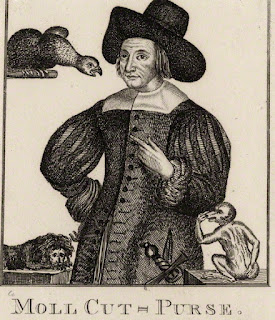
Mary Frith (nickname - Moll Cutpurse) was the daughter of a shoemaker and lived in Aldersgate Street near St Paul’s Cathedral. From an early age she was often in trouble with the law for stealing. To try to reform her, a minister tried to ship her off to New England in America, but Mary dived off the ship and swam back to shore.

From then on, she was arrested frequently for robbery and was held in various prisons - The Old Bridewell, the Compters and Newgate. She was branded on the hand on several occasions – this was a common punishment for thieves. Her stamping ground was St Paul’s Church (now the re-built Cathedral) where she would cut the strings of purses, (hence her nickname) and she also traded as a ‘fence’ for stolen goods and a pimp for younger women. Victims of pickpockets who had lost jewellery or valuables would come to Mary, and she would trade with the criminal underworld to return the items for a cost.

Mary was nearly always dressed as a man, drank in taverns and carried a sword. She is also credited with being the first woman to smoke a long clay pipe. She had a long association with the theatre and by the turn of the century she was performing on stage in men's clothing at the Fortune Theatre. On stage she bantered with the audience, fenced in mock fights, and sang, accompanying herself on the lute.

She was a keen horsewoman and was once bet twenty pounds that she wouldn’t ride from Charing Cross to Shoreditch dressed as a man. Of course she won the bet, and made it all the more entertaining by doing it on Morocco, the most famous performing horse of the day. Her riding skills enabled her to turn highwaywoman during the English Civil War. A staunch Royalist, she robbed the Roundhead general, Sir Thomas Fairfax by holding up his coach on Hounslow Heath.

We know a lot about her because The Life of Mrs Mary Frith of 1662 was one of the first biographies of a female criminal to be published in England and was highly influential in bringing women’s lives to the public interest. It is thought that Defoe’s book, Moll Flanders, was based on her life.

Heiress and Highwaywoman Katherine Ferrers

Lady Katherine Ferrers was the inspiration for the 1945 film The Wicked Lady, starring Margaret Lockwood and James Mason, which tells the story of a 17th century aristocrat and heiress who turns to highway robbery. Katherine was supposedly persuaded to a life of crime by her highwayman lover Ralph Chaplin, but he was caught and hanged on Finchley Common. After his death she worked alone, but was caught when she held up a coach and shot the driver; unfortunately it was a trap, and two of the occupants of the coach were armed and shot back. Fatally wounded, she galloped home to Markyate Manor, where she was found lying on the front steps - dead, but still dressed as a highwayman.

This of course is not the real story. The real story is one of plunder and possession in The English Civil War, and a time when rural farmers were trying to keep their lands out of the pockets of the aristocrats and were experimenting with new ways of communal living. In my young adult books about the life of Katherine Ferrers I explore these themes, and I enjoyed deconstructing and reconstructing the legend.

Sources:

Outlaws and Highwaymen - Gillian Spraggs 

The Elizabethan Underworld – Gamini Salvado

Dunstable History Society

Pictures: Wikipedia, East End Women's Museum, Project Gutenberg

Find me and my books on my website www.deborahswift.com


Friday, 1 April 2022

SALT in the 17th and 18th Century #Salt #History #Artisan

 by Deborah Swift 

Salt comes from two main sources: sea water, and the mineral halite (also known as rock salt). Salt is something we take for granted nowadays, forgetting that the term for our pay, the salary comes from the Latin salarium, originally denoting a Roman soldier's allowance to buy salt.

Near where I live in Lancashire and Cumbria, there is a long history of panning for salt in the Morecambe Bay. In 1748, William Brownrigg’s The Art of Making Common Salt mentions ‘sleeching’ on Morecambe Bay. Sleeching, I discovered, is scraping up salt-impregnated sand and silt, then watering out the salt to produce a concentrated brine, then boiling in 'saltcotes' –  small huts installed with lead pans over a fire.


But as canals and railways allowed the cheap transport of salt from inland mines and abroad, coastal salt-making gradually faded away, and by the 1860s it had almost entirely disappeared. One of the biggest producers of salt was Lion Saltworks in Cheshire and you can find a wonderful post and pictures,like the one above, about it here.

Norwich, Nantwich, Middlewich

Many towns and cities in England end in –wich  (or wych) and these are traditionally associated with salt production.  The suffix -wich derives from an Anglo-Saxon word meaning roughly "a dwelling or fortified place" and usually these were places with trading activity on low-lying coasts or on salt marshes, so many of these towns were also active in producing salt, which was a major and lucrative export.

White Gold – Salt from sea water

During the Early Modern Age, salt production from seawater was a profitable industry and soon became Scotland's third-largest export after wool and fish. It was deemed so valuable by the 18th Century that people called it "white gold”. The remains of nine salt pan houses and a windmill can still be seen at St Monans in Fife, Scotland, and the industry remains in the names of places like Prestonpans. The picture below is of salt harvesters in Brittany. 


New Forest Salt

Lymington in the New Forest, on the Solent estuary, is a town that began as an Anglo-Saxon village and is recorded in the Domesday Book as "Lentune". From the Middle Ages and up to the 19th century, Lymington was well-known for its salt making 

On a visit to Lymington in the 1690's traveller Celia Fiennes writes of Lymington as having a few small ships, but “the greatest trade is by their salterns” and she gives details of how the seawater was pumped through pipes into iron or copper pans situated into the salt-houses where it was evaporated away by boiling rapidly over coal fired furnaces. A vast amount of salt could be made in a single pan beneath which the furnace was kept blazing away all day and night (see the picture). By the middle of the eighteenth century there were about one hundred and fifty active salt pans. 

Read more about Celia Fiennes here, on the English Heritage site. The picture of the boiling off of water over a furnace is from National Gallery of Scotland.


A Tax on Salt

Salt was a precious and valuable commodity used the world over, as it is an essential nutrient. In 1641, during the commonwealth period, the previously abolished salt tax was reintroduced to raise money for Parliament. However the tax was revoked on the King’s return in 1660 and not reinstated until 1693 under the reign of William III. The tax was originally set at two shillings a bushel on foreign salt, but only one shilling on native salt to protect English salt workers.

Salt Wars

In the early 17th century, while well-known nutmeg wars were fought between Dutch and English merchants over imported and exotic "East Indian" spices, a different but equally intense rivalry erupted as traders in the Netherlands tried to secure their salt supply for the processing of herrings, butter and cheese.

The Baltic and Poland had extensive salt deposits, but the best supplies were controlled by the Spanish monarchy, in Portugal and the Caribbean, where salt more suited to herring was produced. Throughout the 17th century, the problem of salt supplies determined the Dutch attitude to the Spanish and Portuguese, and affected these empires’ prosperity in the Dutch "Golden Age".

 Want to know more? The history of salt is fascinating and far too big for a single post. Watch this interesting video on the history of salt.

https://www.youtube.com/watch?v=DFOxbmgr4so

Or read Mark Kurlansky's Salt 


Deborah Swift is the author of  nine books set in the 17th Century, as well as others set in the 20th Century. Find her at www.deborahswift.com or chat with her via Twitter @swiftstory


Friday, 1 October 2021

Historical Fiction: Ways to keep your inner muse inspired

 by Deborah Swift


I have been writing for quite a number of years now and in that time the publishing landscape has changed enormously. I am now reliably informed by Google that there are 2,700 books published every single day, and against that tsunami of books, my sitting down at my desk every day to write another  can seem rather pointless. Why would anyone need even one more book?

When I first began writing, I was inspired by the whole craft of writing. I got myself a shelf full of books which told me about plot, structure, research, and other craft skills. Most of these books are now something I rarely look at as they offer the same old advice re-packaged. So where is a seasoned writer to find the inspiration to carry on writing?

Here are some online ideas I find really useful when I am particularly jaded. They are all free, and won't cost you a thing.


First up - there is always research. Research is my life blood and the interesting facts I discover whilst I'm doing it are not only what keeps me engaged, but also enables me to breathe a semblance of life into my books.

Visual Feasts - Go on a live tour.
There are online walking tours to just about everywhere now. How about one I've just enjoyed? It takes about 45 minutes and is an ideal visual orientation and overview of the subject I'm researching. You can tip the tour guide if you want but its not obligatory. Jewish History in Amsterdam
There are offerings on this site from every corner of the world -  London -Way of Death is about the execution sites and the Necropolis of Old London.
For a longer tour you could sample this from a different company, which has a different approach more like a lecture tour, and more in depth information - it lasts an hour and a half .


Pin Back Your Ears - Listen to a podcast by another historical novelist
I love to hear other writers offer me their pearls of wisdom, and hearing someone else talk about their own difficulties helps me to feel I'm not alone in tackling my own big project.

Here are some good ones to get you started.
The Write Show - Writing Historical Fiction about a little known figure (Mary Magdalene) and how the writer handled contradictions in her sources.
Art in Fiction - Writers (most are historical novelists) talk about artists, writers and performers that feature in their books and how they brought them to life. 
Historical Fiction and the Perils of Family History - Emma Darwin unpacks how to fail writing about your famous family!
Historical Fiction Unpacked  - a regular selection of historical novelists talk about their process in creating their latest work.


Dig a bit Deeper - Fire up your brain 
The question most historical novelists are tired of answering gets a breath of fresh air in this 
 in-depth article in The Literary Hub by Caitlin Horrocks.
The anxiety of writing historical fiction  or this take on the old debate about accuracy from Hilary Mantel; Facts are not the Truth 


Take a Tip from the Experts - You're never too old to learn
However expert you are, a novel is always a new journey. Of course there are many classes and courses that will take your money, but if you're just a bit jaded and need some free pep, then here at the National Centre for Writing, there are free soundbites, classes and courses including ones by Sarah Perry and Nicola Upson.  Want to write a convincing fight scene? Try these tips from the New York Editors Blog.

Mooch round a Museum - without leaving your chair


Tired of your view? How about visiting the Frick Collection in New York? Expect to see Old Masters, decorative arts, and European sculptures in this former residence turned art museum.
Or how about Blenheim Palace - wander three hundred years of history and the sumptuous gilded rooms with only a mouse. My personal favourite is the Rijksmuseum, home of Dutch Masters and a visually stunning website.


The Beauty of the Book - can't beat the real world
Of course one of the obvious and best ways to get inspired (and yes I deliberately left it until last) is to read. I love my local secondhand bookshop. In it I can browse openings of dozens of pre-read novels for a flavour of the writer.  Other writers' voices are not like mine, and I love to see what the differences are and how they construct their stories. There are also old books - the solid language of Victoriana, and the hip lingo of the 1970's.

As most of my life as a writer is conducted online or via the computer, it is great to get back to the real world of books. Weirdly, no matter how obscure my subject matter I can usually find something of interest in a second hand bookshop. It encourages the cross-fertilization of ideas because there are so many random books close to each other - many of which are not the bestsellers touted in every other bookshop. Nearly all my non-fiction research books are actual books rather than ebooks, and often second-hand. It is much easier to find stuff again in a real book, and I often read the book more than once and need to put post-its on them with my notes about why that extract is useful.

Struggling with a title? Your secondhand bookshop will provide lots of ideas. Need to think of a blurb? Again, the second-hand bookshop will give you back-cover ideas culled from the last fifty years at least.

Here's my local bookshop, Carnforth Books. I'm glad to give them a shout out with their thousands of second hand (and new) books,


Hope you found this post useful, and I'd be glad of any other ideas to keep my nose to the grindstone. And no, it's not procrastination, honest.

You can find my latest book, a biographical novel of Renaissance poisoner Giulia Tofana, here, and my website for more exploring here.

Chat with me on Twitter @swiftstory

Saturday, 4 April 2020

Charcoal Burning - our woodland heritage

by Deborah Swift


“The charcoal burner has tales to tell.
He lives in the forest, alone in the forest,
He sits in the forest, alone in the forest,
And rabbits come up and they give him good morning,
And rabbits come up and say, ‘Beautiful morning’,
And the moon swings clear of the tall black trees,
And owls fly over and wish him good night.
Quietly over to wish him good night.”

A. A. Milne

As an art student way back in the 1970's I used to draw a lot in charcoal. It came in small white boxes, labeled 'Willow Charcoal' , but at the time I never really questioned where the charcoal came from or what it was. Later I used charcoal briquettes at family barbecues, and even ate charcoal biscuits when I had an upset stomach on my travels in India. Charcoal in England has a long history and is somewhat of an art form in itself, so here are a few pointers to this lovely craft.

Charcoal drawings from the Chauvet Cave

Charcoal History
The earliest examples of animals drawn in charcoal can be found in the Lascaux Caves, which date to approximately 15,000 BCE. Early Egyptians developed techniques using charcoal for writing on papyrus, and the Phoenicians discovered the antiseptic properties of activated charcoal and began using it to purify their water. A well known practice for any long sea voyage was to store water in barrels that had been charred.

Charcoal has been used since earliest times for medicinal purposes, such as aiding digestion, and as a tooth cleaner before the invention of toothpowder and toothpaste. In the 17th Century physicians used poultices made from charcoal and bread crumbs, or yeast, as well as giving patients charcoal powders to treat ulcers, acidity in the stomach, and nosebleeds.

In early crafts, charcoal was the traditional fuel of a blacksmith's forge because it burns much hotter than wood or coal and an intense heat is required to forge iron. Traditionally this craft was particularly common in the iron industries of the Weald, Forest of Dean and Lake District. In warfare, charcoal was also extensively used in the production of black powder, an ingredient of gunpowder, and more recently, fireworks.


The Trees used in Charcoal Making
Apart from willow, hazel and other softwoods from our native woodlands, Alder traditionally makes the best charcoal, and used to be used in gunpowder because it can be ground down very finely. Ash is usually set aside for firewood. Coppiced oak was frequently used, leaving the sturdier limbs for crafts like boat-building. Charcoal for fires was prized because it produced no odour or smoke and little ash, and had the advantage of providing intense heat, and long burning hours.

Coppices
In years gone by, coppicing was a way of managing traditional English oak woodlands. The coppicing allows trees to put out new shoots from their stump. A coppiced wood was called a copse. In a copse, as well as charcoal, the bark he oak would be stripped for tanning leather, the long thin shoots used as poles for fencing, and the brushwood collected to make faggots or kindling for lighting fires. Oak would be coppiced every 16 – 20 years. In 1808, in the Teign Valley,  a coppice would fetch between £15 – £20 an acre. The bark would command a price of one shilling a hundredweight and the charcoal about 2 shillings a bushel. 

The Method
A core of brushwood would be tied to thick stake known as a ‘motty pin’ or ‘mottle peg’. Poles would then be stacked leaning in towards the centre and forming a cone a bit like a teepee. This was then covered with dampened turf. Holes were left to allow a draught to 'draw' the fire once it was lit. 
After that, the central stake was taken out, and the stack fired. The whole thing would then be sealed up, leaving the wood to slowly carbonize, a process which could take several days. When the pile showed small wisps of blue smoke, the charcoal was ready, the fire would be doused, and the charcoal taken out for use.

If you want to know more about charcoal burners, and watch a video of the traditional craft of charcoal burning today, you can find it here.


Credits:
Pics from Wikipedia unless linked
Weald and Downland Open Air Museum
https://www.revolutionaryplayers.org.uk/