
 |
| Cookery Books |
No-where is this more apparent than on the cookery book shelves. I have a storage problem here, too. The bookcase in the kitchen which holds my collection is jammed with spillover stacked around. Time for a cull, but once I begin to look at what's there, I feel reluctant to lose any of them. As Neil Young says: all my changes are there. Cookery books take you back to a particular time and place. Not only your own personal circumstances, but the society around you. I grew up in the fifties and sixties in a lower middle class household at a time when for most people (people like us) olive oil was sold in the chemist as a cure for ear ache, coffee came out of a bottle and spaghetti came out of a tin.

 My mother was a very good cook, as her mother had been before her, but the food we ate was a plain, British cuisine. British food has been much maligned, perhaps because it is so familiar to us, or maybe because restaurant and hotel food used to do it so badly, but when it is done well, it is very good indeed. My mother could see no reason to go outside her extensive repertoire of traditional dishes. If she used a recipe book at all, it was Marguerite Patten.
As a child, I was happy enough to go along with this, I knew nothing else, but as an older teenager, I began to be aware that there were different kinds of food out there, the kind of things that people ate in books and in films. My first introduction to foreign food, as it was suspiciously termed, was Chinese. My brother took me to a Chinese restaurant in Birmingham for a Businessman's Lunch. After some initial caution, it looked so different, I tried a forkful of Chow Mein and I loved it! Deep Fried Banana - even better. Not long after this, a boyfriend took me to an Italian restaurant in Soho. I burnt my mouth on the Cannelloni that I had chosen because I wasn't sure how to eat 'proper' spaghetti but I was determined to learn.
My first foray into 'foreign' cooking was when my brother introduced me to Vesta and a whole battery of exotic meals: Chow Mein, Risotto, Paella and Curry. I thought they were achingly sophisticated and they didn't tax my minimal (at this time) culinary skills.
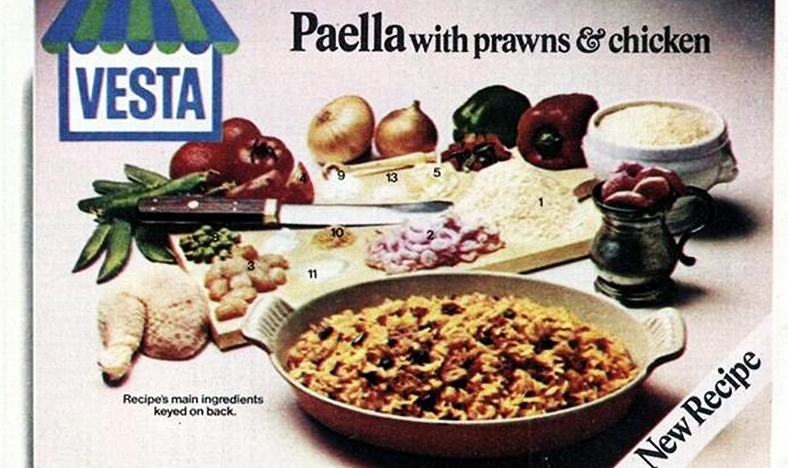
My mother did not approve. She didn't object to the foreignness but she did object to almost everything else. The highly processed nature of it, all the goodness freeze dried out of it. If my brother and I wanted to eat food like this, we would learn how to cook it together from fresh ingredients. She bought an international cookery book called something like Foods From Around the World, which to my lasting regret I no longer have, and we never looked back.

After university, I moved to Manchester and remember buying Susan Campbell and Caroline Conran's Poor Cook in the bookshop in St Anne's Square. I forget the name of the shop but it is a Waterstones now. Manchester introduced me to different cuisines: Italian, Greek, Mexican, Peking Chinese as well as different styles of Indian cooking. I had my first taste of Lasagna, Hummus, Moussaka, Peking Duck, Chilli Con Carne, Rogan Josh. I got the hang of eating spaghetti and mastered chopsticks. Susan Campbell and Caroline Conran not only taught me how to prepare different kinds of recipes but also told me about food, cookery and cookery writers. The ingredients were readily available: ethnic shops for vegetables and spices, hippy health food places for the beans, chick peas and lentils needed for vegetarian recipes (like those in The Cranks Recipe Book - what goes around comes around). Not every effort was a success, I remember my first attempt at Hummus had the look and consistency of quick setting cement, but I was hooked on trying different things and hooked on cookery books. I bought books on Greek Cookery, Indian Cookery, French, Italian. I discovered the great cookery writers, Elizabeth David and Jane Grigson and read their books avidly. I found that a good cookery book is not just about recipes, it is about the places the recipes come from, the people who live there, what they eat and how they live. Cookery books like this make you want to travel, experience those places for yourself.


Celia Rees
www.celiarees.com
