Showing posts with label cookery. Show all posts

Friday, 6 November 2020

Food, Glorious Food! - Celia Rees

 My last post magically coincided with the publication of my first adult novel, Miss Graham's Cold War Cookbook. That novel began with this cookery book. The kernel of the idea was sown when I found the book among my mother's effects. The book was stained, faded and falling apart. I could have thrown it out but I stayed my hand. 

 It had an interest of its own as a historical document. A book given away with gas cookers - does anyone talk about regulos now, or even know what they are? There's a section on Invalid Cookery, Barley Water, Beef Tea, Calf's Foot Jelly and it gives a taste (literally) of what people ate in the mid Twentieth Century that we tend not to eat any more. Recipes for Heart (Baked), Sheep's Head, Calf's Head, Brain Sauce. 

It is also a kind of time capsule. When I opened it, I found all kinds of recipes that had been clipped from newspapers and magazines, many of them from the Second World War. I spent a long time poring over these, fascinated.  This was a little treasure trove, a tiny historical archive that brought a particular time to vivid life. These were not facsimiles. They were of that time, faded and folded, carefully clipped from long gone newspapers: The Daily Herald, Daily News and Westminster Gazette and magazines that had disappeared decades ago. There were leaflets and pamphlets issued by the Ministry of Agriculture and Fisheries, the Ministry of Food, '"New Wartime Recipes" price 7/12d, post free'. DIG FOR VICTORY LEAFLET No. 10'.

They spoke directly of a time of rationing, scarcity, government departments devoted to managing food production and distribution and of the ingenuity of the individual householder in managing  the family, the ration, doing his or her bit to improvise, to add to the basic ration by growing as much food as possible, digging up the garden, tending the allotment. On a macro level, they illustrate the far sightedness of the British Government in protecting food supply and distribution in a country heavily dependent on food imports which were likely to be curtailed, even cut off by enemy blockading. The simple strategy of encouraging more home production while safeguarding fair distribution and coming down hard on hoarding and black market trading were important strategies in maintaining a healthy working population and adequate supplies for the fighting troops. 

Dig For Victory was no idle instruction.  

I found all this fascinating, but the most valuable finds were the hand written recipes slotted into the pages, on different stationery, in different writing. These were from the people who had handled and used this cookery book, swapping recipes as women did then and still do. Now, it might be a link to a page or a computer print out but the desire to share a favourite recipe is common to cooks. These recipes, swapped between my grandmother, aunt and my mother, were the only written connection that I had found between them. There was something here that I knew I had to write about. I carefully saved the book. It was now  a 'found' document of special significance. 


It was years before I discovered the key that would link to that initial idea and provide the inspiration for  Miss Graham's Cold War Cookbook. The Radiation Cookery Book remained central to the writing of the novel. Hand written recipes, swapped between women, morphed into coded messages; the recipes in the Radiation Cookery Book providing the key to the code. I also found a use for all those newspaper and magazine clippings. My main character, Edith Graham, is a school teacher but she has an alter ego, the rather dashing cookery writer,  Stella Snelling. This allows her to lead a hidden life and I've  always loved hidden lives...


Celia Rees

Miss Graham's Cold War Cookbook HarperCollins

Wednesday, 18 April 2018

Cooking Up History... - Celia Rees

Cookery Books
Like many writers, I have lots of books: fiction, non fiction, biographies, books bought for research which could cover almost anything, travel books, history books, books about writing,  myths and legends. The list is endless. I have many book cases and book shelves but they are all stuffed full, so the books spill into piles: current reading, current writing projects, books I vaguely mean to read about things I vaguely mean to do. I need to get rid of some but like other writers, I find that difficult. I might need them. I know if I get rid of something, I will almost certainly have an idea which means I need to look at that very book.  Not only that, there's a deeper problem. I've had some of these books for a long time, since childhood, school, university. My own history is on those shelves.

No-where is this more apparent than on the cookery book shelves. I have a storage problem here, too. The bookcase in the kitchen which holds my collection is  jammed with spillover stacked around. Time for a cull, but once I begin to look at what's there, I feel reluctant to lose any of them. As Neil Young says: all my changes are there. Cookery books take you back to a particular time and place. Not only your own personal circumstances, but the society around you. I grew up in the fifties and sixties in a lower middle class household at a time when for most people (people like us) olive oil was sold in the chemist as a cure for ear ache, coffee came out of a bottle and spaghetti came out of a tin.
My mother was a very good cook, as her mother had been before her, but the food we ate was a plain, British cuisine. British food has been much maligned, perhaps because it is so familiar to us, or maybe because restaurant and hotel food used to do it so badly, but when it is done well, it is very good indeed. My mother could see no reason to go outside her extensive repertoire of traditional dishes. If she used a recipe book at all, it was Marguerite Patten.


As a child, I was happy enough to go along with this, I knew nothing else, but as an older teenager, I began to be aware that there were different kinds of food out there, the kind of things that people ate in books and in films. My first introduction to foreign food, as it was suspiciously termed, was Chinese. My brother took me to a Chinese restaurant in Birmingham for a Businessman's Lunch. After some initial caution, it looked so different, I tried a forkful of Chow Mein and I loved it! Deep Fried Banana - even better.  Not long after this, a boyfriend took me to an Italian restaurant in Soho. I burnt my mouth on the Cannelloni that I had chosen because I wasn't sure how to eat 'proper' spaghetti but I was determined to learn.

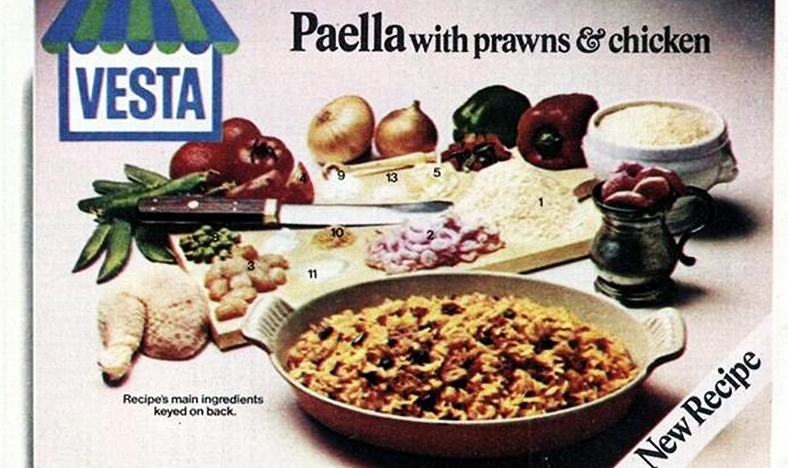
My first foray into 'foreign' cooking was when my brother introduced me to Vesta and a whole battery of exotic meals: Chow Mein, Risotto, Paella and Curry. I thought they were achingly sophisticated and they didn't tax my minimal (at this time) culinary skills.


My mother did not approve. She didn't object to the foreignness but she did object to almost everything else. The highly processed nature of it, all the goodness freeze dried out of it.  If my brother and I wanted to eat food like this, we would learn how to cook it together from fresh ingredients. She bought an international cookery book called something like Foods From Around the World, which to my lasting regret I no longer have, and we never looked back.


When I went away to university, this little book went with me - a gift from my mother. Wise woman, she knew the ways to a man's heart. I've had the book ever since, stained and dog-eared the pages browned and foxed. I still cook from it sometimes - there is an excellent recipe for Sweet and Sour Pork - and Goulash.

After university, I moved to Manchester and remember buying Susan Campbell and Caroline Conran's  Poor Cook in the bookshop in St Anne's Square. I forget the name of the shop but it is a Waterstones now. Manchester introduced me to different cuisines:  Italian, Greek, Mexican, Peking Chinese as well as different styles of Indian cooking. I had my first taste of Lasagna, Hummus, Moussaka, Peking Duck, Chilli Con Carne, Rogan Josh. I got the hang of eating spaghetti and mastered chopsticks. Susan Campbell and Caroline Conran not only taught me how to prepare different kinds of recipes but also told me about food, cookery and cookery writers. The ingredients were readily available: ethnic shops for vegetables and spices, hippy health food places for the beans, chick peas and lentils needed for vegetarian recipes (like those in The Cranks Recipe Book - what goes around comes around). Not every effort was a success, I remember my first attempt at Hummus had the look and consistency of quick setting cement, but I was hooked on trying different things and hooked on cookery books. I bought books on Greek Cookery, Indian Cookery, French, Italian. I discovered the great cookery writers, Elizabeth David and Jane Grigson and read their books avidly. I found that a good cookery book is not just about recipes, it is about the places the recipes come from, the people who live there, what they eat and how they live. Cookery books like this make you want to travel, experience those places for yourself.


Nothing evokes the past more than a particular dish, a particular recipe and, for me, nothing conjures a time more than the book in which that recipe is to be found. From Elizabeth David and Jane Grigson through Graham Kerr, Keith Floyd and the Two Fat Ladies,  River Cafe, Hugh Fearnley-Whittingstall, to Ottolenghi and Hemsley and Hemsley, these cookery books don't just catalogue a personal culinary history, they take us from the middle of the twentieth century into the new millennia. They chart changes in what we eat, and how we live. The market follows taste and demand. What was once a rarity is now readily available in any supermarket. One day, Ottolenghi and zahtah will mark a point in our history as clearly as Marguerite Patten and Camp coffee. That's why I can't get rid of my old cookery books. No matter how old they are, or what kind of state they are in, they speak of time and place and what the world was like then.


Celia Rees
www.celiarees.com

Saturday, 22 August 2015

Hungry Heart by Kate Lord Brown


Even in the days of Kindle, Abebooks, Amazon and all the online book retailers there are some out of print books so rare that you have to be patient to find a copy, let alone one within budget. I had lusted after a copy of 'The Artists' & Writers' Cookbook' for years, but all the ones I'd come across were hundreds of dollars. Finally the stars aligned a couple of months ago - the (*coughs*) excuse necessity of research and a bookshop that was closing down in California brought a near pristine copy of the 1961 publication to me. I don't know about you, but I rather like the inscriptions in second hand books - it makes you feel like the caretaker rather than the owner of special books like this - Sybil Boucher had given this one to the previous owner in 1980.

It was worth the wait, a handsomely bound book on heavy stock, and it had me seduced from the dedication:


Couldn't agree more. The book was edited by Beryl Barr and Barbara Turner Sachs, and designed by Nicolas Sidjakov. The illustrations are idiosyncratic and rather wonderful, but have nothing on the recipes. Among the contributions from Alice B Toklas, Elizabeth Frink and Terry Frost ('Leeks a la Cornwall'), there is Man Ray's recipe for a Dadaist day ("Diner: gather wooden darning eggs ... pierce lengthwise. Lay the skewered eggs in an oblong or oval pan and cover with transparent cellophane"). One of the most extraordinary is Pliny's recipe for recreating blood in paint:


One recipe I will be trying out is Marcel Duchamp's Steak Tartare, if only because he says 'it can be prepared on horseback at a swift gallop, if the conditions make this a necessity'. The idea of Cossacks lovingly preparing a 'bird's nest' of the finest chopped beef, in which 'two egg yolks recline' then arranging a 'wreath' of the following ingredients while in full flight is quite wonderful:


Serve with Russian pumpernickel bread, sweet butter and tall bottles of vin rose - enjoy.


Thursday, 21 June 2012

Wedding Cake, anyone? by Imogen Robertson


I’m getting married this weekend, and frankly the way my brain is at the moment you’re lucky this post doesn’t just consist of that sentence repeated again and again. Still, I can’t think a non-wedding related thought, so forgive me and I promise I have got some history in here somewhere. 
Ned and I have gone for a do-it-yourself type of affair. We’re having the party in an eighteenth century barn on a working farm belonging to friends of friends, and I knew it was the right place for us when I walked in there, looked up at the beams and said, ‘Oh, darling! It’s just like the barn where Harriet and Crowther performed their first autopsy!’ Ned teared up a little and squeezed my hand.

The beef is roasting in our kitchen as I type; we’re collecting most of the rest of the food from Borough Market tomorrow morning, and my mother has made the wedding cake. Now, when we asked Mum to make the cakes it was for reasons both practical and selfish. Yes, huge fancy wedding cakes with icing roses and corinthian columns can look lovely, but they aren’t very us and I love my Mum’s fruit cake. I can also pay her with a big smile which helps the budget. Now, what I didn’t realise was we are actually being quite eighteenth century about it. Hannah Glass’s bride cake recipe from her The Art of Cookery, 1774, is really very like what we are going to eat on Saturday, only Hannah places her candied orange and lemon in layers within the cake rather than mixing it all together. I think Mum would have cried if I’d asked her to do that. I also think Mum’s used a little less brandy than Hannah’s half pint per cake. We’re having almond icing like just Hannah’s, though I don’t think Mum whisked it for ‘an hour or two’.

Even the question of fancy icing versus plain is centuries old. In English Etymology 1783, George William Lemon notes that the ceremonial cake had its roots in Roman times, then continues, ‘ - but whatever were the ingredients of the antient bride cakes, the modern are made of such costly articles, that the wealthy now-a-days seem to vie with each other more in the extravagance of the composition than in a knowledge of the institution.’ Indeed.

The tradition of sleeping with bride cake under your pillow to make you dream of your future husband or wife was already established, though in a volume of The Spectator from 1776 a correspondent reports trying this, only to wake to find he couldn’t remember his dream, and he had eaten the cake. Perhaps his experiment failed because he didn’t pass his bit of cake through the wedding band as soon as the wedding rites were over. No one is going to try that at my wedding, I’m afraid. Once the rites are over the ring is staying on my finger and anyone trying to shove cake through it is going to get my hard stare. The writer of an article in The Connoisseur in 1775 did much better, the bride cake under the pillow providing a long allegorical dream of different brides and grooms sharing differently iced cakes that illustrated the wisdom or folly of their marriages. Moral lessons through cake. Who would have thought?

One note brought me up short; in the Lake District it was traditional to break the bride cake over the bride’s head. Sounded like a terrible waste of good cake to me and very messy, so I was delighted to learn in this case the cake was ‘a thin current cake’ and a white cloth was placed over the bride’s head before she was attacked with confectionary. Still, I’ve no idea where that tradition comes from or what the underlying symbolism is. If anyone knows, please share. According to John Nichols in Anecdotes of William Hogarth of 1782, this is about to happen in Hogarth’s third sketch for the ‘Happy Marriage’ series he planned but never finished. At least it looks like a good sized sheet.