Showing posts with label Wilfred Owen. Show all posts

Friday, 4 November 2022

Anthem for Doomed Youth - Celia Rees


What passing-bells for these who die as cattle?
— Only the monstrous anger of the guns.
Only the stuttering rifles' rapid rattle
Can patter out their hasty orisons.
No mockeries now for them; no prayers nor bells; 
Nor any voice of mourning save the choirs,—
The shrill, demented choirs of wailing shells;
And bugles calling for them from sad shires.


What candles may be held to speed them all?
Not in the hands of boys, but in their eyes
Shall shine the holy glimmers of goodbyes.
The pallor of girls' brows shall be their pall;
Their flowers the tenderness of patient minds,
And each slow dusk a drawing-down of blinds. 


I'm sure many people reading this blog will instantly recognise Anthem for Doomed Youth by Wilfred Owen. It was written in 1917, a year before his death on 4th November, 1918. He was twenty five years old. When he died, Owen was almost unknown - only five of his poems were published in his lifetime - but today, we are nearly as familiar with the details of his life as we are with his poetry. He was born and spent his early years in Oswestry, a Shropshire lad. The death of his grandfather marked a change in fortune. His family moved to Birkenhead for his father to take up a post as Station Master. Owen avidly read boarding school books and The Boys' Own Paper and grew up with a feeling of loss of status, having not attended boarding school, or gone up to Oxford. When he joined up, he was made an officer, thus gaining the status he so wanted. Unfortunately, the generation who were educated in the schools he had envied, were doomed. Junior officers were easily identified by German snipers, marked out by their distinctively different uniforms and their positioning on the battlefield, first over the top, leading from the front, pistol in hand. They were killed in their thousands  Rolls of Honour in every boarding school chapel attests to the numbers lost.   

Wilfred Owen 1893 - 1918


I first discovered Wilfred Owen when I was in the Sixth Form, transfixed by a classroom reading of  'Dulce et decorum est', the sensory overload of horror the poem lays on the reader line after line, conjuring those public school boys, those 'children ardent for some desperate glory', their passing soon to be recorded on chapel walls, celebrated by 'The old Lie: Dulce et decorum est, pro patria mori'.


If in some smothering dreams, you too could pace

Behind the wagon that we flung him in,

And watch the white eyes writhing in his face,

His hanging face, like a devil’s sick of sin;

If you could hear, at every jolt, the blood

Come gargling from the froth-corrupted lungs,

Obscene as cancer, bitter as the cud

Of vile, incurable sores on innocent tongues,—

My friend, you would not tell with such high zest

To children ardent for some desperate glory,

The old Lie: Dulce et decorum est

Pro patria mori.


Dulce et Decorum Est - Wilfred Owen


 It was the Sixties, the Vietnam War was raging, Oh, What A Lovely War! was transferring from the theatre to the big screen, anti-war sentiment was everywhere.  Owen's poems spoke to me, as they do to every generation because no generation since the 1914 - 18 has been untouched by conflict, the reality brought right into our living rooms on the TV News. Over a hundred years after his death, Owen's poetry still resonates as we see the devastation in Ukraine, villages and cities, fields and forests turned into no-man's-land, dead bodies by the sides of roads, soldiers huddled in their trenches, watching the water rise, waiting for the winter that's coming.

Our brains ache, in the merciless iced east winds that knive us . . . 
Wearied we keep awake because the night is silent . . . 


..Tonight, this frost will fasten on this mud and us, 

SShrivelling many hands, and puckering foreheads crisp. 

The burying-party, picks and shovels in shaking grasp,

Pause over half-known faces. All their eyes are ice, 


Exposure - Wilfred Owen


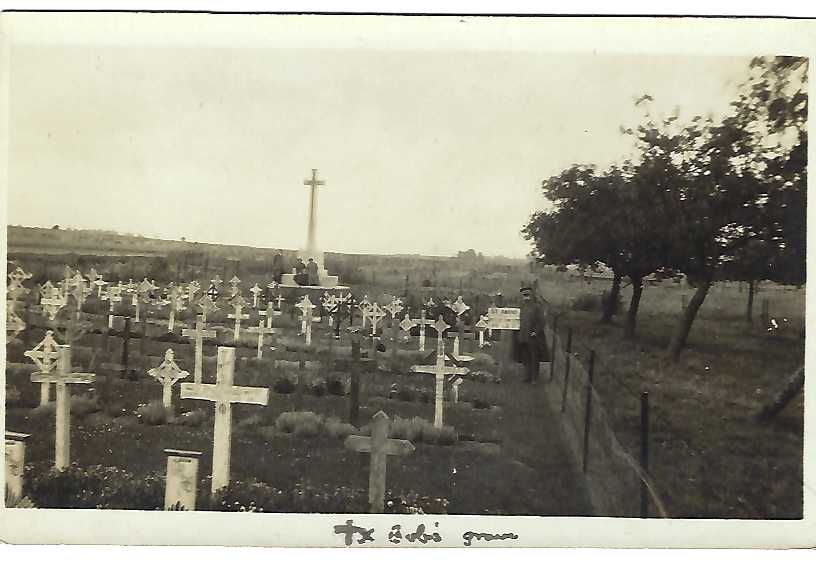
    Wilfred Owen died 104 years ago today, a week before Armistice was declared and the war was over. There is something especially poignant being killed so close to the ending of hostilities.  My Uncle Bob was killed on 14th June, 1918, close enough for the family legend to grow that he was killed in the last days. My uncle’s experience is largely unknown and unknowable. He sent letters to his family, pencil written because he was ‘other ranks’. He also sent water colour sketches of the places, churches and castles he saw behind the lines. He pressed wildflowers he found growing in no-man’s-land, on the borders of the roads he tramped, in the trenches he manned. Poppies, yes, but also Larkspur, Scabious, Ragged Robin. He saw beauty there, as Owen did. We know nothing of his other experiences: the suffering he saw, the fear, the fighting and dying. In that Wilfred Owen speaks for him. He speaks for all of them. 


My Uncle Bob with his family
His temporary grave in Flanders


His name, Pte R. W. Goodway, on the War Memorial in Leamington Spa


Tuesday, 6 November 2018

The Men Behind The Glass Sheena Wilkinson

I’m writing this on 4 November 2018 at my home thirty miles from the Irish border. A border I cross at least weekly, a border whose future I worry about daily thanks to Brexit.

The British border in Ireland during the Troubles


On the radio today I have heard –

Tributes to Wilfred Owen, who was killed in action 100 years ago today, including the playing of a German bugle he found on a dead German soldier. This was moving. 

The president of the United States declare that barbed wire ‘used properly’ can be beautiful. This was horrifying. And disgusting. 

Wilfred Owen
A few weeks ago I was involved in a creative writing project in a local school, helping sixth formers to respond creatively to the  school’s World War One archive. The initiative was part of a wider school remembrance project called The Men Behind The Glass. https://menbehindtheglass.co.uk.

Campbell College is a boys’ school in east Belfast -- C S Lewis was a pupil -- and between 1914-1918 many of its alumni served as soldiers, medics, and chaplains. This was, of course, typical of schools of the period, all over Europe.  In my previous career as a teacher I explored the wartime experiences of my own school, Methodist College as inspiration for the story ‘Each Slow Dusk’ in The Great War (Walker Books, 2014) and the novel Name Upon Name(Little Island, 2015). (I wrote about it for my first ever HG post -- http://the-history-girls.blogspot.com/search?q=sheena+wilkinson.)  So when I was asked to work with pupils  at Campbell, along with two neighbouring girls’ schools, Strathearn and Bloomfield Collegiate, I was delighted – this was so very much my kind of project. 

Campbell College
Photos of the 127 men who died in the conflict are displayed around the walls in the school’s central hall – hence ‘the men behind the glass’. Our work was designed to take their stories off the walls and into the hearts and minds and imaginations of the sixth formers who honoured their memories with their responses. I shared with the group my own experience of using an archive to inspire creative work, and we discussed the issues involved. They had biographies of some of the men, which they used as inspiration for their own work – mostly imagined letters home from the western front.

My story in this anthology was inspired
by research in another school archive
The highlight of the project was hearing the students read their work in that hall, surrounded by the portraits of young men often barely older than they. I didn’t understand every word of the finished pieces – my A Level German studies are thirty years behind me now, but that didn’t matter. 

Oh yes. Did I not say? The pieces were in German. It was a German A Level class, and the stories were shared online with a partner school in Germany who will be writing their own wartime stories in English.  Hearing these letters read in German was extraordinarily moving: not only had the students imagined themselves into the minds of young Irish soldiers from a century ago, but, by voicing the sentiments in German, they were also echoing the words of the thousands of German soldiers who would have written home from the same fronts. In that way, it was the most truly European project I have been involved with. Physically the students may not have left the school; imaginatively and emotionally they travelled beyond borders, with or without barbed wire. 

When I heard that German bugle played today, in memory of Wilfred Owen, I detected the same notes of hope. I just hope they can be heard above the clamour of more raucous voices.

Thursday, 23 October 2014

HOW TO REMEMBER THEM? by Leslie Wilson (contains an image which may cause distress)

 I received this cardboard poppy in the unsolicited post in late September, from the British Legion. It invited me to write a message on it, so it could be placed in Flanders Field to 'remember with pride the sacrifices that hundreds of thousands of British and Commonwealth Service men (sic) made..' and 'to remember the thousands who have laid down their lives for our country since then.'

To be fair, the covering letter does also mention servicewomen. You can read for yourself what the envelope says:

But were the dead really 'the bravest of the brave? I don't think so. They were the sacrifices to modern mechanistic warfare, sent out to walk, well-spaced apart, across No Man's Land, while the enemy fire hammered them. For most of them, there was no opportunity for courage, and even those who won VCs spent the rest of their lives trying to forget (something which has been movingly depicted by many of my co-contributors to the Stories of WW1 anthology.) But let a man who experienced it speak here.

What passing bell for those who die as cattle?
Only the monstrous anger of the guns.
Only the stuttering rifles' rapid rattle
Can patter out their hasty orisons.
No mockeries now for them, no prayers nor bells;
Nor any voice of mourning save the choirs, -
The shrill, demented choirs of wailing shells;
And bugles calling for them from sad shires. 
Wilfred Owen, Anthem for Doomed Youth

My English grandfather didn't fight in the war: his heart condition forbade it, but my uncle by marriage, Edgar, did - he survived Gallipoli, and his wife, my Aunt Molly, told me about his bad nights, sweating, and muttering in his sleep: 'They're coming! They're coming!' I had forgotten this, till I began re-reading my father's autobiographical fragment for a future blog. As I have said before, my German grandfather was a teenage soldier and two of my great-uncles on the German side were killed; my uncle Leo's head, brutally blown off at Verdun, leers at the myths of heroism. 
The British Legion poppy card says 'for all those who fell' - but is that what they truly mean? What will they think if I write Leo Kolodziej on it, 'killed fighting for Germany at Verdun'? Will they include it, or throw it away? Everywhere else, it is stressed that the intention is to honour British and Commonwealth soldiers.Why cannot we remember those who fought on all sides, especially this year?

I was on a British Airways  flight to Hamburg a few years ago, and it was the 11th November, and 11am was just after take-off. So the captain came on the air and said we would observe the 2 minutes silence 'for British servicemen.' This was a flight to Hamburg, for God's sake! What would it have cost him to include all the victims of war? If you visit the exhibition of the incineration of Hamburg at the ruined St Nikolauskirche, you will read that Operation Gomorrah was the deserved result of German aggressive militarism. I would take a slightly different view. I think two wrongs don't make a right, and I contest the ethics and even the effectiveness of the bombing of civilians.What had the small, half-Jewish Wolf Biermann,* for example, done to deserve the terror of running across melting tarmac with his mother, to escape the walls of flame? What had all the children done who didn't make it out? I do not apologise (warnings notwithstanding) for posting the following dreadful image, from Dresden (which was full of refugees at the time of the incendiary raid). This is what air-raids do.

File:Fotothek df ps 0000048 Blick in einen öffentlichen Luftschutzraum mit 243 Leiche.jpg

View of a public air-raid shelter, with 243 corpses,
fourteen months after the bombing of Dresden
photographer Richard Peter (1895-1977)
Deutsche Fotothek, Saxon State Library/
State and University Library, Dresden
Bomber Harris  would have loved to cause a big firestorm in Berlin, but was frustrated by the layout of the city; the roads were too wide for the flames to leap across, and the buildings mainly made of stone and brick. There were small firestorms however, which few people survived.
And that brings me to what I dislike about Remembrance Day (apart from the rhetoric of 'heroes); it seems only to be about those who fought and those who were actively engaged in supporting them. But what about the civilian victims of war, world-wide? Who falls silent to remember them? Well, demonstrators, and Quakers. But officially, civilians don't count. Are the British Legion inviting us to remember great-aunts or grandparents and great-grandparents who died in Zeppelin raids, or family members who died in the air-raids of World War 2, even on the British side? Or the countless victims of landmines? They aren't, because they are a charity that works for British ex-service personnel - which is of course why they don't extend Remembrance Day to other combatants. I do think disabled soldiers get a raw deal, and deserve support. But the fact that Remembrance Day seems to 'belong' to the British Legion is questionable, to my mind, because of the excision of civilians. Do we need a second Remembrance Day for them, or is it possible to extend the day, make it more generous, and open the fund-raising field to those who support ALL victims of war?

I did send the poppy back, with my uncle Leo's name on it. I wonder if they will put it in the field?

*Wolf Biermann was an East German singer-songwriter. His father was murdered (and his body incinerated) at Auschwitz, with the whole of his Jewish family. I need not state the irony.