Showing posts with label Stories of WW1. Show all posts

Friday, 14 November 2014

Eugene Bullard, Black Swallow of Death Catherine Johnson

Another WW1 story you might not have heard, that of  Eugene Bullard,  a young black man who found freedom and respect far from his homeland. I'd never heard of him until recently and  found there are heaps of parallels between his life and that of Mathew Henson,  a hero abroad but ignored in his native land. Bullard became the first ever black military pilot in 1916 and won the Croix de Guerre, but ended his life working as a lift operator in the Rockefeller Center.

Eugene Bullard

Eugene Bullard stowed away on a ship and ended up in Aberdeen. He said he witnessed his father's narrow escape from a lynching. He made his way to Glasgow and worked there for a while. Life outside segregated America held a whole load more opportunities for a young black man and he settled in Paris in 1913 and worked as a prize fighter and sometimes in the music hall. He enlisted in 1914 on the outbreak of war and joined the French Foreign Legion. His unit, the 170th Line Infantry Regiment were known poetically as L'Hirondelles de la Mort,  the swallows of death.
Regimental badge of the 170th

Seriously wounded at Verdun he joined the French Air Force and went first on gunner training and then as a pilot. He flew with other American pilots in the Lafayette Flying corps and shot down at least one German plane, eventually promoted to the rank of Corporal. When the Americans joined the war they organised for American pilots in the Lafayette Corps to transfer to the USA Air Force. Bullard, naturally, was refused on account of his colour.

Bullard had a row with a French officer and was punished by demotion to the infantry. He continued to serve in the 170th until the end of the war, his nom de guerre was The Black Swallow.

Bullard stayed in France owned his own nightclub, married a wealthy woman and was part of Jazz Age Paris, his friends included Josephine Baker, Langston Hughes and Louis Armstrong.

He joined up again for WW2,  but was seriously injured and fled to the States. However life for a black man in America was hard, he was no longer the celebrated flier and nightclub owner, he found work as a security guard and sometime interpreter for Louis Armstrong.

He suffered too in the Peeskill Riots in 1949, when a Paul Robeson concert was attacked by anti communist American veterans. Bullard was one of the victims, his attackers included Law Enforcement officers and even though the attack was filmed no one was ever bought to justice.

Bullard was not forgotten in France. In 1954 he  was invited to rekindle the flame that was lit on the Tomb of the Unknown Warrior and in 1959 he was awarded the Legion d'Honneur. Bullard died in 1961 of cancer but it wasn't until he was dead that the USA recognised his achievement; he was posthumously awarded the rank of Second Lieutenant in the USA Air Force.


Catherine Johnson

Thursday, 23 October 2014

HOW TO REMEMBER THEM? by Leslie Wilson (contains an image which may cause distress)

 I received this cardboard poppy in the unsolicited post in late September, from the British Legion. It invited me to write a message on it, so it could be placed in Flanders Field to 'remember with pride the sacrifices that hundreds of thousands of British and Commonwealth Service men (sic) made..' and 'to remember the thousands who have laid down their lives for our country since then.'

To be fair, the covering letter does also mention servicewomen. You can read for yourself what the envelope says:

But were the dead really 'the bravest of the brave? I don't think so. They were the sacrifices to modern mechanistic warfare, sent out to walk, well-spaced apart, across No Man's Land, while the enemy fire hammered them. For most of them, there was no opportunity for courage, and even those who won VCs spent the rest of their lives trying to forget (something which has been movingly depicted by many of my co-contributors to the Stories of WW1 anthology.) But let a man who experienced it speak here.

What passing bell for those who die as cattle?
Only the monstrous anger of the guns.
Only the stuttering rifles' rapid rattle
Can patter out their hasty orisons.
No mockeries now for them, no prayers nor bells;
Nor any voice of mourning save the choirs, -
The shrill, demented choirs of wailing shells;
And bugles calling for them from sad shires. 
Wilfred Owen, Anthem for Doomed Youth

My English grandfather didn't fight in the war: his heart condition forbade it, but my uncle by marriage, Edgar, did - he survived Gallipoli, and his wife, my Aunt Molly, told me about his bad nights, sweating, and muttering in his sleep: 'They're coming! They're coming!' I had forgotten this, till I began re-reading my father's autobiographical fragment for a future blog. As I have said before, my German grandfather was a teenage soldier and two of my great-uncles on the German side were killed; my uncle Leo's head, brutally blown off at Verdun, leers at the myths of heroism. 
The British Legion poppy card says 'for all those who fell' - but is that what they truly mean? What will they think if I write Leo Kolodziej on it, 'killed fighting for Germany at Verdun'? Will they include it, or throw it away? Everywhere else, it is stressed that the intention is to honour British and Commonwealth soldiers.Why cannot we remember those who fought on all sides, especially this year?

I was on a British Airways  flight to Hamburg a few years ago, and it was the 11th November, and 11am was just after take-off. So the captain came on the air and said we would observe the 2 minutes silence 'for British servicemen.' This was a flight to Hamburg, for God's sake! What would it have cost him to include all the victims of war? If you visit the exhibition of the incineration of Hamburg at the ruined St Nikolauskirche, you will read that Operation Gomorrah was the deserved result of German aggressive militarism. I would take a slightly different view. I think two wrongs don't make a right, and I contest the ethics and even the effectiveness of the bombing of civilians.What had the small, half-Jewish Wolf Biermann,* for example, done to deserve the terror of running across melting tarmac with his mother, to escape the walls of flame? What had all the children done who didn't make it out? I do not apologise (warnings notwithstanding) for posting the following dreadful image, from Dresden (which was full of refugees at the time of the incendiary raid). This is what air-raids do.

File:Fotothek df ps 0000048 Blick in einen öffentlichen Luftschutzraum mit 243 Leiche.jpg

View of a public air-raid shelter, with 243 corpses,
fourteen months after the bombing of Dresden
photographer Richard Peter (1895-1977)
Deutsche Fotothek, Saxon State Library/
State and University Library, Dresden
Bomber Harris  would have loved to cause a big firestorm in Berlin, but was frustrated by the layout of the city; the roads were too wide for the flames to leap across, and the buildings mainly made of stone and brick. There were small firestorms however, which few people survived.
And that brings me to what I dislike about Remembrance Day (apart from the rhetoric of 'heroes); it seems only to be about those who fought and those who were actively engaged in supporting them. But what about the civilian victims of war, world-wide? Who falls silent to remember them? Well, demonstrators, and Quakers. But officially, civilians don't count. Are the British Legion inviting us to remember great-aunts or grandparents and great-grandparents who died in Zeppelin raids, or family members who died in the air-raids of World War 2, even on the British side? Or the countless victims of landmines? They aren't, because they are a charity that works for British ex-service personnel - which is of course why they don't extend Remembrance Day to other combatants. I do think disabled soldiers get a raw deal, and deserve support. But the fact that Remembrance Day seems to 'belong' to the British Legion is questionable, to my mind, because of the excision of civilians. Do we need a second Remembrance Day for them, or is it possible to extend the day, make it more generous, and open the fund-raising field to those who support ALL victims of war?

I did send the poppy back, with my uncle Leo's name on it. I wonder if they will put it in the field?

*Wolf Biermann was an East German singer-songwriter. His father was murdered (and his body incinerated) at Auschwitz, with the whole of his Jewish family. I need not state the irony.

Monday, 22 September 2014

The Angels of Mons by Kate Lord Brown


The commemorative service at Mons during the summer reminded me of an interesting tale from WW1 that I came across researching the work in progress. As ever, much of the research has hit the cutting room floor in the final telling - however tempting it is to shoehorn in a fantastic bit of history, if it doesn't serve the story, you have to let it go. 

On August 23rd 1914 the British Forces were confronted and outnumbered by enemy troops at Mons. The 'Victory by Christmas' looked set to turn into a protracted nightmare. In the heat of the battle - so the legend goes - a soldier called upon St George for help.


The accounts of angelic and divine intervention at Mons came from several sources. Arthur Machen's 'The Bowmen' is one of the most well known. Printed six months after the event, and conveniently 'unable to reveal sources for security reasons' it was at once military propaganda and a morale boost for the troops and public. Machen described the visions as 'English angels with longbows'.


Another account surfaced in a parish sermon, and reached the newspapers. From William Doidge of the Scots Guard, to Brigadier General John Charteris who wrote to his wife on 5th September 1914 of an 'angel of the Lord on a white horse and with a flaming sword', the accounts came from sources across the spectrum of the British forces.


The retreat of the 80,000 from Mons to the Marne saw them caught up in a nightmarish battle of shrieking, thundering guns and shells that tore men limb from limb. In the midst of this furnace of torment, the idea that someone cried 'May St George be a present help to the English' has more than a whiff of propaganda about it. And yet. There are many different accounts of a line of angelic shapes beyond the British line, a cloud of arrows descending on the enemy, and of slain men found with arrow wounds. Or of individual warriors with 'a shining about them', and of three vast angelic figures hovering over enemy lines protecting the British. It was enough to turn one 'old contemptible' I read about from a hard drinker to a teetotal pillar of the community.

Then there was a group of Coldstream Guards, the last to retreat from the Battle of Mons, cut off and lost in the Mormal forest. They had dug in for a valiant last stand, when a tall slim angel apparently beckoned them towards an open field, and a hidden sunken road where they were able to effect their escape from the enemy swarming towards them.

Angelic intervention, or mass hallucination? Whatever the truth, the story of the Angels of Mons helped morale and saw British troops through the hell to come at Loos, the Somme and Passchendaele. It would be interesting to know how many of the HGs have come across tales of supernatural intervention researching their historical periods?


Wednesday, 23 April 2014

THE DAY THE WAR ENDED, by Leslie Wilson


My grandfather's WW1 medal, the one everyone
got for taking part, with the black-red-white
Imperial colours.

Last year I was asked to contribute a story to an anthology that does what it says on the tin: 'Stories of World War One.' It is published this month by Orchard and has turned out to be a brilliant collection that I am proud to be part of. Full of wonderfully-written, thoughtful stories. Tony Bradman, the editor, asked me to write about the German side of WW1 for 10-14 year-olds. I demurred: I said the German experience of the trenches wasn't so different from the British experience (except that, by all accounts, their trenches were a bit better built and equipped), but Tony said what he really wanted was a story about a young girl in Berlin during wartime. That seemed much more attractive and interesting, and there was a bit of family history I could integrate. None of my English family fought in World War 1 - except for Uncle Sam, my great-aunt Nellie's husband (who she had, it was said in the family, reclaimed from a life of Vice and Drink). He was an ex-soldier, so he must have fought, but I never knew him or heard any stories about his wartime experience.

On the other hand, my German grandfather was a teenage soldier (he joined up, as a trainee non-commissioned officer, when he was seventeen) and my German grandmother lost two of her brothers in the war, including her favourite brother, Leo.

German soldiers in a trench. Photo: Bundesarchiv
The other thing I really wanted to do was to write about the German revolution, which occurred just two days before the Armistice was signed. I have discovered that a great many British people don't know anything about the German revolution; when I've asked them they've said that they vaguely supposed the Kaiser was removed by the Allies, as part of the Treaty of Versailles.

This was not the case. There has been a bit of a spat between historians recently, and what it has usefully opened up is that in Imperial Germany, in 1914, all adult males had the vote (though you still hear people suggest that the Kaiser's regime was as bad as the Nazis. That is viewing WW1 through the prism of WW2, a great mistake, historically). Many of the British Tommies who fought and died did not. But just as in Britain, before the Parliament Act of 1911, the dead hand of the Lords lay on the Commons, in Germany the Kaiser and his ministers kept the Reichstag  (The Parliament) firmly on the constitutional leash.

The German Social Democrats had been gaining ground however. They needed to; as in Britain, there was an enormous gulf between rich and poor and the workers in the factories were badly exploited. The slums of Berlin were as big a disgrace as the slums of London, and when during the war the British blockade cut off food supplies, the poor suffered worse than anyone else and unrest grew. There was a winter called the 'Kohlrabi winter' when kohlrabi was literally almost all there was to eat. Though I like kohlrabi as a salad vegetable, I would hate to have to live on it.Towards the end of the war the Kaiser's government tried to save itself through the carrot of parliamentary reform; the military government was replaced by a democracy and various electoral and economic reforms were promised. But it was too late.
Sailors in revolt: the placard says SOLDIERS' COUNCIL; LONG LIVE
THE SOCIALIST REPUBLIC. Photo: German federal archive
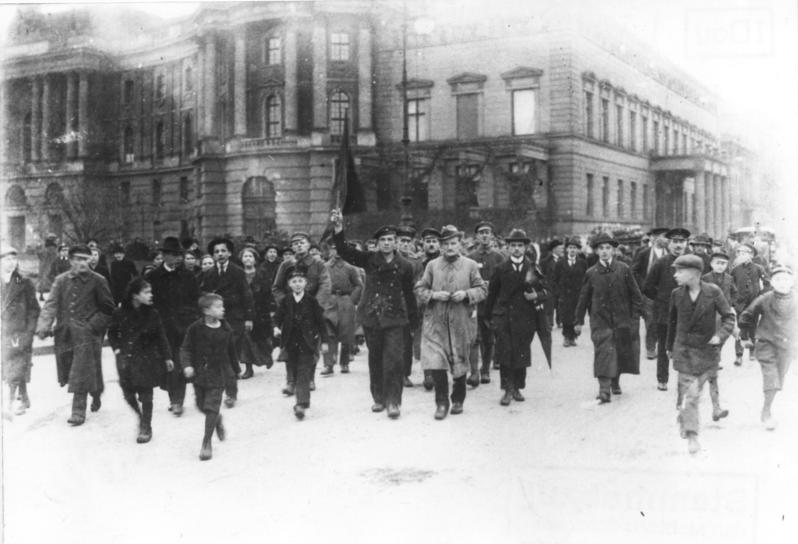
The revolution began in October 1918 (only a year after the Russian Bolshevik revolution), when the sailors of the German navy refused to go out and fight the British in the channel. Arrests were made, but there was further unrest and demonstrations: Freedom and Bread was the slogan. The military fired on the demonstrators, killing seven people and severely injuring twenty-nine. The demonstrators fired back. The protest became an uprising, spreading all over Germany. It was very much a grass-roots revolution, with the people forming 'workers' councils' and 'soldiers' councils.' I can't put my finger on chapter and verse right now, but I am pretty sure that at the Front whole regiments threw down their arms and surrendered. They were motivated by war-weariness and a revulsion from the pointless slaughter, but many also were sick of fighting other 'small people' just like themselves, at the behest of the military/capitalist/aristocratic authorities. On the 9th November (a recurringly fateful date in 20th-century German history) the Revolution came to Berlin.

Demonstration Berlin 1918. Photo: German Federal Archive
The fourteen year-old young girl in my story has a brother at the front, and is falling in love with a bright worker's son, Lukas, who lives near her in Prenzlauer Berg in Berlin. Her elder brother, Leo, was killed at Verdun, like my own great-uncle Leo. She is aware of the war-weariness and really wants her brother Paul to survive, yet is reluctant to let go of the idea of her eldest brother's heroic sacrifice. Lukas gets her to join one of the marches, and she ends up witnessing the Social Democrat Scheidemann announcing the Revolution and the abdication of Kaiser Wilhelm II, from the balcony of the Reichstag.
Before I wrote the story, I spent some time reading the war-time diaries of the great print-maker and sculptor Käthe Kollwitz, who lived in Prenzlauer Berg and lost one of her own sons early in the war. Honest and anguished, they gave me a handle on what it felt like to go through those times. Kollwitz was a Social Democrat, not a rightist, and certainly didn't reverence the military or Kaiser Wilhelm, but like many people, when war happens, she was swept along by what Vera Brittain called 'those white angels who fight so naively on the side of destruction.' Ideas of self-sacrifice, of courage in the face of loss (and both her sons went willingly to the Front), of endurance and solidarity with the nation. And one must remember that the main threat the Germans saw in the war to their freedom was Russia, and that means Tsarist Russia with its secret police, its prison camps in Siberia, its autocratic government and its pogroms.
The Grieving Parents; monument by Kollwitz to her dead son Peter,
in Vladslo, Belgium. Photo: Wikimedia Commons
The other tremendous value of Käthe Kollwitz's diaries was that they gave me a day by day account of what was going on, so I owe her a great debt of gratitude. From the memoir of Sebastian Haffner, called in German Geschichte eines Deutschen, and in English Defying Hitler, I got some more thoughtful insight into the problems posed by the Revolution, and also that invaluable and hard to come-by information, what the weather was like. It was foggy. I thought that was a marvellous metaphor for the uncertainty of the future for defeated Germany.
The trouble was that the new Republic was sabotaged from the start by the conditions of the Treaty of Versailles. They had announced that the war would end; the German envoy was already in France discussing the Armistice; and the only way they could have got a better settlement was by fighting on, which was impossible. So they told the envoy to sign. This was the basis of the 'stab in the back' legend, which was so useful to Hitler later on, and yet, looking at the circumstances, I cannot see what else the new Government could have done.
I have read historians stating that this treaty was perfectly 'fair' because Germany had imposed just as harsh a treaty on Russia a year earlier, or else because Germany began the war (though in fact it was Austria who began it). They then go on to say that because the treaty was fair, it couldn't possibly be blamed for the rise of Hitler. This strikes me as an irrational and slightly childish argument.
Fairness is not the issue here: what matters is cause and effect. Though all countries were hit by post-war depression, it hit Germany worse, because she had lost the industrial base in the Ruhr to France. The treaty imposed enormous reparations on Germany, while depriving her of the means to pay them. The result was hunger, the traumatic hyper-inflation of 1919, when people had to spend their wages within hours before they became valueless, and my grandmother's family once exchanged their grand piano for a loaf of bread - and a fragile economy. If you want to understand what those times felt like, read Hans Fallada's Little Man, What Now? (Kleiner Mann, was nun?).
Five-million Mark note. Photo: Boeing 720 via Wikimedia Commons.
When the double-whammy of the Wall Street crash hit, those who had hated the Revolution from the start thought democracy had failed Germany, and looked for an alternative. Leftists despaired of capitalism and voted Communist. Those inclined to vote for the Right looked to the nascent Nazi movement, which promised the restoration of prosperity and order, which meant no more pitched battles on the streets.
Going back to November 1918, even if it had been sensible to pulverise the German economy as revenge for 'starting the war,' the war had been started and conducted bythe Imperial government, which was no longer in place. The Germany that was punished was the new democracy. Clearly, those who made the treaty, especially the French, could not know what was to come, but the lesson was learned and put into practice by the victors of World War II, who took care to let Germany build herself up again.
This may seem too much weight of history and foreboding for a short story for teenagers to carry, but I had five thousand words, which helps, and also what matter most are the feelings; grief, fear, hope, humiliation, hunger. A bespectacled boy comes out of the fog and says: 'We'll have to fight them again'; an old Conservative, tears running down his face, accuses the Socialists of betraying Germany with the treaty; a young working-class man who has lost his right arm during the war, shouts back, furious with the military ethos of Wilhelmine Germany which he blames for the conflict. And people are still queueing up for scarce food. Those were the feelings which drive voting patterns, then as now.
And on the Western Front, shedding tears of fury that day, was a young skinny man with a dark moustache who was to rise to the head of his party at just the most hideously appropriate moment.
Hitler, on right, with fellow soldiers in WW1. Photo Wikimedia Commons