I'm sure many people reading this blog will instantly recognise Anthem for Doomed Youth by Wilfred Owen. It was written in 1917, a year before his death on 4th November, 1918. He was twenty five years old. When he died,Owen was almost unknown - only five of his poems were published in his lifetime - but today, we are nearly as familiar with the details of his life as we are with his poetry. He was born and spent his early years in Oswestry, a Shropshire lad. The death of his grandfather marked a change in fortune. His family moved to Birkenhead for his father to take up a post as Station Master. Owen avidly read boarding school books and The Boys' Own Paper and grew up with a feeling of loss of status, having not attended boarding school, or gone up to Oxford. When he joined up, he was made an officer, thus gaining the status he so wanted. Unfortunately, the generation who were educated in the schools he had envied, were doomed. Junior officers were easily identified by German snipers, marked out by their distinctively different uniforms and their positioning on the battlefield, first over the top, leading from the front, pistol in hand. They were killed in their thousands Rolls of Honour in every boarding school chapel attests to the numbers lost.
Wilfred Owen 1893 - 1918
I first discovered Wilfred Owen when I was in the Sixth Form, transfixed by a classroom reading of 'Dulce et decorum est', the sensory overload of horror the poem lays on the reader line after line, conjuring those public school boys, those 'children ardent for some desperate glory', their passing soon to be recorded on chapel walls, celebrated by 'The old Lie: Dulce etdecorum est, pro patria mori'.
If in some smothering dreams, you too could pace
Behind the wagon that we flung him in,
And watch the white eyes writhing in his face,
His hanging face, like a devil’s sick of sin;
If you could hear, at every jolt, the blood
Come gargling from the froth-corrupted lungs,
Obscene as cancer, bitter as the cud
Of vile, incurable sores on innocent tongues,—
My friend, you would not tell with such high zest
To children ardent for some desperate glory,
The old Lie: Dulce et decorum est
Pro patria mori.
Dulce et Decorum Est - Wilfred Owen
It was the Sixties, the Vietnam War was raging, Oh, What A Lovely War! was transferring from the theatre to the big screen, anti-war sentiment was everywhere. Owen's poems spoke to me, as they do to every generation because no generation since the 1914 - 18 has been untouched by conflict, the reality brought right into our living rooms on the TV News. Over a hundred years after his death, Owen's poetry still resonates as we see the devastation in Ukraine, villages and cities, fields and forests turned into no-man's-land, dead bodies by the sides of roads, soldiers huddled in their trenches, watching the water rise, waiting for the winter that's coming.
Our brains ache, in the merciless iced east winds that knive us...
Wearied we keep awake because the night is silent . . .
..Tonight, this frost will fasten on this mud and us,
SShrivelling many hands, and puckering foreheads crisp.
The burying-party, picks and shovels in shaking grasp,
Pause over half-known faces. All their eyes are ice,
Exposure - Wilfred Owen
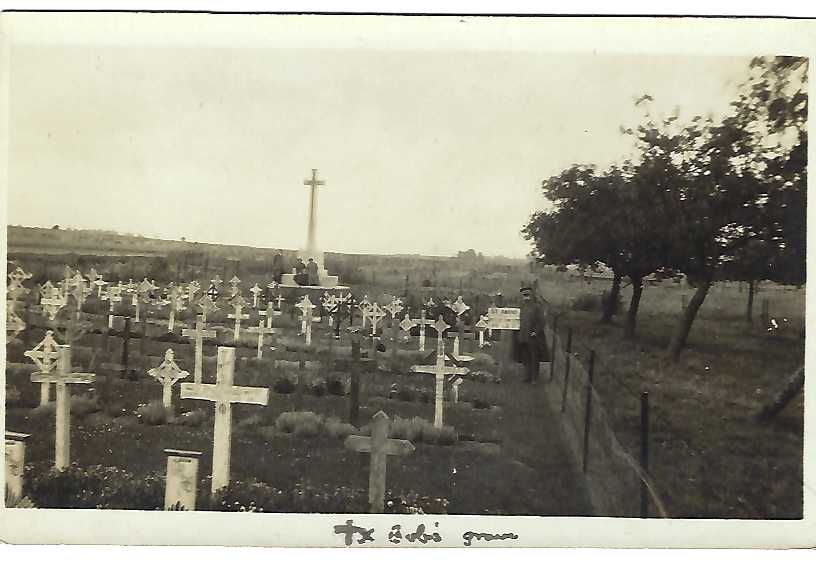
Wilfred Owen died 104 years ago today, a week before Armistice was declared and the war was over. There is something especially poignant being killed so close to the ending of hostilities. My Uncle Bob was killed on 14th June, 1918, close enough for the family legend to grow that he was killed in the last days. My uncle’s experience is largely unknown and unknowable. He sent letters to his family, pencil written because he was ‘other ranks’. He also sent water colour sketches of the places, churches and castles he saw behind the lines. He pressed wildflowers he found growing in no-man’s-land, on the borders of the roads he tramped, in the trenches he manned. Poppies, yes, but also Larkspur, Scabious, Ragged Robin. He saw beauty there, as Owen did. We know nothing of his other experiences: the suffering he saw, the fear, the fighting and dying. In that Wilfred Owen speaks for him. He speaks for all of them.
My Uncle Bob with his family
His temporary grave in Flanders
His name, Pte R. W. Goodway, on the War Memorial in Leamington Spa
My latest research has been into the German Occupation of Jersey during WW2. At first, the surrender by the British and the occupation by the Germans was polite, and the aim by both sides was to make as little disruption as possible, but inevitably as time progressed, relationships between the German occupiers and British citizens began to break down, leading to many reports of trauma and atrocity.
One of the things that caused fear and distress on the island of Jersey was the treatment of the forced labourers of Oganisation Todt. Named for its founder, Fritz Todt, an engineer and senior Nazi, Organisation Todt was a civil and military engineering confederation responsible for building infrastructure such as defence works and railways.
Hitler saw The Channel Islands as key to the control of Europe and Great Britain. With this in mind, he became obsessed with the idea that The Channel Islands should not be lost, and became determined to defend them, with the idea that eventually, after Europe was defeated, they would become the ideal base for Nazi families to enjoy holidays in a 'Strength through Joy' (Kraft Durch Freude) Camp. Worryingly, when I searched for more about the KDF, I found it still exists, and has branches in the North of England. Here is a typical Propaganda poster, the only one I could find not emblazoned with swastikas.
In order to defend the islands a massive programme of fortification began, and the Organisation Todt provided the labour. This obsession with Jersey was seen by many Germans as Hitlers inselwahn - island madness. Before Hitler's supposed final victory, the islands were to be a stronghold and submarine base for forays into English waters.
For those living on the island, they had to endure the appearance of nearly 500,000 metres of reinforced concrete to make anti tank walls, gun emplacements, underground barracks and bolt holes. Historic castles were fortified with concrete, and new roads cut through the previously quiet lanes to carry truckloads of building materials, plus the many workers needed for this enormous enterprise. To prevent landing by sea, the beaches were mined by more than 100,000 mines.
The workers for this frenzy of building were imported labourers and prisoners of war from Russia, Poland and the Ukraine. According to Nazi propaganda, the Slav races were untermenschen and treated as slaves to the Nazi building machine.
To house the workers, camps known as lagers were constructed in several places, all named after famous German poilots such as ‘Richthofen’ and ‘Immelmann’. The treatment of the workers was appalling, and most were on inadequate rations because the food was progressively stolen by German employees and guards - either for their own use, or for sale on the black market. The lorry that brought the inadequate soup to the quarries and construction sites, also took away the corpses of those who had died from malnutrition, cold, exhaustion or disease.
Note the armed guard supervising these construction workers
Jersey people were suddenly reminded through these atrocities, that their occupying force could treat pepople in this barbaric way, and this made the constant fear of the occupation much worse. The Germans shot workers caught stealing potatoes from the fields. Suddenly, their Germman neighbours seemed much less civilized when the treatment of their 'slaves' was exposed. Civilians were warned of the penalties for giving the workers food, but a number of Jersey people did try to rescue them, taking them into their homes at great risk to themselves.
According to 'The IslandWiki' - the Channel Island Website, German records show that by May 1943 there was a total of 16,000 foreign workers in Jersey, Guernsey and Alderney. In November of the same year, numbers had halved to 8,959 and by July 1944 only 817 remained.
Workers from Organisation Todt feature in one of the stories in a new collaboration by writers fron many countries - all proceeds are in aid of the United States Holocaust Memorial Museum. The stories focus on the theme of Resistance, and the collection of ten novellas is available now.
Admit it, you’re sick to death of Crimea. Writing a series
set in one war has made me rather single-minded, and looking back
over my time at the History Girls I seem to have written about little else. But
as this will be my final post here I hope you’ll let me take just one
last look at it, and tell the story no-one else in the West seems to want to
tell.
They really don't. When the official
narrative is that ‘Russia has stolen Crimea’, no-one wants to hear about
Crimeans except as Ukraine’s ‘property’ and a pawn in the Great Game. What they
forget is that Crimeans are also people, and sometimes ordinary people can
change the world. In the last week of February 2014 some of them did just that, and just this once I'd like it to be recognized.
All right, February is hardly history, but I think the story fits here because of what it reveals about the historical process
itself. To me it was a unique one, because I know the place, I know the people, and
I was aware of what was happening before it was history. Usually I start with the official
narrative and work backwards to the primary sources, but this time I’ve watched
events unfolding through the eyes of the people actually living them – and been
astounded to see the entirely different narrative now hailed as ‘official
history’. It’s made me start to wonder how much official history we can believe
in at all.
We certainly can’t rely on contemporary media. It was almost
fun at first, being ‘in the know’, watching with smug superiority as a Western
reporter scrambled round mispronouncing everything and screaming ‘BREAKING
NEWS! A Russian frigate is approaching Sevastopol Harbour!’ The poor man
obviously didn’t know there’s always a
Russian frigate patrolling the harbour entrance to protect the base of the
Black Sea Fleet – and sometimes a great deal more. This is a photo from my last
visit there, and I hate to think what he’d have said if he’d seen this:
But it didn’t stay funny for long. The tensions were real,
of course, and the forces of the Black Sea Fleet did indeed intervene to ensure
the referendum went ahead, but the tone of the reportage gave everything an increasingly
unfair and sinister twist. The presence of the naval base has always meant a
constant stream of military traffic between Russia and Crimea, but suddenly
every truck with Russian number plates was ‘proof of invasion’. Conscription in
Ukraine had only ended four months ago, Crimea was obviously full of people
with military experience, but still reporters wrote excitedly that the ‘little
green men’ were obviously professionally trained and the Russian Army itself
was invading.
'Russian' soldiers in Crimea
I knew then what the narrative was going to be, and am not
ashamed to say I felt sick. I knew this was a genuine popular uprising, my
friends had been talking about it for weeks, but I also knew no-one would ever
believe it.
I switched off the news and went back to work. I’m a
historian, I steer clear of ‘current affairs’ for fear of being ‘political’,
and it seemed best to keep my head well down. But even history wasn’t safe. As I already
mentioned here, Facebook, Twitter, political and even historical forums were
seething with ‘revised’ history which whitewashed Russians out of Crimea’s past,
and if I attempted to point out the fallacies I was invariably rewarded with a
response like ‘What’s the weather like in Moscow?’ or more simply ‘F*ck off,
Putin-bot.’ Even historical knowledge had become suddenly dangerous if it
clashed with the official narrative on Crimea.
But history is crucial to all this, and without it we can’t
begin to understand why the Russians of Crimea did what they did. I don’t want to be political, and can’t even
say I agree with all of it, but here (just for once) is the story as it looks from
their point of view.
It starts as a military one. I’ve already written about the
Russian ancestors in Crimea before the Khanate, but when Catherine the Great
conquered the peninsula in 1783 it quickly became the heartland of Russian military
power. The vital warm water port of Sevastopol became home to the Black Sea
Fleet, and the town itself was built to service it.
This was the place the British, French and Turkish came to
conquer in 1854 – and the incredible resistance they encountered forms the
centrepiece of the Crimean War. My novels deal mainly with soldiers and
battles, but the British were even more awed by the women and children who
worked with their own hands to build up by night what the Allied guns destroyed
by day. Tolstoy’s beautiful ‘Sevastopol Sketches’ gives a unique picture of the
courage of ordinary Russians going about their daily business while the guns
fired relentlessly overhead. For me his most unforgettable image is of the
pavements shattered by British artillery – and two little girls playing
hopscotch over the cracks.
They fought to the end. Only when the French took the ‘Malakoff
bastion’ did the civilians finally retreat over a pontoon bridge to the safety
of the ‘Severnaya’, but even that was an astonishingly brave operation,
performed at night in such disciplined silence that not even the British at
their gates knew it was going on. After eleven long months, the Siege of
Sevastopol of 1854-5 has to be one of the most gallant defences history has
ever known, and no-one demurred when the peace settlement of a few months later
returned the town to the people who’d fought for it for so long.
Detail from 'Last Look' by Franz Roubaud - The Evacuation of Sevastopol
That’s surely enough military glory for anyone –
but in WWII Crimea had to do it all over again. I must stress that not all
Ukrainians and Crimean Tatars collaborated with the Nazis, but the fact remains
that the only significant resistance to Germany’s invasion of 1941-4 was made
by the Russian people of Crimea. The role of Kerch is often ignored, but the
resistance held out for months in the obscurity of the catacombs until they
were betrayed by locals and murdered underground by poison gas.
Russian soldiers and civilians in the Kerch catacombs
But predictably the brunt was borne by Sevastopol, as they
endured their second great Siege. For more than nine long months they held out,
suffering sickness and starvation as well as bombardment, and in tying up
Germany’s 11th Army for so long they played their part on saving Stalingrad
too. Civilian casualties were appalling, and historian Sergey Kiselev claims
that no fewer than one in ten of the Red Army’s losses in WWII fell in Crimea.
Memorial of the Eternal Flame in Sevastopol
This matters, even today. Britain hasn’t been invaded for
centuries and it’s hard for us to understand, but when a people fight this hard
to protect their home, then their sacrifice gives the place a kind of sanctity
nothing can erase.
And the people of Sevastopol have a right greater even than
that. When Stalin ordered it rebuilt in 1948 he made it a condition that those
who’d fled the siege could only return if they gave their own labour for free.
So they did. Lawyers, bankers, and accountants took off their ties, rolled up
their sleeves, and turned to brick-laying, women cooked, cleaned, carried, and
did administrative work, while some even worked cheerfully alongside the men.
The beautiful city of Sevastopol that we know today was mostly built by its own
people – and what possible right of ownership can be greater than that?
The sense of this is almost palpable even today. On my first
visit my guide eagerly dragged me across the Catherina Square to inspect the
wall of an administrative building which her grandfather had built himself. But she was proud of the whole city, and it was impossible not to notice how
immaculately clean it was kept, how free of litter and graffiti. Child of
the Cold War that I am, I assumed this was the same kind slavish obedience to
totalitarian states that enabled Mussolini to make ‘the trains run on time’,
but my guide (and now good friend) saw it differently. ‘It’s our city,’ she
said, puzzled by my lack of understanding. ‘Would you write rude words on the
walls of your home?’
Except, of course, that it wasn’t ‘their’ city any more, and
the closer I grew to these people the more I began to understand their
frustrated yearning for recognition. No-one asked their opinion when in 1954 Khruschev
gifted the whole of Crimea to Ukraine, and the old man I asked about it had
tears in his eyes as he described what it felt like. ‘Like a sack of wheat,’ he
said, blowing his nose noisily. ‘They gave us away like a sack of wheat.’
Maybe it didn’t matter much back in the days of the USSR
when the distinctions were more administrative than actual, but when the Soviet
Union collapsed and Crimea was suddenly in danger of finding itself in a
completely separate country then it mattered very much indeed. Russia finally
recognized that, and in 1991 it gave Crimea the chance to vote themselves the
status of an autonomous republic which would be independent of Ukraine. Crimeans voted in favour by an overwhelming 94%, and Russia was confident it had given the
peninsula all the protection it needed.
So it had – if Ukraine had only respected it. Crimea
obviously had its own doubts, and in 1992 sought to clarify its position by
announcing full self-government with its own constitution, but Ukraine
denounced the movement as part of an ‘imperial disease’ and responded by
creating a ‘Ukrainian presidential representative in Crimea’ – a back-door way
of asserting sovereignty. Tension mounted on both sides, but only when Russia
had safely signed the Budapest Memorandum in 1994 did Ukraine take the radical
(and illegal) step of abolishing Crimea’s own presidency and tearing up its
constitution. From this point on, Crimea was ipso facto part of the new
Ukraine, whether it liked it or not.
It’s hard to imagine how that felt. It was at least good news for Crimean Tatars, and those who had been unfairly deported by Stalin after WWII were
finally allowed to return, but the Russian people of Crimea were cut off from
their history, their heritage and nationality, and suddenly became a minority
in a land that basically hated them. The hatred would be understandable if it
were directed against Stalin or the old USSR, but it was aimed at living people
whose only crime was to be born of at least one Russian parent.
There were economic hardships too. As a Westerner fully aware
of the oppressions of the old USSR I’d always imagined independence would be a
wonderful thing – but it was only when I went to Crimea that I realized the
price that had to be paid for it. Ukraine had kept the worst aspects of the old
system (the corruption that saw the rise of the oligarchs) but had quietly
shuffled off the good bit – the complete social security that kept a loyal
citizen safe for life. Pensions were halved. The free healthcare for which
Russians had paid taxes all their lives was suddenly only available to those
willing and able to pay bribes. I felt shockingly uncomfortable talking to
people whose relatives had died or were dying for the lack of medicine or
simple operations we in Britain take for granted.
All Ukraine was suffering, of course, but the predominantly Russian areas of south and east did seem to be hit the hardest. Even a
soldier from Ukraine’s own ATO had to confess in a recent interview that he’d
never seen poverty on the level he saw in the Donbass, and I can testify myself
to what it was like in Crimea. I remember the flavoured water that passed for
soup in some of the ‘restaurants’, and how I waited ten minutes for my guide to
haggle for her husband’s supper – which turned out to be a single cabbage. It
was never anything like as bad as Africa, but seemed all the worse for existing
in a magnificent European city with university-educated people just like those
I’d meet at home.
But as history has shown us in Nazi Germany, economic
hardships can lead to a rise in nationalism and the need for easy scapegoats.
In came Svoboda and the Right Sector, and by 2010 Ukrainian MP Irina Farion was
already telling 5-year old schoolchildren that if they wanted to use their
Russian names they would need to pack their bags and move to Russia. I heard
all about this and the Nazi taunts of ‘Moskals!’ ‘Vatniks!’ on my first visit
to Crimea, and it was already clear that something was going to have to break.
But worse even than this was Ukraine’s creeping desire to
smear Russia’s past military heroism, to elevate Stepan Bandera to hero status,
and thus make traitors of the gallant men and women of Crimea who gave their
lives fighting Nazism. This would be appalling anywhere – but in Crimea it’s
unbearable. Crimea, where Russian guide Irina Niverova recently explained to the National Post that “Every stone and every tree… is covered with the blood
of brave Russians, and that is what is in our hearts.”
'In Our Hearts' Sevastopol May 9th - children march with pictures of their ancestors
In their hearts and everywhere on their land. Crimean war
graves are beautifully kept, their memorials immaculate and flower-strewn, and
May 9th celebrates a history of military heroism which is second to none. How could a people like this allow their past sacrifices to
be whitewashed away? How could they see the memory of their dead brothers,
fathers, grandfathers spat on by the very people they died to protect? And make
no mistake about this – that’s what’s happening. I already posted this video
from Lviv in 2011 where Russian veterans have the St George ribbons ripped from
their chests as they go to lay flowers on their comrade’s graves.
Then came Maidan.
For Crimea, Maidan was an outrage. Yanukovich may well have been as corrupt as his predecessors, but
he was the first to improve Ukraine’s economic state, he at least acknowledged
the voices of the regions, and he was the legitimately elected President for
whom Crimea had overwhelmingly voted. How would we feel in Britain if the
losing side of a General Election set London on fire and overthrew our chosen
government by force? How would we feel if we saw American politicians
encouraging this, and heard leaked telephone calls in which foreign powers
decided what our own government should be?
Crimea felt all this, and more. I have no idea when the first activists made
contact with Russia, and none of my friends were ever involved at this level,
but everyone knew they had to do something. The West wouldn’t help. It talked a
lot about human rights, but every Russian in Crimea knew what The Telegraph has only just admitted – that some Maidan protestors were being funded not only by the
US, but also the EU. Russia mightn’t help either, and she’d never officially
taken Transnistria under her protection. In January this year Russian Crimeans knew
that somehow they'd have to help themselves.
The timeline of how they did it is a matter of public
record, but it begins on February 23rd, and no single western outlet has
explained what it was that lit the fuse.
It was this. The ‘Khersun Pogrom’. On 20th February Russian Crimeans
made their own protest at Maidan, and ‘The Kherson Pogrom’ is the phrase used
to describe the events of their homecoming. The western media blackout on it
has been absolute, but for the first time there’s a video available with
English subtitles to tell us what happened on the night of February 20th 2014.
Please ignore the political slogans framed round the narrative, but the primary source material both eyewitness interviews and original gloating footage shot by the perpetrators themselves.
The Right Sector. They attacked the homecoming convoy, burnt
the buses, then beat, stripped, and humiliated the people. They almost
certainly did worse than that, but all we can say with certainty is that seven
of the Crimeans on those buses have never been seen again. When the survivors
were finally released the Right Sector thugs taunted them with the threat that
they would soon be coming to Crimea itself – and then they would ‘do worse’.
Nor were these empty threats. By 23rd February Yanukovich
had been driven out and the new (unelected) government was already making their
intentions clear. The raft of new bills included laws to make Holocaust denial
legal, to ban Communist Party activity, to make a member of Svoboda the new
Prosecutor General, and to deny the rights of minorities (including Russians)
to use their own native languages.
Crimea acted. They rallied in their tens of thousands in Simferopol and swore to form their own independent administration, but still no-one quite dared to take it further. Protests were all right, no worse than Maidan had done, but nothing was yet irrevocable.
Until 27th February when Channel 5 broadcast a leaked conversation between the leaders of
Ukraine’s two Neo-Nazi organizations – People’s Deputy Oleh Tyahnybok of
Svoboda, and Dmytro Yarosh of the Right Sector.
With apologies for the poor
Google translation, here’s a sample of their conversation:
It’s not just idle talk. These are men with significant
power in the new regime, and they are talking of Crimea as an immediate target
for a punitive operation.
What could Crimeans do? What would you do? History has shown
us all too tragically what happened to the Jews of Nazi Germany who sat
obediently at home waiting for the axe to fall, and Crimeans weren’t about to
make the same mistake. They turned off their televisions, dug out old uniforms
from their conscription days, and went out to take the airport while they
called on Russia for help.
I don’t want to be naïve, and certainly don’t believe Putin
had been sitting idle all this time, but the fact remains that it was Crimeans
who made the first move, and Russia’s ‘intervention’ would have had small
chance of success without them. No-one can say exactly when Russian troops left
their base in Sevastopol, but of the men who initially guarded the borders from
Kyiv intervention, some were veterans, some existing members of Ukraine’s own
army, some were Berkut – and a great many were ordinary civilians. I even know
two of them. I can’t give their names for obvious reasons, but one was a
historical re-enactor who went out in his Red Army uniform with a replica gun,
and the other was his wife.
The western media wasn’t having it, and every day we heard
more screams of ‘Russian troops in Crimea!’ One of my friends sent me a tiny video of Sevastopol women
bringing food and cigarettes to their men on the ‘front line’, but it didn’t
look very convincing so I’m afraid I didn’t publicize it.
I wish I had now, because there’s actually something
endearingly amateur about it that sets the tone for the whole affair. This was
not the slick Kremlin operation the mainstream media would like us to think,
but a case of ordinary people showing extraordinary courage in order to save their
land.
And they did it. Yes, Russia intervened, Russia allowed the
Black Sea Fleet to secure the borders, and Russia finally accepted Crimea into
the Federation, but none of that should blind us to the people who really made
it happen. History isn’t only about kings and queens and governments, but
sometimes it’s made by ordinary people too.
That's all I wanted to show here. In my own novels the Russians of Sevastopol have to be the 'villains', but perhaps that's why I felt I had to do this one last post before I leave. The media ignores them, history will almost certainly ignore them, but even if it's only here in this one blog, I did just want the voices of the Russians of Crimea to be heard.
***
A.L. Berridge's dreadfully neglected website is still here, and one day she'll get round to updating it.
Meanwhile a huge thank you to everyone here at the History Girls for lettingme bore all for so long. I've loved being part of it, and hope you'll let me sneak back in for comments.
And just think - you may never need to hear the word Crimea AGAIN!!
Warning: This is a longer, grimmer piece than usual, and if
you’re looking for entertainment I’d strongly advise you to skip it! This is
for those who like their history raw…
People are being killed in Ukraine. That’s ‘current
affairs’, of course, and won’t be ‘history’ for at least another twenty years,
but that doesn’t mean historians shouldn’t be studying it very closely indeed.
Because in Ukraine the battleground is history itself – and every
single ethnic group in the country has good historical reasons for hating the
others. Ukrainians hate Russians because of years of oppression under Stalin,
and in particular the atrocity of the Holodomor. Crim-Tatars hate Russians for
displacing them, and particularly for Stalin’s mass deportations in 1944.
Jewish citizens are wary of both Crim-Tatars for their role in the ‘round-up’ of
Jews under the Nazi Occupation, and Ukrainians who participated in Jewish
murders and served as notoriously vicious guards in the concentration camps. Russians
hate both Tatars and Ukrainians for their collaboration with the Nazis, and
resent the fact that the break-up of the Soviet Union left them a stranded
minority in a country full of people who hate them back.
All these grievances are valid - but the problem comes when none seem able to recognize those of the others. Russians, for
instance, were legitimately furious when their traditional Victory Day
parades were banned as ‘pro-Russian rallies’ – but on May 18th the Russian
Federation tried to ban the Crim-Tatars’ own little memorial parade in Crimea
on the grounds that it would be ‘provocative’.
The Tatars went ahead with the commemoration anyway
But Victory Day is the big one – and it was on May 9th that
we saw the biggest split between Ukrainians of different ethnic origin. You
won’t need to speak Russian to understand the reaction of the crowd in this
video, for instance, when at 1” the Ukrainian nationalist governor of Kherson
calls Hitler a ‘liberator’ who saved the country from Stalin:
My personal sympathies are with the woman and old man who wrest
away the microphone – but that’s perhaps
my own historical bias showing, since my country fought alongside the Russians
against Hitler. Such a bias would currently be very dangerous in Ukraine. Even
the traditional symbol of remembrance, the ‘St George ribbon’, marks someone as
a ‘pro-Russian’ and a legitimate target, and those who wear them are known
derisively as ‘Colorado beetles’ after the orange and black of the stripes. This little French video even shows footage from Lviv when 'Right Sector' thugs tear the St George ribbons from veterans' chests as they go to lay flowers on their comrades' graves.
'Colorado beetles' - Resistance Veterans in Sevastopol May 9th 2011
I can’t defend those actions, but I can in a way understand
them. How can those who suffered under Stalin distinguish
between ‘good Russians’, whose Red Army did more than any other to achieve
victory over Hitler, and ‘bad Russians’ who oppressed, tortured and murdered so
many in the dark years of the USSR? Yet both things are true. History isn’t a question of
‘either/or’, but a long procession of ‘and…and’s, and if we show only half the
picture then it’s no longer history, but propaganda.
But there’s a worse kind than that, when history is
deliberately rewritten to support a current agenda. I was first drawn into this
when I read newspaper accounts of Crimean history like this one, which constructed
their entire narrative round the Tatars being displaced by evil Russian
invaders. Say – what?? All these pieces began in the late 13th century,
completely omitting the fact that the ancestors of Russia were already there in
the people of the ‘Kievan Rus’, and it was they who were displaced by the
Tatars in the Mongol Invasion from 1223. Crimea was actually the birthplace of
Russian Orthodox Christianity in the 10th century, and Kiev was the original
capital of Russia.
Vladimir Cathedral in Crimea where Prince Vladimir of Kiev converted to Christianity
Even the later history has been blurred. Very few articles
mentioned that Crimea was only transferred to Ukraine in 1954 as a kind of
‘wedding gift’ by Khrushchev – a gift that might reasonably have been returned
when the break-up of the USSR led to the ‘divorce’ in 1991. None I’ve seen
offer any hint of Crimea’s resistance ever since: of the mass protests of
1993-4 and 2009-2010, or of Ukraine abandoning even the pretence of
independence by removing the pro-Russian President Meshkov, and scrapping the
entire Crimean constitution. Nope, none of that. Nothing to interfere with the
concept that Crimea was always Ukraine’s, and Russia had no right to it at all.
But even more disturbing was this recent blog by the ‘Euromaidan
PR’ which attempted to do away with the earlier history altogether – claiming
Russia had no relation at all to the Kievan-Rus, and had merely hijacked the
concept to justify their invasion in the 17th century. It’s an astonishingly inaccurate
piece of old-style propaganda, but what I couldn’t understand was why they’d
even bother. These events were centuries ago – why couldn’t the Maidan just
leave history as history and move on?
I’m afraid I think I understand it now. The same source on
Twitter actually claimed there were no Russians in Crimea before WW1, but when
I pointed out this would have meant we’d fought the Crimean War of
1853-6 against an opponent who wasn’t even there, a Crim Tatar entered the
conversation as follows:
That word – ‘iatrogenic’. This man didn’t even see the
Russians as people, but as a disease infecting his land. That was why it was
necessary to rewrite the history – to ‘other’ and dehumanize them by portraying
them as ‘aliens’. There are very good reasons for doing that to a particular
ethnic group, and this 22 second video of Ukrainian parliamentary member Iryna
Farion explains them very well:
‘We should have driven the enemy out of Ukraine as early as
1654…. That’s why these alien creatures who have come to Ukraine deserve only
one thing. They need to be killed.’
She’s ostensibly referring to ‘pro-Russian separatists’, but
those last sentences make clear she is talking about every ethnic Russian in
Ukraine.
But we have seen this kind of
dehumanizing before, and that’s another reason why we desperately need a
historian’s perspective on what’s happening. George Santayana famously
said, ‘Those who do not remember the past are condemned to repeat it’ – and
this is one part of Europe’s past we must never, ever allow to happen again.
And it could do. Even if we look only at the pictures and
iconography it’s impossible for anyone familiar with the 1930s and 1940s to
miss the similarities. Take this poster, for instance. The legend reads ‘Swearing makes you turn into a Moskal’ –
and ‘Moskal’, like ‘Colorado’, is a pejorative term for a Russian. The picture could
have come straight from the pages of Der Stürmer.
So could those images
attached to unverified accounts of atrocities, often involving a very blond
Ukrainian girl with startlingly white skin.This revolting one from the Facebook page of Ukraine’s Right Sector actually dates back to 1945 – as if absolutely
nothing has changed.
Other images are even more familiar, and on a History blog I
doubt I need to comment on these:
There are ‘Nazis’ in Ukraine all right, and in 2012 the Jewish Times was already expressing concern about Svoboda having won seats in
the Ukrainian RADA. They were a dominant force in the Maidan protests, and the
BBC did a good six minute piece about them for Newsnight which you can see
here. This video paints an even stronger picture of what’s happening in Ukraine
today, but I advise against watching the last few minutes where the images are
appallingly graphic.
Of course there’s propaganda here too. Svoboda holds very
few seats, the Right Sector hasn’t even formed an official party, and many
supporters of the Kiev government find them just as repellent as we do. We
could even tell ourselves it’s a lot of fuss about something that’s not much
worse than our own EDL.Or we could have
– until May 2nd and possibly Europe's worst single atrocity since WWII.
Odessa.
I find it difficult to write about this. I was one of about
600,000 people who watched the whole thing happening live, and just thinking
about it still makes me shake. But there’s a survivor’s account in Russian
here with a decent English transcript here, there’s another with
English subtitles here, and two more (slightly sanitized) here. Analyses tend
to be emotionally and sometimes politically charged, but this one gives a clear overview, this one is useful to explain the staging, this one provides good context, and all are well supported by primary sources. Verified
footage and photographs of the whole thing are available all over the net, but
viewer discretion is strongly advised, since the most important evidence is
inevitably inside the charnel house itself.
What I can’t do is link you to Western mainstream media, since all
have refused to cover it. The official story is that there was street fighting in
Odessa provoked by the ‘separatists’, and as a result the House of Trades
Unions ‘caught fire’ and about 39 people ‘died’ in it.
What actually happened is this:
A rally of nationalists and football fans was indeed
provoked to violence when they were fired on by men wearing the red armband
associated with the Right Sector. Some of these also wore the St George’s
ribbon of the ‘separatists’, although they mingled happily with police, and
even fired from behind their protective line. Their efforts succeeded in
drawing a now maddened mob to the House of Trade Unions, where more than 200
ethnic Russian men, women and children had been harmlessly camped since
February. These peaceful protestors were panicked into fleeing inside the
building, which was then deliberately set on fire with Molotov cocktails
prepared by pretty Ukrainian girls much earlier in the day.
The mob watched it burn. When a fire engine tried to get
through they blocked it. When victims fell or jumped to their death from the
windows, they cheered. When desperate faces appeared at the windows they
chanted, ‘Burn, Colorado, burn!’ When some victims tried to escape from lower
floors men in the crowd shot at them. When some made it out through the flames
they were beaten to death with baseball bats and iron bars. It’s all on tape –
and can be verified frame for frame with footage that was streamed live through
four different cameras.
Child looking out at the window. 'Burn, Colorado, burn!'
Even that wasn’t all of it. Killers had already entered the
building, and while the mob chanted outside many Russians were already being
murdered within. Some were shot, others apparently gassed, but bodies were
found with only head and shoulders burnt black, as if they had been doused by
some flammable mixture and set alight. Again, it’s all on tape – much of it recorded
by Right Sector thugs who entered the building afterwards to both rob and mock
the dead.
We don’t know how many died. Only 48 deaths have been
officially recorded so far, but as many again are reported ‘missing’, and survivors
claim there were more still. Even so, it’s not the numbers that are most
shocking, but the way it was done – and the fact ordinary people were so easily
transformed into monsters. It is the inhumanity that makes it so unbearable.
Just one example. In this short clip you hear a woman
screaming inside the burning building, and the crowd comment on it. I’ve had
two people independently verify what the man closest to camera is saying, and
it’s this – ‘That’s not a woman, it’s a separatist’.
‘Dehumanization’ again, and the whole business is riddled
with it. Ukrainian Nationalists have been posting pictures like these on
Twitter and Facebook every day:
Nor is it just the mob. Ukrainian columnist Kateryna Kruk
wrote that ‘Odessa cleaned itself of terrorists’, and presidential candidate
Julia Tymoschenko even congratulated the ‘heroes of Odessa’ for fighting for ‘our
Ukraine’. I have yet to see one single
expression of remorse.
And still the West is silent! The EU statement on the
subject suggests the motive might be to ‘prevent escalation’ – but inevitably
it’s having the opposite effect. Not only have we told every ethnic Russian in
Ukraine that they can be beaten, tortured, and murdered without anyone lifting
a finger to help them, we have also emboldened their murderers. Whatever violence
follows, we will be at least partially responsible.
Which is yet another reason why historians are needed here. When
the media are silent or skewed, then tribalists rush to fill the vacuum, and in
the subsequent ‘info-wars’ it becomes harder and harder to find the truth. ‘Disinformation’
already abounds, such as the fake ‘doctor’ who posted a harrowing tale on
Facebook and was subsequently found not to exist. Mud is also thrown at genuine
sources, so that cries of ‘photoshopped!’ greet the worst stills from Odessa
footage – but the material streamed live could not be faked, and I’m afraid I’ve
been able to match it every time.
We need a historian’s approach. We need calm, common sense
that will look for primary sources, seek to verify everything, and always
remember that people lie to suit their own agenda. Yes, this is ‘current
affairs’ rather than history, but why on earth should our approach be any different?
None of us would consider a historical newspaper from one ‘side’ a reliable
source – so why should we think our own are any better today? Why are we so
sceptical about the propaganda of the 19th century – and apparently rarely
question that of the 21st?
But there are reasons, and here's just one example
to illustrate them:
The catalyst that toppled Kiev’s president and brought the
US and EU galloping into the fray was the shooting of upwards of 70 Maidan
protestors by the riot police – the ‘Berkut’. It was obviously intolerable for
a president to fire on his own people, and it was a wave of that understandable
outrage that swept the present ‘interim government’ into power.
Remembering the Maidan victims
However, considerable evidence has since emerged that the police were innocent, and the shootings were actually a deliberate provocation to achieve precisely this happy result. Since then even the head of Ukraine's own investigation has been forced to admit that the bullets in the bodies don't match the guns used by the police, and there's really no evidence against them at all.
As historians we're all familiar with the 'false flag' scenario, and if this had happened in 1814 rather than 2014 we'd all be happy to say this was one of them. But we can't say it NOW. Claim a ‘false flag’ in 1814 and we’re
historians – but claim one in 2014 and we’re ‘conspiracy theorists’. Historians
must be impartial, but to make such a comment when the event is still reverberating
is to be seen to take sides.
And that’s wrong. Truth doesn’t ‘take sides’ and neither
does history. My sympathy is entirely with the victims of Odessa, but that
doesn’t stop me recognizing that ethnic Russian separatists have also committed
atrocities of kidnapping, torture, and maybe even murder. I loathe the Odessa
murderers, but know there were also good people among the Ukrainian
nationalists, some of whom even erected scaffolding to try to rescue the
victims. Again it’s a case of ‘and-and’ rather than ‘either-or’, and to believe
one thing does not negate belief in another.
Odessans try to save victims from the fire
We can still speak out, without being ‘tribalists’ who only believe one side’s
version of events. If only we could all approach current affairs and history
with a genuinely impartial interest in truth, then info-wars and propaganda wouldn’t
stand a chance. Maybe news media would start to be more honest. Maybe some people would even reconsider what they're doing.
And maybe people wouldn’t be dying in Ukraine.
***
The website of the Very Not Communist A L Berridge can be found here.