Showing posts with label World War 1. Show all posts

Friday, 4 November 2022

Anthem for Doomed Youth - Celia Rees


What passing-bells for these who die as cattle?
— Only the monstrous anger of the guns.
Only the stuttering rifles' rapid rattle
Can patter out their hasty orisons.
No mockeries now for them; no prayers nor bells; 
Nor any voice of mourning save the choirs,—
The shrill, demented choirs of wailing shells;
And bugles calling for them from sad shires.


What candles may be held to speed them all?
Not in the hands of boys, but in their eyes
Shall shine the holy glimmers of goodbyes.
The pallor of girls' brows shall be their pall;
Their flowers the tenderness of patient minds,
And each slow dusk a drawing-down of blinds. 


I'm sure many people reading this blog will instantly recognise Anthem for Doomed Youth by Wilfred Owen. It was written in 1917, a year before his death on 4th November, 1918. He was twenty five years old. When he died, Owen was almost unknown - only five of his poems were published in his lifetime - but today, we are nearly as familiar with the details of his life as we are with his poetry. He was born and spent his early years in Oswestry, a Shropshire lad. The death of his grandfather marked a change in fortune. His family moved to Birkenhead for his father to take up a post as Station Master. Owen avidly read boarding school books and The Boys' Own Paper and grew up with a feeling of loss of status, having not attended boarding school, or gone up to Oxford. When he joined up, he was made an officer, thus gaining the status he so wanted. Unfortunately, the generation who were educated in the schools he had envied, were doomed. Junior officers were easily identified by German snipers, marked out by their distinctively different uniforms and their positioning on the battlefield, first over the top, leading from the front, pistol in hand. They were killed in their thousands  Rolls of Honour in every boarding school chapel attests to the numbers lost.   

Wilfred Owen 1893 - 1918


I first discovered Wilfred Owen when I was in the Sixth Form, transfixed by a classroom reading of  'Dulce et decorum est', the sensory overload of horror the poem lays on the reader line after line, conjuring those public school boys, those 'children ardent for some desperate glory', their passing soon to be recorded on chapel walls, celebrated by 'The old Lie: Dulce et decorum est, pro patria mori'.


If in some smothering dreams, you too could pace

Behind the wagon that we flung him in,

And watch the white eyes writhing in his face,

His hanging face, like a devil’s sick of sin;

If you could hear, at every jolt, the blood

Come gargling from the froth-corrupted lungs,

Obscene as cancer, bitter as the cud

Of vile, incurable sores on innocent tongues,—

My friend, you would not tell with such high zest

To children ardent for some desperate glory,

The old Lie: Dulce et decorum est

Pro patria mori.


Dulce et Decorum Est - Wilfred Owen


 It was the Sixties, the Vietnam War was raging, Oh, What A Lovely War! was transferring from the theatre to the big screen, anti-war sentiment was everywhere.  Owen's poems spoke to me, as they do to every generation because no generation since the 1914 - 18 has been untouched by conflict, the reality brought right into our living rooms on the TV News. Over a hundred years after his death, Owen's poetry still resonates as we see the devastation in Ukraine, villages and cities, fields and forests turned into no-man's-land, dead bodies by the sides of roads, soldiers huddled in their trenches, watching the water rise, waiting for the winter that's coming.

Our brains ache, in the merciless iced east winds that knive us . . . 
Wearied we keep awake because the night is silent . . . 


..Tonight, this frost will fasten on this mud and us, 

SShrivelling many hands, and puckering foreheads crisp. 

The burying-party, picks and shovels in shaking grasp,

Pause over half-known faces. All their eyes are ice, 


Exposure - Wilfred Owen


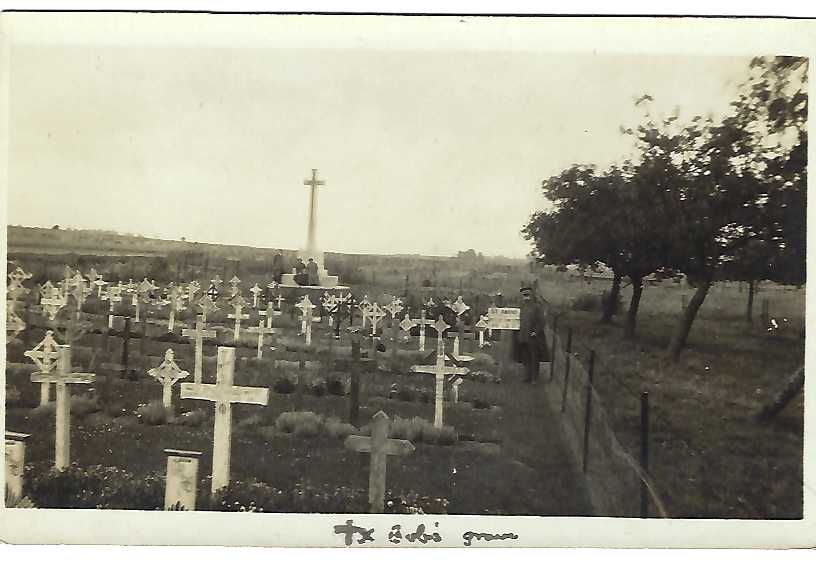
    Wilfred Owen died 104 years ago today, a week before Armistice was declared and the war was over. There is something especially poignant being killed so close to the ending of hostilities.  My Uncle Bob was killed on 14th June, 1918, close enough for the family legend to grow that he was killed in the last days. My uncle’s experience is largely unknown and unknowable. He sent letters to his family, pencil written because he was ‘other ranks’. He also sent water colour sketches of the places, churches and castles he saw behind the lines. He pressed wildflowers he found growing in no-man’s-land, on the borders of the roads he tramped, in the trenches he manned. Poppies, yes, but also Larkspur, Scabious, Ragged Robin. He saw beauty there, as Owen did. We know nothing of his other experiences: the suffering he saw, the fear, the fighting and dying. In that Wilfred Owen speaks for him. He speaks for all of them. 


My Uncle Bob with his family
His temporary grave in Flanders


His name, Pte R. W. Goodway, on the War Memorial in Leamington Spa


Friday, 11 June 2021

Pigeon Post by Judith Allnatt


Communication was no easy matter during World War One. There’s an old joke about a message that originated as ‘Send reinforcements; we’re going to advance’ but which eventually arrived as ‘Send three and fourpence; we’re going to a dance!’ Although admittedly amusing, the joke has a dark side when one thinks of the consequences of inaccurate communication when applied to crucial military messages, and the difficulties of passing on messages verbally were by no means the only ones encountered.

Signallers using flash lamp near Bouzincourt, 10th July 1916.
Where military positions were established, messages could be sent to and from HQs telephonically once Signallers had laid down cables along trenches or buried them in the ground. This was dangerous work in itself and wires often needed repairing, leading to loss of life. However, when attacking, it was difficult to keep pace with an advancing force and impossible to connect sideways to other battalions moving forward in parallel. As a result, some ingenious communication methods were adopted.


In addition to the use of rare and cumbersome radios and runners who may or may not survive a journey fraught with mines, artillery fire and snipers, vast numbers of pigeons were housed in mobile pigeon lofts so that they could be moved around the field of conflict. A smaller number could then be carried in a wicker basket on a man’s back to a position in the line and released to return ‘home’ with messages in tiny cylinders attached to the bird’s leg. 

The Royal Engineers Signals Service on the Western Front, 1914-1918
A former London double-decker bus camouflage painted, used as a travelling loft for carrier-pigeons. Pernes, 26 June 1918.

 Pigeons have a ‘sixth’ sense – the ability to detect and navigate using the earth’s magnetic field. Although the mechanism for this homing sense was not understood during the Great War, in the 1980s researchers discovered tiny crystals of magnetite inside nerve endings in the upper part of the beaks of pigeons which detect the strength of the earth’s magnetic field. Others found that chemical reactions induced by light entering the bird’s right eye allow awareness of the direction of the magnetic field. These two together enable the bird to ‘see’ the magnetic field and find their way home.

As well as taking messages from the trenches to the rear, pigeons were taken up in planes being used for reconnaissance to bear messages from aviators to HQ. Even more ingenious was the practice of fastening a small camera to the bird’s chest and releasing it at a pre-planned time. Aware of the route the bird would take to get home, the camera could be attached to a timer that operated the shutter, thereby collecting aerial images – literally a bird’s eye view!


Sergeant of the Royal Engineers Signals Section putting a message into the cylinder attached to the collar of a messenger dog at Etaples, 28 August 1918. McLellan, David (Second Lieutenant) (Photographer)


Dogs were also used to carry messages or sometimes even to carry other messengers, as pigeon baskets could be strapped onto their backs.

Before basic radio transmitters, communication from a plane, to inform on the fall of enemy artillery for instance, was initially by dropping messages inside weighted streamers over the side. Kite balloons were also used for reconnaissance over enemy lines. Two observers went up in the wicker basket fixed beneath. One cable was used to tether the balloon to a lorry and the other to relay telephonic messages. The balloons made easy targets and, under fire, men ‘bailed out’ with parachutes. 

Disembarking from a kite balloon


Despite these resourceful methods, communication difficulties must have hamstrung officers making decisions on the ground. Once an attack had started there was no quick, reliable way to contact troops to redirect them or to call for reinforcements. There may be other reasons underpinning the epithet ‘Lions led by Donkeys’ but the lack of timely, dependable communication must have been a contributory factor in many decisions that turned out to be bad ones and resulted in an incalculable number of casualties.

Friday, 13 December 2019

Shot at Dawn. By Judith Allnatt

Private Henry Burden, a Northumberland Fusilier, was shot at 4 a.m. on 21st July 1915 having been found guilty of desertion. He was just seventeen years old.

Like many young men keen for adventure and caught up in the patriotic rush to war, he had lied about his age in order to join up. Once sent overseas, he lost friends at the Battle of Belwaarde Ridge, experienced nerve shattering barrages of shelling and was sent to a military hospital to recover. On the same afternoon that he was discharged, he was sent forward with his battalion to the front line. Burden left his post, he said, to visit a neighbouring battalion to see a friend who he had heard had lost a brother. Two days later he was arrested and two days after that he was tried by a court martial. He had a record of going absent without leave, which went against him and he had no one to defend him as those who could have spoken up for him had all been killed. He wasn't asked about his age and he didn't raise it. He was found guilty, not of the lesser charge of going AWOL, but of desertion, and condemned to death.


Photo credit: Harry Mitchell [CC BY 4.0 (https://creativecommons.org/licenses/by/4.0)] 

In the British Army, discipline was harsh. The offences for which a soldier could be executed were many and various. They included: cowardice, casting away of arms, disobedience, striking an officer and desertion. Falling asleep on sentry duty could also carry the death penalty as it endangered a whole section of the line. Soldiers on duty at night stood with head and shoulders above the parapet, rather than using a periscope, so that they could get a good field of view. (There being less chance of being hit in the dark other than by a random shot). It was therefore very obvious, if a sentry slumped, that he had fallen asleep and those who did so were easily caught. Standing at their posts for hours, dealing with mind-numbing boredom and body-numbing cold, it was all to easy to be overtaken by exhaustion. Fear of the consequences resulted in the practice of using matchsticks to prop their eyes open.

Around 3,000 soldiers were executed for offences such as those listed. There is a strong sense of the authorities using the ultimate punishment to 'set an example', a stark warning to re-assert discipline. Before facing the firing squad, the soldier's General Service buttons were removed from his tunic as a mark of his shame. Blindfolded and manacled, he was led to a stake and a target such as an envelope was pinned to his chest. Often, the firing squad was chosen from the soldier's own unit, presumably to hammer home the lesson that breaches of discipline would not be tolerated. One can barely imagine the horror and mental anguish that this practice must have caused both the man and his comrades. Apparently, the traditional belief that one of the bullets used would be a blank so that each soldier was left with the moral let-out that his shot may not have been the lethal one, is actually untrue. The whole squad were, in fact, given live ammunition.

The man's disgrace often continued after death: there were relations who chose not to talk of the relative who had brought shame on the family and memorials in towns and villages that omitted their names. Not until the 21st Century, when it became clear that many of those found guilty had suffered what we now know as Post traumatic Stress Syndrome (PTSD) , was there any attempt to give them a memorial.


At the National Memorial Arboretum in Staffordshire, this shift in understanding and attitude found expression. The memorial Shot at Dawn, by Andy de Comyn, consists of a larger-than-life sized statue of Henry Burden, blindfolded and with his hands tied behind his back. Before him, the firing squad is represented by six juniper trees and behind him are an array of wooden stakes representing 309 other victims, each one individually named. These are the men who were posthumously pardoned by the British government in 2006. The pardons were granted not to imply blame for the officers who had acted in line with army regulations and without the understanding of PTSD that we now have, but in a spirit of mercy and in recognition of the battle trauma experienced by many, often very young men, and the suffering of their families. The Director of the Arboretum said that  "over 80 years of medical, psychological and sociological advantage (was) denied those who sat on the court-martial boards that passed sentence."

So, what of Henry Burden? As always, it is the small human details that suddenly pierce the heart. I think of his body taken down from the stake to be prepared for burial and the tattoos discovered upon it of "clasped hands" and "Love Lilly".  I am glad that his statue is placed at the eastern end of the arboretum where the sun's first rays strike.

At the going down of the sun and in the morning
We will remember them.

Laurence Binyon 1914


Friday, 23 November 2018

Broken Faces by Judith Allnatt


In WW1, the use of weapons such as grenades, flamethrowers and howitzers meant that war was waged on a vicious industrial scale. Those lucky enough to survive their injuries were often maimed or facially disfigured and returned to ‘Blighty’ both physically and emotionally scarred.

My own great grandfather, who suffered a terrible head wound that required a trepanning operation, was greatly affected by his injury. The metal plate that covered the hole in his skull caused agonising headaches and he became irascible and depressed. Like many returning soldiers, he found it difficult to adapt once more to civilian life. He couldn’t work; his life could not be as it had been before the war. He had seen and experienced too much. He no longer felt like the same person.

This sense of lost identity, felt by many returning soldiers, was a subject I wanted to explore in my book ‘The Moon Field’. I chose to write about facial disfigurement in particular - what the French called ‘gueules cass
ées'  – broken faces. What could be more apt as a symbol of lost identity than the loss of one’s own familiar face?The public treatment of these war veterans was mixed. In parks, benches were set aside for disfigured soldiers and painted blue so that other people could avoid them. Whilst this may have been a well-intentioned effort to give the men some privacy, it also isolated them further, making them feel as if they were monsters. In my research I came across references to them as ‘droolers’ and stories of job vacancies swiftly withdrawn, café owners ushering the men to seats well away from the windows and even the throwing of stones. In my novel, the character with the broken face retreats to a ‘back room’ job as a cinema projectionist, withdrawing to the safe cocoon of darkness. It was my task, as writer, to take him on a journey back to the light.

At the start of the war, before the invention of the techniques that became the forerunners of modern plastic surgery, disfigured men were fitted for masks. The hospital units concerned became known, with gallows humour, as ‘the tin noses shop’. The metal masks could be taken on and off, with arms that fitted over the ears as with spectacles but which were also fixed securely at the back of the head with a wire fastening.


Men and women, who had been genteel sculptors who carved statues and fountains before the war, became instead shapers of men’s faces. One such, Anna Coleman Ladd, in a startling juxtaposition of the two worlds, described the galvanised copper of a mask as being ‘as thin as a visiting card’. They took enormous care to make the masks realistic: real hairs were laid on one at a time to make the eyebrows; the man’s skin tones were matched as nearly as possible and even a slight blue was added to replicate the effect of a ‘five o’clock shadow’. 

Making a mask began with laying bandages soaked in plaster across the face to make a cast. Holes were left at the nostrils for the patient to breathe through but nonetheless it was a rather suffocating experience that had to be carefully timed, as the plaster became hot as it dried. A clay ‘squeeze’ would then be taken from the cast and the sculptor would copy the ‘good’ side of the face to create a mirror image, so that the mask modelled on it would restore the symmetry of the face. 


For men who had been so badly disfigured that they experienced people recoiling from them, sometimes even their own children running from them in fear, having a mask could return to them some dignity. Despite the fact that their expression was inevitably fixed and ‘doll-like’, being able to show the world a recognisably human face meant that they had the freedom to go out in public again. I found it heartbreakingly poignant to read the words of a grateful patient, in a letter sent to Mrs Ladd: ‘My wife no longer finds me an object of revulsion, as she had every right to do’. 

Some men who wore masks were able to return gradually to a more socially integrated life, particularly when supported by close family. Others seemed to create new ‘families’ through congregating with others who had been similarly damaged: a community was set up in France by the Union des Blessés de la Face (the Union of the Facially Wounded) where disfigured men turned away from the outside world and lived and farmed together. At last, new identities were forged and the men often felt that their mask became so much a part of them that they asked, in their wills, to be buried in them.


Tuesday, 23 August 2016

August 1914: The Enemy Within? by Leslie Wilson


'Two Germans entered the tube at Belsize Park. While the train was in motion they conversed in German, but during the short periods of silence at the stations they relapsed into bad, gutteral French. Two young men, hearing a reference to carrier pigeons, broke their journey at Leicester-Square and followed the Germans through Coventry-Street to a café. '

I was given this brown scrap of newspaper by another Quaker; it comes from the archive of Edward H. Milligan, once archivist at Friends House, a man who has been a valued resource for anyone working on Quaker history for many years. He has recently moved from a house to a flat, and has had to pass on many of his impressive collection of books and documents, quite a few of which I have been lucky enough to acquire.

The zealous young men were hugely excited at the opportunity of catching German spies and fifth-columnists. Did they really hear the words 'carrier pigeons' (Brieftaube), or was the wish father to the thought? They might have been complaining about dust (Staub) for example, or mentioning that someone was deaf (taub). Or the word might have been used figuratively. (Note that the French had to be 'gutteral', a term of abuse against foreign languages that I don't get, since gutterals are just gs, ks, chs, js, etc, and English has plenty of them). One young man sat down to keep the villains under observation, while the other one rushed off to Vine Street police station to tell them what they'd discovered. He then returned, to find that the Germans were departing. The amateur detectives trailed them to Leicester Square, hemmed them in, and told them they were being watched. The Germans 'hurried on, hoping to get rid of us,' and when they saw police, tried to make their escape. Or so the young men told the police. The amateur sleuths 'marked the house which they entered, and informed the local police, who have the matter in hand.'

And all for the crime of talking German between themselves, and talking bad French at the stations.


WHOLESALE ARRESTS, proclaims another column. Two 'alleged Germans' who said they were Russians, were overheard by a teacher of German, 'talking suspiciously' in Conway, and were arrested. (They might well have been Russians of German ethnicity). In London, a German was arrested as a spy and the police seized 'several large deed-boxes' full of documents. The man was held, pending enquiries, at Moor Lane police station. The documents were maybe his business papers. Three supposed German spies were captured on the railway line at Maidstone.

German reservists were being 'arrested wholesale.' I wonder if they were really reservists, since the German reserve had already been mobilised by then, so why would 'a hundred and thirty Germans and Austrians' arrive on boats in the Mersey? Maybe the captains were staggeringly bad at navigation? Apparently many Germans were employed in the lace trade in Nottingham, and they too are described as reservists, and were being arrested 'wholesale.' I do wonder if any young men of military age were considered to be reservists.

Maybe someone has some information that could elucidate this for me?

What the last snippet does reflect is the number of Germans who had lived cheerfully and inoffensively in this country for hundreds of years up till the beginning of the war.The German Lutheran church, in London, pictured below, was founded in 1762.
German Lutheran Church, London, secretlondon 123

Like Friedrich Wilhelm Singer, pastor of the German seamen's mission at Shields, who was remanded on bail, charged with spying.

The language employed is interesting. TELL THE POLICE! urges a headline, describing how more enthusiastic citizens were informing the police about the whereabouts of German residents, who were required to register immediately, or pay a fine of £100 or be imprisoned for six months. The registration offices were the police stations, and the paper says that since the early morning they had been 'invaded' by foreigners making enquiries. So it was an annoyance (to the Evening News, at least) that the Germans and other foreign nationals were following instructions. The paper also seems to regard it as outrageous that many of the Germans were prosperous, and arrived in carriages and taxi-cabs (the implication being that they'd grown rich on payments from the Imperial intelligence agency?).

Spy fever was running high: telegraph wires were reported as being 'tampered with' by Germans, and also soldiers and sailors were said to have been accosted by Germans, eager to pump them for information about troop movements, warships and stores. There was a German who 'left England recently for Germany, who for some time served in a British regiment and obtained the rank of sergeant.' One wonders how much information he'd have gleaned, if he was a spy, serving in such a modest capacity.

There were also, apparently, armies of spies masquerading as commercial travellers. Clearly, there were German spies working in Britain at the time, but surely they'd  have had to be pretty stupid to employ such very visible agents.

In an incident that has spooky resonances of poor Jean Charles de Menezes's murder by the British police, a man 'of foreign appearance' was seen carrying an attaché case near the high level bridge over the Tyne in Newcastle. A patrol challenged him, but instead of stopping he began to run, got into a boat and pushed off. The patrol got another boat and gave chase, but 'as he still declined to stop' he was fired on and wounded. He was said to have thrown the attaché case into the river (or maybe it just fell in?) He died soon after he'd been captured. 'The authorities are very reticent', the paper says.

This story has come through two filters, that of the patrol and that of the newspaper. There are plenty of instances of modern shootings where the police account has been edited, shall we say? One wonders what was really going on there. Of course, the man could have been a quite ordinary thief.

At the same time, shopkeepers were jacking up the price of stores, and there were demonstrations against grocers and bakers in Hitchin; people were panic-buying provisions, though expressly told not to, since, for example 'mild-cured bacon does not pretend to keep like the old farmhouse kind'. People were buying a year's supply of potatoes, and also laying in butter; the paper advises against this, since 'the old-fashioned method of salting fresh butter and keeping it in jars is no longer followed. That last snippet demonstrates the usefulness for the nerdishly inclined historical novelist of reading old newspapers. So people were eating what my mother-in-law called 'sweet butter' at the time, rather than salted, which I grew up with and always supposed to be traditionally British. And anyone writing about the 19th century might like to know that salted butter was sold in jars. I wonder at what period specifically?Anyway, the uncertainty about food probably contributed to the general atmosphere of paranoia.

German missionaries interned at Alexandra Palace, Imperial War Museum
There were in fact around 50,000 Germans or Britons of German origin living in the country in 1914. German shopkeepers (even naturalised Britons) had their windows smashed in; Germans married to British women were marched off to internment camps, which were described by their inmates as 'veritable hell.'

People with German names changed them pretty quickly in order to avoid xenophobic abuse and violence; among them, of course, the Royal Family, who became Windsors instead of Saxe-Coburgs. Given that George V was the first cousin once removed of Kaiser Wilhelm, they might easily have fallen under suspicion.

What struck me, reading these ancient and fragile cuttings, was a resonance between the xenophobia and the outbreaks of racial and xenophobic abuse following the referendum result on June 23rd this year: sheer tribalism. One can only imagine the distress of all those people who had settled here and regarded these islands as their home, at what had occurred, and (because I am half German) I can imagine that many of them must have felt torn in half that their birth country and their adopted country were now at war and their neighbours suddenly hated them.


(The Evening News was part of Associated Newspapers by then, and was thus a sister paper to the Daily Mail.)


The painting of the German missionaries is the work of  George Kenner.

Monday, 28 April 2014

Grandfathers, by Clare Mulley


During a recent sort out, my mum found a small square of newspaper, cut out and neatly gummed onto a piece of glass cut to size. It had been sellotaped too, protecting the ink and turning the paper a deep golden-yellow, but before it was stuck down someone had penciled their name on it in three different places, as well as scratching their initials on the back. The date, handwritten alongside, is 28 June 1919.

The clipping is from the ‘London “Daily Express” Aeroplane Post’, and the headline is ‘Peace Proclaimed.’ You don’t get much of the story, but everything important is captured in sixteen words: ‘The Peace Treaty was signed by the Peace Emissaries of the Allied and Enemy Countries today’.

Dick Mulley's keepsake of the announcement of peace, 1919

The penciled name is ‘R Mulley’. This was my grandfather, Richard Mulley, better known as Dick, then a fourteen-year-old boy with very tidy writing. He was clearly hugely aware of how momentous that day was, marking the end of what was then known as The Great War. Little wonder, since one of his older brothers had served in the Royal Navy and was twice on ships that were torpedoed - although amazingly he survived to run a toyshop in the peace. Dick’s deep sense of moment is captured both in the number of times he scribbled his name on the paper, and in his determination to write so neatly on this small keepsake of history.

I have very little that once belonged to my dad’s dad, although there are a few photos of his many naughty, handsome brothers and long-suffering sisters. I love the fact that this small plaque has survived, a momento of a boy who had clearly been following the war, and had a sense of history as well as of victory. It is also a momento of my father, who must have cautiously held this fragile square of paper and glass, just like I have, and wondered about the boy who grew up to become his father. These two men carefully kept this small cutting safe for ninety-five years.


My husband, Ian, has similarly precious little from his father’s father; in fact he has even less. However, as a child he did inherit his father’s stamp collection, which he carefully stuck in an album bought for the purpose in the 1960s, adding to it as he went. Looking at the individual stamps, however, some of these must have come down from another generation, from Ian’s father’s father, Reiner.

This album contains stamps from all over the world. The smaller the country, the more fabulous the stamp, my dad once told me, looking at his own childhood collection with me. The same is true here, but the most fascinating stamps in this album come from Ian’s grandfather and father’s birth-country; Germany.

Germany first issued stamps in 1872. Sadly there are none in this album from then, but there are two Germany pages, very neatly distinguishing stamps dating from 1949 which were issued in the Deutsche Demokratische Republik, ie post-war Eastern Germany, and look suitably Soviet, from an older collection from the Deutsche Reich.

These Reich stamps are fascinating. The oldest, perhaps, is a pretty dark blue one showing a stylised hunting horn for a value of 6 marks. The collection quickly moves up in face-value however to 200, 400 and 500 marks. In the years after the First World War the value of the German mark fell rapidly, mainly as a result of reparation payments and the penalties imposed on German trade, combined with the depression. As the German government printed money, the country experienced rapid, debilitating inflation. German stamps in circulation were overprinted to reflect this. A pink stamp in the album that had been issued at a face-value of 500 marks, had been given a value of 250,000 marks in around 1923, while below it a paler pink 200 mark stamp is overprinted with a value of 2 million marks! Some of these stamps do not even look used, as though even when revalued in the millions they could hardly cover the cost of delivering a letter.


Deutsche Reich stamps from the album, c.1920s

So while, as a lad, one grandfather, Dick Mulley, was cheerfully sticking his newspaper cutting on to some glass to keep it nice, another, Reiner Wolter was - possibly less cheerfully - not sticking stamps onto envelopes, but keeping them safe nonetheless, with a sense for preserving history that was just as keen as Dick’s.

So what happened to these two boys when they grew up? In the Second World War my father’s father, Dick, served as a chef in the navy, cooking Christmas dinner for 1,400 men one year; ie for two troopships. He survived the war, and later worked for the New Zealand Shipping Company. Story has it that one day, in a storm, he chopped his own thumb off but simply sewed it back and got on with dinner.

Ian’s grandfather, Reiner, was drafted too, but he was less lucky. There are several stories as to his end, but the one that seems most likely is that he was sent to the Russian Front, and died or was killed at Stalingrad, with so many others. We don’t really know. His widow, Ian’s beloved German grandma, fell in love again a few years later, with an English soldier based in the British-occupied zone of post-war Germany. They married, and although her older sons chose to stay in Germany, she brought her youngest son, Ian’s father, with her to England when her new husband was posted home. Very little came with them, no photos that we know of, but a few Christmas tree baubles and a small collection of stamps. And she sang wonderful German carols in their house at Christmas time.

So my children have great grandfathers who fought on both sides of that second terrible world war: men who were boys once, and collected small souvenirs of peace – little bits of gummy paper that still survive to tell us something rather wonderful about them, something about being aware of the zeitgeist that they might have recognised in each other.

Saturday, 28 December 2013

'Joyeux Noel', by Clare Mulley


Earlier this month I was invited to contribute to a three-hour festive marathon; Channel 5’s ‘Greatest Ever Christmas Movies’ special, which was shown on Christmas Eve. As I went in to the studios, Aled Jones came out. My specialist subject was war films. War may not typically be associated with the Christmas film feel-good factor, but it led to some merriment in our house as we tried to work out whether Christmas had featured in The Eagle Has Landed, Downfall or The Hurt Locker. In the end it turned out there was only one war film among Channel 5’s festive top 40 list: Christian Carion’s very beautiful French film Joyeux Noel from 2005, about the Christmas truces down the Western Front in 1914.

The Joyeux Noel poster (2005)


Joyeux Noel is a visually stunning film, with wonderful music – not least the singing of ‘Stille Nacht’ and ‘Ave Maria’ between the trenches. However it does rather romanticize this most powerful moment of peace and humanity amidst one of the most violent episodes in modern history, the First World War. When it was released, the New York Times film critic, Stephen Holden, neatly declared that the film was ‘as squishy and vague as a handsome greeting card declaring peace on earth’. But while it is tempting to write off Joyeux Noel as purely Christmas feel-good, with a narrow focus that does little to help widen our understanding of this remarkable moment in the war, the film does prick interest in the truly extraordinary story of the 1914 Christmas truces.

Joyeux Noel is pegged around a rather feeble love story. A handsome and feted German opera singer has been drafted to the front. His beautiful wife, who hails from the same trade, has negotiated his return from the trenches for the night of Christmas Eve so that they can duet at the officers’ party. Our hero then forgoes a night of peaceful romance to dutifully return to the front, prompting his wife to follow. As far as I am aware, there are no reports of female opera singers performing at the Christmas truces, but the premise certainly provides lots of powerful cinematic and surround-sound opportunities. However, despite this, and a few other historical inaccuracies, the fundamental premise of the film, the most apparently unbelievable thing of all, is entirely true – there were a series of unofficial ceasefires down the length of the Western Front, during which the men who had been killing each other one day put down their arms, climbed out of their opposing trenches, and met in no man’s land for a day of shared Christmas peace.

German soldiers of the 134th Saxon Regiment
with men of the Royal Warwickshire Regiment
in no man’s land, Christmas 1914


At the start of the Great War, as it was then known, there were several localized cease-fires and some fairly accepted codes of conduct among soldiers of both sides. In late 1914, the first winter of the war, 101 British women wrote an ‘Open Christmas Letter’ to the women of Austria and Germany, hoping to promote peace. Pope Benedict XV followed their lead, calling for an official Christmas truce, sadly without success.

Nevertheless, on 24 and 25 December 1914, around 100,000 troops stopped fighting along the length of the Western Front. As in the film, along some stretches of the trenches, German soldiers set up small Christmas trees, lit with candles. Carols were sung collectively by the men of both armies, and some later met to exchange uniform buttons, photographs and gifts of wine and Christmas puddings. Over the following days the fallen were retrieved and buried in peace, religious services were held and, if not refereed football matches, there were at least informal kick-arounds.

The ceasefires were not official policy, and they were not ubiquitous. In some places the peace lasted just one night, in others several days. Some soldiers were shot under cover of the truce, and along much of the front there was no cessation of hostilities at all. Most commanders opposed the truces as did, famously, one young corporal of the 16th Bavarian Reserve Infantry called Adolf Hitler. But the truces did take place, as hundreds of letters from both sides of the front testify.

Letter from Major Hawksley, Warwick Regiment,
27 December 1914

‘The Germans were quite friendly with us’ Lance Corporal Cooper of the 2nd Northampton’s wrote home. ‘They even came over to our trenches and gave us cigars and cigarettes and chocolate and of course we gave them things in return.’ ‘Fancy shaking hands with the enemy!’ scribbled Private B Calder of the 6th Gordons, ‘I suppose you will hardly believe this, but it is the truth’. Despite attempts at censorship the British press were quick to cover the story, some more sentimentally than others, and many quoted the soldiers’ letters. The Times endorsed the men’s lack of malice, and The Mirror regretted that the ‘absurdity and tragedy would begin again’.


The Daily Mirror: 'A Historic Group;
British and German soldiers photographed together'


Like most of those articles, Joyeux Noel is a film with an intimate focus. It does not consider the political or military causes, or wider morality, of the First World War. At most, it hints at the later public swell of feeling to never let such an atrocity happen again, which led to the establishment of, among other organisations, the League of Nations, the Save the Children Fund, and the German Youth Hostel Association, the latter founded by a returning soldier who had taken part in the Christmas truces. There is also a poignant reference to the failure of this movement, when the Iron-Cross holding German commanding officer mentions that he is Jewish.

Essentially however, Joyeux Noel is a statement about the insanity of war, the shared horror of trench warfare and, above all, about the men who found humanity in this least human of situations. Its message, that war is dehumanising, and that even our soldiers must not be made to demonise their enemies, is sadly still relevant today. With its sentimental romance, it might not make a list of top war films, but it does Channel 5 credit to include it in their Christmas list. Films about snowmen can be beautiful and important, but war, and peace, should be remembered at Christmas too.


Tuesday, 12 November 2013

A different kind of remembering? by H.M. Castor


I was going to write an entirely different post today about Remembrance Day – I had it fully imagined, and even half written – but something else has swept it off my mental desk. Something that’s still about the world wars, in part, and most certainly about remembrance: it’s a juxtaposition, in fact, of three different things.

First, a picture appeared last week in a newspaper’s online gallery – it was a copy of this picture of a woman and child:


This photograph is from a Victorian book called Street Life in London, which documented the lives of some of the city’s poorest citizens. It was published in 1877, with text by Adolphe Smith and photographs by John Thomson. A rare original copy is currently up for auction (hence the gallery in the newspaper).

I know this book well, because I bought a facsimile copy of it some years ago (you can find details of the same edition here). Every one of its photographs and each accompanying piece of text is fascinating but, right from the start, one image grabbed me most particularly (and painfully): this same photograph. In Street Life in London it is described, not as a portrait of “A woman and child”, as the gallery caption puts it, but as a picture of a “crawler” – a horribly vivid term. The accompanying article defines the word like this:

Huddled together on the workhouse steps in Short’s Gardens, those wrecks of humanity, the Crawlers of St Giles’s, may be seen both day and night seeking mutual warmth and mutual consolation in their extreme misery. As a rule, they are old women reduced by vice [though neither case the text goes on to describe involves any vice at all] and poverty to that degree of wretchedness which destroys even the energy to beg. They have not the strength to struggle for bread…
[Street Life in London by A. Smith & J. Thomson, p.108]

Adolphe Smith’s text then tells the stories of two widows who, through ill health, have lost their ability to work, and therefore also their lodgings.

The woman [in the picture], though once able to earn money as a tailoress, was obliged to abandon that style of work in consequence of her weak eyesight, and now her great ambition is to “go out scrubbing”. But who will employ even for this menial purpose, a woman who has no home, no address to give, and sleeps on the workhouse steps when she cannot gain admittance into the casual ward?
[Street Life in London, p.110]

(This same workhouse, Smith later notes, punishes with imprisonment and hard labour anyone who seeks refuge in its ‘casual ward’ three times in the same month.)

At the time this picture was taken, the woman was earning a little bread and tea by looking after the child pictured with her, while its mother (who had formerly been a “crawler” living on the same doorstep) worked in a coffee shop. Because the woman had no home, the child was “kept out in the streets through all weathers.” She told Smith, “it pushes its little head under my chin when it is very cold, and cuddles up to me, so that it keeps me warm as well as itself.” Smith reported, however, that the child was wheezing and coughing – its health was clearly suffering from the exposure.

The situation is almost unbearable to contemplate. And although I was glad to be reminded, through seeing this picture, of this interesting book sitting on my shelves, it was a painful reminder too.

But I mentioned a juxtaposition, didn’t I?

So, I saw this picture last week. Then, a couple of days later, I happened to read two articles by two different writers.

The first was a piece by Harry Leslie Smith, entitled ‘This year, I will wear a poppy for the last time.’ (You can read it here.) Harry is 90 years old, a survivor of the Great Depression and a WWII RAF veteran. In this thoughtful and passionately argued column, he talks, among other things, of how many of the war dead from the First World War were poor:

My uncle and many of my relatives died in [the First World War] and they weren't officers or NCOs; they were simple Tommies. They were like the hundreds of thousands of other boys who were sent to their slaughter by a government that didn't care to represent their citizens if they were working poor and under-educated.
[The Guardian, 8th November 2013]

Harry feels that our modern view of World War I – which will feature in a lot of media coverage next year when the centenary of the outbreak is marked – is losing touch with the harsh realities of the soldiers' lives away from the trenches.

We must remember that the historical past of this country is not like an episode of Downton Abbey… I can attest that life for most people was spent in abject poverty where one laboured under brutal working conditions for little pay and lived in houses not fit to kennel a dog today. We must remember that the war was fought by the working classes who comprised 80% of Britain's population in 1913.
[The Guardian, 8th November 2013]

Harry argues that it behoves us at this time of commemoration to consider the home lives of the soldiers, and the lives of the families they left behind, both during the war and afterwards. Those soldiers, after all, came from the same society in which the “crawlers” lived. Although 37 years separated the publication of Street Life in London from the beginning of the First World War, no revolution in social care had occurred in the meantime, and many people still lived in life-threatening poverty. In Love and Toil – Motherhood in Outcast London, 1870-1918 (OUP, 1993), Prof. Ellen Ross says that “starvation deaths continued to be a regular occurrence even in the kinder years after 1870.” Indeed, the cases detailed in her book show just how often poor mothers went without sustenance in order to feed their children – or the children of their neighbours. In the summer of 1905, for example, when a poor widow named Annie Higgs was found dead of starvation in Long Street, Shoreditch, it was discovered that her three young children had been kept alive for many weeks by food offerings from the surrounding poor households.

Can we truly imagine, now, the life of the “crawler” or of poor Annie Higgs? Can we truly imagine the type of country this was before the creation of the welfare state, when people were found dead in the street for want of food? Looking at the abject poor in other countries, perhaps we can. But even in this country, those lives and deaths occurred not so very long ago. One of my great-grandfathers was killed in an industrial accident one day in May 1909, leaving his wife with five children to support, and no income – no pension, no compensation, no child benefit, no help of any kind whatsoever. They got through – goodness knows how – without recourse to the dreaded workhouse, but my grandmother (who was 9 at the time of the accident) bore the psychological scars of the experience to the end of her days.

Many of the Tommies Harry Leslie Smith writes about returned from the unimaginable horrors of the trenches, only to be faced with unemployment and homelessness; the governments of the 1920s were unable to deliver a “land fit for heroes”. No wonder that, two decades later, the overwhelming feeling following the end of the Second World War was that the whole of society must take responsibility for the whole of its citizenry. The push for social reform and the creation of a welfare state gained huge support in 1945, not least from members of the armed services, and resulted in a shock defeat at the polls for Winston Churchill – despite his huge achievements as wartime leader.

Would it be fair to say that the generation that fought in World War II decided that life must be viable for all citizens: for the child born to the poorest family; for the aged and the infirm; for those permanently disabled by war – and for all people with disabilities; for those whose mental health had been damaged by war – and for all people with mental health problems?

And yet… back to my juxtaposition. There was the photograph of the Victorian “crawler”. There was the article on poverty behind the trenches. And the third thing?

The third thing was an article by the journalist Polly Toynbee, about the current government’s 'benefit sanctions' system, which is a system of docking benefits or taking them away altogether from claimants who are deemed unworthy (you can read the article here). The Department of Work and Pensions has recently published statistics showing that, for example, nearly 600,000 jobseeker's allowance claimants had their benefits docked or stopped in the eight-month period up to June 2013.

The idea behind this new, tougher system is to make sure people are actively looking for work. Toynbee, however, has discovered from speaking to job centre staff that they are specifically encouraged to find ways to stop people’s benefits regardless of the situation. Staff are given sanction targets to meet, and punished if they fall below them. Toynbee writes:

"You park your conscience at the door," [one job centre worker] tells me. "Sanctions are applied for anything at all to hit the targets."
…People are often sanctioned for a no-show at appointments they never knew about. If they call to rearrange an appointment, "we don't answer the phones, so that's a bit tricky". A flowchart on the wall shows how to raise a successful sanction.
…Someone with a disability who is knocked off employment support allowance can reclaim while awaiting an appeal. "But we are explicitly forbidden from telling them that – in black and white in the briefing pack – so these often very ill, quite confused and low-capability people are easy meat."
[The Guardian, 8th November 2013]

The effects of these sanctions can be utterly disastrous. I don’t think I’ll ever forget reading about the case two years ago of Mark Mullins and his partner Helen, who killed themselves rather than carry on with their lives of desperate struggle. And, tragically, they have not been the only ones.

Now, two years later, the number of people in situations of desperate difficulty is rising. As people lose their income, too often – like the “crawler” in John Thomson’s photograph – they also lose their homes. The charity Crisis says on its website:

After years of declining trends, 2010 marked the turning point when all forms of homelessness began to rise. However, it is likely that homelessness will increase yet further, as the delayed effects of the economic downturn, cuts to housing benefit and other reforms all start to bite.

The same website states that rough-sleeping figures for London have shown a 62% rise in the last 2 years.

Harry Leslie Smith argues that though we wear poppies and pay our respects to the dead of the two world wars (as well as other conflicts), we are in grave danger of forgetting the ideals of his generation, of undoing their hard-won achievements and of ignoring their hard-earned wisdom.

The “crawler” photograph is a picture of what poverty looked like before that same wartime generation decided – through the social reforms made after World War II – that a civilized society cannot view its members solely as economic units (worthless unless able to produce financial capital), and must care for its most vulnerable citizens. How can we say we are truly remembering and honouring that generation when we are dismantling precisely what they – who sacrificed so much – worked so hard to build?


Photograph by Alan Stanton (Nation Wide, Nation Deep)
[CC-BY-SA-2.0 (http://creativecommons.org
/licenses/by-sa/2.0)], via Wikimedia Commons


The website for Shelter (England) is here.
The website for Shelter (Scotland) is here.
The website for Crisis is here.
Homeless Link's website is here.


www.hmcastor.com