
Showing posts with label bicycles. Show all posts

Friday, 11 August 2023

Bicycling Ladies Revisited by Joan Lennon

In 2012, I wrote a History Girls post about Bicycles and Revolution - I was just a reservist back then, and it was just a casual interest. Eleven years later, it is becoming a bit more than that as I return to the topic for an upcoming book. So here is the post from then to enjoy for now!

(The original video I got off YouTube has disappeared, but the one below is a longer version of the same event, beginning with a rather anxious parade of ladies, carefully bracketed by 'wheelmen', and then showing some skills not dissimilar to those displayed at Crufts.)


As we watch these elegant, white-clad, straight-backed ladies weave genteelly in and out, it is hard to remember that they were commiting an act of rebellion. Snooks were being cocked. Gauntlets flung.

At the end of the 19th century, a bicycle with a woman astride was still a disconcerting sight - a challenge to trouser-wearing men. In Cambridge, when the question of full degrees for females was being discussed in the Senate, an effigy of a "rationally dressed" lady on a bicycle was hung out of the window of the building opposite, flanked by banners declaring “No Gowns for Girtonites” and “Varsity for Men”.
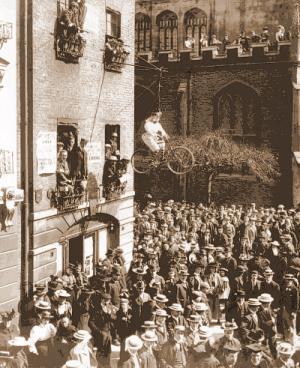


(Image: Cambridge Daily News, 21 May 1897.)

The effigy was burned later in the day, and the motion was defeated. But the ladies went on riding. They wore bloomers. They went places without being taken by a man. They started carrying toolbags.

"Let me tell you what I think about bicycling," said Susan B. Anthony, American campaigner for Votes for Women, in 1896. "It has done more to emancipate women than anything else in this world. It gives her a feeling of self-reliance and independence the moment she takes her seat; and away she goes, the picture of untrammeled womanhood. I stand and rejoice every time I see a woman on a wheel."

It was a wheel that would not be turned back. But completely "untrammelled womanhood"? Not quite. Even in a world full of "new women" there had to be some standards ... In 1895 the New York World printed a list of Don'ts for Lady Cyclists, which included the following admonitions:

Don’t be a fright.
Don’t faint on the road.
Don’t forget your toolbag
Don’t imagine everybody is looking at you.
Don’t go to church in your bicycle costume.
Don’t wear a garden party hat with bloomers.
Don’t contest the right of way with cable cars.
Don’t wear white kid gloves. Silk is the thing.
Don’t ask, “What do you think of my bloomers?”
Don’t let your golden hair be hanging down your back.
Don’t allow dear little Fido to accompany you
Don’t scratch a match on the seat of your bloomers.
Don’t discuss bloomers with every man you know.
Don’t scream if you meet a cow. If she sees you first, she will run.

Still good advice about cows, though.

Also see YS Lee's 2015 History Girls post Bikes, Bars and Bloomers for more on this fascinating subject.

Joan Lennon website

Joan Lennon Instagram

Saturday, 3 January 2015

Bikes, Bars, and Bloomers, by Y S Lee


Living in southeastern Ontario, I count on having white Christmases. To everyone’s surprise and disappointment, this year’s was warm and browny-green, so my family and I made the best of it by riding our bikes often along a waterfront path that follows the curve of Lake Ontario. I seldom spare much thought for my riding gear (apart from wearing a helmet) but in the past week, I’ve been consumed with appreciation for the women of the Rational Dress Society.

In her Bicycle Book, Bella Bathurst quotes early American feminist Susan B. Anthony as saying, in 1896, “Let me tell you what I think of bicycling. I think it has done more for the emancipation of women than anything else in the world”. As Bathurst notes, “It was a surprising claim.”

The earliest bicycles were called velocipedes. They were mass-produced from 1857, but it took a hardy and determined cyclist to appreciate the ride they offered: velocipedes were built of wood, with the later addition of metal tires. When pedalled over patchily paved roads, it’s no wonder they became known as “boneshakers”. The velocipede evolved into the penny-farthing bicycle of the 1870s, with its enormous front wheel. Gears had yet to be invented, so the big wheel enabled the cyclist to ride quickly while pedalling at a reasonable rate. It also improved the ride quality. 

Two men on pennyfarthings, California, 1866. Image via wikipedia
 However, women of the 1870s were still trapped in highly structured skirts with bustles – possibly an improvement over the huge crinoline of the 1860s, but still terribly cumbersome and constricting.

Detail from "Too Early", by Tissot. Image via wikipedia.
It’s impossible to think of athletic activity in such clothing, or even what we now consider a normal range of motion. Contrast the lines of Tissot's gowns (above) with this recent instructional video, which shows how tricky it is to mount and dismount a pennyfarthing.

 
Some women of means briefly considered the tricycle. According to Bathurst, “While out in her carriage one day at Osborne, Queen Victoria spotted a lady on a trike at a distance. Intrigued, she ordered her driver to speed up. The trike rider looked round, realised who her pursuer was, panicked and took off. Sadly, the Queen did not succumb to the temptation to give chase. Instead, she asked to meet the trike’s inventor, James Starley… [and] was pleased enough with the trike to order two. Even so, trike fever never really caught on. Not because there was anything inherently wrong with them, but because the bicycle was better.” It was only with the invention of the safety bicycle in the late 1880s that women began to embrace the machine.

A tandem tricycle, 1882. Image via the Women's History Network.
With the safety bicycle came an immediate and predictable public uproar at the spectre of ladies sitting astride a bike, revealing the existence of legs and possibly damaging the “feminine organs of matrimonial necessity” (quoted in Bathurst)! And there was the very real problem of riding whilst wearing a corset and some 20 pounds’ worth of clothing. It was at this moment that cyclists and clothing reformers found common cause.

"Ladies safety bicycle" from 1889. Image via wikipedia.
Bloomers had been worn – and ridiculed – since their invention in 1851, by the American activist Elizabeth Smith Miller. It required huge confidence to wear bloomers in public: even Amelia Bloomer, who lent her name to the garments, had given up on bloomers by 1859 in favour of undergarment reform. Despite the founding of the Rational Dress Society in 1881, the wearing of bloomers or rational dress (ample trousers overlaid with a shorter skirt) was still considered eccentric and even morally suspect. 

Woman in bloomer costume. Image via National Park Service.
For example, dress reformer and bicycle enthusiast Lady Harberton was refused service in the ladies’ lounge of the Hautboy Hotel in Surrey on the grounds that she was wearing bloomers. She was directed to the bar, where the only other women were prostitutes. When Lady Harberton sued the hotel, the jury found in favour of the landlady.

Despite such setbacks, the bicycle offered just the necessary incentive for the rational dress movement to stick. Bathurst quotes Rose Macaulay's description of the sensation of bicycling as “glorious; the nearest approach to wings permitted to man and woman here below”. Speed, independence, and the sensation of flying? In the long run, the bustle didn’t stand a chance.

Wednesday, 5 December 2012

Bicycles and Revolution by Joan Lennon


As we watch these elegant, white-clad, straight-backed ladies weave genteelly in and out, it is hard to remember that they were commiting an act of rebellion.  Snooks were being cocked.  Gauntlets flung.

At the end of the 19th century, a bicycle with a woman astride was still a disconcerting sight - a challenge to trouser-wearing men.  In Cambridge, when the question of full degrees for females was being discussed in the Senate, an effigy of a "rationally dressed" lady on a bicycle was hung out of the window of the building opposite, flanked by banners declaring “No Gowns for Girtonites” and “Varsity for Men”. 


(Image: Cambridge Daily News, 21 May 1897.)

The effigy was burned later in the day, and the motion was defeated.  But the ladies went on riding.  They wore bloomers.  They went places without being taken by a man. They started carrying toolbags. 

"Let me tell you what I think about bicycling," said Susan B. Anthony, American campaigner for Votes for Women, in 1896.  "It has done more to emancipate women than anything else in this world. It gives her a feeling of self-reliance and independence the moment she takes her seat; and away she goes, the picture of untrammeled womanhood. I stand and rejoice every time I see a woman on a wheel."

It was a wheel that would not be turned back.  But completely "untrammelled womanhood"?  Not quite.  Even in a world full of "new women" there had to be some standards ... In 1895 the New York World printed a list of Don'ts for Lady Cyclists, which included the following admonitions:
  • Don’t be a fright.
  • Don’t faint on the road.
  • Don’t forget your toolbag
  • Don’t imagine everybody is looking at you.
  • Don’t go to church in your bicycle costume.
  • Don’t wear a garden party hat with bloomers.
  • Don’t contest the right of way with cable cars.
  • Don’t wear white kid gloves. Silk is the thing.
  • Don’t ask, “What do you think of my bloomers?”
  • Don’t let your golden hair be hanging down your back.
  • Don’t allow dear little Fido to accompany you
  • Don’t scratch a match on the seat of your bloomers.
  • Don’t discuss bloomers with every man you know.
  • Don’t scream if you meet a cow. If she sees you first, she will run.
Good advice about cows, though.

Many thanks to Joan Lennon, who is one of our History Girl Reservists, for this fascinating post. You can read about her on the About Us Page.