
Showing posts with label Bella Bathurst. Show all posts

Sunday, 5 February 2017

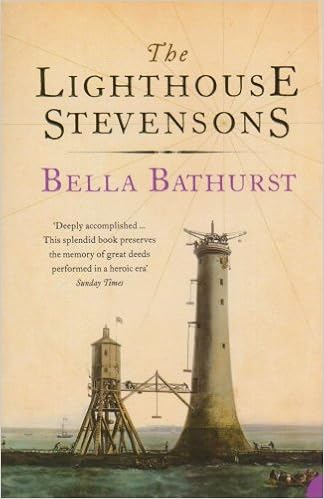
The Lighthouse Stevensons - a review by Joan Lennon


"Scotland is moated by an awkward brew of conflicting tides and currents."  Truer words were never written.  And in The Lighthouse Stevensons, Bella Bathurst tells the tale of what the Stevenson family, over four generations, decided to do about it.

"For several long centuries," she writes, "lives lost at sea were seen by much of Europe as so much natural wastage.  Accounts still exist of sailors watching slack-handed from the gunwales while one of their colleagues drowned.  Once a person had fallen overboard, so the thinking went, he had been claimed by the sea, and it was not for mankind to challenge that claim."

But challenge it the Stevensons did.  Starting with the Bell Rock, a killer reef of rock only clear of the sea at low tide but just a few feet below the waves at high tide, they began to build lighthouses.  If they didn't know how something was to be done, they experimented.  If a tool for a job didn't exist, they invented it.  Lenses and reflectors, dovetailing and cement mixtures, studies of wave patterns and how to drill through sea rock - it was all, as the family's most famous son Robert Louis Stevenson later wrote, a "field that was unexplored; the engineer must read with his own eyes the face of nature ... [and] undertake works that were at once inventions and adventures."

Chronicling the lives and works of four generations of the Stevenson family, with their penchant for re-cycling first names, was always going to be a challenge, and I found it hard to care for some members as much as for others.  But as well as the fascinating historical details of lighthouse building in the 18th and 19th centuries, Bathurst also presents an intriguing series of complicated relationships between fathers and sons (including a repeating, worrying tendency of the younger generation to commit poetry) with sympathy and insight.  The final victim to literature was Robert Louis Stevenson, who tried his best to be an engineer, and then a lawyer, before the ultimate rebellion into writing.  But he never rated himself against the achievements of his fore-fathers.  "Whenever I smell salt water," he wrote in 1880, "I know that I am not far from one of the works of my ancestors."  And in 1886, "all the sea lights in Scotland are signed with our name ... I might write books till 1900 and not serve humanity so well; and it moves me to a certain impatience, to see the little, frothy bubble that attends the author his son, and compare it to the obscurity in which that better man finds his reward."

Bella Bathurst has done an excellent job of lighting that obscurity.    
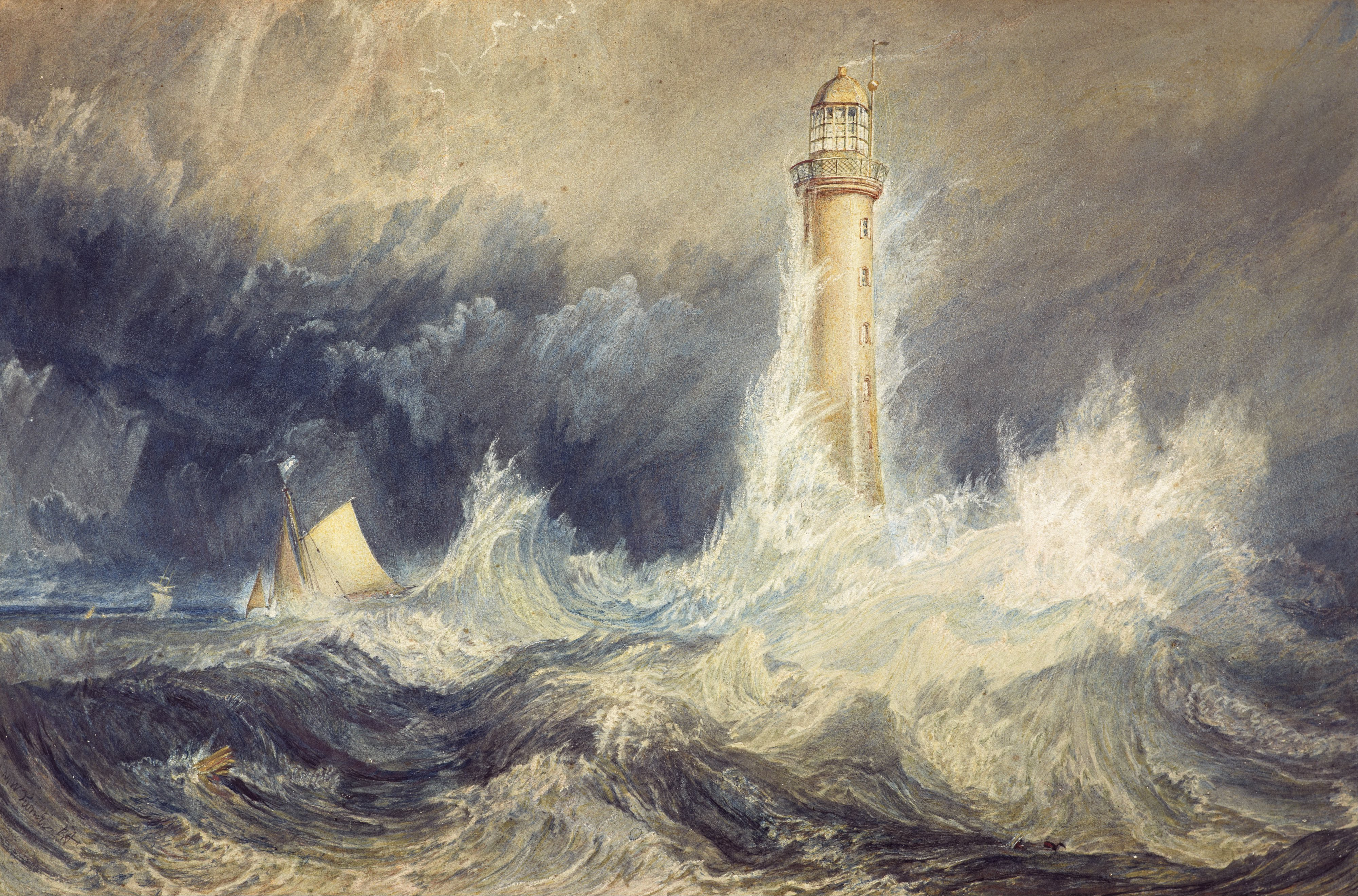


J.M.W. Turner's Bell Rock Lighthouse (1819)

I was keen on lighthouses before I read this book.  Now you can forget keen.  Obsessed is much more the word.  Have a read of Bella Bathurst's The Lighthouse Stevensons, and you may very well join me.


P.S.  I don't always notice the newest books.  And The Lighthouse Stevensons has been around since 1999, so hardly hot off the griddle.  But that had no effect on the enjoyment! 

P.P.S. The 1823 instructions for the Bell Rock Light-keepers also makes for interesting reading, and you can have a look at it here.

P.P.P.S. And if you fancy a little youtube experience of lighthouses and big waves, try here. Ever so slightly heart-stoppingly magnificent, wouldn't you say?


Joan Lennon's website.
Joan Lennon's blog.
Silver Skin.

Saturday, 3 January 2015

Bikes, Bars, and Bloomers, by Y S Lee


Living in southeastern Ontario, I count on having white Christmases. To everyone’s surprise and disappointment, this year’s was warm and browny-green, so my family and I made the best of it by riding our bikes often along a waterfront path that follows the curve of Lake Ontario. I seldom spare much thought for my riding gear (apart from wearing a helmet) but in the past week, I’ve been consumed with appreciation for the women of the Rational Dress Society.

In her Bicycle Book, Bella Bathurst quotes early American feminist Susan B. Anthony as saying, in 1896, “Let me tell you what I think of bicycling. I think it has done more for the emancipation of women than anything else in the world”. As Bathurst notes, “It was a surprising claim.”

The earliest bicycles were called velocipedes. They were mass-produced from 1857, but it took a hardy and determined cyclist to appreciate the ride they offered: velocipedes were built of wood, with the later addition of metal tires. When pedalled over patchily paved roads, it’s no wonder they became known as “boneshakers”. The velocipede evolved into the penny-farthing bicycle of the 1870s, with its enormous front wheel. Gears had yet to be invented, so the big wheel enabled the cyclist to ride quickly while pedalling at a reasonable rate. It also improved the ride quality. 

Two men on pennyfarthings, California, 1866. Image via wikipedia
 However, women of the 1870s were still trapped in highly structured skirts with bustles – possibly an improvement over the huge crinoline of the 1860s, but still terribly cumbersome and constricting.

Detail from "Too Early", by Tissot. Image via wikipedia.
It’s impossible to think of athletic activity in such clothing, or even what we now consider a normal range of motion. Contrast the lines of Tissot's gowns (above) with this recent instructional video, which shows how tricky it is to mount and dismount a pennyfarthing.

 
Some women of means briefly considered the tricycle. According to Bathurst, “While out in her carriage one day at Osborne, Queen Victoria spotted a lady on a trike at a distance. Intrigued, she ordered her driver to speed up. The trike rider looked round, realised who her pursuer was, panicked and took off. Sadly, the Queen did not succumb to the temptation to give chase. Instead, she asked to meet the trike’s inventor, James Starley… [and] was pleased enough with the trike to order two. Even so, trike fever never really caught on. Not because there was anything inherently wrong with them, but because the bicycle was better.” It was only with the invention of the safety bicycle in the late 1880s that women began to embrace the machine.

A tandem tricycle, 1882. Image via the Women's History Network.
With the safety bicycle came an immediate and predictable public uproar at the spectre of ladies sitting astride a bike, revealing the existence of legs and possibly damaging the “feminine organs of matrimonial necessity” (quoted in Bathurst)! And there was the very real problem of riding whilst wearing a corset and some 20 pounds’ worth of clothing. It was at this moment that cyclists and clothing reformers found common cause.

"Ladies safety bicycle" from 1889. Image via wikipedia.
Bloomers had been worn – and ridiculed – since their invention in 1851, by the American activist Elizabeth Smith Miller. It required huge confidence to wear bloomers in public: even Amelia Bloomer, who lent her name to the garments, had given up on bloomers by 1859 in favour of undergarment reform. Despite the founding of the Rational Dress Society in 1881, the wearing of bloomers or rational dress (ample trousers overlaid with a shorter skirt) was still considered eccentric and even morally suspect. 

Woman in bloomer costume. Image via National Park Service.
For example, dress reformer and bicycle enthusiast Lady Harberton was refused service in the ladies’ lounge of the Hautboy Hotel in Surrey on the grounds that she was wearing bloomers. She was directed to the bar, where the only other women were prostitutes. When Lady Harberton sued the hotel, the jury found in favour of the landlady.

Despite such setbacks, the bicycle offered just the necessary incentive for the rational dress movement to stick. Bathurst quotes Rose Macaulay's description of the sensation of bicycling as “glorious; the nearest approach to wings permitted to man and woman here below”. Speed, independence, and the sensation of flying? In the long run, the bustle didn’t stand a chance.