Showing posts with label slang. Show all posts

Tuesday, 10 May 2016

Doing the salami and swallowing the toad - Michelle Lovric


Every language is most alive in its idioms, and none more so than Italian, where everyday expressions are rich in colourful metaphor and hilarious visual images. Most of my novels are populated by Italian characters whom I write in English. All of us writing in this way face the same problem: how to convey the perfume of Italian-ness without silly pastiche. Similarly, when I write Irish characters, I have to rein in the 'Hong-Kong Paddy' of begorrahs and their kin and look for something deeper: the rhythm, the redundancy, the exaggeration that lends Irish English its charm.

With my Venetian protagonists, one of my tricks is to use Italian expressions literally translated into English, so that it makes sense, but hovers in the outlying region of sense ... that debatable land where you often find the poetry.

Below are some examples of the kind of expression that I like to use to show that my English-speaking Italian  characters are not at all English.

The expressions are shown in the original Italian and then in literal English translation, with an explanation of the actual meaning or the English equivalent expression underneath. The middle line is the one my characters use.


Sono contento/a come una Pasqua.
I am happy as an Easter.
I’m happy as can be.

Dormo tra due guanciali.
I sleep between two pillows.
I’ve got no worries.

Ho un culo bestiale!
I’ve got a beastly ass!
I’m a lucky guy!

Sono andato/a in brodo di giuggiole.
I went into the Jujube soup.
I went into raptures.

Mi sono mangiato il fegato.
I ate my own liver.
I kicked myself.


Fa venire il latte alle ginocchia.
He'll makes milk come out of your knee.
He’s a real bore.

Spirito di patata.
The spirit of a potato.
No sense of humour.

Vende solo fumo..
He’s/She’s only selling smoke.
He’s/She’s talking big.

Sono incavolato/a …
I have thrown myself in the cabbages …
I’ve really lost it …

Io me ne faccio un baffo!
I don’t do a whisker!
I don’t give a damn!

Sei un bugiardo della Madonna.
You could lie for the Madonna.
You are one hell of a liar.

Non fare il salame!
Don’t do the salami!
Don’t act like an idiot!

Non ha sale in zucca.
He doesn’t have salt in the pumpkin.
He’s not very intelligent.

Sei uno scarpone.
You are a big shoe.
You are a dead loss.

Ti salta subito la mosca al naso.
The fly really jumps out of your nose
You have a quick temper.


Fai di ogni mosca un elefante.
You make an elephant out of every fly.
Your make mountains out of molehills.

Ho una bella cotta per quella ragazza.
I have a beautiful cooked thing for that girl.
I have a crush on that girl.

Ho una scuffia per lui.
I’ve capsized over him
I’ve really fallen for him.

Lui mi fa sangue.
He makes blood in me.
He turns me on.

Voglio fare l’amore in tutte le salse.
I want to make love in all the sauces.
I want to make love every which way.

Sei come il cacio sui maccheroni.
You are the cheese on the macaroni.
You are the cat’s whiskers.


Faceva la santarellina
She did the little saint.
Butter wouldn’t melt in her mouth.

Mi mordo le mani.
I bite my own hands.
I’m really sorry.

Non so più a che santo votarmi.
I don’t know which saint to pray to.
I don’t know which way to turn.

Ha mangiato la foglia.
He has eaten the leaf.
He’s onto us.

Lui mi ha preso in castagna.
He’s got me in the chestnut.
He caught me in the act.

Vado a lume di naso.
I am going by the light of my nose.
I’m hanging on by the seat of my pants


Doveva essere un spettacolo bello,
ma eravano solo quattro gatti.
It was supposed to be a great show,
but there were only four cats there.

It was supposed to be great show. but only a few people showed up
 
Mi sono cacciato in un ginepraio.
I have thrown myself in a juniper bush.
I’m really in a fix.


E costato troppo poco; deve essere farina del diavolo.
It cost too little. It must be the flour of the devil.
It didn’t cost enough: it must be stolen goods.

Sono rimasto con un pugno di mosche.
I was left with a blow-fly’s punch in the nose.
I was left empty-handed.

The images on this blog come from spreads I designed with Lisa Pentreath and Ornella Tarantola as a book proposal. We thought that visual aids would help settle the expressions into the brain. We all got too busy doing other things, which was a shame.

Here were the alternative covers


I am sure other History Girls and visitors to this site have similar useful expressions from other languages they speak and write. Do share!

Michelle Lovric's website


Tuesday, 6 October 2015

The Slang Trap by Lydia Syson


What a terrible temptation for the historical novelist they are, those dictionaries of slang, enticing you seductively into worlds of rattling mumpers and snappish slubber-degullions. Hundreds have appeared over the centuries, rich mines of the most exhilarating treasures, the fantastic vocabulary of vagabonds and whores, sailors and thieves, mollies and swagmen, the language of canting crew and flashmen all there for the prigging. Sparkling lexical diamonds leap off the page at you, claiming vim and authenticity, begging to be borrowed. Surely they’re the salt and pepper of dialogue? Where else can we better hear the vulgar tongues of times past calling us loud and true? How endlessly beguiling they are. . .books like Hobson-Jobson (beloved of Rushdie, Stoppard and, surely, Amitav Ghosh) and the works of Francis Grose and Pierce Egan, which echo through the Newgate Novelists of the 1830s and straight into the gutter-speech of Joan Aiken’s Dido Twite.


Pierce Egan, Real Life in London, Vol 1 (1821)
University of Leicester, Special Collections 

If only it were that easy. Last week, I was in pursuit of an actual copy of Passing English of the Victorian, a Dictionary of Heterodox English, Slang and Phrase. I’d already found it at the Internet Archive, but intrigued by the wealth of sources – D. cls (Dangerous Classes), Mus. Hall (Music Hall), Society, Stock Exchange, Theatrical … I hoped, if possible, to flick through paper rather than digital pages. The very first entry is A.D., an abreviation which you might once have found on a ballroom programme. It means ‘A Drink’, but one young lady, looking flirtatiously over a potential partner’s shoulder, could easily imagine that he is already engaged to another for that particular waltz. Towards the end of the same dictionary comes ‘Word-mongering’ – an expression apparently used by the press in 1878 ‘in critical scorn’ signifying ‘redundancy of description’. A danger indeed. Nothing in this particular dictionary is remotely relevant to the book I’m working on right now, and there was no ‘hard copy’ to be found there, but still the Philology, Slang shelves of the London Library had me hooked. 


From amongst dictionaries of Polari, Austral English, seafaring speak, Robert Graves’ essay on the future of swearing and a hilarious reprint of a genuine phrasebook of English as she is spoke, a sort of 19th century version of Google Translate compiled by a Portuguese educational entrepreneur who was clearly translating literally from French, I pulled out Julie Coleman’s magisterial A History of Cant and Slang Dictionaries (OUP). The scales – of course – fell from my eyes.


‘‘The history of British cant and slang lexicography is long and frequently disreputable…Literary critics and historians seize upon them for background information, often without reference to the unreliability of their contents. Playwrights, poets, novelists, and film-makers turn to them for lively contemporary or period dialogue, equally unsuspecting that the word-lists might not be all they seem,” writes Coleman. Over four fascinating volumes, she teases out the knots in this ‘tangled tradition’, exposing the cheats and pilferers of the world of lexicography, rapping the knuckles of the undisciplined and unscholarly, and those who fail to take sufficient account of the complex social contexts in which real language presents itself.

Caveats abound. The father of canting lexicography turns out to be a man called Thomas Harman, who published a short glossary of beggars’ language in 1567 called Caveat or Warening for Common Cursetors: “Here I set before the good reader the lewd, lousy language of these loitering lusks and lazy lorels, wherewith they buy and sell the common people as they pass through the country.”  His plan was to rid the land of its undeserving poor by exposing the tricks and disguises of England’s rogues and beggars. 
John Camden Hotten's Dictionary of Modern Slang, Cant and Vulgar Words
 goes one better and offers a map of cant symbols. His publishing house became Chatto and Windus.

Through the seventeenth and eighteenth centuries glossaries, word-lists, and catalogues of slang from cant to flash multiplied. Their authors seemed to prig from each other as much as they did from the streets, back-alleys and gambling dens. By the mid-nineteenth century, Coleman finds attitudes had changed: ‘No longer menacing and thrilling glimpses of an exciting underworld, slang terms were just the vulgar, obscene, and profane effusions of the uneducated. They might provide a brief diversion, but those who sought respectability should steer clear of their contaminating influence.’ Later word-collectors betray a sense that they're recording an unwritten language just before it dies, or trying to preserve a time rather more adventurous and colourful than the present. Volume 3 covers 1859-1936, finishing just before the publication of Eric Partridge’s game-changing Dictionary of Slang and Unconventional English. Gems of this era include collections of American jazz-jargon from the ‘30s (The ‘Slanguage’ of Swing-terms the ‘Cats’ Use), Jewellery Auction Jargon from the 20s* and Die MƤnnliche HomosexualitƤt in England (1910) by Leo Pavia, the German translator of Oscar Wilde.  As Coleman points out, you can see who and what was deemed interesting and worth recording at any cultural moment: there’s glamour and romance in gangsters, hoboes, first world war soldiers and even college boys, but was anyone taking note of the slang of schoolgirls or shift-workers or indeed insurance salesmen? 

I'm warier now, though also more addicted. What writer doesn't love encountering new words, and I've always been a sucker for the mystique of specialism - even chandlery shops excite me.  When I was writing That Burning Summer  I thoroughly enjoyed discovering exactly the right RAF slang a Polish pilot would have had to learn during the Battle of Britain (not to mention the fact that all the controls on British fighter planes were on the opposite side to Polish ones). And of course I'm all for accuracy and authenticity. But as a reader, if I start feeling an author has swallowed a (slang) dictionary, I'm quickly alienated. It's a very fine balance.  After this philological day, I went to the National Theatre’s new production of Our Country’s Good, a play I’d been wanting to see for several decades. Its themes remain horribly, depressingly relevant. One character, the erudite British Jew John Wisehammer convincingly loves (respectable) words with a passion, having learned them from his father’s dictionary (though only A-L). Liz Morden’s monologue accounting for her descent into crime sounds plucked from the pages of any lexicon of the canting crew. The effect is more flattening than vivifying. Historical novelists, beware.


*Here's a sample of its obscurity: “Prat-the-shill – a verb phrase, giving an order to ‘shillabers’ to step to the rear of the ‘come-ons’. Its meaning is different from its connotation.” Baffling. 


Monday, 9 September 2013

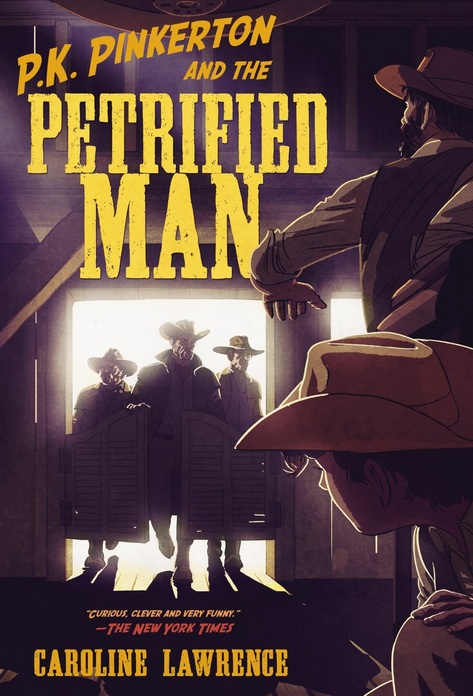
Tips for Writing Dialogue by Caroline Lawrence

AKA The Case of the Good-looking Corpse
In real life, dialogue is usually pretty dull. But we novelists need to learn to write dialogue that sounds real but is interesting. Why?

• Dialogue identifies a character.
• Dialogue reveals motives and desires.
• Dialogue helps exposition.
• Dialogue breaks up blocks of text.
• Dialogue can provide comic relief.

Ideally, your most important characters should have such a unique voice that the reader can tell who is speaking solely by length of sentence, choice of vocabulary and various verbal ticks.

I’m a visual person so my ear for dialogue is not as good as some writers’. For this reason, I’ve made a special effort to pick up tips and advice. Over the years, I have compiled a checklist of things to keep in mind I write dialogue. I often refer to these once I’ve written my first draft and apply them in subsequent passes. Here are twenty in no particular order:

1. Period slang. When writing historical fiction, have characters use a few period words or slang phrases that immediately tell your reader where and when you are.
‘You dam scalawag. That stung where you shot me.’

2. Have characters interrupt each other. In real life we don’t always wait for the other person to stop talking.

3. Answer a question with a question. The response can either imply the answer or be used as avoidance. (Or occasionally indicate that the speaker is Jewish.)
‘You want your ma should look like a saloon girl?’

4. Accents. These can be suggested with words and word order.
‘Sure and it’s a bold notion. But have you ever worn a corset at all?’
           
5. Have your character’s dialogue reveal his attitude towards the person he is talking to. For example, a woman would speak differently to her lover than to her arch-enemy.
‘Don’t be angry, Jacey,’ she spoke in a pouty little-girl voice. ‘I only wanted to spend time with you.’

6. Two paths. In a dialogue, character A often ignores character B and vice versa as they talk pursue their own agendas. Sometimes these dialogue paths converge and diverge several times in the course of a scene.

7. Jargon. A character’s vocabulary will often provide clues about their profession or obsessions.
‘Me and my pard Frenchy had a nice little claim in Flowery Canyon. Then a passel of Frisco Fat Cats came and ruined us.’

8. Left-field. A response might seem irrelevant, surprising or unconventional. But this might be a clue about the responder’s preoccupation or mental state.
           
9. Chop-chop! Some characters might chop words off the beginning of sentences and other characters might tail off without finishing a thought.
‘You had dinner?’

10. Good grammar/bad grammar. An extremely useful way to show a character’s education and even social status.
‘They called him that because they don’t know no better. Cheeya be his real name.’

11. Delayed gratification. Character A asks a question and B talks about other things before answering A’s question.

12. Self-adjustment. A character starts, then stops and tries a new approach. We do this all the time in real life.

13. Profanity. From ‘Gee whiz!’ to the worst four-letter words, each character will have their own pet swear words. And if you’re writing historical fiction these can be period slang.
‘Dang my buttons,’ said Mr. Sam Clemens. ‘I do believe I am lousy.’

14. Me, me, me. Some characters are so self-obsessed that everything they say concerns them.

15. Displacement. Character A might express anger, affection, passion towards Character B because they are afraid to directly address Character C.

16. Subtext. A character’s choice of words often reveals what s/he is feeling below surface.

17. Freudian slips. We all do it: find ourselves saying something we didn’t mean to say. This is a great way of revealing hidden motives and desires.

18. Actions. Non-verbal reactions can be a form of dialogue, if a character drops an object, faints or bursts out laughing in response to a statement or question.
‘Jace will never marry you,’ I said.
She blew out smoke, hard & down. 

19.  Silence. The lack of response in dialogue can sometimes be as powerful as any word spoken or shouted.
Violetta narrowed her eyes at me. ‘What is Jace to you anyway?’
I did not reply.


20. Hodor. Sometimes even a single word can carry a world of meaning. In my current work in progress, The Case of the Bogus Detective, I have one character speak another’s name three times but with three different facial expressions.

P.K. Pinkerton's 3rd detective case is set in Carson City, Nevada Territory in early 1863

The Case of the Pistol-packing Widows is out now in the UK and  the USA.