Tuesday, 4 April 2017

Personal Names in Historical Fiction - Katherine Langrish


'Fair Rosamund' by John William Waterhouse

Here, in the imagination of John Waterhouse, is the Fair Rosamund, leaning out of a rose-bedecked tower window, longing for her lover King Henry II while her cruel rival and soon-to-be-murderer Queen Eleanor peers at her from behind the arras. Most of this is pure fiction. The reason I'm depicting her here is that back in the 12th century 'Rosamund' was an extremely unusual given name. It was possibly unique to this particular woman and was rare throughout the entire medieval period, probably because rosa munda (pure rose) and rosa mundi (rose of the world) were epithets reserved for the Virgin Mary.

One of my pet bug-bears about historical novels set in ‘medieval times' is when authors call their characters by names which are unhistorical for the century in which the story is set: after all, the term 'medieval' covers about half of a millenium during which an awful lot of changes in fashion occurred. Fantasies (I'm sorry to say) are some of the worst offenders, perhaps because a vague medieval ambiance is all the author really wants. This is fine if the story is set in some fantasy-land or fairyland in which dragons dwell, where wicked knights in black plate-armour inhabit grim stone castles at one end of the village, fair damsels live in rose-smothered cottages at the other, honest peasants toil in the fields somewhere in the middle, and the whole is surrounded by darksome woods. But – but! – if you start telling me the wicked knights are Normans and the peasants and the heroine are Saxons, and if you set the story ‘just after the Norman Conquest’, then I feel you, the author, ought to get a grip and do your best to present me with a reasonably accurate picture of the time.

The period of active Saxon rebellion against the Norman invaders lasted till about 1070: after that, any widespread popular resentment, if indeed it existed, was probably short-lived. True, the Normans displaced or eliminated most of the Saxon nobility, but for the peasants, free or unfree, life did not change very much. So in a novel set during the century after 1066, the wicked knight will be wearing chain-mail, not plate armour. Unless he is very important indeed he will live not in a stone castle but in a wooden fort on a mound surrounded by a stockade (as the Montgomery lords did at Hen Gomen, not building their stone castle until 1223). And though the peasants will certainly still be toiling in the fields, the fair damsel’s cottage will have no red roses around the door, since cultivated roses would have been a hugely expensive rarity. Moreover, if she’s a Saxon she ought to be called something like Aelfthryth or Eadburh or Edith – not Mary or Alison, names which won't appear for about another two hundred years. If the heroine is a Norman lady you may name her Rose so long as you spell it Roheis, Rothais or Roesia: but be aware that after the 12th century the name goes out of use for about seven hundred years. 

Here, for the benefit of all of us, is a masterclass from Lord Raglan (1885-1964) in nomenclature for the early medieval period. “Let us start with the Saxons,” he begins,

and note without surprise that they were called by Saxon names. Examples of such names may be found in any history – Godwin, Stigand, Siward, Leofric.  The Saxons were not called William, Walter or Robert, because these were Norman-French names which were introduced into England by the Normans. A pre-Conquest Saxon would be no more likely to be called by a Norman-French name than a modern Englishman to be called Marcel or Gaston.

So much for the Christian names of the Saxons; now to surnames. The Saxons had no surnames. A Godric might be referred to as ‘the timberer’ or ‘the son of Guthlac’, but these were not his names; whether he was earl or churl he had one name, and one name only. This single name was never a place name. Like the Scandinavians, Irish and Welsh, the Saxons never used place-names as personal names. It is clear then that when a Saxon ‘ancestor’ is claimed to have been called Bertram Ashburnham or William Pewse, he must be a fake, since no Saxon was ever called Bertram or Ashburnham or William or Pewse. 

The case of the Normans is different. During their residence in France the Normans had almost completely dropped their Norse names, and had adopted such Frankish names as Richard, Hugh and Baldwin. William [the Conqueror’s] army contained many Frenchmen and Flemings, as well as Normans, but their names were much the same. There was also a contingent of Bretons, who had some names of their own. Of these, Alan was the commonest, though the ancestor of the FitzAlans ... did not come over till the next century. 

In that century [the 12th] a few Biblical names began to creep in, probably under the influence of the Crusades [the First Crusade began in 1095]; previously such names as John and Thomas are not found among either Normans or Saxons.

Unlike the Saxons, the Normans had surnames, but before about 1150 these were personal and not hereditary. William, son of Hugh and lord of Dinard, would be called William FitzHugh and William de Dinard, or both. His son would be called Richard FitzWilliam, and would be called Richard de Dinard only if he owned it. If we find Robert de Dinard succeeding Richard de Dinard, it by no means follows that they were relatives; Richard might have sold, or died without heirs, or been dispossessed.

About 1400 place-names began to be borne as surnames without ‘de’ or ‘of’ before them, and it was then, and not till then, that it became possible for men to be called Bertram Ashburnham or William Pewse. 

From ‘The Hero’ by Lord Raglam, 1936, Ch 2

And what about women? Well, ‘the most popular names’ for the 12th century look quite unusual to us now. They include (see this list) Edith, Aethelflaete, Alfgyth, Burwenna, Botilda, Annora, Rikilda, Cecily, Godeva, Ingrid... all much more common than ‘Rosamond’ or ‘Rosmunda’ which turns up only three times between 1206 and 1282. Of course there were unusual names in every century. I really adore the wonderful Dayluue or ‘Daylove’ [OE *Dæglufu], which also turns up three times.

In the 13th century (see here) Matilda comes top of the list, followed by Alice, Agnes or Agneta, Edith, Emma, Margaret, Mabel, Alviva, Isabella or Ysabel, Christiana and Juliana. Most of these are still common in the 14th and 15th centuries, but Joan or Johana now joins the list, as do Katherine and Elizabeth. 

By the 16th century (see here) Elizabeth seems most popular, along – in diminishing order – with Margaret, Jane, Agnes, Isabel, Anne, Alice, Katherine, Jennet, Elinor, Margery, Mary, Dorothy, Ellen, Barbara and Susanna. 
 
Returning briefly to the Fair Rosamund: she was born circa 1148 at Clifford Castle in Herefordshire, became Henry II's mistress probably around 1166, and died in 1176, not yet thirty. Her wikipedia entry calls her Rosamond Clifford, but as Raglan points out, that wouldn't have been how she was known during her life. She was Rosamund, daughter of Walter FitzRichard (aka Walter de Clifford). Her mother was Margaret. And she had two sisters, Lucy and Amice. 

Rosamund, Lucy and Amice: Pure Rose, Light, and Friendship... I wonder which parent it was who chose such fancy names for their three beautiful daughters? 


Picture credits

Fair Rosamund by Waterhouse, Wikimedia Commons 
Fair Rosamund by Dante Gabriel  Rossetti, Wikimedia Commons

Monday, 3 April 2017

Naming by Debra Daley

I’ve only ever bestowed names on two actual human beings (my children), but as a fiction writer I am obliged to name hosts of characters – and sometimes it can be tricky. Historical fiction requires you to invent names that are appropriate to their times and location as well as those that reflect something of a character’s identity, but for me there are other conditioning factors. I feel I can’t use names that belong to friends and family. Even if I think it unlikely that Uncle Anton is going to read anything I’ve written, I want to forestall even the possibility of his eye falling on a page penned by me, which features “a sinister-looking thug, in spite of his age and receded hairline. Anton, I learned, was his name”. If I were writing a Japanese character, I would love to endow her with what I consider to be one of the most romantic given names I’ve come across – Chikage, which means One Thousand Shadows. But, this name belongs to a longtime friend in Japan and I couldn’t possibly appropriate it.

Names can be quite the minefield. I don't like to give characters names that are currently popular in print or on screen. Or names with ambiguous pronunciation, like Featherstonehaugh/Fanshaw, Beaulieu/Bewley, Ralph/Rafe – or names that stray into Pychonesque absurdity, like Mike Fallopian and Herbert Stencil. They have to look and sound and be right by belonging to their correct region or rank – but I would like to write a character someday with a statement name, like El Elegante or La Païva (the 19th-century celebrity prostitute) or a clan title like The O’Neill.

I’m no expert on anthroponomastics (which, as I’m sure every Jon, Rick and Barry knows, means the study of names of persons), but I’ve always been fascinated by personal names. From an early age, I would list in a notebook striking names carried by real people I encountered. Xeno Captain, Dr Hazard, Pam Pumphrey, I remember you still. And how could I forget the rejection letter I once received that began, Dear Miss Dalek? There is no end either to the list or to my delight in it. Probably the first name that I found listworthy was one that belonged to a girl in my street, with whom I became friendly. She was called Teeny Bus. Actually, she had another name, a proper Dutch name, but “Teeny Bus” was the alternative her immigrant parents had come up with, believing it to sound more Anglo.

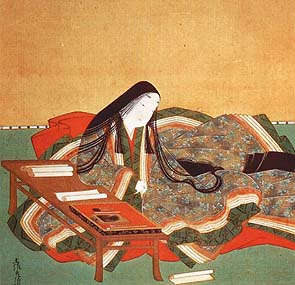
A convent education caused me to be early intrigued by the concept of hidden names. We were terribly curious about the nuns and speculated about their unknown birth names. Wild rumours passed through the corridors. Sister Ignatius was really called Maureen – and someone else heard from a relative in Rotorua that Sister Zita, who was Maori, was once named Hinemoa. Oh, the mystery of it. But I properly came across naming taboos when I read the Japanese masterpiece Tale of Genji, written by Lady Murasaki early in the eleventh century. The characters in this proto-novel are referred to by their functions or attributes (The Lady of the Paulownia-Courtyard Chamber, the Minister of the Left). To mention a person’s given name explicitly was disrespectful and a breach of Heian-era court manners.

 Tosa Mitsuki, Murasaki Shikibu writing, from his series The Tale of Genji 17th century.

 This cultural taboo had migrated to Japan from China, where speaking or writing the given names of exalted persons, or of the deceased, was a severe transgression. Historically in China, given names consisted of a family name, a first name (or “true name”) and a familiar name/nickname. Calling a man by his true name was considered insolent, at the very least, unless you were his parent, lord or sovereign, and fatal when it came to the true name of the emperor. The taboo against using the emperor’s given name, and those of his ancestors, was proscribed by law, with a death penalty attached. There was a work-around for the bothersome business of the emperor’s name, though. You were permitted to write it, only in some laudatory context, of course, as long as you omitted the last stroke of its characters. That little swoosh of the brush made all the difference between life and death – as an unfortunate scholar named Wang Xihou discovered in 1777.

The Qianlong Emperor (1711-1799). His deadly given name was Aisin Giro Hongli.

 The 18th-century Qianlong Emperor of the Qing dynasty was inclined to genocides (Tibet, Mongolia) and literary inquistions. When his inquisitors came calling on suspect intellectuals, they left no inkstone unturned, no scroll unrolled. The Emperor’s literary police were nothing if not thorough. Every text in the house was scrutinised sentence by sentence. Wang Xihou was found to have criticised the content of a dictionary authorised by the Qianlong Emperor’s grandfather. More heinous still, the scholar had written the emperor’s name without leaving off the characters’ final strokes. As punishment for this insult to the imperial name, Wang Xihou was beheaded, along with all of his relatives in a ghastly guilt-by-association judgment.

A secret name is difficult enough, but when a multiplicity of monikers attaches to an individual, historical research can become complicated and, frankly, maddening. Take the custom which allows artists and artisans in Japan to possess numerous names for different purposes – the 19th-century netsuke master Kokusai, for example, was born Ozaki Sōzō in Edo (Tōkyō) and also went by the name Iseya Risuke. He took the art name Kokusai, although occasionally signing himself Takeda Kokusai, Takeda Minamoto and Takeda Yasugorō – suggesting a connection with the 16th-century lord Takeda Shingen of the Minamoto lineage. He also styled himself as Iseya Sōzō. And finally, after his death (from eating a toxic puffer fish), he came in receipt of one last name, Hōjuin Reitoku Nichiyū Shinshi, in the traditional Buddhist naming ceremony that is a part of Japanese funeral rites.

Yagō, meaning “house name” is the term for names passed down within a Japanese guild or studio. Kabuki actors famously are known by their guild names. Onoe Kikugorō V, one of the most celebrated actors of the Meiji period, bore the guild name of Otowaya. He was at various times, and in different contexts, also known as Ichimura Kakitsu IV, Ichimura Uzaemon XIII,  Ichimura Kurōemon, Onoe Baikō V and Onoe Kurōemon I, and used Baikō and Kakitsu as his poetry names. (I don't have a poetry name, but my mood name is definitely Summer Cloud.) 

Multi-named kabuki actor Onoe Kikugorō V.
I apply a version of house names to my characters too, in the interim, employing terms like Heroine, Boss, Benefactor, Informer and Victim. Like Apache children, and children of the Warlpiri people in central Australia, who go unnamed from birth until judged strong enough to survive (usually at around two or three years of age), my characters remain nameless until I have done the hard work of dredging the psyche and figuring out who they are. Unfortunately for them, there is no naming ceremony overseen by a wise elder – there’s just me stalking around the house saying the names over and again in my head until I feel they are alive.  


Sunday, 2 April 2017

Denying the doldrums through history, food, and favourite cookbooks - by Gillian Polack


I’m having a bad day. Not a day when big things go wrong and the world is a walking disaster. Just one of the those days that don’t feel quite right. 

Normally, to fix bad days, I cook. I can’t do that today, because I’ve had a lot of bad days recently, and my refrigerator is full. If anyone wants mango pasta with berry sauce, or homemade bread or a number of other delectable foodstuffs, I’m your person. However, I still have a way out of the badness of the day. You’re going to help me: I’m going to introduce you two a couple of historical (food-related) books. It would cheer me up even more if we talked about historical food in the comments!


Nicholas Stavroulakis’ The Cookbook of the Jews of Greece is one of the best cookbooks I own. So many amazing recipes. So much history. What interests me today is the history, for the recipes are among those I cooked last week.

The Jews of Greece have a complex and fascinating past. Thre is not one simple Jewish culture or group in Greece, but several, so they don’t have just one cuisine. Stravroulakis gives us recipes from Jews who come from the Greece of Classical times, and from later Sephardi arrivals. Just the two. The Sephardi dishes aren’t the same (although there are overlaps) as Sephardi dishes from elsewhere. And the Romaniot (the ancient Jews of Greec) are purely Greek in their cooking, but Jewish. Some of the names of recipes are in Ladino (a cousin of Spanish) and others are in in Greek. And they’re all related to the Jewish dishes I have from my very different set of backgrounds. 

Every now and again I open the book at random and cook from it, because cooking from it gives me more of the history and reminds me of the people. Each dish contains history. 

I was going to talk about one or two recipes with you, but they’re all so lovely. I think I shall make this the type of food I eat for Passover this year. I have no Greek ancestry, but I’m an 1/8 Sephardi, so that will do. Either way, I shall celebrate one of the finest cuisines I’ve encountered.

Passover is an eight day festival that has very specific cooking. No observant Jews eat leavening, Askenazis don’t eat some legumes. It can be complicated. Just for today (for Passover is over a week away) I shall skip the complications and head straight for the special recipes for the festival itself. My family has a chicken soup, and something we call “matzah brie” (its name doesn’t rhyme with the name of the cheese) and we eat a lot of pickles. This is very much the Australian version of Eastern and Central European Jewish food.

This year I shall be adding haminados (an egg dish) to that, along with a chicken soup and bourekia, both made without leavening. 

This cookbook also gives some of the history of the festival. Stravroulakis talks about the picnic that Greek Jews have on the last day of the festival, for instance, and the ovens some localities had that were specifically used for the unleavened bread we eat throughout the eight days. 

History and food are so tightly linked that it’s impossible to separate them. The world likes to assume that Jewish history is simple and that Jews are all the same. Our food reminds us that the world is wrong. We eat our favourite foods to keep our identities straight. We’ve done this for a very long time, so it helps keep our history straight, too. This is one of the critical reasons why food and history are so tightly linked. It’s also a reason why concentration camp victims sometime wrote cookbooks while being starved. We can retain joy in our food-culture even when there is no joy left in the world.

This is my theory, anyhow. Stravroulakis supports my theory (without knowing it) by giving five recipes for charoset. Charoest is a symbolic dish – it’s to remind Jews of the mortar used when we were forced to build for others in Ancient Egypt. It’s the history and the food tightly bound
Add different recipes for different regions and groups within the region and even families, and it’s possible to explain how Jewish cultural integrity works, historically, just by eating. The Greek charoseth recipes have dates and raisins and currants. My family’s recipe has almonds and apple and cinnamon. All our recipes have wine.


The other cookbook is the polar opposite in history terms. It’s someone saying “Look at me!” Not “We shall remember who we are and celebrate survival” but “I am important enough to write my own cookbook.”

I don’t use this volume very often, but I look at it a lot. It reminds me that some people are shiny and get a lot of attention in their time, but are forgotten very soon after. In this case, Mrs Mary Eales is remembered only through her cookbook. 

Eales claims in her book that she was the confectioner to Queen Anne. Shiny. Someone who pushed her own importance during her lifetime and was probably given great respect for it, but whose star waned and who is now largely forgotten. This is important to me now because of the number of people who push and say “Look how important I am.”

We can judge Eales by her recipes and her cuisine. We no longer get the glamour. Some historical figures retain glamour – Richard I, for instance, or Madame de Pompadour. In everyday life, these aren’t the people we would think are shiny if we were around them. They wouldn’t move in our circles, or even at the edge of our circles. We’d focus on those closer to home and talk about how special they are. Some of them would genuinely be special and some of them would be hollow with only the shine making them worthy of attention. 

The fact that Eales wrote down her recipes and that someone published them after her death means that she was one of these shiny people. Not so many people published in the early eighteenth century, so this small cookbook says a lot about how she was seen. It enabled her to continue to be seen, too, for the book was published and republished, and republished again. Mrs Mary Eales was very shiny for a while. This is certain. Her shine faded later in the century and her book went out of print. 

The book is a careful listing of the types of sweets one can make with a set range of ingredients. The recipes are mostly not very original. They’re very much of their time, which is the early eighteenth century. She wasn’t testing herself by creating the limited range: those were the ingredients available just then. 

Those ingredients reflect the trade routes and the local farms. They show us a lot about the society Mrs Eales lived in. They also show us a careful woman who didn’t just buy ingredients and cook with them. She thought about preservation and making sure there was food across the null seasons. Angelica was dried, green apricots were preserved, cherries were turned into jam, currants were transformed into clear-cakes. 

Mrs Eales gives a complete guide for making sure that the fruit and even some of the nuts and vegetables of one season could be available for cooking all year round. Then she gives the recipes using both fresh and preserved fruit.

It’s very much the food of the south of England. So much cream! Clouted Cream and Spanish Butter and “all sorts of Fruit-Cream” and, for the first time in any English language cookbook, ice cream.
It’s a household manual as much as a cookbook, but it’s at the luxury end. How to make the food that enriches the day and widens the waistline and makes many people much happier. Given how even writing about it makes me happier, I’d say that the woman who carefully worked all this out and made all these recipes (which I have tested for deliciousness, but which I don’t make any more because of the sheer abundance of cream and because some of the ingredients are not easy to find or even safe) is a woman of substance. Not just shiny. 

These recipes make history sexier. So do those of the Jews of Greece. They do so, however, in entirely different ways.


Saturday, 1 April 2017

April Fool's Day - Celia Rees


Today, I'm Mary Hoffman and that's no April Fool. We've swapped days for this month. My day is the 18th, the kind of day when nothing much ever happened, but 1st April is April Fools' or All Fools' Day. Now, there's something to blog about...

Traditionally, pranks or hoaxes are played until midday and after that the joke rebounds on the hoaxer. Anyone been caught yet? A time in the calendar when fooling is allowed and tricks can be played is common in many parts of the world, although why our date should be the 1st April is shrouded in mystery. Every theory is disputed. One common idea is that April 1st marked the beginning of the year until the Gregorian Calendar was introduced and January Ist became New Year’s Day. People who still celebrated on April 1st were mocked as ‘April Fools’ but this has always seemed thin to me. Some theories point to the date's proximity to the vernal equinox – a time of celebration since ancient times. Other theories suggest that the custom can be traced back to the Romans. Although one explanation, put forward by one Joseph Boskin, a Professor of History at Boston University (that bit is true), asserting that the practice began in the reign of the Emperor Constantine turned out to be itself a hoax. 

Spaghetti Harvest

Over the years, there have been memorable hoax news stories reported in the newspapers and on TV.  On April Fool's Day, 1957, the BBC had a three minute report on Panorama showing a family in Switzerland harvesting spaghetti. 

Spaghetti Tree

After the broadcast, a number of viewers contacted the BBC for advice on growing their own spaghetti. Since most people's acquaintance with spaghetti in 1957 would have been via a Heinz tin, maybe that was understandable. 

In 2008, the BBC carried out another elaborate hoax when ex Python Terry Jones reported on a colony of flying penguins. I don't know how many people believed it, but I'd have thought the presenter might have given a clue.  

Flying Penguins
On April 1st, newspapers traditionally carry at least one hoax story often on the front page. On April Fools' Day, 1977, The Guardian published a seven page supplement featuring the fictional mid-ocean state of San Serriffe and in 2010 The Daily Telegraph would have had us believe that Virgin Media were using ferrets to lay their cable "due to their strong nesting instinct, their long, lean build and inquisitive nature, and for their ability to get down holes." 

The internet has been quick to get in on the act. Google is well known for running annual April Fool's jokes and in 2007, a designer of illusions for magicians posted an image of a dead fairy on his web site. He later sold it on eBay for £280. The internet and social media have made hoaxing a whole lot easier. 

Dead Fairy

I wonder what the news media have in store for us today? Although in these days of false news and alt news who needs hoax stories? With Brexit triggered and Trump in the White House, spaghetti trees and flying penguins seem to belong to more innocent times.

Happy All Fools' Day!

Celia Rees

www.celiarees.com