Showing posts with label Domitian. Show all posts

Friday, 8 November 2024

In Praise of Martial By LJ Trafford

Author's own pumpkin carving effort.
Alas the month of October has passed. October is a great month, it is the bridge between autumn and winter, the final resting point before the shops decide it’s Christmas and force the festival season down our throats until we surrender and start humming Slade’s Merry Christmas Everyone and having nightmares about undercooked/overcooked turkeys. There’s also this thing called Halloween at the end of October which bloggers feel compelled to write about.


My History Girls slot is pretty darn close to the 31st October but I’ll spare you the Halloween blog post because the Romans didn’t have Halloween. They did have ghosts and ghost stories and festivals connected to the dead but I am not going to make any tenuous links between anything they believed in and children dressed up as tiny Harry Potters escorted door to door collecting sweets.


No what I want to write about is #Classicstober ! #Classicstober as you’ll gather from the # is a Twitter, (or as it is now known X) event, it is a whole month dedicated to promoting ancient Greek and Roman history run by @GreekMythComix and @DrCoraBeth. Each day of October was dedicated to a different man or woman from antiquity offering up the opportunity for Classicists and enthusiasts alike to big them up for the education of the wider X audience. I was flattered to be asked to nominate an individual for the 24th October and as Pliny the Elder had already been nabbed I went for the poet Martial. Because I think he’s brilliant and by the end of this article you’ll think so too.


The Man


Author's own, heavily index stickered,  copy of The Epigrams by Martial.

Marcus Valerius Martialis was born probably in the late 30’s/maybe 40 CE or it could have been 41 CE and died possibly around 102/103/104 CE depending on what short bio you are reading on him. We certainly know he was alive during the 80s and 90s CE because he makes reference to Emperors Titus and Domitian and events under their reigns like the grand opening of the Colosseum in 80 CE. Yes really, Martial was there.

We also know that he was Spanish by birth, a Roman citizen who moved to the big city at some point in his life and attempted to make it big as a poet. Which he did. And that is about all we know about him. We could try to deduce his personality from his work but how much of that is truth and how much does he dish up to us simply because it makes a good gag? I like to think the latter because Martial as depicted by himself is not always a sympathetic character, in fact he’s often a bit of a git.

Why do I think Martial is brilliant? I’ll fess up and admit that a large part of his appeal is that he writes a form of poetry known as epigrams. An epigram according to the Merriam-Webster dictionary is ‘concise poem dealing pointedly and often satirically with a single thought or event and often ending with an ingenious turn of thought.’
Sssh, don’t tell the Classics lot but I’m not a big fan of epic poetry as written by Homer and Virgil. Epic poetry is well epic, and that means long, very long. Epigrams are much shorter, deliciously so. Some of Martial’s epigrams are only two lines, such as this one: 

‘If from the baths you hear a round of applause, 
Maron’s prick is bound to be the cause.’ 8.88.

Which means you can happily digest Martial’s views on a wide variety of topics in the same number of lines that Homer dedicates to listing the ships that made up the Greek forces battling Troy.

So, yes my own lack of attention is a part of why I enjoy reading Martial but there are many other reasons too, such as his versatility as a poet. I have written three non-fiction books on ancient Rome: How to Survive in Ancient Rome which was a general introduction to the city in the year 95 CE, Sex and Sexuality in Ancient Rome an in-depth look at that topic and Ancient Rome’s Worst Emperors. Three very different books to which Martial was a key source for all. Let me explain.


Do as the Romans do.

When ancient Rome is portrayed in film or on TV there is a leaning towards certain topics and these topics generally are soldiers, gladiators and sexually depraved crazed Roman Emperors. None of which I disapprove of, I hardly could when I’ve personally contributed to it through my own books. However, Ancient Rome was brim full of people who weren’t soldiers – so didn’t have to worry about them pesky British tribes, nor gladiators – so no need to worry about an imminent and bloody death and who weren’t emperors – so didn’t live in luxury beyond our wildest imaginations. No, it was full of men like Martial whose concerns in life were let us saw charitably somewhat more trivial.

A great many of Martial’s epigrams are dedicated to dinner parties, such as not getting invited to one:
'Our dinner invitations are one-sided. When I ask you, you usually come, yet you never ask me. I shouldn't mind provided you asked nobody else. However you do. Neither one of us, Gallus, comes out blameless. [] I'm stupid & you're shameless.’ 3.27.

Then there’s the growing suspicion and paranoia about why he’s not on the party list, is it because he has not reduced himself to bribery?
‘How has it so suddenly come to pass, that, after so many pledges of affection on my part, and after the lapse of so many years, I, old friend as I am, am not included in your invitations. But I know the reason; I have not sent you a pound of refined silver, or a fine toga, or a warm cloak.’ 7.86


Or is it because his penis is too small?
You invite no one, Cotta except those whom you meet at the bath; and the bath alone supplies you with guests. I used to wonder why you had never asked me, Cotta I know now that my appearance in a state of nature was unpleasing in your eyes.’ 1.23


When he does secure an invitation he is not at all grateful and whisks off epigrams that are uncannily like the end of Come Dine with Me when that night's host is cruelly critiqued. '
Last night, Fabullus, I admit you gave your guests some exquisite perfume
 - but not one slice of meat.'. 3.12
'You drink the best yet serve us third-rate wine. I'd rather sniff your cup then swill from mine.'

Although to be fair to Martial some of the dinners he attends do sound absolutely dreadful.

The reason you ask us to dinner, Ligurinus, is no other than this, that you may recite your verses. I have just put off my shoes, when forthwith in comes an immense volume among the lettuces and sharp-sauce. Another is handed, while the first course is lingering on the table: then comes a third, before even the second course is served. During a fourth course you recite; and again during a fifth. Why, a boar, if so often placed upon table, is unsavoury. If you do not hand over your accursed poems to the mackerel-sellers, Ligurinus, you will soon dine alone.’3.50

The picture of Rome that Martial paints is one we don’t often get to see, a Rome of battling dinner party hosts, of an overcrowded city ‘Novius is so close a neighbour I could stand at my window and touch him with a hand’ 1.86, of gossips ‘Marius’ earhole smells. Does that surprise you Nestor? The scandal that you tells enough to make it fester’ 3.28 and bad hair ‘You’ve dyed your hair to mimic youth, Laetinus. Not so long ago you were a swan, now you’re a crow. You can’t fool everyone.’ 3.48

As you can tell Martial is delightfully candid and unafraid of causing offensive. This is as true when he tackles the subject of sex.


Martial on Sex
When I was researching my book Sex and Sexuality in Ancient Rome, I would stumble across references to certain Martial epigrams only to track them down and discover that there was no officially published English translation of them. When I finally managed to locate an English version I quickly realised why; because they are pure filth.

As an example I give you an extract from poem 11.21, translation courtesy of sententiae antiquae who you will find on X. Martial's issue is with Lydia's vagina which he finds too wide, he then proceeds to compare it with a series of other roomy objects.
Lydia is as wide as the ass of a bronze rider’s horse,
[] Or the old trousers of a British pauper,
Or the foul throat of a Revennian Pelican.
I am reputed to have fucked her in a salty fishpond.
I am not sure: I think I fucked the fishpond

It’s not often you read a poet complaining his girlfriends vagina is too big. But Martial is not done complaining about vaginas, oh no he’s also plagued by noisy ones.
'Galla, you have a fault which is not altogether trifling. Whenever I came to you and we were moved about with mingling groins, you were silent – but your vagina wasn’t. Oh, would that the gods would make you speak and it stay silent! I am offended by your vagina’s loquacity. 7.18

The poem continues with Martial wondering if sodomy with Galla would have been a better option. This does make it surprising that Martial alongside such filth also wrote poems for the Emperor Domitian. Like I said, Martial is versatile.


Poet to An Emperor
The Emperor Domitian ruled from 81-96 CE, 15 whole years which counts as a bloody long reign for a Roman emperor. In the 3rd century the average reign of an emperor was a measly 2.3 years. There’s not a lot you can do as a leader in 2.3 years but there’s plenty you can do in 15 years and Domitian did, including introducing new morality laws which were placed stricter penalties on things like divorce. That Martial should end up as a poet to an emperor who cared deeply about public morals borders on the staggering.
The Emperor Domitian. Claude, Buste Vatican, James Anderson, silver print.. Digital image courtesy of Getty’s Open Content Program

Well maybe not so surprising because it wasn’t as if Domitian turned to his nearest lackey and requested he bring forth that poet who wrote that thing he liked about women with noisy lady parts. Martial desired the emperor’s attention, he wanted to get his poetry in front of Domitian and he petitioned to do so through his work in a poem aimed directly at one of Domitian's chief lackies, his chamberlain Parthenius.

‘You know the times when our Jove is at ease, when he beams on us with his own benignant countenance, with which he is wont to refuse nothing to suppliants. You have no reason to fear that our request is extravagant; a book which is decorated with cedar and purple, and swells proudly with dark bosses, never makes too great or inconvenient demands. Yet do not put these compositions too forward; but hold them as if you were offering and contemplating nothing. If I know the votary of the nine sisters, he will of his own accord ask for the purple-covered book.’ 5.6

Parthenius helped out, perhaps buttered up by poems Martial wrote for him, including one for the Chamberlain’s son Burrus on the occasion of his birthday.

Sooooo what type of poetry did Martial, the author of a poem about his girlfriend’s noisy vagina and a friend’s bad hair dye write for the emperor? The answering is exactly what was required of him. Sucking up poetry of the highest order, and my god when Martial does suck up he really gets on board with it.

‘The Rhine now knows that you have arrived in your own city; for he too hears the acclamations of your people. Even the Sarmatian tribes, and the Danube, and the Getae, have been startled by the loudness of our recent exultations. While the prolonged expressions of joy in the sacred circus greeted you, no one perceived that the horses had started and run four times. 
No ruler, Caesar, has Rome ever so loved before, and she could not love you more, even were she to desire it. 8.11

 There is this one on the palace that Domitian had built on the Palatine Hill.

Smile, Caesar at the miraculous pyramids of Egyptian kings; let barbarian Memphis now be silent concerning her eastern monuments. 
How insignificant are the labours of Egypt compared to the Parrhasian palace! The god of day looks upon nothing in the whole world more splendid. 8.36

Domitian's palace on the Palatine. Photo By Scott Rowland


This is a radically different style of poetry to that which Martial had otherwise produced. There’s no gag at the end, no caustic put down. Martial’s poetry for Domitian has a saccharine punchline..

O ye gods, but such as are due to earth; since for so great a god as Caesar what prayers can be extravagant? 4.1

When you do not wear it, Caesar it may be called a breast-plate; when it sits upon your sacred breast, it will be an aegis. 7.1 
 An aegis being a shield that was carried by the gods Jupiter and Minerva

Caesar, the barbarian is as much delighted as awed. 7.5

Come on, it’s impressive. The art of praise, of positivity is something we play down in our society. We think the caustic and the sarcastic the product of a cleverer mind. That Martial can do both, be offensively sardonic and flamboyant praise is testament to his talent.
Talking about talent, could you produce a poem on the niche topic of the Emperor Domitian’s recently introduced anti castration legislation? No? Martial can.

'It used to be a common sport to violate the sacred rites of marriage; a common sport to mutilate innocent males. You now forbid both, Caesar and promote future generations, whom you desire to be born without illegitimacy. 
Henceforth, under your rule, there will be no such thing as a eunuch or an adulterer; while before, oh sad state of morals! the two were combined in one. 6.2

He’s brilliant, isn’t he?
And if you don’t agree with me I leave you with my all time favourite Martial poem which encompasses everything that is brilliant about him: it’s short, to the point, offending and funny.

‘You ask me what I get out of my country place, 
the profit gross or net, is never seeing your face.’ 2.38


LJ Trafford writes books about Ancient Rome. You can find some of them for sale here


Friday, 10 May 2024

A Dark Plot by L.J. Trafford

Death of an Emperor

On the 18th of September in the year 96 CE, a young Imperial slave boy was attending to the shrine to the Lares, the gods of the household, that resided in the bedchamber of the emperor Domitian. Domitian paid very serious attention to religion and proper adherence to it. He favoured the god Jupiter and goddess Minerva, rebuilding the temple of the former after it had been burnt to the ground and holding a special festival at his Alban villa for the latter. Elsewhere in his now 15-year reign he had overseen the trial of a Vestal Virgin accused of breaking her sacred chastity. Found guilty he had her entombed alive as both the law and the gods insisted upon.
The Emperor Domitian. Getty Open Content.

 
As the boy went about his job, no doubt anxious that the notoriously short-tempered Domitian might find fault with his work, word was brought to the emperor that outside the chamber there was a man named Stephanus who sought an urgent audience with him. What could possibly be so urgent as to disturb the emperor in his private bedchamber? A conspiracy, Stephanus was claiming, a grievous conspiracy to murder the emperor and what’s more he had the proof of it.


That was all Domitian needed to hear, he told his guards to let Stephanus in. It was unlikely that the emperor recognised the man who now entered his most private of rooms. Although, an Imperial freedman, Stephanus was new to the palace. He’d previously worked as a steward in the household of Domitian’s niece, Domitilla but had been absorbed into the emperor’s own household after Domitilla had been banished by her uncle. He stood in front of the emperor with the scroll clasped in his right hand that he claimed named these conspirators. As he handed over the scroll to the eager emperor, perhaps Domitian noticed that Stephanus’ left arm was heavily bandaged. Perhaps he did not. The chance to remove yet more men wanting to murder him was of more importance than how some random slave’s injury came about.


As Domitian unfurled the scroll Stephanus ripped off his bandages and pulled out the dagger he’d concealed beneath them. Then he stabbed the emperor in the groin. Domitian getting to his feet yelled to the slave boy to fetch him his dagger that he always kept under his pillow. The slave boy diving onto the bed, lifted the pillow and found nothing underneath. As the emperor grappled with Stephanus, he shouted again for the boy to get help. Running to a door the boy found it to be locked, as were all the other doors to the emperor’s chamber.


Domitian continued to fight his assailant, lacerating his fingers trying to grab the dagger off the steward. Both hit the floor, with Domitian on top of Stephanus and attempting to gouge out his eyes. This was when the doors finally opened and in ran other members of the Imperial household: Clodianus, Maximus, Satur and an unnamed gladiator from the imperial training school.


However, these four were not there to help or at least not help Domitian, they were plan b and they set about their allocated task, unsheathing their own weapons and adding seven more blows to the ones Stephanus had already inflicted upon Domitian. Although he had made good work of fighting off Stephanus, Domitian could not fight off five of them. The emperor was dead. Every detail we know about the killing of Domitian comes from that one terrified slave boy. Although none of the historians who use his story ever bothers to give him a name.

The Aftermath

Domitian’s death had been a brutal, sustained attack, a noisy one too what with the emperor yelling for his dagger and for help. him and Stephanus rolling on the floor crashing into the furniture amd perhaps the little slave boy screaming in terror. Help came too late to save the emperor, but it was in time to catch the murderers bloody handed standing over their victim. We are told Stephanus was killed ‘when those who had not shared in the conspiracy made a concerted rush upon him’.Cassius Dio. I think we can assume that Clodianus, Maximus, Satur and that unnamed gladiator were also run down by the still loyal servants of the emperor.
The palace that Domitian built but was also murdered in. 
Photo by Scott Rowland

The emperor was dead, his assassins were also dead. However, this was potentially a combustible situation, for the childless Domitian had left no heir. In 41 CE after the Emperor Caligula had been brutally stabbed to death in a corridor there had been a clash of intentions as the Senate declared the restoration of the Republic at the exact same time the Praetorian Guard had found Caligula’s uncle Claudius cowering behind a curtain and proclaimed him emperor. The Guards being the ones with swords they easily won the argument that day.

In 68 CE when the similarly childless Nero had committed suicide a brutal civil war had been unleashed as four men: Galba, Otho, Vitellius and Domitian’s father, Vespasian battled each other to become emperor. People still remembered 69 CE, the year of those four emperors, and they feared a bloody sequel to it. But that didn’t happen. There was no clash of intentions between the different power brokers in Rome, there were no battles between competing would be emperors because by the end of the day, the very same day that Domitian was killed there was already a new emperor in place. His name was Nerva and he was the first of what Edward Gibbon, author of Decline and Fall of the Roman Empire, christened the Five Good Emperors.

Anyone who knows anything about the assassination of Roman emperors has probably just spat out a mouth of coffee and half a masticated hobnob across their lounge. Because the aftermath of Domitian’s death, the ease at which we move from one dynasty to another is quite unusual in the ancient Roman political sphere. I’d go as far as to say it is unprecedented.

The most violent act that follows Domitian’s assassination is dished out by the Senatorial class on the many images of the now dead emperor that littered the city. ‘It was our delight to dash those proud faces to the ground, to smite them with the sword and savage them with the axe as if blood and agony could follow from every blow. Our transports of joy – so long deferred – were unrestrained; all sought a form of vengeance in beholding those bodies mutilated, limbs hacked in pieces, and finally that baleful, fearsome visage cast into fire, to be melted down, so that from such menacing terror something for man’s use and enjoyment should rise out of the flames.’ So says a rather surprising vandal, the lawyer and prolific letter writer, Pliny the Younger.


There is a reason for this orderly transition of rule. There had been a plan. A well thought out plan that considered the before, the during and both the immediate aftermath and the longer-term implications of murdering the emperor.
Stephanus, Maximus, Clodianus, Satur and the gladiator may have undisputably stabbed Domitian to death, but they weren’t the ones who’d set in motion the plan.
The instigators of this most successful of plots, the hatchers of the conspiracy, the planners of the assassination were clever men who’d kept well out of the way of the bloody murder they’d set up, avoiding the fate of Stephanus and co. Their names were Entellus and Parthenius and they were a Chamberlain and Head of Petitions, the highest ranking, most trusted of all of Domitian’s staff.


The men who really killed Domitian

The lives of imperial slaves and ex-slaves are generally of no interest to Roman historians who all hail from the elite classes of Rome. Snobbery likely plays a part in this omission no doubt, a distaste for the stench of slavery on the now freed. But also jealousy probably played a part too. Imperial freedmen had unique access to the emperor far beyond any Senator had, they were thus first in line to receive the material benefits of the emperor’s pleasure and certainly many palace freedman became enormously wealthy as a result.

Freedmen could also control access to the emperor, which was bound to put Senatorial noses out of joint. The Senate had never disabused itself of the notion that it was the most important and wisest body of men in the whole empire and was so owed oodles of respect, even from the emperor. That many emperors chose to rely on slaves who lacked a family tree that went all the way back to Romulus was an eternal mystery to them.
That such powerful and influential men in their own time as Imperial freedmen go largely unrecognised and un-noted demonstrates just how deeply Roman class divisions went. However, we do know a little about the brains behind Domitian’s murder from an unlikely source: the poet Martial.

Martial is the author of what is my all-time favourite poem from ancient times. ‘You ask what I get out of my country place. The profit gross or net, is never seeing your face’
Glorious, isn’t it? Martial paints a unique portrait of Rome through his poems as crowded, smelly and overwhelmed with people he found grievously annoying.
However, Martial had a clear ambition to be more than a scribbler of scurrilous slander. He fancied being a court poet with all the fame and fortune that came with the post (if you were any good at it).

This wasn’t a job you could simply apply for, you needed a way in, a contact on the inside who could convince the emperor that he really very much needed another poet in his entourage. Martial’s contact on the inside was Parthenius, Domitian’s chamberlain.

We see how Martial seeks his influence from his own work. There are several of his poems that feature Parthenius; a verse written for Parthenius’ son Burrus’ fifth birthday, a thank you for a snow-white toga gifted to the poet by the chamberlain ‘You surpass in whiteness the lily, the budding flower of the privet, and the ivory which glistens on the hill of Tivoli. The swan of Sparta and the doves of Paphos must yield to you; and even the pearl fished from the Indian seas.’ Gushes Martial.


This flattery in friendship has a point, as becomes apparent in later poems, Martial wants Parthenius to put his poems in front of the emperor.
The Senate House. Photo by Scott Rowland.

 
Whither, my book, whither are you going so much at your ease, clad in a holiday dress of fine linen? Is it to see Parthenius? certainly. Go, then, and return unopened; for he does not read books, but only memorials; nor has he time for the muses, or he would have time for his own.’

‘And if by chance (but for this we must scarcely hope) he shall have a moment to spare, beg him to present with his own hands our verses to the emperor; and to recommend this little book, so humble and so small, with merely four words: "This your Rome reads."

Evidently this nagging by poetry worked for Martial does end up praising the emperor and his many wonderful actions in verse form. Credit to Martial for managing to make a poem out the mundane subject of Domitian widening of the pavements and his anti-castration legislation.

To you, chaste prince, mighty conqueror of the Rhine, and father of the world, cities present their thanks: they will henceforth have population; it is now no longer a crime to bring infants into the world. The boy is no longer mutilated by the art of the greedy dealer, to mourn the loss of his manly rights.
Err quite.

As well as forming a useful connection in Parthenius, Martial was also buttering up or at the very least taking a paid commission from Parthenius’ fellow Imperial freedman, Entellus. Who it appeared had a very nice garden.
‘He who has seen the orchards of the king of Corcyra, will prefer the garden of your country-house, Entellus. That the malicious frost mar not nip the purple clusters, and the icy cold destroy the gifts of Bacchus, the vintage lives protected under transparent stone; carefully covered, yet not concealed. Thus does female beauty shine through silken folds; thus are pebbles visible in the pellucid waters. What is not nature willing to grant to genius? Barren winter is forced to produce the fruits of autumn.

So there we have it, two ex-Imperial slaves who have spent decades no doubt working their way up the palace staff lists to positions of such height and influence that poets are banging at their doors seeking their patronage. One man who once gifted the poet a beautiful toga and another who was so proud of his garden he sought to have it immoratlised in verse. And then they both involve themselves in a conspiracy to brutally murder their boss. Jarring doesn’t cover it. What on earth had happened to propel these two men to that point?


The Darkness

Cameo of Domitian by Josiah Wedgwood
Metropolitan Museum of Art

Reading any book about Domitian you will come across the fact that he fell out with the Senate big time and that his treatment of them veered towards the cruel. And although many scholars try to argue that Domitian’s reign of terror wasn’t nearly as terrible as the reigns of terror other emperors inflicted upon that class, it still wasn’t a great time to be a Senator. We know this because we have two eye witness accounts of what it was like to serve Domitian from lawyer and letter writer Pliny and the Roman historian, Tacitus.

‘The worst of our torments under Domitian was to see him with his eyes fixed upon us. Every sigh was registered against us; and when we all turned pale, he did not scruple to make us marked men by a glance of his savage countenance.’ So says Tacitus.
Pliny makes several references to Domitian’s rages ‘Domitian was besides himself with fury’ he says, ‘he was infuriated by the hatred he had incurred for his cruelty and injustice.’

Domitian was an intimidating boss. He knew it and he capitalised on it, most notably in the tale of the black banquet to which he invited the foremost senators and equestrians. This is what the party guests arrived to find: ‘He prepared a room that was pitch black on every side, ceiling, walls and floor, and had made ready bare couches of the same colour resting on the uncovered floor; then he invited in his guests alone at night without their attendants.  And first he set beside each of them a slab shaped like a gravestone, bearing the guest's name and also a small lamp, such as hang in tombs. Next comely naked boys, likewise painted black, entered like phantoms, and after encircling the guests in an awe-inspiring dance took up their stations at their feet.’

Having made it home alive after such a terrifying evening, the party guests must have thanked the gods profusely, at least until there came a knock at the door and a messenger from the emperor was announced. The messenger had come with a gift from the emperor, but his real mission was to further mess with their minds. No wonder those senators smashed Domitian’s statues to pieces when he died.

Alongside a general mental terrorising of the Senatorial class, there were also arrests, trials and executions. At which point you may be wondering what indeed my point is. How does Domitian’s treatment of the Senate impact on the actions of Parthenius and Entellus? It doesn’t. But I think it raises a revealing point, if this was what the emperor was inflicting upon the elite class of Rome, men with means, money, influence and connections that might be of some use to them (Pliny and Tacitus make it through the entirety of Domitian’s reign mentally scarred, true but also higher in rank than they started it) what might he be inflicting on his household of slaves and ex-slaves who had nothing to protect them and no one to write down their tales of suffering. They were constantly at the emperor’s side, unlike the Senators who at least had homes to escape to and breathe a sigh of relief they weren’t for the chop that day.

If Domitian could create such an oppressive atmosphere during a standard meeting with his Senatorial advisors, what was the atmosphere like for those living at the palace with the increasingly paranoid emperor. ‘He used to say that the lot of princes was most unhappy, since when they discovered a conspiracy, no one believed them unless they had been killed.’ Suetonius.
In fear of the conspiracies he could not prove Domitian had the palace floor polished so that he could see any would be assassin reflected as he snuck up on him. He had executed Epaphroditus, a now elderly Imperial freedman, because twenty-five years previously Epaphroditus had been present with Nero when that emperor had committed suicide. In Domitian’s head Epaphroditus had allowed the death of his master, an emperor no less. Epaphroditus’ own death was to serve as a warning to Domitian’s own staff.

Coin depicting Emperor Nerva
Metropolitan Museum of Art


Jupiter knows how many of the imperial slaves found themselves summarily executed for similar imagined crimes in the emperor’s head. How many found themselves, like Tacitus and Pliny, terrorised by the emperor’s rages. We shall never know. But it had to be darker than the black banquet up there at the palace. So dark that two freedmen who were friends to a poet, one of whom had a nice garden and the other a giver of snow-white togas saw no other way but to set up a conspiracy to murder the emperor that they had both prospered under.

They very nearly got away with it too. With Stephanus and the others slain there was no one to point the finger at Parthenius and Entellus as ever having been involved. Except there clearly was because nearly two years after Domitian’s death the palace was overrun with soldiers demanding that Nerva hand over the culprits. A sword pressed against his throat, Nerva felt he had no choice but to give into the guards’ demands. We know not what happened to Entellus. We do know what happened to Parthenius. The Guards sliced off his testicles and shoved them in his mouth, suffocating him.
Nerva, who owed his position to Parthenius, was allowed to die of natural causes a few months later.


L.J. Trafford is the author of several books on Ancient Rome including Ancient Rome's Worst Emperors


Friday, 15 January 2021

Run Your Town Like a Roman - 12 tips from the past, by Ruth Downie

Human nature, it seems, has changed little since AD 91, when the emperor Domitian issued a set of laws for the town of Irni. Many of them made me laugh, because it was clear that the rules were designed to head off exactly the same sort of misunderstanding and mischief-making that still goes on today. Others were clearly based on a mindset very different to our own. Here are a few gems of advice from the past:

1 Everyone in town must know what the rules are. They must be engraved on bronze plaques and put up in the middle of town where they can clearly be read from ground level. There is to be no burying of bad news, hiding devilish detail in small print or placing plaques so high that nobody can read them without a ladder. 

Two people looking up at tall Roman building
"Did you bring the binoculars?"

 2 Remember that while mortal guardians sleep, the gods and the divine ghosts of emperors past are always on the lookout for wrongdoing. Everyone who holds office in the town must swear by Jupiter and the Divine Augustus and the Divine Claudius and the Divine Vespasian Augustus and the Divine Titus Augustus and the genius of the Emperor Domitian Augustus and the Penates that he will act in good faith.

3 There is to be no fake news. All decisions must be read out as soon as possible and council scribes are to make a public record of what’s been decided without entering anything false or leaving anything out, or else incur the wrath of Jupiter, the Divine Augustus, etc.

4 Two men with equal authority should be placed in charge of the council. Ideally they will be so busy squabbling with each other that neither will pose any threat to the higher authorities. In order to get necessary business done even when relations are bad, some ground rules will be necessary – for example, nobody can make decisions about money unless three-quarters of the councillors are there to vote on them. And when one of the top men has called a meeting, the other one can’t demand that everyone abandon it and come to his own meeting instead. (Ordinary residents, of course, should not be allowed to hold large meetings at all. No good will come of it.)

5 Cheer everyone up by supporting the arts – as soon as possible, vote a budget for religious observances, games and public dinners.

Modern gladiators in the amphitheatre at Chester
Everyone enjoys the Games

6 Make it clear that the councillors in charge of drains, roads, etc. will have the help of municipal slaves to do the actual dirty work.

7 Are there still not enough willing councillors, despite the offer of free labour and public dinners? Have the names of every eligible man (obviously non-men are not eligible) written up in public. At ground level. Order them to nominate each other. You will have an instant rush of nominees.

8 Now you have the nominees - some advice on elections. Nobody is to do anything to prevent the election being held. Everyone seeking election can place a scrutineer by each ballot box. If two candidates have the same number of votes, the one who is married will be elected. If they are both married, tot up the number of legitimate sons each of them has. The one with the most sons wins. (For the avoidance of dispute, use the official points system to allow for any children who have not survived. If this still doesn’t settle the matter, draw lots.)

outline of ballot box
9 Get a grip on the grain supply and keep control of weights and measures and the retail sector. Ban hoarding and price-fixing. No-one is to corner the market in any one commodity - not even toilet rolls.

10 Tired of the endless grumbling from residents who demand that “the council ought to do something about…” x, y or z? Remind them that residents can be conscripted for five days each year to work without pay on major Council projects. This will test their resolve.

11 Ambassadors. Being sent away to represent the town’s views (whatever you think of them) is not always a popular job, so any man who claims to be ineligible because he is ill, or over 60, should be made to swear it in front of Jupiter, the Divine Augustus, etc. If he is later found out to be lying, he will suffer not only the wrath of Jupiter, the Divine Augustus, etc., but also a fine of 20,000 sesterces. This is enough to pay 16 legionaries for a year, so if a modern army private in the UK earns about £20,000 a year, set the fine at £320,000.

Bust of the Emperor Domitian - Photo of Domitian - derivative work: Steerpike (talk)Domitian_capitoline_profile.png: Steerpike, CC BY-SA 3.0 <https://creativecommons.org/licenses/by-sa/3.0>, via Wikimedia Commons
The emperor is running out of patience.

12 And finally – the laws end with a special letter from the emperor Domitian himself. Its meaning is now lost to us, but if, in the light of recent legislation, you are concerned about the hasty marriage (?) that you contracted, this is for you. The emperor wants you to know that he is prepared to overlook the past, but he is now running out of patience. Don’t do it again.

The Lex Irnitana, the statement of law for the southern Spanish town of Irni, was discovered on bronze plaques in the 1980s. I’m immensely grateful to Paul du Plessis, who originally drew my attention to it, but who shares none of the blame for what lies above. Anyone wanting to make a serious study of it should consult:

The Lex Irnitana: A New Copy of the Flavian Municipal Law Author(s): Julián González and Michael H. Crawford Source: The Journal of Roman Studies , 1986, Vol. 76 (1986), pp. 147-243 Published by: Society for the Promotion of Roman Studies Stable URL: https://www.jstor.org/stable/300371 JSTOR

Ruth Downie writes a series of murder mysteries set mostly in Roman Britain, and featuring Roman army medic Ruso and his British partner, Tilla. www.ruthdownie.com 

Photo of Domitian - derivative work: Steerpike (talk)Domitian_capitoline_profile.png: Steerpike, CC BY-SA 3.0 <https://creativecommons.org/licenses/by-sa/3.0>, via Wikimedia Commons


Tuesday, 19 February 2019

The Terminators By L.J. Trafford


In a previous post I examined just how damn dangerous it is being a Roman emperor (click here).
You have a whoppingly high chance of an unnatural death and within that category you are far more likely to be deathed unnaturally by assassination than by any other way. 


 Given the high number of assassinations I thought it might be interesting to examine a few to see if they had anything in common, any key themes or motivations they all shared. I wanted to look at the how, the who and the why of the subject.

Then realising there are 24 emperors who met that end, I decided that we may need a bigger boat in the shape of a Part Two to this subject.

So welcome to Part One of The Terminators.


1) Julius Caesar

No piece on assassination in Ancient Rome is complete without looking at the most famous assassinations of all time; that of Julius Caesar. It’s so famous that it has become part of our cultural conversation. Phrases like “Et tu, Brutus?” and “Beware the Ides of March” are bandied around. That Shakespeare bloke write a play about it. Novelists continue to use it as the pivotal dramatic scene in their books. Who can blame them when it presents such epic themes.


The How

It was, as we all know, the Ides of March (aka 15th March 44 B.C.) Caesar had gone to the Senate House. The stage direction in the Shakespeare play is very to the point, several sharp points that is: 

CASCA first, then the other Conspirators and BRUTUS stab CAESAR 


Plutarch goes into far more detail:

Tullius tore Caesar's robe from his shoulders with both hands, and Casca, who stood behind him, drew his dagger and gave him the first stab, not a deep one, near the shoulder. Caesar caught the handle of the dagger and cried out loudly in Latin: "Impious Casca, what doest thou?" Then Casca, addressing his brother in Greek, bade him come to his aid.


And now Caesar had received many blows and was looking about and seeking to force his way through his assailants, when he saw Brutus setting upon him with drawn dagger. At this, he dropped the hand of Casca which he had seized, covered his head with his robe, and resigned himself to the dagger-strokes.

The conspirators, crowding eagerly about the body, and plying their many daggers, wounded one another, so that Brutus also got a wound in the hand as he sought to take part in the murder, and all were covered with blood. 


The assassination of Julius Caesar, painted by William Holmes Sullivan, c. 1888
{{PD-US}}


The Who 
There were in total sixty conspirators. Which is rather a lot of people to keep a secret this big. But keep it they did.
The two you will have heard of are Cassius and Brutus. But the others we have names for are: Quintus Ligarius, Basilus, Casca, Casca Longus, Decimus Brutus, Cimber, Trebonis, Cassius’ brother Longuinus, Parmensis, Caecilius, Ruga, Spurius, Naso, Aquila, Petronius, Turullius, Laebeo

The key thing to note here is that all of these men are of good families, they are men of high standing who’d held the highest positions in Roman society. Cassius for example was a war hero, a member of Marcus Crassus’ doomed invasion of Parthia. After Crassus and the best part of three legions were exterminated by the Parthians it was Cassius who led the survivors of the slaughter to safety and held the enemy off from over running Syria.

Cimba had been the governor of Bithynia and Pontus.

Trebonius had served as Caesar’s legate in Gaul and held the governorship of Spain. Five months before taking part in the assassination Caesar had appointed him Consul, the highest position available.

Brutus was a close family friend to Caesar, his mother Servilia was Caesar’s long term mistress.
Decimus Brutus was even remembered in Caesar’s will.

Several of the conspirators had served with Caesar. Others had been on the wrong side of the recent civil war between Caesar and Pompey. Yet Caesar had forgiven them and appointed them to positions in government.

There’s a big question hanging in the air. Let’s answer it.


The Why
It’s the Why that makes Caesar’s assassination so interesting to the likes of Shakespeare and Robert Harris.
Caesar had returned to Rome the victor of the civil wars. He’d been given the title of Dictator. This was a position handed to others in the past, but on a purely temporary basis. Caesar had been made Dictator for life.
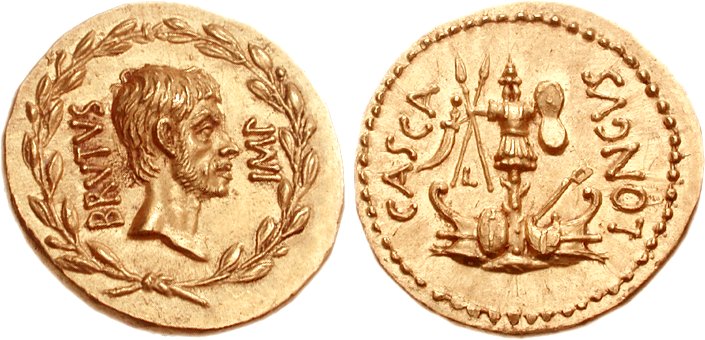
Rome had been ruled by Kings but the last of them, Tarquin had been cruel and tyrannical. He’d been killed by another Brutus, ancestor of our Brutus.
That Brutus had sworn that they would : “never tolerate Kings in Rome evermore, whether of that family of any other."  Livy.
Coin issued by Brutus two years after Caesar's murder

That killing had ushered in the Roman Republic, a system without kings where power was deliberately minimised and shared out so that no one man could overwhelm like Tarquin had.
The conspirators believed that Caesar wanted to make himself King and destroy the Republic. They aimed to get rid of him before he could do so. An anticipatory assassination to preserve the political system they had sworn to serve, to free the Roman people from a future tyranny.

It makes for good dramatic scenes as Brutus and co torment themselves with the terrible task they must complete to save Rome and her people from one man rule.


The Aftermath
With Caesar’s bloody corpse on the floor Brutus, himself saturated in blood, attempted to talk to the Senators present in the house. Unsurprisingly they are pretty freaked out by events and leg it. The conspirators then went to the Capitol Hill. They held up their bloody hands and daggers and declared liberty. Brutus began to make a speech.
And from that point on it all went wrong......

Because although Caesar might have annoyed at least 60 of the posh types of Rome, he was very popular with the people. They weren’t keen on him being murdered, particularly when Caesar’s will was read out and they heard that he’d left every person in Rome a sum of money. Also Caesar, as a successful all conquering general, was held in great esteem by the army too.

Moving down to the Forum for further appeals they faced an increasingly hostile crowd. So hostile they were forced to flee.
The people continued demonstrated their displeasure with Caesar’s death with enough vigour that in the end the conspirators were forced to flee Rome.

Caught up in ideals of their own noble torment they had totally misread the mood. They had assumed that they would be congratulated on their act, that it would be recognised as the great noble deed it was. They’d anticipated a tyranny and acted. But they’d never anticipated or even considered that there might be an opposition. Certainly they hadn’t considered an opposition that might be more eloquent than they were, in the shape of Mark Antony, who might actively seek to punish them for murdering his friend.
They soon found themselves hunted down by Antony and, another beneficiary of Caesar’s will, his great nephew Octavius. They were both fully intent on avenging Caesar. Brutus and Cassius were both killed at the Battle of Philippi.


Was the assassination a success? 
The motivating aim of the assassination of Julius Caesar was to prevent him making himself king and destroying the Republic.
What followed Caesar’s assassination were a series of civil wars that resulted in one man, Caesar’s great nephew Octavius ruling Rome under the name of Augustus and forming a dynasty. The Republic as it had been was over. Rome was now a monarchy in all but name.
So no, it was not a success. It was an utter failure, hastening what it sought to prevent.


2) Caligula


Julius Caesar was assassinated for what he might become in order to preserve the state. Our next assassination is lacking noble ideals. Rome’s third Emperor Caligula had ruled Rome for 3 years and 10 months when he was assassinated at the age of 29. This is an interesting one because the reign is so short. Caesar took decades to build up sufficient resentment to be offed. Caligula manages to really annoy in 3 years and 10 months. Which I think we should take a moment to appreciate.


Right appreciated.

The How 

Suetonius has the tale for us.:

On the ninth day before the Kalends of February at about the seventh hour he hesitated whether or not to get up for luncheon, since his stomach was still disordered from excess of food on the day before, but at length he came out at the persuasion of his friends. 
In the covered passage  through which he had to pass, some boys of good birth, who had been summoned from Asia to appear on the stage, were rehearsing their parts, and he stopped to watch and to encourage them; and had not the leader of the troop complained that he had a chill, he would have returned and had the performance given at once.  
From this point there are two versions of the story: some say that as he was talking with the boys, Chaerea came up behind, and gave him a deep cut in the neck, having first cried, "Take that," and that then the tribune Cornelius Sabinus, who was the other conspirator and faced Gaius, stabbed him in the breast. Others say that Sabinus, after getting rid of the crowd through centurions who were in the plot, asked for the watchword, as soldiers do, and that when Gaius gave him "Jupiter," he cried "So be it," and as Gaius looked around, he split his jawbone with a blow of his sword. 
As he lay upon the ground and with writhing limbs called out that he still lived, the others dispatched him with thirty wounds; for the general signal was "Strike again." Some even thrust their swords through his privates. 


It’s a bloody death isn’t it? Deliberately brutal – note the thrusting swords into his groin. 
Caligula really managed to piss people off, but who were they?


The Who 
Two are named by above, the Tribune Cornelius Sabinus and commander of the Guards, Cassius Chaera. Though you’d have thought the suspicious Romans wouldn’t have trusted a man named Cassius with their personal security. Suetonius says these two succeeded thanks “to the cooperation of the most powerful freedmen and the Guards’ Commanders” 
Bust of Caligula in the Louvre.
Photo by Clio20
I smell a bit of palace intriguing and plotting. Cassius Dio has a little more detail:
“There were a good many, of   course, in the conspiracy and privy to what was being done, among them Callistus and the prefect.

Practically all his courtiers were won over, both on their own account and for the common good. And those who did not take part in the conspiracy did not reveal it when they knew of it, and were glad to see a plot formed against him.” 

Callistus was Caligula’s secretary. See here for an article I wrote examining his slippery life.
So pretty much everyone knew it was going to happen within Caligula’s inner circle. But nobody took any steps to stop it.


The Why
Caligula is the poster boy for the demented ruler. A young man utterly unsuited to ruling who gets steadily more demented, steadily more autocratic and steadily more cruel.
A couple of anecdotes will suffice to give a flavour of Caligula’s rule and why people might want him dead:

At Puteoli, at the dedication of the bridge that he contrived, as has been said, after inviting a number to come to him from the shore, on a sudden he had them all thrown overboard; and when some caught hold of the rudders of the ships, he pushed them off into the sea with boathooks and oars. 
Suetonius


He was no whit more respectful or mild towards the senate, allowing some who had held the highest offices to run in their togas for several miles beside his chariot and to wait on him at table, standing napkin in hand either at the head of his couch, or at his feet. 
Suetonius


If you really want to know more I’d recommend Mary Beard’s documentary for the BBC or alternatively the soft porn film Caligula starring Malcolm McDowell. It’s terrible in the sort of eye popping way Caligula’s court probably was. 

To recap Caligula was possibly mad, definitely cruel and getting rid of him was for the public good. But is that really the why of the situation? No, no its not.

Let us look at chief assassinator and aptly named Cassius.

Chaerea was an old-fashioned sort of man to begin with, and he had his own special cause for resentment. For Gaius was in the habit of calling him a wench, though he was the hardiest of men, and whenever it was Chaerea's turn to command the guard, would give him some such watchword as "Love" or "Venus” 
Cassius Dio


And here’s Suetonius:  

For Gaius used to taunt him, a man already well on in years, with voluptuousness and effeminacy by every form of insult. When he asked for the watchword Gaius would give him "Priapus" or "Venus," and when Chaerea had occasion to thank him for anything, he would hold out his hand to kiss, forming and moving it in an obscene fashion. 


There’s your why for you.
And a good life lesson. Never taunt or humiliate the man who is responsible for your personal safety. Oh and who carries a sword as part of his job


The Aftermath
The only people seemingly not in on the plot were Caligula’s German bodyguard. Who realising their epic job fail tried to make amends by a general massacre. First up were Cassius and Sabinus and their fellow dagger welders. Then some “inoffensive senators” as Suetonius puts it. RIP inoffensive senators.
Then random people, our sources don’t indicate whether they were offensive or not.

In the style of Caesar’s assassins Caligula’s murderers had given absolutely no thought to what happened next. Which I think underlines the personal nature of the assassination, this is not about politics or an unsuitable ruler. It’s about revenge.
Revenge doth not run a government and in the chaos that followed Caligula’s death there were two very different views of what should happen

The Senators rushed to the Senate House and declared the Republic should be restored and there no longer be emperors. Hadn’t Caligula’s rule showed in fully bloody horror the evil of a one man rule?

The Praetorian Guard had in the meantime found Caligula’s uncle Claudius hiding behind a curtain and made him Emperor. 

Proclaiming Claudius Emperor by Lawrence Alma-Tadema{{PD-US}}
 
Was it a success?

If Cassius’ aim was to inflict revenge and pain on the man who’d taunted him then yes it was an amazingly successful assassination.
Also for all those freedmen like Callistus who involved themselves in the plot they rid themselves of a demented boss.
The lesson from Caligula’s assassination is that if you set the bar low for the outcome of your plot, then you can consider it a wild success.


3) Domitian 96AD


Rome’s 11th Emperor fared much better than Caligula in clocking up 15 years of rule before annoying enough people to get killed. 
Statue of Domitian
Photo by Steerpike


The How
In order to assassinate a ruler you need to get close to him. In Caesar’s case his killers knew his schedule and waited for the optimum time and place to get their daggers in. With Caligula it was his own Guards who assassinated him, so they were by his side anyway. In the case of Domitian the ‘how to get close’ part of the plot is really quite ingenious and thought out:

“To avoid suspicion, he wrapped up his left arm in woollen bandages for some days, pretending that he had injured it, and concealed in them a dagger. Then pretending to betray a conspiracy and for that reason being given an audience, he stabbed the emperor in the groin as he was reading a paper which the assassin handed him, and stood in a state of amazement. “ 
Suetonius

Element of surprise rating 8/10. Domitian really did not see this coming. Had the event ended there it would have been an incredibly neat affair. But Domitian wasn’t going quietly.

“The emperor grappled with Stephanus and bore him to the ground, where they struggled for a long time, Domitian trying now to wrest the dagger from his assailant's hands and now to gouge out his eyes with his lacerated fingers.” 
Suetonius

Ouchy. Several other conspirators then rushed in and helped finish Domitian off in a very messy way.
If you’re wondering how we know all this . Well there was a witness . One of the Imperial slaves, a young boy, was tending to the household shrine when it all kicked off.


The Who

The man who did the stabbing was Stephanus, a former steward of Domitian’s exiled niece.
But he was far from the only one involved. Helping him finish off Domitian were Clodianus, Maximus, Satur and a gladiator from the Imperial school. All of them were palace staff.

They were the do-ers but they weren’t the plotters. They were much higher up the Imperial ladder:
Parthenius, Domitian’s chamberlain
Sigerus, another chamberlain
And Entellus, head of petitions.


We know a little bit about Parthienus, for the poet Martial courts his influence in the hope of getting his poems before the Emperor.


ON A TOGA GIVEN HIM BY PARTHENIUS. 

This is that toga much celebrated in my little books, that toga so well known and loved by my readers. It was a present from Parthenius; a memorable present to his poet long ago; in it, while it was new, while it shone brilliantly with glistening wool, and while it was worthy the name of its giver, I walked proudly conspicuous as a Roman knight. 


Martial even writes a poem to celebrate the birthday of Parthienus’ infant son, Burrus.
So here we have three senior members of Domitian’s staff planning his murder and employing other members of the palace staff to enact it.
I think we need to know why.


The Why
Though a capable administrator Domitian had become increasingly paranoid. Though justifiably so given in 89AD a Roman General named Saturnius had initiated a revolt against him. That was fairly easily suppressed but it clearly left its mark on Domitian, not least in his party hosting, which had taken a turn towards macabre: 
Bust of Domitian
Photo by Jastrow

He prepared a room that was pitch black on every side, ceiling, walls and floor, and had made ready bare couches of the same colour resting on the uncovered floor; then he invited in his guests alone at night without their attendants. 

And first he set beside each of them a slab shaped like a gravestone, bearing the guest's name and also a small lamp, such as hang in tombs. Next comely naked boys, likewise painted black, entered like phantoms, and after encircling the guests in an awe-inspiring dance took up their stations at their feet. 
After this all the things that are commonly offered at the sacrifices to departed spirits were likewise set before the guests, all of them black and in dishes of a similar colour. 
Cassius Dio

Yikes. Senators were executed, relatives exiled and a Vestal Virgin buried alive under Domitian’s increasingly paranoid rule: 

He used to say that the lot of princes was most unhappy, since when they discovered a conspiracy, no one believed them unless they had been killed. 
Suetonius


Domitian had a particularly bad relationship with the Senate. The writers Tacitus and Pliny the Younger both served in the Senate under Domitian and it’s clear from them just how frightening it was. Nobody knew when he might pick on them.
But, as we’ve seen, the blow when it came, came not from the persecuted Senators but rather his closest advisers. We are supplied with the reason: 

He had first banished and now slew Epaphroditus, Nero's freedman, accusing him of having failed to defend Nero; for he wished by the vengeance that he took on Nero's behalf to terrify his own freedmen long in advance, so that they should venture no similar deed. Yet it availed him naught, for he became the object of a conspiracy in the following year 
Cassius Dio


Epaphroditus was a freedman of Nero, who had accompanied the emperor on his final flight from Rome. As the soldiers had closed in on Nero, Epaphroditus had assisted him into suicide. This was 27 years before. That’s quite a statement. Clear as glass. And aimed directly at his own staff.
What we can conclude from their actions, particularly Parthienus the recipient of Martial’s kind poems, was that they saw it as a him or us scenario.
This is born out by this little tale:

He invited one of his stewards to his bed-chamber the day before crucifying him, made him sit beside him on his couch, and dismissed him in a secure and gay frame of mind, even deigning to send him a share of his dinner. 
Suetonius
The message was clear. It could be any of them. So they acted.


The Aftermath

Stephanus and the others who had physically attacked Domitian were instantly slain by the Guards.
There was undoubtedly a bit of chaos but the very same day that Domitian was murdered, Marcus Cocceius Nerva was proclaimed by the Senate as Emperor. Take a moment to take that in. THE VERY SAME DAY. 
Statue of Nerva
Photo by Carole Raddato

Was it a Claudius behind the curtain scenario or something quite different? Nerva was 66 years old, an experienced feature of the government and very firmly loyal to the Flavian dynasty of which Domitian was the last. Had he been lined up before hand by Parthienus, Sigerus and Enntellus?

Cassius Dio says yes:

They discussed the matter with various men, and when none of them would accept it (for all were afraid of them, believing that they were testing their loyalty), they betook themselves to Nerva. For he was at once of the noblest birth and of a most amiable nature 

It would certainly explain the speed of the ascension.
Nerva ruled for 2 years, dying naturally at age 67. He became the first of what Edward Gibbon called the Five Good Emperors, an era of prosperity and peace.

So it was a success then? 
As with the other assassinations let us go back to the principle aim. The conspirators were motivated by fear for their lives from an increasingly paranoid boss.
That boss was removed. So a tick for that one.
However did it save their lives? Not Stephanus it didn’t. He was instantly killed. And the chief plotter Parthienus? He lasted incredibly until October the following year when the Praetorian Guard who’d been firm supporters of Domitian stormed the palace and insisted Nerva hand him over.
Domitian had been wildly popular with the army, mainly because he had massively increased their pay, so the question here is surely why did it take so long for them to revenge their emperor?

The answer is quite chilling: because they didn’t know Parthienus was involved. Remember he was the plotter, he didn’t actually take part in the killing. Domitian’s former Chamberlain spent a whole year knowing what he had done and no doubt wondering whether that would be uncovered. That’s got to be stressful. We have to wonder whether he was betrayed by someone on the inside, another palace employee letting the great secret slip?

Nerva was given little choice in the matter, held at knife point by soldiers
Parthienus was handed over. He was executed in a particularly horrible way.

So no it did not save Parthienus’ life for long either. Though maybe if he hadn’t been betrayed we might never have known the man who brought Martial a toga was also behind an Emperor’s murder.


Here we end part one of The Terminators......


L.J. Trafford is the author of the Four Emperors series. Of which assassination and general massacres feature highly.