Showing posts with label Roman. Show all posts

Friday, 3 February 2023

HAMILTON'S TREASURES ... by Susan Stokes-Chapman

Thankfully the ship rests in the shallows. He has not used this apparatus before and will not venture any deeper than he must. Twenty feet below the surface. No danger there, he tells himself. And he knows exactly where to look. Under careful instruction the object he seeks was safely hidden within the starboard bow, away from the other shipments tightly packed in the hold, but the ship broke apart in the storm; he hopes his luck stays true, that the crate has not strayed too far along the seabed, that no one else has managed to retrieve it ... Extract from: Pandora


In the harsh winter of 1798, the Royal Navy’s formidable warship, HMS Colossus, met a tragic fate off the treacherous coast of the Scilly Isles, succumbing to a fierce and unforgiving storm. Hidden deep within its hull was the prized collection of Greek antiquities belonging to the British diplomat William Hamilton. With Napoleon’s forces poised to invade Naples, Hamilton had wisely chosen to send his treasured artifacts back to England for safekeeping. Yet, in a cruel twist of fate, these invaluable relics were lost beneath the waves, swallowed by the very sea meant to protect them.


William Hamilton harboured a profound passion for Greek vases, amassing an impressive collection during his 35 years residing in Naples. Serving as British Ambassador to King Ferdinand from 1764 to 1799, Hamilton’s official duties provided the perfect backdrop for his intellectual and cultural pursuits to flourish. He became deeply engrossed in antiquities, acquiring Greek vases from private collectors, sponsoring archaeological excavations, and even opening ancient tombs. What began as a scholarly interest quickly blossomed into a full-fledged obsession; by 1766, he had amassed a remarkable collection of over two hundred individual pieces.

For his own scholarly satisfaction — and perhaps to share his passion with the wider world — in 1766–67 Hamilton published a lavish four-volume set of engravings showcasing his treasures, entitled Collection of Etruscan, Greek, and Roman Antiquities from the Cabinet of the Honble. Wm. Hamilton, His Britannick Maiesty's Envoy Extraordinary at the Court of Naples.


Hamilton’s first collection of antiquities was sold to the British Museum in 1772 for the substantial sum of £8,410, where many of the pieces remain on display today. Among them is the celebrated red-figure volute crater famously known as the 'Hamilton Vase'Yet, scarcely had he parted with this treasured assemblage — perhaps with some seller’s remorse — before Hamilton resumed his collecting with renewed zeal. He went on to publish a second catalogue, titled Collection of Engravings from Ancient Vases Mostly of Pure Greek Workmanship Discovered in Sepulchres in the Kingdom of the Two Sicilies but Chiefly in the Neighbourhood of Naples During the Course of the Years MDCCLXXXIX and MDCCLXXXX.

What makes this particular collection especially poignant is that it was among these very vases, immortalised in the engravings, that were tragically lost aboard HMS Colossus.


He was, understandably, devastated. In a letter he wrote to his nephew Charles Greville in 1799, he said of his vases 

“they had better be in Paris than at the bottom of the sea; have you no good news of them? they were excellently packed up, & the cases will not easily go to pieces, & the sea water will not hurt the vases. All the cream of my collection were in those eight cases on board the Colossus, & I can't bear to look at some remaining cases here in which I know there are only black vases without figures.”

Regrettably, only a handful of items from Hamilton’s lost collection were recovered during his lifetime. It was not until 1974 that a dedicated recovery team succeeded in raising some of the salvaged fragments from the depths. These damaged yet invaluable pieces now reside within the British Museum’s esteemed collection.

Despite this tragic loss, William Hamilton’s legacy endures. His meticulously published volumes became essential references for artists and craftsmen, notably influencing figures like Josiah Wedgwood. One of Wedgwood’s most celebrated creations is his exquisite reproduction of the famed ‘Portland Vase,’ pictured below—a testament to the lasting impact of Hamilton’s passion for antiquity.


~~~~~~

My debut novel Pandora opens with the recovery of an ancient vase from the shipwreck of HMS Colossus, and features William Hamilton quite prominently as a key character. To read all about it you can order by clicking the image below:

Instagram: @SStokesChapman

Friday, 5 August 2022

AGE OF ELEGANCE ... by Susan Stokes-Chapman

In my previous blog post, I explored the world of Georgian jewellerythe crowning glory of any ensemble. But while those glittering finishing touches were undoubtedly important, they were only one part of the story. To truly appreciate the splendour of the era, we must also turn our attention to the fashions these jewels were meant to enhance, and the way dressmakers and tailors drew inspiration from the elegance and grandeur of the ancient world.

It was the Enlightenment that sparked this cultural shift. The Age of Enlightenment — a sweeping intellectual and philosophical movement that flourished across Europe during the 17th and 18th centuries — championed ideals such as human happiness, reason, empirical knowledge, liberty, and social progress. These Enlightenment values led to a renewed fascination with the classical civilisations of Greece and Rome, a reverence that inevitably found its way into the world of fashion, especially in what we now associate with the Regency period.

Women’s clothing, in particular, began to cast off the stiff structure of corsetry in favour of a more fluid and graceful silhouette. Inspired by ancient statuary and drapery, dresses adopted the flowing lines and high waistlines of classical antiquity — what we now call the Empire Line — designed to flatter the figure with a soft, slender elegance. Men’s fashion, too, echoed this classical ideal, embracing a leaner, more statuesque form reminiscent of the heroic figures of Grecian myth.


It is little wonder that the ancient world held such allure. With the rise of archaeology and the increasing accessibility of classical artefacts, many brought to wider attention through the aristocratic tradition of the Grand Tour, the beauty and refinement of classical imagery captivated the European imagination. The aesthetics of antiquity were irresistible: men were depicted as clean-shaven, with artfully curled hair and sculpted, athletic physiques that embodied virile strength and nobility. Women, by contrast, were portrayed with flawless skin, elegant hairstyles, and an air of serene grace, together forming the classical ideal of human perfection that so enchanted the Georgian mind.


© Victoria and Albert Museum

 
© Victoria and Albert Museum

The earliest Grecian-inspired gowns were simple, column-like shifts, most commonly made from muslin. Though other fabrics were occasionally used, muslin dominated the fashion plates of the day, prized for its soft drape and airy lightness. These gowns were intentionally unstructured, with shape achieved not through stiff corsetry, but by a ribbon or tie just beneath the bust, creating the now-iconic Empire Line silhouette.

This style offered women a remarkable sense of freedom and comfort. The dresses were lightweight, required minimal underpinning, and were paired with flat shoes, liberating wearers from the discomfort of high heels. White, in all its subtle variations, was the prevailing colour, evoking the purity and simplicity of classical antiquity. During the day, women often wore soft pastel shades, while deeper tones appeared in shawls, trims, or decorative tunics — many of which were edged in gold. These elegant overlays enhanced the Greco-Roman aesthetic, echoing the timeless beauty of ancient dress.


These ensembles were often complemented by delicate reticules (small handbags that sometimes echoed the elegant contours of a Grecian urn) and by hoods inspired by the Grecian caul, a fine cloth or netting designed to cover the hair and extend gracefully down the back in an elongated shape:

Returning briefly to jewellery, one accessory in particular captured the imagination of the era: the tiara. Frequently seen in contemporary portraits, these elegant headpieces also drew inspiration from the mosaics and pottery uncovered in archaeological excavations across Greece and Rome. As the examples illustrated below reveal, the classical heritage made tiaras a natural and highly fashionable adornment:


© The British Museum

Moreover, cameos were perhaps the most overt homage to the ancient world in Georgian jewellery. As early as 1805, the Journal des Dames observed that “a fashionable lady wears cameos at her girdle, cameos in her necklace, cameos on each of her bracelets, and a cameo on her tiara.” Below is a striking portrait of Queen Louise Augusta of Prussia, painted by the French artist Madame Le Brun, which beautifully showcases a cameo adorning her tiara, an elegant testament to this enduring classical influence.


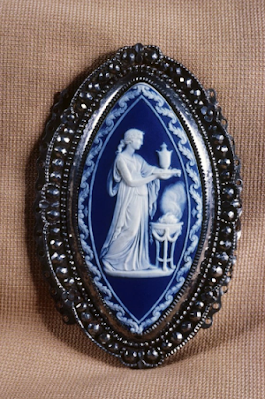
The English potter Josiah Wedgwood found great success with his jasperware, renowned for its exquisite classical scenes. Featured below is a belt clasp framed in cut steel and adorned with Matthew Boulton’s faceted steel studs, depicting a priestess performing a sacrifice. Such cameos were a popular accessory among Georgian women (and even some men) who embraced these classical motifs as a mark of style and sophistication.

© The Walters Art Museum

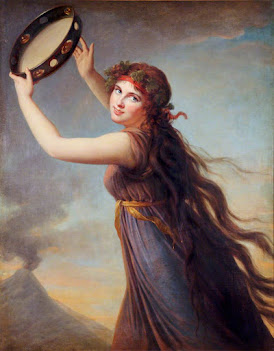
And speaking of priestesses, the painting below by Madame Le Brun portrays Lady Hamilton — Lord Nelson’s famed mistress — as a graceful dancing priestess. Her layered garment and intricately patterned underdress blur the line between Regency fashion and ancient Grecian robes, so striking is the resemblance. In the background, the eruption of Mount Vesuvius serves as a vivid reminder of the recent excavations at Pompeii, an archaeological discovery that further fuelled the Georgian era’s fascination with the classical world.


For men, the approach to fashion was notably more restrained. Gentlemen wore breeches crafted from fabrics that stretched comfortably across the legs, subtly accentuating their form, while skin-tight pantaloons evoked the virile grace of classical statues much admired during the period. The dandy Beau Brummell — depicted below — famously asserted that the purpose of men's fashion was to “clothe the body so that its fineness may be revealed,” emphasising understated elegance over ostentation.


Of course, not all bodies conformed to the idealised shapes of the era. For women of fuller figure, the Empire Line dresses remained remarkably flattering, gracefully skimming the silhouette. Men, however, who lacked the muscular contours celebrated in Grecian heroes, often did not hesitate to enhance their form with padded garments to create the desired curves. This humorous caricature below playfully captures that very practice. Beside it is a surviving example of a padded stocking, a testament to the lengths men would go to achieve the perfect classical profile.


There is much more to be said about Georgian fashion, but for the purposes of this blog, I wanted to focus on the striking visual parallels between Regency styles and the ancient world. Personally, I believe they were truly onto something remarkable. It feels high time these fashions made a comeback. They were elegant and regal, wonderfully cool in the summer months, and flattering to every shape and size. What more could one possibly ask for?


~~~~~~

My Georgian-set debut novel Pandora acknowledges this obsession with the ancient world, and you can order by clicking the image below:


www.susanstokeschapman.com
Instagram: @SStokesChapman


Friday, 15 January 2021

Run Your Town Like a Roman - 12 tips from the past, by Ruth Downie

Human nature, it seems, has changed little since AD 91, when the emperor Domitian issued a set of laws for the town of Irni. Many of them made me laugh, because it was clear that the rules were designed to head off exactly the same sort of misunderstanding and mischief-making that still goes on today. Others were clearly based on a mindset very different to our own. Here are a few gems of advice from the past:

1 Everyone in town must know what the rules are. They must be engraved on bronze plaques and put up in the middle of town where they can clearly be read from ground level. There is to be no burying of bad news, hiding devilish detail in small print or placing plaques so high that nobody can read them without a ladder. 

Two people looking up at tall Roman building
"Did you bring the binoculars?"

 2 Remember that while mortal guardians sleep, the gods and the divine ghosts of emperors past are always on the lookout for wrongdoing. Everyone who holds office in the town must swear by Jupiter and the Divine Augustus and the Divine Claudius and the Divine Vespasian Augustus and the Divine Titus Augustus and the genius of the Emperor Domitian Augustus and the Penates that he will act in good faith.

3 There is to be no fake news. All decisions must be read out as soon as possible and council scribes are to make a public record of what’s been decided without entering anything false or leaving anything out, or else incur the wrath of Jupiter, the Divine Augustus, etc.

4 Two men with equal authority should be placed in charge of the council. Ideally they will be so busy squabbling with each other that neither will pose any threat to the higher authorities. In order to get necessary business done even when relations are bad, some ground rules will be necessary – for example, nobody can make decisions about money unless three-quarters of the councillors are there to vote on them. And when one of the top men has called a meeting, the other one can’t demand that everyone abandon it and come to his own meeting instead. (Ordinary residents, of course, should not be allowed to hold large meetings at all. No good will come of it.)

5 Cheer everyone up by supporting the arts – as soon as possible, vote a budget for religious observances, games and public dinners.

Modern gladiators in the amphitheatre at Chester
Everyone enjoys the Games

6 Make it clear that the councillors in charge of drains, roads, etc. will have the help of municipal slaves to do the actual dirty work.

7 Are there still not enough willing councillors, despite the offer of free labour and public dinners? Have the names of every eligible man (obviously non-men are not eligible) written up in public. At ground level. Order them to nominate each other. You will have an instant rush of nominees.

8 Now you have the nominees - some advice on elections. Nobody is to do anything to prevent the election being held. Everyone seeking election can place a scrutineer by each ballot box. If two candidates have the same number of votes, the one who is married will be elected. If they are both married, tot up the number of legitimate sons each of them has. The one with the most sons wins. (For the avoidance of dispute, use the official points system to allow for any children who have not survived. If this still doesn’t settle the matter, draw lots.)

outline of ballot box
9 Get a grip on the grain supply and keep control of weights and measures and the retail sector. Ban hoarding and price-fixing. No-one is to corner the market in any one commodity - not even toilet rolls.

10 Tired of the endless grumbling from residents who demand that “the council ought to do something about…” x, y or z? Remind them that residents can be conscripted for five days each year to work without pay on major Council projects. This will test their resolve.

11 Ambassadors. Being sent away to represent the town’s views (whatever you think of them) is not always a popular job, so any man who claims to be ineligible because he is ill, or over 60, should be made to swear it in front of Jupiter, the Divine Augustus, etc. If he is later found out to be lying, he will suffer not only the wrath of Jupiter, the Divine Augustus, etc., but also a fine of 20,000 sesterces. This is enough to pay 16 legionaries for a year, so if a modern army private in the UK earns about £20,000 a year, set the fine at £320,000.

Bust of the Emperor Domitian - Photo of Domitian - derivative work: Steerpike (talk)Domitian_capitoline_profile.png: Steerpike, CC BY-SA 3.0 <https://creativecommons.org/licenses/by-sa/3.0>, via Wikimedia Commons
The emperor is running out of patience.

12 And finally – the laws end with a special letter from the emperor Domitian himself. Its meaning is now lost to us, but if, in the light of recent legislation, you are concerned about the hasty marriage (?) that you contracted, this is for you. The emperor wants you to know that he is prepared to overlook the past, but he is now running out of patience. Don’t do it again.

The Lex Irnitana, the statement of law for the southern Spanish town of Irni, was discovered on bronze plaques in the 1980s. I’m immensely grateful to Paul du Plessis, who originally drew my attention to it, but who shares none of the blame for what lies above. Anyone wanting to make a serious study of it should consult:

The Lex Irnitana: A New Copy of the Flavian Municipal Law Author(s): Julián González and Michael H. Crawford Source: The Journal of Roman Studies , 1986, Vol. 76 (1986), pp. 147-243 Published by: Society for the Promotion of Roman Studies Stable URL: https://www.jstor.org/stable/300371 JSTOR

Ruth Downie writes a series of murder mysteries set mostly in Roman Britain, and featuring Roman army medic Ruso and his British partner, Tilla. www.ruthdownie.com 

Photo of Domitian - derivative work: Steerpike (talk)Domitian_capitoline_profile.png: Steerpike, CC BY-SA 3.0 <https://creativecommons.org/licenses/by-sa/3.0>, via Wikimedia Commons


Sunday, 28 October 2018

Gang of Suspects Named in Kidnap Case

by Ruth Downie

STOLEN: VILBIA

HELP OF GODDESS SUMMONED

GUILTY PARTY THREATENED WITH BECOMING LIQUID AS WATER

The loss of Vilbia is the most famous cold case that’s come down to us from the Romano-British town of Aquae Sulis (modern Bath). The aggrieved party – whose name we don’t know – called up the goddess Sulis Minerva’s help by writing the suspects’ names on a thin sheet of lead, rolling it up and throwing it in the pool above her sacred hot spring. It wasn’t alone: well over a hundred other curses have been found buried in the silt and others may be hidden there still.

Most of the spidery letters on the scraps of lead are the work of victims asking Sulis Minerva to avenge a crime. Some name the suspects. Some don’t say what they did: presumably the goddess knew what Britivenda and Venibelia had been up to and could punish them accordingly.

Often, though, the victim had no idea who had wronged them. The curse on the modern reproduction below translates as “the name of the culprit who stole my bracelet…” There’s a space left, but no name in it.

When no likely evildoer could be identified, the aggrieved party often reminded the goddess to suspect everyone, “whether man or woman, slave or free.” Children could be in the frame too -“whether boy or girl” - and once, “whether pagan or Christian”.

Some victims offered Sulis Minerva a share of the stolen goods if they were recovered – a sort of ‘no win, no fee’ deal, with the suggestion that the hot property could be handed in anonymously at the temple.

A few of the lead sheets are blank. Others bear rows of squiggles, perhaps put there by people who knew what writing looked like but couldn’t actually do it. All but two seem to have been in different handwriting: some educated, some very clearly not. Writing backwards might have made the curse more powerful: it certainly made for more spelling mistakes. But no matter what was being written, the sight of a stylus waking the dull surface of the lead into a gleaming message for the goddess might have frightened the guilty party into repentance.

If the culprit didn’t co-operate, though, bad things lay in store. Docimedis, whose gloves had gone missing, demanded that the thief should lose his minds [sic] and his eyes. Anyone even remotely involved in the theft of Basilia’s silver ring was to be accursed in blood, eyes and every limb, or even have all his or her intestines eaten away.

Sometimes the thief’s whole family was cursed. And sometimes the curses were subtle enough to work on the conscience. Whoever stole Docilianus’s cloak was to be deprived of both sleep and children until the cloak was returned to the temple. Whether or not he [or she, slave or free] knew the exact wording of the curse, it’s not hard to imagine them lying awake in the night watches and wondering whether they would get a better night’s sleep tomorrow if they got up now and delivered the stolen goods to Sulis Minerva under cover of darkness.

Bath isn’t alone in having a fine collection of curses: they turn up all over the Roman empire. There are attempts to silence witnesses, to sabotage racehorses, and to crush business competitors and love rivals. Most of the Bath curses, though, seem to be about thefts from the bath-house, although one poor chap had his house burgled. The crimes must have been very annoying for the victims, but as a writer looking to set a murder mystery in Aquae Sulis, I have to say there wasn’t as much instant plot in them as I’d hoped.

Even the apparent kidnap of Vilbia might have been less dramatic than it seems. Roger Tomlin, the modern translator, points out that the word has never been found anywhere else. The stolen “vilbia” might simply be an inanimate object with a name that none of us now understands. But while Vilbia doesn’t provide a ready-made plot and cast of characters, the curses as a whole give a lively insight into a busy town and the everyday struggles of its people to thrive and survive. And perhaps of the wider divisions between them.

We know that Roman citizens lived in the town (some of their tombstones have turned up, proudly announcing the three-part names that show social superiority), but none of the curses has a citizen’s name on it. All the complainants and culprits seem to be either lower-class Latin-speakers or native Britons. That might be because, as Pliny put it, the Britons were enthusiastic practitioners of magic while all good Romans ought to look down their noses at it (yes, I am paraphrasing wildly here). It might also be because the poorer you were, the less chance you had of owning a slave who would guard your kit while you were bathing.

Even if you knew who’d done it, in the absence of a police force there wasn’t much you could do unless you had powerful friends or plenty of cash. At a guess, Arminia had neither. She knew exactly who’d made off with her two silver coins – it was Verecundinus, son of Terentius - but getting them back had to be left to the goddess. 

Did Verecundinus pay up? Or did he suffer the punishment of being unable to sit, lie down, walk or sleep? We don’t know. For us, at least, none of these cold cases is resolved. But people believed in the curses enough to carry on throwing them into the spring for over two hundred years. There might have been no police officers to investigate crime, but even while you slept, that lump of lead hidden under the steaming surface of Sulis Minerva’s waters could be working its revenge on your enemies. And that must have felt good.

Roger Tomlin’s work on the Aquae Sulis curses - from which much of this information is drawn - can be found in The Temple of Sulis Minerva at Bath, Vol 2: The Finds from the Sacred Spring – Barry Cunliffe et al – OUCA Monograph no 16, 1988

Read more about the site at https://www.romanbaths.co.uk/

Ruth writes a series of crime novels featuring Roman army medic Ruso and his British partner, Tilla. The latest is MEMENTO MORI, set in Aquae Sulis.

Monday, 9 July 2018

Mysteries of the Roman Dead

by Caroline Lawrence

I have been obsessed with the ancient Graeco-Roman world for over forty years. I studied Greek and Latin at U.C. Berkeley and later at Cambridge and London. I have been writing historical fiction set in the Classical world for nearly twenty years. But the more I learn about the ancients, the less I feel I understand them. 

A free exhibition called Roman Dead currently on at the Museum of London Docklands presents a dozen ancient skeletons of Roman Londoners, as well as ashes of the cremated. There are tombstones, urns and grave-goods (personal objects buried with the dead). It may sound gruesome, but it’s utterly fascinating. The contents of graves from Roman London show us how much we still have to learn about the ancient Romans.

Here are five mysterious aspects of the exhibition that intrigue me. 


1. Why such a big sarcophagus? 

This is the star piece of the exhibition. Found a year ago (in June 2017) at a site on Harper Road in Southwark, this massive box (and lid) is made of limestone imported from Lincolnshire and weighs two and a half tons. Why put a body inside such a heavy stone box? To stop her spirit from haunting the living? To keep robbers from taking her jewellery? Or to stop grave robbers from doing something even worse? As dozens of surviving curse tablets show, many Romans believed in magic. In a recent blog post, Roman magic expert Adam Parker notes that witches used parts of dead bodies for their spells. So maybe this was a way of keeping the witches or sorcerers out of her grave, i.e. of protecting the dead from the living rather than vice versa.   Is that what’s going on here? Is this massive sarcophagus designed to protect the body from misuse or robbery? If so, it didn’t work. The heavy lid had been pushed aside and part of her arm is missing. A tiny scrap of gold hints that she was in fact robbed of jewellery. Creepily, the partial skeleton of a baby was found with her skeleton. Was it originally buried with the woman? Or did it fall into the sarcophagus when it was robbed? 


2. Why is her skull on her pelvis?

From a grave at Hooper Street near Tower Hamlets, we have the complete skeleton of a woman aged between 36-45. She was buried in a wooden coffin on a bed of chalk powder. Some time after she was buried, when she had started to decompose, someone dug her up again, removed the top of her skull and it placed above her pelvis. Then the coffin was reburied and rocks were piled on top. Among the rocks was a copper-alloy key. Was the key part of the reburial? Or accidentally dropped? Why was she buried on a bed of chalk? But most importantly, why was the top part of her skull placed over her pelvis?! Maybe the newly positioned skull, rocks and key (along with a ceremony we can’t guess at) were designed to stop the woman’s spirit from haunting those still above earth. Romans thought the womb was the seat of uncanny power


Listen to a commentary on this and other objects HERE
3. Why is the lucky amulet under a jug?

Also found at the Hooper Street excavations was a young woman in a coffin with jet jewellery. Whitby Jet is not a precious stone but rather ancient fossilised wood from the Jurassic era. When you rub it against wool it produces a static charge that can move hair and other small particles without touching theme. Romans didn’t know about static and believed jet to be a magical substance that could keep away evil. Romans also believed that you could do harm to someone just by looking at them a certain way, hence amulets with staring faces like that of Medusa to ‘reflect back the evil eye’. So a jet medallion of Medusa’s face will be doubly protective. So far so good. But why was this jet medallion hidden under a small ceramic flagon? What is going on here? In addition, her other items of jet jewellery were not on her but near her. Is this magic? 


Listen to a commentary about the lion HERE
4. Why a lion? 

In 1876, Victorian workmen found the remains of a semi-circular tower in the Roman Wall at Bishopsgate, near where the Gherkin stands today. These bastions were built in the 4th century using material from earlier Roman structures. Among the rubble used to build the tower was a stone lion devouring a stag. The stone is imported limestone from the South Cotswolds (London has no local stone) and was carved in the round, so perhaps stood atop a mausoleum. Why a lion? The museum label says the lion stands for the power of death, but I’m not buying it. Why pay a fortune for an expensive carved sculpture made of imported stone just to state the obvious? Could the lion be a warning to people or spirits who might want to do harm to the grave? If the lion is on MY grave, then it’s MY lion. That would be worth paying for. This lion devouring his prey reminds me of the ivory leopard handle of another Roman girl’s folding knife. This is MY knife and therefore MY leopard. Watch out!  


Pinecones for sale in Taormino, Sicily
5. Why a pinecone?

From Great Dover Street, Southwark comes a pinecone made of imported French limestone (shown in the picture above along with the lion). Similar pieces have been found on military sites from the North of England. Ever since I first noticed pinecones for sale in Sicily, I have wondered what they signified in the Graeco-Roman world. Actual pine cones and kernels were found on the site of London’s Mithraeum and also at Londinium’s amphitheatre, as well as at a cremation burial. It is thought that pinecones were burned as incense, perhaps to attract good deities and/or repel evil spirits. At the Roman Dead exhibition, the label suggests they were associated with the god Attis, who represented rebirth and resurrection. Was the pinecone the pagan equivalent of the Christian cross? 

All these mysterious objects remind us that although the Romans were like us in many ways, in others they were very different.

Roman Dead is on until the end of October 2018 at the Museum of London Docklands and it is free. The exhibition is interactive and multi-sensory, with incense to smell, rattles to shake and replica Roman objects to touch. There is even a family trail for kids 8 and older. Ask at the front desk for a free origami Quiz Machine.