Showing posts with label Winston Churchill. Show all posts

Thursday, 27 June 2019

Greyhound Racing by Janie Hampton


I had laid my bet on a shiny, black bitch called Millicent Magic. She had previously been beaten by Jet Stream Smurf and Boherduff Solas, and that night she ran against Boom Boom Love and Smoothappa Razor. Six sleek dogs stood quietly by their handlers in the dim light of a misty evening. A metal cage lay across the track and the dogs calmly stepped into the back. As a florescent rag zoomed past, the trap opened and whoom! The dogs bounded out, as on springs. Their long, powerful legs and flexible spines took them from 0 to 43 mph within six strides. They hurtled around the track, a blur of legs. One dog tripped and somersaulted across the sand. But he rolled upright and was soon only a few lengths behind the pack.
Image result for greyhound racing painting
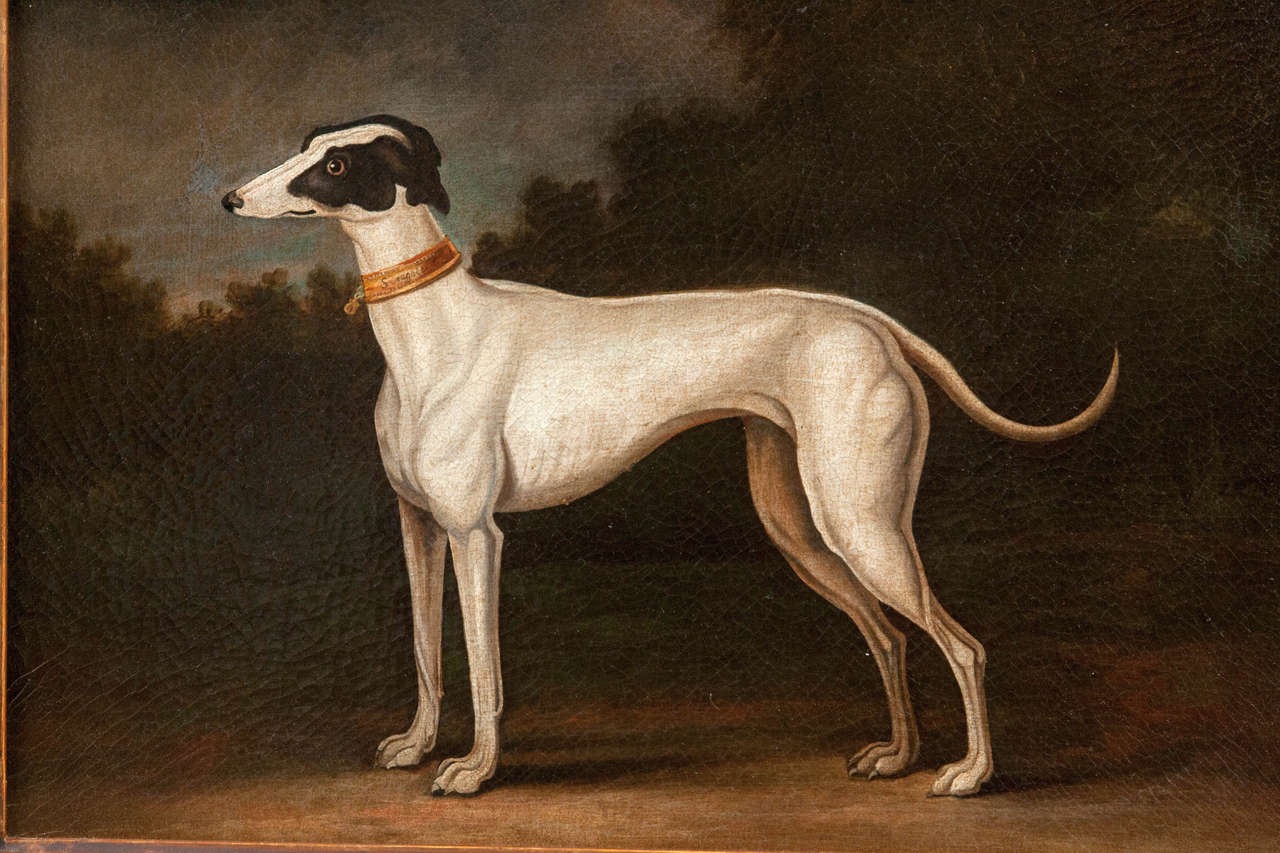
18th century racing greyhound
Less than 30 seconds and 420 metres after they started, there was light applause as the winner flashed past the finishing line. The handlers walked their dogs back to the kennels; their half a minute’s work for the week was over.
My lovely Millicent Magic came last and I lost one pound. Was the trip to Swindon Greyhound Race Track worth a few seconds of excitement? For thousands of people in Britain, greyhound racing has been their world, their life: as trainers, owners, bookmakers, kennel hands and punters.
In 1926, greyhound racing was introduced from the USA to Manchester, England. Within a few weeks over 11,000 spectators attended each Belle Vue meeting and two years later there were 68 tracks around England. There was not much else for the working man to do, and it was a cheap night out.
Giclee Print: Hares and Graces by Harry Woolley Art Print : 24x18in

After a decline during the second world war, there was a post-war boom and 50,000 people regularly attended White City stadium in London. Working men had raced dogs for centuries, and this offered a night out with a bar and the promise of riches.One of them was East-ender Alan 'Ginger' Newman, born in London in 1940. I met him in a cafĂ© and he told me how he had spent his life in the greyhound racing business as a tic-tac signer and bookmaker in all the 33 London dog tracks. ‘White City, Hackney Wick, Wimbledon, Wembley. Back then you could only bet legally on the track, and I knew all the bookies: ‘Fatty’ Sparks; Obie ‘The Chalk’ Dyer; Big Bertie Pearson; Harry ‘Erroll Flynn’ Saffron; and Tony ‘The Professional’ Morris. You’d always knew when Judah and his brother had lost. They would start screaming at each other. Then one of them would kick the other quite hard. The punters loved it.’
“Jock the Thief” was a regular at the Wimbledon track in the 1950s. ‘He always came with a big suitcase,’ remembers Newman. ‘It was stuffed with razors, shirts, silk ties, ladies stockings, scarves, perfume –things that were difficult to get. He sold them out of his suitcase at knock-down prices but nobody asked questions. By the time the races started he had sold the lot. He then proceeded to lose it all on the dogs. Next week, he was back, with another suitcase full.’

Once legal betting shops opened in 1961, track attendances declined. New clientele were attracted by modern restaurants up in the stands. Roger Moore was starring in The Saint when he took Bette Davis to White City greyhound stadium. ‘She loved it,’ wrote Moore. ‘The idea of being able to dine, place bets and watch races every fifteen minutes from our table was like manna from heaven to Bette. Everybody was so pre-occupied with looking at their racing forms, eating and placing bets that they never paid much attention to us.’ It was one place where humans were not the stars.‘Dogs don’t need much training,’ trainer Gilly Hepden told me. ‘You breed them, feed them, groom them, love them and then say “Go!”’ The dogs walk daily on a lead, and once a week they run 350 metres. ‘They don’t need stamina, they need explosive energy,’ said Daryl Porter, a trainer for over 50 years. His dogs eat cornflakes for breakfast, beef and tripe for lunch and vegetable soup for supper. ‘They know when it’s race day. As soon as they get a racing breakfast, they start to get excited. They may look calm standing on the track ready to race, but their hearts are pounding away. A dog won’t race unless it wants to, they just do it because they love it.’
'Running in field', painting by Charles Hampton. 
The dogs are placed in categories from A1 to A10 and so unlike horses, there is little possibility of a surprise outsider winning. There are six dogs in each race, matched as equally as possible. Dogs are remarkably consistent in their form and eyebrows are raised if a dog runs one third of a second out of its normal speed. The owner keeps the prize money which ranges from £35 to £100,000 for the English Greyhound Derby. A Derby winner can then earn £1,000 a pop in stud fees. So there’s a gamble in the owning too.Winston Churchill described greyhound racing as ‘animated roulette’, the dogs were simply running machines on which to bet, and the business had a reputation for cruelty. But now all tracks employ qualified vets who inspect every greyhound before racing. Dogs start racing at about 16 months and are usually retired by six years. Greyhounds make ideal pets for retired or lazy people as they only need a 10-minute daily walk and sleep up to 18 hours a day. ‘They are loveable, calm couch potatoes,’ said Steve Simmon, owner of retired greyhounds. ‘Easy-going and good with children.’
‘In the old days,’ said Gilly Hepden, ‘rich people raced horses and poor people had dogs. Now dogs are owned by all types.’ A greyhound costs anything from £500 up to £40,000 and then £50 a week to train. ‘You never make your money back, that isn’t the idea. People do it for the love of dogs, and the other people who love dogs.’

Just 21 tracks are open now – the land is often worth more for housing. Over 8,000 people attended the last night of racing at Walthamstow, near London, in 2008. Oxford stadium closed in 2012; and Wimbledon in 2017. Swindon track probably wouldn’t survive without speedway and its indoor market and car-boot sales. However, people in Britain still bet over £2 billion a year on the dogs and owning a greyhound has become so cool even Jools Holland has one.
The author with Dylan, a rescue greyhound-cross, or lurcher.
The Retired Greyhound Trust rehomes nearly 4,000 dogs a year,
funded by a levy from bookmakers.
Back at Swindon dog track, I turned my attention to the next race. For one night I was Bette Davis and Mr Hampton was my Roger Moore.

Greyhound Board of Great Britain
Retired Greyhound Trust
Swindon Greyhound Track
www.janiehampton.co.uk

A version of this article originally appeared in The Oldie magazine.


Thursday, 27 August 2015

Small boats in the English Channel by Janie Hampton


Refugees in small boats are much in the news, with governments determined to stop them coming, send them back, or keep them incarcerated in camps. In the summer of 1940, there were refugees in small boats in the English Channel. This is the story of one such refugee family.

Amsterdam, early 20th Century
The Kleins were a hard-working, bourgeois, Jewish family with a comfortable home in Amsterdam. When on 10 May, 1940, the German army invaded Holland, Simon and Maria Klein knew they had to leave everything behind.

Simon had already been a refugee twice. Born in the Austro-Hungarian Empire in about 1900, his parents sent him to Leipzig to escape conscription, and a few years later his relations told him to go to Holland. ‘The land of the free,’ they said. He found work in a firm of tailors’ accessories and married the owner’s niece, Maria. As the representative of “Double-weave underwear” Simon took Maria to Germany but after a few years they returned to The Netherlands with their two small children. ‘In Amsterdam nobody took any notice what religion you were,’ remembered their daughter Josephine. ‘Whether you were Jewish or gentile didn’t make any difference.’

In the late 1930s cousins from Germany stayed with the Kleins en route for America, travelling on through Belgium and France. But by May 1940, that route was blocked.
German soldiers in Amsterdam, May 1940. 
Josephine, 13, and her brother Eli, 15, were asleep on the night of 14 May 1940, when their mother told them to dress quickly and grab their gas masks. With their uncle Ralph, the Klein family took a taxi twenty miles west to the fishing town of Ijmuiden. In the dark harbour, crowds of people were trying to get away from the advancing German army. Mr Klein had struck a deal with a man who owned a small rowing boat, and then given extra money for water and food. The Kleins climbed on board, as more people swarmed down the steps and jumped in.

It was soon full but even so, there were more desperate people. ‘Take me…’ ‘For mercy’s sake, take my son!’ ‘Let my wife come with you!’

German invasion 1940, from The Second
World  War,
W. Churchill, 1948.
As Mr Klein pushed off, tears were streaming down his face. The boat was about 15 foot long, and there was only just room to sit down. None of the dozen people on board were sailors, so Eli and another boy, both Boy Scouts, took the oars. As they rowed into the dark water they could see the flashes of guns behind the town of Ijmuiden. Mr Klein’s plan was to row out to sea, where they would be picked up by a passing ship.

Day came, and night again, and another day, with a rising wind at night and waves that crashed against the boat. They had been tricked and they had only one orange between them and a small tank of water, which they drank from a thimble. There were no passing ships.

On the third morning Josephine noticed the water rising in the boat, and quickly used her gas-mask box to bail out the sea water. The next day they sighted land. They believed they had rowed the hundred miles to the east coast of England. But they had simply drifted down the coast of Holland, towards another invaded port, possibly The Hague. Starving and parched with thirst, the Kleins and their passengers turned out towards the open sea again, and kept bailing.
Dunkirk in 1940
 As a Girl Guide, Josephine had learned to read the stars and she worked out North . But no-one had the energy to row, as they drifted in the English Channel. She tried to get the others to sing Guide songs but everyone was too thirsty. The days were hot for May, and the nights were pitch-dark. Twice they saw aeroplanes. One open plane dipped towards them and the pilot pointed with his arm towards England. They couldn’t lie down and sea water sloshed in the bottom of the boat. An  elderly couple sat up straight as if on a bus, and never spoke a word.

More than week after they left Holland, a British destroyer sighted the tiny boat. By then they were semi-conscious, and their feet were swollen from the sea water.  The British sailors carried them on board and they were taken to a hospital in Maidstone. The hospitals in Kent were all on stand-by for the imminent evacuation from Dunkirk: fully staffed but still empty.

The Kleins were soon recovering from ‘trench foot’ and when the evacuation  from Dunkirk began, they were sent to a refugee hostel in Chelsea filled with Belgian fishing families and run by English lady aristocrats.

Other refugees from The Netherlands in London, May 1940. Princess Juliana of the Netherlands pushing her daughter Princess Irene, with her heir Princess Beatrix beside her. Her friend Elizabeth Van Swinderen points out London barrage balloons.
The Kleins wanted to go to America, but they couldn’t get passports, so they settled in Chester. They were welcomed by neighbours with fresh vegetables, school uniforms and support. Josephine made friends through the local Girl Guides and then the Sea Rangers. European Girl Guides arriving in Britain were called not ‘Refugee Guides’, but ‘Golondrinas’, or ‘Swallows’.

Josephine Klein wrote Our Need for Others 
and Its Roots in Infancy, 1987,  and 
Doubts & Certainties in  the Practice 
of Psychotherapy, 1995. . 
After she left school, Josephine read French and Sociology at the University of London, became a social worker and then a psychotherapist and co-founder of the Refugee Therapy Centre in London. Eli joined the British army, and then went into business, married happily and had three children.

When refugees arrived in Britain in small boats 75 years ago, they were welcomed. Nobody described the men who sold the boats as ‘people traffickers’, nor the refugees as ‘illegal immigrants’. They too were escaping war and persecution, just as people from Syria and Mali are today. The 20th Century refugees contributed to Britain, and helped make it the country it now is.

www.janiehampton.co.uk   @janieoxford

Sunday, 3 August 2014

'Gentlemen, we are at war' - the Great War begins - by Eve Edwards

Winston goes to war
How do wars start?  Usually, far too optimistically.  On 4 August, a hundred years tomorrow as if you needed reminding, when Germany failed to reply satisfactorily to Britain's request that Belgian neutrality be respected, the United Kingdom entered what was to be called the Great War.  Winston Churchill gives a vivid account of the moment:
“It was eleven o’clock at night – twelve by German time – when the ultimatum expired. The windows of the Admiralty were thrown wide open in the warm night air. Under the roof from which Nelson had received his orders were gathered a small group of admirals and captains and a cluster of clerks, pencils in hand, waiting. Along the Mall from the direction of the Palace the sound of an immense concourse singing ‘God save the King’ floated in. On this deep wave there broke the chimes of Big Ben; and, as the first stroke of the hour boomed out, a rustle of movement swept across the room. The war telegram, which meant, “Commence hostilities against Germany”, was flashed to the ships and establishments under the White Ensign all over the world. I walked across the Horse Guards Parade to the Cabinet room and reported to the Prime Minister and the Ministers who were assembled there that the deed was done.”
 His account picks up on the almost holiday atmosphere of the moment.  No one could anticipate the years to follow. It is so much easier to start a war than to end one.


When writing about the war in my two-part series, Dusk and Dawn, I spent a lot of time pondering what it must have felt like to live through it.  The historical novelist is obviously working with hindsight.  You want to shout 'don't do it!' at the governments because you know what is to come.  But the skill is to throw off that problem of too much information and imagine the moment as lived.

Think about 'now' as you read this.  I often picture the present as being like the bow wave forming at the prow of a ship, soon to become the wake at the stern.  No sooner do you see it than it is past.  That's what you have to capture when writing about other times.  Of course, in 1914, it was reasonable to sing songs on the Mall and imagine that this would be glorious.  Problem was the guys on the other side were probably doing the same in Berlin.  Two juggernauts were about to smash into each other, carried along by the same wave of patriotic fervour.

So that's how wars often start.  The news is grim at the moment with a freezing of relations between Russia and the West but perhaps on this day of all days it is worth just thinking about what happens to the people in the path of juggernauts and not rush to raise the tension.

On a cheerier note (!), this is my last posting for a while for the History Girls blog.  I also write as Joss Stirling and Julia Golding and for the moment those names are taking up all my time.  So to Mary, our captain, and the others on the blog, God bless HMS History Girls and all who sail in her.  See you again soon!

Eve

Thursday, 28 November 2013

The Original Hackers, by Clare Mulley


Last week I was delighted to meet Ruth Ive, ‘the woman who censored Churchill’, as she is styled in her memoirs.[i] As a war-time telephone censor, Ruth is probably the last person still with us who once listened in on conversations between Churchill and Roosevelt, but then we still don’t know for sure exactly who else was party to the great men’s conversations. For those who have been surprised by recent phone tapping and state surveillance revelations, it is sobering to remember that hacking has been a recognized policy since a least the Second World War.

Ruth Ive in the 1940s
when she worked in the Postal and Telegraph Censorship


In 1942, Ruth’s shorthand skills led to her being picked out of her job at the postal-censorship offices for a role monitoring the Transatlantic radio link between Britain and America. For three and a half years she worked long shifts, tucked into a small office in a partly destroyed building in St Martins Le Grand. Here Ruth listened in to conversations between the dispersed members of European royal families, a ‘rather bad-tempered’ Mme Chiang Kai-shek, and senior political and diplomatic staff including Churchill and Roosevelt, or Mr Smith and Mr White as they were known over the phone. Ruth’s job was two-fold; to note down everything that was said, and to pull the plug, literally, on any conversation that might in any way compromise the Allied war effort if overheard.

Churchill was ‘a natural telephoner’ Ruth told me over tea and sandwiches in her North London care home, ‘very effusive with Roosevelt and often unguarded in his comments’. Listening down the line, she felt that she never knew what he might say next, and she suspects that Roosevelt did not either. Their conversations might start with a description of Churchill’s dinner, or Roosevelt’s polite enquiry after his opposite number’s family, but would soon develop into often quite passionate discussions. Churchill ‘didn’t hide his emotions’, Ruth remembered. Although he was always confident about ultimate victory, ‘he did not have that clipped, buttoned-up quality’. On one occasion, when he was distraught at the devastation caused by a V2 that had landed near Holborn Circus, Ruth had to cut the line on Churchill twice in quick succession, for fear he would reveal the exact location and extent of the damage caused. And yet the PM only spoke to Ruth directly once, demanding ‘what did you do that for?’ when the line went dead unexpectedly. Ruth had to explain that this time it was her US counterpart who had cut the line on Roosevelt – something Ruth was never allowed to do herself. The only consistent thing in the calls was the way that Churchill always signed off saying, ‘Kaye Bee Oh’. Eventually, unsure how to transcribe this curious farewell, Ruth asked her boss who told her it was K.B.O. for ‘Keep Buggering On’.

The room where Churchill made his Transatlantic calls.
The outside door was disguised it as a toilet,
with a sign that could be moved from 'Vacant' to 'Engaged'.


Ruth knew that all her shorthand notes on the Churchill/Roosevelt conversations were shredded once she had transcribed them and in any case, she told me, a few days later ‘no one could read them, not even me’. After the war, in October 1945, Churchill was asked to attend a US Congressional hearing with the longhand transcripts, and responded that they, too, had been ‘destroyed’. It seemed that that was end of that. Ruth married soon after the war and raised two sons and, having signed the official secrets act, she never spoke about her work listening in to the hottest British hotline of the war.

Ruth's July 1945 reference, noting that she was 'the best censor'
and 'highly recommended for work requiring tact and discretion'.


Fifty years later Ruth was ‘horrified’ to learn about the existence of a German listening station at Valkenswaard, near Eindhoven in the Netherlands, where Philips electronics are based. Up till then she had imagined that her role had been little more than a necessary war-time precaution. ‘If I had had any proof [that the Germans were listening] at the time, I would have just laid down my pencil and made a run for it’ she told me laughing. Looking back, however, she has become fascinated by just who, besides herself and the American phone censor, was eavesdropping on ‘these two old men, talking to each other’.

In 2004 Ruth travelled to the Netherlands to search for the Valkenswaard listening station. Major Tony Bayley, of the British Battalion of the Irish Guards, had introduced her to members of the military team who, just after the war, had found the abandoned Dutch farmhouse that had once served as the German listening station hidden away in some woods. Sadly the building had already been stripped, and all the equipment either thrown into the nearby river or evacuated with the staff. Visiting nearly sixty years later, Ruth found the building was still standing and used as an Arts Centre, but she met ‘a blanket of silence’ when she began asking questions at the Valkenswaard Heritage Centre and other official archives. ‘You imagine that the Dutch are liberal’ she sighed, ‘it is shocking that this happened there’. However she did meet a man who remembered the high security around the building when he was a local teenager during the war.


Post-war Valkenswaard
The former German Intelligence Centre disguised as a Dutch farmhouse.

The American historian, David Khan, has written about the German facilities at Valkenswaard, describing the underground bunker where the technology was kept, and the radio masts hidden among the trees.[ii] Here the thirty-five staff, all fluent English-speakers, lived in comparative luxury, with comfortable bedrooms, an on-site kitchen preparing fresh meals, and a lounge with an open fireplace. ‘Apparently, the quality of the reception was good too’, Ruth added ruefully as we spoke, thinking about her own cramped office, lack of lunches, and sometimes terribly static lines.

On her last day in Amsterdam, ‘this little man turned up on the doorstep’ Ruth told me. Hans Knap was a retired TV journalist who had written a history of official postal monitoring dating back to the end of the nineteenth century.[iii] While researching Valkenswaard he, too, had also drawn a blank with the Dutch authorities. Nonetheless Knap’s research led him to conclude that ‘after forty years of German-Dutch colonial co-operation, German engineers listened to the “hot-line” of Churchill and Roosevelt with the help of the facilities of the Dutch PTT and Philips Electronic Industries’. David Khan, who has looked at records in the USA and elsewhere, even asserts that translations of all the Churchill/Roosevelt talks landed on the Fuehrer’s desk within hours of the calls being made.

Now in her 90s, Ruth is still a woman with a mission. ‘I’ve had a lot of fun’, she told me, ‘and I’ve got very irritated and very angry…’ In a way though, she says, it did not matter that the Germans were successfully listening in. Given the coded nature of the conversations, and her own and her American counterpart’s quick action to prevent any sensitive information from being discussed, she feels sure that they ‘gained little original intelligence’ from the Transatlantic radio line. However, her memoirs tell just one side of a conversation, she explained, and she would still like to know just who these ‘original hackers’, as she calls them, were. ‘I am surprised at people now – that the authorities were so amazed by the recent hacking’, she told me as we said goodbye. ‘Why was it a scandal? We’ve all been doing it for years.’

Ruth Ive's book, The Woman Who Censored Churchill
(The History Press, 2008)


[i] Ruth Ive, The woman who censored Churchill (The History Press, 2008).
[ii] David Kahn, The Codebreakers: The Comprehensive History of Secret Communication fro Ancient Times to the Internet (Scribner, 1996)
[iii] Hans Knap, Forschungsstelle Langeveld: Duits afluisterstation in bezet Nederland (De Bataafsche leeuw, 1998)

Thursday, 12 July 2012

THE GLOWIEST GLOW-WORM - My historical hero, by H.M. Castor


Churchill wears a helmet during an air-raid warning, 1940
(Image: Public Domain under Title 17, Chapter 1, Section 105 of the US Code; 
Source: Library of Congress via Wikimedia Commons)


Captain Berkley noted: ‘Reynaud was not impressive. The PM was terrific, hurling himself about, getting his staff into hopeless tangles by dashing across to Downing Street without a word of warning, shouting that we would never give in etc.’
May 1940 - from ‘Churchill – A Life’ by Martin Gilbert (p.649)

I gather that at No. 10 the PM strode about the house, having been aroused by gunfire in North London, wearing his flowery dressing-gown and a tin hat.
Aug 22nd 1940 – the diary of Jock Colville (Assistant Private Secretary), concerning a night-time air raid

[The fire was] great fun & we all enjoyed it thoroughly.
1908 letter to Clemtine Hozier (later Clementine Churchill) about a fire at a house where Churchill was staying. Churchill, in pyjamas, overcoat and fireman's helmet, had helped to direct the firemen in tackling the blaze.


I want to write about Winston Churchill. I want to express why – when researching his life – he has amazed & enthralled me, given me courage, astonished me. I cannot achieve it, I know, within the space of a blog. It was hard enough to try to fit his life into 127 pages for the book I wrote in the spring of last year. I can only implore you, if you’ve never read a biography of Churchill, to do so. (Roy Jenkins’ ‘Churchill’ is wonderful, as is Martin Gilbert’s ‘Churchill – A Life’.) And then, I can sketch out a few thoughts.

History study at my senior school was a patchy affair. I remember, at the age of about 12, doing a project for homework on the Nuremberg trials (which made me feel, I remember, physically sick), but I never gained an overall grasp of the major events of the Second World War. Thus, I came away with a vague knowledge that Winston Churchill had been our vital war leader, that he had been crucial in maintaining morale, had made great speeches… and there was that Battle of Britain bit (but why was all that dogfighting so important? It’s only in the last few years that I’ve found out).

This vague information wasn’t enough. Growing up as I did during the premiership of Margaret Thatcher, through the miners’ strike and the years of high unemployment, social unrest and ‘there is no such thing as society’, living in a Labour-voting household, suspicious of Tory jingoism, I am ashamed to admit – but admit I must – that as a teenager I was a wee bit suspicious of Churchill. After all, he was a Tory, wasn’t he? (The answer to which, though I didn’t realise it then, is: only some of the time. He swapped parties. Twice.)

And then, in 2000, I was commissioned to write a children’s book about him (the first of two, thus far).

And I became enthralled, amazed, gobsmacked by the man. All my suspicions evaporated. I was awed by the chutzpah, the foresight, the courage – not just his physical bravery (astonishing enough, & demonstrated so consistently, decade after decade, war after war) but the mental toughness. The humanity, the drive, the refusal to give up whatever the situation. The willingness to say what he thought, whatever the reaction it brought. His wit, his wonderful way with the English language. His sheer force of personality.

He was not perfect (of course). He was not always right. He had a high romantic view of empire, for example, which made him oppose Indian independence. But, he was, by any measure, a truly astonishing person.

I’m going to hope that, unlike my young self, you know about his brilliant leadership, 1940-45. That you know about his grasp of the international picture, his strategic vision, his boldness, his stunning speeches (and the fact that he later won the Nobel Prise for Literature). All of that should be enough for any single life, but there are so many more reasons to admire him. Here are just a few:

I admire him for speaking out, throughout the 1930s, about the horrific nature of the Nazi regime (including the persecution of the Jews) & about the dangers of German rearmament, in the face of everything from scepticism to ridicule & taunts from some of his colleagues in Parliament. The speech he made in Parliament after Neville Chamberlain had been greeted by jubilant crowds upon returning home after signing the Munich agreement was a masterpiece (and it's important to mention that the person who spoke after Churchill accused him of being hysterical in his fears):

“I will begin by saying what everybody would like to ignore or forget but which must nevertheless be stated, namely, that we have sustained a total defeat." (At this, other MPs made so much noise - shouting "Nonsense!" and "Ridiculous!" - that Churchill had to pause. At last he went on:) "All is over. Silent, mournful, abandoned, broken, Czechoslovakia recedes into the darkness… It is a tragedy which has occurred.”

Wind back a little further – to the First World War. Amongst many other things, I admire Churchill’s insistence on going to the Western Front – albeit for a few months only – after he lost his government post as a result of the Dardanelles disaster. He could easily have avoided it - friends wanted to find him a safe job. But he insisted on going into the trenches. And on taking both his bath and his painting easel with him.


Winston Churchill in 1916 with the Royal Scots Fusiliers
 at Ploegsteert on the French-Belgian border
(Image: Public Domain; source unknown, via Wikimedia Commons - see link here)

I admire, too, the way he earned the respect and love of his initially highly sceptical men.

Going back further, to the pre-WWI years, I admire Churchill’s considerable efforts to effect social reform. He wanted to introduce a scheme of unemployment insurance to which the government would contribute, to introduce old age and sickness insurance too, and he set up the first labour exchanges in an attempt to de-casualise labour. (In 1908, it’s interesting to note, he made contact with a young university lecturer named William Beveridge). He wanted to reduce miners’ hours and improve safety & conditions in the mines. As Home Secretary Churchill worked to improve conditions in prisons, to curb excessive sentencing (such as 7 years' penal servitude for stealing lime juice), and he established for the first time a distinction between criminal & political prisoners (a move that was of immediate benefit to many imprisoned suffragettes). He worked also to reduce the numbers of young people in prisons and defended this move in Parliament, saying:

“...the evil only falls on the sons of the working classes. The sons of other classes commit many of the same offences. In their boisterous and exuberant spirits in their days at Oxford and Cambridge they commit offences – for which scores of the sons of the working class are committed to prison – without any injury being inflicted on them.”

Indeed, for someone born at Blenheim Palace, Churchill had an arguably surprising sense of social justice. When, during his time as a Liberal, Churchill & Lloyd George found their raft of social reforms threatened by a Lords revolt over the budget, Churchill wrote to his mother:

“I never saw people make such fools of themselves as all these Dukes and Duchesses are doing. One after another they come up threatening to cut down charities and pensions, sack old labourers and retainers, and howling and whining because they are asked to pay their share, as if they were being ruined.”

And in a letter to the King (Edward VII), Churchill wrote: “It must not be forgotten that there are idlers and wastrels at both ends of the social scale.” The King was furious & called him ‘socialistic’.

Churchill was far from a socialist – the idea would have appalled him (hinting at his huge enthusiasm for the study of history, in 1904 he said in Parliament: "It was always found in the past to be a misfortune to a country when it was governed from one particular point of view, or in the interests of any particular class, whether it was the Court, or the Church, or the Army, or the mercantile or labouring classes. Every country ought to be governed from some central point of view, where all classes and all interests are proportionately represented"). However, Tory though he (sometimes) was, I defy the present Tory government to claim him as their own. The current government’s determination, at this time of financial emergency, to protect the rich rather than the poor, & the strong rather than the weak, would not, I am convinced, be one of which Churchill approved.

Wanting to establish minimum standards of living below which no one should ever be allowed by the state to fall, in 1908 Churchill wrote in a letter (to Herbert Asquith): “Dimly across gulfs of ignorance I see the outline of a policy which I call the Minimum Standard.” But, he thought, if he tried to put it into action, “I expect before long I should find myself in collision with some of my best friends – like for instance John Morley, who at the end of a lifetime of study and thought has come to the conclusion that nothing can be done.” 


Churchill aged 23 or 24, 1898
(Image: Public Domain; source: BBC via Wikimedia Commons - see link here)

Churchill’s belief – crucially – was always that something could be done. However dire the predicament, something could always be done. The individual could make a difference. When fears of a Nazi invasion of Britain were at their height, Churchill’s suggestion for a slogan was: ‘YOU CAN ALWAYS TAKE ONE WITH YOU.’

He thought big – he thought audaciously. When he was at the Home Office, his most senior official was Edward Troup, who later said: “Once a week or oftener, Mr Churchill came into the Office bringing with him some adventurous or impossible projects; but after half an hour’s discussion something was evolved which was still adventurous, but not impossible.”

The White Queen might have believed six impossible things before breakfast - Churchill tended to do them.

And, before his arena for the doing-of-impossible-things was politics, Churchill was doing impossible things in the army (which he had entered after his father decided that he wasn’t intelligent enough to be a barrister).

Assuming what Roy Jenkins called “an almost divine right to be present at every scene of military action in the world”, he went to extraordinary lengths to put himself in personal danger. And when he couldn’t go to a theatre of war as a soldier, he managed to go as a war reporter instead.

His attitude to danger seemed a mixture of insouciance and fatalism; en route to fighting with the Malakand Field Force in 1897, aged 22, he wrote to his mother:

“I have faith in my star – that I am intended to do something in this world. If I am mistaken – what does it matter? My life has been a pleasant one and though I should regret to leave it, it would be a regret that perhaps I should never know.”

This attitude, wedded to his longing for adventure, led to some breathtaking Boys’-Own-style episodes, the most famous of which was his extraordinary experience as a war reporter during the Boer War in 1899. After an attack on the armoured train in which he was travelling – during which Churchill took charge of getting the train running again, as well as the rescue of the wounded – he was captured by the Boers, and put in a POW camp. He managed to escape, though without map, compass or means of transport, and with a 300-mile walk to safety in front of him. Against all the odds – after hiding in a train & down a mine – he made it to British-held territory… and promptly asked to be allowed to go straight back to the front.


Churchill as Morning Post correspondent during the Boer War, 1899
(Image: Public Domain; source: BBC via Wikimedia Commons - see link here)

Churchill wanted fame, and a reputation for personal courage – and his efforts to get both annoyed many people. In his brilliantly entertaining autobiography ‘My Early Life’ (which was first published in 1930, and incidentally includes a fascinating chapter entitled ‘The Sensations of a Cavalry Charge’), he acknowledges this with humour, self-deprecation, and no hint whatsoever of apology:

‘Now I began to encounter resistances of a new and formidable character. When I had first gone into the Army, and wanted to go on active service, nearly everyone had been friendly and encouraging.

…: all the world looked kind,
(As it will look sometimes with the first stare
Which Youth would not act ill to keep in mind).

The first stare was certainly over. I now perceived that there were many ill-informed and ill-disposed people who did not take a favourable view of my activities. On the contrary they began to develop an adverse and even a hostile attitude. They began to say things like this: ‘Who the devil is this fellow? How has he managed to get to these different campaigns? Why should he write for the papers and serve as an officer at the same time? Why should a subaltern praise or criticize his senior officers? Why should Generals show him favour? How does he get so much leave from his regiment? Look at all the hard-working men who have never stirred an inch from the daily round and common task. We have had quite enough of this – too much indeed. He is very young, and later on he may be all right; but now a long period of discipline and routine is what 2nd Lieutenant Churchill requires.’ Others proceeded to be actually abusive, and the expressions ‘Medal-hunter’ and ‘Self-advertiser’ were used from time to time in some high and some low military circles in a manner which would, I am sure, surprise and pain the readers of these notes. It is melancholy to be forced to record these less amiable aspects of human nature, which by a most curious and indeed unaccountable coincidence have always seemed to present themselves in the wake of my innocent footsteps…'

But those innocent footsteps, infuriating to so many around him, continued on their way. And that astonishing self-belief & complete unwillingness ever to give up, sit still or believe that he could not make a difference… were exactly what was needed in 1940 when Britain stood alone against Hitler.

Churchill remarked once, at dinner, to Violet Asquith: “We are all worms, but I do believe I am a glow-worm.”

Thank goodness for the self-belief and vision of that glow-worm.


H.M. Castor’s new non-fiction children’s biography of Churchill, Real Lives: Winston Churchill - written under the name Harriet Castor – was published by A&C Black last week.


H.M. Castor's novel VIII - a new take on the life of Henry VIII - is published by Templar in the UK and by Penguin in Australia. It is now available in paperback, hardback & ebook format.
H.M. Castor's website is here.