Showing posts with label Oxford. Show all posts

Friday, 10 January 2020

Felicia Skene: writer & philanthropist by Janie Hampton

Felicia Skene, left, with her niece Zoe Thomson, wife of the Archbishop of York,
and her brother William Forbes Skene, Historiographer Royal of Scotland, in 1892.

When I first moved to Oxford I rather disapproved of the hostel next door, with its Victorian attitude to young, single mothers. I was not surprised when our local vicar told me that it was run by the ‘Skene Moral Welfare Association’. I then learned that the Skene in question was Felicia Mary Frances Skene, one of the most radical women in nineteenth century Oxford. I was even more amazed to discover that she was my grandfather’s great aunt, known in the family as ‘Fifi’. I wanted to know more.
Felicia Mary Frances Skene as a young woman

Her father James, was a wealthy Scottish lawyer and amateur artist whose engravings illustrated Walter Scott’s novels. Born in 1821, Fifi comforted Scott with fairy stories the night in 1825 when he lost everything. Roused by her cheerful spirit, he decided to fight bankruptcy and work through his debts. Scott wrote that Fifi’s parents ‘bring so much old-fashioned kindness and good humour with them that they must be always welcome guests.’ They were also enterprising and resourceful.
James Skene believed that travel was the best form of education, and so led his family on a grand tour around Europe. Fifi was taught the piano in France by Liszt, whom she described as ‘a wild-looking, long-haired excitable man’. Between 1838 and 1845 the family lived in Athens where Fifi sang with the Greek royal family. During an expedition on horseback across the Marathon plain, she spent the night in a shack with Albanian peasants and their pigs. At the age of twenty-four she brought her young nieces aged ten and eleven (one of them my great grandmother Janie) home from Athens by ship and train via Constantinople. Arriving in England she wrote her first book Wayfaring Sketches among the Turks and Christians, first in French and then in English. Her observations of conditions in slave markets, galley- ships and an Ottoman Pasha’s harem made it a bestseller.

Fifi’s father James Skene of Rubsilaw, 1775–1864,
 with two of his grandchildren.
The Skene method of education obviously worked. Her older brother James Henry married Rhalou, a Greek aristocrat and became a British Consul to Aleppo. Fifi’s brother George was Professor of Law at the University of Edinburgh and Sheriff of Glasgow. Another brother William became the Historiographer Royal of Scotland, writing the first academic history from Scotland’s point of view. One of her sisters married the Swedish ambassador to Washington, Berlin and Paris, and the other married a Greek archaeologist– the brother of her sister-in-law.
Fifi settled in Oxford, where her social views were considered overly progressive, especially for a woman. Her 1866 novel Hidden Depths was an exposure of prostitution in Oxford inspired by the injustices she had witnessed in the prison and women’s reformatories. The Athenaeum criticised her writing as ‘unrepresentative of society’, The London Review disapproved of the message and Mudie’s Library considered the subject-matter altogether too provocative. The Lesters: A Family Record warned readers of the dangers of alcohol but was denounced by Saturday Review as being ‘cheap melodramatic horror’ and ‘almost beneath criticism’ while Academy dismissed the novel as 'dull and destined for failure'.
Despite many offers, the auburn-haired and boisterous Fifi was far too busy to bother with marriage. She preferred to carve out her own life as a writer and philanthropist than belong to a man. Fluent in both French and Greek, and possessing a photographic memory, she published more than twenty books under the pseudonyms of Oxonesis, Francis Scougal and Erskine Moir. Her interest in the high-church ‘Oxford Movement’, inspired a theological work The Divine Master, which ran to eleven editions. She wrote for Blackwood’s, Cornhill and Macmillan's Magazines, Quiver, Temple Bar and Good Words, which had a circulation of 100,000 and featured contributions by Thomas Hardy and Anthony Trollope.
Fifi’s 1865 anonymous pamphlet, ‘Penitentiaries and Reformatories’ on the humiliation of ‘fallen women’ whom society ‘sought to hide its blackest curse under a veil of mock prudery. . . because their sin was unfit to be named in the polite society that received with open arms the very men on whom they sinned’. (University of Indiana's Victorian Women Writers Project)
Fifi was a deeply religious and principled woman and used the income from her books and articles to finance her philanthropic work. Her biographer, Edith Rickards, wrote in 1902 that ‘it was her rule throughout her long life never to spend on herself what she gained from her writings, partly from her natural love of giving, partly from an old-fashioned idea that it was an undignified thing for a lady to earn money for her own personal advantage.’

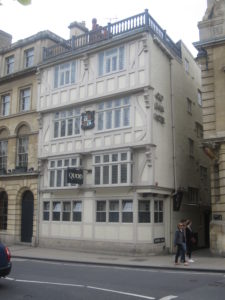
'The Skene Arms', left, in St Michael’s Street, Oxford.

For most of her life, Fifi lived in St Michael’s Street in the centre of Oxford. It’s nickname was ‘The Street of Seven Deadly Sins’. Her home was known as ‘The Skene Arms’, because it was always open to beggars, clergymen, prostitutes, politicians and students. In her Cornhill Magazine article ‘Ethics of the Tramp’ she wrote that like her parrots, men of the road should roam free and never be incarcerated. She braved the wrath of local pimps and drunken husbands by finding refuge for women fleeing prostitution and domestic violence.
Fifi, Tatters and Rev. Algernon Barrington Simeon,
the first Warden of St Edward’s School,
whom she nursed though diphtheria, 1875.
After years of impromptu visits to Oxford Prison accompanied by Tatters, her Skye terrier, Fifi became England’s first official female Prison Visitor. She insisted on complete confidentiality and demanded that male and female prisoners be housed separately, for the protection of the women. On their release, she gave prisoners a hearty breakfast and a reference for employment. She even organised marriages to legitimatize the children of ‘fallen women’. Independently of any political movement, she fought for prisons to be used for rehabilitation; for the abolition of capital punishment; and for the decriminalization of suicide. She also campaigned against female inequality, animal vivisection and religious intolerance. When the Prime Minister, W.E. Gladstone, asked her advice on the new theory of evolution, she told him that Darwin’s discovery was true, and compatible with Christianity. 
Fifi helped found St Edward’s School for the sons of poor clergymen and dug the first sod of earth for its new buildings in North Oxford. With Dr Henry Acland, Fifi trained nurses to deal with cholera and smallpox outbreaks in Oxford. But when she offered her nurses to Florence Nightingale for the war in the Crimea, all but three were turned down for being ‘too working class.’

Fifi, 1821-1899, in old age.


Fifi died of bronchitis in 1899 and was buried in St Thomas Church, near Oxford railway station. A century later the assets of the Skene Moral Welfare Association were redistributed among Oxford’s social housing associations. In old age, Fifi had said of herself, ‘I am like the Martyr’s Memorial – everybody knows me and no-one is interested me.’ Beyond Oxford, she has largely been forgotten, but in 2002 a blue plaque was erected outside her home, now a hostel for single men. The plaque describes Fifi as ‘Prison reformer and friend of the poor’ but there is no mention of her literary achievements.
At times I have felt that my own career, which is split between writing popular history books and international development, confuses people. Great Aunt Fifi demonstrated that a woman can have as many different careers as she likes.
 Some of her titles: Wayfaring sketches among the Greeks and Turks, and on the shores of the Danube by a seven years resident in Greece, 1849. The Isles of Greece, and other poems, 1843. Use and Abuse,  a tale, 1849. The Inheritance of Evil or, The Consequence of marrying a deceased wife’s sister, 1849. The Tutor's Ward, 1851.  The Divine Master, 1852. S. Alban’s, or, the Prisoners of Hope, 1853.  Hidden Depths ,1866. Still and Deep, 1875. Memoir of Alexander, Bishop of Brechin, 1876. Raymond, 1876.  Life of Alexander Lycurgus: archbishop of the Cyclades, 1877. More than Conqueror , 1878. The Shadow of the Holy Week, 1883. A Strange Inheritance, 1886. The Lesters: a Family Record, 1887. Through the Shadows: a Test of the Truth, 1888. Awakened. A tale in nine chapters, 1888. Dewdrops: selections from writings of the saints,1888. Scenes from a Silent World, or, Prisons and their Inmates, 1889.
Saturday, 27 July 2019

Colouring in Oxford by Janie Hampton

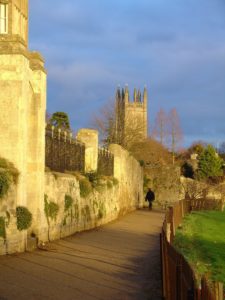
The tower of Magdalen College was built in 1492 beside the River Cherwell
Copyright Janie Hampton, 2019.
The River Cherwell (pronounced ‘Charwell’) flows into the River Thames- but where it flows through Oxford, the Thames is called the Isis! It then goes back to being the Thames until London and then the English Channel. On May Morning, Magdalen choir sing from the top of the tower at dawn. Then drunk students leap off Magdalen Bridge into the River Cherwell. It is shallow enough to punt, so a dangerous pastime. On the left are the Oxford Botanical Gardens, home to many exotic and wonderful plants.
It is far too hot here in Southern England to read much. So here are some drawings of the history of Oxford you may print out. Then go and sit under a tree, or any shadey, cool place, and colour them in. Choose your favourite. Or print out several and offer them to friends, or neighbours. But don't sell them or use them for commercial gain. You can use paint, coloured pencils or felt pens, or a combination of all three. There are no rules for colouring. Use any colour you like, stay in the lines, go over the lines, add your own flowers, leaves and people. The only rule is that you should enjoy doing it. This is not work, or school prep, it is for fun!
Queen Elizabeth I (1533-1603) visited Oxford once, in 1566.
The castle mound in the background is still there. Copyright Janie Hampton, 2019.
In 1566 Queen Elizabeth I (1533-1603) visited Oxford during her annual ‘Royal Progress’ around England. The Queen and her courtiers were entertained by university students with debates, plays and music. She attended discussions at the Church of St Mary the Virgin and closed the final debate herself with a speech in Latin. Five years later in 1571, she founded Jesus College, the first Protestant college. Her father, Henry VIII, had ensured she was well-educated and although she had no children of her own, she paid for the education of many of her 100 godchildren.
Alice Lidell (left) and her sisters Lorina and Edith with ukuleles in 1848.
From a photograph by Lewis Carroll, author of ‘Alice in Wonderland’.
Copyright Janie Hampton, 2019.
The drawing above of Alice Lidell (1852-1934) and her sisters is possibly the first ever photo of anyone playing a ukelele. Though some people dispute these were exactly like ukeleles that we play today. Can you spot the characters from ‘Alice in Wonderland’? 
Stained glass window in Christ Church Cathedral, designed by Pre-Raphaelite artist Edward Burne-Jones (1833-1898) . Copyright Janie Hampton, 2019.
Christ Church cathedral was built on the site of St Frideswide's monastery, which dates back to the 12th Century. Christ Church College, where many British Prime Ministers were educated, was built in 1525, funded by Henry VIII as part of his dissolution of Roman Catholic monasteries and establishment of the Church of England.
Oxford, originally called Oxnaforda, (the place where Oxen could cross the river without a bridge) has been here for over a thousand years. I have lived in Oxford thirty four years this week, and little has changed, apart from more traffic, more visitors and more cafés with wi-fi. It is not often I really look at this beautiful, old city. Doing these drawings made me look, and think, and appreciate. One day I may have enough to make a whole book. But for now, I share a few of them with you, gentle readers. If you like them I shall do some more.

Thursday, 27 June 2019

Greyhound Racing by Janie Hampton


I had laid my bet on a shiny, black bitch called Millicent Magic. She had previously been beaten by Jet Stream Smurf and Boherduff Solas, and that night she ran against Boom Boom Love and Smoothappa Razor. Six sleek dogs stood quietly by their handlers in the dim light of a misty evening. A metal cage lay across the track and the dogs calmly stepped into the back. As a florescent rag zoomed past, the trap opened and whoom! The dogs bounded out, as on springs. Their long, powerful legs and flexible spines took them from 0 to 43 mph within six strides. They hurtled around the track, a blur of legs. One dog tripped and somersaulted across the sand. But he rolled upright and was soon only a few lengths behind the pack.
Image result for greyhound racing painting
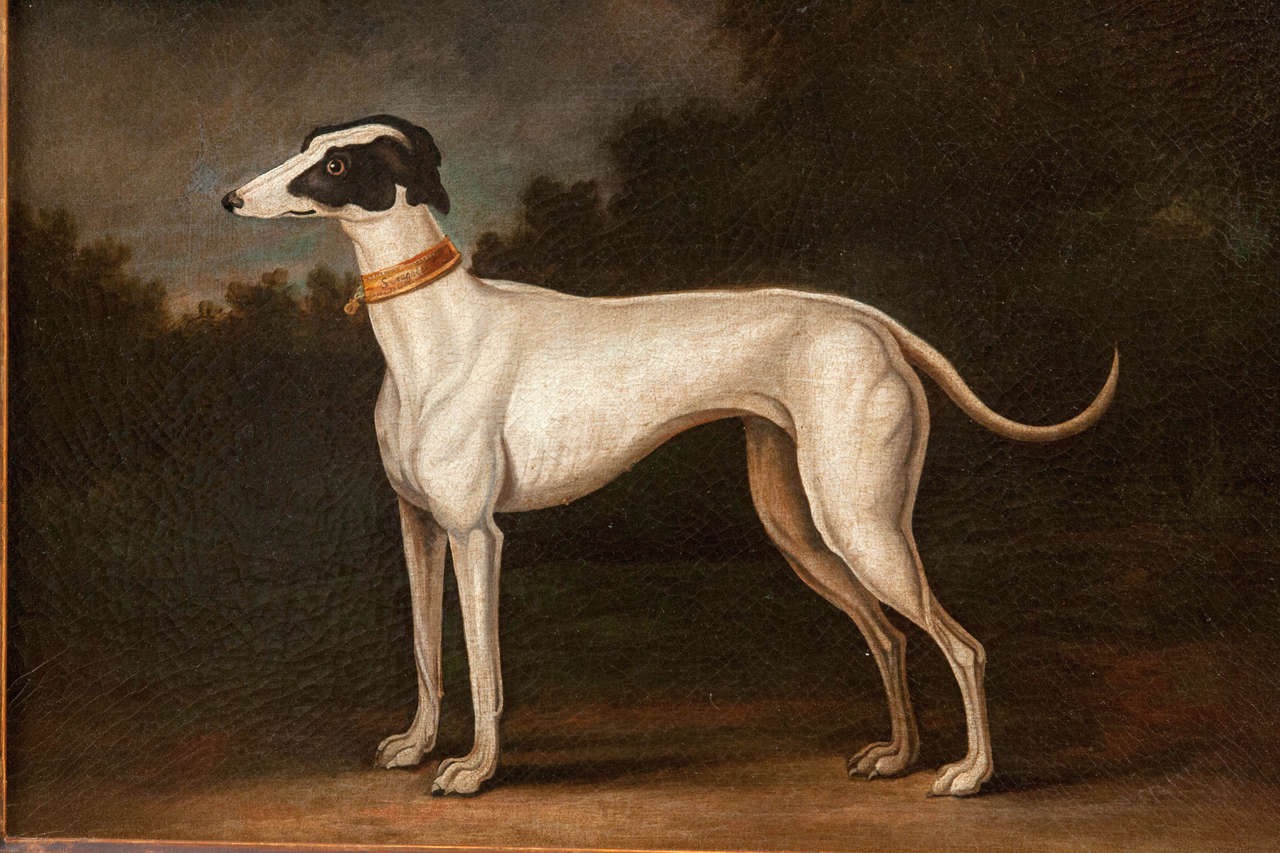
18th century racing greyhound
Less than 30 seconds and 420 metres after they started, there was light applause as the winner flashed past the finishing line. The handlers walked their dogs back to the kennels; their half a minute’s work for the week was over.
My lovely Millicent Magic came last and I lost one pound. Was the trip to Swindon Greyhound Race Track worth a few seconds of excitement? For thousands of people in Britain, greyhound racing has been their world, their life: as trainers, owners, bookmakers, kennel hands and punters.
In 1926, greyhound racing was introduced from the USA to Manchester, England. Within a few weeks over 11,000 spectators attended each Belle Vue meeting and two years later there were 68 tracks around England. There was not much else for the working man to do, and it was a cheap night out.
Giclee Print: Hares and Graces by Harry Woolley Art Print : 24x18in

After a decline during the second world war, there was a post-war boom and 50,000 people regularly attended White City stadium in London. Working men had raced dogs for centuries, and this offered a night out with a bar and the promise of riches.One of them was East-ender Alan 'Ginger' Newman, born in London in 1940. I met him in a café and he told me how he had spent his life in the greyhound racing business as a tic-tac signer and bookmaker in all the 33 London dog tracks. ‘White City, Hackney Wick, Wimbledon, Wembley. Back then you could only bet legally on the track, and I knew all the bookies: ‘Fatty’ Sparks; Obie ‘The Chalk’ Dyer; Big Bertie Pearson; Harry ‘Erroll Flynn’ Saffron; and Tony ‘The Professional’ Morris. You’d always knew when Judah and his brother had lost. They would start screaming at each other. Then one of them would kick the other quite hard. The punters loved it.’
“Jock the Thief” was a regular at the Wimbledon track in the 1950s. ‘He always came with a big suitcase,’ remembers Newman. ‘It was stuffed with razors, shirts, silk ties, ladies stockings, scarves, perfume –things that were difficult to get. He sold them out of his suitcase at knock-down prices but nobody asked questions. By the time the races started he had sold the lot. He then proceeded to lose it all on the dogs. Next week, he was back, with another suitcase full.’

Once legal betting shops opened in 1961, track attendances declined. New clientele were attracted by modern restaurants up in the stands. Roger Moore was starring in The Saint when he took Bette Davis to White City greyhound stadium. ‘She loved it,’ wrote Moore. ‘The idea of being able to dine, place bets and watch races every fifteen minutes from our table was like manna from heaven to Bette. Everybody was so pre-occupied with looking at their racing forms, eating and placing bets that they never paid much attention to us.’ It was one place where humans were not the stars.‘Dogs don’t need much training,’ trainer Gilly Hepden told me. ‘You breed them, feed them, groom them, love them and then say “Go!”’ The dogs walk daily on a lead, and once a week they run 350 metres. ‘They don’t need stamina, they need explosive energy,’ said Daryl Porter, a trainer for over 50 years. His dogs eat cornflakes for breakfast, beef and tripe for lunch and vegetable soup for supper. ‘They know when it’s race day. As soon as they get a racing breakfast, they start to get excited. They may look calm standing on the track ready to race, but their hearts are pounding away. A dog won’t race unless it wants to, they just do it because they love it.’
'Running in field', painting by Charles Hampton. 
The dogs are placed in categories from A1 to A10 and so unlike horses, there is little possibility of a surprise outsider winning. There are six dogs in each race, matched as equally as possible. Dogs are remarkably consistent in their form and eyebrows are raised if a dog runs one third of a second out of its normal speed. The owner keeps the prize money which ranges from £35 to £100,000 for the English Greyhound Derby. A Derby winner can then earn £1,000 a pop in stud fees. So there’s a gamble in the owning too.Winston Churchill described greyhound racing as ‘animated roulette’, the dogs were simply running machines on which to bet, and the business had a reputation for cruelty. But now all tracks employ qualified vets who inspect every greyhound before racing. Dogs start racing at about 16 months and are usually retired by six years. Greyhounds make ideal pets for retired or lazy people as they only need a 10-minute daily walk and sleep up to 18 hours a day. ‘They are loveable, calm couch potatoes,’ said Steve Simmon, owner of retired greyhounds. ‘Easy-going and good with children.’
‘In the old days,’ said Gilly Hepden, ‘rich people raced horses and poor people had dogs. Now dogs are owned by all types.’ A greyhound costs anything from £500 up to £40,000 and then £50 a week to train. ‘You never make your money back, that isn’t the idea. People do it for the love of dogs, and the other people who love dogs.’

Just 21 tracks are open now – the land is often worth more for housing. Over 8,000 people attended the last night of racing at Walthamstow, near London, in 2008. Oxford stadium closed in 2012; and Wimbledon in 2017. Swindon track probably wouldn’t survive without speedway and its indoor market and car-boot sales. However, people in Britain still bet over £2 billion a year on the dogs and owning a greyhound has become so cool even Jools Holland has one.
The author with Dylan, a rescue greyhound-cross, or lurcher.
The Retired Greyhound Trust rehomes nearly 4,000 dogs a year,
funded by a levy from bookmakers.
Back at Swindon dog track, I turned my attention to the next race. For one night I was Bette Davis and Mr Hampton was my Roger Moore.

Greyhound Board of Great Britain
Retired Greyhound Trust
Swindon Greyhound Track
www.janiehampton.co.uk

A version of this article originally appeared in The Oldie magazine.


Tuesday, 30 April 2019

April Competition

To win a copy of Jake Lynch's Blood on the Stone (see yesterday's guest post) just answer the following question in Comments:

“What howlers, anachronisms such as the ones Jake avoided, have you found in a published book?”
Then email your answer to me at maryhoffman@maryhoffman.co.uk so I can get in touch with you in you win.

Closing date 7th May

We are sorry our competitions are open only to UK Followers


Monday, 29 April 2019

Blood on the Stone by Jake Lynch

Our guest for March is one of our rare "History Boys," Jake Lynch.

Photo credit: The University of Sydney
This is what Jake says of himself:

Jake Lynch is Associate Professor of Peace and Conflict Studies at the University of Sydney, and the author of seven books and over 50 refereed articles and book chapters. Over 20 years, he has pioneered both research and practice in the field of Peace Journalism, for which he was recognised with the 2017 Luxembourg Peace Prize, awarded by the Schengen Peace Foundation. He has held Fellowships at the Universities of Johannesburg, Bristol and Cardiff, where he read English Literature and got a Diploma in Journalism Studies. His PhD was from City University, London. Before taking up an academic post, Jake enjoyed a successful career in journalism, with spells as a Political Correspondent for Sky News at Westminster and the Sydney correspondent for the Independent newspaper, culminating in a role as a presenter (anchor) for BBC World Television News. Jake divides his time between Australia and Oxford, where he performs in amateur dramatic productions and runs a local book group. He is married with a teenaged son.

Website: www.jakelynch.co.uk 

Welcome, Jake! 

From fact to fiction


From Boar’s Hill, the poet Matthew Arnold gazed down on Oxford – a prospect that inspired his poem, Thyrsis, with its famous image of “that sweet city with her dreaming spires.” The land was acquired in the first ever purchase by the Oxford Preservation Trust, to ensure the view could never be built out. The final components of Arnold’s skyline were the Georgian Radcliffe Camera, built to house a collection of scientific books, and Tom Tower, designed by Sir Christopher Wren and erected on the St Aldate’s side of Christ Church College, beginning in 1681.

Its transfer from blueprint to physical shape was, therefore, in the planning stage when King Charles II brought the English Parliament to Oxford, earlier in that same year. By then, however, the city’s masons were running short of the limestone whose distinctive pallor imparts the “fugitive and gracious light” celebrated in Arnold’s verse. Headington quarry was all but worked out. Intrigues over building material were a notorious source of local disputes. And they take an imaginative turn to enter the plot of Blood on the Stone, my fiction debut: an historical mystery thriller just published by Unbound Books.

The hero is Luke Sandys, Chief Officer of the Oxford Bailiffs, and the nearest equivalent in the period to a modern-day detective. At the behest of Bishop John Fell, the Dean of Christ Church who commissioned Wren’s Gothic masterpiece, Luke and his deputy, Robshaw, agree to escort a gang of workmen to the ruins of Osney Abbey. From there, Fell hopes to recycle stone from the old walls and cloisters. Their visit is interrupted by Robshaw’s encounter with a ghost. So he believes, anyway – but, as he is suffering a bout of marsh fever at the time, Luke is sceptical.

To choose Oxford as the setting for a novel is to enjoy opportunities for lyrical description – and for on-foot research in areas of the city that have scarcely changed in many centuries. Looking down from horseback on the way across Osney Meadow, Luke notices the snake’s heads, Oxford’s signature flowers, “turning their gorgeously purpled gaze demurely downwards.” The blooms can still be seen today, at this time of year (the picture is from the Thames at Iffley).
In another passage, I try my hand at emulating the many writers who have adapted Arnold’s image and made it their own. From the opening of Chapter One: “It had been one of those Oxford mornings when mist seems to percolate from domes and spires, as if they had been dreamed into existence overnight, and were about to fade away.” I snapped the Bodleian library, with the Sheldonian theatre behind it, in conditions of typical honey-tinged haze.
The Oxford novelist also takes on significant pressures of reader expectation. Never mind Victorian poets – there are plenty more recent literary giants on whose shoulders one is aware of standing. The best-known tradition is, of course, high fantasy – with the outstanding Philip Pullman picking up where the ‘Inklings’, Tolkien and CS Lewis, left off. Then, undergraduate days have inspired such classics as Gaudy Night and Brideshead Revisited. Following Colin Dexter’s Inspector Morse novels is a rich array of gritty, modern-day detective stories. Oddly, though, for a place so steeped in its own sense of history, there are relatively few historical novels: Iain Pears’ clever An Instance of the Fingerpost being an exception that proves the rule.

At any rate, the deep reservoir of local knowledge among the city’s inhabitants underscores the duty to accuracy. There would be no shortage of readers to correct the erring writer! One may take the occasional liberty with the historical record, but only insofar as the ‘feel’ is right. “The past is not dead ground”, Hilary Mantel observed, in a BBC Reith Lecture some years ago; “and to traverse it is not a sterile exercise… the past changes every time we retell it.” The political tensions building as MPs gathered in Oxford in 1681 were real enough, even though my murder victim, William Harbord MP – leader of an extremist group agitating for a ‘crackdown’ on Catholics – quit the city, in real life, with body and soul still together.

John Radcliffe, whose bequest funded the Camera, only actually qualified as a doctor a year after the events of Blood on the Stone, but to have him treating patients, and for that to play a part in the plot, was irresistible – especially given his enduring renown in Oxford, where the local hospital is also named after him. And I don’t actually know whether stone from Osney Abbey ended up in Tom Tower, but it must have gone somewhere: the ruins shrank from the still-substantial structure of the seventeenth century, depicted on the book’s cover, to the single surviving wall of today.

I only just pulled back from the brink of committing some potentially embarrassing mistakes to print. These included anachronistic words. Seeking a metaphor to convey the dangerous qualities, at the time, of non-conformist religious ideas, I described a book on Luke’s office shelf as “theological cordite” – only to realise, just in time, that cordite was not invented until the nineteenth century. There were a few like that. And my blessed editor at Unbound spotted that I was sending the King to watch a performance, at the Sheldonian Theatre, of Christopher Marlowe’s bloodthirsty Tamburlaine the Great: a production so incendiary that it would never pass the censor. In actuality, the court was treated to a bowdlerised version, Tamerlane the Great, by the justly-forgotten Charles Saunders, instead.

In Blood on the Stone, Luke and Robshaw must solve Harbord’s murder before it can be used to ratchet up the sectarian fury of the mob. They must rely on evidence, logical deduction and due process. For those to be set against the bombast of powerful interests, fomenting and exploiting divisions for political gain, is a pattern of many historical detective novels – and, perhaps, one that is of enduring importance in other contexts, in our own time as well.


Saturday, 27 April 2019

May Day by Janie Hampton


'Bringing in branches at Maytime', from 
A Book of Hours by Jean Poyer, 1500

The first of May has been important in our family ever since my grandmother Rachel Gurney was born on that day in 1886. Two years later, her sister Richenda was also born on 1 May. Both survived into their 80s and enjoyed many shared birthday parties.
For over 30 years I have lived in Oxford, where May Morning has been celebrated since mediaeval times with garlands of greenery, dancing and music.
The new growth of Spring has been celebrated in Europe since ancient times: the Romans celebrated Floralia, the Celts observed Beltane, and Germanic peoples had Walpurgisnacht. The early Christian church incorporated the lively pagan traditions involved in  bringing in the May, but by 1250, the Chancellor of Oxford University felt the need to  forbid ‘alike in churches, all dancing in masks or with disorderly noises, and all processions of men wearing wreaths and garlands made of leaves of trees or flowers or what not.’ However Spring is Spring and not easily repressed, so by 1550 in Thame, the churchwardens had again bought fifteen yards of green and yellow fabric and bells to make coats for their Morris dancers. In Abingdon in 1566, the churchwardens‘paid for setting up Robin Hood’s bower, eighteen pence.’ ‘Church ales’, or festivals, were often used as  fund-raising events. The church financed the amusements and sold the ale. Profits then paid for the maintenance of the parish church, and  alms to the poor.
Philip Stubbes’ Anatomie of Abuses (1583) describes how hundreds of people of all ages ran into the woods on May Eve and made merry all night. At dawn they returned with branches of trees, pulled by twenty or forty yoke of oxen, each with a sweet nose-gay of flowers placed on the tip of his horns. ‘Their chiefest jewel they bring home from thence is their Maypole (this stinking idol rather) which is covered all over with flowers and herbs, bound round about with strings, from the top to the bottom, and sometimes painted with variable colours, following it with great devotion. And thus being reared up with handkerchiefs and flags streaming on the top they straw the ground about, bind green boughs about it, set up summer houses, bowers and arbours hard by it. And then fall they to banquet and feast, to leap and dance about it, as the Heathen people did at the dedication of their Idols.’


File:St. George's Kermis with the Dance around the Maypole by Pieter Brueghel the Younger.jpg
St. George's Kermis with the Dance around the Maypole', 
Pieter Breughel the Younger, 16th century. 
Note the drinking bower on the right  
In 1598 there was a May Day clash between Town and Gown in Oxford when youths, including the mayor's son William Furness, fought the University authorities. Nineteen years later, a group of  young men were found guilty of insulting the Mayor by dressing up on May Day.  William Stevenson an apprentice, Frost the cobbler, Peter Short the cutler, Tilcock the painter and Pigeon the chimney sweep were held in the stocks for two hours the next market day, with paper notices pinned to their hats describing their offences.
King James I was entertained by ‘Suites for morrice dancers all lyke with garters of bells’ on his first Royal Progress to Oxford in 1605. He described Maypoles and Morris dancing as ‘harmless recreation’ in his 1618 Book of Sports.
17th-century woodblock from the ballad sheet 'The May Day Country Mirth'
During Oliver Cromwell’s Protectorate , May revels were shut down everywhere. In Oxford, Anthony Wood reported on May Day in 1648 . ‘ This day the Visitors, Mayor, and the chief officer of the well-affected of the University and City, spent in zealous persecuting of the young people that followed May-Games, by breaking of Garlands, taking away fiddles from Musicians, dispersing Morrice-Dancers, and by not suffering a green bough to be worn in a hat or stuck up at any door, esteeming it a superstition or rather an heathenish custom.’
With the Restoration of the Monarchy in 1660, May Games returned, to widespread public  rejoicing, and Wood reported, ‘the people of Oxon were so violent for Maypoles in opposition to the Puritans that there was numbered 12 Maypoles besides 3 or 4 morrises.’
However, to  Thomas Hall, Flora was a heathen goddess. He wrote in 1660, Funebria florae, the downfall of May-games, that Flora was ‘the whore of the city of Rome, in the county of Babylon’. She attracted a pack of ‘ignorants, atheists, papists, drunkards, swearers, swash-bucklers, maid-marions, morris dancers, maskers, mummers, may-pole stealers, health-drinkers, gamesters, lewd men and light women’.
By the late 17th Century, singing from church towers was widespread in Europe, and Oxford diarist Anthony Wood, recorded in 1695: ‘the choral ministers of this House do, according to an ancient custom, salute Flora every year on the first of May, at four in the morning, with vocal music of several parts. Which having been sometimes well performed, hath given great content to the neighbourhood and auditors underneath’. They then processed to St Bartholomew’s Hospital on Cowley Road, with ‘lords and ladies, garlands, fifes, flutes and drums to salute the great goddess Flora and to attribute her all praise with dancing and music.’ This was only abandoned after too many  clashes between Magdalen men and ‘the rabble of the town’.
Hornblowers accompany the May garland, from Hone's Table Book of 1827. 
During the 18th century, boys in Oxford blew horns early on May morning. In 1724, Thomas Hearne writes: ‘The custom of blowing them prevails at Oxford, to remind people of the pleasantness of that part of the Year, which ought to create Mirth and Gayety.’ ‘Whit-Horns’ were made from strips of willow bark wound into a funnel and fixed with hawthorn or blackthorn spines. The reed was made of bark and the mouthpiece pinched to create a primitive oboe. From about 1800, Oxford town boys blew their horns at the foot of Magdalen Tower to drown out the choristers.
May Day outside the parish church Great Tew, Oxfordshire, 1911.
The Victorians forgot about the pagan origins of May Day celebrations as they embraced the myth of Merrie Olde England. Three Victorian men helped popularise May Day: Alfred Tennyson with his poem The May Queen; William Holman Hunt with his painting May Morning on Magdalen Tower; and John Ruskin who taught trainer teachers May Day dances at Whitelands College in Chelsea.
By the early 20th Century when my granny Rachel married a vicar, choosing the May Queen was an important part of the parochial calendar. Once seen as a pagan goddess in human form, she was now chosen not for her beauty, but for her regular attendance at Sunday School!
Grand-daughters and great nieces celebrate Rachel and Richenda's
80th and 78th  birthdays, May 1 1968.  The author is on the far left. 
The people of Oxford still celebrate May Morning, starting at 6 a.m. with Magdalen College choir singing the 17th Century Hymnus Eucharisticus from the Great Tower. Church bells then peal out over the city for 20 minutes, and the carousing begins. In Broad Street the Whirly Band  play 'Rough Music'; Sol Samba perform on Magdalen Bridge; and Oxford's community street band Horns of Plenty in Queen’s Lane. Pubs and cafés are open from dawn.
An alternative May Day was started in 1972 by the sculptor Michael Black (1928-2019). His daughter Chess recalls, ‘Michael built a 30 ft high scaffold replica of Magdalen Tower. A full-size plaster ox was decorated with flowers and filled with beer. The Headington Morris men danced outside the Anchor Pub near Aristotle Bridge.Then the dancers came to a slap-up breakfast at Michael's house, cooked by us daughters! Much more drinking and singing followed.’ This year, there will be a wake for Michael in the form of more dancing, drinking and singing at dawn.

www.maymorning.co.uk   www.dailyinfo.co.uk/mayday

 www.janiehampton.co.uk
.

Sunday, 27 January 2019

Save the Children Centenary by Janie Hampton


Eglantyne Jebb (1876-1928)
This year is the 100th anniversary of the founding of Save the Children, one of Britain’s most notable charitable institutions. It was started by two indominatable sisters, Eglantyne and Dorothy Jebb. Their father was an English land-owning barrister and founder of a literary and debating society, while their mother started a charity for ‘Home Arts and Industries’. Both Anglican parents gave their daughters a keen sense of social justice, and a responsibility to challenge inequality; their French governess Heddie taught them about Prussian oppression; while their unconventional aunt Bun taught them carpentry, fishing and even how to make lead bullets.
As one of the first female students at the University of Oxford, Eglantyne attended meetings of the Christian Socialists and the Salvation Army. The established church did not appeal to her and she felt a close, personal relationship with the God who had chosen her to do His work. She had one complaint ‘which does for every­thing,’ she said, namely: ‘The world is wrong.’ As a young woman she investigated the working and living conditions of the poor, although she was sceptical about the effect of upper-class philanthropy, and her own poor health prevented her from doing much. At the age of 40 her health improved, and the injustices and suffering of the 1914-18 world war provided the motivation she needed. She became a passionate, dedicated and inspiring champion of children’s rights – though didn’t actually like individual children very much.
Dorothy Buxton (1881-1963)
Dorothy Jebb went to Cambridge University and in 1904 married Charles Roden Buxton whose family had been steeped in political campaigning since the 18th century. Both Charles and his brother Noel were radical Liberal, and later Labour, MPs who campaigned against the Macedonian massacres and together survived an assassination attempt in the Balkans. Their great grandfather was the slave liberator Thomas Fowell Buxton MP and their great great aunt was the prison reformer Elizabeth Fry. Dorothy, Charles and their children lived in unfashionable Kennington, London, among the people whose hardships they hoped to alleviate.
During the First World War, Dorothy and Eglantyne were distressed by the demonisation of the German people in the British press. To emphasize the common humanity of all Europeans, they published Notes from the Foreign Press. Dorothy was a member of the radical Women’s International League for Peace and Freedom, and believed that all governments shared responsibility for the suffering caused by war, and were creating a humanitarian crisis across Europe that could not lead to lasting peace. In 1916 she and Charles both joined the Independent Labour Party and became Quakers.
After the Armistice in 1918, the British government continued to blockade German ports, which led to a devastating famine. In 1919 the sisters founded the Save the Children Fund to help humanitarian agencies already working on the ground. They understood that controversy would help to raise awareness, so Eglantyne distributed leaflets in Trafalgar Square showing starving Austrian children. She was arrested, taken to court and fined. However, as well as gaining valuable publicity, she managed to persuade the prosecuting counsel to make a donation.
When Eglantyne asked Randall Davidson, the Archbishop of Canter­bury, to make an appeal on behalf of the children starving in Europe, he showed no interest. So she wrote to Pope Benedict XV. Clare Mulley, a former History Girl and Eglantyne’s biographer, recounts: ‘Pope Benedict had already been impressed by Miss Jebb’s lobbying to end the British economic blockade of Europe after the Armistice. In December 1920, he took the unpre­cedented step of issuing an encycli­cal, Annus Iam Plenus (On Children of Central Europe), in which he asked Catholic churches around the world to collect for Save the Children. It was the first time that the Roman Catholic Church had sup­ported a non-denominational cause.
‘Just before the appeal, Miss Jebb and her colleague Dr Hector Munro, who had witnessed the famine in Vienna, were granted a papal audience. Because she had been brought up in the Church of England, Miss Jebb was nervous about jeopardising the meeting by some slip in etiquette. In the event, her anxiety was forgotten in the drama of the moment: the Pope had fallen behind schedule, and, as Miss Jebb’s appointed slot approached, “The man who was showing us the way turned to us with violent gesticulations,” Miss Jebb later recounted to her sister. “Then he turned round again, and, to my utter amazement, took to his heels and ran. He was wearing a purple flowing garment like a dressing gown, which blew out all around him as he ran, so that he had the odd appearance of a purple ball bounding along the corridor.
“There was nothing for it but to run, too. Grasping my mantilla to prevent it falling off, I ran after him, through one gorgeous antechamber after another, where groups of soldiers and gentlemen-in-waiting turned to look. At last, through an open door, he turned, apparently too breathless to speak, with a wild wave of his arms. Precipitating myself in his wake, I perceived a small lonely figure, like a ghost, standing stock-still in the vast room, and, recollecting that popes always dressed in white, dropped on one knee. To my relief, I found that Dr Munro had run, too, and was making the poorest attempt at a genuflexion that I ever saw.” ‘
Dr Munro was not im­pressed by Eglantyne’s “attempt to curtsey” either, but the Pope didn’t notice. After asking many questions, he donated £25,000 to launch the appeal, insisting that it should be allocated to all children, irrespective of their faith. This prompted Archbishop Davidson to change his mind, and soon many other faith groups, from the Jewish community to the Theosophists, followed. Save the Children became a global appeal on an unequalled scale.
Children starving in the 1921 Russian famine were helped by Save the Children
Although Dorothy had the initial idea for the charity, her radical political activities were well known, and vilified by the right-wing British press. When in 1921 they claimed that Save the Children was aiding the next generation of German militants and Russian Bolsheviks, she handed over the reins to Eglantyne.
Save the Children was soon working in 24 European and Asian countries, assisting children regardless of their nationality, religion or their parents’ politics. In 1924 Eglantyne’s Declaration on the Rights of the Child, was adopted by the League of Nations. It later evolved into the United Nations' Convention on the Rights of the Child, which remains the most universally accepted human- rights instrument in history. ‘Miss Jebb had launched an international aid operation, saved the lives of thousands of children, redefined how child welfare oper­ates, and had written social policy of permanent world significance, all in an era when women did not even have the vote,’ wrote Mulley. Yet like so many successful women, she still felt a failure. Only eight years later, at the age of 52, she died of heart failure.
SCF began working in Africa in the 1930s.
Exhausted by fundraising and campaigning, and haunted by dreams of child famine victims, in 1923 Dorothy had a nervous breakdown. After her recovery, she campaigned on behalf of refugees from Germany and against concentration camps, and in 1935 went there to challenge Hermann Goering. She knew it was probably futile, but felt doing nothing was worse. She died in 1963, aged 82.
SCF assisted children affected by war in Britain, 1939-45 .
Eglantyne and Dorothy rebelled against both class and gender restrictions, and their belief in the importance of humanitarian aid and internationalism remains as relevant today as ever. Save the Children today works with more than 10 million children in 120 countries.
The Woman Who Saved the Children by Clare Mulley won the 
Daily Mail Biographers’ Club Prize. All the author's 
royalties from this book go to Save the Children.

Monday, 27 August 2018

Julie Summers' "Our Univited Guests" by Janie Hampton


Trainee agents on the rope bridge across the muddy River Cam 
at Audley End, Essex. ©Polish Underground Movement 
Oxford writer Julie Summers has written another extraordinary book about the realities of life in Britain during the Second World War. ‘Our Uninvited Guests’ focuses on the people who had to leave their homes and start new lives in places where Hitler's Blitz could not reach them. Oxfordshire coped with over 37,000 evacuees moved from more vulnerable areas of southern England. Nobody then had heard the rumour that Hitler would never bomb Oxford, when Blenheim Palace, about 12 miles up the road from Oxford, was colonised by schoolboys.
When in September 1939, Malvern College in Worcestershire was requisitioned for civil servants, the private school was moved into Blenheim Palace. They brought with them 55 van loads of books, iron bedsteads and musical instruments, including 20 pianos. The laundry was converted into physics and biology laboratories, while the riding school became the gymnasium. The windows of all 187 rooms had to be blacked out so that no chink of light could be seen by the Luftwaffe. The boys slept in the state rooms where valuable artworks were covered with board to protect them from stray darts and ink bombs.
Items transported from Malvern College, Worcestershire to Blenheim Palace, 
Oxford shire, included twenty pianos and 400 beds. © Country Life
Pregnant women from the East End of London were evacuated to Brocket Hall in Hertfordshire to give birth to their babies. Still a splendid house, it had been the home of Lord Melbourne, Queen Victoria’s favourite British Prime Minister. Lady Melbourne had decorated the principal rooms for her lover, the future George IV. Mothers recovering from childbirth slept in hospital beds in the lavish surroundings of the Prince Regent’s suite, stripped of its red and gold pagoda double bed, but not its beautiful Chinese wallpaper. The new born babies were bathed next to the wine cellar in the basement.
In Brocket Hall, Hertfordshire, mothers recover from childbirth in the Prince 
Regent’s suite, decorated in early 19th century Chinese wallpaper. 
© Imperial War Museum 
Summers toured round England and Scotland, finding out the role of Britain's stately homes and country houses. Using extensive research and interviews, she describes in rich detail, life in some of Britain’s greatest country houses which were occupied by people who would otherwise never have seen such opulent surroundings. People from all walks of life often found the splendour and opulence at odds with their needs. The Rothschilds’ magnificent French chateau-inspired Waddesdon Manor in Buckinghamshire, housed one hundred children under the age of five evacuated from London. They ate lobster, rabbit curry, and Woolton Pie - a vegetable recipe named after the Minister of Food, Lord Woolton. Over in Warwickshire, Lord Bearsted moved his bank ‘Samuel & Co’ from London to his country home Upton House. There his 23 employees were provided with wellington boots and ate rook pie.
Coleshill House in Oxfordshire was a 17th Century mansion with no heating, no electricity and water pumped by hand. Recruits to the ‘Auxillary Units’ – a secret band of saboteurs preparing for invasion by Germans - lived in the stables. They each received a crash course in unarmed combat, petrol bombs, booby traps and explosives to attack the invading army’s supplies and transport. At night they roamed the surrounding countryside to practice this art of ungentlemanly guerrilla warfare. Over 600 underground operation bases were constructed all over England for the stay-behind saboteurs to attack from behind. Their whereabouts was top secret. Had there been in invasion in 1940, the life expectancy of saboteurs was estimated to be about 15 days.
Operation bases for saboteurs were constructed
underground and their locations kept top secret. 
‘Our Uninvited Guests’ captures the spirit of upheaval when thousands of houses were requisitioned by the government for the armed forces, secret services and government offices as well as vulnerable children, the sick and the elderly, all of whom needed to be housed safely, or secretly. In Essex, Polish special agents were trained in the grounds of Audley End House, a royal palace in the 17th century. In the old nursery and the extensive woods, they learned the skills needed to make their way back into occupied Europe and carry out sabotage and subterfuge.
I have to confess that Summers and I are friends: we go on regular walks with our dogs on the Thames towpath. We support each other in the trials and tribulations of writing social history – the excitement of new discoveries; the brain exhaustion of writing it into a readable book; and the joy of publication. Our books cover similar periods in European history, so we often share ideas and swap contacts. Once we went to interview the same person together - an elderly woman who was both a WWII evacuee (Julie’s interest) and a Brownie Guide (mine). It was fascinating to witness how we extracted quite different stories from the same person. But I’m not the only person who has enjoyed this book, which has been well reviewed. Craig Brown wrote in The Mail On Sunday, 'Julie Summers has an amazing instinct for unearthing good stories and telling quotes.' 'Summers is a good and knowledgeable writer…powerful, emotional stuff' stated The Independent newspaper, while BBC History Magazine said the books is 'A poignant, lingering account. ' 
A student midwife bathes a new born baby next to the wine cellar
at Brocket Hall, Hertfordshire. © Imperial War Museum 
 Summers is a former History Girl blogger, and her most well-known book is ‘Jambusters’ a history of the Women’s Institute during the Second World War. This inspired the ITV television series ‘Home Fires’ which ran for two exciting seasons. Sadly, we were all left wondering who had died in the final scene of a plane crashing into a house. We had to content ourselves with the knowledge that the people inside were fictional, and not the real members of a rural Women’s Institute. Summers’ latest thought-provoking and evocative narrative captures a crucial period in the social history of Britain.
‘Our Uninvited Guests- the Secret lives of Britain’s country houses 1939-45',
 published by Simon & Schuster, 2018. 
                 Janie Hampton            Julie Summers


Saturday, 11 August 2018

Ghostly Oxford

Who doesn't love a good ghost story? And ghost stories abound in the city of dreaming spires. Now, I've never seen a ghost, but I know people (very intelligent and well-adjusted people) who swear that they have. So I'm willing to keep an open mind.


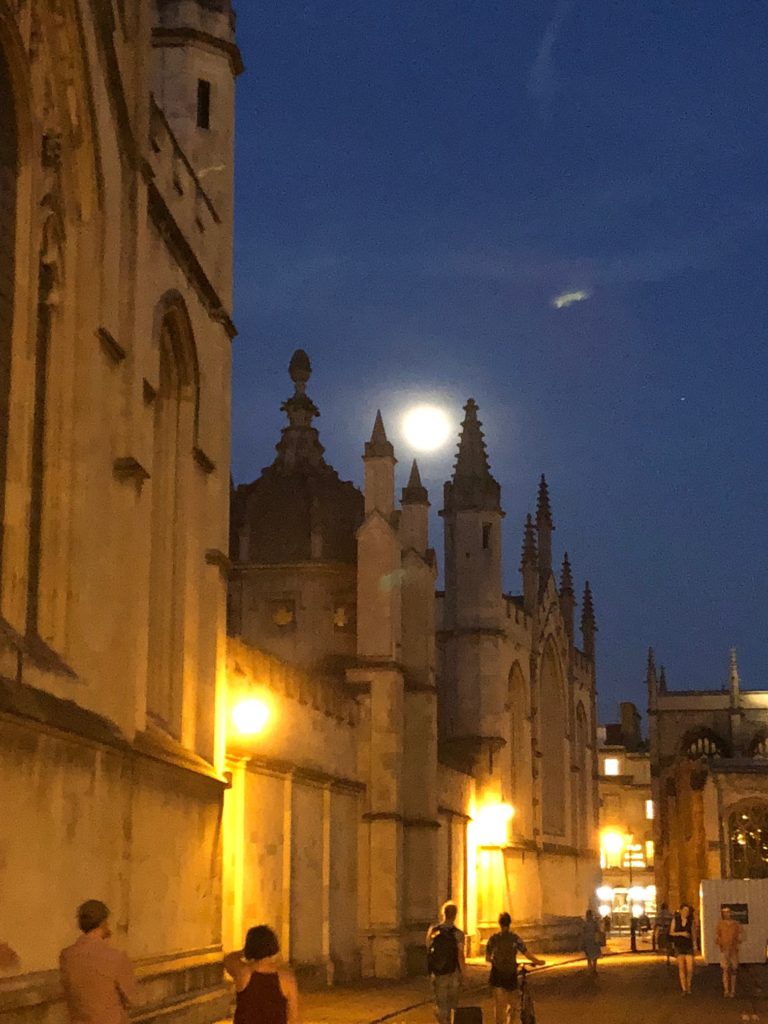
I'm not surprised that there are many supernatural sightings in Oxford. The city is amazingly romantic at night, when the day trippers have left and it is the haunt of students, Oxonians, the homeless . . . and hoards of teenaged foreign language students.


Merton College

Lovely Merton College library (below) has the ghost of poor Colonel Francis Windebank, a Royalist who was executed by his own side in 1645, during the English Civil War.


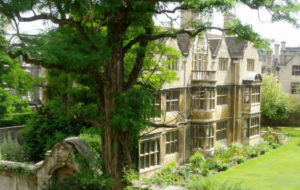
It’s a sad story. Windebank was a young, newly married colonel in the Royalist army  and was appointed governor of Bletchingdon Park, near Oxford (below).  

In April 1645 he invited his young wife and friends for a ball at the house to raise their spirits (not the ghostly kind).  But a Parliamentarian spy may have been present, as during the ball the house came under attack by Cromwell’s forces. 

The house was well protected, and probably could have withstood the attack, but Windebank surrendered immediately. It is likely that he did so in order to protect the lives of his wife and friends.

Windebank went to explain to the King in Oxford (where the King had his headquarters), but his excuses were not accepted and he was tried by a Royalist court-martial for failing to protect Bletchingdon Park.

They took just three hours to find him guilty and sentence him to death by firing squad.

His execution took place against the length of town wall abutting Merton College. Windebank bared his chest to the muskets and exclaimed “God Save the King.”

Windebank’s ghost haunts the site of his execution at Dead Man’s Walk, (above) which abuts Merton College, and has also been seen in the college library.

He’s a well known Oxford ghost, and is thought to haunt because of his lingering feeling of injustice at being executed for what he considered a chivalrous action.

It is also said that Colonel Windebank walks around on his knees. Rational thinkers (?) say that it is more likely that he is walking on the original (lower) ground level of the seventeenth century.


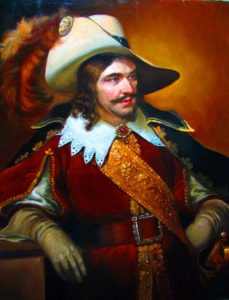
I couldn’t find a picture of poor Francis, but here’s a generic Royalist Cavalier, so if you’re wandering along Dead Man’s Walk, you’ll know what to look for.


Wadham College

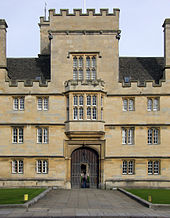
In my husband's family Wadham is known as Wadham-Oh. His uncle was a student there in the '50s and when someone asked him what college he was a member of and he said "Wadham", the inevitable reply was, "Oh."

And yet Wadham is not a new college. It was founded in 1610 by Dorothy Wadham, in accordance with the terms of her late husband's will. She was the first woman not of the Royal family to found a college at Oxford.


The land she chose was originally the site of an Augustinian Priory. In those days its lovely gardens were a series of orchards and market gardens.
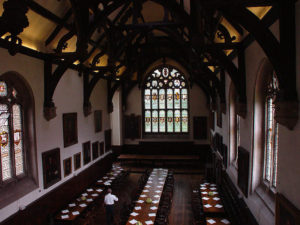
Perhaps this is why Wadham's well-known ghost is thought to be a priest. A white figure in robes walks from the chapel door (in the left-hand corner in this photo) across first quad and into the hall (in the right-hand corner, out of sight), and then across the hall to vanish just in front of High Table (below).

The ghost has been observed over the years by witnesses of veracity, including one head porter and two scouts. And the former Head-Steward, Mr Maurice Howes, would complain on a regular basis of hearing footsteps late at night from his office. They seemed to enter the hall, but never left it...
Augustinian Friar

  
I go to the College every year to see Shakespeare performed in the gardens. This year it was a lively production of Love's Labours Lost. In the interval I went from the garden, past the chapel door and into the first quad to visit the amenities, but I didn't see the resident ghost. 


New College Lane/Queen’s Lane


One of my favourite places at night in Oxford (and during the day) is the atmospheric New College Lane, which becomes Queen’s Lane once past New College. Down this winding lane the cavaliers rode on their way to do battle with Cromwell’s New Model Army.


Sometimes, they say, particularly on a windy autumn evening, you can hear the ghostly hoofbeats… 

And this is what was heard by an Australian tourist, as reported by the Oxford Mail in 2010:
http://www.oxfordmail.co.uk/news/8427740.Tourist_captures_spooky_image_on_camera/


Another tourist captured a ghostly image in that very lane (left). 

I have to admit to feeling a real sense of spookiness if I walk down that lane alone as dusk falls. The wind dances through the winding lane, picking up little sounds and magnifying them. It has a sense of timelessness that is compelling. 


St John’s College

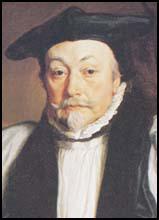
The distinguished College has a most distinguished ghost, Archbishop of Canterbury, William Laud, who was beheaded in 1645, after being impeached by the Long Parliament.

(The Long Parliament lasted from 1640 until 1660, and passed, among other acts, the first Habeas Corpus Act – which as a lawyer gets me quite excited, because a Writ of Habeas Corpus provides that the Crown must “certify the true cause” of imprisonment. It’s one of the fundamentals of English and Australian criminal law).

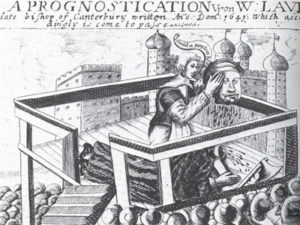
Here’s a particularly horrible depiction of Laud's execution:


Laud was educated at St Johns, and his bones are buried under the altar of the chapel.

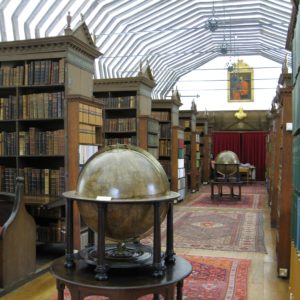
His ghost has been known to disrupt students in St John’s College Library.

Some say he pulls his head from his neck and rolls it at people, others say he kicks it along the floor with a candle in his hand. Here’s the library where he plays football with his head.


Now those who read Harry Potter will recognise the similarity to Nearly Headless Nick. But Laud looks nothing like John Cleese. In fact, I don’t think the Archbishop looks like the ghostly sort, myself. I certainly don’t see him playing football with his head. (I’ve always seen him as an honourable man, on the wrong side of history.)


University College

The wonderfully named Obediah Walker (the ghost who walks – get it!) was the Catholic Master of University College in the seventeenth century.


He tried to follow James I into exile in France but was captured and imprisoned for ten years. When released he was a broken man and his ghost supposedly haunts Staircase VIII (where the Master’s residence used to be).


I could find no picture of Obediah, but here is Staircase VIII,
the place where Walker walks.


Christ Church College


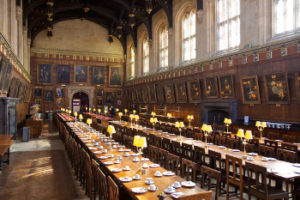
Oxford was a Royalist stronghold during the English Civil War. The King made the Christ Church College Deanery (below) his palace and held Parliament in its Great Hall (right).


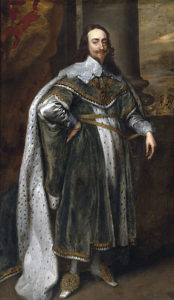
The spirit of King Charles I has been known to appear in the grounds of Christ Church College and in the Great Hall, sometimes with his head, sometimes without.


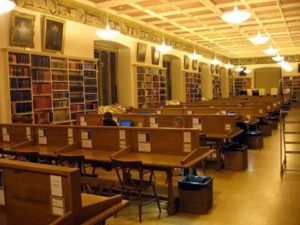
Apparently King Charles also appears in the Bodleian Library. While in Oxford, the King was denied leave to take books from the Bodleian in 1645. He has been seen at night running around in the upper reading room pulling books from the shelves reading one line and placing them back in an endless game of fortune telling, again sometimes with and sometimes without his head.


But that is not why I eschew the Upper Reading Room (above) and always do my study in the Lower Reading Room. I'd be quite chuffed to see a Royal ghost, actually...


Magpie Lane


In the former bank that stands on the corner of Magpie Lane is now the Quad restaurant, and I had a lovely brunch there last Thursday.


Next door is the entrance to delightful Magpie Lane.

The lane leads to Merton Street and is reputedly haunted by the ghost of Prudence Bostock who died of a broken heart when her Cavalier lover ran away. She continues to roam the lane in the hope that he will return.

I've walked down this pretty little lane many times, and never has Dear Prudence come out to play (you have to be a Beatles fan to get that reference!!)