Showing posts with label Catherine Hokin. Show all posts

Friday, 5 June 2020

Beautiful Libraries & Travel Dreams by Catherine Hokin

Like every writer I know, I am wedded to libraries and bookshops and, ten weeks into this strange new world we are now living in, I am missing my regular haunts.

I have two libraries I regularly spend time in - my local university library in Glasgow and the Wiener Holocaust Library in London - and too many virtual ones to count. Independent bookshops in Glasgow are, unfortunately, thin on the ground but Edinburgh is only a hop away and we have a suitably eccentric second-hand bookshop at the bottom of our road that I really hope survives the current closures.

 El Ateneo Grand Splendid Bookstore - Flickr
Travel seems a long way away but I have been digging through the photos and planning trips, and libraries and book stores are always part of the itinerary. Last year, while researching my novel The Fortunate Ones, I was lucky enough to visit Buenos Aires and the incredible El Ateneo Grand Splendid. This bookshop was built in 2000 inside the Grand Splendid Theatre which itself opened in 1919. The shop retains many parts of the original theatre, including the stage - which is now a cafe - the balconies and boxes and even the red curtains. I have never seen a shop like it, and we lost hours in there.

 Washington National Library - my picture
A few months before that, I was in Washington where I almost broke my neck craning for a better view of the magnificent ceilings in the Library of Congress.The decoration is breath-taking, the library is in the Beaux Art style which means it is theatrical and heavily ornamented. It was the largest library in the world when it opened in 1897, and still is. Its collections number more than 170 million items and that number is constantly growing - about 10,000 items are added to its lists every working day.

The Library of Congress is, however, a long way from being the world's oldest library. That honour falls to the Library of Ashurbanipal, which was founded in Ninevah in modern day Iraq in the seventh century BC. The ancient world also housed the legendary Library of Alexandria which attracted scholars from around the Mediterranean until it was destroyed by fire - either in 48 B.C., 270 A.D or at the end of the fourth century depending on which record you read. The oldest surviving library collection - roughly 1800 scrolls - dates from 79 A.D and was discovered in the Villa of the Papyri when Herculaneum was excavated in the eighteenth century. The scrolls were blackened and carbonized after spending so long entombed in the mud and ash left by the volcanic eruption which buried Herculaneum along with Pompei. Much of the catalogue has yet to be deciphered, but studies have already revealed that the library contains several texts by an Epicurean philosopher and poet named Philodemus.

Libraries have always been viewed as an essential part of our world and I, for one, cannot wait to walk into one and breathe that special printed page smell again. We are currently, I think, evaluating many of the things that are important to us, and I hope libraries continue to get the support and funding they, and we, need. In a time of fake news and sometimes too fast news, they have never been more essential to us - libraries provide equality of information and they are the custodians of truth. They are also, many of them, stunning works of art in their own right. I am sure many readers of this blog have their own favourites - Trinity College Library in Dublin is another of mine - but the following pictures are top of my my wish list. As soon as the world opens up again, I'm on my way...

Royal Library, El Escorial, Madrid, Flikr

 George Peabody Library, Baltimore, Wikicommons


Friday, 6 December 2019

From Sinister to Sweet: The Strange Tale of the Nutcracker by Catherine Hokin


A deeply creepy inventor ‘uncle’, a seven-headed mouse, a little girl who tears her arm open on broken glass and a curse which traps first a queen and then a boy inside the misshapen body of a giant nutcracker: what better story to entertain your little ones with this Christmas? 

For the next few weeks theatre foyers will mill with children stickily clutching wands and toy soldiers and waiting to be inducted into the wonderful Christmas world of The Nutcracker, a ballet with far darker origins than their sugar plum fairy and sweetie-filled heads can possibly imagine.

The Nutcracker was first performed on the 18th December 1892 at the Imperial Mariinsky Theatre in St Petersburg, set to music by Tchaikovsky. The book on which this ballet was based - Histoire d’une Casse-Noisette by Alexandre Dumas - was not, however, the original story. That first appeared in 1816, in ETA Hoffmann’s The Nutcracker and the Mouse King

Hoffmann wrote a number of spooky stories that were set to music during the 19th century. One of these, The Sandman which is about about evil inventors who create a robotic girl, appears in the Offenbach opera, The Tales of Hoffmann and likely inspired the ballet Coppelia, in which a young man who falls in love with a life-size dancing doll. The original Hoffmann story, as outlined above, is a complex thing which blurs fantasy and reality. The rodents are cursed, the parents are oppressive and cruel and the little girl at the centre of the story runs away to her nightmare/dream world and does not return.

The Dumas version, which continues to form the basis of the ballet, simplified the plot and made the story rather more gentle. In this version, Clara rejects the fantasy world and wakes up happy and smiling under the Christmas tree, a Hollywood-style ending which was largely the reason for the ballet’s future success. And its success was very much in the future. In 1892, the unimpressed Russian critics called the choreography confusing, the libretto lopsided and the whole experience (according to the St Petersburg Gazette) “the most tedious thing I have ever seen.” After the first Russian Revolution in 1905, the ballet was dropped from the repertoire and, in a twist Hoffmann (and his fan Edgar Allen Poe) may have appreciated, its principal male lead, Sergei Legat, slit his throat.

Many of the Mariinsky dancers scattered across Europe in the early twentieth century and the ballet re-appeared, first in Budapest in 1927 and then in London in 1934. 

It took an American showman, however, to bring The Nutcracker fully back into the light. In 1940, Walt Disney used the entire Tchaikovsky score in Fantasia, bringing the music to a huge new audience. On Christmas Eve 1944 the San Francisco Ballet performed the first complete version of the ballet and in 1954 George Balanchine’s New York production turned the ballet into the classic Land of Snow and Kingdom of Sweets version we recognise today. Where America went, the rest of the world followed: more companies have performed The Nutcracker than any other ballet. In 2015 the Royal Ballet December production was beamed live to 2000 cinemas and, according to Daniel J Wakin of the New York Times, its holiday run “is generally the foundation of an American dance company”.

Why has The Nutcracker become so popular that even non-ballet fans, who would run a mile at a suggestion of an evening with Les Sylphides, are happy to be dragged along? 

Perhaps because it truly is family-friendly: it has parts for over 35 children; a pattern of short, highly-charged dances and watered-down cute mice and dancing toys. Perhaps because, in the words of Isabel McMeekan, founder of Everyday Ballet and a former dancer, it is“the eternal fantasy of Christmas come to life on stage…the girl, the guy, the dream, the magic tree that grows to 7 feet, the glittery snowflakes.” Or perhaps because it has proved so adaptable. As well as traditional outings, there have been hip-hop, LGBT and Jewish versions and, my own personal favourite, Matthew Bourne’s Dickensian orphanage with its pyjama-clad cupids and cast of very wicked sweets (check out the exceedingly sticky Knickerbocker Glory). 

And in that, I think, lies the ballet’s endurance – to paraphrase one supermarket’s ad: however you do Christmas, there’s a Nutcracker for you.

Monday, 22 July 2019

An Appearance of Serenity: Christian Dior & Fashion in WW2 by Catherine Hokin

 V&A Museum: Wikimedia Comons
London’s V&A is currently hosting one of its most sumptuous exhibitions, Christian Dior: Designer of Dreams. It features clothes from the design house’s founding to the present day and, for anyone with even the slightest interest in fashion who can bag one of the gold dust tickets, it is a visual feast.

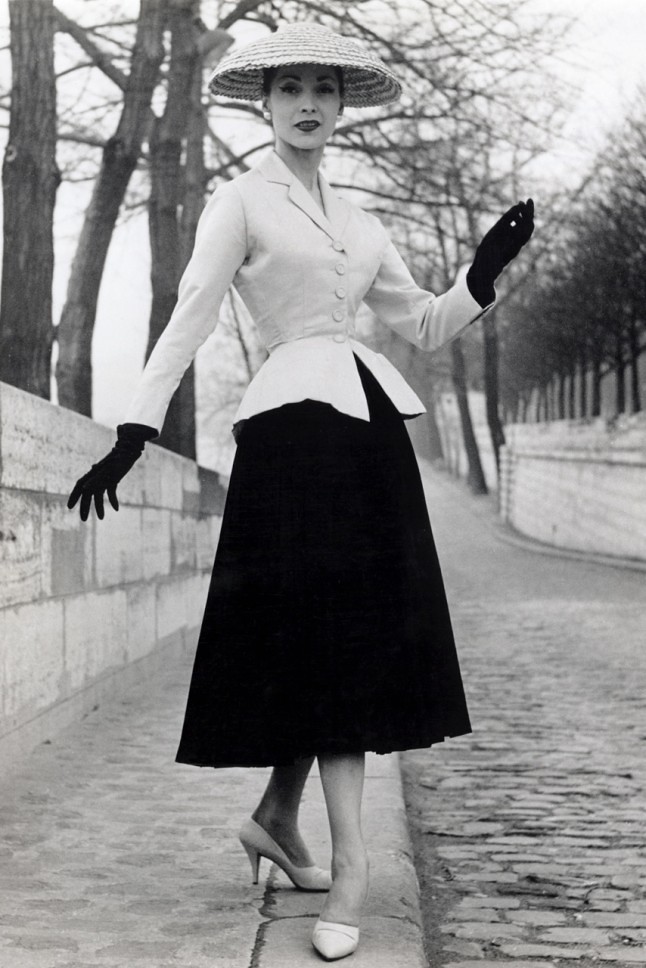
Christian Dior is synonymous with the full skirted, nipped-in-waist fashion revolution launched in 1947 and christened the New Look by American journalist Carmel Snow. At a time when fabric was severely rationed and clothes were plain to the point of austere, his billowing skirts took up to 17 yards of material, required taffeta linings to create their shape and made (in Dior’s words) “flower women” out of the “square-shouldered boxers” uniforms and wartime restrictions had created. Nancy Mitford described the “magic potion” effect of these dresses which were constructed with padding and false hips to give women made thin by rationing the required hourglass shape. Vivien Leigh, Olivia de Havilland and Rita Hayworth were devotees and Dior hosted a private showing of the seminal 1947 collection for the Queen Mother and Princess Margaret. The iconic dress he designed for the Princess’s 21st birthday is part of the current exhibition.

 Carmel evening gown, Andrew Stawarz, Flikr
Dior saw himself as a magician, one of the guardians who would return “French couture … to its traditions of great luxury.” His ethereal creations, in the words of his biographer Marie France Pochna, “brought dreams, drapes and romance back…onto the streets.” The New Look, however, was not universally applauded. One of the criticisms of the current exhibition is that, to quote Rachel Cooke’s Guardian review, “it exists in a bubble”, without context. There were protests in America against styles which were seen as a reversal of the freedoms women had won during the war, under the slogan (coined by the Little-Below-The-Knee Group) “We abhor dresses to the floor!” Closer to home, a 1948 photo shoot in Montmartre’s Rue Lepic led to a model’s dress being torn off by a shortage-hampered public furious at the excess. In Britain, Alison Settle, the editor of British Vogue, was forbidden to even mention Dior by a Board of Trade fearing a run on the country’s restricted fabric supplies. None of this features in the exhibition. Neither does the wider context from which Dior emerged: the fashion industry of occupied Paris.

 Hitler in Paris
An appearance of serenity is a quote from Lucien Lelong, one of pre-war Paris’s leading couturiers, Dior’s mentor (he worked for Lelong from 1941-46) and the man credited for saving the French fashion industry during the German occupation. As with all aspects of the occupation, the story of the fashion industry’s survival is a complex one. The history of WW2 is littered with ruined cities: in May 1940 with the Wehrmacht closing in, Paris could have expected to become the next Warsaw or Rotterdam. Hitler, however, viewed Paris as the model for the Berlin he planned to build. Protecting its culture heritage, albeit stamped with a German ideology, would show the world the National Socialists’ civilised face, and a key part of this culture was the fashion industry.

Germany’s desire to supplant France as the world’s fashion leaders pre-dated WWI. The fall of France in 1940 was seen as the perfect opportunity for this ambition to be finally made good: the first edition of Die Mode, published in January 1941, stated that “the German victory over France has an incisive meaning for fashion.” Other articles continued this theme: the trade publication Manufaktur was quite clear that “the fashion of the past was Paris – the fashion of the future lies with Greater Germany.” The Nazis’ plan, to be put into immediate operation in 1940, was to merge the French couture industry into the German one by physically relocating its ateliers and workers to Berlin and Vienna. Lucien Lelong, in his role as head of the Chambre Syndicale de la Haute Couture (the industry’s official body) was informed of both this and its alternative: the total suppression of the industry. Lelong, argued, and kept arguing, that the industry’s 20,000 workers and fragmented supply chain could not be uprooted and transported and survive. For whatever reason – whether (as he claimed) it was Lelong’s persuasive skills or the pressures of the Battle of Britain and the opening Russian Front – the Nazis dropped their demands and the French fashion industry was left to be just that.

 Dior's New Look Paris 1947
Haute Couture survived in Paris, albeit with mixed fortunes. Lelong continued to show collections as did Jacques Fath, Marcel Rochas and Nina Ricci. Coco Chanel became a supporter of the Vichy. Other designers, including Mainbocher, left. By 1944, 12,000 people still worked in the industry and over 60 salons remained open. The question of collaboration remains a thorny and nuanced one. Lelong remained vocal in his view of fashion’s importance in giving “France an appearance of serenity…the more elegant French women are…the more our country will show…it does not fear the future.” Schiaperelli likened fashion to resistance: every hat that used up material was “a slap in the face of the Nazis.” Berlin appeared to view occupied Paris as a fashion bread-basket: over 200 Nazi wives acquired special permission cards to buy fashion from its salons. Lelong was tried for collaboration at the end of the war but acquitted, ruled to have only co-operated minimally to save jobs and France’s cultural heritage. He stayed in Paris long enough to celebrate his protégé Dior’s 1947 collection but then retired due to ill health.

It is not surprising that Dior, the dreamer and magician, would launch a collection with such a romantic view of the world; it is not surprising a glamour-deprived world, largely, fell in love with it. It is the V&A’s choice to stage an exhibition where context is outside the remit. But it’s a shame. Fashion doesn’t exist in a bubble: from dandies to punks it reflects the world it comes out of and its story runs deeper than simply paying homage, no matter how beautiful the dresses might be. For anyone wanting to read wider than the skirts, can I recommend Nazi Chic by Irene Guenther which tells the story of both Germany and Paris and makes fascinating reading.

Saturday, 22 June 2019

Wedding Lintels & Marriage Customs by Catherine Hokin


 Marriage Lintel from 1610, Falkland
I have developed a couple of new obsessions since moving to Scotland six years ago, not all of which revolve around whisky. Moody looking castles are up there, as is the tooth-destroying confectionery known as Tablet, but the one currently leading the pack is hunting for marriage lintels.

A marriage lintel (also known as nuptial, marriage or lintel stone) is a carved inscription above the doorway of a house owned by a newly-married couple. They are a feature of the east coast of Scotland and date primarily from the sixteenth to the eighteenth centuries - the one pictured from 1610 is one of the best examples and commemorates the marriage of Nicol Moncrief, a servant of James VI. All feature the year of the wedding and the couple's initials and some also include pictorial details - there is a particularly lovely one on what is now known as the John Knox House on the Royal Mile in Edinburgh, commemorating the marriage of goldsmith John Mossman to Mariotta Arries.

 Stone from 1801
The lintels serve as a record of a marriage and the joining together of two families, who were often aristocratic or monied. Lintels could be added to a building which was built specifically for the married couple, or were carved into a pre-existing lintel. They were always set over the main entrance and some also appear inside houses, above the most visible fireplace. Wherever they were placed, they were meant to be seen: perhaps we should think of them as an early form of social media - Mr and Mrs Smug-Married boasting about their updated status and their swanky new home. 

There is, unfortunately, little information about the lintel stones beyond what they symbolise - or little I can find. There's no list of the surviving stones (although Wikipedia cites some examples if you want to go hunting) and, as you can see in the third photo, many have become detached from their original position. 


The custom of marriage lintels had died out by the end of the nineteenth century, as have some of the other traditional Scottish practices. Grooms are no longer expected to carry a creel (a large basket) filled with stones around the village until their bride releases them from their burden with a kiss. Brides might still find themselves standing to the groom's left but hopefully no one is still doing it because the 
bride is the ‘warrior’s prize’ who the groom needs to hold with his left hand so he can fend off her family and other foes with his right. Similarly presenting swords from one family to the other as a sign of extended protection and acceptance isn't regarded as quite so crucial anymore.

 A quaich
Some customs do, however, continue. Although grooms aren't necessarily required to bring 'siller' (silver coins) to the ceremony anymore, a traditional wedding will still involve a scramble - throwing coins in the air for the children to collect. Wedding walks still take place, where the wedding party walk to the church preceded by a fiddler. Whether they have to turn around and start again if they meet a pig or a funeral as the rules once dictated is presumably a matter of choice these days, or very bad luck. Many couples still use a quaich, a two-handled 'loving cup' for the first toast to symbolise the joining of their lives. This tradition stems, as many of these practices do, from clan customs: the quaich was once used by two clans to celebrate a bond between them, with each leader sharing the whisky it contained. In a similar vein to sharing the quaich, some couples will still 'pin the tartan' - swapping rosettes to show that both husband and wife are accepted by the other's families. For anyone wanting to delve further, there are some excellent oral histories here, including blackening, the breaking of the bride-cake and betrothal customs. 

 The Goddess Juno
Where Scots have broken with custom is the wedding date. Traditionally the most popular auspicious month to marry was June - this was partly because the goddess Juno (for whom June is named) was the protector of women, particularly in marriage and childbearing. On a more practical note, others chose June in order to time conception so that births wouldn’t interfere with harvest work. Last year, however, the most popular month in Scotland was September - no doubt because this is the one month of the year when the weather is at its most predictable. A Scottish June bride needs a dress that co-ordinates with wellies, an umbrella and, this year at least, a winter coat! 

If you and yours are struggling to choose the right month for an upcoming ceremony, perhaps this poem might help. The message about May does seem rather clear...

Married when the year is new, he’ll be loving, kind and true.

When February birds do mate, you wed not dread your fate.

If you wed when March winds blow, joy and sorrow both you’ll know.

Marry in April when you can, joy for Maiden and for Man.

Marry in the month of May, and you’ll surely rue the day.

Marry when June roses grow, over land and sea you’ll go.

Those who in July do wed, must labour for their daily bread.

Whoever wed in August be, many a change is sure to see.

Marry in September’s shrine, your living will be rich and fine.

If in October you do marry, love will come but riches tarry.

If you wed in bleak November, only joys will come, remember.

When December snows fall fast, marry and true love will last.

–Anonymous

Which ever you go with, have the happiest day and, in the words of this Scottish blessing: May your blessings outnumber the thistles that grow and may troubles avoid you wherever you go. Now let's see if you can still recite that when the bills come in... 

Wednesday, 22 May 2019

The Beginning of the Wars of the Roses? By Catherine Hokin

Anyone who cares about history is obsessed with dates. We locate rulers with them. We decide what's historical and what's too close to our own lifetime to dare creep into that camp with them. As historical fiction writers we frequently weep over them and wish we could smudge a birth date here or a battle there to make our plot lines work. But how many, to borrow a phrase from 1066 and All That, can we trust are genuine - is it, as Misters Sellars and Yeatman would have it, really only two, reduced from four as two weren't memorable?

 Warren Field Lunar Calendar: University of Birmingham
Trying to keep track of the time goes back almost to the dawn of it. The first formulized calendars date from the Bronze Age, but the title of 'world's oldest calendar', awarded in 2013 (more than three sources quote this date so I'm going to accept it) goes to an arrangement of twelve pits and an arc in Warren Field, Scotland which is approximately 10,000 years old. The oldest-still-in-use award is claimed by the Jewish calendar which was introduced in the ninth century BC. 

 The Lost 11 Days: Today in History
Baked into the development of all our measuring systems is the differing lunar year (354 days) and solar year (365 days). The Roman Calendar, 45 BC, introduced the concept of leap years to try and solve this mismatch. By the time the Gregorian Calendar was floated in 1582, the Roman's miscalculation of the solar year had thrown the seasons, and therefore Easter, out of sync. Pope Gregory's attempts to solve this involved changing the leap year system to a new calculation based on years divisible by four rather than an extra day every four years. Or something on those lines that defies my understanding. Anyway it obviously worked because, as we all know, Easter is now an immovable feast. Not everyone liked the changes: Germany resisted the swap until 1700 and England, as warm then to the idea of European regulations as it ever was, stuck it out on the old system until 1752. By this point the seasons were so messed up, Parliament took the rather fabulous decision to advance the year overnight from September 2nd to September 14th, thus removing 11 days at a stroke. Take all this into account and is it any wonder that the dates we choose as significant can sometimes feel more like a collective act of will than a fixed and certain point?

 Assassination of Franz Ferdinand
Which brings me back, finally, to where you might have thought this article was going: the beginning of the Wars of the Roses. Dating the start of conflicts is always a troublesome thing. I remember my confusion at school after being initially taught that dates were absolute and then being introduced to the Hundred Years War. Rounding down its extra 16 years seemed to offend both the laws of History and Maths. That the conflict was a series of wars and didn't even attract that name until the nineteenth century was a revelation left for university, by which time I was, luckily, a more cynical creature. If the Thirty Years war lasted longer than the 1618-1648 timeline given to it, I don't want to know.

Perhaps the problem goes back to our need to define the reasons for a key event in a way that can be regurgitated in an exam format. Four causes good, one cause even better. The start date for WWI is recorded across all common sources as 28 July 1914, when Austria-Hungary declared war on Serbia. If asked, I would guess most people would state the main cause as the assassination of Franz Ferdinand - or, as Baldrick so beautifully puts it in Blackadder Goes Forth, when 'Archie Duke shot an ostrich because he was hungry'. That act has become our shorthand for all the colonial and dynastic disputes that went before. Similarly we start WWII on 1 September 1939 with its blitzkrieg images rather than the 1938 Anschluss, or the 1933 Nazi rise to power, or the end of WWI...  Obviously only the world's biggest bore would refuse to accept the commonly-agreed answer and we'd soon lose the pub quiz and all our mates if we disputed every date. The narrative of remembering is however, as always, in the victors' hands.

 Henry VI Part One
Today, May 22nd, is the anniversary of the First Battle of St Albans, fought between the rival houses of York and Lancaster in 1455 and commonly given as the starting point for the Wars of the Roses. The battle itself was a short-lived thing, lasting less than an hour and without major casualties (in context of the engagements that would follow), apart from Edmund Beaufort, Earl of Somerset who was killed. Its consequences, however, were widespread. The alignment of Somerset with the House of Lancaster led not only to his but to the death of all his male heirs, ending the House of Beaufort. The bravery displayed by the Earl of Warwick began the myth-building around him which led to his 'kingmaker' title and his later over-reaching. King Henry VI's capture paved the way for the Duke of York to reclaim his position as Protector of England and take again the controlling hand over the kingdom the Lancastrians had only just seized back following the King's prolonged period of physical and mental incapacitation. And the Yorkists won, so they liked to remember it.

The battle started the openly bloody phase but it did not start the civil war. The origins of that go back to the eleventh century and the first Plantagenet king, Henry II, and his battling brood. No one sat comfortable on the throne for two hundred years and then, in 1399, the key split came: the deposition of Richard II by his cousin Henry Bolingbroke, the future Henry IV. That particular tussle split an already hostile family into two competing branches (the Lancastrians following Henry's line and the Yorkists from Richard) and the original Game of Thrones began. What finally tipped the dynastic feuding into full-blown conflict? A weak king. The saintly Henry VI with his catatonic illness was, by any measure, unfit to rule. Pair that with a strong man in opposition (Richard, Duke of York), a Queen with a long-awaited heir and no intention of relinquishing power (Margaret of Anjou) and all the fortunes tied up in aristocratic privilege and it's little surprise that a war erupted. And our shorthand for all that is the First Battle of St Albans. (And yes, I appreciate that's a whirlwind tour but there's a lot more detail in my novel, just saying). Perhaps the next question should be when did the civil war end? Easy: 1485 and the Battle of Bosworth. Except, of course, it didn't - the ramifications were still shaking the throne when the Tudors climbed on it. 

Mary Beard's Twitter Challenge
Causes and dates. We need them to make sense of where we are in the world and what brought us here but they aren't always reliable. A few months ago, Mary Beard asked her followers on Twitter to set future exam questions on what got us to Brexit. The answers were depressingly entertaining. A Level, 2069: Summarise the latest plan for Britain to exit the EU. Discuss the shifting relationship between Britain and Europe, using examples from 6200 BCE, 55 BCE, 43 CE, 410 CE, 865, 1066, 1534 and 2016-2019. To what extent did Brexit mean Brexit? My particular favourite was the short and to the point: When did Brexit End? Hopefully we can all agree on a date to that soon.

Monday, 22 April 2019

Living Memorials: Sachsenhausen Concentration Camp by Catherine Hokin


And I know one thing more - that the Europe of the future cannot exist without commemorating all those, regardless of nationality, who were killed at that time with complete contempt and hate... Andrzej Szczypiorski, Prisoner 

The above quote appears on the wall at Sachsenhausen, a
 Sachsenhausen main gate
concentration camp on the outskirts of Berlin whose liberation took place seventy four years ago today, on the 22nd April 1945. I visited the camp a few months ago as part of a research trip. It was, of course, a deeply unsettling experience - like any of these facilities, no matter how much you read before you go, you are not prepared for the emotions they engender.

The first thing that is difficult to comprehend about Sachsenhausen strikes you before you get to it: this is no isolated space tucked away from prying eyes. The camp is situated in the small town of Oranienburg, 22km or less than an hour's train journey from the centre of Berlin. High-ranking officers lived in mansions around the perimeter and a large SS housing estate bordered the camp - local girls married the men who served there and families lived backing onto the walls and within earshot of the camp's brickworks and shooting gallery. Prisoners were marched through the town between the camp and forced labour details and there are accounts of the residents closing their doors and shutters at the sound of marching feet. The Camp Commandant's office was landscaped with trees and a duck pond and the barracks for the guards were surrounded by gardens. It is almost surreal how much part of the local fabric the camp was and how much of a village feel was created for the men who ran it. 

 Plan of the camp showing its triangular shape
Sachsenhausen was established in 1936 and was initially used to imprison "undesirables" during the prettifying of Berlin that formed the background to the 1936 Olympics. Between then and 1945, over 200,000 people were interned there, including Jews, Sinti and Roma, homosexuals, “career criminals” and “antisocials”. By 1944, about 90 % of the internees were non-Germans, primarily citizens of the Soviet Union and Poland. The camp quickly became the model of what the National Socialists believed a concentration camp should be: an expression of absolute power. The barracks' triangular placement, fanning out from the parade ground, means that every aspect was overlooked by a huge machine gun set on top of the gate. If the prisoners faced the other way they were confronted by a gallows and the roll-call area is bordered by a running track where shoes were tested on a variety of materials, including cinders and cracked stones, by men carrying heavy packs of sand on their backs. Few survived this treatment for more than a matter of days. Visitors (including the industrialists who used its forced labour) were offered tours, the SS were trained there and, in 1938, the “Inspection of the Concentration Camps”, the central administrative office for all concentration camps in the territories controlled by Germany, was moved here.

Due to its proximity to Berlin, Sachsenhausen was a key
 Memorial to the dead
forced labour camp. As well as the details in the camp itself, prisoners made up the workforce for the massive Klinkerwerk brickworks on the nearby lock, as well as the munitions factories operated by AEG and Siemens. By 1942, more than 100 satellite details and satellite camps worked out of Sachsenhausen. Tens of thousands of internees died from this forced labour, or from hunger, disease, and the medical experiments which were a feature of the site. In addition many were deliberately murdered, either in a specifically-built  “neck shot unit” (the fate of 13,000 Soviet POWs in 1941) and, from 1943, in a purpose built gas chamber. When asked at his trial why he introduced the mass extermination facility, Commandant Anton Kaindl responded "because it was a more efficient and more humane way to exterminate prisoners." On a busy day with school parties everywhere on site I have never been anywhere so silent as the remains of that chamber.

In 1945, with the war nearing its end, Sachsenhausen,
 Prisoners, Sachsenhausen
along with the rest of the camps, was cleared. In February an SS special unit headed by Otto Moll murdered 3,000 internees who were considered dangerous (which could mean because they had military training) or were declared unfit and another 13,000 were taken to be killed at Mauthausen and Bergen-Belsen. On the 21 April more than 30,000 remaining internees were marched off on Death Marches towards the north-west, the intention, according to Kaindl's trial transcripts, being "to drive them onto barges out to sea and let them sink." The number who died remains unknown. On 22 April 1945, units of the Soviet and Polish armies liberated the 3,000 prisoners left behind due to sickness. 300 of the camp’s former inmates did not survive their liberation and died, and are buried, there.

 Soviet barracks for German prisoners
This, however, was not the end of Sachsenhausen's story. From August 1945, Sachsenhausen became Special Camp No 7: an internment camp for German officers and political prisoners held by the Soviet Union. By 1948, the site, by now renamed Special Camp No.1, was the largest of three special camps in the Soviet Occupation Zone which together held over 60,000 prisoners. Information at the site describes the conditions during this period as inhuman: "Hunger and cold prevailed in the Special Camp. The inadequate hygienic and sanitary conditions and the insufficient nourishment led to disease and epidemics." By 1950 when the camp closed, another 12,500 men were added to the role of Sachsenhausen's dead.

The first memorial at Sachsenhausen was inaugurated in 1961
 The red triangle memorial
by the pre-reunification East German government. In line with their thinking, the main emphasis then was on the role of political resistance. An obelisk was erected in the middle of the site which carries 18 red triangles, to commemorate the 18 nationalities of the political prisoners held there between 1936-45. Post reunification, along with other sites of this nature, the emphasis was on the victims who suffered and died. That two systems remembered Sachsenhausen in different ways caused problems for the site and how it was to be used and there are still visitors today who find the juxtaposition of Soviet and German memorials complicated. It is, I think, to the site's credit that the question of what it exists for is still under scrutiny. The historian Gunther Morsch, a previous director of the Sachsenhausen memorial and museum, has been very vocal about the need to re-examine how we approach these places, particularly in a political climate which is seeing a rise in populism and the right. "We want to keep honoring the victims. And most exhibitions are about their fate. But it has become clear that the emphasis must be shifted to the perpetrators' motives and the structures that enabled these crimes to be committed. More and more visitors were rightly asking, "How could such a thing happen?" and "Is it possible today?" Unfortunately, the second question had to be answered in the affirmative, because "National Socialism actually showed in its most radical form what people are capable of – even today." 

Sachsenhausen does not shy away from exploring the systematic extermination policy of the Nazis and its impact on individuals. The site is full of personal testimony which makes the numbers real and an art exhibition by former inmates which is both heart-breaking and hopeful. It is a brave place to visit - both for what it is trying to tell and what it demands from its visitors. If you go, don't take a tour - they'll whisk you through and serve you a potted version. Get the train from Berlin and walk from the station, it's horribly close. I spent a day there, too much in some ways, not enough in others. I wish I could go back and drag everyone who doesn't get the need for humanity and a united Europe with me. I defy even the toughest nut not to crack.

Friday, 22 March 2019

Stories From the City of the Dead by Catherine Hokin

Going out-out - the big night out that demands special clothes and a day off to recover - is one of those phrases I would never willingly use (along with party as a verb). I am, however, now tempted to declare that I've just been on a holiday-holiday. I've spent the last year working on a WWII story set partly in Buenos Aires (it's out on submission, send kindness) not knowing that, while I was in the thick of researching it, my OH was planning a surprise trip. Yes, he's a keeper. I've just returned and would go back in a heartbeat. Buenos Aires is an astonishing city bursting with contradictions. It is part of a once-colonised country with a love of all things European; its public history is both extravagantly told and tightly controlled, masking a troubled, hidden past; it harbours real poverty against architecture that will make your jaw drop. It could spawn a thousand blogs (if that book makes it, it will) but I'm going to focus here on the famous Recoleta Cemetery where we went for a couple of hours and lost a day.

The cemetery covers over 13 acres and, although the surrounding land was once orchards and fields, it is now situated in the middle of one of the city's priciest neighbourhoods. The cemetery takes its name from the monks of the Order of the Recoletos and is built around their convent and a church (which can both be visited) dating from the 1730s. The cemetery itself opened in November 1822, after the monks had been expelled, and was opened to all religions after 1863. Inside its high walls there are over 6,400 statues, coffins and crypts, and some 30,000 inhabitants. It is laid out in blocks, with narrow sidewalks branching out from wide walkways. The mausoleums are built from marble in a variety of styles including art deco, art nouveau, baroque and neo-gothic, each style grouped together and adding to the sense that you are wandering through a city's neighbourhoods - some of which are more up-and-coming than others. Many of the buildings have glass fronts and coffins above ground as well as below and the state they are in varies considerably. A grave in Recoleta is bought for eternity: even if the annual fee for maintenance isn't paid, it won't be cleared. Several of the older tombs have been shored up but are crumbling and the coffins that are visible lie under thick layers of dust. Some, however, are still used and gleam with polished glass and starched cloths. 

The cemetery is, of course, full of stories which run the full gamut from the personal to the political. There are generals on every street, surrounded by plaques commemorating their long-forgotten victories. It has a resident ghost - a grave-digger who worked for 30 years saving money for his own plot and statue and killed himself once the architect finished the work, walks round at dawn jangling his keys and unable to leave. There is also a great statue of a couple who fought so much in life their effigies are now placed back-to-back.

Rufina Cambacere
However, as befits a place where you feel quite certain Edgar Allen Poe would have thrived, the most tragic (and popular) stories centre round beautiful young women. The story of Rufina Cambacere is actually the stuff of nightmares. Having been taken ill at her 19th birthday party, either with a heart problem/an epileptic fit/because she found out her mother was having an affair with her boyfriend (the stories all have stories) Rufina was buried in a beautiful marble tomb. Unfortunately the poor girl wasn't dead. Screams were heard on the night of the burial and, when the groundsmen plucked up the courage to investigate the next morning, the coffin had moved and poor, now dead, Ruffina was all covered in scratches where she had clawed at her face and throat. This incident is credited with leading to an Argentinean law stating that a body cannot be buried any earlier than twelve hours after the death certificate has been signed. Why it prompted her parents to add a statue of the poor girl emerging alive out of the tomb is anyone's guess. 

Another cemetery favourite is the tomb of Liliana Crociati. Although the bronze statue looks far older, this mausoleum in fact dates from the early 1970s. 

  
 Liliana Crociati de Szaszak
The young Liliana met her end on her honeymoon aged 26 when an avalanche swept over her hotel in Innsbruck, Austria and she died of suffocation. Rumour has it that she and her dog Sabú were so attached to each other that he died in Buenos Aires at the same time. The tomb, none of which is visible at ground level, is apparently a reconstruction of Liliana's childhood bedroom. That and the statue of her in her wedding dress patting Sabú was paid for by her grief-stricken parents. Interestingly there is no mention anywhere of the widowed groom. As you might be able to tell from the photograph (apologies for the quality, it was a very bright day), the green patina has been completely worn off Sabú's nose because visitors nowadays rub it for luck. 

In Buenos Aires, Recoleta Cemetery also goes by the names the City of the Dead, the City of Cats and the City of Angels. Although it was the only place in the city where we actually saw a cat, Angels are really the place's emblem. They are everywhere although you need to crane up to see most of them. Some represent the Angel of Death and carry an hourglass, many carry trumpets or baskets of flowers; without exception they are beautiful and every face looks different. Which accounts for why we lost a day there.

Recoleta angel
There is one grave I haven't mentioned although many visitors flock to it clutching their flowers to poke through the gates and that is the one belonging to Eva Duarte Peron. Although Eva died from cancer in 1952, her body only arrived in the cemetery in the 1970s and the story of what happened to her body in the intervening years is as shrouded in myth as her life. A great mausoleum was planned following her death but the overthrow of her husband, President Juan Peron, in 1955 led to all references to Peronism in Argentina being erased. Eva's embalmed body disappeared - its alleged hiding places including a storage container labeled radio parts at a Buenos Aires military intelligence office and a graveyard in Milan - until Peron was restored in 1971 and brought the body back to Madrid. According to the (many and lurid) stories, he then stored the coffin in the dining room of the house he shared with his third wife, frequently opening it to look at Eva's preserved face. After Peron's death in 1973, it was left to his wife Isabel (who was now President) to take over control of the body. She had it interred in the presidential place, most likely to shore up support for her own power grab as Eva's name was now in the ascendant again. When Isabel herself was overthrown in 1976, Eva's body was turned over to the Duartes who were, by then, keen to acknowledge their illegitimate family member. Eva's mother was the mistress not the wife and she was turned away from all claims on the family estate when the wealthy Juan Duarte died. Its interesting to speculate what might have happened to Eva if the Duartes had been a little more welcoming in the 1920s - presumably not the harsh choices grinding poverty left her with. Eva is now interred in their crypt at Recoleta where her body is buried 5m below ground under two trapdoors and three plates of steel to prevent any further threat to it - Eva continues to be a controversial figure in Argentina, both despised for her brand of politics and worshipped to the point of a cult. Being in the former group, we gave that particular tomb a swerve and went back to the maze of mausoleums and angels we could more comfortably admire.

My advice if you visit - don't take a tour, do what we did and get lost. And then go to the barking mad cafe over the road and sit at a table with a frighteningly realistic Borges. They don't let go of their dead in Buenos Aires.

Friday, 22 February 2019

How Fictional is your History? by Catherine Hokin

We're having something of a surge in historical fiction films at the moment. You can lose yourself in the politics of medieval or Tudor Scotland with Outlaw King and Mary Queen of Scots, or the excesses of the eighteenth court with The Favourite. If the racial-tensions of 1960s America are more your thing, there's Green Book or you can loop back round to politics with Vice - which I'm including here as it covers Dick Cheney's early life and therefore slips in past the 30 year HNS rule for classifying a work as historical fiction. A little tenuous perhaps but that is rather my point...

 Robert the Bruce - Chris Pine would be preferable but
not Netflix's wrath
What the above films share is the accusation that they all play fast and loose with the facts, and are guilty of providing what Simon Jenkins in the Guardian called “fake instant history.” Screen outings that, in other words, become received wisdom - what I am re-christening Braveheart moments in honour of  the film dubbed the most historically inaccurate movie ever made. I'm not going to list all its errors here - there is a whole industry devoted to logging them - start with the small point that William Wallace was never called Braveheart (that was Bruce, and not in his lifetime) and the whole timeline is about 20 years out which really messes up a lot of marriages and deaths and you'll get the idea. Does it matter? Well yes - the last time I was at the Wallace memorial there was a full-size (thankfully cardboard) Mel Gibson waiting to greet the hoardes of visitors. To my mind this not only gives the film a legitimacy it doesn't deserve, it also necessitates a whole lot of de-bunking I'm not sure was widely available.

As I said in my review of Outlaw King (Historia Magazine, it's a bit ranty) I don’t mind a bit of cinematic embellishment if it enriches the story. Queen Anne didn't keep 17 bunnies in her bedroom to replace her lost children (rabbits being eaten not petted at the time) but that worked for me in The Favourite as a good visual shorthand for the depths of her loss. And no major historical events were harmed by their use. The Favourite does what many historical writers do - it found a story lurking round the facts (the competition between the two female favourites, the allegations around Anne of 'unnatural' preferences) and it wove something bigger. As Lucy Worsley said in the Guardian: "people at the time thought that Queen Anne and the Duchess of Marlborough were [lovers] and this was a line of attack that was used by their political enemies, so that’s one thing...Another thing is that people were very much sharing beds the whole time; that was a standard way of sleeping. So who knows when they were and when they weren’t having sex? It’s all very difficult to define, isn’t it?” So difficult to define but plausible, not jaw-dropping in the way of Outlaw King (read the review) and not down-right dishonest as in the case of Mary Queen of Scots. 

Personally I don't mind about the accents in this film or others set in periods where dialect and accent are hard to be purist about. Whether it was French or Scottish or some hybrid, we don't really know which one Mary had and we don't know what either of those accents actually sounded like at the time. But I'm with Simon Schama regarding the two women meeting - “the whole drama of Elizabeth and Mary lay in the fact they never did meet”. Like Outlaw King, one of the key words you hit when you google this film is true. It's not: the two women meeting is a major distortion I've already had to explain to more people than I wanted to (or who wanted to hear it). To coin an overused and too-needed phrase: it's fake news. 

The criticisms over the other films mentioned above are different - perhaps because those portrayed in them or their families are still alive. Green Book has been condemned by the family of African American pianist Donald Shirley for what they see as a completely false portrayal ("a symphony of lies") and for them not being consulted, precisely for that reason. Vice has been accused of being misleading, of fabricating events, of being shallow and being evasive with the truth over Cheney's portrayal - including by a large number of people with no reason to defend him at all.

 Kirsten Dunst as Marie Antoinette
Things that were never historically done/said becoming not only popular belief but often the main thing we 'know' about a time/character is nothing new. The phrase let them eat cake was attached to a number of insensitive royals before it stuck to Marie-Antoinette and there's no contemporary account proving the accuracy/existence of Elizabeth I's famous Tilbury speech, although we're pretty sure Mary wasn't there. It is, however, a truism, if an annoying one that many people get their understanding of history from television and films, and likely also from novels. So where does a creative's responsibility lie?


Clearly no one wants to impose some kind of Stalinist censorship on film-makers or writers, who are also not exempt from these charges of being elastic with the truth. The recent condemnation of Heather Morris's best-seller The Tattooist of Auschwitz by the Auschwitz Memorial Research Centre as being a book which "contains numerous errors and information inconsistent with the facts, as well as exaggerations, misinterpretations and understatements” has not made comfortable reading. Or stopped it getting a sequel. Film-makers insist they are not reporting history but a version of it. As writers we are all looking for the story in the gap, and we are also not historians: we are writing fiction. We do, however, live in a time when real and fake news seem to blend seamlessly together and there are concerns about the level of critical thinking many people are exposed to. What then, if any, is our responsibility when we take readers into the past? Is it to make it clear (through notes or end-pieces) how much of a novel has been invented as Kate Atkinson does in Transcriptioncommenting that she has made one thing up for everything true? She then does then go on to prove how rooted in fact all the made-up stuff is and how it never distorts the truth it's based in. Or perhaps it's Stephanie Merritt's (who writes as SJ Parris) advice that holds true: "if you are going to play fast and loose with historical fact for the sake of a good story, you'd better have done your research thoroughly if you want readers to take you seriously; only then will you have the authority to depart from those facts."

For me, I like things simple and to do as I would be done by. Let writers and film-makers turn Jane Austen into a zombie slayer if they want, as long as they call it fantasy. Let them bring bunnies or tigers or whatever they like into the nursery, as long as its clearly a metaphor. But please don't mess with timelines or bring in ridiculously anachronistic behaviour or change the nature of history. That's a different kind of fiction entirely.

Tuesday, 22 January 2019

Europe's Grandmother: the Death of Queen Victoria by Catherine Hokin

 Victoria, Albert & their 9 children
It's hard to write anything at the moment without the current political turmoils shouting to be heard. I'm deep in WWII and the parallels are strong enough to be frightening. I thought it would be worthwhile therefore, on the anniversary of Queen Victoria's death (22nd January 1901) to remind ourselves how closely entwined the UK once was with her continental neighbours, through the network of marriages entered into by the Queen and Prince Albert's nine children.

In the last decades of her life, Victoria earned the nickname 'The Grandmother of Europe' and on her death The Economist referred to her crown as "a golden link." That's hardly surprising when you run through the list of the matches she made and the offspring they produced. Take a breath and here they are.

 Victoria walks Princess Beatrice down the aisle
Victoria, the Princess Royal, became Empress of Germany and Queen of Prussia, and went on to be mother to Kaiser Wilhelm II who led Germany in WWI, and Queen Sophie of Greece. Edward VII married Princess Alexandra of Denmark and their daughter Maud became Queen of Norway. Princess Alice became Grand Duchess of Hesse and her daughter became the ill-fated Empress Alexandra of Russia. Prince Alfred married Grand Duchess Maria Alexandra of Russia and one of their daughters, Marie, became Queen of Romania. Princess Helena married into a German house (Shleswig-Holstein) as did Prince Leopold (Waldeck and Pyrmont). Prince Arthur married Princess Louise of Prussia, one of their daughters becoming Crown Princess of Sweden and Princess Beatrice married Henry of Battenberg, their daughter Victoria Eugenie then becoming Queen of Spain. Only the commonly-branded "unconventional" Princess Louise bucked the trend, marrying the Duke of Argyll and remaining childless. It's an exhausting list and tracing the multiple strands that run on from it through Europe has to be the work of many spreadsheets.

 Victoria with some of her children & grandchildren
Many of the family ties were shattered by World War One and its redrawing of Europe's political structures. Nevertheless, it is likely that all the current royal families of Europe, either in place or aspiring, can claim Victoria as their common ancestor. That includes: Sophia, wife of Juan Carlos of Spain who abdicated in 2014; Haakon Magnus, the Crown Prince of Norway and Carl XVI of Sweden. Her reach continues to be a long one, as was the hemophilia which Victoria and many of her female descendants carried.

The obituaries and funeral reports of the time frequently allude to apprehension over the future, which is hardly surprising at the end of such a long reign.

 Funeral cortege, 4 Feb 1901, Manchester Guardian
The Economist notes that "it is not a reign but an era which closes with her death." The Manchester Guardian talks quite lyrically about the silence that marked the cortege's passing in a way that seems to echo that apprehension: "It was a silent crowd; indeed its supreme characteristics were its blackness and silence. People were silent because they wished to be silent, because the magnetism of the hour was upon them, and its solemnity. Shutting one's eyes, it was the seashore that seemed to sound – not the busy city with its clamorous voices and roarings. Over London there hung the light mist of our winter mornings, and the sun shone like a dim, far-off lighthouse, with its intervals of eclipse. When the dead Queen's body was borne past, the silence simply deepened – that was all."

Silence seems to be something we are sorely lacking at the moment, every political moment is dominated by noise. Don't get me wrong, I'm no monarchist and have no desire to return to out-moded and, in the case of Empire, repugnant political systems. My thoughts here are simply about connections: trace back any of our tangled ancestral DNA and we're all a mix of more countries and customs than most of us know beyond a generation or two. The Economist obituary concludes its section on the strengths and weaknesses of the Queen with: "The hearts of the people are full of grief ... but there is no solid reason for political fear." On the anniversary of the death of that particular link across Europe, I wonder how many of us can feel the same.

Saturday, 22 December 2018

Seasons Greetings & A Couple of Creepy Cards by Catherine Hokin

                                               
 1950s card, not a photo of my house
Christmas cards: to send or not to send, that is the
question. I wish I could claim my inability to buy/write/post them stems from a concern for the planet but the more honest reason is forgetfulness when it comes to writing down addresses I don't regularly visit and a love of all things electronic when it comes to communication. Also I never know how to display the last few we get - I can't bear them on strings or cluttering up shelves - it's the only aspect
of Christmas that turns me into the Grinch. I'm down to sending a handful now and, in that at least, it seems I'm on trend. Large companies like Hallmark have seen the amount of Christmas cards purchased each year decrease by a third since 2007 and the drop isn't just in the UK: research from the American Greeting Card Association suggest that Europeans and Canadians now send an average of 11 cards per household per year compared to the staggering 300 posted out by pre-baby boomer families, while Americans (despite the best stationary shops on the planet) only send 8.


 Prang Christmas card with Santa's hotline
The tradition of sending cards goes back to the mid nineteenth century. Producing the first commercial Christmas card is an honour claimed by Sir Henry Cole in 1843 but it was a German immigrant to the USA who started the greetings card industry as we now know it. In 1856 Louis Prang opened a small lithographic business near Boston, by 1866, he had perfected the colour lithographic process and by the 1870s he was publishing a range of deluxe Christmas cards. These were mainly sold in England where the introduction of the halfpenny stamp had made sending cards affordable across a wide range of society but the habit also gained ground in America with Prang's cards taking such a big share of the market (he was printing 5 million cards a year by 1881) that he became known as the father of the American Christmas card. This seasonal success story then takes on more of an It's A Wonderful Life feel: Prang's cards were lavish and expensive to produce, often with 30 colours on one print plus glitter (and occasionally tassels) and he was eventually forced out of business in 1890 as cheap copies flooded the market. His cards are now highly collectible - although not quite as valuable as the first Cole card which sold at auction in 2001 for $35,800. That's one I would have made a bit of space for.

 As with many of our current Christmas traditions, sending cards was something the Victorians leaped on with all the fervour of Tiny Tim spying a roasted goose. According to BBC research, the new greetings card industry produced over 11 million cards in 1880 alone and competitions were regularly held to help feed the demand for new designs. In 1879, card publishers to the royal family Raphael Tuck (who produced as many as 3000 designs a season) held an exhibition at the Egyptian Hall in London, with 500 guineas in prizes. It attracted nearly 900 entrants and was so popular that a second competition, judged among others by Sir John Millais, followed in 1882 with this time £5000 being awarded in prizes. It was Raphael Tuck who introduced novelty cards alongside the more traditional Christmas scenes, including cards that could be turned into ships and horses and soldiers. And then things got really strange...

 Santa's reindeer having an off day
Children riding bats anyone? Beetles dancing with frogs, mice riding lobsters? Children being menaced by snowmen even Stephen King couldn't dream up? The iconography of Christmas - trees, puddings, the jolly old Santa - is there in nineteenth century cards but there are also a host of other influences, from the Germanic Krampus and 'monsters of nightmareland' as Gleeson White (editor of The Studio) called some of the images in 1894, to natural history (a Victorian obsession) and what some historians have catalogued as social messages: dead robins in the snow as reminders of the starving poor. Whatever the reasoning was behind the macabre designs has been lost in the passage of time and it may be that these cards were the oddities not the commonplace - the fact of their collection giving them perhaps more importance now than they had at the time. Today the most popular card sold features three cutesy cherubic angels, including one with eyes that would sit better on a spaniel. Since Hallmark first produced it in 1977, this image has sold 34 million copies.

Do not send me it. These, on the other hand, would take pride of place. Enjoy and Merry Christmas one and all.

 Mummy's on the sherry again

 Doing the Christmas recycling
  The Spirit of Christmas