
Showing posts with label Moll Cutpurse. Show all posts

Friday, 30 September 2022

Women of the Road - Real-Life Highwaywomen

by Deborah Swift


There is something very appealing about the highwayman’s disguise – the tricorne hat, the cloak, the breeches and boots – and even more so when this disguise is worn by a woman. Contrary to popular belief, records show that there were women who risked the noose, to make their living on England’s rutted and treacherous roads, and who showed their own unique brand of ruthlessness and courage.

Double – Crosser Joan Phillips

Joan was the daughter of a rich and well-established farmer. Her beauty (and wealth) brought her to the attention of Edward Bracey, a small-time crook, who planned to seduce her, persuade her to marry him, and then abscond with her dowry, leaving her flat. 

Joan was intelligent enough not to fall for this plan, and though allowing herself to be seduced, foiled the rest of the plan. Edward Bracey, according to the Newgate Calendar ‘was very agreeably deceived; for Joan was as good as he … she consented to rob her father, and go along with him on the pad; all which she accordingly accomplished.’ 

So Joan was determined to gain an upper hand, and they never did marry, but Joan and Edward frequently robbed together on the highway, though it seems Joan was always the one in control.

Joan had a long criminal career including running an inn, but eventually, the Law caught up with her and she was arrested in 1685 after robbing a coach.  She was tried under the name Joan Bracey, found guilty, and executed the same year in Nottingham. Records diverge on how old she was when she died, some saying she was as young as twenty-one. 

Watch a video about her 

BBC Criminal Histories "The Highway Woman"

https://www.youtube.com/watch?v=YnuYdL4TrO4

Tudor Highwaywoman Mary Frith
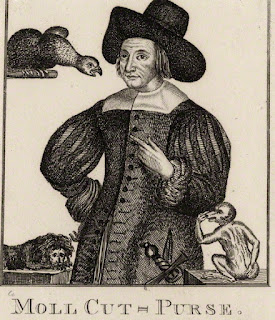

Mary Frith (nickname - Moll Cutpurse) was the daughter of a shoemaker and lived in Aldersgate Street near St Paul’s Cathedral. From an early age she was often in trouble with the law for stealing. To try to reform her, a minister tried to ship her off to New England in America, but Mary dived off the ship and swam back to shore.

From then on, she was arrested frequently for robbery and was held in various prisons - The Old Bridewell, the Compters and Newgate. She was branded on the hand on several occasions – this was a common punishment for thieves. Her stamping ground was St Paul’s Church (now the re-built Cathedral) where she would cut the strings of purses, (hence her nickname) and she also traded as a ‘fence’ for stolen goods and a pimp for younger women. Victims of pickpockets who had lost jewellery or valuables would come to Mary, and she would trade with the criminal underworld to return the items for a cost.

Mary was nearly always dressed as a man, drank in taverns and carried a sword. She is also credited with being the first woman to smoke a long clay pipe. She had a long association with the theatre and by the turn of the century she was performing on stage in men's clothing at the Fortune Theatre. On stage she bantered with the audience, fenced in mock fights, and sang, accompanying herself on the lute.

She was a keen horsewoman and was once bet twenty pounds that she wouldn’t ride from Charing Cross to Shoreditch dressed as a man. Of course she won the bet, and made it all the more entertaining by doing it on Morocco, the most famous performing horse of the day. Her riding skills enabled her to turn highwaywoman during the English Civil War. A staunch Royalist, she robbed the Roundhead general, Sir Thomas Fairfax by holding up his coach on Hounslow Heath.

We know a lot about her because The Life of Mrs Mary Frith of 1662 was one of the first biographies of a female criminal to be published in England and was highly influential in bringing women’s lives to the public interest. It is thought that Defoe’s book, Moll Flanders, was based on her life.

Heiress and Highwaywoman Katherine Ferrers

Lady Katherine Ferrers was the inspiration for the 1945 film The Wicked Lady, starring Margaret Lockwood and James Mason, which tells the story of a 17th century aristocrat and heiress who turns to highway robbery. Katherine was supposedly persuaded to a life of crime by her highwayman lover Ralph Chaplin, but he was caught and hanged on Finchley Common. After his death she worked alone, but was caught when she held up a coach and shot the driver; unfortunately it was a trap, and two of the occupants of the coach were armed and shot back. Fatally wounded, she galloped home to Markyate Manor, where she was found lying on the front steps - dead, but still dressed as a highwayman.

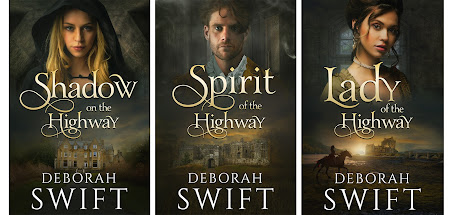
This of course is not the real story. The real story is one of plunder and possession in The English Civil War, and a time when rural farmers were trying to keep their lands out of the pockets of the aristocrats and were experimenting with new ways of communal living. In my young adult books about the life of Katherine Ferrers I explore these themes, and I enjoyed deconstructing and reconstructing the legend.
Sources:

Outlaws and Highwaymen - Gillian Spraggs 

The Elizabethan Underworld – Gamini Salvado

Dunstable History Society

Pictures: Wikipedia, East End Women's Museum, Project Gutenberg

Find me and my books on my website www.deborahswift.com


Saturday, 11 March 2017

Women of the Road: The Real Highwaywomen of the 17th Century by Katherine Clements

When you picture a highwaywoman, you probably think of something like this…

Margaret Lockwood as The Wicked Lady, 1945.

Or this…

Illustration by Eric Fraser from Folklore Myths and Legends, 1973.

We’re all familiar with the romantic folklore figure of the dashing highwayman – from Dick Turpin to Adam Ant, it’s an image that has excited the popular imagination for generations. It was certainly part of the attraction when I first started researching the legend of an infamous female highway robber, the Wicked Lady, for my novel, The Silvered Heart.

The story of Lady Katherine Ferrers is brimming with classic romance: the young, orphaned heiress, forced into a marriage of convenience, turns to a scandalous life of crime with her handsome lover. You can read about the legend and my take on it here. The myth is entertaining enough, but I wanted to explore the reality behind the romance, and I had to answer one question first: Were there really women working as highway robbers in the 17th century?

The concept of the gentlemen thief has been around for centuries, but the famous examples are all men, with swooning female accomplices – or victims – falling under their charismatic spell. I was convinced the reality could not be so neat. But is there any evidence?

As early as the 13th century, there are records of female robbers working the highways, usually as part of a gang or with their husbands. Whole families might make a living this way, with wives and children acting as lookouts or decoys. Sometimes women were more than just convenient bait. The Middlesex Session records, covering 1549-1688, contain several cases of women accused of ‘robbery with violence’. In one case of 1564, one woman was hanged for robbing another at Hammersmith, then no more than a village on the road out of London. But in most cases, the nature of these crimes is not elaborated.


Famous female criminals could certainly make a name for themselves. Mary Frith, better known as Moll Cutpurse, became a notorious, celebrated figure of the London underworld in the 17th century. She made a living through thievery, and other dubious activites, but stories of her career as a highwaywoman during the Civil Wars are almost certainly invention. The Newgate Calendar (a compilation of accounts of criminals and their crimes, published in the 18th century) claimed that Moll, a passionate Royalist...

‘went on the highway, committing many great robberies, but all of them on the Roundheads, or rebels, that fomented the Civil War against King Charles I … A long time had Moll Cutpurse robbed on the road; but at last, robbing General Fairfax of two hundred and fifty jacobuses on Hounslow Heath, shooting him through the arm for opposing her, and killing two horses on which a couple of his servants rode, a close pursuit was made after her by some Parliamentarian officers quartering in the town of Hounslow, to whom Fairfax had told his misfortune. Her horse failed her at Turnham Green, where they apprehended her, and carried her to Newgate.'

Moll would have been in her fifties by this time; an unlikely age to have taken up a such a risky and physically demanding enterprise, and there is no documentary evidence to support these flights of fancy, reported long after her death.

But there is evidence of women working as accomplices in highway robbery if we look hard enough. Susan, Lady Sandys, wife of infamous gentleman robber Sir George Sandys, was implicated in his crimes several times and charged twice, though she escaped her husband's eventual comeuppance. After his execution in 1618 it’s believed she continued to act as accomplice to her son and even, possibly, in her own right. A broadside ballad of 1626 describes her as the ‘wicked Lady wife’. Is this our first Wicked Lady of legend?

Indeed, the transgressive figure of the cross-dressing, lawless woman became a feature of sensationalist literature and broadside ballads of the Restoration period (perhaps explaining the exaggeration of Moll Cutpurse’s exploits). Richard Head’s novel of 1665, The English Rogue, tells the story of the fabulously monikered Meriton Latroon, and includes encounters with several such female robbers, all loose-moraled and sexually voracious. The book was a huge success, proving that the appeal of the gentleman thief was well established, but telling us more about the public appetite for scandalous, titillating content than it does about any real woman committing such crimes.


If we look to a later but more reliable source, the Old Bailey Proceedings from 1681 – 1800, there are around 300 transcripts reporting female highway robbers. Only one case, in 1744, involves a woman, heavily disguised, acting alone and on horseback, displaying all the expected attributes of the gentleman highwayman.

The accused, Ann Hecks, was eventually acquitted on insufficient evidence, but the sheer volume of other records suggests that this was probably not a one off. If this is the case in the 18th century, it follows that the same likely applies to earlier decades, especially during the anarchic years of the English Civil Wars, when people sometimes turned to a life of crime to make ends meet. The threads of evidence, though tenuous, stretch back through the centuries, suggest that highway robbery was not the realm of men alone.

But what of my Wicked Lady? What of Katherine Ferrers? Is it possible that a woman of aristocratic birth, finding herself poverty stricken and abandoned, with very little left to loose, might take matters into her own hands? On balance, I’d say yes. Is it likely? I’ll leave that to my readers to decide.

www.katherineclements.co.uk
www.facebook.com/KatherineClementsBooks