Showing posts with label English Civil War. Show all posts

Friday, 1 September 2023

'The Secret lies in the Thimble' by Karen Maitland

17th Century silver thimble
Photo: Llangefni

In my Jacobean novel Traitor in the Ice, one of my characters passes a secret note to another folded into a band and hidden inside a thimble. This method of passing secret or coded messages was frequently used in times of religious persecution during the Tudor period and probably for centuries before that, and was still being used during the 17th century English Civil War. A band of folded paper was easily concealed in a thimble, which, even in a room crowded with people, a woman could causally set on table for the recipient to pick up, or it could be slipped into a work basket. Even the decoration on the thimble itself could be used as a coded message.

But the practising of concealing things in thimbles has a much older origin and is linked to what the thimble has come to symbolise. 

Thimbles have been excavated from ancient Chinese sites dating as far back as the 206BC to 220CE, as well as from Roman sites, such as Herculaneum and Pompeii, buried when Vesuvius erupted in 79CE. 


Copper-alloy thimble ring c. 1400-1600
Found in East Sussex
Photo: Andy Stanley
The Portable Antiques Scheme/
The Trustees of the British Museum

In the Middle Ages, most thimbles made from brass or copper alloy and were used by men, women and children. For sewing coarse cloth, they used topless thimble rings, pressing the needle with the side of the finger, and for finer cloth and embroidery, they used bee-hive shaped thimbles. 

By Tudor times, the giving of elaborately decorated thimbles as a lover’s token or an occasion gift was well established. These were often engraved with initials, coats of arms, and mottos, or decorated with emblems in the forms of birds, flowers and animals. Queen Elizabeth bestowed thimbles studded with precious stones on her favoured ladies-in-waiting.


C. 1708, a child's silver  thimble
with machine made circular punch marks
Photo: Kult Adams, Bristol City Museum
The Portable Antiques Scheme/
The Trustees of the British Museum

In 1693, John Lofting, a Dutch thimble manufacturer set up a thimble factory in Islington, in London, England, before moving his production to Buckinghamshire to take advantage of water-power. He was able to turn out two million thimbles per year, such was the demand. 

But thimbles had become far more than tools for sewing, they had taken on symbolic meanings too. Traditionally, a ring, a coin and a thimble are baked into a wedding cake for guests to share. The person who gets a ring will find happiness. The one who gets the coin will become wealthy, but the one who gets the thimble with remain unwed, a ‘spinster.’ The same applied, if a girl was gifted three thimbles, presumably because that meant she’d had three suitors and had not settled for any of them. 

'First Sun' by Camille Martin (1861-1898)
Photo: Vassil
Museum of Fine Arts of Nancy

The more important meaning of thimble, though, was protection and good fortune. A thimble is one of the most common objects metal detectorists unearth in fields and gardens. Many were simply lost there. At harvest time, field hands often wore thimbles to protect their hands when binding straw, and women and children would join menfolk for the harvest, and continued to sew or mend while resting from the heat of the day. So many thimbles were probably mislaid. But some seemed to have been deliberately placed in the earth, and contain scrolls of paper, grains of cereals, hazelnuts, crystals, and pebbles, many found with scraps of cloth inside. Some of these clothes, of course, would have been rags used as padding to keep the thimble snug to the finger, but not all. 

Since thimbles symbolised protection, if a woman was anxious about a son going off to war, a daughter giving birth, or a lover on a sea voyage, she’d write their name on a piece of paper and tuck it into a thimble, which she’d then bury in the earth to protect them. If she couldn’t write, she’d use some scrap belonging to the person, such as a strip cut from a garment or a fragment of something they'd used, even a piece of a consecrated wafer from Mass.

Copper- alloy thimble c.1400-1600
Found on the Isle of Wight
Photo: Frank Basford, Isle of White Council
The Portable Antiques Scheme/
The Trustees of the British Museum

The thimble could also be used to protect the whole household from the plague, or as a prayer for a good harvest. So, while thimbles unearthed with a grain of wheat or corn in them can simply be the result of them being lost during harvesting, sometimes a grain of corn might have been put inside deliberately. 

Often too something red would be added – a red bead, rowan berry or red thread to keep what was inside safe, and ensure it couldn’t be taken by evil spirits to cause harm. In a curious blending of the two superstitions, some years ago, I was thrilled to be given two Victorian silver thimbles by an elderly lady, which were tied together by a red cord. But I was warned never to cut or untie the red cord or tie a third thimble to the cord, for fear of bad luck.

Right up until the 1940’s, the tradition was that if a wife of a famer or farmworker died, a strip of cloth cut from her dress would be stuffed into her thimble and thrown out on to the field where she had worked. If a corpse of a woman was proving difficult to get inside a coffin because of stiffness or size, it was said that if her thimble was cast into the coffin first, her body would follow easily.

A Nürnberg thimble
Cast brass 14th Century
Photo: Llangefni

So if you are lucky enough to dig up an old thimble in your garden, do check carefully inside it before you wash the mud out.

If want to discover more, a good starting point is thimbles (colchestertreasurehunting.co.uk). It has a fascinating piece on the history of European thimbles, including why ‘Empress Maria Theresa of Austria. sent spies to Nürnberg to steal the secret of the thimble making,’ together with some excellent photographs of thimbles found in fields and gardens, dating from 12th century onwards to help you date yours.


Friday, 30 September 2022

Women of the Road - Real-Life Highwaywomen

by Deborah Swift


There is something very appealing about the highwayman’s disguise – the tricorne hat, the cloak, the breeches and boots – and even more so when this disguise is worn by a woman. Contrary to popular belief, records show that there were women who risked the noose, to make their living on England’s rutted and treacherous roads, and who showed their own unique brand of ruthlessness and courage.

Double – Crosser Joan Phillips

Joan was the daughter of a rich and well-established farmer. Her beauty (and wealth) brought her to the attention of Edward Bracey, a small-time crook, who planned to seduce her, persuade her to marry him, and then abscond with her dowry, leaving her flat. 

Joan was intelligent enough not to fall for this plan, and though allowing herself to be seduced, foiled the rest of the plan. Edward Bracey, according to the Newgate Calendar ‘was very agreeably deceived; for Joan was as good as he … she consented to rob her father, and go along with him on the pad; all which she accordingly accomplished.’ 

So Joan was determined to gain an upper hand, and they never did marry, but Joan and Edward frequently robbed together on the highway, though it seems Joan was always the one in control.

Joan had a long criminal career including running an inn, but eventually, the Law caught up with her and she was arrested in 1685 after robbing a coach.  She was tried under the name Joan Bracey, found guilty, and executed the same year in Nottingham. Records diverge on how old she was when she died, some saying she was as young as twenty-one. 

Watch a video about her 

BBC Criminal Histories "The Highway Woman"

https://www.youtube.com/watch?v=YnuYdL4TrO4

Tudor Highwaywoman Mary Frith


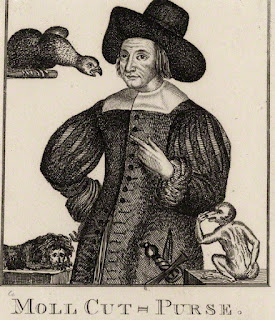
Mary Frith (nickname - Moll Cutpurse) was the daughter of a shoemaker and lived in Aldersgate Street near St Paul’s Cathedral. From an early age she was often in trouble with the law for stealing. To try to reform her, a minister tried to ship her off to New England in America, but Mary dived off the ship and swam back to shore.

From then on, she was arrested frequently for robbery and was held in various prisons - The Old Bridewell, the Compters and Newgate. She was branded on the hand on several occasions – this was a common punishment for thieves. Her stamping ground was St Paul’s Church (now the re-built Cathedral) where she would cut the strings of purses, (hence her nickname) and she also traded as a ‘fence’ for stolen goods and a pimp for younger women. Victims of pickpockets who had lost jewellery or valuables would come to Mary, and she would trade with the criminal underworld to return the items for a cost.

Mary was nearly always dressed as a man, drank in taverns and carried a sword. She is also credited with being the first woman to smoke a long clay pipe. She had a long association with the theatre and by the turn of the century she was performing on stage in men's clothing at the Fortune Theatre. On stage she bantered with the audience, fenced in mock fights, and sang, accompanying herself on the lute.

She was a keen horsewoman and was once bet twenty pounds that she wouldn’t ride from Charing Cross to Shoreditch dressed as a man. Of course she won the bet, and made it all the more entertaining by doing it on Morocco, the most famous performing horse of the day. Her riding skills enabled her to turn highwaywoman during the English Civil War. A staunch Royalist, she robbed the Roundhead general, Sir Thomas Fairfax by holding up his coach on Hounslow Heath.

We know a lot about her because The Life of Mrs Mary Frith of 1662 was one of the first biographies of a female criminal to be published in England and was highly influential in bringing women’s lives to the public interest. It is thought that Defoe’s book, Moll Flanders, was based on her life.

Heiress and Highwaywoman Katherine Ferrers

Lady Katherine Ferrers was the inspiration for the 1945 film The Wicked Lady, starring Margaret Lockwood and James Mason, which tells the story of a 17th century aristocrat and heiress who turns to highway robbery. Katherine was supposedly persuaded to a life of crime by her highwayman lover Ralph Chaplin, but he was caught and hanged on Finchley Common. After his death she worked alone, but was caught when she held up a coach and shot the driver; unfortunately it was a trap, and two of the occupants of the coach were armed and shot back. Fatally wounded, she galloped home to Markyate Manor, where she was found lying on the front steps - dead, but still dressed as a highwayman.

This of course is not the real story. The real story is one of plunder and possession in The English Civil War, and a time when rural farmers were trying to keep their lands out of the pockets of the aristocrats and were experimenting with new ways of communal living. In my young adult books about the life of Katherine Ferrers I explore these themes, and I enjoyed deconstructing and reconstructing the legend.

Sources:

Outlaws and Highwaymen - Gillian Spraggs 

The Elizabethan Underworld – Gamini Salvado

Dunstable History Society

Pictures: Wikipedia, East End Women's Museum, Project Gutenberg

Find me and my books on my website www.deborahswift.com


Saturday, 13 July 2019

Markyate Manor – Home of The Wicked Lady

by Deborah Swift 

I am not the first writer to be inspired by the life and legend of Lady Katherine Fanshawe. The first novel based on her life was by Magdalen King-Hall who wrote a book called The Life and Death of the Wicked Lady Skelton in 1945. I have a copy and it is exciting reading, though long-winded in the telling by today’s standards. The book was a smash hit in its day and was made into a film - The Wicked Lady. 

The film starred Margaret Lockwood in the title role as a nobleman's wife who secretly becomes a highwayman to relieve her life of boredom. The mystery of why she would take such an extreme action was the sensation of its day – women were supposed to be safe at home doing the housekeeping! The film had one of the top audiences ever for a film of its period, 18.4 million – a staggering number. I can remember my mother talking about it as one of her favourite films.

It was such a hit that the film was re-made in 1983 and starred Faye Dunaway in the lead role, but the film was a total disaster and earned Faye Dunaway an award for the Worst Actress.

The legend is set in and around Markyate Manor. The name Markyate is derived from the Old English words mearc and geat and means 'the gate at the boundary', presumably the boundary between Hertfordshire and Bedfordshire. On the original site was a hermitage, which housed the nun Christina of Markyate. Known for being taken over by heavenly visions, she gathered quite a following and she founded a priory on the site under Benedictine rule. More about Christina's extraordinary life can be found here. 

The Priory did not fare well during the Dissolution and was demolished in 1537. The much more elaborate Markyate Manor was built on its footprint, although it is still sometimes known as Markyate Cell - the cell being the original hermitage. George Ferrers retained the name when he bought the land in 1548. The Ferrers family controlled this land when Markyate Cell was the home of Katherine Ferrers, also sometimes known as The Wicked Lady. 

Markyate Cell

After the death of her husband, Katherine’s mother re-married. The land was soon under the iron control of Katherine’s step-father, Sir Simon Fanshawe. Worse, at only twelve years old, Katherine was forced into an arranged marriage with his nephew, Thomas Fanshawe, so that he could retain control of the estate.
Picture from Project Gutenberg

After that, the story gets even more interesting as the legend credits Katherine with being a notorious highwaywoman. She lived in the house through the years of the turbulent English Civil War, much of it alone as her menfolk were away fighting. She finally died there, so the legend goes, having been mortally wounded trying to rob a coach on Nomansland. 

Her ghost has been seen dressed in highwayman clothes riding her horse at full gallop, and even in 1840 when part of the manor was destroyed by fire, the blaze was blamed on Lady Katherine. Whilst helping to put out the fire several locals said that they felt a ghostly presence and feared they were being watched by her ghost. But unsurprisingly, she is not the only ghost that haunts this building - in the late 1850s workmen repairing a wall saw the figure of a nun. Perhaps this was the anchorite Christina? The nun has been seen several times since, walking in an avenue near St John's Church.

In 1957 the bypass around Markyate was being built. A night watchman was sitting by his brazier one night when he looked up and saw someone warming their hands by the fire. The figure was that of a young man who promptly vanished as the night watchman was looking at him. Was this an appearance of Markyate's legendary Phantom who may also haunt Hicks Road and the High Street? Luton Paranormal Society
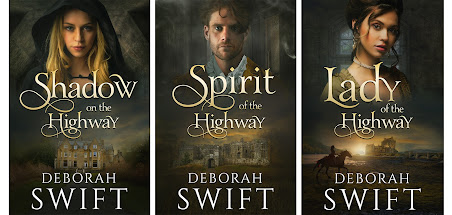
There has always been a mysterious young farmer associated with the legend, although I can find no trace of him in historical records. His name, according to local lore, was Ralph Chaplin. I have re-imagined him as a fiery young man who wants to change the old order by joining the radical Diggers Community. The legend of his relationship with Katherine led to the story-line for 'Spirit of the Highway'. I thought the history would appeal to young adults, with its touch of the paranormal, and be a good introduction for newcomers to the period of the English Civil War.

Like to know more about the legend? check out this article in the Daily Mail for a summary of the life and legend of Lady Katherine Ferrers (Fanshawe).
Deborah’s website 
Twitter @swiftstory

also worth looking up is Katherine Clement's excellent adult novel about the same legend, The Silver'd Heart.
Image sources: wikicommons unless cited

Tuesday, 23 October 2018

Voices Unearthed: Diane Purkiss's 'English Civil War.' Leslie Wilson


  In my childhood, I went to historical novels if I wanted to find out about the lives of ordinary people: even Trevelyan's 'Social History of England,' which my father gave me when I was a young teenager, was rather too general in its narrative. I always wanted to get an idea of what life was like for ordinary people, not just for the generals, the nobles, or the King. Above all, I was interested in the lives of women. When I first started to write historical fiction, very few historians seemed interested in women's lives; they were peripheral to the main action.When I started to write about Nazi Germany, I did begin to get access to these, through diaries and journals and also covert reports from Social Democrats on life inside the Third Reich. But the lives of women in earlier times, when women were largely illiterate, were much harder to come at (though Alice Clark's The Working Life of Seventeenth Century Women was an invaluable resource.)

But here is a work of history, written by a distinguished scholar, as fascinating as any novel. Of late years, I've noticed that historians are beginning to go through 'unimportant' bits of detail, diaries, account books, wills, to resurrect the lives of women, and though there is still much we cannot get at, we are getting enough to give us a much better idea than we previously had. Diane Purkiss is writing in this tradition; though The English Civil War does also give us the voices of men, and she tells the stories of the King and Cromwell, Henrietta Maria and women of the aristocracy.

But in this book you also can hear  the common soldier , and ordinary, lower middle-class women whose voices were recorded because they became preachers in some of the Independent sects that grew during the ferment of this period, as well as those of the gentry are also heard. The book opens up the experience of a broad section of English society during the conflict.

As well as giving voice to the ordinary people (and examining the role starvation, which was widespread as the war dragged on, played in people's actions and reactions,) this book gives an in-depth, considered analysis of the causes and drivers of the conflict. Too many authors, for example, have described the religious issues of the times in the convenient portmanteau phrase: 'the Royalists were Anglicans, the Parliamentarians were Puritans'. In fact, many of the Parliamentarians were Anglicans, and Anglicanism in those days meant Calvinism, a theology nowadays more likely to be associated with Presbyterianism. The distinction between those who believed some humans were predestined for damnation, some for salvation, was far more complex than the Cavalier/Roundhead divide. This is important, because religion was a crucial part of people's lives in those days and needs to be understood.

Diane Purkiss also shows us the hideous anti-Catholic prejudice which meant many Catholics had their houses destroyed, were abused, attacked, and murdered. It was an atmosphere which reminded me of present-day Islamophobia, and gave an uneasy flavour of what might happen if it is nurtured, as it is at present. The mutilation of the Royalist camp followers after Naseby, who were considered to be whores and Irish Catholics (many of them were Anglican soldiers' wives), was what we would nowadays see as a horrific war crime. In addition, she tells the story of Matthew Hopkins's notorious Essex witchhunt, and makes a convincing case for the war's agency in the outbreak of a kind of witch prosecution otherwise absent from England.

What comes across, crucially, in this history, is that the protagonists of the Civil War didn't behave the way we would like them to; they were people of their own time. It's far too common for even historians to be partisan in writing about the conflict (and most of them taking the 'Cavalier' side). But what matters in the end is not who won, who had flowing locks and was romantic, who were people we'd like to identify with (none of them, once you really look at it). These people had ideas, many of which filled the ruling establishment with horror, which we would now view as mainstream or even old-fashioned, since few even of the Levellers and Ranters wanted women to have the vote. Indeed, some Ranters thought women had no souls (one was set to rights by George Fox, one of the first Quakers, an organisation that did give women the right to speak and continued that after the ferment of the wartime period had died down). But they had those ideas, and that was important. Yes, works of art were destroyed and images in churches were destroyed, but that was also part of their passionate belief in a religion that didn't rely on outward show.

As a Quaker, I can comprehend that, since I worship in a plain, unadorned room, mostly in silence, and the price of that precious worship was partly the destruction of statues in our cathedrals. Diane Purkiss says at the end of the book that she wouldn't exchange Milton's 'Paradise Lost' for the Rubens crucifixion that was destroyed during the war. 'Sometimes destruction is the price we pay for artistic breakthrough.' And spiritual, and political.

There is not enough written about the English Civil War. If you want to start reading about it, or want to revisit the period, this is the book to get going on. I wasn't able to put it down.