Showing posts with label Revolution. Show all posts

Friday, 11 August 2023

Bicycling Ladies Revisited by Joan Lennon

In 2012, I wrote a History Girls post about Bicycles and Revolution - I was just a reservist back then, and it was just a casual interest. Eleven years later, it is becoming a bit more than that as I return to the topic for an upcoming book. So here is the post from then to enjoy for now!

(The original video I got off YouTube has disappeared, but the one below is a longer version of the same event, beginning with a rather anxious parade of ladies, carefully bracketed by 'wheelmen', and then showing some skills not dissimilar to those displayed at Crufts.)


As we watch these elegant, white-clad, straight-backed ladies weave genteelly in and out, it is hard to remember that they were commiting an act of rebellion. Snooks were being cocked. Gauntlets flung.

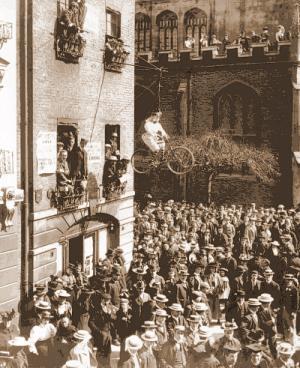
At the end of the 19th century, a bicycle with a woman astride was still a disconcerting sight - a challenge to trouser-wearing men. In Cambridge, when the question of full degrees for females was being discussed in the Senate, an effigy of a "rationally dressed" lady on a bicycle was hung out of the window of the building opposite, flanked by banners declaring “No Gowns for Girtonites” and “Varsity for Men”.


(Image: Cambridge Daily News, 21 May 1897.)

The effigy was burned later in the day, and the motion was defeated. But the ladies went on riding. They wore bloomers. They went places without being taken by a man. They started carrying toolbags.

"Let me tell you what I think about bicycling," said Susan B. Anthony, American campaigner for Votes for Women, in 1896. "It has done more to emancipate women than anything else in this world. It gives her a feeling of self-reliance and independence the moment she takes her seat; and away she goes, the picture of untrammeled womanhood. I stand and rejoice every time I see a woman on a wheel."

It was a wheel that would not be turned back. But completely "untrammelled womanhood"? Not quite. Even in a world full of "new women" there had to be some standards ... In 1895 the New York World printed a list of Don'ts for Lady Cyclists, which included the following admonitions:

Don’t be a fright.
Don’t faint on the road.
Don’t forget your toolbag
Don’t imagine everybody is looking at you.
Don’t go to church in your bicycle costume.
Don’t wear a garden party hat with bloomers.
Don’t contest the right of way with cable cars.
Don’t wear white kid gloves. Silk is the thing.
Don’t ask, “What do you think of my bloomers?”
Don’t let your golden hair be hanging down your back.
Don’t allow dear little Fido to accompany you
Don’t scratch a match on the seat of your bloomers.
Don’t discuss bloomers with every man you know.
Don’t scream if you meet a cow. If she sees you first, she will run.

Still good advice about cows, though.

Also see YS Lee's 2015 History Girls post Bikes, Bars and Bloomers for more on this fascinating subject.

Joan Lennon website

Joan Lennon Instagram

Wednesday, 14 November 2018

Dancing into the Modern Age: 150th Anniversary of the Meiji Restoration - by Lesley Downer

November 1868: Emperor Meiji enters Edo in his phoenix palanquin
On November 26th 1868, a hundred and fifty years ago this month, a vast procession three and a half thousand strong filed through the massive gates of Edo Castle, with musicians stepping out in front. Right at the centre, born on the shoulders of forty or fifty close packed bearers, was the imperial palanquin, topped with a golden phoenix, carrying the sixteen year old Emperor Mutsuhito, whom we now know as Emperor Meiji. 
Emperor Meiji on his way to Edo

He had been wending his way across the country from his ancestral home in Kyoto for twenty days. Ten thousand people lined the streets to watch him pass. Shortly afterwards Edo was renamed Tō-kyō, ‘Eastern Capital’, and Edo Castle became the Imperial Palace. The event was dubbed the Meiji Restoration. A whole new era had begun. 

Shoguns had held power in Japan for many centuries. During those years the emperors had been like popes, spending their lives sequestered in the imperial palace in Kyoto and never leaving. For 250 years the country enjoyed uninterrupted peace. Japanese culture flourished - the world we see depicted in woodblock prints and on the stage of the kabuki theatre, the world of Basho’s haiku, Zen and much else. 

During most of those years Japan was closed to the west. The only westerners were 20 Dutch merchants who were allowed to live on a small island off Nagasaki. A Dutch ship came once a year and kept the Japanese up to speed with western science and developments. Thus the Japanese knew a fair bit about the west but the west knew very little about Japan. 
The rickshaw, invented in Japan in 1869


Then, in a single day - July 8th 1853 - everything changed. Fishermen in their boats at the mouth of Edo Bay saw four monstrous ships surging towards them, spouting steam. ‘As large as mountains,’ the fishermen reported, ‘moving as fast as birds.’ It was as if aliens had landed. But it was not Martians. It was Americans. It was Commodore Matthew Perry and his famous Black Ships. 

The fifteen years of turmoil that followed ended with the shogun being overthrown. The fifteenth and last shogun retired to his family lands and the teenage Emperor was borne in splendour into Edo, now Tokyo. And straight away things started to change. 

Ginza Bricktown 1874
Under the shoguns Edo had been an eastern Venice, lined with canals, with willow trees swaying along the banks. People went around by water, on foot, by palanquin or on horseback. There were no wheels for transporting people, only for goods. Wheels were quick to arrive. The rickshaw was invented almost instantaneously - in 1869. Soon rickshaws were everywhere, clattering through the streets, with the drivers shouting and threatening to mow people down if they didn’t leap out of the way fast enough. 

Tokyo mushroomed much as China is mushrooming now. New buildings shot up in the western mode, of brick and stone, not wood. One of the first was the Mitsui House, a splendid wedding cake-like confection, owned by the wealthy shopkeeping and money exchanging Mitsui family, soon to found a business and banking empire.

Then in April 1872 an area called the Ginza, full of furniture shops and second hand shops, mysteriously burnt down. No one was hurt, generating the suspicion that the fire had been set deliberately. The area was rebuilt entirely in sparkling new brick buildings and called Ginza Bricktown. The street was lined with all sorts of wonderful shops - a brand new newspaper office, a post office and a beef restaurant where people could dine on an exciting new dish - beef. In 1874 the Ginza was lit with Japan’s first gas lamps. 
First train at Shimbashi station by Shōsai Ikkei, circa 1870 -
donated to Wiki Commons by the Metropolitan Museum of Art
  Also in 1872 the first train line opened linking Tokyo and Yokohama, built under the direction of the Englishman Edmund Morell. He had succumbed to fever and died at the age of 30 the year before the railway opened and is buried in the Foreigners’ Cemetery in Yokohama. The emperor was there in all his regalia to open it. He was 20 by now. He soon set an example by changing to western clothing (a military uniform with lots of medals) for official duties. He also made the revolutionary announcement, ‘I shall eat beef.’ 

The empress followed suit. In 1873 she announced she was going to give up teeth blackening which was quite as shocking as if Meghan had suddenly announced she was going to blacken her teeth. Up till then adult women had always painted their teeth with lacquer to make them a lovely shiny black.
View of Benten Shrine: The Emperor and Empress cherry blossom viewing with their attendants
by Utagawa Hiroshige III 1881 - donated to Wiki Commons by the Metropolitan Museum of Art
In the cities at least everyone who could afford it was madly experimenting. Men rushed to the new-fangled barber shops - the first opened in 1869 - to have their oiled samurai topknots cut off and their hair cut in the latest style, the jangiri style, the cropped cut. People who had grown up wearing topknots and swords tried the bizarre new western fashions - trousers and Sherlock Holmes capes and incredibly uncomfortable leather boots.

Women were more conservative in their dress choices. Geisha being trendsetters were the first to try western clothes - bustles and bonnets. The very first person to wear high heeled shoes was a Nagasaki geisha in the 1880s.

Then in 1883 the Rokumeikan - the Hall of the Baying Stag - opened in central Tokyo right opposite the Imperial Palace. It was a rather flashy Italianate mansion of white painted brick with colonnaded verandas, set in landscaped gardens. There Japanese high society - gentlemen in frock coats, ladies in bustles, bows, corset and bonnets - dined on French food cooked by a French chef, using knives and forks, played billiards, had charity bazaars, sang western songs and played western musical instruments.

Dancing into the future - at the Hall of the Baying Stag
There were also famous balls. The idea was that gentlemen should appear with their wives on their arms as western people did. But unless you were an ex-geisha as quite a few of the ladies were, most upper class Japanese women were not accustomed to going out with their husbands, so a lot of the ladies at the Rokumeikan were actually the geisha of the gentleman in question, not the wife.
From Aguranabe, 'Sitting round the beef pot'
by Kanagaki Robun

All this modernising was a lot of fun but it also had a serious purpose - to persuade the western powers that the Japanese were every bit as civilised as them so that they would repeal the hated unequal treaties, by which the Japanese had to pay inflated export duties and the exchange rate was rigged in the westerners’ favour and many other humiliating clauses besides.

But despite all the dancing and modern clothes, the treaties were not repealed until 1895, after Japan defeated China in the Sino-Japanese War. As a Japanese diplomat said wearily a decade later, after Japan defeated Russia in the Russo-Japanese War: ‘My people had been sending artistic treasures to Europe for some time, and had been regarded as barbarians. But as soon as we showed ourselves able to shoot down Russians with quick firing guns, we were acclaimed as a highly civilised race.’


In case anyone might like to hear more, I’m giving a couple of lectures to mark the 150th anniversary of the Meiji Restoration - at the Ashmolean in Oxford on Friday November 23rd from 1 to 2 and at the British Library on Tuesday November 27th at 7.15. 

Lesley Downer’s latest novel, The Shogun’s Queen, is an epic tale very much based on a true story and set in Japan at the time of the turmoil preceding the Meiji Restoration- out now in paperback. For more see www.lesleydowner.com.

All pictures courtesy of Wikimedia Commons or private collection.

Monday, 27 November 2017

Tamara Karsavina & Henry Bruce, Part 2, by Janie Hampton

Tamara Karsavina in Le Spectre de la Rose
choerographed by Fokine, costume by Bakst, in Paris 1913.

Continuing the story of the British diplomat Henry James Bruce and Russian prima ballerina Tamara Karsavina, who fell in love in St Petersburg in 1913. Eight months after they had witnessed the October Revolution in 1917, Lenin declared Britain an enemy of the Bolshevik government. Henry’s British Embassy colleagues fled from Moscow to Britain via the Crimea. But Henry went in the opposite direction, north to Petrograd, to rescue his lover and their 19 month old son, Nikita.
Read Part One of their adventure  here. 
Petrograd had been Tamara’s home all her life, but now she agreed with Henry that it was time they left. Although she had no political objections to the new order, communal life was stressful. The apartment in Millionaya Street, where she lived with Nikita and their cook, nanny and maid, was now shared with five families. Life was chaotic, with children playing in the shared passage, its ceiling criss-crossed with washing lines. Tamara’s cook Liza had been elected onto the house soviet committee but nobody knew who owned the house or to whom they should pay rent? 
Henry James Bruce at Eton in1899
Tamara had been with handsome, clever Henry for five years but now that Lenin had made peace with Germany, her dull husband, Vasilii Moukine, might return from fighting. He had agreed to divorce Tamara but the Bolsheviks had abolished both marriage and divorce. 
Postcard sent from Berlin in 1912 to Tamara,
written in French, the address translated into Russian
The chaos extended far beyond Millionaya Street. When Moscow became the capital in March 1918, Petrograd, formerly St Petersburg, was of little national or international importance and was now bankrupt. The canals, once busy with barges bringing food and fuel, were collapsing and choked with rubbish and sewage. Cholera and typhus had already killed several thousand people that winter. Although the population had halved, there was not nearly enough food. Most of the cab-horses had starved to death, and the electric trams no longer ran. Henry was compelled to walk to the former British Embassy where he found Captain Cromie, the Naval Attaché, the only British diplomat left. Cromie showed him coded telegrams which revealed that all routes south to the Crimea, east to Japan and west to Finland and the Baltic Sea were closed. Their only way out of Petrograd was north via Murmansk in the Arctic Circle, where British troops were stationed to reinforce the White Army. 

Tamara Karsavina and Vaslav Nijinsky in Jeux, by Debussy, in Sir Thomas Beecham's
Grand Season of Russian Ballet at Theatre Royal Drury Lane, June 1912.
However, they couldn’t tell where the front line of the civil war between the White and Red armies was located, only that it was getting closer every day. As a foreigner, Henry needed a permit from the Foreign Ministry in Moscow to travel; and even Tamara needed permission from the workers’ soviet that now controlled the Marinsky Ballet. Another problem was that Tamara’s face was even better known than the Czarina’s or Lenin’s. For 15 years she had appeared to two thousand people at each performance in the Marinsky Theatre and she had toured all over Russia and Western Europe with Diaghlev's Ballet Russe. Postcards were sold of her posing as Giselle and Salome; and with Nikita on her lap. His thick curly hair and his mother's large dark eyes were unmistakable. If a reward was posted for their capture, they might easily be denounced to the authorities in exchange for a meal or a few logs of firewood. 
Famous all over Russia and Europe, Tamara Karsaviina
as  Zobeide on Sheherazade  by John Sargent, 1913.
After a tense week of enquiries, an unidentified woman telephoned the apartment. She had passes for a steam-ship departing the following morning. It would take them along the River Neva and through Lakes Ladoga and Onega north to Petrozavodsk, which was beyond the front line on the railway to Murmansk. Tamara packed two trunks, which was the most they risked taking without arousing suspicion. She found it a nightmare choosing what to include and after a desperate search failed to find the key to her bureau containing her personal letters and photos. They waited until three in the morning when it was dark enough not to be seen. Liza the cook and Katiousha her maid put aside their new revolutionary status and marked an ancient custom. They all sat in a circle in silence, then crossed themselves and quietly said goodbye. Tamara’s neighbour Prince Dolgorukov accompanied them to the pier on the Neva embankment. Henry spoke fluent Russian, French and German, and both he and Tamara had travelled all over Europe. But neither of them had travelled incognito, with a child, through enemy country before. 
Portrait of Tamara Karsavina by Henry J. Bruce, 1918.
The steamship was crowded with families anxious to return to their homes around the inland lakes before they were cut off by civil war. There were also young men eager to join the fighting – wherever the front line was now. A young Count told them that he planned to join the White Army, though it already had a surplus of officers and not enough soldiers. The Red Army had the opposite problem – too many private soldiers, who decided military strategy by vote. 
After five days the boat arrived in Petrodovask on the west coast of Lake Onega, where they planned to catch the steam-train north. Henry and the Count disembarked cautiously. The road leading up from the empty harbour to the railway station was shrouded in drifts of willow seed, stained with blood. A French officer told them that the streets were overlooked by snipers and the trains were full of Red Army soldiers, whose few officers could not control them. He advised them to return to Petrograd, even though the situation there had deteriorated even further. Count Mirbach, the German ambassador, had been assassinated in Moscow and Lenin had laid the blame on Britain. As a result, Captain Cromie had been killed defending the former British Embassy in Petrograd. They decided to remain on the boat which was heading to the north of the lake. The young Count went to search for food but was shot by a sniper within sight of the steamer. He managed to crawl back to the boat, his plans to join the White Army in ruins. 
Map of the route from Petrograd by steamer and cart to Lake Sumo, July 1918
Five days later their boat arrived in Povenetz, a village at the far north end of Lake Onega. There they were told of a disused post-road leading north-east for about 200 miles to the White Sea, and they hired a horse and cart. Tamara was forced to reduce their luggage to a few pictures, some blankets and a teaspoon which had belonged to the dancer Taglioni. She gave away most of Nikita’s clothes, and asked the captain to return their trunks to Petrograd. From Povenetz, they travelled slowly through the forest, crossing marshes and rounding lakes. Mosquitoes rose in huge clouds and swarmed around their heads. For several days they saw only the occasional peasant, shrouded in muslin, working in an isolated clearing. At night, they shared the floor of rough window-less huts, lit by rushes. They drank weak tea, and ate hard sausage. The local people were friendly, but knew nothing of politics or the movements of the Red Army. Twenty years of dieting and dancing with bleeding feet, had taught Tamara to ignore both hunger and pain, while Henry had been toughened up by British boarding school. Nikita, a pampered city child, clung to his mother and screamed. 
After six days and nights in the forest, they arrived at a slightly more prosperous village on the edge of Lake Sumo. They had just let the horses go for the night when they learned that the village had a soviet committee. Without realising it, they had crossed the line into Red Army territory. Worse still, a consignment of vodka had just arrived. In an effort to improve productivity in both factories and farms, the Tsar had passed a law, which the Bolsheviks had upheld, against distilling vodka. But with the increasing anarchy, it had been impossible to enforce. After a short, fitful sleep in a hut, the leader of the soviet, Commissar Solkov woke them and announced that rather than let them continue round Lake Sumo by cart, his men, who were all drunk, would row them across. He obviously didn’t trust this well-dressed man with a strange accent, his beautiful wife with soft hands, and their child who wore shoes. If they did not agree, then he would lock them up in a barn. Henry remained outwardly calm, guessing that the commissar would almost certainly set the barn on fire.

Postcards of Tamara Karsavina were on sale in Russia.
Here she is with Louloushka, her King Charles Spaniel.
Tamara pointed out that a storm was brewing, the lake was already rough and Nikita could not swim, whereupon he said, “It matters not if the little cur drowns.” At this Tamara was enraged and flew at him, screaming. She could cope with the new social order, but not with insults to her son. Henry thought it was all over. Despite their luck and fortitude so far, their escape seemed to be ending in disaster.
Will they get away? Find out next month.
Part Three, December 27.

Sunday, 3 July 2016

HISTORY IN THE MAKING, by Vanora Bennett

Being a part of history in the making is never comfortable. 

I learned that in my previous life as a foreign reporter, covering the various coups, conflicts, and crises that afflicted the people whose countries I was working in.

In those days I was usually in a foreigners’ bubble (with my finances and livelihood protected, a safe place to live, and a British embassy down the road), so I was a bit less bothered than everyone around me by whatever shock news was in the headlines that day. But still, there was something both utterly gripping and utterly boring about having to live through whatever the crisis was, in real time, rather than look back on it through a book or film.

It felt as though time itself started behaving in unpredictable ways when a crisis set in.

First it would race along – and someone’s career or life or a whole country would be gone before you’d had time to draw breath. But then things would slow agonisingly down. The rest of the story always took so long to unfold. You’d need to wait for the next day, or week, or month, for the next instalment, resignation, currency collapse, invasion, or whatever. 

And you’d need to fill the hours by worrying through the night, or fretting with friends about what would happen next, or doing the ironing or making breakfast, all the time itching with the enforced passivity of not being able to fast-forward to the happy-ever-after bit where it all finally gets sorted out.


I have since discovered, on starting to write historical novels, that one of the ways in which being a fiction writer is incomparably superior to being either a journalist or a person actually living through a public crisis is that you never need to live through the boring bits. You’re looking back, so you are in control of time, and have the power to just jump your characters from one speeded-up action moment in history to the next. The slow times are left out as if they never happened – at most, abbreviated to three dots.

Now, I think it’s safe to say most people in this country haven’t personally experienced major historical crisis, even if historical novelists do it vicariously all the time. But living through the past few weeks of Brexit Britain keeps reminding me of how bewildering time can feel when you’re in the grip of one - when reality starts doing that speeding-up-and-slowing-down thing, and there’s nothing you can do about it.

First came the time-flashing-forward bit. On referendum night, my very political teenager, who’d wanted to watch the whole vote-counting drama play out and the result be announced, finally conked out at 4am. We woke him up at 8 and told him that Britain had voted for Brexit and the Prime Minister had just resigned. “WOTTT,” he said disconsolately. He’d only been asleep for four hours, yet he’d missed the moment when his world had changed.


“Now what?” he said, once he had recovered. We couldn’t tell him. We didn’t know, any more than anyone else. And, for all the millions of words spoken and written about it in the weeks since, we’re none the wiser now. Because now we’re in the slow-motion bit. Waiting.

I think part of what felt so bleakly funny about the cropper Boris’n’Gove came more recently was the speed with which it happened. No need to wait for a punchline, it was on us almost before we’d heard the beginning of the joke. 

Another quick thing happening at last, hoorah! At last, something we could understand without waiting forever to get to the end of the story! At last, a break in the tension! 

I think part of the belly-laugh the nation gave was in sheer relief.

But it's worn off. Slo-mo is back. I’ve returned to fretting on Facebook and scouring the papers for clues, omens and portents, waiting for the next convulsion in the bigger real-life drama. 


I can’t help feeling that I’m behaving as foolishly as those fearful or exultant crowds that get an occasional three-line mention in historical novels, frantically checking out the comets or mumbling superstitiously about giant fish in the Thames while, centre stage, Henry VIII shrugs off Wife One and pulls out of Rome. 

But I can’t help it. Time – real time, not the time we novelists have the luxury of rearranging in our work – is hanging heavy on my hands, just as it did on those people’s. There is history in the air. And there’s nothing else to do.


Thursday, 3 December 2015

Slaves, Fish, Crochet, by Vanora Bennett

I didn’t intend to go to the art exhibition now on at London’s centre for Russia-lovers, Pushkin House. I was there for a talk on something else Russian and cultural in the same room, to do with the novel I’m researching, and very interesting it was too. Yet, as I listened to the talk, I couldn’t help but be struck by the textiles hung on the walls. They weren’t particularly astonishing when you first came in. Their (brilliantly) bizarre wrongness took a while to sink in, and make you stare.

The artworks were big blanket-like knits in dingy colours, with dividing lines that made them look like brick walls (think Pink Floyd album covers), and with graffiti-like Russian words in bright wools sewn on. Slogan type words, only backwards, or upside down, or altered; or swearword type words.

On another wall there were some neatly crocheted multi-coloured shapes – the kind of sweet table-mat thing you can imagine a granny with a slightly wonky sense of colour working, over a nice cup of tea. But these shapes were Russian letters, and the letters were strung together in more words, and, again, they were quite subversive, altered, wrong versions of Soviet slogans.

It was definitely confusing to see all those very butch power words – the shorthand script of the Soviet elite who, in their 70 years in power, gave us Stalin and the Gulag and millions of deaths, and the brutal vocabulary of choice of the violent Russian underworld that flourished under them – re-rendered here in neat, fluffy, well finished plain-and-purl-and-a-bit-of-embroidery. If you ever wanted an illustration of the feminisation of history, this was it.

It was only after the talk was over, and I turned round and noticed the quietest exhibit of all, at the back of the hall, that I actually burst out laughing.

This one was a large white lacy oblong, with frilly edges – the kind of cosy, conservative decorative item one might expect to find on a wire, not quite covering a cobwebby dacha window somewhere, with snow outside and whichever kindly auntie had done the crocheting glancing proudly round at it as she passed more tea (possibly from a samovar). It looked the concentrated essence of a particular kind of Russian innocence – the get-away-from-politics-to-the-simple-life mood that makes country weekends in those little wooden houses so enchanting. At least, it looked that way until you looked more closely and saw, all mixed up with the intricate patterns, that its main decorative feature was the – wildly inappropriate - great shouty Soviet propaganda word, PRAVDA (TRUTH), also the name of the main Soviet-era newspaper, followed by a disconcerting question mark.

The pieces, it turns out, are the work of a young Moscow artist called Olga Bozhko.

The exhibition blurb says Bozhko “plays with ideas of memory and history as they are reflected both in the language of the streets and in the language of government propaganda. She is fascinated by the way everyday Russian language mutates alongside ever-changing Russian perceptions of history. Living and working in Moscow, Bozhko pays attention to the graffiti, advertising and government slogans which comment, often unconsciously, on Russian society today.”

“The works for installation were knitted by hand - a symbolically soft and feminine medium. The large size of the works imply a considerable investment of labour and time: we usually associate this type of labour with domestic craft, which sets out to ‘wrap’ home life in comforting, soft hand-made material. But the images and particularly the inscriptions on the works are unsettling. Some of them imitate brick walls covered with angry graffiti, others - net curtains - but with slogans woven in to them. In the context of the elegant early Georgian architecture of Pushkin House, they turn into politically-charged comments on the past and present of Russia.”

The one that struck me most wasn’t in the room at all. It was at the bottom of the stairwell.

It’s a large hand-knitted fishing net, in the red, white and blue colours of the Russian flag.

The inscription Bozhko has snuck into the middle of the net looks and sounds like the heroic early Soviet propaganda slogan, “Raby Ne My” – “We Are No Slaves”. Between 1917 and the onset of perestroika in the mid-1980s, this phrase always featured in the Soviet primary school literacy programme and as a result resonates today with generations of Russian-speakers.

By now, though, I knew better than to take Bozhko’s slogans at face value. So I looked again. Sure enough, she’d changed a few letters to give a very different message, “Ryby Nemy”, or “Fish Are Dumb” – the title of her exhibition.

“This play on words,” Pushkin House’s gloss on the show says, “shows how very subtle changes can disarm (and in fact then re-arm) a powerful propagandistic message. To Russian ears, the phrase ‘We are no slaves’ is associated with one of the grand ideological narratives of the last century; ‘fishes are dumb’ may be read factually or of course as a metaphor for silent shoals of people caught in nets of government propaganda.”

“I like these,” I said, with growing fellow-feeling. Bozhko seemed so clearly the visual equivalent of so many female historical novelists today – cleverly re-examining the past, using new methods and materials and values, emphasising some things more and de-emphasising others, poking a bit of quiet fun at some of the sacred cows of tradition, and generally filling in the gaps left by the male academicians who did the writing first time round.

“I don’t,” the man sitting next to me replied, in cross David Starkey style. “I decided that before you got here.”

But you might enjoy Bozhko's mocking girl challenge to the orthodoxies of modern Russian history if you are open-minded. Even if you're male.

See Vanora Bennett’s website


Monday, 6 April 2015

BEARDS: ANCIENT AND MODERN by Lydia Syson

Not far into writing Liberty’s Fire, I realised that my male characters would have to have facial hair.  There was just no getting round it.  Pretty much the only clean-shaven men in Paris in 1871 were priests, and the sensible ones were either in hiding or trying to escape the city dressed as women.  (I exaggerate just a little.)

I consulted my daughter.  She made a face.  Just don’t mention it, she said.  Specially not when there’s kissing involved. There’s something about the word moustache. 

I knew exactly what she meant, but I’d hoped it was a private prejudice.  Are YA readers ready to embrace romantic heroes with facial hair?

Looking around my neighbourhood, I feel she can’t be entirely right.  The beards have been moving in for a few years now. Around the same time as the London orbital came our way – something between the train and the tube, and an excellent thing for us transport-deprived South-East Londoners –  an explosion of facial hair (and fixies) took place in and around the local bars and cafés.  Young beards.  In fact, I notice, intrigued, not unlike Communard beards. 

Photograph: Brock Elbank

The Beard exhibition at Somerset House has now closed but Mr Elbank’s brilliant contemporary beards can be seen in all their glory on Tumblr and will give you a good idea of what I'm talking about.  Beardseason, the Australian-born campaign to raise awareness of melanoma which was the start of this portrait series, continues to go from strength to hirsute strength.  To support it, I bring you a small selection of inspirational facial hair from nineteenth-century France, complete with links to more information about the revolutionaries (and one reactionary) sporting them.

Jules Vallès, journalist and author of the intensely vivid and highly autobiographical Commune novel, L'Insurgé (The Insurgent), as painted by fellow Communard Gustave Courbet:


 Courbet himself (photographed by Nadar):


Journalist and politician Henri Rochefort…


And as painted by Manet…


…more than once…here he is again, this time escaping from New Caledonia (4,500 Communards were deported to the Pacific penal colony after the fall of the Commune):


Napoléon La Cécilia, who found refuge in London where he taught French at the Royal Naval School then in New Cross:


Jarosław Dąbrowski, Polish activist, who died on the barricades during the final Bloody Week of the Commune.  His nom de guerre was Dombrowski, and was honoured in the name of an International Brigade battalion made up mostly of Polish miners during the Spanish Civil War.


Maxime du Camp, probably the Commune’s most vitriolic and effective critic and author of the 4-volume attack Les Convulsions de Paris, whose representations of women in the Commune endure to this day:


And finally, a man from a different kind of commune altogether, the transcendentalist Fruitlands, which was established by Louisa May Alcott's father in 1843. Joseph Palmer's interest in utopian politics, free speech and prison reform was sharpened by his own imprisonment after he fended off some men attempting to shave his beard in 1830, when beards were anything but fashionable. His gravestone in Massachussetts is apparently marked 'Persecuted for Wearing the Beard':