Showing posts with label Seville. Show all posts

Sunday, 14 April 2019

A Samurai in Seville - by Lesley Downer

Hasekura in Rome. Portrait by Claude 
Deruet (1588-1660), with his galleon, 
the Date Marubehind.
On October 28 1613 a samurai called Hasekura Tsunenaga set off on an epic voyage to an unexplored and little known part of the world - the land of the Southern Barbarians. He crossed the Pacific and travelled by way of Acapulco on a succession of magnificent galleons with gilded prows and billowing sails, and arrived in Spain on October 5th 1614. There he met King Phillip III, was baptised, and eight months later went on to Rome where he had an audience with Pope Paul V. All in all he was away for seven years.

The conquistadors and Japan

This was the era of the conquistadors, little more than a century after Columbus. The Spanish now ruled much of Central and South America, had colonised the Philippines and were eying up Japan.

But the Portuguese got there first. In 1543 they were already selling matchlock rifles to the warring Japanese clan lords. Shortly afterwards, in 1549, Francis Xavier and his Jesuit missionaries arrived and started converting sections of southern Japan. The Japanese realised that the Jesuits were the thin end of the wedge and that invading armies might follow, but they felt able to hold their own.

Portuguese with big hats enjoying very early female kabuki dancing
in Japan around 1603
In those days Spanish galleons plied the Pacific carrying Mexican silver to Manila where they loaded up with spices and goods from Asia to take back to Acapulco. In 1609 one of these galleons, the San Francisco, was wrecked on the coast of Japan near the booming city of Edo, present day Tokyo. The captain survived and went on to meet the retired shogun, Tokugawa Ieyasu, and set up a trade treaty. The Englishman William Adams, model for James Clavell’s Shogun, had arrived 9 years earlier and become Ieyasu’s right hand man and the British East India Company had set up a factory (trading station) near Nagasaki.
Hasekura with his samurai sword as
depicted by Scipione Amati,
a German artist, in 1615

The One-Eyed Dragon of Oshu

Japan had recently come to the end of half a century of warfare and was now unified under the rule of Ieyasu but up north the formidable warlord Daté Masamune - the ‘One-Eyed Dragon of Oshu’ - had different ideas. He was interested in the Southern Barbarians and their Christianity and could see a way of using them to increase his own influence and perhaps escape from under the thumb of Ieyasu. So he decided to send a mission to the west. With Ieyasu’s approval he commissioned a splendid galleon, called the Daté Maru in Japanese and the San Juan Bautista in Spanish.

Hasekura’s adventure

Hasekura Tsunenaga was a samurai with a somewhat chequered background, but Daté decided he was the man for the job. He headed a delegation of thirty samurai plus 120 Japanese merchants, sailors and servants together with 40 Spanish and Portuguese. His brief was to negotiate trade treaties. This was Japan’s first official venture to Europe and he was the ambassador.

After three months at sea the galleon arrived at California then followed the coast to Acapulco where they stayed for two months. They were received with great splendour in Mexico City, then boarded another galleon, the San Jose, to cross the Atlantic and reached the port of Sanlùcar de Barrameda, at the mouth of the river Guadalquivir, in Spain, on October 5th 1614.
Seville in the 16th century with the river full of galleons and the cathedral
rising behind: Vista de Sevilla attrib. Alonso Sanchez Coello, d 1588
And so they arrived in Seville, the jewel in Spain’s crown. "The Japanese ambassador Hasekura Rokuemon, sent by Joate [Daté] Masamune, king of Boju [Oshu], entered Seville on Wednesday 23rd October 1614," reports a contemporary Spanish text. "He was accompanied by 30 Japanese with blades, their captain of the guard, and 12 bowmen and halberdiers with painted lances and blades of ceremony."

Seville, Seville

The Alcazar gardens with cathedral behind
Seville was the greatest and most glamorous city in Spain. It was the European port of departure for the Americas and had a monopoly on all Spanish trade with the new-found continent. Day and night galleons laden with American gold and silver and treasures from the Indies plied their way up the Guadalquivir, unloading their bullion at the Royal Docks. Seville was the hub of world trade, a cosmopolitan melting pot of money seekers, where merchants from across Europe flocked to acquire goods from the New World. Much of the bullion was spent on Seville’s glorious architecture and there was a huge flowering of the arts. Velazquez was starting his career, Cervantes was working on the second part of Don Quixote.

Gentleman in padded breeches -
Seville Cathedral
Hasekura must have enjoyed this magnificent city of golden stone, so different from the wooden and bamboo cities he knew with their towering white-plastered castles. He no doubt visited the cathedral, completed a hundred years earlier, and marvelled at the ornate carving of the spire. Such a high-ranking envoy was probably invited to the Real Alcázar, Philip III’s residence in Seville, and must have admired the gold ceiling and intricate stone fretwork of the Salón de Embajadores and the lavish gardens, so different from the gardens of Japan. He also must have enjoyed the orange trees, which perhaps reminded him of the orange groves of Shikoku, and the streets crowded with fashionable ladies in ruffs and enormous bell-shaped skirts and gentlemen in doublets, padded breeches and hose.

Homecoming

Hasekura went on to Madrid where he met King Philip III on 30 January 1615 and delivered a letter from Daté Masamune proposing a trade treaty. He was baptised on Feb 17 1615 by the king’s personal chaplain.

In all he and his colleagues spent eight months in Spain, being treated with all the honour due to visiting dignitaries.
Hasekura meets the Pope in Rome, 17th century Japanese painting

Then they sailed on. They were forced by the weather to make a three day stop in Saint Tropez, where they caused quite a sensation. From there they went on to Italy where Hasekura had an audience with Pope Paul V, just as Galileo was formulating his theory that the earth circled the sun, not the sun the earth.

In April 1616 they were back in Spain and in June 1616 left Seville for New Spain (Mexico) on the first leg of their journey home. Six samurai stayed behind and in the little town of Coria del Río, just outside Seville, seven hundred of the 25,000 inhabitants now bear the surname Japón, marking them as descendants of the expedition.
Seville orange tree

But when Hasekura and his colleagues got back to Japan after seven years away, like Urashima Taro, the Japanese Rip van Winkle, they discovered everything had changed. The retired shogun Ieyasu had died and his son, the shogun, had decided to eradicate Christianity and persecute Christians. The treaties Hasekura had worked so hard to negotiate were useless.

Lesley Downer’s latest novel, The Shogun’s Queen, is an epic tale of nineteenth century Japan and is out now in paperback. For more see www.lesleydowner.com.


Old pictures courtesy of Wikimedia Commons. New pics author's holiday snaps.

Sunday, 13 January 2019

The Plight of the Moriscos in 17th Century Spain

by Deborah Swift

Seventeenth Century Persecution in Spain

The Spanish Inquisition is associated with the persecution of the Jews but it is not common knowledge that Muslims were also tried and tortured by this institution. When researching A Divided Inheritance I took a trip to Seville and visited the remains of the San Jorge Castle, the place of imprisonment for victims of the regime. There I saw chilling evidence of this persecution, which the Inquisition applied not only to rival faiths to Catholicism but also to mystics of their own faith.

What made this climate interesting for my novel was that in seventeenth century England Catholicism was repressed, whereas in Spain Catholics were the ruling majority. To understand the climate of oppression for religious minorities in Spain in 1609, one must look back a few centuries to 1248, when Seville, formerly a Moorish city, fell to Christian armies.

Moorish tiles from the Alhambra
.
Symbols of Lost Culture
During the following centuries after moorish Spain was conquered, Christians were determined to expand their dominion over Spain, and in 1492 Muslim Granada fell - a momentous day for Christian Europe, a day of rejoicing, but for Muslims it became a day of eternal sorrow. Precious buildings were sacked and destroyed, atrefacts such as ceramics with islamnic designs smashed. 

Just as the day is marked by celebrations in Spain, in Morocco black flags are hung out to indicate loss and mourning. Some descendants of those expelled still retain the original 15th century keys of their Andalusian homes as a symbol of their lost culture.

After the conquest of Granada by Christians, the Jewish population was driven out, whilst tolerance was promised to its Moorish citizens. So by the seventeenth century the Moors had become indelibly Spanish. Some were genuine Christian converts, and many, like Sancho Panza’s neighbour Ricote (in Cervantes’ novel Don Quixote), and Luisa in my novel 'A Divided Inheritance', thought of themselves as ‘más cristiano que moro’ (More Christian than Moor).

The Burning of Books
A short period of relatively peaceful co-existence between the Muslims and Christians was shattered when the Archbishop of Granada, Hernando de Talavera, was replaced by the fanatic Cardinal Cisneros, and Muslim religious leaders were persuaded to hand over more than 5,000 priceless books with ornamental bindings, which were then consigned to bonfires. Only a few books on medicine were spared the flames. Unsurprisingly, this event led to an armed response from Muslims in the First Rebellion of the Alpujarras in 1499. By 1502 the monarchy had rescinded the treaty of tolerance and Muslims in Andalusia were forced to convert or leave. Those who converted were called Moriscos, which means “little Moors”. 

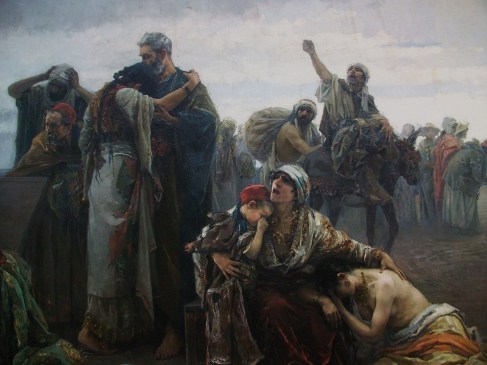
The Expulsion of the Moors from Denia - Painting by Viincente Mostre

A Secret Religion
Many Moriscos professed their allegiance to Christianity while practicing Islam in secret. Every aspect of the Islamic way of life, including the Arabic language, dress and social customs – was condemned as uncivilised and pagan. A person who refused to drink wine or eat pork, or who cooked meat on a Friday might be denounced as a Muslim to the Inquisition. Even practices such as buying couscous, using henna, throwing sweets at a wedding or dancing to the sound of Berber music were un-Christian activities for which a person might be reported to the Inquisition by his neighbour, and obliged to do penance.

Rebellion

Further repression of the Moriscos resulted in a second Rebellion. Fearing the rebels were conspiring with the Turks of the Ottoman Empire, the uprising was brutally suppressed by Don John of Austria. In a spate of atrocities the town of Galera, to the east of Granada, was razed to the ground and sprinkled with salt, after the slaughter of 2,500 people including 400 women and children. Some 80,000 Moriscos in Granada were forcibly dispersed to other parts of Spain, including Seville. Christians from northern Spain were settled on their empty lands. Ayamena and Nicoloao in my story were displaced from Granada before settling in Seville.

As early as the 16th century The Council of State proposed expulsion as a solution to the on-going Morisco 'problem', for which the previous expulsion of the Jews provided a legal precedent. However, the action was delayed because of Spain’s pressing political concerns abroad and because of the drawbacks of losing so many skilled Muslim labourers from the Spanish working population. Muslim labourers and artisans were responsible for much of the beautiful spanish architecture we admire so much today.

Final Expulsion of 400,000 people

Juan de Ribera, the ageing Archbishop of Valencia, who had initially been a firm believer in missionary work, and the conversion of the Moorish population to Christianity, became in his declining years the chief partisan of expulsion. In a sermon preached on September 27th, 1609, he said that Spanish land would never become fertile again until these heretics (the Moriscos) were expelled. The Duke of Lerma, the corrupt chief minister agreed with him. The new king, Felipe III, known as Phillip the Pious for his supposed religious zeal, finally acquiesced to political pressure and in the expulsions began. 

The embarkation order was read out in Seville on January 10th 1610. The entire Muslim population, along with anyone who had converted from Islam to Christianity, was ordered to leave Spain on threat of death. By 1613 it is estimated 400,000 people had been forcibly removed in this mass expulsion from Spanish territory.

This little-known part of seventeenth century forms one of the threads of the narrative in my novel,' A Divided Inheritance'. Read more in this excellent article by Roger Boase in History Today