
Showing posts with label Time Travel Diaries. Show all posts

Thursday, 9 May 2019

The Scent of Hemlock

hemlock in spring (Wikimedia Commons)
by Caroline Lawrence

As I write this, in May 2019, I’m working on a book set in ancient Athens. As usual, I’m seeking out as much sensory detail as possible: sight, sound, taste, touch and smell. I do that to spark synapses in the imaginative right brain, thereby bringing the book alive to young readers. But I’m also doing it for the same reason I write my books: to transport myself back in time. 

In my latest book, The Time Travel Diaries, a 12-year-old London schoolboy named Alex goes back to third century Roman London to find a blue-eyed girl with an ivory knife. She was a real girl whose grave was found not far from the site of Shakespeare’s Globe. In the sequel, which I’m working on now, Alex goes back even further to witness the death of Socrates. 
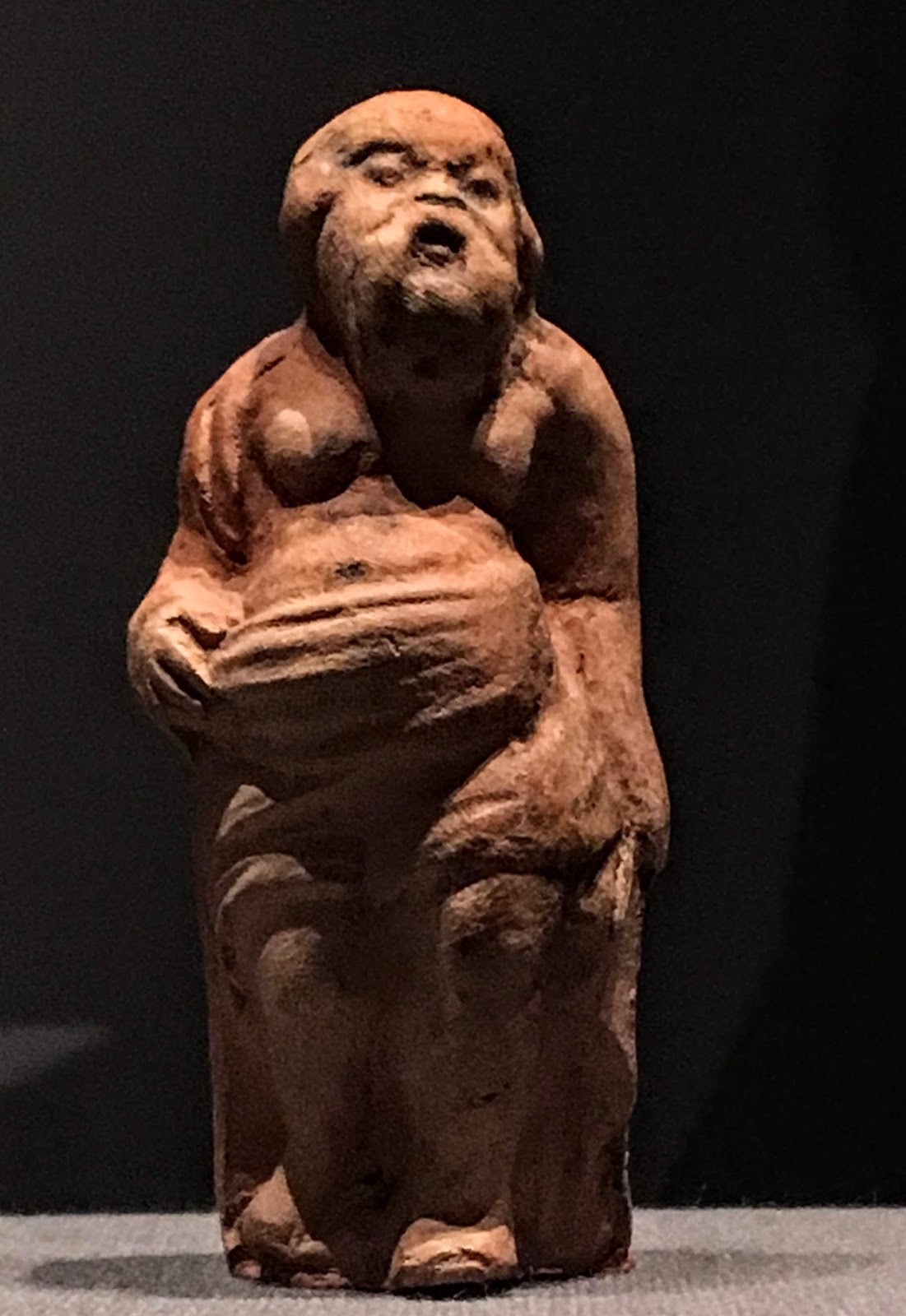

figurine of Socrates in the British Museum
Socrates was the famous fifth century BC Greek philosopher who was the first to bring philosophy down from the stars and into men’s lives. He buzzed around Athens like an annoying mosquito, challenging ancient Greeks to make sure their souls were noble. He’s the one who claimed that ‘The unexamined life is not worth living’.  Finally the politicians and the people he’d pestered decided that enough was enough. They charged him with impiety and sentenced him to death. 

And so, in early summer of the year 399 BC, seventy-year-old Socrates had to drink poison hemlock. 

Apart from a possibly spurious verse, Socrates left not a single written word. But like Jesus, who also died a martyr’s death, he was immortalised by his disciples, the most famous of whom was Plato. Plato is, of course, a giant of western philosophy. All his so-called dialogues have survived and he has been studied avidly without ever going out of fashion for two and a half thousand years. Plato taught Aristotle and Aristotle taught Alexander the Great. 

But it was Socrates who started it all. Without him, our culture would look very different.
David's famous 'Death of Socrates' (1787) Wikimedia Commons

Over the past two and a half millennia scholars have debated the accuracy of Plato’s portrayal of Socrates. For example, at the end of the dialogue called Phaedo, Plato writes vividly of Socrates’ death. He describes how Socrates bravely downed a cup full of hemlock and asked the executioner what he should do next. ‘Walk around until your legs begin to go numb, then lie down.’ Socrates duly walked around, gently rebuking a dozen or so of his friends for wailing and weeping. He reminded them that it is right to die in dignified silence. 

As the paralysis worked its way up, he lay down on his prison cot. The executioner pinched his calves and then thighs, asking if he could feel anything. As the pinches went higher, Socrates calmly said he could not feel anything. ‘When it reaches your heart,’ said the man who had given him the hemlock, ‘it will be over.’ Socrates covered his face and lay quietly. Suddenly he uncovered his face and spoke his last words to his aged best friend: ‘Crito, we owe a rooster to Asclepius; pay it and don’t forget.’ Then he covered his face again. A little later Socrates twitched and when the executioner uncovered his face they saw that he was dead. Crito gently closed his friend’s mouth and eyes. 

The death of Socrates is so calm and dignified that many commentators argued that Plato was sugar-coating the description. They claim that real hemlock poisoning would have included violent convulsions and other unpleasant symptoms. This is because over the years several different plants have received the name hemlock, including ‘water hemlock’ and a kind of fir tree. Although Plato only refers to the poison as the pharmakon (the drug) in this particular dialogue, he mentions hemlock by name in a few other places (e.g. the dialogue called Lysis) using the Greek word konion


In an article published in 2001 by Enid Bloch: Hemlock Poisoning and the Death of Socrates: Did Plato Tell the Truth? Bloch concludes that if konion refers to conium maculatum also known as ‘poison hemlock’, then ‘Plato not only told the truth, he did so with astounding medical accuracy.’ You can read the article online HEREA slightly longer version of this paper was published in 2002 in The Trial and Execution of Socrates: Sources and Controversies. This version of Blochs article contains sixty-five footnotes, some of which describe the smell of hemlock and the bodily sensations it arouses. 

One feature of the plant that everyone from Pliny the Elder to Dioscorides has mentioned is the strong or ‘heavy’ smell. Some commentators have likened the smell of hemlock to that of mice or even cat urine. In footnote 64, Professor Bloch confesses that she has never lived with either cats or mice so she can neither confirm nor deny this observation. 


hemlock in winter (Chelsea Physic Garden)
In footnotes 12 & 63 Bloch tells how a gardener at Cornell University’s Poisonous Plants Garden showed her various types of hemlock and other toxic plants. Krissy Faust even gifted Bloch with some poison hemlock plants so she could study them in the privacy of her own home. When Bloch remarked on the gnarled appearance of the roots, Faust explained that in loose or sandy soil the roots would have grown straight down, like carrots, but ‘in the hard clay of Ithaca, New York’ the roots become bent and twisted in a way which perfectly illustrates one Greek description of the roots as koilay kai ou bathia (twisted and not deep). 

In footnote 65 Bloch relates how on several occasions she has brought hemlock into her Socrates classes. She offers students the opportunity to examine the stalks, always warning them of the possible toxic effect of merely sniffing the plant. ‘Virtually everyone’ who has a sniff reports an ‘immediate feeling of car-sickness and a mild but sharp headache’. Bloch herself describes the queasy sensation as something closer to morning-sickness than car-sickness but acknowledges that most of her students might not be familiar with that particular kind of nausea. 


Elsewhere in the article Bloch says the scent of hemlock is ‘like a very heavy, peculiar tea, clinging obnoxiously in the mouth and nose, as if it had entered the body and not let go.’ A 12-year-old Time Traveller like Alex might describe the smell as Cat Pee Tea. 

So, although Bloch believes that Socrates died peacefully and with dignity, her findings also persuade us that drinking hemlock was nonetheless very unpleasant.

Kids, don
t try this at home! 

The Time Travel Dialogues, Caroline’s sequel to The Time Travel Diaries, will be published in 2020.

Tuesday, 9 April 2019

Leather Bikini Bottoms!

replica Roman leather bikini bottoms
by Caroline Lawrence 


(This blog post is about how a pair of 2000-year-old leather bikini bottoms in the Museum of London inspired a scene in my new kids’ book, The Time Travel Diaries.)


A few days ago a new case appeared in the Roman Gallery of the Museum of London, near the marble head of Mithras. The display contains objects from the grave of a 14-year-old girl from South London. The girl lived around 1800 years ago in what was then known as Londinium. DNA and stable isotopes tell us she had blue eyes but grew up in the southern Med, possibly North Africa, before making the long sea-voyage to Britannia. Three of the five objects buried with her feature heavily in my new Time Travel Diaries book and I am extremely grateful to curator Jackie Keily for putting them on display. I hope the artefacts will send kids to my book and vice versa. 

objects found in a Roman girl's grave

Artefacts are wonderful for creating the possible backstory of a character and these generated ideas for a story about a blue-eyed girl with an ivory leopard knife almost immediately. 

But sometimes artefacts inspire me in less obvious ways, and Im certain this holds true of other authors. This happens when you write with Both Sides of the Brain.

Memory masters know that it is often the juxtaposition of strange objects and images that helps fix dry facts or numbers in the head.

That’s why they turn numbers into pictures and then link them to memorable images as with the Number-Rhyme System or the Number-Shape System. 

Number-Shape Memory System
For example, I recently used the Number-Shape system to teach kids the first ten emperors of Rome in order. In less than ten minutes.

You take a left-brain list of the first ten emperors, then make it right-brain-friendly by adding colour, image, movement, humour, rudeness and the five senses.

Example? Number one looks a bit like an arrow. I get kids to visualise an arrow. Occasionally they can’t do it until I help them by being more specific.

‘Imagine a standing-up arrow with a wooden shaft, a sharp steel arrowhead and red feathers’ I might say. ‘Now imagine touching the smooth wooden shaft, the sharp tip (ouch!) and the soft feathers. Now stroke the feathers the wrong way. Now make the feathers a different colour. Or multi-coloured. You choose! Now make the arrow lean towards you and rotate it in 3-D.’

Memory masters teach themselves do this. A few of them can’t help it. The famous Jewish mnemonist ‘S’ (made famous in A.R. LuriaThe Mind of a Mnemonist) not only saw numbers as specific shapes but also associated them with colours and taste,

Once you’ve trained yourself to imagine the arrow in detail, using all the senses, you can apply the technique. Imagine someone firing your steel-tipped, red-feathered arrow into a calendar on a wall opened to the month of August. (Make the image on the calendar evoke August for you.)

By linking an arrow (number one) with the month of August you will remember that Augustus was the first emperor. It sounds cumbersome, but it works because you’re using both sides of the brain: the logical, verbal, numerate left hemisphere and the non-verbal, imaginative right hemisphere. 

In the Number-Shape System, the number two is shaped like a swan. Make yours a giant one, swimming on the River Tiber. (Can’t visualise Rome’s river? Put a giant colosseum behind it. Or make it tiger-striped. Or both!) That will help you remember that Tiberius was the second emperor of Rome.

A number 3 on its side looks like a baby’s bottom. Imagine patting talcum powder on a smooth baby’s bottom and then noticing he’s wearing baby-sized Roman boots. The word for ‘Baby Boots’ in Latin is Caligula! 

And so forth. By making boring facts visual and linking them with bizarre, funny, colourful objects you help cement them in your memory bank of stored images.

(I’ll bet you don’t have another giant swan swimming on a tiger-striped river with the Colosseum looming in your memory banks!)

real Roman leather bikini bottoms
In the same way, juxtaposition of unusual artefacts often inspire scenes in my books. For example, there are a pair of Roman leather bikini bottoms now on display in the Museum of London. These are one of two pairs (!) found in a Roman well. Experts think the bikinis might have belonged to girl acrobats. Near the case displaying the leather bikini bottoms is a delightful model of the port of Roman London, one of my favourite items in the museum.

Great screenwriters like Orson Welles, Stanley Kubrick and Paul King (the Paddington writer/director) know the power of miniatures. I love to stand there and look down at this model of Londinum’s port. The longer you gaze, the more you see.

acrobats in Nîmes 
Remembering some re-enactor acrobats I’d seen at a weekend of Gladiator Games in Nîmes, I suddenly had the image of girl acrobats walking along the side of London Bridge, like gymnasts on a balance beam. That gave me the idea that maybe my young hero Alex has to get to the north bank fast but there is a traffic jam on the bridge. Sarah Dhanjal once mentioned that it took an hour to cross London Bridge in Medieval times.

model of London's Roman Port
Impatient to cross the bridge in order to get to the gladiator games in Londiniums amphitheatre, Alex hears the crowd of people begin to laugh and buzz like bees (a popular method of applause in Roman times). Alex and his two friends see the reason: four leather-bikini-clad girl acrobats doing cartwheels on the guard rail. 

illustration by Sara Mulvanny
The sight of the girls making their way across the side of London Bridge gives Alex and his friends an idea. They can copy the girls and walk along the guard rail, too. 

This is a great idea because it also involves ‘Crossing the Threshold’ another one of my favourite mythic plot beats, where the hero leaves one world and enters another. As Romans knew, thresholds can be magical places.

As I visualised the scene, using all my senses, a something happened that I had not consciously considered. Alex falls, but not in the way you think… Or maybe you can guess!

That’s the magic of using both sides of your brain when you write by linking concrete artefacts and the sensory imagination.


Ill be sharing all my best writing tips in my next book, How to Write a Great Story, out August 2019. 


Saturday, 9 February 2019

Ways to Die in Londinium

by Caroline Lawrence

When I went back in time to look for the blue-eyed girl with the ivory knife, I never thought I would actually find her. The only reason I took the job was for the money. 

So starts my new book, in which a 12-year-old London schoolboy named Alex Papas is recruited to go back in time to Roman London to find a girl who lived in the mid-third-century AD. 

Why did I decide to leave my usual literary stamping grounds of the sunny Mediterranean and set some books in Roman Britain, specifically London? 


Because whereas Roman Britain used to be dull and dry – on account of very few written sources – the past decade or so has given us some superb material to work with. Recently, more than 14,000 individual artefacts were recovered in the restoration of the Mithraeum to its original site under Bloomberg LP’s new European headquarters. 

Also, scientific advances in DNA and stable isotopes means that archaeologists such as Dr Rebecca Redfern can study a skeleton and determine eye and hair colour, maternal place of origin and even where the subject grew up. 


In 2003, the grave of a 14-year-old girl was found on Lant Street near Borough tube station in Southwark, about half a mile south of the Tate Modern. Her grave goods suggested she was a rich girl. They included two small glass bottles and a clasp knife on a chain. 

The exotic ivory handle of the knife was carved in the shape of a leopard. Despite these rich objects, close study of her bones showed that the girl suffered from rickets, a disease often associated with malnutrition. Her teeth were very bad, too, and suggest that she was either a slave or grew up under hard conditions. Her skeleton is actually on display during free interactive sessions called Written in Bone for kids in Key Stage 2, i.e. aged 8-11. 


The so-called Lant Street Teen came into the headlines recently when her DNA and stable isotopes were analysed. They showed that she grew up in the Southern Mediterranean – possibly even North Africa! – and that she had blue eyes. Even more astonishing, archaeologists can tell that at the age of about nine she made the long and arduous journey to Britannia. Sadly, she died about five years later and was buried with her grave goods on an expensive bed of white chalk. 

I was intrigued by this discovery and thought it would be fun to imagine a scenario that might bring the blue-eyed girl from North Africa to Britannia and explain all the fascinating aspects of her bones. 


Around the same time, I attended the re-opening of London Mithraeum with its well-researched display of artefacts and spooky immersive experience. It occurred to me that it would be the perfect place for a time portal to the third century AD. That was when I decided to write my first timeslip book. 

In the book, originally called Ways to Die in Londinium, my main character Alex has been chosen to go back to Roman London for several reasons. First, he is small for his age and probably won’t hit puberty for a while. Why is this important? One of my contrivances is that for every hour you spend in the past, it takes a year off your life expectancy… unless you are a kid, in which case you only lose a month per hour. That’s why bazillionaire Solomon Daisy hires Alex to go back and find out more about the so-called Lant Street Teen. 

Second, Alex does Latin club at school and therefore knows some basic Latin phrases. 

Third, Alex speaks modern Greek, close enough to Ancient Greek to be just about understood. And Greek was a lingua franca at that time. 

I have a few other contrivances to make the book fun and exciting. For example, the three rules of Time Travel are:  

1. Naked you go and naked you must return. 
2. Drink, don't eat. 
3. As little interaction as possible.


Alex is clever and resourceful. He memorises a map of third-century Roman London and learns several useful Latin phrases such as puellam oculis caeruleis quaero et cultro eburneo (I seek a blue-eyed girl with an ivory knife.) 

Alex prepares in other ways, too. In the back pocket of his jeans, he has a small notebook. One of the page entries reads:

Ways to Die in Londinium:
1. Death by illness (no antibiotics)
2. Death by infected cut (no antiseptic cream)
3. Death by chariot (hit and run)
4. Death by starvation 
5. Death by choking (no Heimlich manoeuvre)
6. Death by fire (or inhaling smoke)
7. Death by rabid animal bite
8. Death by mugger
9. Death by rampaging gladiator

As Alex learns more about the perils of time travel he adds:

10. Death by misunderstood gesture
11. Death by transporting into something solid

And eventually:

12. Death by Angry Priest of Mithras
13. Death by Thames Foreshore Mud

That's only the beginning!  


As a student of history, I am constantly reminded of how blessed we are to live in a time of prosperity, leisure and superb medical care, especially compared to almost any previous historical period. 

On Wednesday 20 February and Friday 22 of the same month from 1-2pm, I’ll be doing two family-friendly interactive talks called Ways to Die in Londinium

I will ask kids to come up with some ways that a Roman Londoner might die. 

I will then show them some real and ancient (replica) artefacts and ask which would have been most valuable to an ancient Roman Londoner. 

I might also ask if they can guess which one of the following would have been worth its weight in gold?

Tomato
Chocolate bar
Alarm clock
Glasses
Mobile phone
Savlon
Puppy Soft Andrex 


Finally, I will read some passages from the first Time Travels Diary

I want to remind myself (and kids) just how privileged we are to be living today. 


Caroline's two halfterm events at the Museum of London are now sold out but there are other fun Roman-themed events including Styx, Stones and Roman Bones