
Showing posts with label Socrates. Show all posts

Thursday, 9 May 2019

The Scent of Hemlock

hemlock in spring (Wikimedia Commons)
by Caroline Lawrence

As I write this, in May 2019, I’m working on a book set in ancient Athens. As usual, I’m seeking out as much sensory detail as possible: sight, sound, taste, touch and smell. I do that to spark synapses in the imaginative right brain, thereby bringing the book alive to young readers. But I’m also doing it for the same reason I write my books: to transport myself back in time. 

In my latest book, The Time Travel Diaries, a 12-year-old London schoolboy named Alex goes back to third century Roman London to find a blue-eyed girl with an ivory knife. She was a real girl whose grave was found not far from the site of Shakespeare’s Globe. In the sequel, which I’m working on now, Alex goes back even further to witness the death of Socrates. 
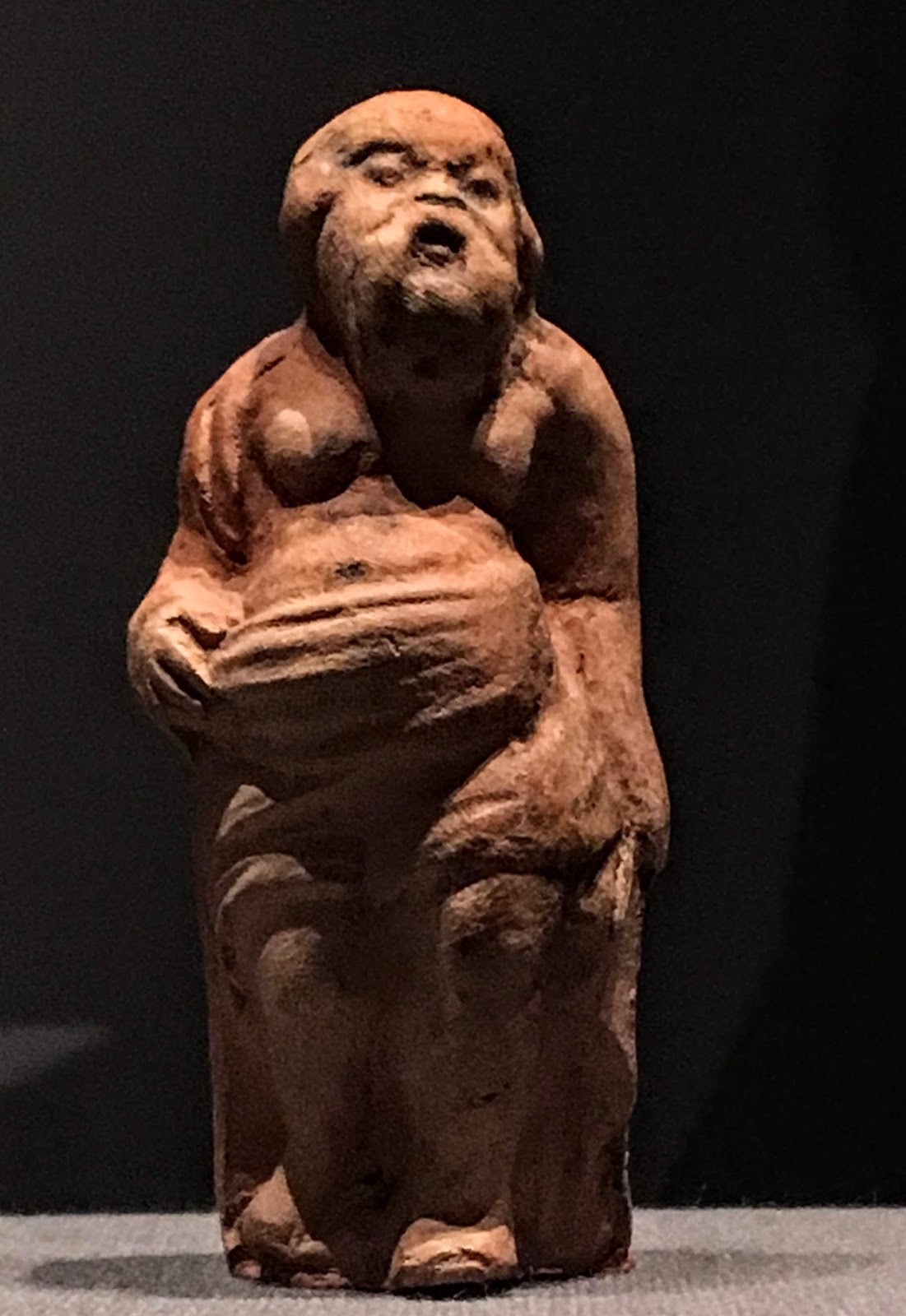

figurine of Socrates in the British Museum
Socrates was the famous fifth century BC Greek philosopher who was the first to bring philosophy down from the stars and into men’s lives. He buzzed around Athens like an annoying mosquito, challenging ancient Greeks to make sure their souls were noble. He’s the one who claimed that ‘The unexamined life is not worth living’.  Finally the politicians and the people he’d pestered decided that enough was enough. They charged him with impiety and sentenced him to death. 

And so, in early summer of the year 399 BC, seventy-year-old Socrates had to drink poison hemlock. 

Apart from a possibly spurious verse, Socrates left not a single written word. But like Jesus, who also died a martyr’s death, he was immortalised by his disciples, the most famous of whom was Plato. Plato is, of course, a giant of western philosophy. All his so-called dialogues have survived and he has been studied avidly without ever going out of fashion for two and a half thousand years. Plato taught Aristotle and Aristotle taught Alexander the Great. 

But it was Socrates who started it all. Without him, our culture would look very different.
David's famous 'Death of Socrates' (1787) Wikimedia Commons

Over the past two and a half millennia scholars have debated the accuracy of Plato’s portrayal of Socrates. For example, at the end of the dialogue called Phaedo, Plato writes vividly of Socrates’ death. He describes how Socrates bravely downed a cup full of hemlock and asked the executioner what he should do next. ‘Walk around until your legs begin to go numb, then lie down.’ Socrates duly walked around, gently rebuking a dozen or so of his friends for wailing and weeping. He reminded them that it is right to die in dignified silence. 

As the paralysis worked its way up, he lay down on his prison cot. The executioner pinched his calves and then thighs, asking if he could feel anything. As the pinches went higher, Socrates calmly said he could not feel anything. ‘When it reaches your heart,’ said the man who had given him the hemlock, ‘it will be over.’ Socrates covered his face and lay quietly. Suddenly he uncovered his face and spoke his last words to his aged best friend: ‘Crito, we owe a rooster to Asclepius; pay it and don’t forget.’ Then he covered his face again. A little later Socrates twitched and when the executioner uncovered his face they saw that he was dead. Crito gently closed his friend’s mouth and eyes. 

The death of Socrates is so calm and dignified that many commentators argued that Plato was sugar-coating the description. They claim that real hemlock poisoning would have included violent convulsions and other unpleasant symptoms. This is because over the years several different plants have received the name hemlock, including ‘water hemlock’ and a kind of fir tree. Although Plato only refers to the poison as the pharmakon (the drug) in this particular dialogue, he mentions hemlock by name in a few other places (e.g. the dialogue called Lysis) using the Greek word konion


In an article published in 2001 by Enid Bloch: Hemlock Poisoning and the Death of Socrates: Did Plato Tell the Truth? Bloch concludes that if konion refers to conium maculatum also known as ‘poison hemlock’, then ‘Plato not only told the truth, he did so with astounding medical accuracy.’ You can read the article online HEREA slightly longer version of this paper was published in 2002 in The Trial and Execution of Socrates: Sources and Controversies. This version of Blochs article contains sixty-five footnotes, some of which describe the smell of hemlock and the bodily sensations it arouses. 

One feature of the plant that everyone from Pliny the Elder to Dioscorides has mentioned is the strong or ‘heavy’ smell. Some commentators have likened the smell of hemlock to that of mice or even cat urine. In footnote 64, Professor Bloch confesses that she has never lived with either cats or mice so she can neither confirm nor deny this observation. 


hemlock in winter (Chelsea Physic Garden)
In footnotes 12 & 63 Bloch tells how a gardener at Cornell University’s Poisonous Plants Garden showed her various types of hemlock and other toxic plants. Krissy Faust even gifted Bloch with some poison hemlock plants so she could study them in the privacy of her own home. When Bloch remarked on the gnarled appearance of the roots, Faust explained that in loose or sandy soil the roots would have grown straight down, like carrots, but ‘in the hard clay of Ithaca, New York’ the roots become bent and twisted in a way which perfectly illustrates one Greek description of the roots as koilay kai ou bathia (twisted and not deep). 

In footnote 65 Bloch relates how on several occasions she has brought hemlock into her Socrates classes. She offers students the opportunity to examine the stalks, always warning them of the possible toxic effect of merely sniffing the plant. ‘Virtually everyone’ who has a sniff reports an ‘immediate feeling of car-sickness and a mild but sharp headache’. Bloch herself describes the queasy sensation as something closer to morning-sickness than car-sickness but acknowledges that most of her students might not be familiar with that particular kind of nausea. 


Elsewhere in the article Bloch says the scent of hemlock is ‘like a very heavy, peculiar tea, clinging obnoxiously in the mouth and nose, as if it had entered the body and not let go.’ A 12-year-old Time Traveller like Alex might describe the smell as Cat Pee Tea. 

So, although Bloch believes that Socrates died peacefully and with dignity, her findings also persuade us that drinking hemlock was nonetheless very unpleasant.

Kids, don
t try this at home! 

The Time Travel Dialogues, Caroline’s sequel to The Time Travel Diaries, will be published in 2020.

Saturday, 9 March 2019

Socrates in Love

Armand D’Angour, Oxford professor of Classical languages and expert in ancient music, has just published a book called Socrates in Love. I, Caroline Lawrence, have just finished the first draft of a kids book about the last days of Socrates. Therefore, I was thrilled to discover that Professor D’Angour had written about a completely different period of the philosophers life, one I don't believe any other authors have ever addressed: a young Socrates in love! 


Professor D’Angour kindly agreed to answer some of my questions for an interview. 


Boris Johnson reads Armand d'Angour's Olympic Ode in 2012

Caroline Lawrence: I first met you in 2012 when Boris Johnson, the Mayor of London at that time, read a new Olympic ode which you had composed in the style of Pindar. Ancient Greek is a challenging language to translate, but to actually compose an ode – and one in the style of Pindar – is mind-boggling. I am in awe of your achievements. Having come to Classical Greek fairly late, at the age of 19, I don’t think I’ll ever master it. How old were you when you began studying the language and did it immediately captivate you? 

Armand D’Angour: No one can ever fully master ancient Greek! I was lucky to start at the age of 9, having learned Latin from 7. This was in the 1960s, and though Latin only was taught at my junior school, my Latin teacher John Evans realised I had a penchant for languages and decided to teach me Greek as well on a one-to-one basis. Mr Evans was a brilliant draughtsman, and personally drew a textbook for me, the memory of which I cherish to this day. For instance, to illustrate comparatives and superlatives, he drew three chubby comic men wearing togas and holding bags of cash of different sizes, marking them with the Greek words for ‘rich’, ‘richer’, ‘richest’. I was immediately captivated both by his drawings and by the lovely Greek script.

Caroline: I’m currently trying to revive my Greek by doing a class at London’s City Lit. We’re reading Plato’s Apology and it does my head in! Are you able to open up one of Plato’s dialogues and just read it, or do you need a dictionary and commentary? 

Armand: Plato’s Greek is relatively straightforward and I can read much of it fluently, but there will always be bits that need going over slowly and with a commentary to work out the meaning and implications. Early dialogues such as Apology are far easier to read and understand than more concentrated and theoretical later works. The main texts that I can read entirely without aids and purely for pleasure in Greek are Homer’s Iliad and Odyssey, because I learned them from the age of 12.

Caroline: What sparked your desire to explore the idea of a young Socrates in love? 

Armand: The idea came to me when I was teaching Aristophanes’ comic play Clouds many years ago. The figure of Socrates is a central character, and he comes on stage sitting in a basket that is swung from a crane. I thought that might make a good start to a film about his life, and wrote a screenplay ending with his trial and death. But Socrates was already 46 at the date of Clouds; when I started to investigate what was known about his earlier life, I uncovered evidence that he was from a relatively wealthy and educated background and milieu. Initially I thought of writing a book called ‘Young Socrates’, but I needed to know what spurred him to become a philosopher rather than, say, a soldier or politician. It seemed to me that it must have involved a formative personal experience, perhaps involving a love affair. In Plato’s Symposium, Socrates says he learned the truth about love from a clever woman. After scrutinising the text closely I realised that Plato had left undoubted clues about who that woman was – a contemporary of his whom he knew as a young man. I imagined that Socrates’ trajectory might be explained if he had fallen in love with her, learned from her, and perhaps even suffered rejection at her hands.

Caroline: Socrates is described by three famous contemporaries, Plato, Xenophon and Aristophanes. How useful were these three sources and what other sources did you draw on?  

Armand: Plato and Xenophon are the crucial biographical sources, but both those authors were born when Socrates was already in his 40s so would only have known him in his 50s and later. They give a very admiring portrait of him as a thinker and moral exemplar, and say he was deeply lovable despite being ugly and fat. Aristophanes portrays a comic version of Socrates in Clouds when he was aged 46, and says nothing about his being ugly and fat, which seems an important indication that he wasn’t known for those attributes until later in life. Regarding other sources, Plato’s pupil Aristotle contradicts Plato in over a dozen details, which is important because he is only likely to have done so if he had known otherwise from what Plato says. For instance, Plato only tells us about one woman, Xanthippe, whom Socrates was with in his 60s, while Aristotle says he married Myrto and had his two older sons with her. There are numerous other minor sources, and I was particularly struck by authors who indicate that Socrates was a real, earthy, man and not a ‘secular saint’. They tell us, for instance, that he inherited rental properties from his father, and that he was lustfully bisexual from his teens onward. I see no reason to doubt their testimonies.


Caroline: You are a classical musician and also one of the pioneers in exploring what ancient Greek music would have sounded like. Do you think music was important to Socrates?

Armand: Socrates would have been surrounded by music all his life. His early instruction on the lyre was by a famous teacher called Lampros, and in his 40s he took it up again under a teacher called Konnos to try and learn something of the latest style. We know something about that style from writings and from a piece of music that survives from a play by Euripides, which I reconstructed for my earlier project on Greek music. Socrates was clearly a knowledgeable but not expert musician – one of his sayings was that the search for truth is the ‘supreme music’, and I think that metaphor tells us that he cared about music but even more about philosophy.

Caroline: Did you have any revelations while you were writing Socrates in Love, either about the man himself or fifth century Athens?   


Armand: The biggest revelation was that when Socrates in Plato’s Symposium attributes a key element of his thought to a clever woman, he is telling the truth. That woman is given a false name, Diotima, by Plato, so it has often been assumed that the claim cannot to be taken seriously. Once the woman is identified – she turns out to be Aspasia (partner of Pericles), an important intellectual figure of her day – we need to imagine a different picture. This led me to view fifth-century Athens in rather a different light from the rather static, male citizen-oriented picture we normally assume. It was abuzz with influential foreigners, women of varying status, slaves who in some cases became free and wealthy, and playful and precocious children. Those groups would have been far more important contributors to the life of the city than our written sources generally indicate.

Caroline: If a time-traveller went back to Socrates’ Athens, what would most surprise them? 

Armand: I think it would be a shock to see the illiterate agrarian peasants driving their oxen and haggling in fishmarkets juxtaposed with magnificent colourful temples and porticoes, busy lawcourts and political assemblies, platoons of hoplites on the march, and noisy dockyards loading goods and assembling superbly constructed triremes for war. Socrates’ Athens was both a big village and the centre of a sophisticated maritime empire.


figurine showing the older Socrates 
Caroline: In our Greek class we just read the bit of Apology where Socrates likens himself to a gadfly, stinging Athenians into virtuous behaviour. My classmates and I had a lively discussion about whether we would have wanted to sit next to Socrates or not. Would you have actually liked the 45-year-old Socrates or found him utterly insufferable? 

Armand: I’ve always rather got on with nerdy, intense types, so I think I might even have been an admirer of Socrates aged 45. Though I can see why others might have found him a pain.

Caroline: A friend of mine who teaches Classics at secondary school says she and her class have cast middle-aged Charles Dance as a middle-aged Socrates. If they ever made a movie of Socrates in Love, who would be your dream actor to play the role? 


Adrian Grenier (Wikimedia Commons)
Armand: I’m actually in discussions to have a movie made, but since the young Socrates and Aspasia are their 20s I’m out of touch with the field. A friend of mine suggested Bradley Cooper and Lady Gaga! Why not…But when I was trying to find someone who looked like I think the fit younger Socrates did - wide face, eyes and nose, thick lips, tousled curly hair - I came up with Adrian Grenier... What do you think?


Rami Malek (Wikimedia Commons)
Caroline: I think Adrian Grenier would be a great choice! I also think Rami Malek, this years Oscar-winner for Bohemian Rhapsody, might make a charismatic Socrates in Love. Thank you for answering my questions, Armand D’Angour. I cant wait to read your book! 


Socrates in Love is out in hardback, Kindle and audio format

Friday, 4 January 2019

Socrates Talks Sense, and Penguin Classics - by Katherine Langrish


Do you remember Penguin Classics – that fantastic collection of black-liveried paperbacks comprising translations of classic literature from all over the world?  They still exist of course, though redesigned: and they still retain their black jackets, but I began buying them in the 1970s as a teenager, and with their assistance and entirely for pleasure read my way through much of Plato, Sophocles, Aeschylus and Euripides. Call me a nerd, but there was a time when on solitary hill walks (yes, they would have had to have been solitary!) I used to parody the charmingly stilted effects (at least in translation) of Socratic dialogue, for my own amusement:

'So, for information about sheep you would go to a shepherd?' 
'Yes, Socrates.'
'And for information about ships you would talk to a sailor? Or if you desired to know something about insects you would visit an entomologist?"
'Yes, certainly.'
'And you would think it useless to ask a sailor about sheep, or to demand information about ships from an entomologist?'
‘That would be ludicrous indeed, Socrates.'

...and soon, once Socrates has established that for information about birds you would visit an ornithologist, and for details of the lives of celebrities you would buy Hello magazine, and that you would be disappointed in a shepherd who knew nothing about sheep, you find yourself agreeing that a statesman or stateswoman really ought to possess some notion of the Good, and of Justice and the  Laws. Both Plato and Socrates held opinions about about democracies, and neither would have approved of referendums:

‘So you would expect a ship’s master to be knowledgeable about seamanship?’
‘I would, indeed, Socrates.’
‘In fact you would expect him to know much more about it than his passengers and crew?’
‘Of course: he would not be qualified to command if he did not.’
‘And you would be surprised if, instead of guiding the ship himself, he asked everyone on board to decide how he should steer and what landfall to aim for, even though they had no experience of the winds, the currents, the coast or the rocks?’
‘I would suppose the gods had struck him mad, Socrates!’

See? You can find yourself wandering off into all sorts of unrealistic places. 

It was possible to pick up a pretty good education simply by choosing one title after another from those blocks of severe black which occupied prominent shelf-space in nearly all bookshops. They were by no means all about the Greeks. Courtesy of Penguin Classics I discovered poems by Li Po, haiku by Bashō, and the writings of the eleventh century Japanese lady Sei Shōnagon, whose ‘Pillow Book’ has to be one of the most urbane and delightful books in the world.  

Shōnagon was born around 965, according to Ivan Morris’s introduction to the book (all quotations below are taken from his Penguin translation). She acted as lady-in-waiting to the Empress Sadako at the court of the mid-Heian emperor Ichijō. This was a fascinatingly cultured and civilized court. At a time when in England, Ethelred the Unredy was trying to buy off the Vikings, and literacy was the province mainly of monks, in upper-class Heian Japan it was impossible even to function socially, still less conduct a love-affair, without the ability to compose at a moment’s notice impromptu verse written in beautiful calligraphy on coloured paper, complete with allusions to classical Chinese poetry.


Although at the time upperclass Japanese men and women were both literate, the men tended to get that extra bit of education. They learned Chinese for exactly the same reasons that men in the West learned Latin. The result: they themselves wrote in Chinese and their work remained derivative, while the women wrote in their own native tongue and composed lasting works of literature. Murasaki Shikibu’s immensely long and wonderful novel ‘The Tale of Genji’ dates from this period: she was a contemporary of Sei Shōnagon, and disliked her.

Sei Shōnagon has the most extraordinary air of self-satisfaction… She is a gifted woman, to be sure. Yet, if one gives free rein to one’s emotions even in the most inappropriate circumstances, if one has to sample each interesting thing that comes along, people are bound to regard one as frivolous. And how can things turn out well for such a woman?

How very Jane Austen that sounds! Anyway, Shōnagon’s ‘Pillow Book’ is a collection of miscellaneous writings bundled together over about ten years’ worth of observations. They range from gossip and scandal, to the beauties and sorrows of the world, to mundane things like the extraordinary way the lower classes shovel in their food (yes, she was a snob). One of her most fascinating habits is the occasional interspersion of lists of various things with different qualities. Like this:

Things That Give a Clean Feeling
An earthen cup. A new metal bowl.  A rush mat. The play of light on water as one pours it into a vessel.  A new wooden chest.

Adorable Things
One picks up a tiny lotus leaf that is floating on a pond, and examines it…
An extremely plump baby, who is about a year old and has lovely white skin, comes crawling towards one, dressed in a long gauze robe of violet with the sleeves tucked up.
Duck eggs.
An urn containing the relics of some holy person.
Wild pinks.

Squalid things
The back of a piece of embroidery.
The inside of a cat’s ear.
A swarm of mice, who still have no fur, when they come wriggling out of their nest.
Darkness in a place that does not give the impression of being very clean…

"The back of a piece of embroidery..." Yes, yes and yes! If you don’t know her already, you will find Shōnagon a wonderful companion. In the meantime, since we might as well take our minds off things while the ship of state veers towards the rocks with the passengers and crew all fighting like cats in a sack, here in Shōnagon’s honour is a list of my own.

Things which are pleasant to use:

An old-fashioned rotary push-along lawnmower: the whirring noise and the way the grass clippings pour in green showers  off the blades.. 

A rotary egg-whisk: the double sort you wind with a handle.

A really sharp pair of scissors, with the crisp snark-snark sound they make as they cut through cloth.

A ratchet screwdriver: the clickety, clockwork sound of the ratchet and the way each twist of the hand adds to the last.

A good fountain pen freshly filled with black ink: the nib swims over the paper leaving a shining trail and  you feel as though what you have written must be good…

A clean block of white paper. 

A fresh eraser as soft as a mushroom: the tingling dusty feel under your fingertips, and the way it shreds at the corner when you begin to rub out.

What would your own list contain?