Showing posts with label Tony Bradman. Show all posts

Wednesday, 23 April 2014

THE DAY THE WAR ENDED, by Leslie Wilson


My grandfather's WW1 medal, the one everyone
got for taking part, with the black-red-white
Imperial colours.

Last year I was asked to contribute a story to an anthology that does what it says on the tin: 'Stories of World War One.' It is published this month by Orchard and has turned out to be a brilliant collection that I am proud to be part of. Full of wonderfully-written, thoughtful stories. Tony Bradman, the editor, asked me to write about the German side of WW1 for 10-14 year-olds. I demurred: I said the German experience of the trenches wasn't so different from the British experience (except that, by all accounts, their trenches were a bit better built and equipped), but Tony said what he really wanted was a story about a young girl in Berlin during wartime. That seemed much more attractive and interesting, and there was a bit of family history I could integrate. None of my English family fought in World War 1 - except for Uncle Sam, my great-aunt Nellie's husband (who she had, it was said in the family, reclaimed from a life of Vice and Drink). He was an ex-soldier, so he must have fought, but I never knew him or heard any stories about his wartime experience.

On the other hand, my German grandfather was a teenage soldier (he joined up, as a trainee non-commissioned officer, when he was seventeen) and my German grandmother lost two of her brothers in the war, including her favourite brother, Leo.

German soldiers in a trench. Photo: Bundesarchiv
The other thing I really wanted to do was to write about the German revolution, which occurred just two days before the Armistice was signed. I have discovered that a great many British people don't know anything about the German revolution; when I've asked them they've said that they vaguely supposed the Kaiser was removed by the Allies, as part of the Treaty of Versailles.

This was not the case. There has been a bit of a spat between historians recently, and what it has usefully opened up is that in Imperial Germany, in 1914, all adult males had the vote (though you still hear people suggest that the Kaiser's regime was as bad as the Nazis. That is viewing WW1 through the prism of WW2, a great mistake, historically). Many of the British Tommies who fought and died did not. But just as in Britain, before the Parliament Act of 1911, the dead hand of the Lords lay on the Commons, in Germany the Kaiser and his ministers kept the Reichstag  (The Parliament) firmly on the constitutional leash.

The German Social Democrats had been gaining ground however. They needed to; as in Britain, there was an enormous gulf between rich and poor and the workers in the factories were badly exploited. The slums of Berlin were as big a disgrace as the slums of London, and when during the war the British blockade cut off food supplies, the poor suffered worse than anyone else and unrest grew. There was a winter called the 'Kohlrabi winter' when kohlrabi was literally almost all there was to eat. Though I like kohlrabi as a salad vegetable, I would hate to have to live on it.Towards the end of the war the Kaiser's government tried to save itself through the carrot of parliamentary reform; the military government was replaced by a democracy and various electoral and economic reforms were promised. But it was too late.
Sailors in revolt: the placard says SOLDIERS' COUNCIL; LONG LIVE
THE SOCIALIST REPUBLIC. Photo: German federal archive
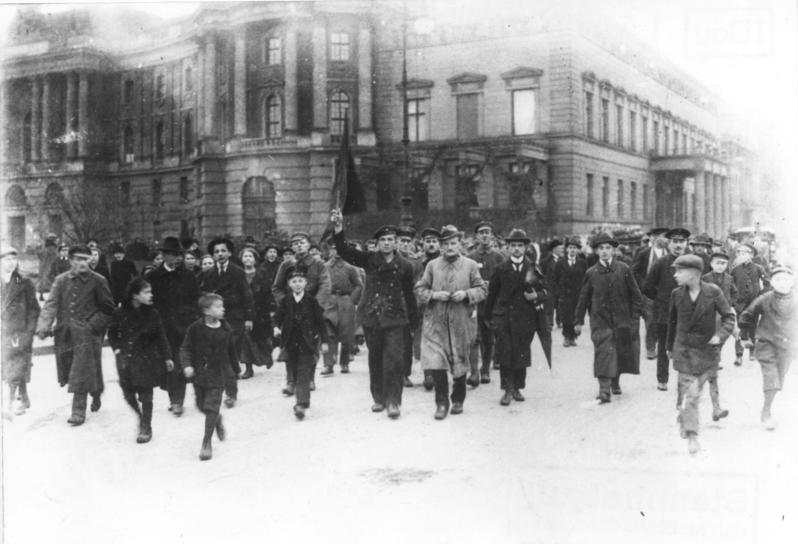
The revolution began in October 1918 (only a year after the Russian Bolshevik revolution), when the sailors of the German navy refused to go out and fight the British in the channel. Arrests were made, but there was further unrest and demonstrations: Freedom and Bread was the slogan. The military fired on the demonstrators, killing seven people and severely injuring twenty-nine. The demonstrators fired back. The protest became an uprising, spreading all over Germany. It was very much a grass-roots revolution, with the people forming 'workers' councils' and 'soldiers' councils.' I can't put my finger on chapter and verse right now, but I am pretty sure that at the Front whole regiments threw down their arms and surrendered. They were motivated by war-weariness and a revulsion from the pointless slaughter, but many also were sick of fighting other 'small people' just like themselves, at the behest of the military/capitalist/aristocratic authorities. On the 9th November (a recurringly fateful date in 20th-century German history) the Revolution came to Berlin.

Demonstration Berlin 1918. Photo: German Federal Archive
The fourteen year-old young girl in my story has a brother at the front, and is falling in love with a bright worker's son, Lukas, who lives near her in Prenzlauer Berg in Berlin. Her elder brother, Leo, was killed at Verdun, like my own great-uncle Leo. She is aware of the war-weariness and really wants her brother Paul to survive, yet is reluctant to let go of the idea of her eldest brother's heroic sacrifice. Lukas gets her to join one of the marches, and she ends up witnessing the Social Democrat Scheidemann announcing the Revolution and the abdication of Kaiser Wilhelm II, from the balcony of the Reichstag.
Before I wrote the story, I spent some time reading the war-time diaries of the great print-maker and sculptor Käthe Kollwitz, who lived in Prenzlauer Berg and lost one of her own sons early in the war. Honest and anguished, they gave me a handle on what it felt like to go through those times. Kollwitz was a Social Democrat, not a rightist, and certainly didn't reverence the military or Kaiser Wilhelm, but like many people, when war happens, she was swept along by what Vera Brittain called 'those white angels who fight so naively on the side of destruction.' Ideas of self-sacrifice, of courage in the face of loss (and both her sons went willingly to the Front), of endurance and solidarity with the nation. And one must remember that the main threat the Germans saw in the war to their freedom was Russia, and that means Tsarist Russia with its secret police, its prison camps in Siberia, its autocratic government and its pogroms.
The Grieving Parents; monument by Kollwitz to her dead son Peter,
in Vladslo, Belgium. Photo: Wikimedia Commons
The other tremendous value of Käthe Kollwitz's diaries was that they gave me a day by day account of what was going on, so I owe her a great debt of gratitude. From the memoir of Sebastian Haffner, called in German Geschichte eines Deutschen, and in English Defying Hitler, I got some more thoughtful insight into the problems posed by the Revolution, and also that invaluable and hard to come-by information, what the weather was like. It was foggy. I thought that was a marvellous metaphor for the uncertainty of the future for defeated Germany.
The trouble was that the new Republic was sabotaged from the start by the conditions of the Treaty of Versailles. They had announced that the war would end; the German envoy was already in France discussing the Armistice; and the only way they could have got a better settlement was by fighting on, which was impossible. So they told the envoy to sign. This was the basis of the 'stab in the back' legend, which was so useful to Hitler later on, and yet, looking at the circumstances, I cannot see what else the new Government could have done.
I have read historians stating that this treaty was perfectly 'fair' because Germany had imposed just as harsh a treaty on Russia a year earlier, or else because Germany began the war (though in fact it was Austria who began it). They then go on to say that because the treaty was fair, it couldn't possibly be blamed for the rise of Hitler. This strikes me as an irrational and slightly childish argument.
Fairness is not the issue here: what matters is cause and effect. Though all countries were hit by post-war depression, it hit Germany worse, because she had lost the industrial base in the Ruhr to France. The treaty imposed enormous reparations on Germany, while depriving her of the means to pay them. The result was hunger, the traumatic hyper-inflation of 1919, when people had to spend their wages within hours before they became valueless, and my grandmother's family once exchanged their grand piano for a loaf of bread - and a fragile economy. If you want to understand what those times felt like, read Hans Fallada's Little Man, What Now? (Kleiner Mann, was nun?).
Five-million Mark note. Photo: Boeing 720 via Wikimedia Commons.
When the double-whammy of the Wall Street crash hit, those who had hated the Revolution from the start thought democracy had failed Germany, and looked for an alternative. Leftists despaired of capitalism and voted Communist. Those inclined to vote for the Right looked to the nascent Nazi movement, which promised the restoration of prosperity and order, which meant no more pitched battles on the streets.
Going back to November 1918, even if it had been sensible to pulverise the German economy as revenge for 'starting the war,' the war had been started and conducted bythe Imperial government, which was no longer in place. The Germany that was punished was the new democracy. Clearly, those who made the treaty, especially the French, could not know what was to come, but the lesson was learned and put into practice by the victors of World War II, who took care to let Germany build herself up again.
This may seem too much weight of history and foreboding for a short story for teenagers to carry, but I had five thousand words, which helps, and also what matter most are the feelings; grief, fear, hope, humiliation, hunger. A bespectacled boy comes out of the fog and says: 'We'll have to fight them again'; an old Conservative, tears running down his face, accuses the Socialists of betraying Germany with the treaty; a young working-class man who has lost his right arm during the war, shouts back, furious with the military ethos of Wilhelmine Germany which he blames for the conflict. And people are still queueing up for scarce food. Those were the feelings which drive voting patterns, then as now.
And on the Western Front, shedding tears of fury that day, was a young skinny man with a dark moustache who was to rise to the head of his party at just the most hideously appropriate moment.
Hitler, on right, with fellow soldiers in WW1. Photo Wikimedia Commons


Wednesday, 10 October 2012

September Competition Winners

And the winners of Tony Bradman's Viking Boy are: 

Sally
Sarah
Manda Scott
Catherine
Sue Purkiss 


Please contact Paul Black at Walker Books to get your books:
paul.black@walker.co.uk

Congratulations!

Saturday, 29 September 2012

A South London Viking Boy - Tony Bradman

Our guest post this month comes from a very old friend, Tony Bradman. I (Mary Hoffman speaking) have known Tony for so long that I can't even remember when or where we first met. We've been on committees together, argued over the merits of books, sometimes agreed, campaigned for justice in both global and individual causes. So I know he is an all round good bloke, with his heart in the right place. I am not much of a one for weapons of war but if it ever came to any other kind of  fight, I'd certainly want him as my wingman.


Here's what our guest says about himself:

Tony Bradman has been involved in the world of children’s books as a writer, reviewer and anthologist for over 30 years. He has been a member or chair of various committees and a judge of several major book awards. And yet strangely he is still not rich or famous enough to retire...


Photo courtesy of Speaking of Books


This autumn sees the publication of my first standalone novel, Viking Boy, and I’m very honoured (as a mere male) to be invited by the History Girls to explain how I came to write it. I feel that I’m in exalted company, and in particular I’m delighted to be following in the footsteps of Kevin Crossley-Holland, a writer I admire enormously. His own recent novels Bracelet of Bones and Scramasax set the bar for fiction with a Viking background high indeed!

I have a very clear memory of the moment when my passion for all things Viking began. It would have been on a Saturday morning, probably in 1965 or maybe 1966. My parents had been divorced for a couple of years, and my Dad’s access visits generally involved him taking me out on Saturdays. We went to all sorts of places in London – occasionally somewhere special like the British Museum or the Tower of London, more often to see a film – but on the way home my Dad always gave me some money to spend in a shop of my choosing.

For a while that had usually been a toyshop where I could buy an Airfix model. But by the age of eleven or 12 I had become a bookish boy, and had discovered that my Dad could be persuaded to buy me a book. He was a reader too, and Puffins at that time were very reasonably priced – a children’s novel could be had for three shillings and sixpence in old money, which is only 17 and a half pence today (this all sounds incredibly historical, but then it is nearly 50 years ago!) – and the place to find them was the nearest branch of W.H. Smith.

So there I was, browsing through the shelves, when I came upon a title that caught my interest – Horned Helmet by Henry Treece, an author I hadn’t come across before. I pulled the book out and was instantly captivated by the striking image on the cover. It showed a bearded Viking warrior in a horned helmet who was also holding a sword and shield. Behind him were two more Vikings, and the billowing sail of a Viking ship. Of course, at the time I didn’t know that the cover and brilliant black and white pictures inside the book were by the legendary illustrator Charles Keeping. But there was something about those characters – their wildness, their sheer toughness – that I responded to.


Horned Helmet is the story of Beorn, a fugitive Icelandic boy who falls in with a group of Vikings led by Starkad, the warrior on the cover. It’s a short book (128 pages) written in a very spare, even stark style which I realised later is Treece’s attempt to reproduce the clipped, bare language of the original sagas. At the time I read it one gulp, and loved everything about the world it depicted – the chainmail and swords and spears and axes, the menace of these men, their easy banter and the sheer practicality they relied on in dealing with the harsh northern world they lived in. It’s not a word I would have used then, but it’s the only one that really sums up how I felt then – Vikings were just very cool. For a boy living with his mum and sister in grotty rented flat in south London they were like a bracing blast of chill northern air, and I couldn’t get enough of it.

After that I went through the rest of Henry Treece’s books like a dose of salts, and loved his Viking Trilogy. I moved on to Rosemary Sutcliff (some of whose books Charles Keeping also illustrated), although she wrote far less about the Vikings than the Celts and Romans – but she did produce two of my all-time favourite Viking novels, Blood Feud and The Shield Ring, her story of the long resistance of the Cumbrian Vikings to the Norman yoke. Reading fiction about the Vikings also led me to reading some proper history, and that helped me to fill my mental picture of the Viking world with a great deal more detail.


I should mention one last influence. I’d be lying if I didn’t admit that a lot of my internal visual image of the Viking world is taken from one of the greatest movies of all time (I can never understand why it isn’t number one in the Sight and Sound list of great movies), The Vikings. Kirk Douglas, Tony Curtis, Janet Leigh, Viking ships, Kirk Douglas throwing battle-axes at a castle gate so he can use them to climb up it, lots of quaffing ale from cow horns, rampant sexism, Ernest Borgnine leaping to his death in a snake-filled pit with a Viking war cry – I mean, what’s not to like? I probably saw it on TV at about the same time I read Horned Helmet, and not long after that my Dad took me to see another Viking epic, The Long Ships starring Richard Widmark as a Viking adventurer and Sidney Poitier as his deadly enemy, a north African corsair.

Let’s fast forward a few years now, to my early days as a writer of children’s books. I remember talking to an editor in the 80s – I started out as a writer of poetry and picture book texts, but wanted to write historical fiction. The editor warned me off, saying that ‘nobody was interested in historical fiction any more’, so I put that particular ambition on hold and concentrated on shorter books. I had a fair amount of success in that area and made a decent living out of it, so by the time historical fiction was back in fashion (as it has been recently) I was locked into other kinds of books. I still wanted to write longer fiction, but I wasn’t sure I could afford to. I’m a slow writer, and I knew a novel would take me far more time than the average advance for one would buy.

Enter a certain Mr David Fickling, or to be more precise, his comic project, known at the time as The DFB and subsequently transmuted into The Phoenix. I’ve known (and admired) David for a long time – he’s a great publisher. He asked me if I had any ideas for a story strip, and I came up with an outline for a story about a Viking boy whose home is raided and his father killed. At around that time I’d written a short book for Barrington Stoke about Harald Hardrada, the Norwegian king and Viking adventurer killed at the battle of Stamford Bridge in 1066 (my book is called Harald Hardnut, which is pretty much what hardrada means in Old Norse). My interest in the Vikings had never died, but the research I’d done for that book had brought it to the front of my mind.

It didn’t work out with The DFB, but not long after that I had a conversation with another editor I’ve known for a long time, Gill Evans of Walker. Gill told me they were going to be publishing some graphic novels, so I showed her my outline for Viking Boy, as it had become by then. Gill liked it, but as we were talking about it I suddenly realised that I wanted to write it as a novel. I was lucky enough to be commissioned, and set about working on it.


This involved doing a lot of research. I read about the Viking period, of course, but I also read the Viking sagas to get a feel for the kind of people they were – the sagas are amazing stories, full of incident and insight into human nature, with fully rounded characters who leap off the page. I studied some Old Norse so I could read the Havamal, the brilliant collection of Viking proverbs and practical wisdom. I visited Norway and Denmark to do some on-the-spot research at the Viking Ship Museums in Oslo and Roskilde. The latter has a shipyard where you can go for a ride in a reproduction of a small Viking ship, which I did, of course. Inside the Roskilde museum there’s also an area where you can dress up as a Viking. There were few people around the day I was there, so of course I did what I would have done as a Viking-mad 11-year-old...

The writing itself took quite a long time. I’ve spent most of my career writing fiction of less than a few thousand words, so to begin with I felt I just wasn’t writing enough. That led to a first draft of 60,000 words, but Walker wanted a junior novel of not much more than 30,000. The prospect of cutting my draft by half was daunting, but I got it down to 42,000. Then came the copy edit, and although I was asked to change very little, when I re-read the story I had that sinking feeling we all get sometimes when we realise that what we have written could be a lot better. It was just too long-winded in parts – it needed to be as sparse and stark and cool as I could make it. In recent years I’ve been working with my son Tom – we’ve written quite a few books together now – and he gave me some advice that really helped. So I settled down for a six-week burst of cutting and re-writing, and the final version is 32,000 words. And though I say so myself, I think it’s a much better book – a proper Viking book.

That was the point for me. I wanted to pack into it everything I liked about the Vikings. There had to be a boy on quest for his father, mostly because as someone whose Dad wasn’t around much in my childhood the theme of fathers and sons has a lot of resonance for me – so my young hero Gunnar decides to go to Valhalla to get his Dad back. There had to be a special sword with a name, and a beautiful Viking longship. There had to be a fantasy element – Odin makes an appearance, as do his Valkyries (women warriors who ride giant flying wolves in the original tales!). There had to be lots of tough Viking warriors (one of them is called Starkad!) and some great fight scenes which were exciting but which would still leave the reader in no doubt that violence is terrifying, especially when it affects those we love. Last but not least there had to be a great plot, one with the kind of twist that’s a real surprise, and as we all know, the dark art of creating a great plot is not easy.

Walker have done me proud in terms of production – Viking Boy is a very handsome paperback with a great cover and black and white illustrations by a young French illustrator called Pierre-Denis Goux. It was a very long journey from that moment when I became a fan of the Vikings, but I love the idea that it started with a book and ended with one too. Whether or not I’ve succeeded in writing a good story is something only readers can tell, but I have a strong feeling that if a certain 11-year-old south London boy had picked it up in W.H. Smiths in 1965 he would have read it at a gulp. I hope so, anyway.


Let's hope the journey hasn't ended yet, Tony! And, blog readers, look out for a giveaway of copies of Viking Boy tomorrow.  I'm only disappointed we didn't get a photo of Tony dressed up as  Viking!