Showing posts with label Hans Fallada. Show all posts

Wednesday, 23 April 2014

THE DAY THE WAR ENDED, by Leslie Wilson


My grandfather's WW1 medal, the one everyone
got for taking part, with the black-red-white
Imperial colours.

Last year I was asked to contribute a story to an anthology that does what it says on the tin: 'Stories of World War One.' It is published this month by Orchard and has turned out to be a brilliant collection that I am proud to be part of. Full of wonderfully-written, thoughtful stories. Tony Bradman, the editor, asked me to write about the German side of WW1 for 10-14 year-olds. I demurred: I said the German experience of the trenches wasn't so different from the British experience (except that, by all accounts, their trenches were a bit better built and equipped), but Tony said what he really wanted was a story about a young girl in Berlin during wartime. That seemed much more attractive and interesting, and there was a bit of family history I could integrate. None of my English family fought in World War 1 - except for Uncle Sam, my great-aunt Nellie's husband (who she had, it was said in the family, reclaimed from a life of Vice and Drink). He was an ex-soldier, so he must have fought, but I never knew him or heard any stories about his wartime experience.

On the other hand, my German grandfather was a teenage soldier (he joined up, as a trainee non-commissioned officer, when he was seventeen) and my German grandmother lost two of her brothers in the war, including her favourite brother, Leo.

German soldiers in a trench. Photo: Bundesarchiv
The other thing I really wanted to do was to write about the German revolution, which occurred just two days before the Armistice was signed. I have discovered that a great many British people don't know anything about the German revolution; when I've asked them they've said that they vaguely supposed the Kaiser was removed by the Allies, as part of the Treaty of Versailles.

This was not the case. There has been a bit of a spat between historians recently, and what it has usefully opened up is that in Imperial Germany, in 1914, all adult males had the vote (though you still hear people suggest that the Kaiser's regime was as bad as the Nazis. That is viewing WW1 through the prism of WW2, a great mistake, historically). Many of the British Tommies who fought and died did not. But just as in Britain, before the Parliament Act of 1911, the dead hand of the Lords lay on the Commons, in Germany the Kaiser and his ministers kept the Reichstag  (The Parliament) firmly on the constitutional leash.

The German Social Democrats had been gaining ground however. They needed to; as in Britain, there was an enormous gulf between rich and poor and the workers in the factories were badly exploited. The slums of Berlin were as big a disgrace as the slums of London, and when during the war the British blockade cut off food supplies, the poor suffered worse than anyone else and unrest grew. There was a winter called the 'Kohlrabi winter' when kohlrabi was literally almost all there was to eat. Though I like kohlrabi as a salad vegetable, I would hate to have to live on it.Towards the end of the war the Kaiser's government tried to save itself through the carrot of parliamentary reform; the military government was replaced by a democracy and various electoral and economic reforms were promised. But it was too late.
Sailors in revolt: the placard says SOLDIERS' COUNCIL; LONG LIVE
THE SOCIALIST REPUBLIC. Photo: German federal archive
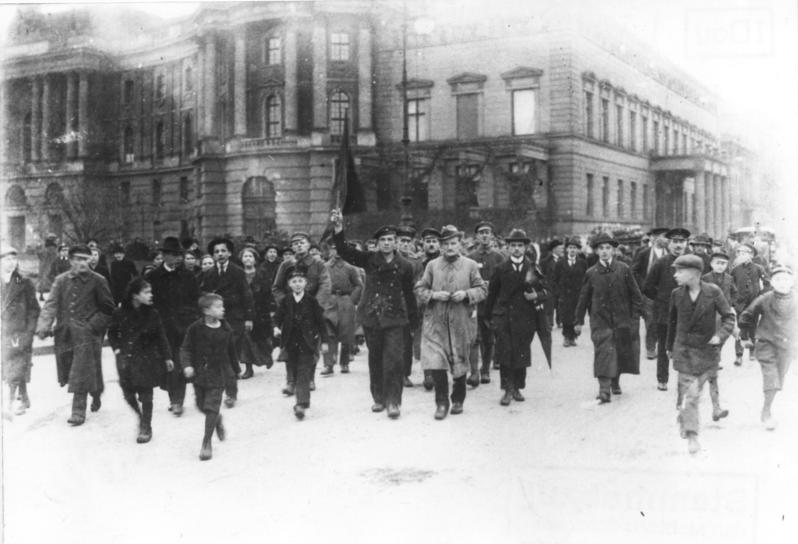
The revolution began in October 1918 (only a year after the Russian Bolshevik revolution), when the sailors of the German navy refused to go out and fight the British in the channel. Arrests were made, but there was further unrest and demonstrations: Freedom and Bread was the slogan. The military fired on the demonstrators, killing seven people and severely injuring twenty-nine. The demonstrators fired back. The protest became an uprising, spreading all over Germany. It was very much a grass-roots revolution, with the people forming 'workers' councils' and 'soldiers' councils.' I can't put my finger on chapter and verse right now, but I am pretty sure that at the Front whole regiments threw down their arms and surrendered. They were motivated by war-weariness and a revulsion from the pointless slaughter, but many also were sick of fighting other 'small people' just like themselves, at the behest of the military/capitalist/aristocratic authorities. On the 9th November (a recurringly fateful date in 20th-century German history) the Revolution came to Berlin.

Demonstration Berlin 1918. Photo: German Federal Archive
The fourteen year-old young girl in my story has a brother at the front, and is falling in love with a bright worker's son, Lukas, who lives near her in Prenzlauer Berg in Berlin. Her elder brother, Leo, was killed at Verdun, like my own great-uncle Leo. She is aware of the war-weariness and really wants her brother Paul to survive, yet is reluctant to let go of the idea of her eldest brother's heroic sacrifice. Lukas gets her to join one of the marches, and she ends up witnessing the Social Democrat Scheidemann announcing the Revolution and the abdication of Kaiser Wilhelm II, from the balcony of the Reichstag.
Before I wrote the story, I spent some time reading the war-time diaries of the great print-maker and sculptor Käthe Kollwitz, who lived in Prenzlauer Berg and lost one of her own sons early in the war. Honest and anguished, they gave me a handle on what it felt like to go through those times. Kollwitz was a Social Democrat, not a rightist, and certainly didn't reverence the military or Kaiser Wilhelm, but like many people, when war happens, she was swept along by what Vera Brittain called 'those white angels who fight so naively on the side of destruction.' Ideas of self-sacrifice, of courage in the face of loss (and both her sons went willingly to the Front), of endurance and solidarity with the nation. And one must remember that the main threat the Germans saw in the war to their freedom was Russia, and that means Tsarist Russia with its secret police, its prison camps in Siberia, its autocratic government and its pogroms.
The Grieving Parents; monument by Kollwitz to her dead son Peter,
in Vladslo, Belgium. Photo: Wikimedia Commons
The other tremendous value of Käthe Kollwitz's diaries was that they gave me a day by day account of what was going on, so I owe her a great debt of gratitude. From the memoir of Sebastian Haffner, called in German Geschichte eines Deutschen, and in English Defying Hitler, I got some more thoughtful insight into the problems posed by the Revolution, and also that invaluable and hard to come-by information, what the weather was like. It was foggy. I thought that was a marvellous metaphor for the uncertainty of the future for defeated Germany.
The trouble was that the new Republic was sabotaged from the start by the conditions of the Treaty of Versailles. They had announced that the war would end; the German envoy was already in France discussing the Armistice; and the only way they could have got a better settlement was by fighting on, which was impossible. So they told the envoy to sign. This was the basis of the 'stab in the back' legend, which was so useful to Hitler later on, and yet, looking at the circumstances, I cannot see what else the new Government could have done.
I have read historians stating that this treaty was perfectly 'fair' because Germany had imposed just as harsh a treaty on Russia a year earlier, or else because Germany began the war (though in fact it was Austria who began it). They then go on to say that because the treaty was fair, it couldn't possibly be blamed for the rise of Hitler. This strikes me as an irrational and slightly childish argument.
Fairness is not the issue here: what matters is cause and effect. Though all countries were hit by post-war depression, it hit Germany worse, because she had lost the industrial base in the Ruhr to France. The treaty imposed enormous reparations on Germany, while depriving her of the means to pay them. The result was hunger, the traumatic hyper-inflation of 1919, when people had to spend their wages within hours before they became valueless, and my grandmother's family once exchanged their grand piano for a loaf of bread - and a fragile economy. If you want to understand what those times felt like, read Hans Fallada's Little Man, What Now? (Kleiner Mann, was nun?).
Five-million Mark note. Photo: Boeing 720 via Wikimedia Commons.
When the double-whammy of the Wall Street crash hit, those who had hated the Revolution from the start thought democracy had failed Germany, and looked for an alternative. Leftists despaired of capitalism and voted Communist. Those inclined to vote for the Right looked to the nascent Nazi movement, which promised the restoration of prosperity and order, which meant no more pitched battles on the streets.
Going back to November 1918, even if it had been sensible to pulverise the German economy as revenge for 'starting the war,' the war had been started and conducted bythe Imperial government, which was no longer in place. The Germany that was punished was the new democracy. Clearly, those who made the treaty, especially the French, could not know what was to come, but the lesson was learned and put into practice by the victors of World War II, who took care to let Germany build herself up again.
This may seem too much weight of history and foreboding for a short story for teenagers to carry, but I had five thousand words, which helps, and also what matter most are the feelings; grief, fear, hope, humiliation, hunger. A bespectacled boy comes out of the fog and says: 'We'll have to fight them again'; an old Conservative, tears running down his face, accuses the Socialists of betraying Germany with the treaty; a young working-class man who has lost his right arm during the war, shouts back, furious with the military ethos of Wilhelmine Germany which he blames for the conflict. And people are still queueing up for scarce food. Those were the feelings which drive voting patterns, then as now.
And on the Western Front, shedding tears of fury that day, was a young skinny man with a dark moustache who was to rise to the head of his party at just the most hideously appropriate moment.
Hitler, on right, with fellow soldiers in WW1. Photo Wikimedia Commons


Saturday, 23 July 2011

Alone in Berlin - original version, by Leslie Wilson

I first read this book in German, when I was researching Last Train from Kummersdorf, and it made a huge impact on me. I was startled, but not at all surprised, when the translation burst on the international scene the year before last and became a best-seller.

But now it appears that the version I read, the one that has been so widely translated, is not the full version; it was subject to editorial cuts after Fallada's death, and the German Aufbau Verlag - the publishing house that originally brought the novel out - has discovered the unexpurgated version in its archive and published it. Aufbau Verlag was then a Russian-zone publishing house. The name means 'Reconstruction Press.'

Actually - as the German afterword tells me - it's a wonder that this novel got published at all. The original response from the publisher's reader is stupidly negative, and it's dreadful to think that Fallada had to endure it when he was already dying. There is no middle stratum in this novel, the reader said; the characters are either all good or all bad; the Persicke family are over the top; the characters are unconvincing; too many coincidences - and historical inaccuracies - and anyway, it's 'a novel of pimps with a political veneer.'

Fallada was never well enough to discuss this with Kurt Wilhelm, the publisher at Aufbau Verlag. He knew that he'd written one of his best works; it's to be hoped that he managed to remember that in the midst of the nightmare (Fallada's expression) that the reader's report was to him. And the novel did get published - but cuts were made.

One of those cuts (which has actually been reversed in the translation) was to suppress the fact that the postwoman Eva Kluge was a Party member. Also, for some reason, the character originally called Barkhausen was renamed Borkhausen - and there are a few editings that were seriously needed - such as the section where Enno Kluge and Barkhausen ransack poor Frau Rosenthal's flat which goes on forever in the uncut version.

Another character who has had some grey tones removed from his personality is Judge Fromm, who tries and fails to shelter Frau Rosenthal, at the beginning of the novel. Wiegler scissored out his admission to Frau Rosenthal that he was known as 'the bloody Fromm,' or 'the hanging judge Fromm.' This casts another, more sinister light on his cold passion for justice - and his coldness is one of the things that prevent him from saving Frau Rosenthal's life.

But to me the most significant issue is that the best part of a whole chapter vanished, because the desk editor cancelled Anna Quangels membership of the Nazi Frauenschaft (the Women's Organisation.) The Frauenschaft, in wartime, carried out many WI-type jobs, running courses for housewives on how to cook a good meal on rations, how to bottle fruit and vegetables safely and to make and make over clothes. But the crucial role of the Frauenschaft was described in its founding statement as 'the National Socialist indoctrination of German women.' It was members of the Frauenschaft who made punitive descents on my grandmother in 1933-34, when my grandfather, a Social Democrat policeman, was fighting for his job and for his life. They would turn the house over, inspect the books on the shelves, make insulting comments on my grandmother's housekeeping, and tell her she was scum and would end up in concentration camp.

The original Chapter 17 relates how Anna got herself out of this noissome organisation.

At the risk of spoiling it for anyone who wants to read the complete version; she achieves it by harassing - in her capacity as a 'Frauenschaft' functionary - the wife of an SS man who is evading war work. She is, of course, not meant to trouble such 'ladies.' The woman then does as Anna intended and kicks up such a stink that it ends with Anna's ejection from the Frauenschaft. It's a wonderful piece of writing, full of black humour, and it is a shame to miss it.

But it's inaccurate, historically, since women weren't called up for war work in Germany in 1940, this didn't happen till 1943. At which time many middle-class women did slip out of war work by getting doctors to certify them unfit, and the wives of Nazi high-ups of course wriggled out of the call-up. Fallada explains to the reader that at that stage slave labourers hadn't been imported from the occupied countries to work in factories. Quite true, but in 1940 the slave labour was being done by Jews, who worked themselves into the ground, knowing that if they didn't they'd disappear eastwards.

Whether this matters is an interesting question. I'm aware that I've breathed smoke and flames about the divagations from historical probability of books like 'The Boy in the Striped Pyjamas.' But the slip in the timing really doesn’t affect the quality of Fallada's fiction or, more importantly, the sense of the era that it conveys. As Kath Langrish has already said in this blog, many writers try to get the history right, but we don't always succeed. (Nor do historians, but I shan't start on that). In all zones of occupation at the time, denazification was taking place, which meant that people who'd held Party membership were deemed ineligible for important jobs - unless they had a pretty good excuse or were particularly useful to the new political masters. (Later, of course, many of them got back into high positions). But in the Russian zone, history was being rewritten at the same time. Aufbau's political masters wanted heroic resisters to Nazi oppression, preferably working-class and communist if possible. So Eva and Anna were brought into line.

But Fallada, who himself had tried not particularly successfully to survive as a writer under Nazism, didn't ever regard himself as 'clean' - even though he'd also taken some risks that could have proved fatal to him. His intention in writing the novel was to depict the Quangels as 'Mitläufer' - ie people who went along with Nazism - who freed themselves from this position.

In doing so, as both versions of the novel recount, Otto and Anna grow to fully comprehend the many crimes of the Nazi regime, including the persecution of the Jews, which previously haven't bothered them so much. So it is important that Anna Quangel has belonged to the Frauenschaft, and ironic that in removing that part of her history the editor did actually remove some of that 'middle stratum' whose absence the reader bemoaned.

Ironically, too, the regime under whose auspices the novel was first published perpetuated many of the horrors described in the novel; the surveillance state, the informer culture, the imprisonment and torture of dissidents, and the distortion of the truth. That being so, it is wonderful that this brilliant and deeply honest work managed to be published almost unscathed.