
Showing posts with label art. Show all posts

Friday, 26 April 2024

To Tate Britain - and Ellen Terry’s Dress. By Penny Dolan

The iconic portrait of Ellen Terry as Lady Macbeth in her beetle-wing dress has been a favourite painting of mine for many, many years.


I am not alone in my enthusiasm as, with the detachment of someone who had been on stage almost all her life, the actress herself commented:

“The picture of me is nearly finished and I think it magnificent. The green and the blue of the dress is splendid, and I think the expression as Lady Macbeth holds the crown over her head quite wonderful.”

A while ago, studying Victorian theatre for my children’s novel, I learned that the beetle-wing dress still existed, and was kept as part of Terry’s costume archive at her last home, Smallhythe Place.

The property, a small half-timbered cottage with a tiny theatre, is deep in the Kent countryside, between Tenterden and Rye and now owned by the National Trust. However, the opening hours and parking were limited and Kent is a long way from my home in Yorkshire.

                     Visiting Smallhythe Place's garden | Kent | National Trust

Later, when I was passing through Kent for work, the website informed me that the Trust was now focused on a nearby archaeological site, that Smallhythe Place itself was under renovation and Terry’s dress away for conservation. Ah well, so be it, I thought. By then, my novel A Boy Called M.O.U.S.E was out into the world, other things were happening, and life moved on.

However, about fortnight ago, Ellen Terry came back into my mind. In ‘The Motive and The Clue’, Jack Thorne’s play about the tensions between ageing Sir John Gielgud and young hellraiser, Richard Burton, who wants direction as Hamlet. In response to Burton’s tirade about life as a miners son, Gielgud - most wonderfully played by Mark Gattis - says in a hollow, lonely voice something like “What else could I be, coming from a theatrical family like mine?” Which is when I remembered that Gielgud’s family tree included great-aunt Ellen Terry of the beetle-wing dress. 

Almost on the same day, in a series of tweets by fashion historian Dr Kate Strasdin, I read that, right now, both the Lady Macbeth portrait and that famous dress are on display in Tate Britain, which has prompted this History Girls post today.

The Dress

In 1888, John Singer Sargent, an American-born, European artist, and the leading portrait painter of his generation, attended the opening of Henry Irving’s production of Macbeth. Seeing Terry as Lady Macbeth, he immediately asked to paint her but, as he wrote to his wealthy American patron, Terry delayed until the reviews of the play were in. She “had not yet made up her mind to let me paint her in one of the dresses until she is convinced she is a success. From the pictorial point of view, there can be no doubt about it – magenta hair!”

The blue-green dress was designed by Alice Comyns Carr who made many of Terry’s costumes. The dress ‘shone with a strange metallic lustre’. And had a hint of soft chain mail about it. Carr recorded that her “fine needlewoman” Adaline Cort Nettleship, had “bought this fine yarn for me in Bohemia . . a twist of soft green silk and blue tinsel, and wanted ‘something that would give the appearance of the scales of a serpent”. Photographs, rather than the a painting, show that ‘Mrs Nettles’, as Terry called her, used crotchet work to create the effect.

The design was chosen to invoke fear. Not only was green a dangerously sinister hue but the dress was covered in a thousand glittering scales: the shining wing-cases or ‘elytra’ of the green jewel beetle, which were harvested when the farmed insects had died, which meant little in an era of feathers and furs.

Beetle-wing embroidery originally came from Mughal India, where small sequin-like pieces of ‘elytra’ were traditionally added to decorative and household fabrics and to clothing and accessories for all genders and ages. In the eighteenth century, English women living in India wore soft white dresses embroidered with small green elytra motifs.

However, during the nineteenth century, elytra and elytra fabric were imported to Britain. The fabrics were of lesser quality, but the hard wing cases that glittered in gas or candle-light, were ideal for evening dresses. Terry’s dress, however, was so well-made that it was re-used many times and went on tour to America, before becoming part of her costume archive.

Continuing to describe Lady Macbeth’s costume, Carr noted that: “When the straight thirteenth-century dress with sweeping sleeves was finished it hung most beautifully, but we did not think it was brilliant enough, so it was sewn all over with the real green beetlewings, and a narrow border of celtic designs worked out in rubies and diamonds, hemmed all the edges. To this was added a cloak of shot velvet in heather tones, upon which great griffons were embroidered with flame-coloured tinsel . . . two long plaits twisted with gold hung to her knees.

Note that cloak: though the cloak in the description above is described as “heather”, Carr had also designed a bright scarlet cloak for Terry’s appearance after the Macbeth murder scene. The second cloak offers an interesting view of Terry and Irving’s relationship: although Irving praised the look of the cloak when Terry wore it on the first night, by the second performance, Irving appeared with the cloak thrown around his own shoulders, aware that the splash of the blood-red focused the audience’s eyes on him, on Macbeth. Terry, I assume, shrugged her shoulders.

This action was not necessarily as harsh as it seems. Irving must have felt that, on stage, the cloak would look better on Macbeth as the central character. Irving was always aware of the quality of the acting, but he was also conscious of the picture the scene was creating. He was particular, not only of the positioning and gestures of the actors but also the quality of the painted scenery and the drama added by all the lighting effects. Irving’s intention was that his audience would see each scene as a beautiful, carefully constructed painting: as an example of theatre as high art, not common music-hall entertainment. Ellen Terry, appearing in her green dress, helped to fulfil to his purpose.

The Painting.

Dressed in costume and wearing her long dark-red theatrical wig, Terry took her carriage to Sargent’s studio in Tite Street, London each day for a couple of weeks. She noted that during that time, her “face’s appearance”, as she put it, earned her no fee. Ellen, who loved luxury, was also aware of poverty.

Oscar Wilde, who lived nearby, watched her daily arrival. A Terry fan, he wrote “The street that on a wet dreary morning has vouchsafed the vision of Lady Macbeth in full regalia . . . can never again be as other streets: it must always be full of wonderful possibilities.”

                                     File:Sargent, John SInger (1856-1925) - Self-Portrait 1907 b.jpg ...

John Singer Sargent, although his image indirectly promoted Irving’s play, did not choose a scene from the production. Originally he started work on a series of grisaille sketches, showing Lady Macbeth leaving the castle keep, surrounded by flares and bowing court ladies. 
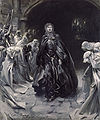
                                     Drawing by Sargent for Terry's golden jubilee programme, 1906

However, Singer was keen to use the richness of oil paints to show the “stained glass effects” that he had observed on the Lyceum stage, so he chose to paint a solitary Lady Macbeth, holding Duncan’s crown above her head, a queen from the Celtic twilight.

In the picture, Terry gazes up at the crown with an extraordinary, enigmatic expression. She saw Lady Macbeth as a woman who, because of love, was as one with her husband and his ambition: “a woman of highest nervous organisation, with a passionate intensity of purpose.” Terry loved the work, describing her look as apprehension, and said that the portrait felt “more like me than any other”.

Jonathan Jones, art critic of the Guardian, writing about twenty years ago, suggested that she looks like a sacred figure from an ancient temple. He also criticised the work, pointing out thatthis is not a real moment of self-loss. It is a painting of what theatre meant to the people at the time, an evocation of Terry’s power to inspire fantasy in her public.”

Sargent may have decorated the frame with Celtic motifs, ready for the portrait's first public viewing, which took place in 1889, at the New Gallery in Regent Street’s  owned by Alice’s Comyns Carr’s husband Joseph. The work became a great attraction. Terry reported it as “the sensation of the year . . . There are dense crowds round it day after day . . . but opinions differ about it.” Though some critics loved Sargent's painting, others did not, and The Saturday Review declared it “the best hated picture of the year.”

Sir Henry Irving bought the painting and hung it at The Lyceum Theatre, where he hosted the all-male Beefsteak dining club and eventually celebrated the hundredth performance of 'The Merchant of Venice'. The painting was also exhibited in Europe and South America, until finally being auctioned off and bought for the Tate by a wealthy donor in 1906.

The Actress

Ellen Terry (1847-1928) was born into a large theatrical family. As an infant, her cot would have been an open chest of drawers in that production’s lodgings. As a young child, she grew up reading the works of Shakespeare with her siblings. Terry grew up as familiar with the hardships of the touring life as with the glamour of life on stage.

Her father, Ben, was the business man, the one who found work with the actor-manager Charles Keans’ company. Sarah, Terry’s mother, who taught the child actress about performance and the importance of being ‘useful’ on stage to the leading actors. Aged five, Terry appeared as Prince Arthur in King John and other young roles in Kean’s productions. At eleven, she took the role of Puck in his A Midsummer Nights Dream, and also appeared in a genteel Shakespearian Entertainment attended by Queen Victoria.

Terry’s lively manner, burnished gold hair and Pre-Raphaelite beauty brought her to the attention of wealthy artistic circles, and her life was not without notoriety. At sixteen she retired from the stage to become the wife of the renowned painter G. F. Watts. Already in his mid-forties, Watts was unsure whether he should adopt his model or marry her.

Watts painted The Sisters, a double portrait of Ellen Terry and her older sister Kate, he also painted her alone: in his work ‘Choosing’, she appears as a young girl, caught between the attraction of a scarlet, scentless camellia and the humble, maidenly sweetness of a bunch of violets. Knowing the circumstances and the outcome, this is a rather unsettling image.

Terry also modelled for the pioneer photographer, Julia Margaret Cameron, who was related to Mrs Princeps, Watt’s too-dominant patron. Terry appears as a simple young girl in classical dress, her eyes closed and her head resting in an innocent dreamlike pose. Sadly, as Watts’ spirited wife, Terry found no role in his already well-organised home and was shunned by his reverential circle of admirers. The marriage was not a success, and Terry returned to her parents. 

                                       Wikipedia:Featured picture candidates/Ellen Terry - Wikipedia 

After some brief appearances on stage, Terry fell deeply in love with the designer and architect Edwin Godwin. She ran away from her parents and the public to live with him in rural Hertfordshire, and was soon the mother of two adored children. With Goodwin often away and Terry cut off from society, the relationship was strained, and their mutual love of art and luxury soon brought financial problems.

Then, in 1874, when Terry’s pony-cart lost a wheel on a country lane, Charles Reade a passing horseman, recognised her. He was a playwright and an old theatrical friend who helped her and persuaded her to return to the stage in one of his own plays. With the bailiffs at the door, and Reade’s money on offer, Terry accepted and found that her audiences welcomed her back warmly, both in London and on tour.

Terry’s true ascent to theatrical stardom came not long after. Squire Bancroft, the renowned theatre manager, cast her as Portia in his 1875 production of The Merchant of Venice. Her appearance, first in a china-blue and white gown designed by Alice Comyns Carr and then in black velvet as lawyer, stole the eye. According to the artist Graham Robertson, she was “the painter’s actress” appealing to the eye and ear, “her gestures and pose being elegance itself; her charm held everyone but predominantly those who loved pictures.” Though the actor playing Shylock did not live up to the role, Terry herself, and the production, shone.

Though Godwin’s stage sets, based on his visits to Venice, were praised, Terry’s trust had gone and the relationship broke down. Before long, now formally separated from Watts, she married the actor Charles Wardell Kelly whom she knew on tour. Marriage brought her respectability and her mother and family, who had disowned her, happily accept their daughter again. Kelly, though, was not happy to accept roles of lesser stature than his wife and so, as Terry’s theatrical reputation rose higher, envy and jealousy blighted the marriage.

Besides, Ellen Terry, at that point, was beginning the most important professional relationship of her life. Henry Irving, the leading stage manager and actor of the Victorian age invited her to play Ophelia to his Hamlet at his Lyceum Theatre. She became his stage partner, establishing a theatrical marriage that continued for twenty-four years. Their personalities on stage were complementary and were once described as “the flower and the tree”. Terry’s warmth, womanliness and lightness contrasted with Irving’s serious attitude and sometimes stiff manner. For her part, she was content to use her famed femininity as a foil to his dominant roles.

                                            File:Henry Irving portrait.jpg - Wikipedia

Irving, in his turn, gave Terry the chance to star in all the female Shakespearean roles: Ophelia, Desdemona, Portia, Juliet, Viola, Beatrice, Lady Macbeth, Cordelia, Imogen, Volumnia and Queen Katherine, for his theatre and she was dubbed, by Oscar Wilde, “Our Lady of the Lyceum.”

And the ‘Missing’ Dress . . .?

I had long given up thoughts of seeing the dress itself, and I did not see the painting when I visited Tate Britain last year, after the great rehang. However, Dr Kate Stradin’s tweet sent me searching online, and there was an answer to the missing garment.

Around the millenium, the National Trust had found that Terry’s archive at Smallhythe Place needed serious attention. There was particular concern about the presence of 'wooly bear moths' within the house and the fabric collection. Consequently, twelve years ago, Zenze Tinka Conservation starting major preservation work on the beetle-wing dress, which was in preparation for the “Sargent and Fashion” exhibition to be held at the Boston Museum of Fine Art in 2023. Reading on, I discovered that the whole exhibition was due to transfer to Tate Britain, in London, in 2024. 

It is 2024 now, and Ellen Terry's famous costume is right here, on display. For the first time since 1889, her green beetle-wing dress, the heather-coloured cloak and Sargent’s portrait will be together in the same place. 

 And on the day this History Girls post appears, I will be down at Tate Britain, meeting and greeting Ellen Terry’s famous green beetle-wing dress at last.

 Maybe, over the summer, I might even take a look at Smallhythe Place again, and see how the conservation work is getting on.

Penny Dolan

PS. After being disappointed by Jonathan Jones’ rather dismissive Guardian review of the Sargent and Fashion exhibition recently, I was hugely cheered to see, on the Letters page, a spirited response from Cally Blackman, asserting the importance of fashion and frocks.

https://www.theguardian.com/fashion/2024/feb/23/throw-off-the-cloak-of-snobbery-and-treat-fashion-as-a-serious-art-form

She writes

Whatever the distress caused to Jones by the lighting, wall colours and glass cases in wrong places, it is a very rare thing indeed to see garments displayed next to the paintings in which they are depicted, and a special joy to see these same garments interpreted on the canvas with Sargent’s consummate skill and aesthetic judgment. Some of the gowns on display are by Charles Worth, the most prestigious couturier in Paris (not “designer” – the word had not been invented then).” 

 Then came Blackman’s warning:

Compared with these, Ellen Terry’s beetle-wing-embellished Lady Macbeth stage costume (“costume” is the term for clothing worn for performance, not for garments worn in everyday life) looked dull and lifeless, yet scintillated in radiant, glowing colour from Sargent’s portrait, a testament to his quality as an artist.”  

I am still looking forward to seeing the dress, and the whole exhibition, tremendously. It has been a long time.


Further information:

Ellen Terry by Joy Melville.

Sir Henry Irving: A Victorian Actor and His World by Jeffrey Richards.

A Strange Eventful History: The Dramatic Lives of Ellen Terry, Henry Irving and their Remarkable Families by Michael Holroyd

https://www.nationaltrust.org.uk/visit/kent/smallhythe-place

Tom Gurney: HistoryofArt.org

https://www.theguardian.com/education/2002/jan/12/arts.highereducation

A Boy Called M.O.U.S.E by Penny Dolan

and 

Dr Kate Strasdin @kateStrasdin The Dress Diary of Mrs Anne Sykes

                    16 stunning Victorian textiles from The Dress Diary of Mrs Anne Sykes

Friday, 12 April 2024

Art, Colonialism and Change by Stephanie Williams


If you move fast, you can just catch the fabulous exhibition Entangled Pasts 1768-Now, Art, Colonialism and Change at the Royal Academy in London which ends on 28 April.

Yinka Shonibare CBE RA used the banisters of Chatsworth House in Derbyshire for his magnificent piece, 'Woman Moving Up'.  Slowly, but steadily, her head a globe of the world, she heaves herself and a suitcase full of heavy baggage, up a splendid marbled staircase. Photo Stephanie Williams


Moving round this exceptional exhibition, I was struck by how much more powerfully a single work of art – rather than any number of words -- can express the pain and contradictions of history. Yet at the same time, offer a fresh perspective on the brutally contrasting and intimately entangled pasts of Africa, India, Britain and the Americas.

Of which we still know so little.

Bust of a Man by Francis Harwood, 1758,
John Paul Getty Museum, Los Angeles
 
You enter the RA’s central rotunda to be greeted by a handful of fine portraits of Black men. Strong, handsome, elegant – among them works by Gainsborough, Reynolds, and John Singleton Copley. Each is accorded all the care and dignity, of any of their white sitters of their time. In the centre stands a black stone bust of a man from 1758 by Francis Harwood. Wonderfully lit, it is reflected up on a series of mirrors to alternate with busts of famous white men beneath the dome. The normal order of the white world has been subverted.

This is a show that makes its points with a light touch. Huw Locke’s Armada imagines the flotillas of craft engaged in the servicing of the plantation economy. At first these look magical. Mesmerising, tiny craft: fishing boats and lighters, miniature Spanish galleons. Look closer. High-rigged slaving ships, their sails, blackened and tattered, like the death ships they were. All are realised from abandoned lengths of string and cloth, plastic, wood and rubber and are suspended like flotsam and jetsam on uneven waves from the ceiling.

Hew Locke RA, Armada, 2017–19, Tate.
Photo © Royal Academy of Arts, London / David Parry. 

Benjamin West’s The Death of General James Wolfe – celebrated in my Canadian past as one of the nation’s great heroes – was painted twenty years after his death after defeating the French on the Plains of Abraham in Quebec in 1759. At his feet sits an idealised First Nation man. In fact he is a Delaware, rather than any of the native tribes to be found in the locale.


Benjamin West, The Death of General James Wolfe (1727-1759) 1779.
National Gallery of Canada

As edition after edition of prints and copies of this painting, conceived as record of a great patriotic victory, were reproduced and circulated around Britain and the world, this image laid the ground for the ideal of the ‘noble savage’ — the admiring onlooker, which recurred in similar works again and again. Here it is challenged by the work of Robert Houle, a Saulteaux Anishinaabe artist, whose Lost Tribes, 1990-1991 can be seen in the next room.

Similarly, Barbara Walker’s Vanishing Point series combines print-making and drawing to make the white figures who dominate well-known classical paintings, such as Titian, recede into the background, mere outlines impressed into paper, while traditionally marginalised Black figures rendered in graphite come vividly to life.

Each of these contemporary works force the viewer to assess well-known paintings from the white European canon afresh.

The Royal Academy itself comes under scrutiny for the works of art that were displayed at its Annual Exhibitions. And consider Johann Zoffany’s family portraits. A founder member of the Royal Academy, he had fallen out of favour with his royal patrons and sailed for India in 1783. Colonel Blair and His Family and an Indian Ayah shows an officer of the East India Company listening to his daughter Jane play the piano, fondly holding hands with his wife. To the right of the picture, his younger daughter, Maria, plays with a cat held by an Indian girl of about the same age. She is too young, surely, to be an ayah, the child’s nurse? Much more likely, she is the offspring of Blair’s Indian mistress.


Johann Zoffany, Colonel Blair and His Family and an Indian Ayah, 1786. Tate 

Phillis Wheatley (1753-1784) Poems on Various Subjects,
 religious and Moral, 1773.  The British Library
I make many new discoveries.

I had never heard of Phillis Wheatley, kidnapped from the Senegambia region of West Africa and enslaved by a family in Boston, who became a poet. Writing as confidently as any white male of the time, she bitterly protested the painting made by Richard Wilson of Niobe, — in Greek mythology the archetypal bereaved mother, who weeps throughout eternity for the loss of her 12 children, murdered by the gods. Niobe was made in 1761, the same year in which Wheatley was captured.

Nor did I know Shahzia Sikander, whose Promiscuous Intimacies 2020, knits together the Mannerist tradition of the west with classical Indian art to highlight the contradictions of a one-sided history.


Shahzia Sikander Promiscuous Intimacies  
Photo © Royal Academy of Arts, London / David Parry


And have fun unpicking the rich symbolism of the Singh Twins in Indiennes: The Extended Triangle from the ‘Slaves of Fashion Series, 2018. 


The Singh Twins, Indiennes: The Extended Triangle 
from the 'Slaves of Fashion series, 2018, 
© The Singh Twins 


I have always been struck by the bombastic power – and incongruity -- of British architecture set down, often by Royal Engineers according to pattern books, in every former colony from Jamaica to Hong Kong. In Primitive Matters: Huts Karen McLean projects a series of large European style homes once owned by wealthy merchants and plantation owners in Port of Spain in Trinidad onto seven huts replicating the local vernacular.


Karen McLean, Primitive Matters, Huts 2010


There is much, more more to see.  Sit for a moment in front of Isaac Julien's film, Lessons of the Hour, about the abolitionist Frederick Douglas, who questioned, What to the Slave is the 4th of July?'  Consider Edwin Long's The Babylonian Marriage Market of 1875 shown not far from El Antsui's poignant Akua's Surviving Children 1996.   


University of London, Egham. Photo © Royal Academy of Arts, London / David Parry
 

The counterpoint between past and present is a potent device indeed.  What a waste it is this show is not on for longer.


Entangled Pasts, 1768 - NOW 

Art, Colonialism and Change is at the Royal Academy of Arts, Piccadilly, London W1 

until 28 April 2024


Photo Bill Knight

Stephanie Williams is a Canadian writer based in London and delighted to be writing for the History Girls, a blog she has often investigated when doing historical research.  Author of BBC Book of the Week, Olga's Story, the life of her Russian Grandmother, her most recent book, Running the Showwas based on an 1879 questionnaire which revealed the extraordinary characters who were Queen Victoria’s colonial governors. She is now at work looking into the back-offices of the East India Company in London to find out  exactly what went on there. See more at www.stephanie-williams.com

Friday, 8 October 2021

Rodin and the Little Japanese Dancer by Lesley Downer

‘It was impossible to hold this look for such a long time. I couldn’t help moving a little bit, and M. Rodin said, “Not so much Hanako, not so much.”’

Hanako
In 1906 Auguste Rodin (1840-1917) was 67 and hugely famous. He had brought sculpture into the modern age with his powerfully muscular, uncompromising works like The Kiss and The Thinker. But his great years seemed to be behind him. Nearly a decade had passed since 1898, when he’d laboured over Balzac, but his masterwork had been rejected. In disappointment, Rodin transformed himself into an official artist, churning out busts of famous, well-paying personalities. He seemed to have lost his spark, his edge, the anger which had driven his creativity.

But he was still obsessed with capturing the body in motion. That year he went to Marseilles to the Colonial Exposition to sketch the Cambodian dancers. There he happened to pass a small hut temporarily erected in the woods with banners in front proclaiming the name of the troupe in white on a red background. Inside a small Japanese dancer was performing a death scene. Rodin stepped inside and was transfixed. He later said that there was ‘a flame which illuminated her from within.’

‘A tiny Japanese gifted with graceful form, lively eyes, a rebellious nose, feline movements.’
Hanako was a tough, resilient, sparky little woman - very little; at 38 she was only 4 foot 6 inches tall (1 meter 37 cm), so tiny and girlish that westerners assumed she was much younger.

Hanako 4 April 1908,Vienna, Austria,
courtesy Wikimedia Commons
Born Ohta Hisa in 1868 in Aichi, Central Japan, she was the oldest of eight children. Her family trained their daughters to have a profession, to be entertainers, i.e. geisha. From the age of five she learned Japanese classical dance and the yakumo koto, a zither-like instrument.

When she was ten her family fell into debt. She married a man twenty years older than her and endured ten years of marriage, then decided to get a divorce. She was at her wits’ end and broke when in 1902 she heard that a Japanese impresario was looking for dancers for an exposition in Copenhagen. The impresario arranged her passage from Yokohama to Marseilles and overland to Copenhagen. After the Expo ended she formed a troupe of Japanese players and toured Germany, performing plays with titles like Bushido and Hara-kiri, playing to western preconceptions of Japan as a land of samurai.

Then they toured England. Hanako was performing at London’s Savoy Theatre when she was spotted by the American dancer and impresario Loie Fuller.

In her memoir, Fuller described her first glimpse of Hanako on stage: ‘She was suddenly able to transform herself with little movements which froze all the anguish of terror into her features. She was pretty, delicate, strange, and stood out even among her fellow countrymen.’ As for her death scene, ‘She was devastating.’
Painting by Ben Ali Haggin: Mme Hanako. 1910.
Courtesy Wikimedia Commons


Fuller became her manageress. She didn’t think Hanako’s plays were powerful enough so she wrote some ‘Japanese’ plays herself. Each play ended in hara-kiri - not women’s suicide, cutting one’s throat, but cutting open the belly. It was completely inauthentic but westerners didn’t know or care.

Fuller took Hanako off to Paris, where she performed The Martyr and other plays, all from Fuller’s prolific pen. She was a huge success. Every play ended with the heroine’s suicide. Hanako cut open her belly with a sword so enthusiastically that the audience in the front rows were sprayed with fake blood.

A reviewer in L’Illustration, November 3 1906, wrote, ‘Hanako is a tiny Japanese gifted with graceful form, lively eyes, a rebellious nose, feline movements.’ Her death is ‘almost too realistic.’

‘An expression of cold terrible rage.’
Back in Paris after that fateful meeting in Marseilles, Rodin invited Hanako to lunch at his atelier, where he asked her to sit for him. He was burning to make a mask of her anguish as she was ‘dying’, to capture the intense expressivity of her face.
Head of Death showing nirami


After that Fuller drove Hanako to Rodin’s atelier every day for half an hour before the afternoon performance. Hanako didn’t speak French or English and Rodin didn’t speak Japanese. Hanako remembered that he followed her obsessively, demanding that she hold her face still without moving a muscle.

‘When I even moved my eyes,’ she remembered, ‘he shouted, “Stop, don’t move your eyes!” He tried to create my head of death with that cross-eyed look I made on the stage. It was difficult to hold the same expression every day. People warned me that my eyes were getting funny.’

Judith Cladel, Rodin’s biographer, writes, ‘Hanako did not pose like other people. Her features were contracted in an expression of cold terrible rage. She had the look of a tiger, an expression completely foreign to our Occidental countenances. With the force of will which the Japanese display in the face of death, Hanako was enabled to hold this look for hours.’

In later years Hanako told her family that it took a tremendous effort to maintain this pose, which was completely opposite to her normally cheerful disposition. ‘Afterwards,’ she said, ‘I was in a good mood for days.’
Head of Death
with nirami

Far from being evidence of a peculiarly Japanese ‘force of will’, Hanako’s expression of ‘cold terrible anger’ was actually a standard kabuki pose called nirami, where one eye turns inward while the other stares straight ahead. A kabuki actor can hold nirami for 20 - 30 seconds. Hanako said she could stay cross-eyed for 3 to 5 minutes. But Rodin forced her to hold this expression for half an hour. No wonder her eyes were going funny!
 
It took 67 attempts before Rodin was satisfied that he had her eyes right. He finished the first Head of Death in September 1906 and went on to create many more.

That summer, during the theatre off season, Hanako stayed at Rodin’s home in the Paris suburbs. She was relaxing in the garden when he ran out shouting, ‘Don’t move, don’t move.’ He grabbed his pencil and declared he was going to make a mask of A Meditating Woman.

‘After that he spent every morning making Head of Death and every afternoon making Meditating Woman,’ she remembered. For him it was a new lease of life.

Meditating Woman
For the next twelve years she stayed at Rodin’s every summer for 3 months, living like a member of the family. His dog slept in her room. If he ‘found her purse thin’ he gave her money. In Paris his acolytes and admirers introduced her to artists, socialites and politicians. She mixed in glamorous circles and was invited to many parties. ‘I was fascinated by the flowery social life of Paris,’ she wrote, ‘and every day was a dream.’

There were rumours that she was his lover, because they were seen on walks together. But there’s no evidence for that, added to which Hanako was also close to Madame Rodin. The old man must have appreciated the company of this bright, lively, cheerful young woman.

Hanako continued to tour. She performed all over Europe, including Sweden and Russia, and went twice to the United States. She wrote letter after letter to Rodin and sent him photographs of herself. And she always came back to Paris and resumed modelling for him.

Hanako’s last meeting with Rodin and Mme Rodin was in 1915, at the start of World War 1, when they were staying outside London and came to see her perform. Rodin died in 1917. Hanako - who must have been 50 by then - visited his tomb the next year at Meudon and wept when his dog wagged its tail when it saw her.
Photograph signed
‘To Monsieur Rodin
With lots of love from Hanako.'


She had never charged Rodin for all the modelling she did for him. The one thing he promised was that he would give her two masks - a Head of Death and a Meditating Woman. But World War I intervened and he died without doing so.

After the war she wrote again and again to his secretary and even to members of the French government and finally received the two busts.

Back in Japan, she lived in a geisha house in Gifu run by one of her younger sisters, where she was rather celebrated. Many famous artists came to visit and admire her masks. She adopted her nephew, Ohta Hideo, who married and had a child, Masako. She spent her last years doting on this granddaughter of hers, who remembers that Hanako was so tiny she had to have clogs specially made for her little feet.

Hanako died on April 2 1945, at the age of 77 - the same age that Rodin had been when he died.


Lesley Downer is a lover of all things Asian and an inveterate traveller. She is the author of many books on Japan, including The Shogun’s Queen, an epic tale of love and death, out now in paperback. For more see www.lesleydowner.com.


The Rodin exhibition at the Tate Modern in London continues until November 21 2021.

The pictures as indicated are courtesy of Wiki Commons. The other photographs are mine.