Showing posts with label Japan. Show all posts

Friday, 2 October 2026

Ladakh: Travelling in memory through time and space ~ by Lesley Downer

When does history begin? When does the present slide through a looking glass and emerge as ‘history’? Is yesterday ‘history’? When I was in Kathmandu back in the last century (1971, to be precise), I felt as if I had travelled through time as well as space. I was in the Middle Ages. 
Here is a story of a visit to Ladakh which felt like a journey through time. 

Ladakh's surreal landscape 1981 painted by me 
Ladakh 1981 
In 1981 I travelled through Kashmir and across Zoji la, a Himalayan pass 11,575 feet (3528 metres) high, to Ladakh, on the back of a motorbike. The road was only wide enough for one vehicle so cars, trucks and buses went one way in the morning and vehicles going the other way had to wait till afternoon. 
But that didn’t apply to motorbikes. We’d pull off the road when a line of vehicles approached and wait till they’d passed, then continue on our way. 
The journey can be done in two days but we took our time, clambering up cliffs to explore remote monasteries and camping in fields beside the rivers. Once we woke to find water rising around us and had to pack up fast; we’d forgotten that the fields are irrigated at night. 
Ladakh 2013
We were riding through an otherworldly landscape of dark mauve mountains, pale turquoise rocks and grey green scree, between orange and lilac and pink and dark maroon sand dunes and rocks and hills and mountains. 
At one point I scrambled up a pink hill to have a look at the view from the top. All around were more pink hills, as far as the eye could see. There was no landmark, no village, no little house, nothing to indicate where I had come from or where my friend Chris and his motorbike were, no indication of north or south or east or west. I was completely disoriented. 
I found Chris and the motorbike again and we carried on through more maroon and mauve hills. Eventually we started to see rivers fringed with bright green barley fields and groves of apricot trees.
We passed through little towns of white-washed houses with bundles of hay on the roof and lines of prayer flags fluttering in the breeze. There were stupas - ‘chortens’ in Ladakhi and Tibetan - on the outcrops, white-washed or carved out of the wine-coloured rock, some as big as houses, others small, stretching in long rows. 

The palace at Leh 1981
Leh 
Finally we got to Leh, a small frontier town of Ladakhi and Tibetan people, where the women wore long dusty black dresses and long pigtails and tall stove pipe hats and everyone wore huge beaming welcoming smiles. Wherever you went you saw the palace, a smaller version of the Potala in Lhasa, rising high above the town, deserted and crumbling, virtually a ruin. 
I settled into an inn run by John Page, an Englishman who was installing solar heating in Ladakhi homes. Leh is 11,562 feet (3524 metres) above sea level and dry with very strong sunshine and very cold winters, so solar heating made perfect sense. John’s girlfriend was Helena Norberg-Hodge, the only westerner who could speak Ladakhi, a dialect of Tibetan. 
Besides me there was a young British couple staying there called Zee and Theresa. Ladakhi food was unappetizing, mainly dry tsampa (barley meal) with a little bit of curry. So we took over the cooking, using a primus stove and charcoal burner, and used our ingenuity to turn out all sorts of delights. 
News of our cooking spread around and every night an unpredictable but large number of Ladakhi intellectuals - monks, poets, professors, students - would show up at meal time. We’d sit around talking, with Helena interpreting where necessary, into the night. 
The palace at Leh
with prayer flags 2013

In the daytime I’d walk out of town, climb the pink hillside and sit on a rock, watching the women scything the barley fields far below with the sound of their whistling drifting up through the thin clear air. It was magical. 
Walking through Leh’s alleys I drew and painted pictures. 

Thiksey 
I also hitchhiked out to see some of Ladakh’s beautiful white-painted monasteries, which crown virtually every hill. Thiksey’s temples, sub-temples, libraries, monks’ quarters and stupas rambled across an entire hill like a medieval castle. They were dilapidated but I could see that the lower buildings were white-washed and the higher ones were brick red or yellow ochre. 
Little house in Leh 1981
At the time I spoke a little Tibetan and was (and still am) fascinated by Tibetan Buddhism. I could recognise many of the sages and Buddhas and benevolent and fierce deities portrayed in the wall paintings and thangkas. So while other tourists strolled in, took a quick look round and strolled on, I would chat to the monks. 
Then they would invite me round the back for butter tea. Butter tea is the national drink. It’s an acquired taste; it’s helpful to imagine that you’re drinking soup. The key thing was to be as enthusiastic as possible, to drink with gusto and to be even more enthusiastic when offered another cup. 
So while other tourists ‘did’ several temples in a day, I ended up spending all day in just one. 
In the end I spent two months there. I ended up going back by bus, which was a lot more frightening than going by motorbike. 
Little house in Leh 2013


Back to the Future 2013 
I went again in 2013, over an even higher pass, Taglang la, 17,480 feet (5328 metres), the second highest motorable pass in the world. (Mount Everest is 29,031 feet (8848 metres). 
Ladakh had changed but not as much as I’d feared. There were roads, traffic, hotels, restaurants and rows of shops offering thangkas, Tibetan jewellery and Pashmina shawls as well as markets where Tibetan refugees sold handicrafts. 
The palace was still there, brooding over the city, now cleaned up and restored. There were steps and a footpath up the rocks, even a motor road. And the food had miraculously improved. 
I was happy to be back and looked for the places I had painted in 1981 and took photographs. 

All paintings and photos are mine. 


Lesley Downer is a Japanophile and inveterate traveller. She had two books out in 2024: The Shortest History of Japan (Old Street Publications) and her first ‘real’ book, On the Narrow Road to the Deep North, reissued by Eland. She is now working on a history of Tokyo and plotting ways to get back to both Japan and India. 

Friday, 3 October 2025

Queens and Empresses: When Women Ruled Japan ~ by Lesley Downer

‘Thank you very much for bestowing the crown today at the coming of age ceremony.’
Prince Hisahito, September 6th 2025

Emperor Naruhito and Empress Masako of Japan

On Prince Hisahito’s 19th birthday, September 6th 2025, there was an elaborate coming of age ceremony at the imperial palace in Tokyo. The prince wore the Kakan-no-Gi, the traditional golden yellow garment with a long train to mark him as a youth, and was presented with a black silk and lacquer crown by deferential courtiers in rustling black robes, recognising him as second in line to the throne after his father, the Crown Prince.

He then changed into the black robes of adulthood and set off to the next ceremonial event in a horse-drawn carriage.

Princess Aiko, December 23 2022 

Prince Hisahito is the nephew of the Emperor of Japan; his father is the emperor’s younger brother. His cousin Princess Aiko is the only child of the Emperor and Empress and, at 23, is older than him. So how does Prince Hisahito come to be second in line to the throne?  

Princess Aiko can’t accede to the chrysanthemum throne for one simple reason: she is a woman.

This is not ancient tradition. Until the passing of Japan’s first constitution in 1889 there was no such rule. The aim of the constitution was to make Japan appear similar to western nations, on the surface at least, so as to end the unequal treaties which forced Japan to kowtow to the west - though ironically at the time Queen Victoria was firmly on the throne in Britain.

After the war the American occupying forces drew up a new constitution which set in stone the law that only men could accede to the throne. Empress Masako, the present Empress, was under great pressure to produce a son and didn’t succeed, though she did have a daughter, Princess Aiko.

But before that first constitution things were different. Female emperors were not common but there were some who played major roles in the development of Japan. And in ancient times there were plenty.
The Sun Goddess Amaterasu Ōmikami
by Utagawa Kunisada 1856


In fact the claim to legitimacy of the imperial family is - again, ironically - that they are descended in an unbroken line from the female Sun Goddess, Amaterasu.

Queens and Empresses part I

Shaman Queen
The very first named person in Japanese history is a woman - Queen Himiko, who ruled from about 190 to 248 AD, just over a hundred years after Boudicca. At the time the kings who ruled the various kingdoms that made up Japan were always fighting and in order to maintain the peace decided to set a woman on the throne.

Himiko, who came from a line of queens, maintained peace for 60 years. She was not only a temporal ruler but a shaman who could intervene with the gods to ensure the food supply and protect her people from earthquakes and volcanic eruptions. After her death a king took the throne and fighting started again. Peace was only restored when Himiko’s 13 year old niece Iyo, who was also a shaman, became queen.

In the years that followed there was a succession of empresses, six in all.

Suiko: Long reigning empress who established Buddhism
Empress Suiko: imaginary picture
by Tosa Mitsuyoshi (1700 - 1772)

Empress Suiko (554 - 628) came to the throne in 593, succeeding her husband, Emperor Bidatsu, and ruled for 35 years. Like Himiko she was installed on the throne in order to establish peace among warring factions, the Soga and the Mononobe clans. Her father, Emperor Kinmei, had been given a statue of the Buddha by the King of Baekje, now part of Korea, who urged him to adopt this ‘most excellent’ religion.

Under Suiko’s rule Buddhism was recognised as the official religion of the country and the country absorbed a great deal of Chinese culture - politics, poetry, laws, religion, food, clothing, architecture and music. Chinese and Korean craftsmen came to Japan. Her government sent its first official embassy to the glorious Chinese court, introduced the Chinese calendar, replaced the Japanese system of hereditary ranks with the Chinese bureaucratic system and established the supremacy of the emperor, laying the foundations for Japan as a unified country rather than a collection of warring states.

Empress Kōgyoku witnesses a spectacular coup d’état.
Empress Kōgyoku

Empress Kōgyoku (594 - 661) had a rather dramatic story. She was the widow of the previous emperor, Suiko’s great-nephew. She came to the throne in 642 and had a new palace built, the Itabuki no Miya. In those days people founded a new capital every time a new emperor came to the throne so as to avoid being jinxed by the ghost of the previous incumbent. She then brought an end to a drought by praying.

But she’d barely settled into her new palace when there was an upheaval. Her son Prince Naka was tired of the Soga clan controlling power. He started meeting with a nobleman called Nakatomi no Kamatari in a wisteria grove where they claimed to be studying Chinese texts but in fact were plotting a coup d’état.

On July 13 645 there was a grand meeting at the new palace. Prince Naka ordered all the gates to be locked, smuggled in a sword and in full view of everyone lopped off the head of the young leader of the Soga clan, Soga no Iruka, thus ejecting the Soga from power. Empress Kōgyoku abdicated immediately because she was polluted by being in the presence of death.

Prince Naka killing Soga no Iruka
from the Tōnomine Engi scroll, Edo period

Empress Kōgyoku’s brother took over but everyone understood that the real power in the land was now Prince Naka and that power was now in the hands of the imperial family again.

After her brother died Kōgyoku came back to the throne with a new, unpolluted name - Empress Saimei. She then set off to lead an armada to attack the Chinese and Sillan (Korean) ships that were threatening Japan but on the way she died. Prince Naka finally took power as the great Emperor Tenji.

The empresses who were to follow played a major part and varied roles in shaping the country Japan was to become. For their stories, watch out for my next riveting instalment!


All images are courtesy of Wikimedia Commons

Lesley Downer is a lover of all things Asian and in particular all things Japanese. She had two books out last year: The Shortest History of Japan (Old Street Publications) - 16,500 years of Japanese history in 50,000 words, full of stories and colourful characters - and her first ‘real’ book, On the Narrow Road to the Deep North, reissued by Eland under her new pen name to acknowledge her Chinese roots - Lesley Chan Downer. For more see www.lesleydowner.com


Friday, 4 April 2025

Japan’s Jazz Age: Flappers and Feminists ~ by Lesley Downer

‘In the beginning, woman was the sun.’
Hiratsuka Raichō

Moga, pictured in 
Mainichi shimbun 
‘Modern gals’
If you had visited Tokyo in the 1910s and 1920s, you would have met Japanese women stepping out confidently with short flapper skirts and scandalously short hair, a million miles from the stereotypical ‘submissive Japanese woman.’ They were moga - ‘modern gals’ - a term coined by the great Tanizaki Jun’ichirō in his novel A Fool’s Love. Not all women were moga, but there were enough to flavour the era.

While Europe was engulfed in World War I, Japan, which was allied to Britain, was enjoying an economic boom. In the Meiji period, Japan’s Victorian era, the country had burst spectacularly into the modern age and onto the world stage. And by now westernisation, prosperity and mass culture had spread to nearly everyone in Japan. Now everyone was enjoying the benefits.

1929 ad for Shirokiya department store

Speed, sport and sex
After the hard work and discipline of the Victorian era, when the government was determined to build up the nation to protect it against colonisation, the new era (named Taishō, after a new emperor came to the throne) was like a fresh breeze blowing through.

The Meiji constitution had been all about keeping women in their place, slotting them into the template of ‘good wives, wise mothers’. But by the 1910s and 1920s the rebuilding was done. Suddenly people were free to let their hair down and be themselves. 

At last the younger generation had a voice. They didn’t have to follow in the drab footsteps of their elders. Those of us who remember the Sixties - Flower Power, Women’s Lib - will recognise the thrill, the exhilaration. 

Moga 1928 in 'beach pyjama' style

Youth power
This was Japan’s Jazz Age - the age of speed, sport and sex, of anything goes. There was universal education. With one of the world’s largest student populations, Tokyo was enjoying a boom in the publishing of books, journals and newspapers. People were free to think and talk and argue and throw around words and ideas like socialism, Marxism, anarchism, democracy and freedom. They also had money which they could spend any way they liked.

Forget ‘good wife, wise mother’. These women had jobs. They could be typists, elevator girls, shop clerks, nurses, writers, journalists or beauticians, and be financially independent. Some moga worked as waitresses in cafes, dispensing sexual favours where they saw fit, like Naomi in Tanizaki’s ground-breaking A Fool’s Love, a sort of Japanese Lolita, the story of a man hopelessly besotted with one of these cool aloof creatures.

Tipsy by Kobayakawa Kiyoshi

The moga were the trendsetters along with mobo - ‘modern boys’. Moga cut their hair short, like boys, and flaunted short flapper skirts, while dapper mobo wore their hair long and swept back in the all-back style and sported bell bottoms, bowler hats and horn-rimmed Harold Lloyd glasses.

They hung out in cafes and bars, they smoked, talked and argued, they practised free love and they strolled along the Ginza, Tokyo’s most fashionable street. They listened to jazz, danced the Charleston, watched American movies and ate ice cream. Until the authorities clamped down, Marxism was all the rage and everyone read the latest revolutionary Russian novels, such as Aleksandra Kollontai’s A Great Love.

Militant feminists
Out of this fizzing free love milieu sprang pioneering feminists.

Hiratsuka Raichō (1886 - 1971),
 
from her autobiography

Hiratsuka Raichō lived the life. She famously said that marriage was ‘slavery during the daytime and prostitution at night.’ In 1908 at the age of 22 she eloped with an older married man, Morita Sohei, and the two tried - and failed - to commit suicide together in time-honoured Japanese fashion. She then had two children by a much younger lover whom she only married when her children were adults, taking her husband’s surname so that her son would not be negatively impacted when he was drafted.

She was also more than prepared to speak up for women’s rights. In 1911 she founded Seitō - Bluestocking - Japan’s first all-women literary magazine. The first words were ‘In the beginning woman was the sun’ - a reminder that in Japanese mythology the Sun Goddess, Amaterasu, is the creator of all life.

The first issue of Seitō, 
September 1911,
cover illustration by 
Naganuma Chieko
Seitō was packed with stories and articles expressing women’s sexuality with no holds barred. One story detailed the break up of an arranged marriage, another was a graphic description of casual sex with a man the author picked up in a bar. The upholders of traditional values, particularly in the government, were outraged and both issues were banned.

Then Hiratsuka started publishing articles daring to attack the capitalist system and the established order and demanding women’s rights. For the powers that be this was the last straw. In 1916 the Home Ministry forbade distributors to supply the magazine. Sales instantaneously dried up and the magazine had to close down.

But that didn’t stop Hiratsuka. At the time women were banned from attending political meetings on the basis that they should be at home looking after their families. In 1922 Hiratsuka and her fellow activists managed to get this law overturned though female suffrage was still a long way off. Women were not included when universal male suffrage was introduced in 1925. She and her fellow activists were condemned as ‘New Women’, a term which they enthusiastically embraced.

Yosano Akiko (1878 - 1942)

Seitō’s most famous contributor was the poet Yosano Akiko. She too had an affair with a married man whom she later married; the couple had eleven children. Her first volume of poems, Midaregami - Tangled Hair - was a passionate expression of her love for him. Critics attacked the book as immoral and obscene but it was loved and widely read and became a beacon for supporters of women’s rights. At the height of the Russo-Japanese War she published a poem entitled ‘Thou shalt not die’, exhorting her younger brother who was a soldier not to sacrifice himself for this senseless war. It became the anthem of the anti-war movement and was picked up again after World War II.

Midaregami (Tangled Hair)
by Yosano Akiko

These were women who took their lives in their own hands. Their power was their independence. Perhaps some of them even thought that the times they were a-changing, that a new age was dawning, as we did in the Sixties as we looked forward to the coming of the Age of Aquarius. But those that did discovered all too soon - as we did - that they were wrong. The era of speed, sport and sex turned out to be just a flash of brightness before the darkness of World War II closed in.


For more on Japan’s pioneering feminists, you could read

In the Beginning, Woman Was the Sun: The Autobiography of a Japanese Feminist by Hiratsuka Raichō, translated with an introduction and notes by Teruko Craig (Columbia University Press 2006)
and
A Girl with Tangled Hair: the 399 poems in the Midaregami by Akiko Yosano, translated by Jane Reichhold and Machiko Kobayashi

All images are courtesy of Wikimedia Commons

Lesley Downer is a lover of all things Asian and in particular all things Japanese. For more about these amazing women and much else, please see my new book, The Shortest History of Japan (Old Street Publications). My travel book, On the Narrow Road to the Deep North, was also reissued last year, by Eland. For more see www.lesleydowner.com


Friday, 6 October 2023

Octopus dreams: Japan, Stonehenge, Knossos ~ by Lesley Downer

takotsubo ya                 Octopus pot
hakanaki yume o          Fleeting dreams
natsu no tsuki               Beneath the summer moon

                                                    Matsuo Bashō (1644 - 1694)

Minoan octopus vase,
around 1500 BC

Husband (in octopus tee
shirt) meets dogū at the
Heraklion Archaeological
Museum
Cultural echoes spring up tentacle-like in the most unexpected of places. Japan and Stonehenge, Japan and Knossos - who would have thought it?

This summer there have been exhibitions at Stonehenge and the Heraklion Archaeological Museum in Crete, celebrating the parallels between the marvellous Jōmon culture of Japan and these two very distant yet in surprising ways not dissimilar island cultures. I was lucky enough to visit both.

Jōmon flame pot at 
Heraklion Archaeological
Museum (3000 - 2000 BC)
 

Jōmon - prosperous hunter-gatherers and the world's first potters
Fifteen thousand years ago the world was engulfed in an ice age. Much of the earth’s water had solidified into ice and sea levels had fallen by several hundred feet. What are now the islands of Japan were part of mainland Asia, connected to present day Siberia and Korea by vast tracts of countryside, plains and hills. It was cold and stormy. Huge long-tusked long-haired ‘Naumann’s’ elephants lumbered around, along with giant deer, horses, tigers, brown bears and wolves, trailed by hardy nomadic people looking for animals to hunt and fruit and vegetables to forage.

Around 14,500 BC, long before anyone else thought of doing so (except possibly the Chinese), some of these people took to moulding the clayey soil and making it into small pots, useful for carrying grain. This was a quite extraordinary development; pots are heavy to lug around when you’re on the move. Millennia later these nomads came to be called Jōmon - ‘rope design’ - after the patterns they impressed on their pots.
 
Jōmon flame pot at
Circles of Stone
exhibition 
at Stonehenge

Then temperatures began to rise. The ice melted and the sea levels rose, turning what had been the extreme edge of the Asian continent into a string of islands. The weather turned balmy. The descendents of those hardy nomads found themselves in a Garden of Eden, enjoying a lush temperate climate. Most lived not far from the sea where fish and seafood could be snatched straight from the water, collected or speared. 

There were mountains where animals roamed and forests overflowing with roots, fruits, leaves and berries. The Jōmon knew about farming; their neighbours across the water in Korea were farmers. But they themselves didn’t need to break their backs hoeing the soil day and night, for they had abundant food all around them. Most peoples didn’t settle down until the advent of farming; but these hunter-gatherers were so prosperous that many stopped wandering and formed communities.

dogū at Heraklion
Archaeological
Museum
Life was so easy that they didn’t need to send everyone out hunting and foraging. Specialist trades developed. Artisans stayed home and built houses or made pots. By now they were using the pots for cooking and serving large communal feasts. And the pots they made became bigger and bigger and more and more gloriously elaborate.

One settlement, at Sannai Maruyama in the far north of the main island, present day Honshu, made up of 700 large thatched houses built around fire pits, was occupied for 1500 years, from 3500 to 2000 BC. The inhabitants dined on mackerel, yellowtail, tuna, salmon, shark and shellfish from the sea, rivers and lagoons, and deer and boar which they hunted with dogs and with stone arrowheads glued to wooden shafts. They ate chestnuts, acorns, walnuts, wild grapes, kiwi fruit, gourds and beans and hunted rabbits and flying squirrels for their warm fur.

Ōyu stone circles
And from 2500 BC to 300 BC they also made amazing figurines - dogū. These were mostly female and may have represented an earth goddess or were used in fertility or healing rituals.

Some 2000 years down the line, these communities began to break up. Some of these smaller communities built stone circles. Around 2200 to 1700 BC, at Ōyu and Isedotai, not too far from Sannai Maruyama, people carried stones from nearby river beds and laid them out with great precision in concentric circles. 

Ōyu stone circles
Most were laid flat with standing stones in the centre that aligned with pillars at the outer edges to mark the sunrise at the summer solstice and made it possible to calculate the winter solstice and the spring equinox and the movements of the sun. Here people gathered to carry out seasonal ceremonies, conduct rituals and bury their dead.

Stone circles: the Stonehenge builders and the Jōmon
Around the same time, 3000 to 2500 BC, on another small island, Neolithic farmers were dragging massively heavy bluestones 180 miles, 290 kilometres, from the Preseli Hills in Pembrokeshire to Salisbury Plain. 
Stonehenge

These two cultures on opposite sides of the globe had no contact between them yet had striking similarities. Both made stone circles, used flaked stone tools, had huge feasts and made beautiful pots. Circles of Stone, a wonderful exhibition at Stonehenge which closed on September 3rd, spotlit these cultures.

While the Jōmon were fishermen, hunters and gatherers, in Britain the weather was far less clement and life as a huntergatherer was rough. Around 4000 BC people started farming. The Stonehenge builders cultivated wheat and barley and had cattle, pigs and sheep. They ate beef and roasted pigs over open fires including piglets, which they ate at midwinter. They also gathered wild foods like their Japanese contemporaries.

They used far bigger stones for their stone circles and stood them upright with lintels resting on the top, akin to the torii gate at a Shinto shrine. Like the Jōmon stone circles they were laid out with great care. 

Minoan and Jōmon figures

Both the Stonehenge builders and the Jōmon, it seems, followed and celebrated the passage of the sun, particularly during the summer solstice, and gathered at these stone circles at key times in the annual calendar for festival and rituals. But the Stonehenge builders did not make human figures like the Jōmon dogū.

島国 shima guni, island countries: the Minoans and the Jōmon
The Minoans developed their civilisation a few millennia later, between about 2000 and 1000 BC. They didn’t build stone circles but huge and splendid palaces painted with frescoes. But as an island nation they had much in common with the Jōmon, who were still thriving across the world in Japan. Legacies of Beauty: Archaeological Treasures from Japan, a wonderful exhibition at the Heraklion Archaeological Museum which closed on September 24th, celebrates the parallels.

Minoan and Japanese haniwa 
horses (6th century AD)

The Stonehenge builders, the Jōmon and the Minoans were all island dwellers. The Japanese call it shima guni, 島国. Wherever you are the sea is never far away. You are well aware of the rest of the world out there and of cultural developments outside your own small community. Both the Minoans and the Jōmon traded extensively. The Jōmon traded with Hokkaido, Korea and China while the Minoans were the centre of an extensive trade network crisscrossing the Eastern Mediterranean.

Both cultures celebrated the sea. Octopuses coil their tentacles across Minoan pots while the triton shell became an essential religious implement in Japan. And both created images of life-nurturing women, probably used in prayers for safe childbirth and fertility.
Minoan goddess


For all their creativity all these cultures died out, leaving ruins large and small, as will no doubt happen to us too.

For more on the Jōmon there’s a wonderful British Museum catalogue, The Power of Dogu, Ceramic Figures from Ancient Japan, edited by Simon Kaner. You can also see Jōmon pots at the British Museum.

The Jōmon also feature all too briefly in my The Shortest History of Japan, to be published next June.

Circles of Stone ran from September 30 2022 to September 3rd 2023 at the Stonehenge Visitors’ Centre

Legacies of Beauty: Archaeological Treasures from Japan was at the Heraklion Archaeological Museum from June 2nd 2023 to Sunday September 24th 2023

The pictures of the Ōyu stone circles are courtesy of Wikimedia Commons. All other pictures are by me, taken at the two exhibitions, at Stonehenge and Heraklion.

Lesley Downer is a lover of all things Asian and an inveterate traveller. She is the author of many books on Japan, including The Shogun’s Queen, an epic tale of love and death, out now in paperback. For more see www.lesleydowner.com.

Friday, 7 April 2023

A Brief Encounter ~ by Lesley Downer

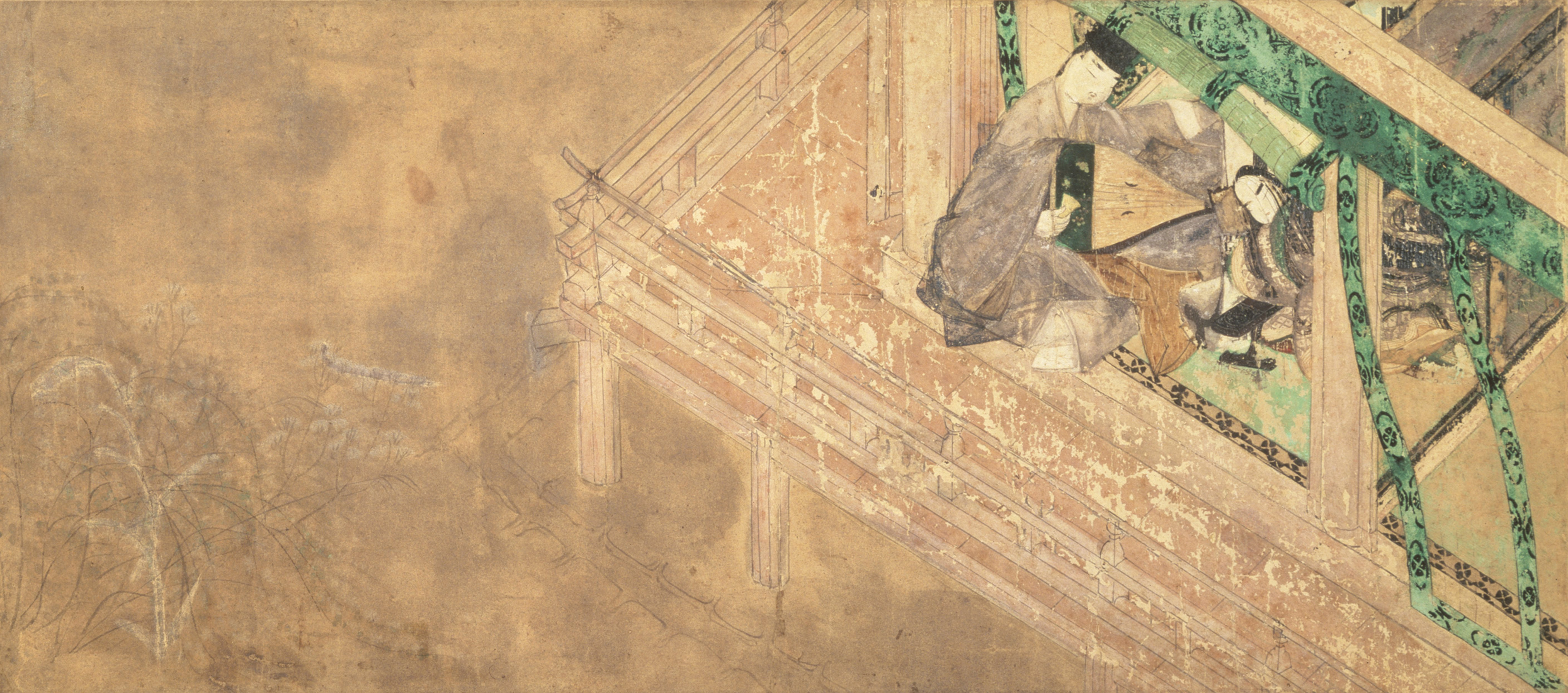
Which is more beautiful, spring or autumn? That was a question bound to stir the interest of any sensitive young woman at the eleventh century Japanese court ...
A Heian lady's day ...

Our story begins with some monks reciting Buddhist sutras all through a long, very dark night. Two young women had crept out of their quarters and lay down on the veranda outside the prayer hall to listen to their beautiful voices. Women were not supposed to be seen but it was dark enough that no one would see them.

It was October 1042. Across the world Edward the Confessor had just come to the throne and commissioned the building of a royal burial church, later to become Westminster Abbey. Beowulf’s epic battle with Grendel had been set down in writing, as had The Song of Roland.

In Japan courtly gentlemen were studying and writing poems in Chinese, which was to Japan as Latin was to the west, the language of educated people. Women learnt kana, a simple alphabetical form of writing, just enough to read and recite the sutras, which was all that women needed, or so men thought. The ladies of the court, however, were smart, sophisticated and very witty and they used the flowing kana script to record their lives, feelings and the often amusing events that occurred, in glorious detail.

One shy young woman was whiling away her years in the provinces, reading, dreaming and writing poems. She wrote an introspective, astonishingly modern account of her thoughts, feelings, regrets and sadnesses, so vivid that we can almost step into her silken shoes and imagine ourselves back in Heian Japan. The diary she wrote - in modern terms, a memoir - is called The Sarashina Diary. She is known only as the daughter of Takasue or Lady Sarashina, though that certainly wasn’t her name.

After many years in the provinces, when she was twenty six, our heroine was invited to the court of Princess Yūshi. On that momentous occasion she wore eight layers of gowns of alternating dark and pale chrysanthemum shades topped with a flowing robe of crimson silk. Eventually she was offered a position as a lady-in-waiting there.

On such a night as this ...
Court ladies and gentlemen spoke separated by screens 
so that the gentleman couldn't see the lady.
 
On that dark night, as Lady Sarashina and her friend were reclining on the veranda, a gentleman strolled by and stopped to engage the ladies in conversation. In the ordinary course of events our heroine would never have met a courtier of such high rank. She was far too humble to attend on high court nobles or senior courtiers, so lowly that such people would never even have known she existed.

The proper thing to do would have been to slip away or summon ladies of the proper status but that would have been awkward. There was nothing for but to respond to his remarks.

Lady Sarashina listened while her friend chatted with the man. She noticed that he was quiet and thoughtful, not flirtatious or forward like other men. He spoke poetically of the brevity of life, mono no aware, the sadness of things. He was a perfect gentleman, in fact.

Then he asked, ‘And who is your companion?’

Lady Sarashina spoke up modestly and the gentleman responded, ‘So there is still a young lady in this palace whom I do not know?’ He showed no sign of wanting to leave, she writes.

It was a starless night and a slight drizzle pattered on the leaves with a charming sound.

‘How beautiful the darkness is,’ the gentleman said. ‘If there’d been a full moon it would have been too dazzling.’ It would also have meant that that they wouldn’t have been able to talk. They could only talk because they couldn’t see each other.

It was then that he turned to the very topic that struck a chord with her, comparing spring and autumn. He spoke of the beauties of spring, when the sky is overcast and the moonlight seems almost to float on the mist. ‘That’s the time when it’s lovely to hear the soft notes of a lute, set in the key of the Fragrant Breeze,’ he said. Then he spoke of autumn, then winter, then asked them which season they most loved.

Her friend spoke up in favour of autumn so Lady Sarashina decided to champion spring. She answered with a poem:
asa midori hana mo hitotsu ni kasumitsutsu oboro ni miyuru haru no yo no tsuki
‘Glimmering green,
Seen through mist,
Merging with the cherry blossom too,
Dimly seen -
The moon on a spring night.’

In those days educated people readily composed poems; it was an essential accomplishment. But our heroine was no ordinary poet but an exceptional one.
A Heian lady's room complete with kicho screen

The gentleman savoured her lines, repeating them again and again. He replied with a poem of his own: ‘From this night on, so long as I have life, such a spring night will hold the memory of you and of our meeting.’

Then he spoke of how he had once gone to the great shrine at Ise to attend the coming-of-age ceremony of the virgin priestess. Awe-inspiring though that experience had been, he said, this dark rainy night that they had spent together was every bit as unforgettable.

With that he left. They still hadn’t seen each other. She had no idea what he looked like, neither did she care. What drew her to him and demanded a place in her heart was his sensitivity, his manner, his poetry, his voice.

Such a fine gentleman could have no idea who she was, which was only proper, or so she thought.

‘Why should you remember it so well?’

Behind the screen ...
The following year, nearly a year after that first encounter, she went to the imperial palace again for an all-night entertainment. She didn’t know that the gentleman was also there and, being of a retiring disposition, stayed in her room.

At dawn she pushed open the sliding doors onto the corridor. The moon was glimmering, very faint and beautiful. Then she heard footsteps on the veranda and that voice she had yearned for, reciting a sutra. He stopped in front of the open doors.

‘I never forget that night of softly falling rain,’ he said, ‘not for a moment, and the precious time we spent together!’

There was no time for a proper answer so she replied with a poem:
nani sa made omohi idekemu nahozari no ko no ha ni kakeshi shigure bakari wo
‘Why, I wonder,
Should you remember it so well?
It was only
An autumn shower
Falling on the leaves.’

Then his companions joined him and she retired to the back of her room without waiting for his answer. That morning she had to leave the imperial palace with the princess and her retinue.

Later her friend brought his reply: ‘If we should ever have another such drizzly night, I should like to play my lute for you, every melody I know.’
'I should like to play my lute for you ...'
She yearned for such another meeting and waited and waited for such a chance. But it never came.

The following year, on a quiet spring evening, she heard that he had come to visit the princess’s palace. She and her friend crept out of their room hoping to meet him but the veranda was bustling with people and the reception rooms were full of ladies-in-waiting so they turned back. She guessed that he too had chosen that night to visit thinking it would be quiet. But he had left without seeing her because of the crowds.

Regretfully she composed a poem:
Kashima mite Naruto no ura ni kogare idzuru kokoro ha eki ya iso no amabito
‘Burning with passion
I yearned to row my boat out
To Kashima on the Bay of Naruto.
Did you know that,
Fisherman on the rocky shore?’

And that’s the end of the story. He never enquired who she was. He was too much of a gentleman to pry. His personality was perfect and he was far from an ordinary man, she writes, but time passed and neither called out to the other ...

The gentleman with whom our heroine had this brief encounter was Minamoto no Sukemichi (1005 - 1060). She was thirty three and he was thirty seven. He was of very high rank, far too grand to mingle with ordinary court ladies like her, and a famous musician and lute player.

Later our shy heroine and her diary became famous. Her poems, particularly the passionate poem about rowing out her boat, were celebrated and included in the imperial anthology, an extraordinary mark of distinction. Today everyone in Japan knows The Sarashina Diary. Ironically, grand though he was, Minamoto no Sukemichi’s name has come down to us only because he was the object of Lady Sarashina’s unspoken passion.

Two ladies, one playing the biwa lute,
the other the
koto.


Lesley Downer is a lover of all things Asian and an inveterate traveller. She is the author of many books, including The Shogun’s Queen, an epic tale of love and death in nineteenth century Japan. For more see www.lesleydowner.com.

There are three translations of The Sarashina Diary:
in Diaries of Court Ladies of Old Japan by Annie Shepley Omori and Kōchi Doi (1934)
As I Crossed a Bridge of Dreams: Recollections of a Woman in Eleventh Century Japan, by Ivan Morris (1971)
The Sarashina Diary: A Woman’s Life in Eleventh Century Japan, by Sonja Arntzen and Itō Moriyuki (2014)

Illustrations:
I haven’t found any illustrations of The Sarashina Diary so have used illustrations of The Tale of Genji and other Heian works to give the mood of the period:

Picture 1: Murasaki Shikibu composing The Tale of Genji at Ishiyamadera by Yashima Gakutei (1786 - 1868), Gift of Charles Lang Freer, Freer Gallery of Art, Smithsonian, public domain, courtesy wikimedia commons and the Smithsonian.

Picture 2: Utagawa Hiroshige (1797 - 1858), Utsusemi from The Tale of Genji in 54 chapters, 1852, National Diet Library, public domain, courtesy wikimedia commons.

Picture 3: Genji monogatari emaki, 1130, owned by Tokugawa Art Museum Nagoya 1937, courtesy wikimedia commons

Picture 4: unknown author, Sei Shonagon, 17th century drawing, courtesy wikimedia commons

Picture 5: Fujiwara Takayoshi, Genji monogatari emaki, Yadorigi chapter, 1130, owned by Tokugawa Art Museum Nagoya 1937, courtesy wikimedia commons

Picture 6, Kobo Shunman (1757 - 1820), Two ladies, one playing the biwa lute, the other the koto, 1815, H.O. Havemeyer Collection, Bequest of Mrs H.O. Havemeyer, Met Museum, public domain


Friday, 7 October 2022

Rediscovering Shōgun - by Lesley Downer

‘In 1600 an Englishman went to Japan and became a samurai ...’               


In the late 1970s I lived in a provincial town an hour’s train ride from Kyoto. Most weekends I’d go to visit. Each time I’d look for a new temple to explore and spend the day there.

One day I wandered into a little temple called Kōtō-in. I sat on the veranda, gazed at the sand and rock garden and idly picked up the English-language leaflet. The temple, I read, had been founded in 1601 by Hosokawa Tadaoki, a samurai lord whose wife had been a Christian convert and who was a famous bowman. There in one of the paper shoji screens was the very hole through which he had shot three arrows - one after the other, with perfect precision.

Map of Japan with picture of Will Adams meeting
shogun, 1705, by Pieter van der Aa

I was staggered. It was the very story that I was reading at that moment in Shōgun. Hosokawa was Buntaro. This was Buntaro’s temple! Clavell had changed his name but not his story. Did that mean that all of Shōgun - despite the changed names - was true?

Reading it again more than forty years later, having spent much of that time absorbed in Japanese culture and history, I’m hugely impressed with how accurate it is, not just in the historical detail but in Clavell’s insight into how it feels to be Japanese.

James Clavell
Clavell led quite a life himself. Born in 1921 into a Royal Navy family, he was captured by the Japanese and interred in Changi prison throughout most of World War II. He went on to become a screenwriter and director in Hollywood. He wrote his first novel, King Rat, in 1960. Shōgun was published in 1975 and sold more than 15 million copies. Apparently it took him three years to research and write and he didn’t plan it out. Some of the plot twists, he said, were as much of a surprise to him as to the reader. He died in 1994.

Closeup of Will Adams meeting the shogun,
1705, Pieter van der Aa

For some reason everyone thinks that Shōgun is not literature. I was interviewed once by Mariella Frostrup and was supposed to speak on books on Japan. She was horrified when I began with Shōgun.

Literature or not, it is undoubtedly one of the most enjoyable books you will ever read and a brilliant source not just of Japanese history but of east west relations at the time, not to mention ships and nautical matters. Clavell’s skills as a screenwriter are readily apparent. Shōgun is dramatic, cinematic, a master class in historical fiction, immersing you in seventeenth century Japan and keeping you hooked from beginning to end.

William Adams the Pilot
Will Adam's ship Liefde lands in Japan -
monument  in De Liefde arrival memorial
park, Kurushima, Usuki City, by N. Tamada 

Clavell takes as his starting point the true and amazing story of William Adams (1564 - 1620), shipwrecked in Japan in 1600, the first Englishman ever to arrive there. Adams was a contemporary of Shakespeare, a ship’s pilot who under Sir Francis Drake helped repel the Armada and fought in the ongoing war against Spain and Portugal. The Japan in which he found himself was at an equally pivotal moment. It was the climax of the warring powers era, when samurai armies battled to control the country. The Portuguese had arrived half a century earlier and were making converts and sizing the place up for colonisation. The last thing they wanted was a Protestant Englishman turning up to tell the Japanese that the outside world was not as they portrayed it. Adams revealed their deceit and changed the course of Japanese history.

Clavell leaves the framework of history pretty much as it is. But he changes the names of the players which allows him to fictionalise freely, taking liberties with the details to make the story even more gripping and exciting. Readers are kept on their toes, anxious to find out how the characters will weather the next terrible ordeal that befalls them.

Tokugawa Ieyasu
by Kanō Tanyū (1602 - 1674)

The story begins in the stinking claustrophobic innards of Blackthorne’s storm-tossed ship, the Erasmus, ‘two hundred and sixty tons, a three-masted trader out of Rotterdam, armed with twenty cannon and sole survivor of the first expeditionary force sent from the Netherlands to ravage the enemy in the New World.’ Most of the Dutch crew are dead or dying of scurvy. The survivors are on the brink of mutiny.

Only one man can control them - Blackthorne, tough, competent, fearless and, as we soon discover, the best pilot on the planet. We learn about their nightmarish two year voyage, in which all the other ships in the fleet were lost, and the rough Elizabethan world that he comes from. As a Navy man, Clavell lards his tale with colourful and authoritative detail about ships, seas and how ships work, the job of the pilot, who commands the ship, and the importance of rutters - the annals which pilots kept, laying down their routes and recording their daily activities.

After the horrors of the tempest comes a complete change of pace. Blackthorne wakes up in a small house in a fishing village in Izu. We see Japan through his eyes - the neatness, cleanliness and occasional nakedness, the Portuguese priest who declares him a pirate and demands he be killed, the samurai casually lopping off a man’s head. Clavell has a lot of fun with cultural differences such as the bath, a daily necessity to a Japanese but a death sentence to an Elizabethan Englishman. The bath becomes a marker of how Blackthorne is adjusting, as he starts to compare the sparkling clean Japanese houses and cities with the disease-ridden filth back home.
 
Will Adams meets Shogun Tokugawa
Ieyasu - by William Dalton 1866

Like Gulliver in Lilliput, Blackthorne and his crew endure a series of humiliations and ordeals, which Blackthorne overcomes through sheer obstinacy, refusal to be cowed and the quickness of wit to fathom how to get by in this disorienting new world.

As the canvas broadens we meet an extraordinary range of people and start to see their world through their eyes as well as through Blackthorne’s. We also begin to discover how much goes on that Blackthorne knows nothing about.

We meet Mura the village headman, ‘small and lean with strong arms and calloused hands’ and a secret judo master; it’s many pages before we find out who he really is. Then there’s Omi, the handsome young samurai, who behaves with suitable disdain to Blackthorne and his crew and equally suitable deference to his uncle, Yabu, the daimyo of the region.

Yabu is a wonderful character, ‘short, squat and dominating,’ forever plotting who to betray in order to advance his own interests. He’s fearless and without scruples and finds death, his own and others’, both erotic and poetic. Early in the story he is trapped at the bottom of a cliff by the incoming tide. Having ascertained that there is no escape he sits down calmly to compose his death poem. Blackthorne meanwhile desperately seeks to rescue him even though Yabu has committed terrible deeds that make them deadly enemies. Yabu survives and continues to be a lethal yet strangely likeable and entirely untrustworthy presence throughout the book.

The women too are vividly portrayed. There’s Kiku the courtesan, exquisitely beautiful yet down to earth too. Her kimonos ‘sigh open’, ‘whisper apart’. Like a flower, her task is to rise above earthy reality, to laugh gaily and take men’s minds off whatever is going on around them, no matter how terrible. There’s also Gyoku-san, the Mama-san, who knows everyone’s darkest secrets, wielding them to advance her own position while appearing to be utterly humble, as a person such as she, on the bottom rung of society, has to be.

Will Adams with daimyo and attendants
by William Dalton 1866 

Meeting the Shōgun
The canvas expands to encompass the entire country as Blackthorne arrives in the giant metropolis of Osaka and is ushered into Osaka Castle, a gargantuan fortress which ‘makes the Tower of London seem like a pigsty.’

Here he meets Toranaga, Clavell’s name for the great warlord Tokugawa Ieyasu (1543 - 1616) who was to become shōgun, taking over the whole of Japan and bringing about 250 years of peace. Toranaga is a consummate politician and statesman who controls and manipulates whatever happens and gives nothing away. He’s also likeable, warm and funny.

Blackthorne also meets Mariko, the Christian convert, modelled on Gracia, the wife of the warlord famous for his archery skills. Buntaro, Clavell’s fictionalised Hosokawa, is rather a tragic character. ‘A short, thickset, almost neckless man’, he is a brilliant warrior and a poet with the bow, utterly loyal to his lord. But he is also a man of terrifying rages, driven mad by his hopeless love for his wife.

Mariko is tiny, beautiful and fearless, a true samurai, prepared to die for her lord. She becomes Blackthorne’s interpreter, confidante and ultimately lover. She shows him how to flourish in this alien world by becoming more Japanese, finding inner peace.

Tokugawa Ieyasu by
Utagawa Yoshitora (1836 - 1880)

Blackthorne communicates with his crew in Dutch and in Portuguese with Mariko, the Japanese Christians and the Portuguese fathers and seamen. With Mariko he also has a secret language of love - Latin; though the two have to be wary. There are always samurai around who may turn out to be secretly Catholic and to understand them.

At one point Mariko and Blackthorne are talking. ‘How childish’, she says to herself, ‘to speak aloud what you think.’ Like children, the westerners are what they appear to be. The Japanese conversely are eternally acting. Apart from Blackthorne, who is an outsider, they all know that this is how you play the game. Clavell gets a lot of fun out of the difference between what the Japanese say and what they’re thinking, let alone what they really intend to do. It’s a key distinction that Japanese recognise between one’s true feeling and the face that one chooses to present to the world.

As the story goes on the focus changes. Blackthorne slips into the background as we step more and more inside the fascinating and complex mind of Toranaga. Clavell spends a great deal of time unravelling the great daimyo’s innermost thoughts as he plays everyone like chess pieces in order to achieve his ultimate aim - to master and bring peace to Japan. Which is why the book is called quite accurately Shōgun.

There are occasional errors. Clavell confuses the shamisen (a lute) and the koto (a zither). He uses the wrong tea for the tea ceremony, and there are small mistakes with the Japanese language. Some of the names are a little odd. But none of this matters. The book is written with such verve that we are totally swept up in the excitement of the narrative and barely notice the occasional small hiccup.

To read Shōgun is to be picked up and thrown into Japan at one of the most exciting moments in its history. For Clavell totally gets Japan. He gets it right, it’s totally convincing, which makes it a great and very satisfying read even for a Japan hand after forty years of engaging with the country.


All pictures courtesy of wikimedia commons.

Lesley Downer is a lover of all things Asian and an inveterate traveller. She is the author of many books on Japan, including The Shogun’s Queen, an epic tale of love and death, out now in paperback. For more see www.lesleydowner.com.