
Showing posts with label weddings. Show all posts

Friday, 18 February 2022

Why didn't I ask more questions? by Sheena Wilkinson

Since I became a History Girl I have often wished I had paid more attention to the stories my gran and great aunt Annie  told me. As a child I had an endless fascination for ‘the olden days’ but I didn’t know then how much my creative and intellectual life as an adult would revolve around women’s social history. So many times, writing novels set in the Belfast of their youth, I’ve thought of them, growing up in the streets I was describing. Without them and their stories, I might not have grown up to become someone who wrote historical novels.

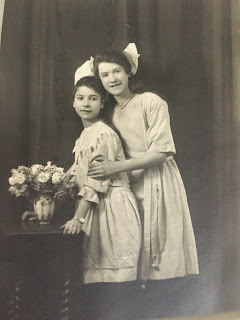
Gran and Aunt Annie c. 1920 

Recently, having married at the unfashionably late age of 53, I’ve been considering, not their long-ago childhoods, but their young womanhood between the two world wars. Aunt Annie never married, became the spinster daughter keeping house for her widowed mother and unmarried brother, with what reluctance or enthusiasm I will never know. I never asked. I didn’t know I would  become fascinated by spinsters, or that I would spend decades of my adulthood uncoupled and independent, like Aunt Annie.  
Gran married during World War 2; she was in her thirties, Granda a little older. This was above average for the times, and, again, I don’t know why. I know that Granda, the oldest son, had family responsibilities; perhaps they precluded him leaving home and marrying earlier. I have no idea if he and Gran had a long courtship or if they had had previous sweethearts.  Why didn't I ask? When I cleared out some old photos recently I found many of Gran in the 1930s with a jolly-looking crowd of young adults from the Christian Endeavour. They seemed to go on lots of jaunts and picnics and in more than one photo she seemed to be close to a young man who wasn’t Granda. But again, I don’t know. These might have been simply pals. Gran and her chum Ellie married brothers, Granda and Uncle Gordon, but I don’t know who introduced whom. I don’t know if Aunt Annie, three years younger and destined not to marry, was jealous or indifferent, if she had suitors, heartbreaks and disappointments or if she always planned the single life. I don’t know if her proclivities, if she ever explored them, were for girls or boys. I do know she would be extremely shocked at my writing such a thing. 
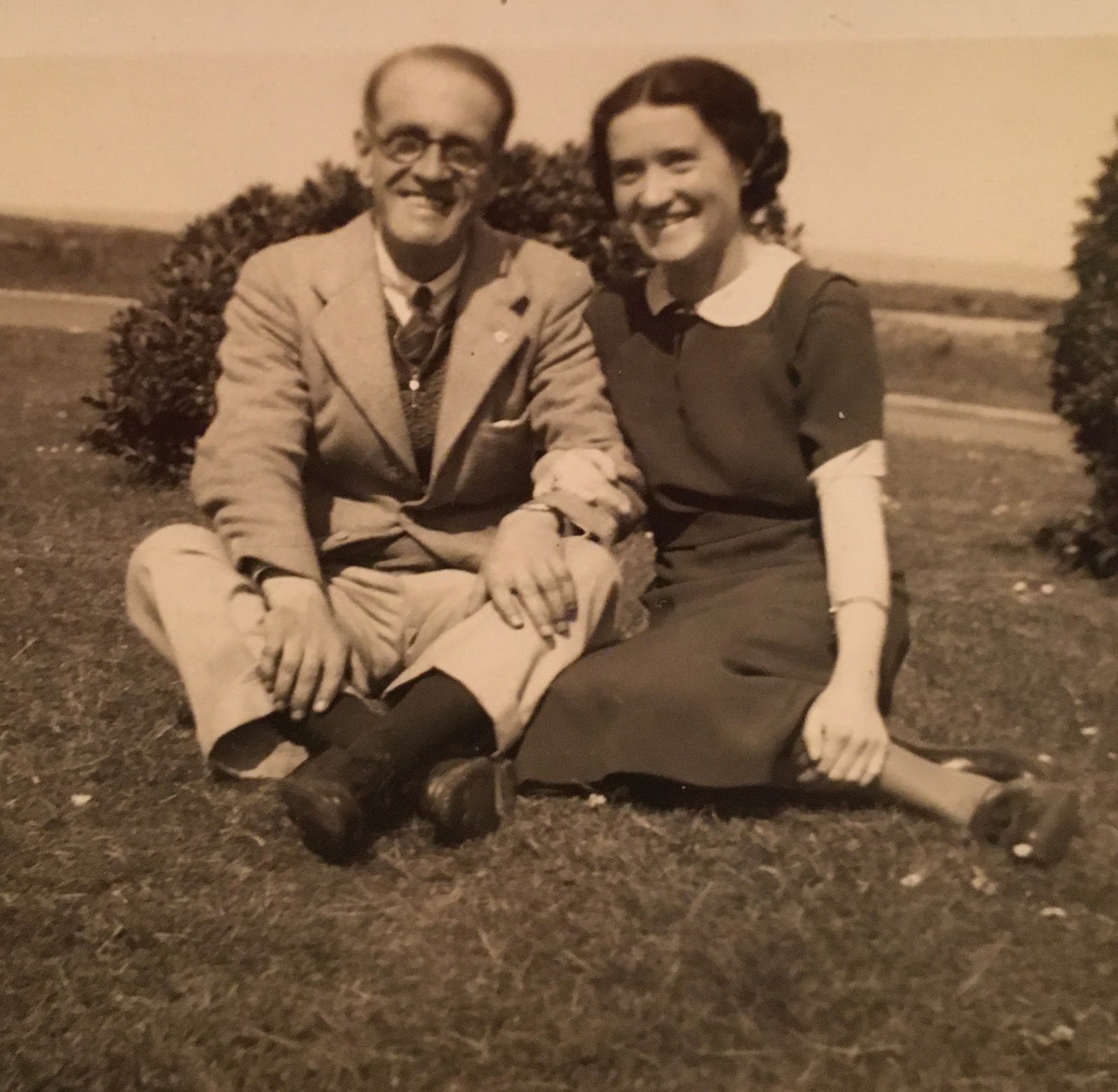


Gran and Granda -- not yet engaged
 

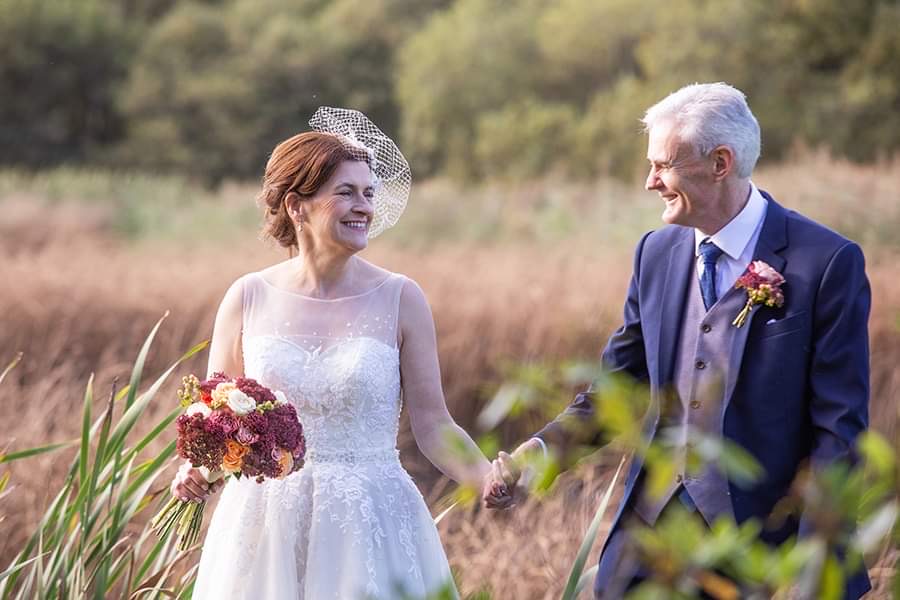
I’ll never know now, and it doesn’t matter. But getting married at 53 after 24 years of living alone and about 20 years of single celibacy has made me think a lot about marriage trends, and about what leads to some people being coupled while others stay alone. In my own case, I married an old friend who had been widowed. Which in itself sounds quite old-fashioned. 


When Gran was my age I hadn’t been born, but photos from the 1960s show that she was certainly preparing for the grandmotherly stage of life. She was grey-haired, comfortably plump, wore a pinny and devoted herself to the domestic and the church. Every year I look more ridiculously like her, and nowhere is this clearer than in our respective wedding photos, even though she is almost twenty years younger.
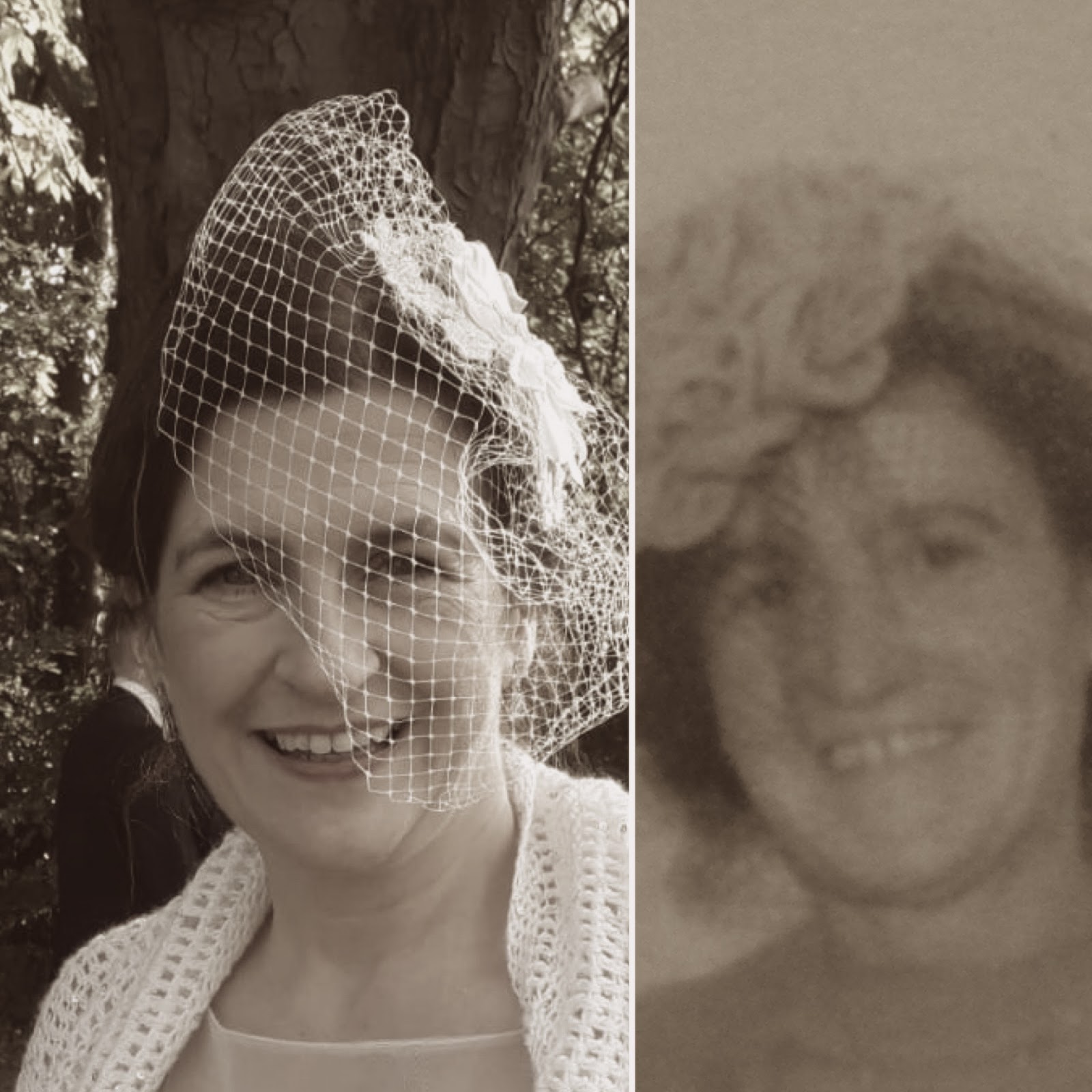


Two brides, 2021 and 1942

Gran married in a pretty but serviceable frock she would get good wear out of. Not only was it wartime but at 35 she would have considered it unseemly to go for something more bridal. I don’t know what she would have made of me at 53. Mutton dressed as lamb, probably. My hair is dyed to disguise the grey, I am over a stone lighter and a dress size smaller than I was in my thirties, and I run and go to the gym partly to keep Gran’s matronly figure at bay.  I chose a vintage-style wedding dress that was probably a bit young for me but it was pretty and flattering so I didn’t care. Perhaps that’s the biggest difference between our generations: the not-caring-what-people-think. I am very domesticated, it’s true – I made my own wedding cake and the shawl I wore over my dress, so perhaps she wouldn’t have entirely disapproved.


Saturday, 22 June 2019

Wedding Lintels & Marriage Customs by Catherine Hokin


 Marriage Lintel from 1610, Falkland
I have developed a couple of new obsessions since moving to Scotland six years ago, not all of which revolve around whisky. Moody looking castles are up there, as is the tooth-destroying confectionery known as Tablet, but the one currently leading the pack is hunting for marriage lintels.

A marriage lintel (also known as nuptial, marriage or lintel stone) is a carved inscription above the doorway of a house owned by a newly-married couple. They are a feature of the east coast of Scotland and date primarily from the sixteenth to the eighteenth centuries - the one pictured from 1610 is one of the best examples and commemorates the marriage of Nicol Moncrief, a servant of James VI. All feature the year of the wedding and the couple's initials and some also include pictorial details - there is a particularly lovely one on what is now known as the John Knox House on the Royal Mile in Edinburgh, commemorating the marriage of goldsmith John Mossman to Mariotta Arries.

 Stone from 1801
The lintels serve as a record of a marriage and the joining together of two families, who were often aristocratic or monied. Lintels could be added to a building which was built specifically for the married couple, or were carved into a pre-existing lintel. They were always set over the main entrance and some also appear inside houses, above the most visible fireplace. Wherever they were placed, they were meant to be seen: perhaps we should think of them as an early form of social media - Mr and Mrs Smug-Married boasting about their updated status and their swanky new home. 

There is, unfortunately, little information about the lintel stones beyond what they symbolise - or little I can find. There's no list of the surviving stones (although Wikipedia cites some examples if you want to go hunting) and, as you can see in the third photo, many have become detached from their original position. 


The custom of marriage lintels had died out by the end of the nineteenth century, as have some of the other traditional Scottish practices. Grooms are no longer expected to carry a creel (a large basket) filled with stones around the village until their bride releases them from their burden with a kiss. Brides might still find themselves standing to the groom's left but hopefully no one is still doing it because the 
bride is the ‘warrior’s prize’ who the groom needs to hold with his left hand so he can fend off her family and other foes with his right. Similarly presenting swords from one family to the other as a sign of extended protection and acceptance isn't regarded as quite so crucial anymore.

 A quaich
Some customs do, however, continue. Although grooms aren't necessarily required to bring 'siller' (silver coins) to the ceremony anymore, a traditional wedding will still involve a scramble - throwing coins in the air for the children to collect. Wedding walks still take place, where the wedding party walk to the church preceded by a fiddler. Whether they have to turn around and start again if they meet a pig or a funeral as the rules once dictated is presumably a matter of choice these days, or very bad luck. Many couples still use a quaich, a two-handled 'loving cup' for the first toast to symbolise the joining of their lives. This tradition stems, as many of these practices do, from clan customs: the quaich was once used by two clans to celebrate a bond between them, with each leader sharing the whisky it contained. In a similar vein to sharing the quaich, some couples will still 'pin the tartan' - swapping rosettes to show that both husband and wife are accepted by the other's families. For anyone wanting to delve further, there are some excellent oral histories here, including blackening, the breaking of the bride-cake and betrothal customs. 

 The Goddess Juno
Where Scots have broken with custom is the wedding date. Traditionally the most popular auspicious month to marry was June - this was partly because the goddess Juno (for whom June is named) was the protector of women, particularly in marriage and childbearing. On a more practical note, others chose June in order to time conception so that births wouldn’t interfere with harvest work. Last year, however, the most popular month in Scotland was September - no doubt because this is the one month of the year when the weather is at its most predictable. A Scottish June bride needs a dress that co-ordinates with wellies, an umbrella and, this year at least, a winter coat! 

If you and yours are struggling to choose the right month for an upcoming ceremony, perhaps this poem might help. The message about May does seem rather clear...

Married when the year is new, he’ll be loving, kind and true.

When February birds do mate, you wed not dread your fate.

If you wed when March winds blow, joy and sorrow both you’ll know.

Marry in April when you can, joy for Maiden and for Man.

Marry in the month of May, and you’ll surely rue the day.

Marry when June roses grow, over land and sea you’ll go.

Those who in July do wed, must labour for their daily bread.

Whoever wed in August be, many a change is sure to see.

Marry in September’s shrine, your living will be rich and fine.

If in October you do marry, love will come but riches tarry.

If you wed in bleak November, only joys will come, remember.

When December snows fall fast, marry and true love will last.

–Anonymous

Which ever you go with, have the happiest day and, in the words of this Scottish blessing: May your blessings outnumber the thistles that grow and may troubles avoid you wherever you go. Now let's see if you can still recite that when the bills come in... 

Thursday, 21 June 2012

Wedding Cake, anyone? by Imogen Robertson


I’m getting married this weekend, and frankly the way my brain is at the moment you’re lucky this post doesn’t just consist of that sentence repeated again and again. Still, I can’t think a non-wedding related thought, so forgive me and I promise I have got some history in here somewhere. 
Ned and I have gone for a do-it-yourself type of affair. We’re having the party in an eighteenth century barn on a working farm belonging to friends of friends, and I knew it was the right place for us when I walked in there, looked up at the beams and said, ‘Oh, darling! It’s just like the barn where Harriet and Crowther performed their first autopsy!’ Ned teared up a little and squeezed my hand.

The beef is roasting in our kitchen as I type; we’re collecting most of the rest of the food from Borough Market tomorrow morning, and my mother has made the wedding cake. Now, when we asked Mum to make the cakes it was for reasons both practical and selfish. Yes, huge fancy wedding cakes with icing roses and corinthian columns can look lovely, but they aren’t very us and I love my Mum’s fruit cake. I can also pay her with a big smile which helps the budget. Now, what I didn’t realise was we are actually being quite eighteenth century about it. Hannah Glass’s bride cake recipe from her The Art of Cookery, 1774, is really very like what we are going to eat on Saturday, only Hannah places her candied orange and lemon in layers within the cake rather than mixing it all together. I think Mum would have cried if I’d asked her to do that. I also think Mum’s used a little less brandy than Hannah’s half pint per cake. We’re having almond icing like just Hannah’s, though I don’t think Mum whisked it for ‘an hour or two’.

Even the question of fancy icing versus plain is centuries old. In English Etymology 1783, George William Lemon notes that the ceremonial cake had its roots in Roman times, then continues, ‘ - but whatever were the ingredients of the antient bride cakes, the modern are made of such costly articles, that the wealthy now-a-days seem to vie with each other more in the extravagance of the composition than in a knowledge of the institution.’ Indeed.

The tradition of sleeping with bride cake under your pillow to make you dream of your future husband or wife was already established, though in a volume of The Spectator from 1776 a correspondent reports trying this, only to wake to find he couldn’t remember his dream, and he had eaten the cake. Perhaps his experiment failed because he didn’t pass his bit of cake through the wedding band as soon as the wedding rites were over. No one is going to try that at my wedding, I’m afraid. Once the rites are over the ring is staying on my finger and anyone trying to shove cake through it is going to get my hard stare. The writer of an article in The Connoisseur in 1775 did much better, the bride cake under the pillow providing a long allegorical dream of different brides and grooms sharing differently iced cakes that illustrated the wisdom or folly of their marriages. Moral lessons through cake. Who would have thought?

One note brought me up short; in the Lake District it was traditional to break the bride cake over the bride’s head. Sounded like a terrible waste of good cake to me and very messy, so I was delighted to learn in this case the cake was ‘a thin current cake’ and a white cloth was placed over the bride’s head before she was attacked with confectionary. Still, I’ve no idea where that tradition comes from or what the underlying symbolism is. If anyone knows, please share. According to John Nichols in Anecdotes of William Hogarth of 1782, this is about to happen in Hogarth’s third sketch for the ‘Happy Marriage’ series he planned but never finished. At least it looks like a good sized sheet.

Saturday, 1 October 2011

Tying the Knot

My middle daughter is getting married tomorrow. Not quite in this style (though it has sometimes felt like it) but it got me thinking about how the big life events have been celebrated in history and by whom.

I read about the marriage of Lorenzo de' Medici (the Magnificent one) to Clarice degli Orsini, when i was writing City of Flowers. I was going to have a grand wedding of four couples in Giglia (= Florence) from the di Chimici family, many of whom are enemies of my Stravaganti.  And I knew there would also be a massacre.

These details are taken from Lorenzo the Magnificent by Hugh Ross Williamson (Michael Joseph 1974):
There were to be eight hundred citizens at a feast
Country people from round about donated 150 calves, 2,000 pairs of hens and capons, together with wine and wax, for this feast.
There were over 50 dishes at the official wedding party for 2,000 guests - 5,000 lbs of sweetmeats alone.
The bride dined with about 50 young married women; 70 "distinguished men" dined separately.
This was considered to "give the citizens an example of moderation, which must not be forgotten at weddings," even though it lasted for three days.

Christopher Hibbert in his book The Rise and Fall of the House of Medici, says that Clarice wore a white and gold brocade dress and rode a white horse. A whole olive tree was hoisted above her to a window in the Medici Palace on the Via Larga (now Via Cavour).  It was a dynastic marriage, not a love match, but Clarice bore Lorenzo ten children nonetheless. This portrait is probably flattering; he was not a handsome man but was so attractive in other ways that he was never short of mistresses.

My Gaetano di Chimici was an ugly young man too but with a great heart and he was one of the grooms at the wedding in City of Flowers. The night before the ceremony, the family held a tournament and a feast where a typical dish was capon in white sauce with silvered pomegranate seeds.

Lorenzo also had a joust but, in February 1469, when his actual marriage to Clarice took place in Rome. Lorenzo wasn't there; a distant family member stood proxy for him. Luigi Pulci wrote a poem about the joust but I have found no verses about the wedding, or the Florentine celebration which involved both halves of the couple the following June.

There were contemporary rumours that Lorenzo was awarded the palm at his joust by his young mistress Lucrezia Donati - something Ross Williamson says severely would have been "an improbable discourtesy."

Whatever the circumstances of the young noble's love life, it is clear that the wedding celebrations were at least partly intended to demonstrate the wealth that both parties were bringing to the marriage. But of course such opulence was the prerogative only of the small minority that made up the ruling class in Renaissance Italy.


Peasant weddings were probably more like this representation by Breughel a hundred years later:

Though even this is probably idealised.

At what point did the "traditional" British white wedding get its stranglehold on the ordinary citizen?
In 12th century England "espousals" were of two kinds: sponsalia per verba de futuro and sponsalia per verba de praesenti. The first kind was a promise to be husband and wife hereafter; the second which took place if they declared at that very moment to take each other as husband and wife.

This second kind was still valid in the 16th century, even though the Church disapproved, unless its blessing was subsequently asked. And civil law did not recognise that a private espousal conferred property rights or identifying heirs. But the "troth-plight"espousal was legally valid. In 1563 the Council of Trent specified a priest and witnesses but by then England was not under papal jurisdiction.

It wasn't until as late as 1743 that the High Court declared it was necessary for a priest to be present to validate the marriage.

This fascinating information comes from an Appendix to the old Arden edition of As You Like it,  (1975) prompted by the question of whether Orlando's mock-marriage in the forest to "Ganymede" standing proxy for Rosalind, is in fact a legal espousal, since she is actually there and makes the vows in her own person.

But when did the eye-watering costs of every element from flowers to honeymoon become something that ordinary people might agree to budget for?

I'm sure that has been influenced by the televising of Royal Weddings. The rot set in with Princess Margaret's wedding to Anthony Armstrong-Jones in 1960, the first to be shown live on UK television.
That and the three that followed (Princess Anne and Mark Phillips; Prince Charles and Lady Diana Spencer; Prince Andrew and Sarah Ferguson) have all ended in divorce. But the appetite for Royal nuptials doesn't seem to have been dimmed by that, if the coverage of Prince William's wedding to Kate Middleton earlier this year in anything to go by. And the queues of people to see the bride's dress, which is now on public display.

Few families can afford to see their daughters married in St Paul's or Westminster Abbey, let alone to have whole trees imported into the church for decoration. But there has been an insidious trickle down effect from all these Saxe-Coburg-Gotha celebrations, spurred on by photos in OK and Hello and "Fairy Princess" weddings like Katie Price's to Peter Andre.

By a weird quirk of fate my daughter's bouquet is being made by someone who "does" flowers for Buckingham Palace. And unlike Lorenzo and Clarice, the couple will both be present at their wedding, to make a little bit of family history. It will be an espousal, a troth-plighting, wedding and marriage rolled into one.