
Showing posts with label ice. Show all posts

Friday, 3 March 2023

'Putting it on Ice the English Way' by Karen Maitland

'Scheherazade and Shahryar'
Artist: Marie-Elenor Godefroid (1778-1849)

When I was a little girl, I was enchanted by the idea of someone reclining on silken cushions on a hot sultry evening, sipping iced sherbet. I think image must have come from Scheherazade and the 'The Tales of the Thousand and One Nights'. But it was only as an adult, I wondered how Scheherazade would have got ice to put in her fruit cocktails on those hot Arabian nights, centuries before fridge-freezer was invented.

A bizarre legend says the 16th century Mughal emperor Babur, who was very fond of iced sherbet, used to send his servants to the mountains of the Himalayas to hack off a chunk of ice or snow, every time he fancied a glass, but this must have caused quite a delay in the drinks service. Ice clearly needed to be stored.

The simplest technique was to take ice or compacted snow from mountains or from frozen lakes and store in underground to preserve it through the summer. In the 4th century BC, Alexander the Great, on his campaigns, had pits dug and covered with vegetation to keep ice through the heat of summer in order to preserve food.

Entrance to Icehouse, Brantwood
Photo: Peter James

Down through the centuries, ice harvested in winter was stored in natural caves, or in deep underground cisterns and tunnels beneath towns, which had often been dug by earlier civilisations for water or shelter. But this meant that the ice was frequently stored some distance from where it was needed, a great disadvantage on a hot summer’s day. So, by the 17th century in Europe, purpose-built ice-houses were in use for wealthier houses.

The oldest known ice-house in England that still exists is in Felbech Hall, Norfolk built around 1633. It is reached via a tunnel and is 28ft deep. But England’s climate was unsettled and since it had its own mini-ice-age beginning in first decades of the 17th century when the Thames regularly froze for weeks, the construction of ice-houses didn’t become widespread until after the Civil War.

The first ones were circular pits dug into some shady spot in the grounds of a manor house or palace, with thickly thatched roof, a wooden floor with holes to drain off the water, and the narrowest-possible door near the top, which was insulated with straw. This style was a direct import from the continent. 

Icehouse at Battle Abbey
Photo: Nilfanion

The English quickly evolved their own version consisting of brick-lined, conical pits which could store ice for up to two years. Many refinements were added including vermin grids and air-traps in the drains helping to keep damp air out in order to slow the melting.

But the biggest problem the English had was where to get the ice to store in them. We don’t have snow-capped mountains close at hand and even our winters don’t regularly produce thick blocks of ice on lakes or falls of deep snow. The answer lay in bowling greens and shallow ponds.

Interior of Ickworth Icehouse
Photo: Bob Jones

In medieval and Tudor times, abbeys and great houses had a series of ponds, usually created by diverting a natural stream, in which fresh fish were fattened to feed the huge households. Often villages too had their own medieval fish ponds. By digging out new shallow ponds and connecting them to the old fish ponds or streams by sluice gates, it meant that if the temperature was likely to drop over-night, these ‘freezing pools’ could be flooded and, because they were very shallow, ice would form on them where it wouldn’t in deeper water.

In the morning, the thin sheet of ice was collected, smashed into tiny grit-like pieces, poured down into the ice-house from an opening above and pounded to compact it.  A film of water might be spread over it to ensure it formed a solid block.
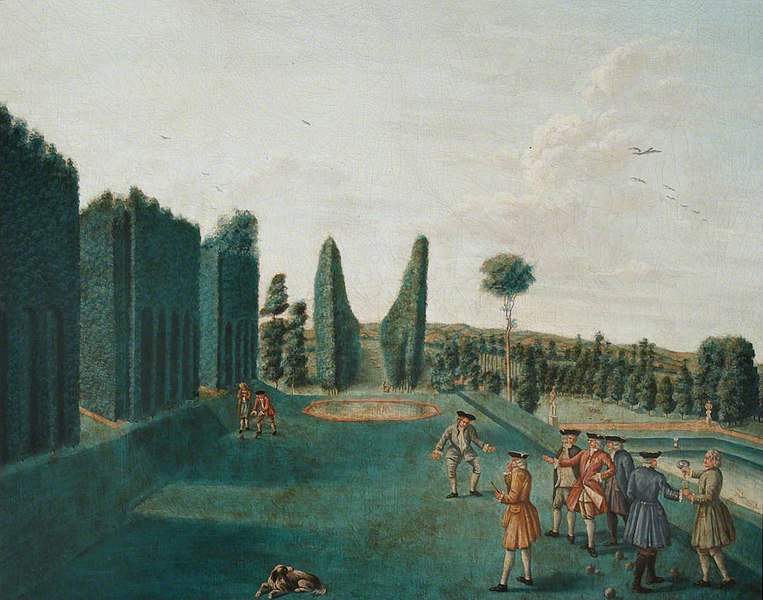
'The Bowling Green and Octagon Pond'
Circa 1700's. Artist Unknown
Hartweel House, Buckinghamshire
National Trust

Many great houses had a bowling green or a croquet lawn surrounded by little grassy dyke to keep the balls in play, and these too were often deliberately flooded in winter, if a frost was expected, to make ice.

By the eighteenth century, ice was being transported by barges all over England having been harvested from the marshes where again it formed easily in shallow bog pools, even when the weather was not cold enough to freeze lakes. But the ice, having been made from fishpond water or marshes was too dirty to be put directly into drinks or food. It could only be used to chill containers of food or bottles. The English had to wait until clean ice could be imported from abroad before it could actually be added to their drinks.

Ice Cutting on the St. Lawerence River
Montreal, Quebec
Photo Alexander Henderson, circa 1870

The first import from Norway proved a bit of a disaster, since by the time customs had decided ice was ‘dry goods’ they were left with nothing but a warehouse full of water.  But by 1830, 150 tons of imported ice was stored beneath the Haymarket in London, collected by steam-driven cutters from lakes in Scandinavia or the Great Lakes of America, brought over by ship and transported round England by barge.

The American lawman, Bat Masterson, (1853-1921) once said, ‘We all get the same amount of ice. The rich get it in summer. The poor get it in winter.’ But finally, that was changing – people could buy clean ice cheaply for their kitchens and in time, cooks in even in modest households could attempt Mrs Beeton’s famous ice creams and lemon-ice recipes.

As for sipping iced sherbet while reclining on silken cushions – it’s still on my bucket list!

Ice Formation Edge of pond
Photo: ThomasLendt


Tuesday, 27 December 2016

Regent's Park Catastrophe 1867, by Janie Hampton


When I was a small child my grandmother told me of a terrible event that she had witnessed. ‘My father took me to Regent’s Park,’ she told me. ‘We walked across the frozen lake. As we stepped off onto the bank, the whole lake tipped up, and all the people skating slipped into the water. Then the ice tilted back, with the people underneath. There was nothing anyone could do. Father and I were so lucky. We got off just in time.’ Her words stuck with me but it was another 50 years before I found an eye-witness account of this disaster which occurred 150 years ago next month. It was by Francis Henry Skrine, the 19 year old son of the Rev. Clarmont Skrine of Wimbledon, and went as follows:
‘Regent’s Park is, indeed, the chief glory of north-western London, and it owes much of its beauty to an artificial lake of vast extent, studded with islets, and the chosen home of a variety of wild fowl. On the 15th January 1867, the Regent’s Park water, as this lake is termed, presented an animated scene. Three days of sharp frost had covered its ample bosom with a sheet of ice, apparently firm enough to support the crowd of skaters and sliders with which it was thronged. The spectators on shore numbered thousands, and a roaring trade was being done by lenders of skates; and vendors of hot chestnuts, “brandy balls” and oranges. The great interest, however, centred round the “hockey on ice” – a game of which I was then an enthusiastic votary. It is played as hockey on dry land, with the exception that the rubber ball is replaced by a disc of cork: and when the pace is hard and the players numerous, it is a highly exhilarating if somewhat risky form of sport. So exciting was the game that I entirely failed to notice the dangerous condition of the ice, and the fact that it was gradually being deserted by all but the most adventurous skaters. 
'It was not till 1.30 p.m. that I paused for an instant to rest. I glanced round me, and saw at once that I was lost. I was exactly in the centre of the lake, 200 yards distant from the islets, or the shore; on a spot too, where I knew the water to be at least 12 feet in depth. The treacherous ice was everywhere a perfect maze of cracks, through which the water was oozing, as the surface bent and undulated under the skaters. I looked for a means of escape and saw close by an employee of the Royal Humane Society with cork life-belt and ladder, making his way gingerly towards the shore; but my entreaties to be allowed a share of his life-belt in case of a break-up, were answered by imprecation [cursing], and the remark that “he would have enough to do to save himself”. To strike out for safety would have endured instant immersion; I therefore lay down on the ice, and awaited the inevitable catastrophe. It was not long in coming. A party of 15 strong men were engaged, a few yards off, in a fierce struggle for the hockey ball. Their weight proved too much for the rotten ice, which gave way, engulphing the entire group. A wave swept over the surface of the lake from the scene of this catastrophe; the ice broke up in all directions and I found myself struggling in the water. I managed to grasp a floe about four feet in diameter, and, clinging desperately to it, shouted “help” with the full force of my lungs: but my despairing appeal was drowned by those of scores of other victims around me. My hands grew number from contact with the slippery ice, and I was burdened with my saturated overcoat, and dragged down by my heavy skates. I felt my grasp slowly relaxing, and knew that I must soon lose hold, slip between the miniature icebergs around me, and sink to rise no more.
‘At this critical moment, I observed, floating a few feet from me, the ladder of my friend the ice man, abandoned in his hasty retreat, and without hesitation, I left my floe, and struck out for the surer support. It was a terrible and almost hopeless effort. Twice I was engulphed amid the floating ice, and twice I emerged breathless from the dark water. But at length utterly exhausted, I reached the ladder, and clung to it with all the strength of despair. I was now in a position of comparative safety and able to glance at my surroundings. The entire surface of the lake was covered in human heads, their owners clinging desperately to ice-floes and rending the air with their entreaties for help. The shores were fringed by a yelling mob of spectators, intensely excited, but utterly unable to assist their perishing fellow-creatures close by. A stalwart fellow who had been one of the most eager and profane of our hockey-players, was praying fervently for mercy. Seeing my ladder, he implored me to push it within his reach, and after great exertion, I managed to do so. The groaning wretch abandoned his temporary support and clutched at my ladder; but the effort was beyond his powers. He went under, and the last I saw of him was two clenched fists slowly sinking between two adjacent floes.
‘A stout individual was lying at full length on an island of ice barely large enough to support his weight and shouting “A thousand pounds to the man who’ll get me out.” This appeal to their cupidity was too much for the “roughs” of whom the most ashore was largely composed. A chain was speedily found, and a score or two, hand in hand, darted into the icy water. After several fruitless efforts, the capitalist was rescued from his perilous position. (I afterwards learnt that he decided not to “execute”, and offered his salvors the paltry sum of £10; that they sued him for the entire amount but they lost, the judges holding the non-existence of a contract!)
‘One after another, the heads around me slowly disappeared, the shouts of the mob grew fainter, I felt a delicious dreaminess invading my sense, and sunk into a profound slumber, the result, doubtless, of the flow of blood from the head.
‘On awaking, I found myself in a comfortable bed, surrounded by kind and solicitous attendants. Collecting with a great effort my scattered senses, I ascertained that it was past 11 p.m. and that I was the guest of a resident in one of the splendid terraces overlooking the park. I learned that, after a prolonged delay, boats had been launched, and the survivors picked up and taken, for the most part, to the infirmary of the Marylebone workhouse. I had been actually the last to be rescued, after an immersion which had lasted towards of four hours, and had been conveyed to my kind hosts, at the suggestion of a friendly park-keeper. I had clutched the ladder to which I owed my life too firmly to allow of its being taken from me, and I was carried to my temporary quarters still holding it in my grasp.
'Medical men were in prompt attendance, and after unremitting exertion on their part for upwards of five hours, I was restored to consciousness. Beyond the loss of my finger-nails, I suffered no ill-effects from my terrible experiences and two days later was able to assist in the mournful task of dragging the lake for victims.
‘Forty-two bodies, mostly youths in the heyday of life, were recovered from the oozy depths, their hands full of weeds and mud grasped in their death agonies. The catastrophe was undoubtedly due to the incompetence of park officials and the police, who should have cleared the lake as soon as the dangerous condition of the ice became manifest. Its repetition has been rendered impossible by a reduction in the depth of the lake to a maximum of four feet. But the 15th January is still a sad anniversary in many an English home. F.H.S. Calcutta, December 1884.’
Maybe my granny saw this and believed it was her?
A year after this event, Francis Skrine joined the Bengal Civil Service and eventually rose to become British Commissioner of the Chittagong Division. The Regent’s Park catastrophe seems to have affected his entire outlook on life. During his 27 years in India, his colleagues were impressed by three water-related achievements: he designed a new system of embankments in the Nadiya District; excavated a great drainage canal at Rangpur; and constructed water-works at Arrah. He was noted for his efforts during three major famines and for his ‘energy and devoted efforts to save life during a very serious cholera epidemic’. Even though this was written 17 years after the catastrophe, the details were still vividly remembered. Maybe that is why my granny recalled being there – after reading this she was convinced she saw it all. I say this because, when I found Skrine’s account among her papers, I realized she was not born until 20 years after it had taken place. So much for oral history!

Wednesday, 10 August 2011

On accosting old ladies on the vaporetto on cold misty mornings - Michelle Lovric


I hope this post will not disappoint. Unlike the two preceding History Girls, I am not going to take my clothes off today, much as we all enjoyed Caroline Lawrence’s and H.M. Castor's historical stripteases. (Especially well done to Caroline for getting naked in her first line, and still being promiscuous in her last.)

For those of you still reading, I’m going pull on my huge fake-fur coat known as ‘Brown Boris’ and take you somewhere very, very cold.

When I’m tired of the library, and can’t bear squinting at the screen for a moment longer, there’s no need to stop researching. For me, there is always the vaporetto. At certain times of day, before the tourists make it impossible to breathe, talk or move aboard, a tribe of translucent ladies in their upper eighties take to the ferries in Venice. I consider them a valuable resource.

It is easy to engage them in conversation. A smile will do it. Or a small comment. They don’t flinch away. They don’t think you must be touched in the head to want to talk to them. Unlike many extremely old ladies in England, for example, they are not apologetic, self-deprecating creatures, accustomed to being overlooked or insulted. No woman is ever non-viable in Italy. She may at any age demonstrate self-respect, being elegantly shod and immaculately groomed, without accusations of being pecora dressed as agnello.

I love to talk to these waterborne old ladies. If one is available, I’ll always go and sit next to her. And my favourite conversations begin when they sigh, ‘Ah, non è come era una volta’: ‘It’s not like it was once upon a time.’ When my old lady of choice says that, I hope that she’s not getting out at any stop soon.

For when they say those words, you’re about to hear how it was once upon a time in Venice. And it is magical.

One old lady told me very proudly about an antique soup tureen she bought at auction. It was more than she could afford, but it was a superb piece, a remnant from a noble palazzo, all hand-painted with meadow flowers and herbs, perfect for a cold summer soup. She would never use it, as she didn’t really entertain ‘come una volta’, but it would look exactly right on her credenza and give the whole dining-room an air. She told me how she’d clutched that tureen all the way home in the vaporetto, and how everyone had given her space because she was holding such a precious object. It wouldn’t be like that now, she shook her silky head sadly, pointing at the backpackers using their kit as weapons to bash other passengers out of their way. One blow from those backpacks could stun or kill an old lady like her, and smash a precious tureen to smithereens. That tureen will soon have a place in one of my books.

It is to another old lady on the vaporetto that I owe a central image in The Mourning Emporium, my novel set in Venice and London in the winter of Queen Victoria’s decline and death. It was a cold and humid day three years ago (yes, in Venice it can be both cold and humid at once). The Bora wind pounced on the city, pummelling the citizens with rough cold paws. Ice crackled underfoot. Mist blurred the palazzi rising out of the water. I crouched in the steamy cabin, fragrant with old ladies apparently marinated in lavender water and inflated to twice their normal volume in sweetly musty mink.

I was writing about an ice-storm that engulfs Venice on the night of December 24th, 1901, stealing Christmas and carrying many Venetians away. So my freezing vaporetto trip was by way of research.

Che freddo infernale!’ I said hopefully to my nearest old lady. ‘What hellish cold!’

Ah si,’ she replied. ‘Ma non è come una volta.’

And we were away.

She told me about the winter of 1929. ‘I was just a little girl, a tiny little thing. We lived near the Fondamenta Nuova. You never saw anything like it. The ice was so thick on the little canals that the gondolas popped up on top like grape pips!’

‘Was the Grand Canal frozen?’ I asked, reaching for my notebook, scribbling ‘1929’.

Non totalmente. But great ice floes like whales floated just under the water. Where I lived the shore was frozen solid. People walked right into the middle of the water between the House of the Spirits and the cemetery island.’

My mind raced. In my stories, the House of the Spirits covers a cavern inhabited by greedy, foul-mouthed warrior mermaids. How could my mermaids survive? Would they too pop out of the ice like grape pips? No, I realized, they would have to swim away from Venice. But where would they go?

The old lady continued to reminisce but I was already in the writers’ land of ‘What if’.

What if the Venetian mermaids swam all the way to London? What if the ice-storm was caused by baddened magic? What if two child characters, Teo and Renzo, ended up in London too? What if Renzo’s mother …? I turned back to my companion, with more questions.

Eventually, drained of memories, my old lady rose and shuffled towards the exit, giving me that special Venetian upside-down wave by which the hand becomes a castanet. I waved her goodbye.

At home, I googled 1929 Venezia and was rewarded with a YouTube video of the city engulfed by ice (see link below). But it was the old lady’s own images that would stay with me and colour what I wrote in The Mourning Emporium.

Shall I one day sit on the vaporetto and be engaged in conversation by a young writer wanting to know what it was like here once upon a time? Shall I wave that writer goodbye with a castanet motion?

I hope so. I have a debt to repay.

Anyone else like to admit to a habit of accosting old ladies or gentlemen on buses or trains? Or other vampirical tendencies? Is anywhere, in fact, safe for innocent members of the public, with historical novelists everywhere ravening for fresh story-blood?


LINKS

Michelle Lovric’s website

You can see the footage of an iced Venice in 1929 on YouTube where there’s also a trailer for The Mourning Emporium and The Undrowned Child

The photo of the vaporetto in the mist is from the excellent pensierospensierato.blogspot.com