
Showing posts with label library. Show all posts

Friday, 14 January 2022

Joy, Happiness, Culture and Refinement - by Ruth Downie

It’s hard to imagine now, but there was a time when, if you didn’t know something and neither did your neighbours, you had to find a book and look it up. When I first worked in a library it was not unusual for people to phone us in search of answers to quiz questions, because unless you owned your own encyclopaedias, there was only one place to find help. So when I started to look at the story of one local library I was amazed at what a struggle its creation had been. Surely everyone would have thought a library was a Good Thing? 
 
Evidently not. 
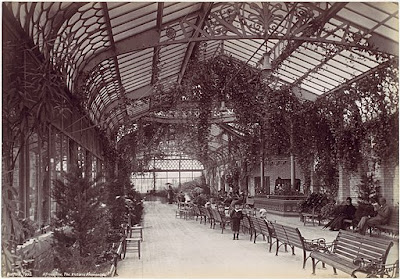
Large Victorian pavilion with plants and seating
Ilfracombe's seafront pavilion, c.1870  

By the later years of Queen Victoria’s reign the small town of Ilfracombe, on the coast of North Devon, was a thriving holiday destination. In the first decade of the 20th century the reading tastes of locals and visitors alike were catered for by no less than five subscription libraries. Readers could thrill to stories by Conan Doyle, Rudyard Kipling and Louis de Rougemont, whose controversial adventures included “Round the World on Wheels”, “Twenty-eight Days Without Food” and the alarming “Shot Through the Head with a Ramrod.” 
 
Victorian gentleman
Louis de Rougemont


Keen to attract customers, the libraries advertised their stock in the newspapers. JS Fletcher’s mystery novel “The Death that Lurks Unseen”, Florence Warden’s “A Lowly Lover” or AEW Mason’s “Miranda of the Balcony” could be borrowed for 3d (just over 1p). Eager readers could have three books at a time for an annual subscription of 21s (£1.05). However, if you couldn’t pay, your chances of enjoying any of the latest tales - including my absolute favourite title, LT Meade’s “Maid with the Goggles” - were slim. There was no mention at all of reference works.

From about 1850 onwards local councils were empowered to set up free public libraries, but take-up was slow. There was a flurry of activity around Victoria’s Golden Jubilee in 1887 but Ilfracombe’s attempts to join in did not begin until early 1899. On 14 January The Ilfracombe Chronicle & North Devon News printed a letter of support from an anonymous ratepayer who hoped the proposed library would prove “a counteractive influence to the public house.” 

The Chronicle’s local columnist, “Man about Town,” was also delighted with the idea, declaring in the same issue that “A library open to all classes, rich and poor, is a great boon to professional men and artizans [sic] alike”.

Unfortunately not all the town’s councillors agreed with him.

“The… speeches of the members,” declared the disgusted Man About Town in his column the following week, “proved… that many of them know nothing at all about the question.” This, he felt, was the only possible reason for the Council’s “utterly inexplicable” veto of the proposal despite widespread public support.

He dismissed the counter-suggestion of a “voluntary library” as “twaddle,” and saw no sense in the decision to consult the ratepayers. Indeed, 94 out of 99 letters sent to the Council chairman were in favour of the scheme.

“In the course of my professional duties,” declared one, “I am constantly brought in contact with students who are hampered in their studies for want of a good reference library.”

Another claimed, “The people of this town are endowed with great natural intelligence, but have been unfairly handicapped in the pursuit of knowledge by the absence of such an institution.”

On 28 January Man About Town returned to the subject for a third week, confident that despite this setback the ratepayers of Ilfracombe would see their own public library before long. Other local papers were not so sure. He quotes the North Devon Journal as being “astonished” at the decision, but the Exeter Gazette concluded that it was “a wise one” in view of other pressing needs for funds. Meanwhile the North Devon Herald pulled no punches. There was, it said, “no valid reason whatsoever why the ratepayers should be taxed… to furnish folks with a very limited selection of books, which they would only grumble and cavil over… the public will always clamour for anything they can see a chance of getting for nothing.”

Portrait photo of smartly-dressed man with white hair and beard
Andrew Carnegie
The Council finally voted to adopt the Public Libraries Act in 1903, but little changed until 1904/5. That was when a knight on a white charger rode into town. In spirit, at least. In body, Dunfermline-born Andrew Carnegie remained in the USA. A man of humble origins, Carnegie had educated himself largely by reading, and subsequently made a fortune in the steel industry. In 1901 he sold his company for $480 million, which made him about twice as rich as Bill Gates is now. Carnegie then devoted himself to philanthropy and, along with much else, his generous grants enabled the setting up of 2509 public libraries across the world. £3000 of his money (about £375,000 today) was on offer to Ilfracombe.

Should the town accept? A Carnegie grant would come with strict conditions, and the recipients were expected to find the library’s running costs for themselves. The council voted to receive the money, but in January of 1905 the Chronicle reported “great differences of opinion” at a lively public meeting:
 
Mr W Pile said "they should put every opportunity of improvement in the way of the young men of the town. (CHEERS)

"…Mr Dadds went on to say that public libraries were a failure nearly everywhere. (HEAR HEAR) What did they read in these libraries? (RUBBISH) The town was expecting to get a Higher Grade School, and did not need the library."

The report offers a great deal more in this vein, suggesting everyone present was having a marvellous time – until the vote. The count was 85 for the library, 100 against.

Nevertheless, plans for a library were approved in 1912. There then follows a long silence, only partly explained by the interruption of the Great War.

On 23 May 1925 the Ilfracombe Chronicle Gazette and Observer ran the subtitle, “Carnegie Trustees want something definite”. This was not unreasonable, as “It is now more than 20 years since the promise was made by Mr Carnegie” and there was neither a library nor any obvious sign of one. The council, still mired in complications over the site, voted to adjourn.

It was not until 1934, 35 years after it was first proposed, that Ilfracombe’s Free Public Library finally opened in the rest room of the magnificent Ilfracombe Hotel - “lofty and airy, flooded with light from the glass dome roof.” (The hotel is the large building on the left in the picture.) There were 820 fiction, 300 juvenile fiction, and 440 non-fiction and reference books. It was created with help of the Devon County library service, which had received substantial help from the Carnegie fund and had set up 463 branches across Devon. The Ilfracombe Chronicle & North Devon News shared the good news on 14 December. 
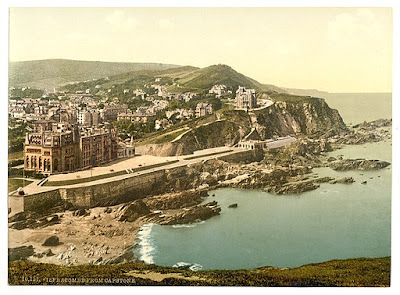
Picture of rocky beach with large seafront hotel
Ilfracombe seafront

“I feel convinced,” announced County Councillor Mr RM Rowe, “that the provision of a public library will not only add to the amenities of this township, but will also bring a large measure of joy, happiness, culture and refinement to the inhabitants.”

The Ilfracombe Hotel is long gone, but the public library which began life there is still bringing joy, happiness, culture and refinement to the town. Sadly I have searched the catalogue in vain for “Maid with the Goggles”. 

*****

Thanks to Ilfracombe Library, who inspired the original research, and Ilfracombe Museum, who provided most of the material. All errors are of course my own.

For a brief summary of the rise of English public library (with occasional refs to NI, Scotland & Wales) visit the Historic England website.

For more on Andrew Carnegie, visit the website of the Carnegie Corporation. 

 *****
When she isn't hanging around museums, libraries and archaeological holes in the ground, Ruth Downie writes a series of murder mysteries. They're set mostly in Roman Britain and feature army medic Gaius Petrieus Ruso, and his British partner Tilla. To find out more, visit www.ruthdownie.com

*****

Photo credits -
Pavilion - Francis Bedford, CC0, via Wikimedia Commons
Louis de Rougemont - George Newnes, Public domain, via Wikimedia Commons 
Andrew Carnegie -User Magnus Manske on en.wikipedia, Public domain, via Wikimedia Commons
Ilfracombe sea front -Photochrom Print Collection, Public domain, via Wikimedia Commons

Saturday, 17 February 2018

STILL SPEAKING IN RHYMES by Penny Dolan

Recently I started helping with Story-times for Under-Fives at my local Carnegie library. My role, at the moment, involves greeting parents & grandparents, giving out musical instruments and then collecting them back into the box. In addition, I have begun singing lots of once- familiar rhymes, hoping to encourage the grown-ups to join in by my cheery enthusiasm, if not the beauty of my voice. 
 
Image result for Harrogate Library picture

Coming across these songs once more, still being sung to two and three year olds, I noticed how the words echo events, practices and customs that aren't central to the lives of these 21st Century children. We wind the bobbin up and back again, watch the mouse climbing the non-digital grandfather clock and march up and down the hill - loudly -with that long ago Duke of York. Moreover,  in our songs, we are still living an agricultural life: we go bumping up and down on a big red tractor (bringing in the hay - Hey! ) while - staring out at Yorkshire's largely arable uni-crop fields, MacDonald's Farm seems an unusually mixed enterprise.  
 
In addition, even though the audience walks or drives into town, the songs tell us that the mummies on the bus chatter and the daddies say "Don't do that!".  I haven't yet worked out how to ease that gender issue when I start leading Story-times myself. 
 
Nevertheless, the History Girl part of me is rather pleased to find that this past world and rural dependency is still being celebrated. As my earlier post, shown below, suggested, these old rhymes and songs can create a child's sense of history.
 
“When were you first interested in history?” is a question often asked of History Girls, so I’ve been thinking about my own interest and some of the places it came from. 

On reflection, my answer would be that History came riding in on the back of words and poems and rhymes, all bringing questions and objects from the past that needed explaining.

What were curds and whey and would I like them?
 Why did that pair go to fetch a pail of water when we had a tap?
Could I entice the King of Spain’s daughter with a silver nutmeg and a golden pear, assuming I had a tree that was better than the overgrown lilac in our tiny garden? 

Could you actually have blackbirds in a pie?
Why did the words "gunpowder, treason and plot" sound so deliciously rebellious and doom-laden? 
 
And why did fat and fair Bobby wear silver buckles on his knee? And what about those rings on her fingers and bells on her toes? Nobody I saw ever dressed so grandly, or rode on such fine horses. It was bikes, buses and the occasional motor-car.
The rhymes read like codes, offering glimpses of life in the past. Those pretty lines didn’t stop me noticing that many carried poverty and cruelty in their pockets. I was quietly sad about poor Piggy on the railroad picking up stones. and although I went along with dipping our heads in the deep blue sea, I knew that big ship sailing on the alley-alley-o had met some kind of tragedy.
The love of such antique rhymes came years before I learned about the Opies and their collections and commentaries of traditional rhymes, or found the lamented Sendak’s clever illustrations for “I Saw Esau.”  I added to my own rag-bag concept of Time Past with a Book of Story Poems, dressed in a faded green Everyman binding, discovered on a shelf at home: each page full of exploits that took place in historical or legendary settings.  Who could resist those heroics and laments?

I met gude Sir Patrick Spens, wi’ the Scots Lords at his feet. 

I heard the bells ringing out the Brides of Enderby as the seething wave swept in from the Lincolnshire coast. 

I wept for mad Cuchulain warring against the tide, for the Forsaken Mermaid and for the Lady of Shalott singing her last song, as she drifted towards Camelot. 


Many of the poems I found in that book, and in other collections at that time, looked backwards rather than forwards. Anthologies now seem different: glancing through some contemporary children’s anthologies, I note that few now have that strong sense of the sea and a maritime nation. Did that go, along with the ports and the docks? Let alone the horses that "the gentlemen" no longer ride by at night?
I know the poems I loved back then were romantic, legendary stuff and not strictly proper history, yet those rhymes and ballads and verses held enough glamour to make the past a living breathing presence for me and create a living sense of time gone by. Soon enough, life brought along proper stories and novels and non-fiction books and school history lessons along with films and tv programmes and museums, but when I look back,  poetry and word of mouth were where I met History first.
Penny Dolan
 
These two illustrations come from Jackie Morris’s truly wonderful collection of nursery rhymes “ The Cat and the Fiddle” published by Frances Lincoln. www.jackiemorris.co.uk  
 
Image result for THE LOST WORDS book cover
PS & NB: More recently, Jackie Morris and Robert Macfarlane created a wonderful picture book, THE LOST WORDS, (above) celebrating the once-familiar vocabulary of the British natural world and which modern children could easily losing to the technological terms now crowding school dictionaries. 
 

Wednesday, 17 April 2013

New Libraries for Old? by Penny Dolan


Today I went to a meeting of the Friends of my local Library, one of the Carnegie buildings. We met in a small neat room in the basement, next to the children’s library. Back in the first half of the last century, the basement held a shooting range for local riflemen. 


 In the recent years of this century, through the National Lottery, the library was revamped and opened up to more daylight. Now it houses adaptable shelving and rows of well-used computers, although the reference library was lost in the alterations. 

The whole interior is painted in the airy lilac with purple accents that are the standard local authority library colours. It is a very pleasant library, yet I can’t help coming back from these meetings - aware of yet another “re-structuring” behind the scenes -  that this is an uncomfortable age for our national libraries.


True, this week, a new library was announced, courtesy of the Margaret Thatcher Trust, which may well be a subscribing or closed library. Somewhere else, no doubt, a free local authority library is closing or transforming into a community library. 

Although I welcome volunteers and a more open mood in libraries, I know the inspiring expertise - spread too thinly – will fade quickly. Rather like the respected collection of early Victorian children’s literature once held at my local library and now, apparently, lost in the counties archives. Last reported in a cardboard box, somewhere, but now untraceable. Gone with the fairies.

I do not feel the destruction of libraries can ever be a good sign. The ravage of the great libraries of the past - Alexandria, Lindisfarne, St David’s, Leuvain and more - was never the sign of greater tolerance. These libraries were destroyed dramatically with blood, fire and hatred, dramatically and awfully. They were true disasters.

But the current re-structuring and rationalisation of the library service feels like the pettiest, meanest-minded aspect of Englishness. It makes me feel ashamed, knowing that the poor, the old, the out-of work, the students and the immigrants who use the libraries that are most affected.   

It goes deeper. Behind the library lies the stock of books available. I enquired, recently, about an expensive academic book on children’s literature. My local library will help by arranging an out-of-county loan for twenty pounds.  

Will our library stock eventually only offer the light romances and whodunits once the core of the Boots subscription libraries? Will biographies of recent and current celebrities be the only lives available? More importantly, will more study be impossible unless one joins a major subscription library? Or signs up and pays for an academic course? Will history only be "now" and not "once" or "then"?


I have always loved being in libraries, in using libraries. My first library was one of those ornate late Victorian library that declared Here is Learning. That building, with its green copper dome, is long gone. The replacement, which I am sure is well used and excellent, is now contained within a big new shopping mall. Which, if times get even tougher, is a much simpler space to disappear. Rather like the use of the word “librarian”, that became “learning resources manager” in many local libraries and secondary schools. How convenient.

 
Excuse this gloomy History Girl post. I love my local library and the people there. But sitting in such a meeting, working out ways to raise money for a notice-board for the railings outside, set my history teeth jangling. Is what I feel the very faintest echo of how it was when only the priests and the rich had access to books? 

I also find it impossible to post about tomorrow’s event.


Penny Dolan

Penny Dolan is the author of A Boy Called Mouse. (Bloomsbury)