Tuesday, 8 September 2015

'Don't Hang the Messenger' by Karen Maitland

'I don't care what your delivery sheet says,
 I'm not signing for the white elephant!'
Having waited all day for a ‘guaranteed’ delivery of a package which has not arrived, I find myself wondering if things were any better before our modern courier services.

Since the time of the ancient civilizations there has always been a need for couriers and messengers to deliver valuable packages and vital documents. Both the Persians and Romans established very efficient networks of state messengers, but by the 11th Century in Europe many commoners such as wealthy merchants, town councils and monasteries discovered they needed to develop their own independent courier systems, not least because they wanted to keep their business interests safely away from the prying eyes of government officials, popes and kings. Even universities in the Middle Ages employed their own couriers so that students could obtain money urgently from their families to pay their fees or refill their wine flagons, and these university couriers were given royal dispensation to travel without hindrance.

But maintaining a courier system was an expensive business, not only did the messengers have to be provided with coins for food and lodgings on the road, but they needed money to change horses, pay tolls, buy passage on ships or river craft, and they often had to be provided with the funds to bribe clerks and officials so that they could be admitted straightaway to see someone of importance and not kept hanging around for weeks. So it made sense for individuals to band together to finance a courier service between them. One of the first of these was the Scarsella dei Mercanti Fiorentini founded in Florence in 1357 by a group of merchants, who hit on the bright idea of not only using the service themselves, but allowing anyone who could afford it to pay to use it too, whenever the need arose.

Couriers had to be fit, tough, trustworthy and resourceful. It helped if you could speak several languages as well. On one occasion when a quantity of gold had to be sent secretly from Verona to St Gall, six messengers were dispatched in pairs travelling by different routes disguised as pilgrims. They were warned that if they were caught, the gold would be bound to their legs with their own thigh sinews!

This was probably not an idle threat, since at the siege of Auberoche in 1345, when the French captured a page boy on his way to deliver a message to the English inside the besieged castle, the poor lad was bound and catapulted into the castle from a trebuchet or siege engine, with the letters he was carrying tied around his neck. Unsurprisingly it is said the knights were much ‘astonished and discomforted when they saw him arrive.’


Before the days of modern ID cards, couriers who were carrying valuables or secret messages had to find a way to prove their own identity and that of the person to whom they were delivering the package. The simplest method was to a cut a coin in half, one being given to the recipient who would then match it to the courier’s. Rings were often use to identify the bearer or recipient, as well as passwords and coded gestures. Confidential documents could be concealed in the linings of clothes or laid flat on a wooden board and coated with a thick layer of wax, so that it would appear to be a cheap writing tablet. Not something a thief would bother stealing.

If messages fell into the wrong hands, the consequences could be disastrous. When Calais was being besieged by Edward III in 1346, the French defenders tried to send a letter to their king telling him they were so desperate they would have to start eating each other or surrender if help didn’t arrive. When one of couriers realised he had been spotted, he tied the letter he was carrying to an axe and threw it into the sea, hoping the axe would weigh it down, but it floated ashore and fell into the hands of Edward III who took great delight in personally sending it to the French king, just to add to his enemy’s humiliation.

Quite apart from the hazards of the journey itself, some couriers must have felt very apprehensive
Valette - Grand Master of the Knights of St. John
about the reception they’d receive when they eventually arrived. The accepted laws of chivalry meant that a messenger delivering bad news should be allowed to speak freely without being punished, but men in authority were seldom noted for their sweet disposition and often the temptation to ‘hang the messenger’ proved too great. 

 In 1565, when a courier delivered the message to Suleiman that his siege of Malta had failed, Suleiman flew into a rage and stamped on the unfortunate man. But to be fair, when the Turks had earlier sent a messenger to Valette, Grand Master of the Knights of St. John on Malta, he had ordered the messenger hanged, and only relented when it was pointed out that the poor man was a slave who couldn’t disobey orders. So instead Valette sent him back with the message that he would hang anyone who came to deliver any further communications.

As for that package – I’m still waiting!

Monday, 7 September 2015

SISTERS by Adèle Geras

Note: When I wrote this post, I  hadn't read Christina Konig's excellent post about LIFE IN SQUARES. I do hope readers of this blog will excuse a slight overdose of the Bloomsbury Group. My post is sufficiently different from Christina's I hope, for this to be excused. 


The whole world, it seems,  is Bloomsbury Mad. Actually, ever since Vanessa and Virginia Stephen moved to 46 Gordon Square in 1904, the lives of these two sisters and their friends have fascinated biographers, critics and anyone interested in a story of highly intelligent people and their doings: literary, artistic and sexual. Perhaps it's their sexual shenanigans which have kept the interest alive and the recent BBC drama, LIFE IN SQUARES, did concentrate on that aspect of their lives perhaps rather too much. The drama was quite well done, I thought, though Virginia I felt, was woefully miscast and Rupert Penry-Jones, much as I admire him, didn't appear to be much older than James Norton, playing the older Duncan Grant. I saw no good reason why the same actor couldn't have been used for both old and young, but there you are. The series certainly looked wonderful and Eve Best as Vanessa has made me resolve to wear my string of amber beads round the house, as she did. Most importantly, the drama suffered, I though from only being three episodes long. There was far too much happening in all these lives to cram into such a short time frame. If it had been longer, the characters could have been much more fully developed and the situations, and complicated relationships of the Group could have been explained to those of the viewing public who didn't know the intricate stories of these lives. As well as that, more episodes would have been able to convey the artistic and literary importance of these two women, who, in the time allowed, were just beautiful people who swanned around, with occasional bouts of grief and thwarted love to interrupt the apparent idyll.


This (above) is Charleston House, Vanessa's home for most of her life.  You are not allowed to photograph the interior, where Vanessa and Duncan Grant and other artists decorated every available surface. You saw the rooms in the TV series, and they are most beautiful. The scale of the house is very small. It's really a farmer's cottage and feels like it: rough, as well as beautiful. The furniture comes from the Omega Workshop, where Vanessa Bell produced wonderful (unsigned) designs for furniture. Duncan Grant's  work is everywhere. He was the love of Vanessa's life and more than that, her closest friend in the world, except for her sister, Virginia. Anyone who missed the tv series and who is interested has only to put Charleston House into Google to see what it looks like. They will also find many of Vanessa's works reproduced.


Many people can't stand the Bloomsbury group.  Snobbish, they say. Elitist. Spoilt. Anti-semitic. And on and on. This may very well be true but also, clever, ground - breaking artistically, and leaders of the intellectual life of their day, whose lives are still fascinating to many, including me. I can say exactly why I am drawn to them. It's because of the relationship between the sisters. I'm an only child and I suppose I romanticise the bond that can exist between sisters, because I've always wished I had one of my own. In February, I read a novel which I can't recommend too highly. It's called 'VANESSA AND HER SISTER,' by Priya Parmar, and it's published in paperback by, of course, Bloomsbury.  It is completely gripping and deals with a period of their lives when they were young. After reading that, I'm now reading an excellent joint biography by Jane Dunn called 'A VERY CLOSE CONSPIRACY.' That is brilliant and shows one thing very clearly.  No matter what was going on in their love life, or in their intellectual lives, each sister was emotionally the centre of the other sister's world. They were close, and loving and Vanessa never stopped being the chief looker-after of Virginia. We know about Virginia suicide, and that death is, horribly, part of the drama of their lives and their story. But what is clear from what I've read is that Virginia, for many reasons, was always in a state of precarious mental health.  Vanessa was her mainstay. Leonard Woolf also looked after her, but it was her sister to whom she was most attached.


Both sisters  had to be constantly creating.  Virginia fell ill when she couldn't write for some reason, and Vanessa, together with other denizens of Charleston, used their artistic talent to transform everything. Both sisters made beautiful gardens, and the mosaic above shows that every corner of Charleston was worked on: painted, decorated with beautiful pictures and patterns and enhanced by the artist's hand and eye.


Virginia and her husband Leonard took a house just a few miles fro Charleston, in the village of Rodmell. The house is called Monk's House and it's a National Trust property. There is no café and therefore none of the lovely NT scones but it's a wonderful place to visit. The photo above shows Virginia as painted by Vanessa and below, there's a screen painted by Angelica Bell, Vanessa's daughter by Duncan Grant, which looks like something from a stage set. That seems remarkably appropriate. The conversations and situations both at Charleson and in Monk's House were indeed very dramatic. I also think it's very beautiful.


Vanessa's bedroom at  Charleston looks out on to the garden. So does Virginia's at Monk's House. They are beautiful rooms, characterised also by very narrow beds. Below is Virginia's, which is the size of the bunks on overnight trains. This is a single bed if ever there was one. 


And in another part of the same room, at the foot of Virginia's bed, is a bookshelf which I found the saddest and most moving thing in the whole house. It's full of Shakespeare Plays, each covered in paper from the endpapers printed by the Hogarth Press. Virginia covered the volumes during one of the times when she was ill. I took a photo of 'ALL'S WELL THAT ENDS WELL,' which struck me as ironic. But here we are, still thinking about the sisters, still reading the novels and looking at the pictures and discussing the lives. That's ending well, in many ways. 

Sunday, 6 September 2015

Ancient History in Sardinia by Lydia Syson

I first fell for Sardinia eight or nine years ago, on a summer house swap. Even the milk cartons charmed me. They used to show a cow standing in front of a crumbling nuraghe – a circular, dry-stone wall structure with a passing resemblance to a Scottish broch, but built considerably earlier, in the Bronze Age.  

Nuraghe Ardasái
© Hans Hillewaert, via Wikimedia Commons
We went to visit one nuraghic site near where we were staying (possibly S’Ortali ‘e Su Monti, near Tortolí) and I have a vague memory of dappled shade, intriguing arrangements of stone, and a very petite guide telling us how incredibly tall the nuraghic people must have been  - at least  5’8”!  But I had four small children in tow, mobile internet wasn’t really ‘a thing’, and when I got back home I never found time to investigate further.

Returning for another family holiday last month, I found the milk cartons replaced by dull plastic bottles. But I also discovered that in the last twenty years the official number of the megalithic towers found on the island has risen almost three-fold to 20,000, and that each one was once in sight of another. Earlier assumptions that their primary purpose was military or defensive are being overturned.

View south from Nuraghe Mannu
As an infectiously enthusiastic guide at the cliff-top site of Nuraghe Mannu explained, ancient Sardinia – mountainous, richly wooded and presumably well-watered in the days before it effectively became a colonial outpost, supplying wood and minerals for a variety of conquerors over the centuries, including of course Rome, both ancient and modern – must surely have been populated by communities who collaborated rather than fighting with each other.  They communicated their sophisticated building techniques and shared other knowledge and beliefs in ways at which we can now only guess.  


View from the ascent of Tiscali


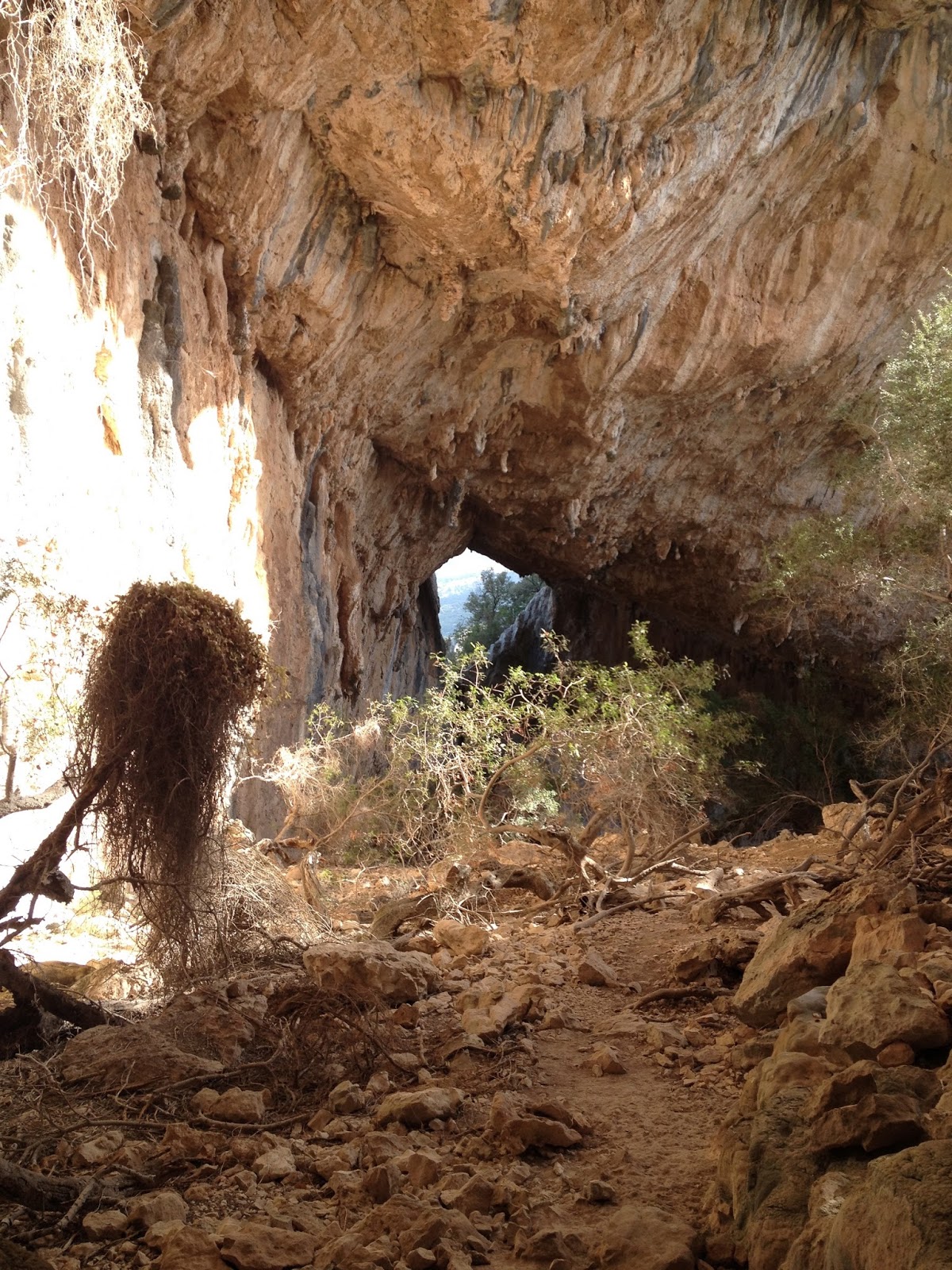
Nuraghe Mannu is one of the easiest sites to get to.  We made a very early start to climb up to another, Tiscali, before the August heat became too intense.  The ruins of this village, well-hidden in a partially collapsed mountain-top cave, a great round karstic sinkhole, date from the very end of the Nuraghic era, or maybe later, first or second century A.D./C.E. 


Tiscali
It’s thought by some to have been a place of refuge at a time when Sardinians were just managing to hold out against the Roman invaders: it’s in the wild area still named Barbagia after Cicero’s description of it as a place of barbarians, and Tiscali remains dramatically and enchantingly inaccessible.  Sadly though, thanks to its remoteness and the fact that it’s only recently been guarded, the site has been repeatedly plundered in the decades since its discovery, leaving it richer in atmosphere than artefacts.

Tiscali


I’ve rarely been anywhere so utterly silent.  Not even a cicada could be heard so early in the day.  And we had the place to ourselves, which I think always makes the mental shift required for imaginative reconstruction a little easier.  Still, I confess I struggled a little to picture the place swarming with people and animals.

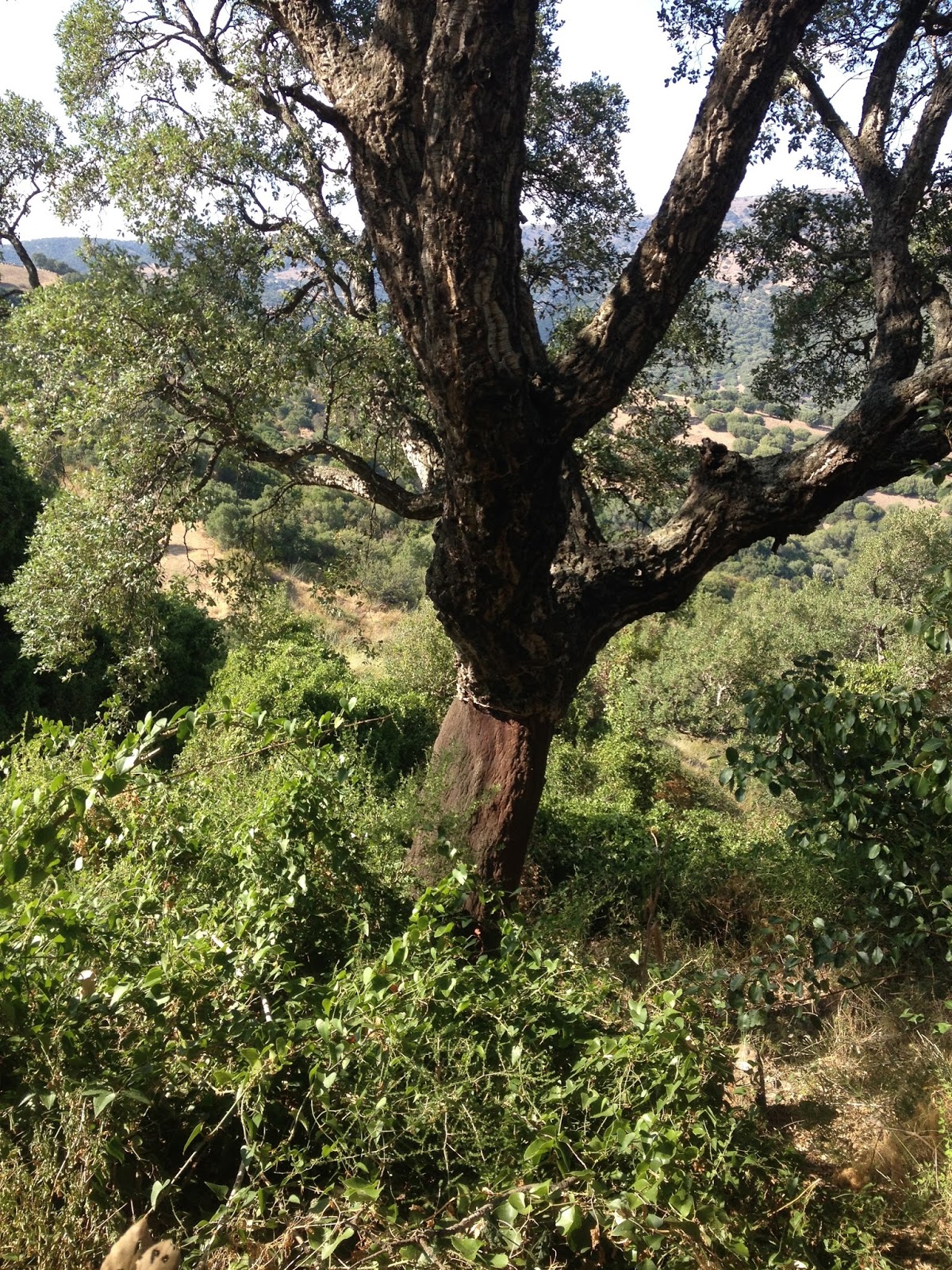
A few days previously, reaching the well temple of Su Tempiesu, still in perfect working order three and a half millennia since it was built, had involved another delightful, steep but altogether shorter walk, through cork oaks, juniper, fennel and fragrant myrtle.

Between visitors, the keeper of Su Tempiesu spends
 his spare time making shepherd's huts and cork watering hose covers

A cork oak
Before we set off, another inspiring and friendly guide showed us around the models, photographs and reproduction bronzetti in the little museum at the top, and explained in patiently slow Italian that the top of the building – originally a truncated pyramid, with twenty votive bronze swords stuck into it with molten lead - had been found in 1953 when the hillside was being terraced to grow tomatoes.  

It was immediately obvious that something 
special was buried beneath the soil as the stones they uncovered were hewn basalt, a volcanic rock which must have been brought to this schist region from at least thirty kilometres away.  The whole complex seems to have been buried by a landslide.  I could absolutely picture the excitement of this discovery, and further investigations thirty years later when the full brilliance of Su Tempiesu’s hydraulic engineering was uncovered as a third, lower pool was unearthed, complete with channels.  Much harder though was visualising the ceremonies that once took place here, and what the significance of its alignment to the equinoxes might have been.

At Nuraghe Mannu, climbing up the steps of a single tower,  
I looked down onto a dense network of low walls spreading out into the undergrowth, wondered exactly who had lived in these houses, and thought how easy I’d had it so far.  Since I started writing historical fiction, I’ve worked in periods so recent I could draw not just on written sources, published and unpublished, but photography, film, and music, never mind artifacts with obvious functions.  I’m not sure if I’ve got the right kind of imagination to take myself back three thousand years or more, to times and places where the evidence is still so sparse, so much archaeological investigation still needs to be done, and about which interpretations are constantly changing.  (In fact, I came home to find this article linking nuraghic Sardinia to Atlantis…) I’d love to know how more daring authors go about this.  I’d find it a truly dizzying prospect, but perhaps others discover a liberation in the mystery and temporal distance?


Some practical stuff if you are in Sardinia:

As you’ll have gathered, there are nuraghic remains all over the island, so you’re sure to find something near by.  Both Tiscali and Su Tempiesu are well worth going off the beaten track for.  For Su Tempiesu, drive to Orune, and you’ll easily pick up signs from the village.  Guidebooks suggest that the walk to Tiscali is much harder than it actually is, and that you might need a guide! Actually, it’s clearly signposted, once you're on the right road from Dorgali, except from the carpark at the bottom, but you just need to keep following the track down to the river bed and over the bridge and then you’ll see the first sign taking you off to the right.  There are a few steep rocky bits on the way up, but nothing very serious and it's lovely and shady a great deal of the way.  If you are reasonably fit you should manage it in 1.5 or 2 hours, allowing the same amount of time to come back down again, but do take plenty of water. And five euros to get in!  I hadn’t found this before we went, but this map could be very useful.


www.lydiasyson.com
The trail winds up to the right and then into the gap behind my head.

Saturday, 5 September 2015

Victorian Photographs and Women Reading by Joan Lennon

This is a post in two parts.

Part the first:  There is a wonderful exhibition on at the National Museum of Scotland in Edinburgh, running till the 22nd November, titled Photography: A Victorian Sensation.  I highly recommend it if you find yourself within striking distance - but beware - we were there for 1 1/2 hours and only got half way round before being politely booted out at closing time.  (I'll try to go again.)

It was dimly lit and the photographs were small in their beautiful cases, but the curators had cunningly provided electronic display thingies where you could enlarge each portrait to your heart's content.  And that was where the time went.  Being able to look closely at the faces, read the stories behind the lines and the expressions.  The majority were full face and because they had to hold their poses for so long, it wasn't possible to hide behind created persona smirks or "Everything's fine!" animation.  They were vulnerable and open.

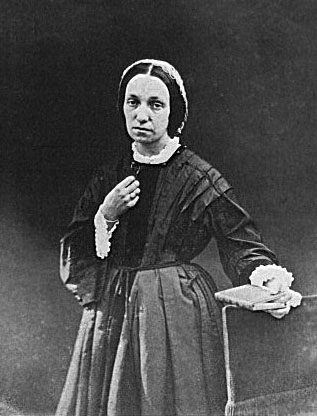
Now, a good number of the men's portraits had them with a finger in a book, but very few of the women were shown this way.  As we weren't allowed to take photographs of the photographs, I found this one of the fabulous Julia Margaret Cameron elsewhere in that pose (she is a heroine of mine and, irritatingly, in the part of the exhibition I got "encouraged" out of.  It was my own fault, of course.)


But what those images made me think of was ...

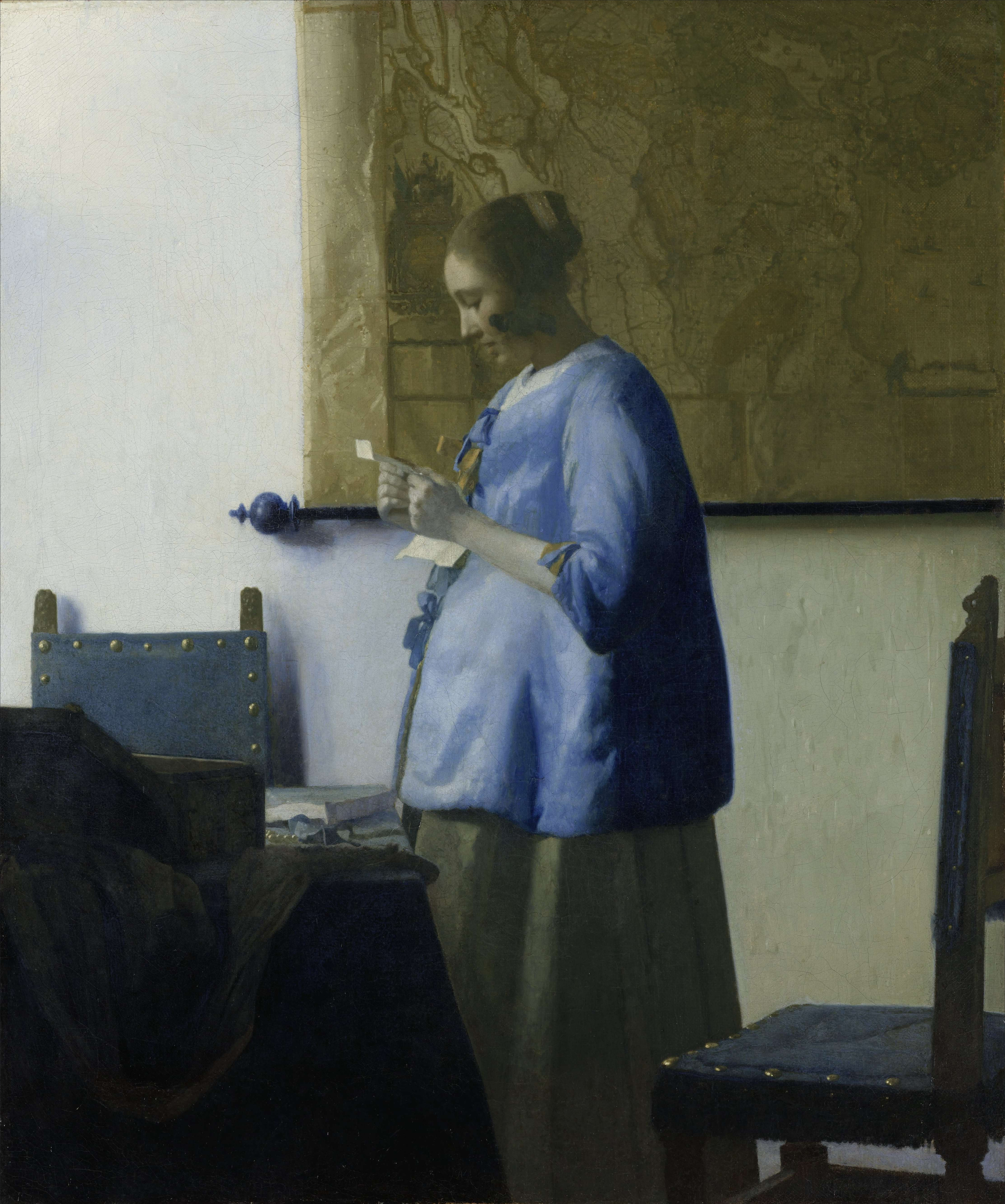
Part the second - paintings of women reading.  There is a similar stillness and lack of defence - the viewer sees the reader's face in repose, but this time without making eye contact.  You will not be surprised to learn I've never been an artist's model, but if I were, I've always thought the best pose to go for would be reading.  With all my clothes on.  This would help with the boredom and goosebumps.  And here are some that I like a lot -


Woman reading a letter by Johannes Vermeer (1632-1675)


Reading “Le Figaro” by Mary Cassatt (1844-1926)


Woman Reading by Utagawa Kuniyoshi (1798-1861)


La Lecture by George Croegaert (1848-1923)


Elisabeth Allan Fraser by Patrick Allan Fraser (1812-1890) 
(She is reading in the dining room at Hospitalfield House, just up the coast from where I live - an amazing place.) 

Do you have a favourite portrait of a woman reading?  If so, I'd love to see it - share a link to it in the comments.  Thank you!  (And go to that exhibition if you possibly can - )


Joan Lennon's website.
Joan Lennon's blog.

Thursday, 3 September 2015

A Tyranny of Petticoats, by Y S Lee

Hello, readers. I am tremendously excited to share with you the absolutely glorious cover of Jessica Spotswood's historical anthology, A Tyranny of Petticoats (Candlewick Press, March 2016). Behold!


My friend Cat taught me the phrase "on fleek", and now I just want to walk around now yelling, "It's SO ON FLEEK!"

Here's a bit more about the collection, which combines historical realist and historical fantasy stories:
From an impressive sisterhood of YA writers comes an edge-of-your-seat anthology of historical fiction and fantasy featuring a diverse array of daring heroines.

Crisscross America — on dogsleds and ships, stagecoaches and trains — from pirate ships off the coast of the Carolinas to the peace, love, and protests of 1960s Chicago. Join fifteen of today’s most talented writers of young adult literature on a thrill ride through history with American girls charting their own course. They are monsters and mediums, bodyguards and barkeeps, screenwriters and schoolteachers, heiresses and hobos. They’re making their own way in often-hostile lands, using every weapon in their arsenals, facing down murderers and marriage proposals. And they all have a story to tell.

With stories by:

J. Anderson Coats

Andrea Cremer

Y. S. Lee

Katherine Longshore

Marie Lu

Kekla Magoon

Marissa Meyer

Saundra Mitchell

Beth Revis

Caroline Richmond

Lindsay Smith

Jessica Spotswood

Robin Talley

Leslye Walton

Elizabeth Wein
My ARC arrived in the mail just this week, which means that it's time to proofread my own short story, "The Legendary Garrett Girls", one last time. As regular blog readers know, I really appreciate this last chance to check the story and catch any clangers. Mostly, though, I'm looking forward to read the other 14 short stories in the anthology. Yes, I could have read them earlier in PDF format, but - call me traditional, if you must - I still find curling up with a print book more satisfying.

I am giddy with delight to be part of this sisterhood, and I owe it all to fellow novelist and worshipper-at-the-altar-of-history Stephanie Burgis: she's the one who first suggested to editor Jessica Spotswood that I might want to be involved. THANK YOU, Steph!

This was my first time contributing to a fiction anthology and I learned so much. To begin with, the parameters were incredibly open: a story with a girl protagonist at any time in American history. Indeed, it was so liberating that I felt almost frozen with indecision - until I realized that fourteen other writers were simultaneously staking out their own historical and geographical territories. Suddenly, it felt like the start of an open-water swimming race: fast and splashy.

I've noticed that in my fiction I lean towards borders and margins, both literal and figurative. Sure enough, I first proposed something along the Great Lakes or in the Thousand Islands area - specifically, a midwinter prison escape from Ontario into New York state, over ice and open water. But Jessica suggested something less marginal and more definitively American, so I began to scan my shelves.

Several years ago, I went on a family holiday to Alaska. True to nerd form, the souvenir I brought back was a reprint of a nineteenth century memoir and travel manual, William B. Haskell's Two Years in the Klondike and Alaskan Gold Fields, 1896-1898.


I'd read bits and scraps of it in Alaska, but when I pulled it from the shelf last summer, it fell open to this quotation: "They now say there are more liars to the square inch in Alaska than any place in the world." -- The Seattle Times, August 1897. Clearly, this was fate: I was going to write a story about con artists in the Gold Rush town of Skagway, Alaska.

That story, "The Legendary Garrett Girls", is just one of the fifteen in A Tyranny of Petticoats. Gloating over the table of contents, I'm struck by how diverse our geographical choices are: not just Boston and Los Angeles, but Wyoming and Indiana; Washington, DC and Washington State. It reminds me how relatively little I know of American history.

I can't wait to change that.

---
Y S Lee is the author of the award-winning Mary Quinn Mysteries (Walker Books/Candlewick Press). She blogs every Wednesday at www.yslee.com.

Wednesday, 2 September 2015

Living in Time - Gillian Polack


I was going to write a delightful post about my favourite works of literature (a few of the many) but fate intervened. I confused my calendars and I am two weeks closer to my holiday period than I thought I was. This means that calendars are on my mind: literature can wait.

One of the earliest children’s rhymes recorded in the English language starts “Thirty days hath September, April, June and November.” From memory, this dates back to the thirteenth century. This means that it was written down then and that the manuscript it was written in has survived. It could be older, but we know it is at least as old as that manuscript. Time is a precarious concept, and measurements are parlous.

The rhyme is also deceptive. It’s tempting to think that people in the thirteenth century saw the year in the same way we do. After all, they used the same rhyme to remember the length of the month.

What tripped me up today is that my holiday season uses a different calendar. That is to say, that some of us use two and even three different types of calendars in our lives. In Australia, the Christmas and summer holidays occur at the same time. The whole nation grinds to a halt in late December. Some of us drag ourselves into the workplace in early January (except me – I was always on holiday duty when I was in a regular workplace, for I take my time off around now, instead) and everyone is back at work when the weather is still impossibly hot and the beach impossibly tempting. The UK doesn’t operate like that at all. A short coldish Christmas season and a long holiday in Australia’s winter. Australia notes Christmas as cold (we get cards with snow on and much television explaining that Christmas is a cold time) so we live with the northern hemisphere calendar alongside our own seasons and festivities. Then there is the school year and the work year and the university year and the Jewish year, the Moslem year, the Hindu year and more. So many years, all wrapped into one. 

Most people handle the complexity by focussing on the bits they need to know. We create our own small calendars to manage our personal and family years. I need to know when my holidays are. I also need to know when Christmas is, because the shops will be closed and it’s a good period to get a lot of work done.

BL Add 21114, f 1


This is far closer to the medieval reality than the strict numbering of days of the month was. Different regions celebrated different saint’s days. Those holidays could change: for instance, a brand-new one was instituted during the twelve days of Christmas just for Thomas (who was murdered in a cathedral and caused a lot of bother for many people both before and after). People kept track of their particular saints and days with Books of Hours, with all the fast days marked and all the feast days.

The fiscal year was different, and so as the regnal year. The law terms were followed by the newly-established universities. System was added to system, and people dealt. Many people would only worry about key dates. Their lives were dominated by those dates and by the seasons. Work was done according to the seasons. No electricity meant that a lot more could be done outdoors and in types of work where natural light was important than in the long summer than in the dark of winter. The dark of winter was the time for quite different activities, normally indoors and in the warmth. Seasons often played a part in whether a war dribbled to a halt or continued a few weeks longer, for it was hard to fight a series of big battles when your foot soldiers were also your peasants and needed to bring in the crops. They’re one of the many reasons for the Hundred Years’ War being so infamously waged in bits and pieces, with gaps both long and short.

My new year is coming up in a bare few days. This is exactly like the experience of many people in the Middle Ages. They had more than one new year, just as I do. There was 1 January, of course (which is my favourite new year, in modern times, if I’m honest, for I like the fireworks over Sydney), but there were celebrations of religious cycles, and of legal cycles and of financial cycles. The regnal year (which I mentioned earlier) changed with each and every king. 

Some people kept track of. Other people relied on those who did. One of my perfect medieval scholars is Bede, for he was a historian. He also pulled calendars together with calculations so that they were workable. An amazing book on the subject talks about Bede and about medieval calendars, but focuses on more recent calendars.  Elisheva Carlebach’s Palaces of Time  is a wonderful book. Whenever I start thinking “we all experience time in the same way, because we share calendars” I get the book from my shelf and remind myself of the reality. How we measure time is complex and fascinating. We have good days and bad days. There are safe moments and dangerous moments.


How we shape time is not just through calendars. It’s through seasons and personal experience and changes in light and dark. This means that each of us has a unique experience of time. I’m tempted to invent words to describe it, using the notion of idiolects, dialects and languages. Idiotime is personal, individual. It’s me and my peculiar sense of time and how I manage my different calendars and make my year function. Then there’s diatime: the time we share with a group of others. That would be the Australian calendar, with its summer overlapping with Christmas. And then there’s the broader cultural experience of time, where we share the calendar. 

This brings me back to where I began, for quite obviously the language level of time for us has to include the data that forms the rhyme “Thirty days hath September...”

Tuesday, 1 September 2015

A HIDDEN ROMAN VILLA by Ann Turnbull


At Sudeley Castle in the Cotswolds there is a small collection of Roman artefacts, among them a statue of a local deity, Apollo Cunomaglos - the Hound Lord. Most of the items are from the site of a 2nd century Roman villa on the Sudeley estate. In the 1880s Emma Dent, the chatelaine of Sudeley Castle, organised the excavation and protection of the remains of this villa. Several mosaic floors had been found, and people had begun taking away parts of them as souvenirs. Emma had the best-preserved mosaic removed to the castle and a replica made. This can be seen on the terrace at Sudeley. The Roman mosaic was then re-laid in its original place and covered with a tarpaulin to protect it; and some of the remaining walls were built up to a higher level.

Also in the Roman collection at Sudeley is a quote from Bill Bryson, who came upon the villa while out walking. He describes his wonder at finding the remains of this ancient building in a little wood, and how he sat down there and thought about the people who had come to this place and built a home there so very long ago.

It was this quote that made me want to do the walk and find the villa. Spoonley Wood is only 2km from Sudeley, but it was a hot day and the two of us took a wrong turning and had to retrace our steps, so it seemed further. There are no signposts to the villa, no mention of it anywhere.


We crossed several fields of sheep,


and two ploughed fields,


and followed hedgerows; and at last we came to the little wood.

You could easily miss the villa, even though a path leads right through it. We saw a few low walls, a few stones, a great slab that must have been a doorstep, and a mystery object that looked rather like a shallow kitchen sink.


In an open shed roofed with corrugated iron, under a cloth and weighted with stones, was the original of the floor we had seen at Sudeley. We did not uncover it all, just lifted a corner.


A stream runs nearby, and the OS map shows at least one spring near the villa. The site was quiet and peaceful, and wonderfully free of all explanation. I enjoy the "Roman experience" as much as anyone - places with videos, labels and reconstructions - but this quiet place allowed me to daydream about the villa and the lives of its inhabitants: to imagine the people who lived there going about their work; children playing by the stream; a cat sunning itself on a wall. Perhaps Apollo Cunomaglos, the Hound Lord, once had an altar in this house?


It was summer, the trees were in full leaf and the brambles were dense; they blocked our way and our view. If there was any more to see there, we didn't discover it. So we walked back, leaving the ancient house to peace and birdsong and the ripple of the stream.

Thank you, Bill Bryson. And thank you, Emma Dent.


More information and photos of the site and the mosaic floor can be seen at
http://en.wikipedia.org/wiki/Spoonley_Wood_Roman_Villa

Mary Hoffman is away