Showing posts with label Alison Morton. Show all posts

Tuesday, 19 December 2017

Io Saturnalia! by Alison Morton

Temple of Saturn, Rome (Author photo)
Rome Saturnalia was THE most important Roman festival. Heavy on feasting, fun and gifts, it was originally celebrated in Ancient Rome for only a day around 17 December (today!), but it was so popular it expanded into a week or even longer, despite Augustus' efforts to reduce it to three days, and Caligula's, to five. Like today's Christmas, this holy day (feriae publicae) had a serious origin: to honour the god of sowing, Saturn. But also like modern Christmas, it was a festival day (dies festus). After sacrifice at the temple, there was a public banquet, which Livy says was introduced in 217 BC. Afterwards, according to the poet Macrobius, the celebrants shouted 'Io, Saturnalia' at a riotous feast in the temple.

Modern mid-winter habits echo Roman conspicuous eating and drinking, and visiting friends and giving gifts, particularly of wax candles (cerei), and earthenware figurines (sigillaria). Masters served meals to their slaves who were permitted the unaccustomed luxuries of leisure and gambling. A member of the familia (family plus slaves) was appointed Saturnalicius princeps, roughly equivalent to the Lord of Misrule.

The poet Catullus describes Saturnalia as 'the best of days' while Seneca complains that the 'whole mob has let itself go in pleasures'. Pliny the Younger writes that he retired to his room while the rest of the household celebrated. Sound familiar?

Macrobius described a banquet of pagan literary celebrities in Rome which classicists date to between 383 and 430 AD. So  Saturnalia was alive and well under Christian emperors, but no longer as an official religious holiday.

But alongside ran the Dies Natalis Solis Invicti (the birthday of the 'unconquerable sun'), a festival celebrating the renewal of light and the coming of the new year and which took place on 25 December. By the middle of the fourth century AD,  the dominant Christian religion had integrated the Dies Natalis into their celebration of Christmas. So it seems that Saturnalia wasn't the official ancestor of Christmas after all. Never mind.

--------------------------

In Roma Nova, Saturnalia is celebrated in much the same way. Here's a tale straight from the Mitela household in Roma Nova...

From the journal of Carina Mitela, Roma Nova, 17 December - Saturnalia

"Thirty-six hours later, we were snowed in. The newsies were having a field day with their graphs and charts. The ploughs and tractors were out soon enough despite it being an official holiday and were attempting to keep the main city roads cleared.

Although most of the public Saturnalia celebrations were cancelled, the priests would make the usual grand sacrifice and invoke Saturn’s blessings. I pitied them today; it was a Greek rite and they’d have to shiver in sleeveless fringed tunics, with heads bare instead of a warm woollen toga snuggly folded over the head. It was a sure bet they’d turn up the heating in the Temple of Saturn and have every open brazier burning hard.

My husband, Conrad, and our youngest daughter, Tonia, sat in silence at breakfast. Our eldest, Allegra, had called first thing to say she would join us just after two when she finished her shift. She looked tired on the screen; hopefully she’d get some sleep before tomorrow. She’d been called in with the rest of the military to help ensure vital services were kept running.

‘I’ll be there, Mama, as long as there are no further disturbances in the city.’

‘What do you mean “disturbances”?’

‘Unfortunately,’ she said in the driest tone I’d ever heard her use, ‘some people seem to think the custodes concentrating on the bad weather crisis means they can help themselves to what’s in the shops. I’ve been freezing my, er, extremities off in the Macellum district all night. We came across some kids with a crowbar in front of a smashed window, pulling stuff out of an electrical goods shop. The alarm was going, but so were others. As soon as they saw us, though, they ran like the Furies were after them.’ She chuckled.

The sight of half a dozen Praetorians marching towards you with intent and attitude would make anybody run.

‘But they’ve opened the basilica for the public banquet. My oppo, Sergilia, has caught guard duty there,’ she added, making a face. The law court hall was huge and could accommodate up to a thousand. But good luck to those trying to keep order.

After checking last details with the steward for the celebration meal later, I retreated to my office for an hour to check my messages and that nobody had found my stash of gifts for the 23rd. Sigillaria was important not just for the kids who loved new toys, but when adults gave each other something to compensate for the excesses that would surely happen today.

Normally on Saturnalia morning, my cousin Helena and I would sip a glass of champagne and exchange jokes and snippets of gossip. She had more than a finger on the pulse of city life; its lifeblood ran through her. She’d also forewarn me about any particularly risqué activities the household were planning for today.

Ceding my place at the head of the Mitela tribe for a day to the princeps Saturnalicius was all well and good, but even misrule and chaos had its limit as far as I was concerned. But for a few hours, the house would be overrun with noise, people, stupid but fun dares, overeating, games, theatricals and stand-up of dubious taste, arguments, falling in lust, laughter and progressive drunkenness. Helena would make sure the children were safe out of the way when the horseplay became a little too raunchy.

By early afternoon the atrium blazed with light. Everywhere was covered in ferns, spruce and pine. In the centre was a large square table covered with linen, silverware, glasses, candles and the best china. I smelt roast pork, lemons and spices. In tune with the reversal of the day Junia, the steward, was enthroned in my usual place. Conrad handed me a glass of champagne. He was on waiter duty. His Saturnalia tunic was bright orange. He shrugged. Then grinned. Wearing over-colourful clothes was traditional, but a strain on the eyes.

‘It’s only for a day,’ he whispered.

‘I know,’ and smiled back. ‘But I wish Gil had been able to make it.’

Our thirteen-year-old son had been staying in the country with Conrad’s cousin and was caught in the atrocious weather. We’d be lucky to see him before Sigillaria. Gil loved the madness of Saturnalia. My geeky son would turn into a shiny-eyed imp of mischief, darting around, laughing and joking, pulling pranks I didn’t know he knew. Now he’d be holed up with Conrad’s serious cousin for days. I only hoped they had enough food and the electricity hadn’t been cut, like the phone.

‘Well, Tonia’s having fun.’ Conrad pointed to her skipping between people with trays of hors d’oeuvres, watched anxiously by the steward’s son, and me. I could see at least one of the trays coming to grief, contents slithering across the marble floor.

Io Saturnalia!’

I blinked at the hearty shout from the household and guests gathered around and raised my glass, then bowed towards the steward. She went to speak, but a blast of cold air and a loud thud interrupted her. All heads turned towards the atrium doors, now open. Allegra, in her military fatigues and winter parka, cheeks burning with the indoor heat, tore off her field cap and shouted, ‘Io Saturnalia’. 

Everybody shouted back, the noise filling the atrium. I hugged her to me, ignoring the cold and wet of her thick coat.

‘I’ve brought you something else, Mama,’ she whispered in my ear and nodded towards the double doors. On the threshold stood a lanky boy – pale, shivering and wide-eyed. He was enveloped in a survival blanket.

 Gil.

'I found him trudging through the city,’ Allegra said. ‘He’s walked the ten kilometres from Brancadorum to get here and –.’

But I didn’t hear the rest of what she said. I ran to the door and crushed him in my arms.

Io Saturnalia, indeed!"


Alison Morton is the author of the Roma Nova thriller series featuring modern Praetorian heroines. More at alison-morton.com 


Sunday, 19 November 2017

Roman sea-borne trading and the port of Ostia by Alison Morton

The Romans were organised, truly organised in complex ways not seen again until at least the 18th and 19th centuries. Trade was vital to Ancient Rome. The empire cost a vast sum of money to run and trade brought in much of that money. The population of the city of Rome grew to over one million and demand for more and different goods and services to build and maintain a high status lifestyle fuelled trade from further and further afield.

Roman trade routes map (ORBIS, Stanford Uni)

In addition to the 80,000 kilometres of first class roads (as at c. AD 200) built primarily for the movement of military forces, used by the imperial courier service, for government administration and lastly for trade, sea routes crossed the Empire through the Mediterranean from Spain, France and North Africa to Syria, north to Britannia and east to the Black Sea.  They supported trade between a network of coastal cities - Rome, Constantinople, Antioch, Alexandria, Carthage. These cities were serviced by a road network permitting trade within their respective hinterlands. River transport was not so widespread as the major pan-European rivers, the Rhine and the Danube, were military frontiers, not the core of the Empire.

The Romans built lighthouses, harbour complexes, docks and warehouses to further sea trade and make it secure. The Roman navy (classis) tried with varying success to keep the Mediterranean Sea safe from pirates. Although the navy was instrumental in the Roman conquest of the Mediterranean basin, it never enjoyed the prestige of the Roman legions. Romans were a primarily land-based people, and relied partially on other nationalities such as Greeks, Phoenicians and the Egyptians, to build and man their ships. Partly because of this, the navy was never wholly embraced by the Roman state, and deemed somewhat "un-Roman". Unlike modern naval forces, the Roman navy even at its height never existed as an autonomous service, but operated as an adjunct to the Roman army.

Trade was facilitated by a single official currency and no complicating customs dues. Trade developed in complexity and reach  as peace became more established and with more trade, prosperity increased. When the Empire disintegrated in the late AD 400s, overseas markets disappeared, supply and distribution routes became unsafe and trade collapsed. The Mediterranean Sea became a dangerous place for merchants as there were no powers to control the activities of pirates who marauded as far north as the English Channel.

What was acquired from where?
The Romans imported a whole variety of materials: beef, corn, glassware, iron, lead, leather, marble, olive oil, perfumes, purple dye, silk, silver, spices, timber, tin and wine. The main trading partners were in Spain, France, the Middle East and North Africa. Britain exported lead, woollen products and tin. In return, it imported from Rome wine, olive oil, pottery and papyrus.

Bireme (Creative Commons)

Ostia, Rome's port
The most important sea port was Ostia situated at the mouth of the River Tiber and only 15 miles from Rome. According to an inscription, the original castrum (military camp) of Ostia was established in the 7th century BC. However, the oldest archaeological remains so far discovered date back to only the 4th century BC when Rome fought several naval actions. The traditional birth date of the Roman navy is set at ca. 311 BC, when, after the conquest of Campania, two new officials, the duumviri navales classis ornandae reficiendaeque causa, were tasked with the maintenance of a fleet. The most ancient buildings currently visible in Ostia are from the 3rd century BC, notably the castrum. From this point on, Ostia starts to play an important role as a military harbour. When Rome installed a new naval magistracy in 267 BC, one of the officials was permanently based in Ostia. Traders and artisans settled in Ostia to make a living in and around the harbour.

Goods could be quickly moved to Rome in barges up the River Tiber after slaves had unloaded and transferred cargo from merchant ships. The Romans built the world's first dual carriageway, via Portuensis, between Rome and Ostia. In 68 BC, the town was sacked by pirates. During the sack, the port was set on fire, the consular war fleet was destroyed, and two prominent senators kidnapped. This attack caused such panic in Rome that Pompey the Great arranged for the tribune Aulus Gabinius to propose a law, the Lex Gabinia, to allow Pompey to raise an army and destroy the pirates. Within a year, the pirates had been defeated.

Development
Ostia was further developed during the first century AD under the influence of Tiberius, who ordered the building of the town's first forum. Temples, bathhouses, a theatre, shops, warehouses, construction yards, workshops, guilds became an integral part of the town.

Ostia Antica forum (author photo)

With the expansion of the physical city and the demands of the population of Rome, traffic on the river became ever more congested. Manoeuvring became impossible on the 100 metre wide river and silting exacerbated the problem. To guarantee a consistent supply of corn for Rome, the emperor Claudius started to build a new harbour (portus) in 42 AD two miles north of Ostia on the northern mouths of the Tiber.

(ostia-antica.org)

Two curving moles were built out into the sea. Between the moles, on an island formed by sinking a large merchantman, a four-storied lighthouse was built. This harbour became silted up and around about 110 AD the emperor Trajan enlarged the new harbour with a huge land-locked inner hexagonal basin still visible today. Its form was hexagonal in order to reduce the erosive forces of the waves. The harbours were connected with the Tiber by canals.

Hexagonal basin (Uni Southampton)

The new Trajanic harbour was described as 'Portus Ostiensis' and the council and magistrates of Ostia also controlled the daily life of Portus. The harbours of Ostia continued their function as a major port as can be seen by traces of the many corn warehouses. This development took business away from Ostia itself which acted principally at that time as a river port only and began its commercial decline. One can only imagine the wrangling between the established guilds, merchants and city councillors in old Ostia and the up and coming traders of the modern, specifically designed new Portus.

Ostia and Portus grew to 50,000 inhabitants in the 2nd century, reaching a peak of some 100,000 inhabitants in the 2nd and 3rd centuries AD. Portus was critically important for supplying the ever-growing city of imperial Rome with foodstuffs and materials from across the Mediterranean.  It also acted as both a point of export for supplies and products from the Tiber Valley to the north of Rome, and a major hub for the redistribution of goods from ports across the Mediterranean. It must also have acted as a major conduit for people visiting Rome from around the Mediterranean.

Roman port litho, Seewesen by Walter Muller, 1893

Ostia was to play a major part in the downfall of Rome when Alaric the Goth captured it in AD 409 knowing that this would starve Rome of much needed food. The port began to enter a period of slow decline from the late 5th century AD onwards, although it was the scene of a major struggle between Byzantine and Ostrogothic troops during the Gothic wars (AD 535-553).

Ostia Antica chandler’s floor (author photo)

Today Ostia Antica in an outstanding site for tourists and students alike and noted for the excellent preservation of its ancient buildings, magnificent frescoes and impressive mosaics (http://www.ostia-antica.org).

Portus is the centre of an exciting project led by the University of Southampton (http://www.portusproject.org/). In 2014, a new canal and town wall at Ostia was discovered. In 2016, the Portus Project launched a series of online ‘tours’ https://tour.portusproject.org/en/about  (Click the menu bars at the top right to start).

I shall be following the project with great interest…

–––––––––

Alison Morton is the author of the Roma Nova thriller series.
More at alison-morton.com


Thursday, 19 October 2017

Roman women in Late Antiquity by Alison Morton

Helena, mother of Constantine the Great 
(author photo, Naples Museum)
I set out to write about women in the late Roman period – ambitious for a blog post, but I thought I could pull some threads out of a big subject and produce a digest. Not that easy, as I discovered...

'Late Antiquity' is a vague name for the period bridging classical antiquity and the early middle ages, approximately 3rd to 6th century, but I was looking at the first half of that period, hoping to focus on the time that Roma Nova, the imaginary country portrayed in my novels, was founded AD 395. The snag? Sources for this period are patchy and often only legal codes, medical texts or written by early Christian fathers with their own agenda.

Women belonged in the private sphere during most of classical antiquity, and the Romans drew a clear line between the public and the private. Formal politics took place outside the private dwelling house; even when senators conducted political and government business in their domus, or family home, it was in the 'public' rooms separated from the  personal familia areas.

Everybody living in the domus was subject to, and the responsibility of, the paterfamilias, the 'father of the family'. In law, this authority did not extend to wives who were subject to their fathers, but in practice husbands ruled.  Women retained the right to manage and dispose of the property they brought into their marriages and enjoyed full inheritance rights on a par with their brothers.

Roman family group
(author photo, Roman National Museum)
Husbands were expected be the public face for their wives in legal cases, but women had the right to act on their own if they chose. It was only by the late fourth century that widows (not divorcees) could be the legal guardians of their children. Christian emperors were obliged to revise the law in order to reflect Christian ideals of the time (heavily influenced by the ever pragmatic Constantine, I suspect!). However, that must have been tricky with the traditionally open Roman divorce law; even at its most restrictive, it probably failed to match the orthodoxy of the new, strict Christian teaching.

Traditional Roman morality saw adultery in terms of property rights; marriage was often an economic arrangement for the pragmatic Romans with the participants often having little say in parents' decisions. The double standard of sexual behaviour remained as it always had throughout Roman times but despite Christanisation, divorce and remarriage were still relatively easy. It would change, of course. But that and differences between slave and free and between concubines and wives must have raised considerable conflict with Christian universalism.

Christianity also challenged aristocratic marriage practice by forbidding marriages between relatives and by making celibacy (and so leaving inheritances outside the family) an acceptable option. The latter, of course, gave women an opportunity for the single life which apart from becoming a Vestal hadn't been available in traditional Roman society.

Fayum mummy portrait 3rd century
Louvre, Paris
Women were expected to dress modestly, but were not veiled nor secluded. Chris Wickham in The Inheritance of Rome says there is plenty of evidence for female literacy and literary engagement not only among the aristocracy. In Egypt, women have been recorded as buying and selling property, renting out property, money-lending, operating as independent artisans and shop-owners as well as practising medicine as midwives and more broadly.

Women still could not hold public political office in this later period, but Wickham cites one female city governor, Patrikia, in Antaiopolis in Egypt in 553 AD. In Alexandria, Hypatia, as the city’s leading intellectual (mathematician, astronomer and head of the Neo-Platonic School), "appeared in public in the presence of the magistrates. Neither did she feel abashed in going to an assembly of men. For all men on account of her extraordinary dignity and virtue admired her the more" (Socrates Scholasticus).

Sadly, Hypatia was killed by a mob in Alexandria in 415 AD, caught in city-wide anger stemming from a feud between Orestes, the prefect (governor) of Alexandria and Cyril, the Christian bishop of Alexandria.

Galla Placidia
And as the Western Empire shrank, powerful empresses such as Galla Placidia were common in the fifth and sixth centuries. Daughter of Theodosius I, Regent for Emperor Valentinian III from 423 AD until his majority in 437 AD, consort to Ataulf, King of the Goths from 414 AD until his death in 415 AD, and briefly Empress Consort to Constantius III in 421 AD, she was a major force in Roman politics for most of her life.


--------------------- 

Thanks to two invaluable sources:
The Inheritance of Rome: A history of Europe from 400 to 1000 , Chris Wickham, Pengiuin 2010

Women in Late Antiquity: Pagan and Christian Lifestyles, Gillian Clark, OUP 1993   


Alison Morton's latest book in the Roma Nova thriller series, RETALIO, is available from the usual retailers as ebook or paperback.

www.alison-morton.com

Tuesday, 19 September 2017

What does ‘Roman’ mean to you? by Alison Morton

Signifer, National Roman
Legion Museum, Carleon
Traditionally, Rome was founded in 753 BC. It grew into one of the largest empires in the ancient world with roughly 20% of the world’s population and an area of 6.5 million square kilometres at its height.

 Plagued by internal instability and attacked by various migrating peoples, the western part of the empire broke up in the 5th century, giving way to the pre-mediaeval ‘Dark Ages’ of Europe. Only Italy, Dalmatia, an isolated part of northern France and parts of Mauretania remained under Roman or Roman shared rule. The last western emperor Romulus Augustulus, abdicated in AD 476, kneeling in the dirt to Odoacer, who styled himself King of Italy.

The western Roman state existed for 1229 years. Although development has moved at rocket speed in recent years, a simple comparison would be from AD 680 to AD 1909 – what a lot of history that covers!

 Popular but not always accurate, depictions include plays like Shakespeare’s Julius Caesar, Coriolanus and Anthony and Cleopatra, feature films like ‘Ben-Hur’, ‘The Fall of the Roman Empire’, ‘The Robe’, ‘Gladiator’ and series such as ‘I, Claudius’ and HBO’s ‘Rome’. Visual depictions often stay in the public’s eye more firmly than images conjured up by books. However, we have every sort of fictional account from humorous with grim undertones such as Lindsey Davis’s Falco series to gritty campaigning and power grabs by inter alia Simon Scarrow, Ben Kane and Douglas Jackson.

But over more than a millennium, what really symbolises 'Roman' for us?
Do we go back to Romulus, founder and first king of Rome 753-717 BC?

From an altar found at Ostia Antica –
The discovery of Romulus and Remus

Or do these pottery heads found on the Capitoline Hill in Rome and dating from 6th century BC tribal societies indicate the essential Romans?


Maybe the ‘great’ Marcus Furius Camillus c. 446 – 365 BC Roman general and statesman who defeated the Etruscans at Veii in 396 BC and expelled Brennus and his Gauls in 390 BC. But patrician to his core, he stoutly resisted granting the plebian representatives rights until 367 BC during a further war against the Gauls when he negotiated a compromise which united the two orders.

Triumph of Furius Camillus
Francesco Salviati (1510–1563)

Perhaps the influential Cornelia Africana, the daughter of Scipio Africanus, mother of the political reforming brothers, the Gracchi. She died at age 90 in 100 BC, and was remembered by the Romans as an exemplar of womanly virtue by saying she needed no other jewels than her children.

Cornelia, mother of the Gracchi
Angelica Kaufmann (1741-1807)

Or this soldier from the Altar of Domitius Ahenobarbus, known as the “Census frieze”, circa 122 BC?


Maybe Augustus 63 BC – AD 14, the first Roman emperor, founder of the Julio-Claudians; power grabber and great reformer. He certainly ensured his image was disseminated throughout the Roman Empire during his lifetime which has left us plenty of evidence of his existence.
The Meroë head 27-25 BC
Photo courtesy of the British Museum

Or his influential and clever wife, Livia, or staunch friend Agrippa, the builder, general and administrator?
Statue, Museum of Roman Civilisation, Rome

The Plinii, Elder and Younger, polymaths, scientists, narrators of the minutiae of Roman life?

The eruption of Vesuvius in AD 79 which has sent us so many poignant messages from Pompeii and Herculaneum into the present?
Domestic items from Pompeii, Naples Museum


Or perhaps Eurysaces, an eccentric baker, who made a fortune out of the grain trade who was introduced to us by Mary Beard?

Does Claudia Severa’s birthday dinner invitation to Lepidina testified by the Vindolanda tablets resonate with us today as we email that invitation to some friends for next Saturday night?

Or perhaps Constantine the Great AD 272 – 337, the first emperor to convert to Christianity?
Capitoline Museum, Rome

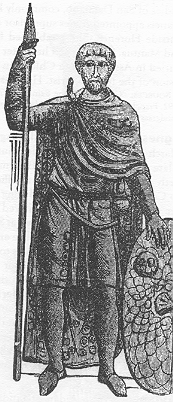
And there’s Flavius Stilichio, the half Vandal general who was magister utriusque militiae (commander-in-chief) of West Roman forces AD 395–408.
From an ivory diptych c. 395AD,Monza Cathedral
(Sometimes attributed to Aetius)

Perhaps Galla Placidia (AD 392 – 450), daughter of the Roman Emperor Theodosius I, Regent for Emperor Valentinian III from 423 until his majority in 437, and a major force in Roman politics for most of her life. She was consort to Ataulf, King of the Goths from 414 until his death in 415, and Empress consort to Constantius III from 417 until his death in 422.

Galla Placidia medallion, minted, Ravenna c.425AD
Bibliothèque Nationale de France

And near the end, Emperor Majorian AD 457-461 who was one of the last emperors to make a concerted effort to restore the Western Roman Empire. Possessing little more than Italy, Dalmatia, and some territory in northern Gaul, Majorian campaigned rigorously for three years against the Empire’s enemies.

Gold coin of Majorian in full military kit

Late Antiquity was a very different place from the days of Romulus and Remus, but people very much regarded themselves as Romans. Indeed some vestiges of Roman ruled lands such as the Domain of Soissons persisted almost until the end of the fifth century  And of course the Roman church, the systems of government, law and administration persisted for further centuries.

What does the word “Roman” conjure up for you?

-------------

Alison Morton's latest book in the Roma Nova thriller series, RETALIO, is available from the usual retailers as ebook or paperback.

www.alison-morton.com


Tuesday, 18 July 2017

Jane Austen: 200th Anniversary - Celia Rees


Portrait of Austen (c. 1810) by her sister,  Cassandra


July has been Jane month on the History Girls and today we are marking the 200th anniversary of her death by posting some of our thoughts and observations, favourite books and film adaptations, characters and quotations. 

It is only right and fitting to begin with our leader and founder, Mary Hoffman:

Favourite novel: Persuasion

Favourite character(s): Mr Knightley and Henry Tilney

Favourite scene(s): Elizabeth Bennet’s rejection of Mr Collins’ proposal and his blithe inability to accept it; Same character’s blissful put-down of Lady Catherine.

Favourite dialogue: “ You have shewn that you can dance, and you know we are not really so much brother and sister as to make it at all improper.”

“Brother and sister! no, indeed.” 

(Emma and Mr Knightley) 

Caroline Lawrence says: As a movie lover, I must share my fave film version. It’s the Joe Wright PRIDE & PREJUDICE with Keira Knightley and Matthew Macfadyen. I saw it four times in the cinema and it was my best film of 2005. The film-making was superb. Five scenes in particular: 1. When Jane arrives at the Bingley's and the door opens and we just see her sneeze. A whole chapter of exposition captured in a single moment. 2. When Elizabeth is on the swing and we see the passing of seasons as she twirls. SO clever. 3. The scene when Darcy confesses his love for Elizabeth in the rain. Women in the audience almost swooned. 4. The scene where Lizzy sees the sunlight through leaves on her closed eyelids. Unique! 5. The final scene in the summer dawn with Darcy coming through the early morning mist and their declaration of love. Bliss!

Pride and Prejudice  
Karen Maitland recommends: 

'...a brilliant new nonfiction book out called The Secret Sisterhood by Emily Midorikawa and Emma Claire Sweeney, exploring the hidden literary friendships between female authors. The first chapter is about the influential friendship between Jane Austen and the playwright, Anne Sharp, all mention of which was excluded from the first biography authorised by the family. As Jane Austin writes in Northanger Abbey - "The men think us incapable of real friendship, you know, and I am determined to show them the difference."


Not all History Girls are Janeites. Elizabeth Chadwick confides:

'I shall always remember the utter relief of the class vote not to read Mansfied Park for 'O' level. We were sent away over the summer holidays to read Austen's novel and Brighton Rock by Graham Greene and decide which of the two we wanted to study. In September, there was a unanimous show of hands for Graham Greene - and especial sighs of relief at the result from the boys in the class. People have told me that Mansfield Park is not the best Austen novel for a beginner, but I have tried others and have yet to get beyond the first couple of chapters. However, I have enjoyed the Austen effect and its inspiration in other ways...'

Elizabeth will explain more in her own post on the 24th. 

As Elizabeth reminds us, likes and dislikes regarding literature often go back to school days - when Catherine Hokin was more a Hardy girl than a Janeite. 

'When I was at school the world was very tribal: Donny Osmond or David Cassidy (the latter, of course); Manchester Utd or Liverpool (the latter of course) and, as the joys of A level English bit, Jane Austen or Thomas Hardy - you've guessed it. I was always a Hardy girl, far preferring his tortured heroines and wild landscapes to heaving bosoms in the parlour. And then I got a little older and did a bit of acting including the hilarious Emma by Doon Mackichan, which involved a fabulous frock (although not enough bosom), pretending to be an 8 year old and singing the Marseillaise very loudly (try and see it). I laughed at Clueless and couldn't avoid Colin and the lake and the pages beckoned again. I'll be honest, I'm still not the greatest fan although I do have a soft spot for Northanger Abbey and I could watch Alan Rickman in Sense and Sensibility on a permanent loop. I'm deeply irritated by Elizabeth Bennet, bored rigid by Darcy and nothing about Mansfield Park has improved since school. But, something about Miss Austen drags you back and I'm a better reader for reading her. And Pride and Prejudice gave us Bride and Prejudice - watch that on a cold rainy day with a bucket of chocolate and you'll be the biggest Austen fan in the world.'


Leslie Wilson's favourite quote is Mr Collins "resignation is never so perfect as when the blessing denied begins to lose some of its value in our estimation." 'We're meant to laugh at him, but I think Austen means us to realise we usually proceed on that basis ourselves...'

Her favourite book: Emma

Favourite adaptation hero: Mr Knightley played by Jeremy Northam. 

Favourite character: Miss Bates.

I'm with Leslie. Emma is my favourite, too. Like Elizabeth and Catherine, I was not massively keen on Jane Austen when I was at school. I went to the kind of school where we were made to read the Classics from the First Year on. I remember reading Northanger Abbey and hating it. It wasn't until I was in the Sixth Form and fostering literary pretensions that I picked up Jane Austen again. I started to read Emma and by the end of the first paragraph, I was a convert. 

"Emma Woodhouse, handsome, clever, and rich, with a comfortable home and happy disposition, seemed to unite some of the best blessings of existence; and had lived nearly twenty-one years in the world with very little to distress or vex her." With the added caveat a few lines later that "The real evils, indeed, of Emma’s situation were the power of having rather too much her own way, and a disposition to think a little too well of herself..."

The whole novel is right there.


I can't leave Emma without mentioning the fabulous 1995 movie, Clueless. A clever, witty adaptation set in 1990s L.A. full of memorable quotations and one liners and surprisingly true to the book. Kardashians with irony? As if!

As writers, we are all aware of the importance and power of that first sentence, that first paragraph. Jane Austen is the past mistress of the consummate opening. She is a novelists' novelist, a superb technician and we still have much to learn from her. 

Carolyn Hughes offers 'three snippets from a book by my friend, mentor and novelist Rebecca Smith, five-times great niece of Jane Austen and former writer-in-residence at Jane Austen’s House Museum, Chawton. The book is The Jane Austen Writers’ Club (Bloomsbury 2016), a guide for writers in which we discover Jane’s “methods, tips and tricks, from techniques of plotting and characterisation through to dialogue and suspense”.

The extracts, from the chapter ‘Plan of a novel’, draw on letters Jane wrote to her niece, Anna, critiquing her draft novels, and to her sister, Cassandra. As I myself am now in “edit mode” with my current novel, I thought these pieces of advice most pertinent!

Don’t clutter your work with unnecessary detail; cut and edit

[From letter to Anna 9th September 1814]: ‘You describe a sweet place, but your descriptions are often more minute than will be liked. You give too many particulars of right hand & left.’

Beware of overwriting and clichés

… ‘Devereux Forester’s [one of Anna’s characters] being ruined by his vanity is extremely good, but I wish you would not let him plunge into a “vortex of dissipation”. I do not object to the thing, but I cannot bear the expression; it is such thorough novel slang, and so old that I daresay Adam met with it in the first novel he opened.’ [Letter to Anna 28th September 1814]

Edit meticulously

Jane noticed [infelicities and repetitions] in whatever she was reading, joking to Cassandra…in spring 1811, ‘It gives me sincere pleasure to hear of Mrs Knight’s having a tolerable night at last, but upon this occasion I wish she had another name, for the two nights jingle very much.’


I'm off to order my copy right now!

Alison Morton reminds us that Jane Austen is one of those writers who can be read and re-read and whose books resonates differently throughout a lifetime. 

'Jane Austen was one of the first writers to capture me entirely. She made me laugh, think and learn at the same time. And reading Pride and Prejudice at 14, 34 and 54 is an entirely different experience. The first time, as a teenager you love the heroine’s story as she makes her painful way to her ‘happy ever after”, as a young married woman in your thirties, slightly wiser about the world, you find yourself nodding, tutting and able to see viewpoint of each character – a much rounder and more satisfying read. At 54 you rediscover this clever, glorious and hilarious book and devour it.

I took my son, then aged 18, to see the film with Keira Knightly (I know, but he had a crush on her!). It was a Wednesday afternoon. I forbade sweets with crackly wrappers – this was Tunbridge Wells and the audience would be packed with older people who were keen Janeites. He scoffed; the cinema would have a dozen people, maximum twenty. Well, we squeezed into practically the last two seats. He surveyed the sea of grey heads and whispered into the silence, “I must be the youngest person here.”

We watched. The photography was splendid, the adaptation pleasant, and Judi Dench suitably terrifying. I ignored the omissions and continuity gaffes. As we filed out, there was genteel chattering. In the foyer, my son, educated at one of the leading boys’ grammar school in the country, turned to me and said. “Really good. But I think I was the only person in there who didn’t know the ending.”'

I leave the last word to History Girl Àdele Geras. 

'Jane Austen's novels have been part of my life since before I was in my teens. She's my favourite novelist and the fact that she wrote so few novels means it's quite easy to read all of them. There's a famous joke told about Harold McMillan, who, when he was once asked if he read novels, answered: "Oh yes, all six, every year!"

My late husband, (Norm Geras, who died in 2013) had read EMMA for his A-levels and liked it very much. He was a slow reader and most of his life as an academic was taken up with reading other things than novels. He was also not fond of travelling but in 2007, I persuaded him to come to Florence on holiday. He took two books: the one he was reading (TRUE GRIT) which he'd almost finished, and PRIDE AND PREJUDICE on the grounds that it was short. He was also aware that it consistently topped the list of most beloved novel in the language.

Have you ever watched someone fall in love? That was what happened. He was just....knocked out. He took to carrying the book around with him all the time and you could see him mentally stroking it and looking at it and just....LOVING it. Being the sort of man he was, once he'd finished that book, he went on to all the others, in order. Then he read the criticism and the lives. Then he read the letters. He became the most ardent Janeite at the age of 64. 

He wrote about her on his blog, normblog, very often. HERE is an account of an event we went to in Ely which speaks for itself. WotN is me. Wife of the Norm. 

I still love Jane Austen best of all but now she has the additional merit of reminding me so much of Norm.'

Monday, 19 June 2017

Alternative history: It’s not just about Nazis by Alison Morton


Adaptations of The Man in the High Castle (original story by Philip K Dick, 1962) and SS-GB (Len Deighton, 1978) have been the most prominent ‘what if’s in front of the viewing public’s eyes recently. These stories have fascinated us as they depict the most horrific thing that could have happened to Western Europe and America in modern history. Robert Harris’s Fatherland (1992) gave Nazi alternative history fiction a good nudge and then along came C J Sansom’s Dominion in 2012. Perhaps the first two are a projection of fears about the Cold War, the second two a re-examination after the collapse of the Berlin Wall in 1989.

But as the Tudors are not the only historical period, so the Nazis are not the only alternative history subject. Our cousins in the US enjoy speculating about the outcomes of the War of Independence or the American Civil War, while any respectable French bookshop inevitably has a section on the ‘what if’ of Napoléon winning at Waterloo.

Alexander the Great, Naples Museum (author photo)

Alternative history is nothing new

Roman historian Livy speculated on the idea that the Romans would have eventually beaten Alexander the Great if he’d lived longer and turned west to attack them (Book IX, sections 17-19 Ab urbe condita libri (The History of Rome, Titus Livius). In 1490, Joanot Martorell  wrote Tirant lo Blanch about a knight who manages to fight off the invading Ottoman armies of Mehmet II and saves Constantinople from Islamic conquest. This was written when the Fall of Constantinople in 1453 was still a traumatic memory for Christian Europe.

What is alternative history fiction?

Althist is a speculative genre with two parents: history and science fiction. Like any genre there are conventions:
– the event that turned history from the path we know – the point of divergence (POD) – must be in the past.
– the new timeline follows a different path forever – there is no going back.
– stories should show the ramifications of the divergence and how the new reality functions.

The world of the alternative timeline can partially resemble our own or be very different. Sometimes documented historical characters appear with or without changed roles and views; sometimes the story centres on entirely fictional characters or a mixture of both. Stories such as Ken Follett’s The Key to Rebecca or Alexandre Dumas’s The Knight of Sainte-Hermine, although ‘what if’ in nature don’t result in a change of the course of history as we know it.  Noami Novik’s excellent Temeraire series where dragons fight in a Napoleonic era is, of course, historical fantasy. Time travel machines, heroines falling through temporal portals, time travellers dropping in to sort out history then popping back out, or goddesses putting everything back as it was are not included. Once the historical timeline diverges, that’s it.

In alternative history, the jumping-off point is the point of divergence from the standard timeline, so wise writers research that period to death; religion, customs, dress, food, agriculture, legal background, defence forces, cultural attitudes, everyday life of all classes and groups. Landscapes and climate should resemble the ones in the region where the imagined country lies. And no serious alternative history writer can neglect their imagined country’s social, economic and political development. Every living person is a product of their local conditions; their experience of living in a place, and struggle to make sense of it, is expressed through culture and behaviour.

Writers need to imbue their characters with a sense of living in the present, in the now. This is their current existence, for them it’s not some story in a book(!). Character-based stories are popular; readers are intrigued by what happens to individual people living in different environments as well as taking part in major historical events. Sometimes it’s more interesting to follow the person’s story than the big event itself.

Whether a historical story is fictitious or a near biographical novel, readers will engage with it and follow as long as the writer keeps their trust. If the story world doesn’t feel plausible and consistent, the reader’s trust will break. However fantastic that imagined world, it also needs to have reached the setting for the current story in a credible way, i.e. have good backstory and history of its own. But no amount of plausibility, research or attention to ‘the rules’, or sense of fun, will disguise poor writing, shallow characterisation and losing the plot.


But how plausible is alternative history?
Alternative history varies in ‘hardness’ with readers and fans grading it by how plausible the 'alternation' is when measured against historical reality. At the ‘hard’ end are well-researched pieces that take into account historical sources and trends and try to relate events that flow from the point of divergence by using historical logic. Having a grasp of how history works despite, or perhaps because of, the butterfly effect is essential. At the ‘soft’ end are works of pure fantasy and ‘Rule of Cool’, generally a result of alien space bats (more classically, the dei ex machina).

I’m very grateful to TV Tropes for dissecting and qualifying the main types so clearly on the sliding scale of alternate history plausibility, and I’ll use their categories to explain in more detail.

Type I – Hard Alternate History: These are works that stick to strict, sometimes scientific, standards in their plausibility. Research is often detailed and intensive. Most historical counter-factuals fall into this category.
Type II – Hard/Soft Alternate History: Often well researched with historical logic and methodology, but allows room for adventurous outcomes or Rule of Drama/Cool/Comedy
Type III – Soft Alternate History: Here, setting up a world that fits the writer’s creative objectives is more important than the plausibility of the setting’s alternate history. Research is often minimal to moderate and plausibility will take a back seat to Rule of Drama/Cool/Comedy.
Type IV – Utterly Implausible Alternate History: These are works that are so ‘soft’ that they melt and so implausible as to be effectively impossible. Often, the author puts their own ideology to the fore at the expense of research, historic details or sensible logistics. Readers with even a passing familiarity with history can’t take it seriously. The original term 'alien space bats' was coined to refer to this level of implausibility.
Type X – Fantastical Alternate History: In contrast with Type IV, these works are deliberately designed as pure fantasy, typically following the Rule of Cool. Mad ideas prevail such as Nazis on the moon in the 2012 film Iron Sky.

Perception is, of course, subjective and depends upon the individual reader’s personal interpretations or on whether they are looking for serious historically logical development, a lighthearted, if not positively wacky, adventure story or something in-between. I stand at the historical end of the scale because I’m a historian as well as a thriller writer.

As with all historical fiction, characters must act, think and feel like real people. The most credible ones live naturally within their world, i.e. consistently reflecting their unique environment and the prevailing social attitudes. Of course, it makes a stronger story if the permissions and constraints of their world conflict with their personal wishes and aims. But that’s what happens in all good fiction!


Some alternative history themes and stories

England has remained Catholic – Pavane, Keith Roberts or The Alteration, Kingsley Amis
Henry VIII and Anne Boleyn have a son and Elizabeth I and Philip II of Spain have a daughter – The Boleyn Trilogy/Tudor Legacy Series, Laura Anderson
Alaska rather than Israel becomes the Jewish homeland – The Yiddish Policemen’s Union, Michael Chabon
Roosevelt loses the 1940 election and right-wing Charles Lindbergh becomes US president – The Plot Against America, Philip Roth
Napoleon Bonaparte escapes from St. Helena and winds up in the United States in 1821 – Napoleon in America, Shannon Selin
Is John F. Kennedy killed by a bomb in 1963? Or does he chose not to run in 1964 after an escalated Cuban Missile Crisis led to the nuclear obliteration of Miami and Kiev? – My Real Children, Jo Walton
A secret fifth daughter of the Romanov family continues the Russian royal lineage –The Secret Daughter of the Tsar and The Tsarina’s Legacy, Jennifer Laam
An England in which James II was never deposed in the Glorious Revolution, but supporters of the House of Hanover continually agitate against the monarchy – Children’s favourite The Wolves of Willoughby Chase by Joan Aiken
A dystopian anti-female religious theocracy – The Handmaid’s Tale by Margaret Atwood
Prolific writers of althist especially from the US viewpoint include Harry Turtledove, Eric Flint and S.M. Stirling.
The Roman Empire has survived into the present day – Romanitas, Sophia McDougall

******

Alison Morton's latest alternate history thriller, RETALIO, came out in April 2017.
www.alison-morton.com  @alison_morton