Showing posts with label Athens. Show all posts

Friday, 7 November 2025

The Gifts of the Greeks: Democracy, Demosthenes and dick jokes? By L.J. Trafford

I have written four novels, three short stories and three nonfiction books about Ancient Rome. It was after completing the last of these, Ancient Rome’s Worst Emperors that I was struck by a feeling of fatigue that I had never known. I looked at my bookcase brimming with books on ancient Rome and I could not be arsed to pick a single one off the shelf and have a flick through. This is most unusual behaviour for me, generally I can’t get through a day without picking up Pliny the Elder’s Natural Histories and seeing what Pliny’s take was on whatever the hot topic of the day is (see my previous History Girls article The Curious Roman for Pliny’s views on the hottest of topics). The stark fact was I was all Romaned out.


Fate then knocked or my door or rather pinged into my inbox, it was an email from my publisher – did I know of anyone who could write the Greek version of my book Sex & Sexuality in Ancient Rome? I didn’t, but I dutifully posted it on a couple of Facebook groups for historical fiction writers. Not a nibble. Which was when a small voice from deep within me piped up, ‘you could write it.’

My outer voice supposed I could, I had studied ancient Greece alongside ancient Rome so I had a reasonable understanding of ancient Greek society and history. It might actually be fun to revisit the ancient Greeks, to dig a little deeper than I had been able to do as an undergraduate back in the days of Britpop and Alcopops. Maybe I had been wrong to turn my back on them post university and concentrate only on Romans. Here was the chance to find out….


What I found out

Two years and 88k words later what I had found out is that, yeah sorry, I do prefer writing about Romans. Chiefly this is because I get Romans, I get how they think. Not that their culture is anything like ours; it’s not but I understand what underpins those differences. Ancient Greece on the other hand is a very strange place which still mystifies me even after having spent two years immersed in its people, its history and its culture.

 
Four men at a symposium. An 18th century copy of an original Greek vase design, Wellcome Collection.


I suspect that this is because unlike ancient Rome ancient Greece isn’t one homogenous mass with a singular centre of power. Ancient Greece was made up of hundreds of city states who were governed in very different ways, ranging from totalitarian military states, absolute monarchies, oligarchies all the way down to the world’s first democracies. These city states had differing laws, variations on religious beliefs and vast differences in culture. This makes them very hard to pin down and make generalized sweeping statements about what the ancient Greeks thought or did, your average Athenian man in the 5th century BCE is going to be wildly different in his views from the average Spartan man living only 150 miles away. This causes many headaches should you have happened to volunteer yourself to write a general history book on a very general subject, sex and sexuality and what the entirely generalized ancient Greeks thought about it, Ooops.


I don’t mind admitting that Sex and Sexuality in Ancient Greece was a difficult and cumbersome write. All of which is fitting for a group of city states who between them gave us the twelve labours of Heracles, one of which involved decapitating the Hydra of Lerna. The Hydra not only had nine heads that needed detaching from her neck by Heracles but also, just to make things unnecessarily complicated, for every head slashed off by the hero, the Hydra would grow two new heads. It’s also a collection of cultures from which sprung Odysseus, a man who took ten years to travel from Troy to Ithaca despite it only being a week’s sailing maximum.

Ancient Greece and the ancient Greeks are unnecessarily complicated, tricky and take unexpected routes when you least expect it. That is their charm, their twinkle and if I should never write about them again let me leave you with something that took me completely by surprise about the ancient Greeks. Those clever men with beards who brought us democracy, philosophy, tremendous works of art and the backbone of medicine also handed to us a far greater gift, one that I believe has enriched our culture immeasurably: the knob gag.


Is that a javelin in your pocket or are you just pleased to see me?

As the person who invented the, then Twitter now X, hashtag #phallusThursday I am not new to images from antiquity of male genitalia. There are very few I haven’t seen, mainly because people still send them to me over social media with the accompanying comment. ‘I saw this and thought of you.’ I am the go-to classical penis woman, which I am fine with.
 
Phallus pillars in front of the Sanctuary of Dionysos, Delos shot by Anna Apostolidou. Wikicomms


However, until I started writing my book I was unaware that the ancient Greeks not only perfected the art of depicting individual penises in very complicated group sex scenes on pots the size of gravy jugs but also the knob gag. As a child of the 70s/80s I grew up watching Carry On films and That’s Life, a magazine style TV show that devoted a whole segment each week to vegetables that had grown into amusingly rude shapes. I had a primordial soup of an upbringing that means I am pre-programmed to enjoy a good knob gag. Ancient Greek comedy is pleasingly bursting, or rather erupting with some tremendous knob gags.

The king of the Greek knob gag is undoubtedly the legend that is Aristophanes. Should anyone be of the misconception that Greek theatre was all heavy weight tales of incestuous marriages, patricide, suicide and gouging out your own eyes (and that’s all in just the one play) I would urge them to pick up a copy of any of Aristophanes’ plays and prepare to have your mind blown and your nipples shoot across the room.

The plot of any Aristophanes play lends itself to at least a dozen decent knob gags, in Lysistrata the women of Greece stage a sex strike to try and end the Peloponnesian War which is the set up for a series of gags revolving around that classic of the knob gag, the embarrassing erection.

‘[Enter the Spartan herald. He, too, has a giant erection, which he is trying to hide under his cloak.]

Spartan Herald: Where’s the Athenian Senate and the Prytanes? I come with fresh dispatches.

Cinesias [looking at the Herald’s erection Are you a man,or some phallic monster?

Spartan Herald: I’m a herald, by the twin gods. And my good man, I come from Sparta with a proposal, arrangements for a truce.

Cinesias: If that’s the case, why do you have a spear concealed in there?

Spartan Herald: I’m not concealing anything, by god.                

Cinesias:  Then why are you turning to one side? What’s that thing there, sticking from your cloak? Has your journey made your groin inflamed?

Spartan Herald: By old Castor, this man’s insane!

Cinesias: You rogue, you’ve got a hard on!

Spartan Herald; No I don’t, I tell you. Let’s have no more nonsense.

 Cinesias: [pointing to the herald’s erection] Then what’s that?

 Spartan Herald: It’s a Spartan herald’s stick.’

 
An assumingly shaped croissant


The Assembly Women sees the women of Athens take over the running of the city (the satirical point being that women couldn’t make any more of a mess of it then the then Athenian council) and institute a law that ’decreed that if a man desires to fuck a young woman, he may do so only after he fucks an old one. Further, should this young man refuse to obey by this statute, the older woman shall be authorised to drag the aforesaid young man by his cock, without any legal ramifications to her person or property!” ‘

In Women at the Festival, Mnesilochus disguises himself as a woman to infiltrate a mass protest by the women of the city. The scene where Mnesilochus’ deceit is uncovered by the women particularly stands out. 


‘Cleisthenes: Stand up straight. What do you keep pushing that thing down for?

First Woman: peering from behind
There's no mistaking it.

Cleisthenes: also peering from behind
Where has it gone to now?

First Woman: To the front.

Cleisthenes: from in front
No.

First Woman: from behind
Ah! it's behind now.


There are perhaps a few things I should mention about Greek comedy at this point, firstly the actors were all male thus all the female characters would have been performed by men. Secondly these male actors all wore costumes, comedy costumes. The images below depict comedic actors, note that thing hanging between their legs. No, your eyes are not deceiving you, it is a costume penis. Generally made from leather these were sewn onto leotard style outfits and they served as a useful prop. Read the scenes above but this time with the floppy, leather costume phallus in your head. You can picture the physical comedy of it better now, can’t you?
 
Comic actors. Terracotta calyx-krater (mixing bowl) attributed to the Dolon Painter, Fletcher Fund 1924, Metropolitan Museum of Art, New York, USA 


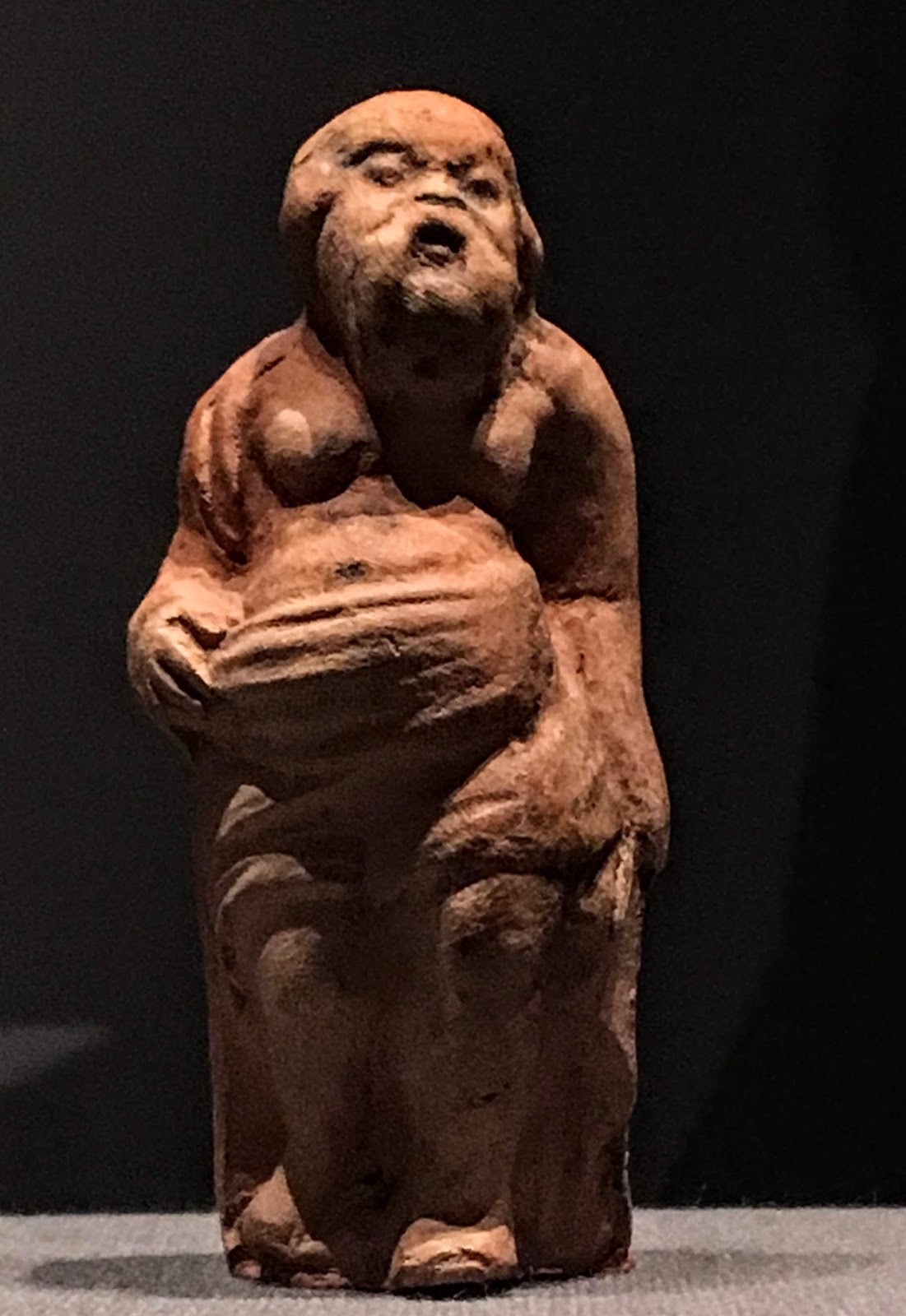
Terracotta statuette of an actor, Rogers Fund 1913, Metropolitan Museum of Art, New York, USA. 

The knob gag deserves to be included amongst all those great things ancient Greece bequeathed us. It is in the cradle of civilisation, snuggled somewhere between medicine and art, for without it our society would be very different. Would any of us want to live in a world where an amusingly phallic shaped vegetable or indeed croissant did not elicit a smile? Absolutely not.

L.J. Trafford writes books about Romans and now the Greeks! Sex and Sexuality in Ancient Greece will be published next year (probably).  You can find details of her other books here


Friday, 15 September 2023

The Caryatids: The (Ancient) History Girls by Caroline K. Mackenzie

The ascent to the Athenian Acropolis.
© Caroline K. Mackenzie.

If you have ever climbed the steep steps up to the Acropolis in Athens, you will hopefully agree that the arduous ascent is worth every breath, as you reach the stunning collection of 5th century BC temples built as a celebration of Athens’ might and power. An earlier temple housed on the Acropolis had been destroyed in 480BC when the Persians invaded Attica. The story goes that following this destruction, the Athenians swore the oath of Plataea, vowing never to rebuild the Acropolis so that it would serve as a permanent reminder of barbaric impiety. However, under Pericles, general and statesman, an ambitious building programme resulted in the magnificent monuments which still stand today; a giant pro-Athenian billboard, you may say.

Even if you haven’t visited, you might have seen the Acropolis on the news this summer. Hoards of overheated tourists, panting and sweating, were adamant that the soaring temperatures and fierce sun would not prevent their pilgrimage to the Parthenon. The Parthenon is the most famous of all the temples on the Acropolis but just to its north, in its shadow, is a temple which has long intrigued me, not least because of the statues of women in its south porch.

The Parthenon (right) and the Erechtheion (left).
© Caroline K. Mackenzie.

This temple is known as the Erechtheion and was a replacement for the old temple to Athene Polias (‘Protectress of the City’) destroyed by the Persians. The building was started in 421 BC but most of it was completed between 409 and 406 BC. It probably housed the old cult statue of Athene, but it was also a temple for the cults of Erechtheus (hence its name) and Poseidon. Erechtheus, the only semi-offspring of Athene, was an Athenian hero and all Athenians claimed to be descended from him.

The breath-taking view across Athens with the Erechtheion in the foreground.
© Caroline K. Mackenzie.

The Erechtheion was the most sacred spot on the Acropolis, and indeed in Athens as a whole. It recalled the complete history of the city. Here, according to myth, Athene and Poseidon competed with each other to become patron of the city. The location preserved the sacred proofs ('martyria') of the contest: the olive tree bestowed on the city by Athene (an olive tree still stands there today) and the marks from Poseidon’s hurled trident and the saltwater spring that sprung up after he struck the rock of the Acropolis. This competition is depicted on the west pediment of the Parthenon.

The uneven terrain on which the Erechtheion was built.
© Caroline K. Mackenzie.

The temple also housed the grave of King Kekrops, a mythical king of Athens who had the head of a man and the body of a snake. Due to the various sacred sites, as well as the uneven terrain, the architecture of the Erechtheion is unlike any other. It had to incorporate space for each deity and hero (including altars for each) and this determined the layout and size of all its rooms. It is unusual as it has an asymmetric shape and is built on different levels.

The olive tree beside the Erechtheion. 
© Caroline K. Mackenzie.

The south porch faces the Parthenon and here stand six Caryatids, statues of females acting as columns. The Caryatids are massive figures (appropriate to their function). They have clinging drapery, a feature of much Greek sculpture, known as ‘diaphanous’ drapery (or, to quote one of my former lecturers, ‘The wet T-shirt competition’ look). Professor of Classical Art and Archaeology, Sir John Boardman, describes the Caryatids as having an ‘emphatic set of hips and legs that look forward to the yet richer styles of the later century’.

The caryatid porch of the Erechtheion, on the Acropolis, Athens.
© Caroline K. Mackenzie.

‘Architects should inform themselves about history’ according to Roman architect and writer, Vitruvius, in his De Architectura (1.1.5). He goes on to say that someone might ask why an architect has replaced columns with ‘marble statues of long-robed women, which are called Caryatids’. Vitruvius explains that Caryatids are so called because during the Persian wars, the Laconian city of Caryae was one of those Greek states which sided with the Persians. After defeating the Persians, the Greek allies turned on Caryae. They murdered the men; and enslaved all the women, regardless of individual women’s social background. The architects of the time symbolised their shame by creating ‘Caryatids’: statues of the women bearing their heavy load. Thus, their punishment was to be publicised forever.

The Erechtheion in the shadow of the Parthenon.
© Caroline K. Mackenzie.

Vitruvius’ theory, however, has not always received support among scholars. Some point out that the Erechtheion is not the first building to use female figures as columns: the Siphnian Treasury at Delphi (late sixth century BC) also has them. However, this doesn’t prevent the possibility that the meaning of their use was ‘reinvented’ in the fifth century. At the time, it could have been seen as a modern twist on an old custom. Vitruvius also tells us that the Spartans built similar statues as supporting columns in their ‘Persian Stoa’ (a roofed colonnade). The statues were dressed in Persian clothing. Thus, these were architectural victory trophies as Sparta had defeated Persia at the Battle of Thermopylae in 480BC.

Another interpretation of the Caryatids is that they are carrying the baskets used in the Panathenaia and are part of the procession. The Panathenaia was a festival celebrated annually in honour of the patron goddess of Athens, Athene. Every four years the Great Panathenaia was held, a grander version of the annual festival, and included an elaborate procession. The Caryatids, therefore, could be standing in readiness to serve the goddess. During the Panathenaia, the Erechtheion was the where the procession reached its grand finale and here the peplos was presented to the olive wood statue of Athene. The peplos is a rectangular piece of clothing worn by women, folded down from the neck and belted and tied or won at the shoulder but sleeveless. The presentation of the peplos to Athene is believed to be represented on the Parthenon frieze, on the central part of the eastern side, the side from which one enters the Parthenon.

Part of the Parthenon frieze (British Museum): the gods frame the presentation of the peplos scene.
© Caroline K. Mackenzie.

The capitals of the columns placed on the heads of the women ensure the weight of the roof and its forces are directed downwards. Their dresses are peploi (Greek plural of peplos), the vertical folds of which recall the flutes of columns. Their hair is thick and plaited and rests on their shoulders and back, which cleverly provides further strength to the structural weak point of the neck. We do not know the name of the sculptor but believe they are from the workshop of Alkamenes, pupil of Pheidias. Pheidias was the artistic director of the construction of the Parthenon and also the sculptor of Athene Parthenos (‘Maiden’) on the Acropolis and of Olympian Zeus at Olympia. This chryselephantine statue of Zeus was regarded by the later Greeks as one of the seven wonders of the ancient world.

Other scholars believe that, as they stand above the grace of Kekrops, they represent mourners for this ancestral figure. If they do represent an above-ground monument for the tomb of Kekrops ('the Kekropeion') located directly below, then they were ‘choephoroi’: devotees who offered libations to the dead hero-king using the 'phialai' (shallow libation vessels) they once held in their hands, as known from ancient copies of these statues. In the building inscription for the temple, the statues are simply called ‘Korai’ (maidens). Caryatids was a name given to them in later years.

The Erechtheion was repaired shortly after 21 BC following a destruction by fire. In the 7th century AD, it was converted into a church, while under Ottoman rule (1458-1833) it hosted the harem of the Turkish commander. In 1803 the column at the northeast corner and one of the Caryatids (known as 'Kore C') were removed by Lord Elgin (of the 'Elgin Marbles' notoriety). The Museum Guide to the Acropolis Museum has something to say about this:

‘The abduction of the Kore, who was replaced by a pilaster, made such an impression on the enslaved Athenian people that they claimed thereafter they could hear the lamenting of the remaining maidens mourning the loss of their sister at night. However, this was not the end. In 1827 during the Greek struggle for liberation, the building was struck by a Turkish bomb that destroyed Kore F. The five remaining Karyatid [sic] statues (Korai A, B, D, F and F, the last having been restored from fragments, are today exhibited in the Acropolis Museum, while the sixth (Kore C) is in the British Museum.’

Ouch.

Kore C currently in the British Museum (left) and a cast of one of her 'sisters' in the Museum of Classical Archaeology in Cambridge (right).
© Caroline K. Mackenzie.

If you are wondering who the imposters are in situ on the Erechtheion today, they are simply replicas made from stone. The originals are made from the superior Pentelic marble. Versions of them can be seen as far afield as Hadrian’s Villa at Tivoli and, in terracotta, in the porch of St Pancras New Church in Euston Road, London. The Museum of Classical Archaeology in Cambridge houses a cast of one in the Acropolis Museum in Athens, removed from the temple in 1979. If you would like to get up close and personal with one of the originals, the Caryatid in the British Museum is tucked away in a rather modest location and is quite separate from the Parthenon Gallery. Whenever I have visited her, I have had her all to myself. The debate about the Parthenon sculptures and their possible return to Athens rages on and the British Museum has been in the news rather a lot recently. As to whether Kore C will be in London for much longer, who knows. I am taking some students to the British Museum later this month to introduce her to them, while I still can.

The porch of St Pancras New Church in Euston Road, London.
Photo from Wikimedia Commons.

Bibliography

Boardman, J. (1985) Greek Sculpture: The Classical Period. Thames and Hudson.

Mitropoulos, A. (2017) Morrison T., Renshaw J. and Steinhauer J. Greek Religion and Democracy and The Athenians. Bloomsbury.

Pandermalis, D., Eleftheratou S., Vlassopoulou C. (2016) Acropolis Museum Guide. Acropolis Museum Editions.

Spivey, N. (1996) Understanding Greek Sculpture: Ancient Meanings, Modern Readings. Thames and Hudson

Caroline K. Mackenzie is the author of three books and is a private tutor in Greek, Latin, and Classical Civilisation. Caroline's online Classics Club meets weekly during term-time and is currently studying Virgil's Aeneid in translation. 'Learn Latin' meets fortnightly on Zoom. 
www.carolinetutor.co.uk

Thursday, 9 May 2019

The Scent of Hemlock

hemlock in spring (Wikimedia Commons)
by Caroline Lawrence

As I write this, in May 2019, I’m working on a book set in ancient Athens. As usual, I’m seeking out as much sensory detail as possible: sight, sound, taste, touch and smell. I do that to spark synapses in the imaginative right brain, thereby bringing the book alive to young readers. But I’m also doing it for the same reason I write my books: to transport myself back in time. 

In my latest book, The Time Travel Diaries, a 12-year-old London schoolboy named Alex goes back to third century Roman London to find a blue-eyed girl with an ivory knife. She was a real girl whose grave was found not far from the site of Shakespeare’s Globe. In the sequel, which I’m working on now, Alex goes back even further to witness the death of Socrates. 


figurine of Socrates in the British Museum
Socrates was the famous fifth century BC Greek philosopher who was the first to bring philosophy down from the stars and into men’s lives. He buzzed around Athens like an annoying mosquito, challenging ancient Greeks to make sure their souls were noble. He’s the one who claimed that ‘The unexamined life is not worth living’.  Finally the politicians and the people he’d pestered decided that enough was enough. They charged him with impiety and sentenced him to death. 

And so, in early summer of the year 399 BC, seventy-year-old Socrates had to drink poison hemlock. 

Apart from a possibly spurious verse, Socrates left not a single written word. But like Jesus, who also died a martyr’s death, he was immortalised by his disciples, the most famous of whom was Plato. Plato is, of course, a giant of western philosophy. All his so-called dialogues have survived and he has been studied avidly without ever going out of fashion for two and a half thousand years. Plato taught Aristotle and Aristotle taught Alexander the Great. 

But it was Socrates who started it all. Without him, our culture would look very different.
David's famous 'Death of Socrates' (1787) Wikimedia Commons

Over the past two and a half millennia scholars have debated the accuracy of Plato’s portrayal of Socrates. For example, at the end of the dialogue called Phaedo, Plato writes vividly of Socrates’ death. He describes how Socrates bravely downed a cup full of hemlock and asked the executioner what he should do next. ‘Walk around until your legs begin to go numb, then lie down.’ Socrates duly walked around, gently rebuking a dozen or so of his friends for wailing and weeping. He reminded them that it is right to die in dignified silence. 

As the paralysis worked its way up, he lay down on his prison cot. The executioner pinched his calves and then thighs, asking if he could feel anything. As the pinches went higher, Socrates calmly said he could not feel anything. ‘When it reaches your heart,’ said the man who had given him the hemlock, ‘it will be over.’ Socrates covered his face and lay quietly. Suddenly he uncovered his face and spoke his last words to his aged best friend: ‘Crito, we owe a rooster to Asclepius; pay it and don’t forget.’ Then he covered his face again. A little later Socrates twitched and when the executioner uncovered his face they saw that he was dead. Crito gently closed his friend’s mouth and eyes. 

The death of Socrates is so calm and dignified that many commentators argued that Plato was sugar-coating the description. They claim that real hemlock poisoning would have included violent convulsions and other unpleasant symptoms. This is because over the years several different plants have received the name hemlock, including ‘water hemlock’ and a kind of fir tree. Although Plato only refers to the poison as the pharmakon (the drug) in this particular dialogue, he mentions hemlock by name in a few other places (e.g. the dialogue called Lysis) using the Greek word konion. 


In an article published in 2001 by Enid Bloch: Hemlock Poisoning and the Death of Socrates: Did Plato Tell the Truth? Bloch concludes that if konion refers to conium maculatum also known as ‘poison hemlock’, then ‘Plato not only told the truth, he did so with astounding medical accuracy.’ You can read the article online HERE. A slightly longer version of this paper was published in 2002 in The Trial and Execution of Socrates: Sources and Controversies. This version of Bloch’s article contains sixty-five footnotes, some of which describe the smell of hemlock and the bodily sensations it arouses. 

One feature of the plant that everyone from Pliny the Elder to Dioscorides has mentioned is the strong or ‘heavy’ smell. Some commentators have likened the smell of hemlock to that of mice or even cat urine. In footnote 64, Professor Bloch confesses that she has never lived with either cats or mice so she can neither confirm nor deny this observation. 


hemlock in winter (Chelsea Physic Garden)
In footnotes 12 & 63 Bloch tells how a gardener at Cornell University’s Poisonous Plants Garden showed her various types of hemlock and other toxic plants. Krissy Faust even gifted Bloch with some poison hemlock plants so she could study them in the privacy of her own home. When Bloch remarked on the gnarled appearance of the roots, Faust explained that in loose or sandy soil the roots would have grown straight down, like carrots, but ‘in the hard clay of Ithaca, New York’ the roots become bent and twisted in a way which perfectly illustrates one Greek description of the roots as koilay kai ou bathia (twisted and not deep). 

In footnote 65 Bloch relates how on several occasions she has brought hemlock into her Socrates classes. She offers students the opportunity to examine the stalks, always warning them of the possible toxic effect of merely sniffing the plant. ‘Virtually everyone’ who has a sniff reports an ‘immediate feeling of car-sickness and a mild but sharp headache’. Bloch herself describes the queasy sensation as something closer to morning-sickness than car-sickness but acknowledges that most of her students might not be familiar with that particular kind of nausea. 


Elsewhere in the article Bloch says the scent of hemlock is ‘like a very heavy, peculiar tea, clinging obnoxiously in the mouth and nose, as if it had entered the body and not let go.’ A 12-year-old Time Traveller like Alex might describe the smell as Cat Pee Tea. 

So, although Bloch believes that Socrates died peacefully and with dignity, her findings also persuade us that drinking hemlock was nonetheless very unpleasant.

Kids, don
’t try this at home! 

The Time Travel Dialogues, Caroline’s sequel to The Time Travel Diaries, will be published in 2020.

Saturday, 9 March 2019

Socrates in Love

Armand D’Angour, Oxford professor of Classical languages and expert in ancient music, has just published a book called Socrates in Love. I, Caroline Lawrence, have just finished the first draft of a kids’ book about the last days of Socrates. Therefore, I was thrilled to discover that Professor D’Angour had written about a completely different period of the philosopher’s life, one I don't believe any other authors have ever addressed: a young Socrates in love! 


Professor D’Angour kindly agreed to answer some of my questions for an interview. 


Boris Johnson reads Armand d'Angour's Olympic Ode in 2012

Caroline Lawrence: I first met you in 2012 when Boris Johnson, the Mayor of London at that time, read a new Olympic ode which you had composed in the style of Pindar. Ancient Greek is a challenging language to translate, but to actually compose an ode – and one in the style of Pindar – is mind-boggling. I am in awe of your achievements. Having come to Classical Greek fairly late, at the age of 19, I don’t think I’ll ever master it. How old were you when you began studying the language and did it immediately captivate you? 

Armand D’Angour: No one can ever fully master ancient Greek! I was lucky to start at the age of 9, having learned Latin from 7. This was in the 1960s, and though Latin only was taught at my junior school, my Latin teacher John Evans realised I had a penchant for languages and decided to teach me Greek as well on a one-to-one basis. Mr Evans was a brilliant draughtsman, and personally drew a textbook for me, the memory of which I cherish to this day. For instance, to illustrate ‘comparatives and superlatives’, he drew three chubby comic men wearing togas and holding bags of cash of different sizes, marking them with the Greek words for ‘rich’, ‘richer’, ‘richest’. I was immediately captivated both by his drawings and by the lovely Greek script.

Caroline: I’m currently trying to revive my Greek by doing a class at London’s City Lit. We’re reading Plato’s Apology and it does my head in! Are you able to open up one of Plato’s dialogues and just read it, or do you need a dictionary and commentary? 

Armand: Plato’s Greek is relatively straightforward and I can read much of it fluently, but there will always be bits that need going over slowly and with a commentary to work out the meaning and implications. Early dialogues such as Apology are far easier to read and understand than more concentrated and theoretical later works. The main texts that I can read entirely without aids and purely for pleasure in Greek are Homer’s Iliad and Odyssey, because I learned them from the age of 12.

Caroline: What sparked your desire to explore the idea of a young Socrates in love? 

Armand: The idea came to me when I was teaching Aristophanes’ comic play Clouds many years ago. The figure of Socrates is a central character, and he comes on stage sitting in a basket that is swung from a crane. I thought that might make a good start to a film about his life, and wrote a screenplay ending with his trial and death. But Socrates was already 46 at the date of Clouds; when I started to investigate what was known about his earlier life, I uncovered evidence that he was from a relatively wealthy and educated background and milieu. Initially I thought of writing a book called ‘Young Socrates’, but I needed to know what spurred him to become a philosopher rather than, say, a soldier or politician. It seemed to me that it must have involved a formative personal experience, perhaps involving a love affair. In Plato’s Symposium, Socrates says he learned the truth about love from a ‘clever woman’. After scrutinising the text closely I realised that Plato had left undoubted clues about who that woman was – a contemporary of his whom he knew as a young man. I imagined that Socrates’ trajectory might be explained if he had fallen in love with her, learned from her, and perhaps even suffered rejection at her hands.

Caroline: Socrates is described by three famous contemporaries, Plato, Xenophon and Aristophanes. How useful were these three sources and what other sources did you draw on?  

Armand: Plato and Xenophon are the crucial biographical sources, but both those authors were born when Socrates was already in his 40s so would only have known him in his 50s and later. They give a very admiring portrait of him as a thinker and moral exemplar, and say he was deeply lovable despite being ugly and fat. Aristophanes portrays a comic version of Socrates in Clouds when he was aged 46, and says nothing about his being ugly and fat, which seems an important indication that he wasn’t known for those attributes until later in life. Regarding other sources, Plato’s pupil Aristotle contradicts Plato in over a dozen details, which is important because he is only likely to have done so if he had known otherwise from what Plato says. For instance, Plato only tells us about one woman, Xanthippe, whom Socrates was with in his 60s, while Aristotle says he married Myrto and had his two older sons with her. There are numerous other minor sources, and I was particularly struck by authors who indicate that Socrates was a real, earthy, man and not a ‘secular saint’. They tell us, for instance, that he inherited rental properties from his father, and that he was lustfully bisexual from his teens onward. I see no reason to doubt their testimonies.


Caroline: You are a classical musician and also one of the pioneers in exploring what ancient Greek music would have sounded like. Do you think music was important to Socrates?

Armand: Socrates would have been surrounded by music all his life. His early instruction on the lyre was by a famous teacher called Lampros, and in his 40s he took it up again under a teacher called Konnos to try and learn something of the latest style. We know something about that style from writings and from a piece of music that survives from a play by Euripides, which I reconstructed for my earlier project on Greek music. Socrates was clearly a knowledgeable but not expert musician – one of his sayings was that the search for truth is the ‘supreme music’, and I think that metaphor tells us that he cared about music but even more about philosophy.

Caroline: Did you have any revelations while you were writing Socrates in Love, either about the man himself or fifth century Athens?   


Armand: The biggest revelation was that when Socrates in Plato’s Symposium attributes a key element of his thought to a clever woman, he is telling the truth. That woman is given a false name, Diotima, by Plato, so it has often been assumed that the claim cannot to be taken seriously. Once the woman is identified – she turns out to be Aspasia (partner of Pericles), an important intellectual figure of her day – we need to imagine a different picture. This led me to view fifth-century Athens in rather a different light from the rather static, male citizen-oriented picture we normally assume. It was abuzz with influential foreigners, women of varying status, slaves who in some cases became free and wealthy, and playful and precocious children. Those groups would have been far more important contributors to the life of the city than our written sources generally indicate.

Caroline: If a time-traveller went back to Socrates’ Athens, what would most surprise them? 

Armand: I think it would be a shock to see the illiterate agrarian peasants driving their oxen and haggling in fishmarkets juxtaposed with magnificent colourful temples and porticoes, busy lawcourts and political assemblies, platoons of hoplites on the march, and noisy dockyards loading goods and assembling superbly constructed triremes for war. Socrates’ Athens was both a big village and the centre of a sophisticated maritime empire.


figurine showing the older Socrates 
Caroline: In our Greek class we just read the bit of Apology where Socrates likens himself to a gadfly, stinging Athenians into virtuous behaviour. My classmates and I had a lively discussion about whether we would have wanted to sit next to Socrates or not. Would you have actually liked the 45-year-old Socrates or found him utterly insufferable? 

Armand: I’ve always rather got on with nerdy, intense types, so I think I might even have been an admirer of Socrates aged 45. Though I can see why others might have found him a pain.

Caroline: A friend of mine who teaches Classics at secondary school says she and her class have cast middle-aged Charles Dance as a middle-aged Socrates. If they ever made a movie of Socrates in Love, who would be your dream actor to play the role? 


Adrian Grenier (Wikimedia Commons)
Armand: I’m actually in discussions to have a movie made, but since the young Socrates and Aspasia are their 20s I’m out of touch with the field. A friend of mine suggested Bradley Cooper and Lady Gaga! Why not…But when I was trying to find someone who looked like I think the fit younger Socrates did - wide face, eyes and nose, thick lips, tousled curly hair - I came up with Adrian Grenier... What do you think?


Rami Malek (Wikimedia Commons)
Caroline: I think Adrian Grenier would be a great choice! I also think Rami Malek, this year’s Oscar-winner for Bohemian Rhapsody, might make a charismatic Socrates in Love. Thank you for answering my questions, Armand D’Angour. I can’t wait to read your book! 


Socrates in Love is out in hardback, Kindle and audio format.