Showing posts with label time travel. Show all posts

Friday, 26 January 2024

When the Old becomes New Again, by Gillian Polack


I have been saved from a post I didn’t want to write by an email on 1 January. Today, you see, is a national holiday in Australia. Australia Day embodies so many dreams and so many conflicts and so much hurt that it would be a very good subject to write about. Not this year. This year too many people hurt and I don’t want to write about people hurting. Or I could talk about the Birthday of Trees, which has just finished. Not this year, either. The Birthday of trees is a wonderful day, but it’s Jewish and it’s not that easy to be publicly Jewish in the world right now. Besides, that email changed everything. It gave me something good to write about, where no-one gets hurt. Except trees… some days I cannot win.

That email concerned a novel (Chocolate Redemption) that had been announced a few years ago. It had been delayed by COVID and by crises and by the world being generally Very Difficult. To start my year (literally, on New Year’s Day), I received the edits from the publisher and the knowledge that it’s finally emerging into daylight. I don’t know yet if the title will remain, but until the release date is announced, then I shall refer to it as Chocolate Redemption, because this is its name in my heart of hearts.

Chocolate Redemption is not just any novel. A long time ago, about the time The Middle Ages Unlocked was on its way, my readers asked me “Why don’t you write more fiction that uses your knowledge of the Middle Ages? You have a PhD in Medieval History and we like to read stories set in the Middle Ages. Write them, please.”

I wrote a time travel novel (Langue[dot]doc 1305) and my readers said, “That was great, but we need more. And it should be different to the time travel novel.”

I answered them, “Maybe one day, when I’m ready to explore the Middle Ages from a different direction.”

I had, to be honest, already started writing this novel. I was on a retreat in the Blue Mountains, at the wonderful writer’s house, Varuna. I finished Ms Cellophane, the novel I went there to write, and I began another. I wrote the first chapter there, and did a ll the research, and wrote an outline. After that, it took me a long time, because life kept getting in the way.

I hesitated to talk about it, too. It wasn’t really a proper fantasy novel. It wasn’t really fully a novel about our world, either. It broke so many genre models. I finished it, and then I put it on hold because I was worried about it. I didn’t think it worked. So I sat on it. And I sat on it. And I sat on it some more. I’m one of those writers who doesn’t always trust their own ability to carry a dream through. With this novel, which (just to be really clear) had amazing support from beta readers, I felt I had failed. So I sat on it some more.

While I sat, I refined it. I was worried about the black dye in one section. I’d included dying because of the place it was set (a town that produced much glorious fabric) but also because I wanted to make the same pun I’d made in Poison and Light. If one has a tenterfield and one is Australian, then the tenterfield needs a saddler. There are bad jokes like this in all my novels, little Easter eggs for readers who enjoy spotting them. Except that in Chocolate Redemption, the tenterfield uses the original definition and is for cloth dying. I wanted the black dye to be accurate, so I asked my textile archaeologist friend, Katrin Kania. I did this throughout the novel. I made sure that there was a basis of historical fact underlying all extrapolation and all whimsy. The invented world for the fantasy side of the novel is mostly Medieval rather than mostly invented, and even the inventions are based on extrapolations: that cloth was my reminder of how I had achieved this. I do that with all my novels. I leave reminders in of the path I travelled to get there.

Then I sat on it some more still. Along the way, I wrote a short story about dancing in a churchyard after the Great Plague, then I wrote another that was a finalist for the Sidewise Award for Alternate History, so my patient readers were not left without any of my Middle Ages. They were just missing this one novel I had written and about which I was unaccountably shy.

Really, there’s nothing scary about this novel. I should not have put in on hold for years. It’s what a novel would look like if half of it were a fantasy Middle Ages with the fantastical was grounded in our actual knowledge of the Middle Ages, rather than in the Medieval themes we often read in fantasy literature. And yet it wasn’t an historical novel at all.

I had not quite emerged from The Middle Ages Unlocked (a non-fiction guide to Medieval England I wrote with <drumroll> Katrin Kania), so my approach to the history was precise. Where else did I get my knowledge? It helps, sometimes, to work with other writers and learn from them. I was working, at that moment, with Felicity Pulman, a marvellous Australian writer of Young Adult novels. She asked me for advice on Medieval Winchester for a detective series she was writing (the Janna Mysteries), and it was that advice that led me into my own approach. The town in Chocolate Redemption is loosely based on Winchester, as me doffing my hat to Felicity. If you’ve not read her writing before, Ghost Boy is particularly clever in its emotional force and its use of history.

Eventually I got over myself and Odyssey accepted the novel and then COVID hit and life went awry again. On January 1 this year I read the edits. Odyssey’s editor was ecstatic about the story and the characters and especially one particular love scene and… I felt very stupid about my lack of confidence.

The novel is about women’s lives. Small lives. Lives that the rest of the world fails to see properly. I love the richness of women’s lives. It was a lot of fun to write about an apothecary in a Medieval town and her Jewish best friend and her love and all her professional concerns, and her kitten, and floods and fury and all the stuff a town goes through in a year.

The Medieval section is about the lives of younger women. Old enough to be independent, but young enough to have big decisions in their immediate future. The Katoomba (modern Australian) section is about an older woman, whose daughter is in the middle of the big decisions and whose life has reached a quietly impossible point.

The novel includes chocolate, and it’s about mapping our streets and our lives.  

For me, it’s a bit of an oddity. It falls between genres. Lives of women do this, all the time. The mapping others do of our lives doesn’t actually match with the way we live. That’s the heart of the story.

I’ll put out an announcement on social media when Odyssey settles the release dates. In the meantime, if anyone wants to be included on the review copy list, send me a note and I’ll forward it to my publisher. Because Odyssey (the publisher) is in New Zealand review copies will be ebooks only. New Zealand is a long way from anywhere other than Australia and islands in the very south Pacific. Postage costs and time for the post to reach far-distant places are other aspects of those small lives I so enjoy writing about.

In the meantime, my January gift to myself is finally being able to talk openly about Chocolate Redemption. Bringing it out of hiding was a difficult thing. Watching others read it and form opinions is going to be exciting, but even more difficult. I shall buttress the emotions with chocolate.

Thursday, 9 May 2019

The Scent of Hemlock

hemlock in spring (Wikimedia Commons)
by Caroline Lawrence

As I write this, in May 2019, I’m working on a book set in ancient Athens. As usual, I’m seeking out as much sensory detail as possible: sight, sound, taste, touch and smell. I do that to spark synapses in the imaginative right brain, thereby bringing the book alive to young readers. But I’m also doing it for the same reason I write my books: to transport myself back in time. 

In my latest book, The Time Travel Diaries, a 12-year-old London schoolboy named Alex goes back to third century Roman London to find a blue-eyed girl with an ivory knife. She was a real girl whose grave was found not far from the site of Shakespeare’s Globe. In the sequel, which I’m working on now, Alex goes back even further to witness the death of Socrates. 


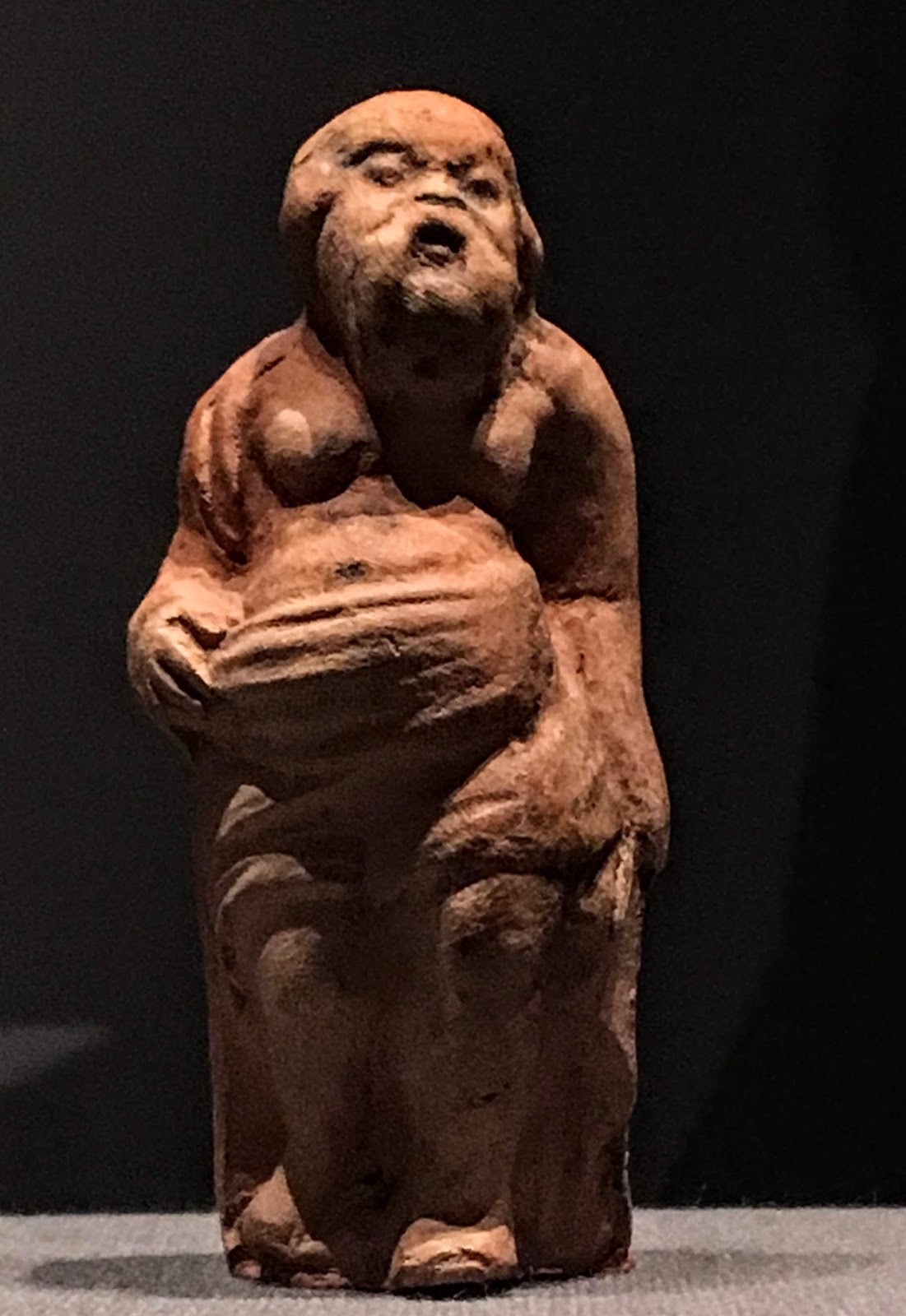
figurine of Socrates in the British Museum
Socrates was the famous fifth century BC Greek philosopher who was the first to bring philosophy down from the stars and into men’s lives. He buzzed around Athens like an annoying mosquito, challenging ancient Greeks to make sure their souls were noble. He’s the one who claimed that ‘The unexamined life is not worth living’.  Finally the politicians and the people he’d pestered decided that enough was enough. They charged him with impiety and sentenced him to death. 

And so, in early summer of the year 399 BC, seventy-year-old Socrates had to drink poison hemlock. 

Apart from a possibly spurious verse, Socrates left not a single written word. But like Jesus, who also died a martyr’s death, he was immortalised by his disciples, the most famous of whom was Plato. Plato is, of course, a giant of western philosophy. All his so-called dialogues have survived and he has been studied avidly without ever going out of fashion for two and a half thousand years. Plato taught Aristotle and Aristotle taught Alexander the Great. 

But it was Socrates who started it all. Without him, our culture would look very different.
David's famous 'Death of Socrates' (1787) Wikimedia Commons

Over the past two and a half millennia scholars have debated the accuracy of Plato’s portrayal of Socrates. For example, at the end of the dialogue called Phaedo, Plato writes vividly of Socrates’ death. He describes how Socrates bravely downed a cup full of hemlock and asked the executioner what he should do next. ‘Walk around until your legs begin to go numb, then lie down.’ Socrates duly walked around, gently rebuking a dozen or so of his friends for wailing and weeping. He reminded them that it is right to die in dignified silence. 

As the paralysis worked its way up, he lay down on his prison cot. The executioner pinched his calves and then thighs, asking if he could feel anything. As the pinches went higher, Socrates calmly said he could not feel anything. ‘When it reaches your heart,’ said the man who had given him the hemlock, ‘it will be over.’ Socrates covered his face and lay quietly. Suddenly he uncovered his face and spoke his last words to his aged best friend: ‘Crito, we owe a rooster to Asclepius; pay it and don’t forget.’ Then he covered his face again. A little later Socrates twitched and when the executioner uncovered his face they saw that he was dead. Crito gently closed his friend’s mouth and eyes. 

The death of Socrates is so calm and dignified that many commentators argued that Plato was sugar-coating the description. They claim that real hemlock poisoning would have included violent convulsions and other unpleasant symptoms. This is because over the years several different plants have received the name hemlock, including ‘water hemlock’ and a kind of fir tree. Although Plato only refers to the poison as the pharmakon (the drug) in this particular dialogue, he mentions hemlock by name in a few other places (e.g. the dialogue called Lysis) using the Greek word konion. 


In an article published in 2001 by Enid Bloch: Hemlock Poisoning and the Death of Socrates: Did Plato Tell the Truth? Bloch concludes that if konion refers to conium maculatum also known as ‘poison hemlock’, then ‘Plato not only told the truth, he did so with astounding medical accuracy.’ You can read the article online HERE. A slightly longer version of this paper was published in 2002 in The Trial and Execution of Socrates: Sources and Controversies. This version of Bloch’s article contains sixty-five footnotes, some of which describe the smell of hemlock and the bodily sensations it arouses. 

One feature of the plant that everyone from Pliny the Elder to Dioscorides has mentioned is the strong or ‘heavy’ smell. Some commentators have likened the smell of hemlock to that of mice or even cat urine. In footnote 64, Professor Bloch confesses that she has never lived with either cats or mice so she can neither confirm nor deny this observation. 


hemlock in winter (Chelsea Physic Garden)
In footnotes 12 & 63 Bloch tells how a gardener at Cornell University’s Poisonous Plants Garden showed her various types of hemlock and other toxic plants. Krissy Faust even gifted Bloch with some poison hemlock plants so she could study them in the privacy of her own home. When Bloch remarked on the gnarled appearance of the roots, Faust explained that in loose or sandy soil the roots would have grown straight down, like carrots, but ‘in the hard clay of Ithaca, New York’ the roots become bent and twisted in a way which perfectly illustrates one Greek description of the roots as koilay kai ou bathia (twisted and not deep). 

In footnote 65 Bloch relates how on several occasions she has brought hemlock into her Socrates classes. She offers students the opportunity to examine the stalks, always warning them of the possible toxic effect of merely sniffing the plant. ‘Virtually everyone’ who has a sniff reports an ‘immediate feeling of car-sickness and a mild but sharp headache’. Bloch herself describes the queasy sensation as something closer to morning-sickness than car-sickness but acknowledges that most of her students might not be familiar with that particular kind of nausea. 


Elsewhere in the article Bloch says the scent of hemlock is ‘like a very heavy, peculiar tea, clinging obnoxiously in the mouth and nose, as if it had entered the body and not let go.’ A 12-year-old Time Traveller like Alex might describe the smell as Cat Pee Tea. 

So, although Bloch believes that Socrates died peacefully and with dignity, her findings also persuade us that drinking hemlock was nonetheless very unpleasant.

Kids, don
’t try this at home! 

The Time Travel Dialogues, Caroline’s sequel to The Time Travel Diaries, will be published in 2020.

Saturday, 9 February 2019

Ways to Die in Londinium

by Caroline Lawrence

When I went back in time to look for the blue-eyed girl with the ivory knife, I never thought I would actually find her. The only reason I took the job was for the money. 

So starts my new book, in which a 12-year-old London schoolboy named Alex Papas is recruited to go back in time to Roman London to find a girl who lived in the mid-third-century AD. 

Why did I decide to leave my usual literary stamping grounds of the sunny Mediterranean and set some books in Roman Britain, specifically London? 


Because whereas Roman Britain used to be dull and dry – on account of very few written sources – the past decade or so has given us some superb material to work with. Recently, more than 14,000 individual artefacts were recovered in the restoration of the Mithraeum to its original site under Bloomberg LP’s new European headquarters. 

Also, scientific advances in DNA and stable isotopes means that archaeologists such as Dr Rebecca Redfern can study a skeleton and determine eye and hair colour, maternal place of origin and even where the subject grew up. 


In 2003, the grave of a 14-year-old girl was found on Lant Street near Borough tube station in Southwark, about half a mile south of the Tate Modern. Her grave goods suggested she was a rich girl. They included two small glass bottles and a clasp knife on a chain. 

The exotic ivory handle of the knife was carved in the shape of a leopard. Despite these rich objects, close study of her bones showed that the girl suffered from rickets, a disease often associated with malnutrition. Her teeth were very bad, too, and suggest that she was either a slave or grew up under hard conditions. Her skeleton is actually on display during free interactive sessions called Written in Bone for kids in Key Stage 2, i.e. aged 8-11. 


The so-called Lant Street Teen came into the headlines recently when her DNA and stable isotopes were analysed. They showed that she grew up in the Southern Mediterranean – possibly even North Africa! – and that she had blue eyes. Even more astonishing, archaeologists can tell that at the age of about nine she made the long and arduous journey to Britannia. Sadly, she died about five years later and was buried with her grave goods on an expensive bed of white chalk. 

I was intrigued by this discovery and thought it would be fun to imagine a scenario that might bring the blue-eyed girl from North Africa to Britannia and explain all the fascinating aspects of her bones. 


Around the same time, I attended the re-opening of London Mithraeum with its well-researched display of artefacts and spooky immersive experience. It occurred to me that it would be the perfect place for a time portal to the third century AD. That was when I decided to write my first timeslip book. 

In the book, originally called Ways to Die in Londinium, my main character Alex has been chosen to go back to Roman London for several reasons. First, he is small for his age and probably won’t hit puberty for a while. Why is this important? One of my contrivances is that for every hour you spend in the past, it takes a year off your life expectancy… unless you are a kid, in which case you only lose a month per hour. That’s why bazillionaire Solomon Daisy hires Alex to go back and find out more about the so-called Lant Street Teen. 

Second, Alex does Latin club at school and therefore knows some basic Latin phrases. 

Third, Alex speaks modern Greek, close enough to Ancient Greek to be just about understood. And Greek was a lingua franca at that time. 

I have a few other contrivances to make the book fun and exciting. For example, the three rules of Time Travel are:  

1. Naked you go and naked you must return. 
2. Drink, don't eat. 
3. As little interaction as possible.


Alex is clever and resourceful. He memorises a map of third-century Roman London and learns several useful Latin phrases such as puellam oculis caeruleis quaero et cultro eburneo (I seek a blue-eyed girl with an ivory knife.) 

Alex prepares in other ways, too. In the back pocket of his jeans, he has a small notebook. One of the page entries reads:

Ways to Die in Londinium:
1. Death by illness (no antibiotics)
2. Death by infected cut (no antiseptic cream)
3. Death by chariot (hit and run)
4. Death by starvation 
5. Death by choking (no Heimlich manoeuvre)
6. Death by fire (or inhaling smoke)
7. Death by rabid animal bite
8. Death by mugger
9. Death by rampaging gladiator

As Alex learns more about the perils of time travel he adds:

10. Death by misunderstood gesture
11. Death by transporting into something solid

And eventually:

12. Death by Angry Priest of Mithras
13. Death by Thames Foreshore Mud

That's only the beginning!  


As a student of history, I am constantly reminded of how blessed we are to live in a time of prosperity, leisure and superb medical care, especially compared to almost any previous historical period. 

On Wednesday 20 February and Friday 22 of the same month from 1-2pm, I’ll be doing two family-friendly interactive talks called Ways to Die in Londinium. 

I will ask kids to come up with some ways that a Roman Londoner might die. 

I will then show them some real and ancient (replica) artefacts and ask which would have been most valuable to an ancient Roman Londoner. 

I might also ask if they can guess which one of the following would have been worth its weight in gold?

Tomato
Chocolate bar
Alarm clock
Glasses
Mobile phone
Savlon
Puppy Soft Andrex 


Finally, I will read some passages from the first Time Travels Diary. 

I want to remind myself (and kids) just how privileged we are to be living today. 


Caroline's two halfterm events at the Museum of London are now sold out but there are other fun Roman-themed events including Styx, Stones and Roman Bones! 

Tuesday, 9 October 2018

Writing Londinium with the Seven Senses

Trying a garland made by Patty Baker (Kent)
by Caroline Lawrence

[This is a shortened and edited amalgam of two papers I gave in early-October 2018, one for the University of Kent and one for a conference called Sensory Experience in Rome's Northern Provinces hosted by the Roman Society at Senate House in London. Go to #SERNP2018 to see lots more about this]

Archaeologist Lindsay Allason-Jones, a visiting fellow at Newcastle University recently said, ‘It wasn’t until I wrote a book from the point of view of a Romano-British woman that I started to think about things like where did she keep her house key?’  


This is what I have discovered. As I write characters who have adventures in the ancient world, I have to imagine them moving through space with the sights, sounds, smells, and all other sensory experiences in order make it seem real to my young readers. This is especially important for children who need to be grounded in a sensory world. 

Here is how I used the seven senses to portray Roman Britain in my most recent series of books for kids, the Roman Quests, and also in my new work-in-progress The Girl with the Ivory Knife, in which a 12-year-old London schoolboy travels back in time to 3rd century Londinium (Roman London). 

SIGHT is the first of the five senses. For my Roman Quests I wanted to get an overview of what Roman London would have looked like. 
Model of London's port at Museum of London Barbican 
• Ruins aren’t so helpful to me… I need more
• Museums are useful, with their statues, inscriptions and artefacts. The Museum of London and it’s archaeology department MOLA gave me tons of material. 
• Models are very special. Storytellers know the power of the miniature.  
• Interactive maps like the one produced by MOLA are super.
superb Bath Roman Baths
• 3D computer walk-throughs on YouTube are too clean but often introduce light effects. 
• Google maps and Google Earth help me get a birds’ eye view of the terrain or walk along a road from Chester to Leicester, for example. 
• Alan Sorrell’s marvellous paintings and drawings. See my blog about him HERE. 
• Visiting sites like Butser Ancient Farm, Bath Roman Baths & Fishbourne provide 3D spatial and sensory experiences especially when they are peopled by re-enactors. 
Hard to Be a God (2013)
• Re-enactment events provide an abundance of unexpected revelations especially when they are performed by those who are passionate about getting details right. I particularly admire the members of Britannia, the Ermine Street Guard and Leg II Augusta. 
• Watching movies. For my book set in Roman London, a place you would NOT want to visit, I watched Hard to Be a God (2013), like Fellini Satyricon only with more mud, excrement and chickens. 
• Film sets can give you inspiration, too. 

London’s Mithraeum hadn’t reopened when I was writing the Roman Quests and besides, those books are set in the late first century. But I could use the Mithraeum for my new work in progress about the boy travelling back in time.

For my Time Travel book, I tried to think of things we don’t see today that would have been commonplace then. 
• A sky full of stars
• Crucified man on a cross
• People in rags and barefoot
• Indoor darkness – a world with no electricity
• Someone carrying a torch, a very symbolic object
• Someone with a staff (Main purpose? To beat off dogs!)
• The different stages of animal sacrifice
• A mind-boggling array of diseases & deformities
• Especially eye infections, skin disorders and toothache

For the first time I could relate ancient objects to modern ones. E.g.
• A tunic could be described as a big T-shirt and a toga as a blanket
• Mithras’ Persian cap is like a Smurf hat
• A Mithraeum initiation could be described as a flight simulator 
• And the seven grades as ascending levels of a video game...


Sophie Jackson on what smells to put in the Mithraeum
SMELL is one of the most evocative senses, and one of the hardest to convey in words. Giacomo Savani, one of the organisers of the conference, started with a quote from Rosemary Sutcliffe in which she speaks of the ‘blue reek of wood-smoke’. Evidence hints that my time travelling boy Alex might have  smelled burning pine cones in London’s Mithraeum, which he will use as the site of a portable portal to third century Londinium. However, Sophie Jackson (above), one of the key archaeologists involved in recreating the Mithraeum Experience, said the smell of men, cooked chicken and damp might have drowned out any pine freshness! 

A Saturnalia dinner with Stephen Cockings
Other scents from Roman London:

• To Alex, a girl smells like apple pie (clove oil for her aching teeth) and church (frankincense perfume)
• Someone’s breath smells of garlic
• Alex gets headache from breathing oil lamp smoke 
• He also smells the peaty smell of outdoor braziers
• And the roast pork smell of body being cremated 
• With an undercurrent of incense burned against demons


Smelly and Tasteable things
TASTE is one of the easiest of the senses to tap into.
• Posca, water with a splash of vinegar, was often drunk by soldiers.
• I make mine with red wine vinegar but you could use white, too.
(Adding even a little wine or vinegar to water kills bacteria. The Romans didn’t know about bacteria, germs or viruses but somehow they knew adding vinegar to water was good.)
• Honey was a hot food, prescribed for those of a phlegmatic humour. 
• Olives, especially the little bitter black ones are ‘a taste as old as cold water…’ (Lawrence Durrell in Prospero’s Cell)
ELMA mastic gum from Chios
• How did they serve a hot sausage in Roman London? Probably with a cabbage leaf wrapper. A clever idea I got from a fast food stall at a Reenactment event.
• Mastic gum. One of the sniffable objects at the Museum of London’s Roman Dead exhibition (on until 28 October) is something called mastic. I first discovered mastic while reading the first century AD epigrams of Martial. He talks about a man who picks his teeth with a mastic toothpick. But it was mainly used as gum to be chewed to freshen the breath. In fact, we get the word ‘masticate’ from mastic. Read more HERE.

SOUND is harder to replicate than taste in my opinion, especially music. Armand D’Angour has been doing fun experiments into ancient Greek music and I often listen to Indian music to try to get an idea of how exotic Roman music might have sounded. We do know about other sounds, such as: 
interactive sound at Museum of London Docklands
• The crowing of a rooster or cluck of chickens in the street
• Dogs barking in the night 
• The wailing of bereaved, more common and more audible then? 
• The shouts of peddlers, bread sellers, a rag-and-bone woman...
• Tepidarium echoes with the sound of slaps and grunts of masseuse
• Blacksmiths hammering
• Door hinges squeaking
• Bells and rattles to frighten off demons and cover unholy sounds

TOUCH can be experienced not just with fingertips and lips, but also with our bare feet. Here are just a few a time traveller might have encountered in Londinium. 

interactive touch at Museum of London Docklands
• Wet grass against bare legs in a tunic
• Bare Feet on a muddy, gravel-studded road
• Or on a mosaic floor or on London brick
• Glutinous mud of the south bank foreshore
• Warmth of a kiln and hard-baked earth around it
• A piglet snuffling at someone’s armpit
• Itchy mosquito bites on bare legs
• Stepping in squishy, still-warm manure
• loom-woven linen & woollen belt pouch
• Carbantinae (one-piece leather shoes) rub top of feet
(The Roman Dead also has a display where you can touch a replica hobnail boot, top and bottom.)

KINESTHETIC means the awareness of the position and movement of the body. Many of the objects I’ve been talking about are interactive. You have to engage with them in a kinesthetic way. 
Richard and Caroline Lawrence in Nimes
• Wearing the clothes including hobnail shoes on the cobbled streets of a Roman town like Nimes.
• Playing with an oil-lamp or a pigskin lamp
• A Saturnalia Dinner
• Leather bikini bottoms as worn by girl acrobats
• NO Bogus Roman Handshake
• NOT using a sponge stick
• Trying out a wax-tablet
• Using a strigil and oil


Tom, Giacomo and Patty try out a strigil and scented oil
At the Sensory Archaeology Conference, co-presenter Tom Derrick brought homemade oil-based Roman perfume. To demonstrate the difference of smell in the bottle and on the skin he borrowed my replica strigil to let people rub his scented olive-oil on their arms and then scrape it off. One conference member, Mr. Colin Gough, observed, One thing that surprised me was the amount of oil left after a good strigiling (is that even a word?). Unless the Romans were a lot better at it there must’ve been a lot of sticky people leaving the baths plus the oil slick on the water! 

THE SIXTH SENSE is the final sense I want to think about. 


A double flame lamp at a Saturnalia dinner
Have you ever meditated about your site, your text, your historical character, your artefacts, your bones? By meditation I mean a contemplation of your world, characters, etc using your non-verbal visual imagination. It's like a virtual reality game but with added sounds, smells and things you would feel? If you meditate, try it. If you find meditation hard, try writing a fictional piece about your subject. Maybe not the main subject but something peripheral. Someone or something on the edges of your topic. You can even do a poem or haiku. 

At the moment I’m involved in a marvellous project based around the archaeology of the House of Amarantus in Pompeii. I had the idea to write a scene from the point of view of a sixteen-year-old slave girl who has recently arrived in Pompeii from Britannia. She sleeps on a mat in the doorway of her mistress’s bedroom. My idea of showing not telling the kids about the layout of the house is that she wakes up one night in pitch black and has to grope her way to the loo. 

So close your eyes for a moment and imagine waking up in the peristyle walkway of a fairly posh Roman house. Think of five different things your fingers might encounter as you push yourself to your feet and start to grope your way along the corridor. Think of five different things you might hear. Think of five different things you might smell. Where do you have to avoid evil spirits in the house? Think of five different ways your body is reacting to this night-time grope. 


Whether we are scholars, writers, historians, teachers or all of the above, let us study the past not just with our heads but with our hearts and with all the senses.

My Roman Quests are perfect for kids studying the topic of Romans in Key Stage 2. My first time travel book, The Girl with the Ivory Knife, is out early April 2019. It is based on real bones and sites from Roman London. 

Thursday, 14 September 2017

‘Algernon and Ernest’s Excellent Adventure’ by Lesley Downer

In October 1866 a young man called Algernon Mitford arrived in Japan. ‘I found myself in a world younger by six centuries than that which I had left behind,’ he recalled. Like the eponymous heroes of the 1989 film ‘Bill and Ted’s Excellent Adventure’, he had stepped into a time machine, but in his case, his experiences were real.

The extraordinary world that Mitford found himself in is the setting for The Shogun’s Queen as well as the other Shogun Quartet novels. One of the most exciting parts of my research was reading Mitford’s Memories. His writing is so vivid, fresh and full of life that he brings alive that Japan of a century and a half ago that was even then on the brink of disappearing.
Algernon Freeman Mitford
portrait by 
Samuel Lawrence, 1865

Japan had been largely closed to outsiders for 250 years, until 1853 when the American Commodore Matthew Perry arrived to force open its doors. Just eight years had passed since 1858 when a treaty was negotiated permitting westerners to visit, trade and settle in a few specific ports.
Ernest Satow 1869


Algernon - the grandfather of the famous Mitford sisters - was 29 years old and had been posted to Japan to join the newly established British Legation under Sir Harry Parkes. He had paid his own way. In those days you had to have private means to be a diplomat.

Another of the officials at the legation was the 23 year old Ernest Satow, from Clapton. He’d arrived in Japan in 1862 and was fluent in written and spoken Japanese. The two became firm friends. Satow, too, later wrote his memoirs, a gripping account entitled A Diplomat in Japan.

At the time there were few westerners in Japan and most were confined to the heaving port of Yokohama. In those days Yokohama was like a wild west gold rush town, populated largely by unscrupulous adventurers who’d gravitated there, pretending to be merchants or traders, out to make a quick buck by fair means or foul. The only westerners allowed to live and travel outside the port were diplomats attached to the legation - like Mitford and Satow.

'younger by six centuries' pic from Rutherford Alcock
The Capital of the Tykoon 1863
After several of their small wooden houses had burnt down in the regular fires that took place, the two set up house in Edo, now Tokyo, in a little temple in Shinagawa, near the Legation, in the south east of the city, as far as possible from Edo Castle where the shogun lived. It was the roughest part of town, a ‘sinister and ill-famed quarter’. On a morning ride they sometimes passed a headless body lying at the side of the road, the aftermath of a vendetta execution.

'Like hobgoblins of a nightmare'
Samurai by Felice Beato
‘Edo,’ Mitford writes in his stirring prose, ‘was like the Edinburgh of the olden days with the cries of the clans and the clash of arms ringing in its wynds and alleys, and a Walter Scott is needed to tell the tale.’

Shinagawa was where the execution ground was. The standard mode of execution was crucifixion on a X shaped cross and Mitford writes of seeing the executioners, who were of the outcaste class, sitting peacefully smoking their spindly pipes, having finished their work for the day, with the corpse still hanging on the cross.

In Japan this was a time of enormous and dramatic change with the empire-building British doing their best to interfere in every means possible so as to advance Britain’s influence and power. Mitford and Satow hobnobbed with all the major players on both sides of what was rapidly developing into full scale civil war. They dined with the last shogun, Tokugawa Keiki, who features in The Shogun’s Queen. Mitford describes him as ‘the handsomest man that I saw during all the years that I was in Japan. ... He was a great noble if ever there was one.’ 
Tokugawa Keiki, the Last Shogun, 1867

Mitford also witnessed some of the fighting that brought about the fall of the shogunate and saw troops of samurai in full armour ‘with crested helms and fiercely moustachioed visors’ and streamers of horsehair floating to their waists, ‘like hobgoblins out of a nightmare.’

But the biggest adventure was a trip which the two took overland through territory which no westerner had ever passed through before. They travelled by palanquin with a guard of twenty men. Crowds gathered to see what to their eyes were ‘strange wild beasts.’ 

Whenever the two were out of sight of people they walked though in order to preserve their dignity they had to squeeze back into their cramped and uncomfortable palanquins whenever they passed through a populated area.

They were nearing the end of their journey when they came to a hurdle. Impatient to reach their destination, Osaka, they had decided to take a short cut. But the officials they met up with that night argued incessantly that they should take the regular route, which was longer. The officials dreamt up all sorts of arguments but Mitford and Satow were well aware of the real reason - to keep them away from the sacred city of Kyoto which no westerner had ever been allowed to visit and which would be defiled even by their proximity.

'cramped and uncomfortable' - palanquin
Eventually Mitford, exasperated, demanded that the officials put their arguments in writing and said that if they did so they would comply with their demands. The officials did so and the two men reluctantly took the longer route. 

They reached Osaka two days later, having been on the road for 15 days. Only then did they learn by chance that there had been four hundred samurai lying in wait along the shorter route to ambush them, intending to cut them down to punish them for defiling the neighbourhood of the sacred city. ‘Had we taken the route which we proposed we should have been dead men,’ Mitford wrote.

Unknowingly the Japanese officials had saved their lives.

Lesley Downer’s latest novel, The Shogun's Queen, set in the world of Mitford’s Japan, is out now in paperback. For more see www.lesleydowner.com

Wednesday, 9 November 2016

Time Travel in Rome's Piazza Navona

On the day this blog is due I will be in Rome, being a writer-in-residence to kids at St Stephen's High School. So I thought I’d dig up a suitable post from my Roman Mysteries Travel Guide. When in Rome, try a little Time Travel. Here’s how to do it in Rome’s Piazza Navona! Caroline Lawrence


A Top Fan took my advice... and loved it!
Sit in at an outdoor table of the Tre Scanlini in Piazza Navona as the afternoon is cooling into evening. Order a tartuffo. Tartufo is Italian for ‘truffle’. But this is no fungus; it’s a triple chocolate ice-cream treat. It will be expensive. That doesn’t matter. You will never forget this experience. 

As you wait for your tartuffo to arrive, look at the shape of the
Piazza Navona. Does it remind you of anything? It used to be a race-course for chariots, like the Circus Maximus, only smaller. It was built by the Emperor Domitian, Titus’s younger brother. Where the people are walking (and where you are sitting!) used to be the race course, with chariots driving at breakneck speed. Imagine four-house chariots driving there now – from your left to your right, and trampling all the unsuspecting tourists! 


The central part of the Piazza Navona – with its obelisk and fountains – would have been much thinner in the first century AD, about the width of the base of the obelisk. That was the central barrier of the racecourse, called the ‘spina’ or the ‘euripus’. The fountains are too wide and wouldn’t have been there in Roman times, but parts of the euripus would have been filled with water for the sparsores, the boys who sprinkled the track with water to keep the dust down. Instead of the big fountains at either end, imagine bronze cones, each about as tall as a cypress tree. Those cones were called metae, and they were the turning posts. This is where all the worst crashes occurred, as charioteers made a 180 turn at great speed. 


The chariots weren’t wooden chariots like the ones in Ben-Hur. Those were ceremonial chariots, used for solemn processions. Racing chariots were probably not much more than a wicker basket on wheels, designed to be as light and fast as possible. Imagine driving a basket on wheels behind four powerful stallions going at breakneck speed.

You have the reins wrapped around your waist, to keep your hands free to use the whip or tweak a particular rein. But if you are thrown out of your chariot you will be pulled along the sandy racetrack. Charioteers were given a knife in their belt to cut themselves free of the reins if they were thrown out of the chariot. Imagine trying to cut through eight thick leather straps as you are dragged along the sandy track with horses thundering past on your right and left, their hooves only inches away! Whew!


Your tartuffo should have arrived by now. You deserve it. As you savour the triple chocolate, remind yourself that chocolate was unknown to the Romans. Poor Romans. But wait, they had chariot races and we don’t. Which would you rather have: chocolate or chariot races? 


Now look at some of the Roman men and women walking in the Piazza. Imagine them dressed in tunics and sandals. Imagine the women in stolas and pallas. You can easily see which Roman men would have been patricians or senators. And you can easily spot the rustic farmers and peasants. That beautiful female street-sweeper must be a slave from Germania. And that big muscular youth, showing off to his friends, is probably a gladiator. That man with the thinning hair and the wire-rimmed glasses is the spitting image of Cicero. 

One mystery I have never been able to solve is this: What did Italian men do with their hands before cigarettes and mobile phones were invented? 

Author of the million-selling Roman Mysteries, Caroline Lawrence is now writing the Roman Quests, a series set in Rome and Roman Britain in the final years of the volatile Emperor Domitian, who had a caffé named after him.

Sunday, 17 May 2015

WRITING TIME? by Penny Dolan


Most of my writing is for children and when I’m asked "When's your novel set?", the easiest response is to name a historical period, such as The Victorian Age.

However, on reflection, another answer might be “A historical time that I’ve found something to say about.” Which then leads into a slightly worrying question: “And quite how will the young reader read themselves into your intended historical world? How will they hear what you have to say?”

Children’s knowledge of history is often minimal. On school visits, I enjoy using history topics as starting points for writing workshops. Unfortunately, curricular pressure at Key Stage 2 has thinned history and humanities teaching so greatly that this doesn’t seem the rich ground it once was, alas!

 I’d be pleased to be proved wrong - and no doubt a visit to museum or from historical re-enactors and / or authors like Caroline Lawrence would help immensely. 


Therefore, given the young reader may well be on unfamiliar ground, how can they be attracted into this or that historical period? Where, exactly, should their young feet be planted for the journey? Should I stand them in "then" or "now", the "past" or the "present"?


Historical fiction placed firmly in the past gives reader the immediate experience of walking in another’s shoes, especially when written in the first person or diary form. Examples of “past history” novels for teens are Catherine Called Birdy by Karen Cushman, Geraldine McCaughrean’s Tamburlaine, Tanya Landman’s The Goldsmith’s Daughter or the first of Catherine Johnson’s Sawbones series. 


Each writer entices the reader onwards with strong plot and subtle historical information, creating a believable “platform” for the young reader to stand on. This kind of storytelling seems to come from the conviction that the past is an interesting enough place for its own sake. 


Another form -  the “slip back in time” novel - makes that historic distance explicit. The writer offers the reader a fictional step or still point to ease them into this particular historical journey. The young reader identifies with the “present time” hero/heroine and is then lured back into historic time. The “slip” need not be mysterious. Michael Morpurgo is an expert in the “I found a diary/ a letter / an object/ a photo and this was the story” approach.  My personal Morpurgo favourite is The Wreck of The Zanzibar about pilot boat crews on the Scilly Isles. 

Traditional time-slip novels have a slightly ghostly quality: classics include Tom’s Midnight Garden or The Children of Green Knowe, characterised by a circular structure and a mysterious link revealed at the end of the plot. Were those writers – Philippa Pearce and Lucy M. Boston – eager to tell the reader that history’s “past” and today’s “present” are deeply connected?
 
Then there are the complex time slips – time travel, in fact - when the book moves between the past and the future, with the reader’s own present world as a balance point between the two. Susan Price’s books, The Sterkarm Handshake and The Sterkarm Kiss, balance future greed against the culture of the border rievers. (Any fans out there will be glad to hear a third Sterkarm will soon to be published.) 


 Joan Lennon’s Silverskin takes her reader into an even more distant community: her “future character” travels back to the world of Skara Brae. It seems to me that such time-slips, aimed at the teen and Y/A audience, invite the reader to learn lessons from the past, to examine the consequences in the future and consider choices being made now, for good or ill.
  
Finally, there’s the joy of writing historically rooted fantasies, books like Katherine Langrish’s West of the Sun troll trilogy, Michelle Lovric’s Undrowned Child Venetian fantasies, or Mary Hoffman’s world of Stravaganza. Is the fantasy reader being invited to experience the possibilities of story, or explore “what might have been” or just to play – and not always in pleasant ways - with the whole idea of “past times”?


Such a range of historical riches!
 
 So how does one choose where to plant the reader’s feet? Historical fiction is many layered activity - inspired by a person, a place, an event, an object, a document or map or more – but how does one decide to tell about a true-but-fictitious historical world? Gut instinct? Maybe you don’t know until you’ve begun to scribble anyway? Or does the historical intention consciously supply the starting shape of your story? Or is it all a mystery anyway?

What do you think?

Penny Dolan

NB. Today’s post came into my mind after I’d read The Spirit of the Place, a book by Dennis Hamley, aimed at academic or adult readers. Originally written in 1993, this time-slip novel links the master plan of Nicholas Fowler - a fictitious minor eighteenth century poet, alchemist and grotto-builder - with Lyndsey Lovelock - a literature student, studying Fowler’s Pope-like poetry – and Rod, her suspicious boyfriend  who starts to investigate the secret research going on in Coswold, Fowler’s old house.

When the book was originally written, the human genome project was only just in the public’s consciousness and any effects were unknown. Republishing The Spirit of the Place twenty years later, Dennis Hamley could add to the novel, tell the 21st century  reader what had happened to Lyndsey and Rod and add a post-script to his original predictions. Now there’s time slipping indeed!