Showing posts with label Casanova. Show all posts

Friday, 2 August 2019

Casanova and me, and Me Too - Michelle Lovric

My first novel, Carnevale, published eighteen years ago. I was anxious then – because I was daring to be the first female writer to describe how it might have felt to be loved by a man like Casanova. Today I would be much more afraid. For Casanova has fallen foul of the Me Too movement, something I learned at a fascinating symposium held in Venice last month.

Delegates explained how last year’s touring exhibition about Casanova met with fierce criticism in the United States. Some galleries even stoked the fire to court publicity. Today’s sensibility has judged him harshly on his interest in very young girls, the avidness of his seductions and two cases of violence against women (for which he also condemned himself).

I cannot defend him on any of those points, but those who now vilify him would find some surprising material if they went so far as to read any of his 3000 pages of memoirs. Casanova was no Don Giovanni. He deplored cold-hearted notchers of bedposts. He thought women had more pleasure from sex than men, ‘because the feast takes place in their own house’ and because they risked the pain and danger of childbirth with each sexual act. As Malina Stefanovska observed during the symposium, Casanova may have been projecting somewhat when he declared that the visible pleasure of his lovers made up four-fifths of his own. However, he took responsibility for contraception. He would stay celibate rather than transmit a sexual disease. He would not sleep with England’s premier courtesan Kitty Fisher because his English would not have allowed for the all-important post-coital chatting. For these reasons, and because he once declared that he would like to be reincarnated as a woman, I suspect that he might have been rather on the side of the Me Too movement.

'Casanova in Place', beautifully choreographed by Kathleen González, was a multidisciplinary event, uniting an international cohort of academics, biographers and novelists in a spirit of amity, curiosity and sometimes hilarity. In this, it would have delighted the man who inspired it.

I was honoured to sit on a panel of writers discussing how to render in fiction or biography a man who had written 3000 pages about himself. The day before, novelist and academic Gregory Dowling had delivered a lecture about Casanova in fiction, in which I found my work discussed in rather starry company. Then it was time for the writers to speak for ourselves.


You can see us here above, left to right. Malina, our facilitator, had previously treated the symposium to a reading from one of her own letters to Casanova, in this case on the subject of exile. (This hybrid form, part personal essay, part academic study, proved a moving and apt way to encounter Casanova. I was so inspired by Malina’s rendering that I wrote a poem in response.) Next right there’s myself, author of Carnevale and The Wishing Bones. Then Ian Kelly, who wrote and researched Casanova, a biography, which has been turned into a ballet by Kenneth Tindall , which was also screened for the symposium. Barbara Lynn-Davis wrote Casanova’s Secret Wife, an intense and lyrical first-person account of one of his most famous love affairs through the eyes of his teenage lover Caterina Capretta. Kathleen González is the author of Seductive Venice: In Casanova’s Footsteps (published in Italy by Supernova Edizioni as Casanova’s Venice: A Walking Guide).

Kathleen herself has written here a precis of our discussions about how, as a writer, one handles the hot property that is Casanova’s life.

I was the unicorn in the room, not because I wrote about Casanova in a novel, but because I’d put him into a novel for children aged nine to twelve. So I had the opportunity to explain why, against all expectation, I felt that Casanova was not just an acceptable but even an excellent protagonist for a children’s book.

The Casanova of The Wishing Bones is thirteen rising fourteen, and on cusp of adulthood. All transitions are potentially perilous. You need lots of peril in a children’s book. The symposium seemed rather bemused when I explained that the rule in all children’s books is that you must immediately get rid of the parents - otherwise, someone is looking out for the children and they cannot have proper adventures. Well, Zanetta and Gaetano, Casanova’s parents, delivered that for me without being asked. Gaetano died when Casanova was eight. Zanetta took little notice of her son, regularly abandoning him to travel the courts of Europe as an actress/courtesan/whatever, and even despatching him to the mainland as a very young child to board in terrible conditions on the pretext that the air in Venice was bad for his frequent nosebleeds.

I then explained that the child-protagonist must have an urgent agenda of their own - an inconsolable need or want. As Malina eloquently pointed out the day before, Casanova needed to make the world pay for his abandonment. His issues triggered behaviours that I could use as storylines.

Casanova’s unusually intense youthful physicality made him a useful character. Children can identify with Casanova’s sense of being an outsider, in a bodily and emotional sense, till he was eight. This was manifested in his muteness, his outrageously prolific nosebleeds and the strange cure he underwent for them. In The Wishing Bones, I originally used the entire episode of the trip to Murano with his adoring grandmother, who put him in the hands of a witch who cured his muteness and his bleeding in a series of picturesque acts and visions. However, in the end, this part of my book was abbreviated and accessorised with other elements more appropriate to this age range, such as beating hearts in buckets and rude talking cats. (Casanova's own witch had black cats, but they were silent).

Casanova’s frank greed for particular foods makes him a suitable character for children’s book. Children are very interested in food. It is one of the few things in which they can exercise power, even if it is the power of 'NO!' And Casanova's totemic foods - his ‘Madeleine moments’ - are even character-aligned … the crab soup his abandoning mother craved when he was in the womb, for example.

I explained that I write for children in the specific genre of junior ‘histfantfic’, which allows for magic. Casanova dabbled for profit and pleasure in occult practices, notably with the elderly Marquise d'Urfé, the richest woman in France, whom he pretended to impregnate with her own cloned spirit. In so far as his memoirs are an act of self-creation, there are many metaphorical rabbits pulled out of many plumed hats. He even wrote his own magical-real novel, with science-fiction elements. So I think Casanova would have enjoyed histfantfic.

His love of novelty also made Casanova an ideal candidate to be the protagonist of a children’s novel. Most of my children’s books feature young, lovely and rather rude mermaids, who speak sea-salt slang because how else would they learn Humantongue except by eavesdropping on pirates? Casanova loved new faces - new ‘title pages’, as he styled them – so imagine Casanova with a cavern full of beautiful young women whose ‘treasure’ (as he would put it), is mysteriously situated – almost like that of the Bellino of his memoirs. Obsessively attracted to this young ‘castrato’ male singer, Casanova unmasked Bellino as a girl masquerading as a boy using an ingenious rubber device that rendered her a virtual hermaphrodite.

Moreover, the mermaids of The Wishing Bones are compelling, strong women who wear scallop shells on their breasts. How is Casanova not going to be fascinated by them? For me, it was a kind of chemistry experiment: put young Casanova with magical creatures possessing a powerful femininity – and see what bubbles up.

I was also able to make use of Casanova’s invention of himself as an extrovert, a larger-than-life person. People like that always mess up. In The Wishing Bones, Casanova’s innocent enthusiasm for the witch on Murano – the one who stopped his nosebleeds - leads him to betray his friends, almost fatally.

I was asked to keep Casanova rather polite in The Wishing Bones. My original draft included verbal hints of his burgeoning sexual awareness, but that did not survive into the final manuscript. Even though in real life he had already acquired sexual experience by the age I show him in the novel, that side of his life is not visible. Instead, I tried to show the abundance of his joys, his lively greed, his charm and his desire to please ladies. He is attracted to one of my young female protagonists, and she takes pleasure in his warmth. But there is no question of precocious sexual activity being allowed when writing for this age group.

Among my embellishments is Casanova pre-shadowing his work as a violinist. He is hired to entertain the English guests at their Venetian 'Hotel of What You Want’ with singing, violin-playing and heart-tugging recitals of romantic verse. The violin – restrung with mermaid hair – becomes young Casanova’s tool for repainting the colour in a city that has been drained of its beauty by the enactment of an ancient prophecy.

Of course he needs to stare deeply into the eyes of a lovely girl while he goes about this important work.

Will this site me in the sights of Me Too? I hope not.

Michelle Lovric’s website

P.S. Apologies to anyone who was planning to attend my Wishing Bones event at the Finchley Road O2 Waterstones on this coming Sunday August 4th. Almost appropriately, for a book set in Venice, this event has been delayed by a flood. It will be reconvened as soon as possible.


Friday, 10 April 2015

Casanova's recipe for chocolate cake - Michelle Lovric

It was Casanova’s birthday this week.

He was born on April 2nd, 1725.

A little celebration was in order, I thought.

A man so gifted in many ways was not adverse to gifts himself. He loved novelty of all kinds.

I gave Casanova words for his birthday. He liked words, and was a great connoisseur of them. He was also keen on oysters, stinking ripe cheese, the smell of a woman’s sweat, but I couldn’t deliver any of those items to his sadly unmarked grave in Bohemia.

My gift was in fact one I’d prepared earlier, and published in my first novel for adults, Carnevale, which tells the story of Cecilia Cornaro, a young portrait painter who becomes one of Casanova’s lovers. I believe it was the first novel written from the point of view of a woman who loved him. The book is about to be reissued by Bloomsbury with a new cover.

I’m not the only one celebrating Casanova at the moment.

My gift of words is to be displayed as part of Il Grande Mosaico, Opus magnum, a collection of tiny canvases on the most controversial of Venetians. Only in this prismatic way can one hope to glimpse even a paltry proportion of the many sides of this fascinating character, who was, in his time, a trainee priest, a necromancer, a violinist, the author of a science fiction novel, a philosopher, a diplomat, an inventor, a spy.


 The idea is the masterpiece of Manuel Carrión of the Carrión Gallery, founded in January 2014 at the Giudecca.


Here is how I made my tile.

Obviously, I began with the poem ...


                                         Casanova's Recipe for Chocolate Cake


First, you need the lips to eat it.

Lips of purple heather, lips of persimmon, lips like mandarin skins scraped through honey.

And then the occasion to eat it.

 The first time you make love to her, the last time you make love to her, one of the times in between (may they be many, or at least long).


Of course you also need the sweet wine to moisten it.
With the soul of a bottle inside you, your tongue sees more clearly. This is true, be it Falernian, Scopolo, Tokay, Burgundy, pink partridge-eye Champagne, or that liquid chalk they make in Orvieto. No matter. Maraschino from Dalmatia, even, with cinnamon and sugar. Or milk. Once I myself, on my knees, suckled from the rose-pink spigot of a young mother in Milan.


In those days, I had teeth.


Where was I? O yes, chocolate cake.


Then you need a bed.
 A bed to lie on, a bed to feed on, sleep on, in which to lose the crumbs to lick off the next morning.


And a surprise is always acceptable, too.

A snuffbox with a secret spring, an unexpected dearth or luxuriance of hair,
a fruit preserved for just this moment,

a virgin who proves as amorous as a pigeon.


Oh, and yes, you need a chocolate cake, too.
 Send out for one immediately!


(from Carnevale 2001)
A birthday present needs attractive packaging. So I made my unusual shopping list of images - spigot, breast, chocolate cake, snuffbox ... Then I searched my collection of ephemera to find them. I used to be a packager of illustrated books, so I happen to have useful drawers full of images for 'devices', 'death' and 'body parts'.


I found what I wanted and arranged them around the poem.


Then glued them.
And photographed my tile


And sent it to indefatigable Rosemary Wilmot who’s been kindly coordinating the UK end of operations for the Carrión Gallery. She and her husband Brian had it printed to the right size and mounted on the tile … to go to Venice.

So Happy Birthday, Casanova.

Wish I could blow out your candles.

Love,

Michelle


Michelle Lovric’s website


Here's a sneak preview of the new Carnevale jacket at left.
The Bloomsbury edition is out in June.

You can see all the Casanova tiles here:


 Carrión Gallery
Venetian Soho
Giudecca 317
30133 Venezia (VE)
carriongalleryvenice@gmail.com
+39 335 1587654
+39 328 3526992


Thursday, 10 April 2014

Venice on the eve of World War One, part two - Michelle Lovric


Having left you cruelly dangling last month – wondering both which History Girl and which lovers were in play – I am now resuming my journey down the Grand Canal, inspired by research that I undertook for Michael Portillo’s Great Continental Railway Journeys television programme.

Ever cruel, I’m still not going to tell you which History Girl or which lover. Instead, I’ll I take you straight to Casanova-ville, the San Samuele stretch of the Grand Canal. Visible from the water at the left are the church of San Samuele and Ca’ Malipiero, both the settings for formative scenes in the  life of Giacomo Girolamo Casanova, including his birth in 1725 in a narrow alley behind the Malipiero palace. (In those days it was called the Calle delle Commedia).


plaque marking the birthplace of Giacomo Girolamo Casanova
Poor misunderstood Casanova, misrepresented as a Don Juan with no respect for the humanity or tenderness of women! On the contrary, Casanova adored women, body and soul. He believed a woman derived more pleasure from sex than a man, ‘because the feast is celebrated in her own house’, and declared that four-fifths of his own joy in sex was in the visible pleasure he gave. He even hoped that he might come back in another life as a woman. He loved the smell of a woman’s sweat, and he rejoiced in preparing sumptuous meals for his lovers. He wrote candidly of the sensual joy of exchanging oysters from mouth to mouth.

picture courtesy of Wikimedia Commons
A British visitor to Venice in 1913 might well have been aware of many such delicious details. Casanova’s memoirs, penned a century before, had been translated into English for the first time in 1894 and then again in 1902. Although somewhat censored at that stage, the twelve volume memoirs are not at all what might be expected. They constitute kind of Hello magazine for the 18th century, and are delightfully easy to read. In fact less than a third of the writing is devoted to his love life. Casanova was a scientist, an alchemist, a happy medical charlatan, a novelist and an autobiographer. He knew everyone and noticed everything from shoe buckles to salt cellars.

The picture at right was made by Casanova's brother, Francesco. It shows Casanova in his twenties.

I recorded some of the boy Casanova's San Samuele shenanigans in my earlier History Girls blog, There goes the neighbourhood.

Let us avert our eyes hastily from this scandalous behaviour and look right to Ca’ Rezzonico, an imposing structure started by Baldassare Longhena 1667 and finished by Massari in the 18th century.
Ca' Rezzonico, photo by Wolfgang Moroder, courtesy of Wikimedia Commons

Robert Browning
In the late 1880s, Ca’ Rezzonico became the home of Pen Browning, adored and over-coddled son of Robert and Elizabeth. Pen was by this time an undistinguished artist who had married an American heiress, Fanny Coddington. She eventually divorced him, after which the palace would be sold again.

Robert Browning had his own apartment in Ca’ Rezzonico. There he kept a parrot called Jacko who liked cake. Browning loved to feed pomegranates to the elephant at the Giardini Pubblici, often accompanied by his sister Sarianna. The pair used to go to walk or ride on the Lido in the afternoons. Pen was also an animal lover, who kept dogs and parrots and large snakes. (I’d have divorced him, too.)

Browning senior had first come to the city with his wife Elizabeth in 1851. Here is a picture of Elizabeth Barrett Browning and the young Pen, who also loved the city.

“I have been," she wrote, "between heaven and earth since our arrival at Venice. The heaven of it is ineffable. Never had I touched the skirts of so celestial a place.”

So it was perhaps fitting that her widower died in the city on December 12, 1889, after a cold swiftly turned nasty.

Robert Browning's funeral service held in Ca’ Rezzonico’s imposing portego with expatriate Venetian royalty in attendance: the Layards, Mrs Bronson, the Curtises. The poet had not be averse to giving readings and recitals of his works in their palazzi. And he had assisted in their campaign to set up an English church in Venice.

At this time, the American portrait painter John Singer Sargent also had a studio in the palazzo.

Later Cole Porter would rent Ca’ Rezzonico for 4000 dollars a month, engaging 50 gondoliers to act as footmen.

A few yards away from Ca' Rezzonico is a palace that always enchants visitors to Venice, seeming a perfect rosy little jewel of the Gothic. It is now a very pleasant hotel.

Palazzetto Stern, courtesy of Wikimedia Commons
 
But Palazzetto Stern was quite new in 1913. Lady Enid Layard’s diary entry of 30 April 1912 records: ‘I went to the housewarming given by Mme Stern at the Palace she has just had built at S. Barnaba on the Grand Canal. It is in the Venetian gothic style & the exterior is not bad—but the interior is weird & resembles more a mosque than a dwelling house. In appears that she put the whole thing into the hands of a 2nd rate artist here Marnelta by name, a man who has evidently no idea of the wants of the life of a lady & he has therefore made domes & mosaics & put up pictures & statuettes & sheets of alabaster behind wh are electric lamps. The whole thing is one huge mistake & must be very uncomfortable to live in. Mme Stern who is an elderly lady with very good manners received her guests with great amiability & gave an excellent tea.


Renaissance and Gothic side by side.
The red shoes are gratuitous.
A little further along on the same side we see the semi-detached Ca’ Contarini degli Scrigni and the Ca’ Contarini Corfu. The family who lived here was so rich that it was thought that the palazzo was full of treasure chests (scrigni).

This was where a good Englishman would go to pray up until the late 19th century. In 1842, the Diocese of Gibraltar was established to provide visiting clergy for English-speaking communities in the Mediterranean. At the time of the unification of Italy, Rev. John Davies Mereweather, Cavaliere della Corona d’Italia, settled in Venice. He officiated at Anglican services in his apartment in Palazzo Contarini degli Scrigni for 33 years until 1887.

As explained in the previous blog, many of our Edwardians would be clutching their Ruskins, and would look upon these sibling palaces with well-informed eyes. Ruskin’s The Stones of Venice championed the earlier palace’s Gothic style over that of its Renaissance neighbour. Long story criminally short, he favoured the curlicued trefoiled Gothic because it mimicked the wild perfection of God's natural creation, exemplified in the acanthus leaf, whereas Renaissance architecture showed only the hard and pitiless perfection of human geometry. Also, the Gothic style gave dignity to its artisans, who might fashion individual beauties. To Ruskin, the builders of the Renaissance were anonymous toilers with no more creative contribution allowed than to the men who built the pyramids.

 
Turning to our left, we see the unusual liagi or towers of the Ca’ Falier Canossa. This was originally a Gothic structure, and the characteristic windows are visible at the inner layer of the facade. The two towers were added in the late 18th century, lending the palazzo an oriental feel, surprisingly similar to buildings as far away as Muscat. 
a building with liagi in Muscat Old Town. Picture by Hin-Yan Wong

As the stupendously young American consul to Venice, William Dean Howells was driven out of this, his honeymoon palace by a venal maid, Giovanna. He later wrote about her depredations in his bestselling book Venetian Life which also contains a memorable account of a slanging match between two gondoliers and stories of Venetian cats, dogs, puppets. It was everyone’s favourite book about Venice for decades, and rightfully so. It is still one of mine.

We are now in sight of the Accademia Bridge. The current curved wooden structure is from the 1933. Our Edwardian travellers would have seen a much less romantic, flat iron bridge constructed by the Scottish engineer Alfred Neville in 1854. He built it at his own expense, charging tolls. For a brief period there were two bridges, while the new one was under construction.
 

Today lovers weigh the structure down with padlocks that the authorities are kept busy snipping off. Perhaps the first lock was piquant or faintly amusing, but the practice has now become a hazardous visual cliché. And smokers perpetually set fire to the wooden bridge by dropping their smouldering cigarette butts. The city periodically launches competitions to design a new bridge, and has even offered to sell its name and extensive advertising rights to a sponsor for the project. Watch this space, but do not invest much hope in it.

At the foot of the bridge, travellers in 1913 might have found rest at the Albergo Universo, inside the Palazzo Brandolin Rota. Indeed, Robert Browning used to stay here with his sister in 1880 -1, before the grandeur of Ca’ Rezzonico was available to him.
Ca' Barbaro, second on the left, at night

Whistler by Ralph Curtis
Ca’ Barbaro at left after the Accademia Bridge, was the home of the most prominent Americans to settle in Venice in the late nineteenth century: Daniele and Ariana Curtis, who rented it from 1881, bought it in 1885. Their son Ralph was a painter. Their cat was called Caterina Cornaro, after the queen of Cyprus, who brought the island to Venice.

Ca’ Barbaro was a great gathering place for literary and high society, though the Curtises were stern judges. Violet Piaget (also known as Vernon Lee) was another interesting character who was part of the community. She fell out with the Curtis family over her story about the community in Venice.

The Barbaro circle included Bernard Berenson, Isabella Stewart Gardner,
Edith Wharton and Charles Eliot Norton and the painter Whistler. Here is Anders Zorn's 1894 painting of Isabella emerging through the drapery on one of those wondrous evenings of the gilded expat society in Venice. (Courtesy of Wikimedia Commons). Isabella would buy parts of Venetian palaces to set up her own Gothic-style museum in Boston.

Henry James in 1913
by John Singer Sargent
courtesy of Wikimedia Commons
Henry James stayed here, principally in 1887, and wrote many letters from his Venetian ‘nest’. He finished my personal favourite of his novels, The Aspern Papers, while a guest of the Curtises.

The Wings of a Dove (1902) was partly set there, though not written there, as is frequently supposed. Palazzo Leporelli in the novel is Palazzo Barbaro, and parts of the 1997 film adaptation were made here.

John Singer Sargent, a relative of the Curtises, painted in Venice every autumn from 1902 to 13. He created an atmospheric portrait of the palace and his hosts in in 1898.

photo of Arianna and Daniele Curtis
in the drawing room of Ca' Barbaro,
courtesy of Wikipedia Commons

Later Harry Belafonte would perform at the Palazzo Barbaro, and more recently the Venetian scenes from the 1981 television adaptation of Brideshead Revisited were filmed here too.

Across the other side of the canal we see the pretty Ca’ Contarini Polignac.

At the beginning of the 20th century, it hosted the salon of  Princess Winnaretta de Polignac, a patron of the musical avant-garde in Europe. One can imagine the guests draped over the wonderful loggia and stairs on the left. Igor Stravinsky was among the guests here.

The Palazzo Balbi Valier Molin delle Trezze was the original home of Horatio Brown, an institution for educated British visitor. As mentioned in the previous blog, Horatio took over from Rawdon Brown as general fixer for British travellers Venice. He also took over from his namesake the historical research on the Calendar of State Papers and Manuscripts relating to English Affairs existing in the Archives of Venice and Northern Italy. Horatio Brown was an author in his own right of various interesting books about the city. My favourite is Life on the Lagoons, 1884, which explores the customs, folk tales, superstitions and mating practices of the Venetians.

Horatio Brown moved to Ca’ Torresella on the Zattere, where he lived till 1926 when he when died, apart from a temporary evacuation during WW1. Every Monday evening (so as not to clash with Lady Layard) he gave a salon there and British visitors armed with letters of introduction could meet all the great and good.

Perhaps it was because of Horatio Brown that Walter Sickert claimed that the Zattere smelled ‘of the British and the Church of England and of Ruskin.’

One of Horatio Brown’s great friends was the writer John Addington Symonds.

Both had close relationships with Venetian gondoliers. Horatio Brown’s was Antonio Salin; Symonds loved Angelo Fusato – described in his explicitly homoerotic memoirs that were not published till 1984. Horatio Brown, acting as his executor, had suppressed much unpublished material after Symonds' death.

At right we see the open square of San Vio and the English church of Saint George. Its stern walls give the clue that the building was originally secular.

More and more Anglo Saxons were coming to Venice … there was a steamer service from India and from USA, and the huge English tourist boom. By the early 20th century, there were around 200 people wanting an Anglican service in the city every Sunday. So, as previously mentioned, Horatio Brown, Robert Browning, Henry Layard and others collected funds to buy a mosaic and glass warehouse in San Vio that became the Church of Saint George in Venice in 1892. There's a window dedicated to Browning.

Helen, Countess of Radnor, lived in the Palazzo Morosini in San Vio, and was the choir mistress of Saint George. The chaplain from 1905 till 1912 was the Rev Canon Lonsdale Ragg.

Palazzo Barbarigo. Photo by Leandro Neumann Giuffo, courtesy of Wikimedia Commons
 
At right, just past San Vio, we see Ca’ Barbarigo 16th century. It was fashionable to decry the mosaics (applied only in 1886) as seriously vulgar, but they continue to delight the tourists who know no better. It was for 50 years the 'town' home of Frederick and Caroline Eden, who owned the fabulous 'Garden of Eden' on Giudecca, to which they were rowed daily by gondola. Caroline Eden was the older sister the famous gardener Gertrude Jekyll.

The Edens also owned a private steam launch for excursion into the lagoon. Visitors to the Garden of Eden included Isadora Duncan, Gertrude Stein and Marcel Proust, who came to Venice when researching his hero, Ruskin, whom he was translating into French. He stayed in Venice from October to May of 1900.


Giovanni Boldini's portrait of Luisa Casati with
peacock feathers, from 1912
Luisa Casati in 1912
by Adolf de Meyer
Palazzo Venier dei Leoni – now better known as the Guggenheim Collection – was just a private palace on the Grand Canal in 1913. And it was at that time the home of Luisa Casati, Marquise Casati Stampa di Soncino (1881 –1957), who was one of Venice’s more colourful figures. She rather insisted on it, saying ‘I want to be a living work of art.’
Luisa Casati in 1912
by Alberto Martini

Among those who endorsed her artistry were Jean Cocteau, Cecil Beaton and her lover Gabriele D’Annunzio, who from 1914 lived just a gondola ride across the Grand Canal at the Casetta delle Rose.Luisa Casati was known for walking around with a pair of cheetahs on leashes. She wore living snakes as jewellery.

She moved into the palazzo in 1910, and immediately began a series of legendary soirées with artists, writers, fashion designers and musicians of the time. Naturally she was a patron of Fortuny, whose dresses were featured in part one of the blog. Forty years after her death, she was the inspiration for John Galliano’s 1998 summer collection for Christian Dior. Alexander McQueen revisited her style in his 2007 collection, as did Karl Lagerfield in 2009.

During her lifetime, artists were encouraged to paint Casati’s portrait or sculpt her likeness. Augustus John, among many others, obliged. In spite of her old money, and evident love of decadence, she was a muse to the Futurist Marinetti.
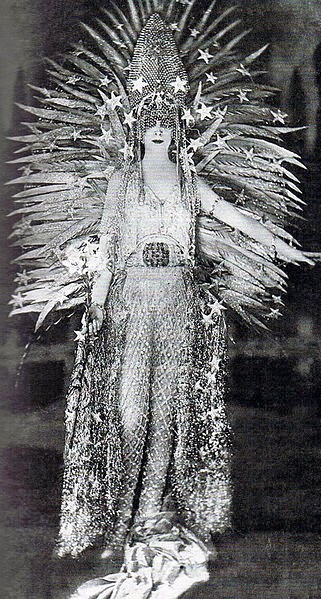
Luisa Casati in 1922
photographer unknown
She inspired characters in various films, including La Contessa (1965) in which she was played by Vivien Leigh, and A Matter of Time, when her role was taken by Ingrid Bergman. (All photos of Luisa Casati courtesy of Wikimedia Commons.)

Just a little further up on the left hand side we see the austere contours of the Hotel Gritti. Ruskin and his wife Effie stayed here in five rooms at eastern end of first floor, during 1851 -2 while he was researching the second and third volumes of The Stones of Venice. At the beginning of the twentieth century, the palace was converted into a hotel.

Later Somerset Maugham would write on its terrace, ‘Few things are equally wonderful as sitting here, while the sun goes down and immerses the Canal in bright colours.’

Hemingway also favoured this hotel, as would Winston Churchill, Graham Greene, and Orson Welles.

 
Virginia Woolf by
Geoge Charles Beresford,
courtesy of Wikimedia Commons
We are in the Honeymoon Hotel Mile. Palazzo Ferro Fini at left was once The Grand Hotel, where Virginia and Leonard Woolf spent part of their honeymoon in 1912 (the middle of her three visits). She found the noise and crush of Venice quite overwhelming.

The Hotel Europa Regina on the left was the site of George Elliot’s honeymoon in Venice, 1880. At 60 the writer had married John Cross, 20 years her junior, who jumped out of the hotel window. Much unfortunate hilarity has been expended on this incident which presumably resulted from intense private pain and probably illness.


Contarini Fasan
The pretty Contarini Fasan was one of Ruskin’s favourites. It is sometimes known
as Desdemona's palace.

Two palazzi up is the somewhat austere Ca’ Alvisi. It was the home of the redoubtable Mrs Katherine de Kay Bronson, American society hostess in Venice from the 1880s almost until her death in 1901, when it was inherited by her daughter, by then Countess Rucellai.

In her time Mrs Browning entertained Whistler, Browning, Sargeant and Henry James. Whistler wrote, 'Venice is only really known in all its fairy perfection to the privileged who may be permitted to gaze from Mrs Bronson's balcony'.

At right we see Ca’ Dario, a lurching 15th century structure, studded with lozenges of porphyry and serpentine. This building is famous as the most haunted house in Venice, the site of an unfair share of the city’s unexplained deaths and suicides. Rawdon Brown who lived there 1838- 42, was ruined by the restorations. But many people were fine there

In fact, Pen and Fanny Browning rented it while doing up the Rezzonico, and I have seen no untoward reports of their time there. The poet Henri Regnier also enjoyed his time there. Claude Monet made this painting of it in 1908, when a guest at Ca' Barbaro (of course). Painting courtesy of Wikimedia Commons. And Lady Enid Layard recorded that in May 1912 she went to visit the Bournes, a pleasant French family who had recently taken up residence at Ca' Dario.


A little further on the right we see Ca’ Semitecolo, a small 15th century Gothic palazzo with six arched windows opposite Giglio, left of Salviati’s mosaic-facaded town headquarters. The writer Constance Fenimore Woolson (photo right,courtesy of Wikimedia Commons) in 1894 occupied the top two floors of this building. She committed suicide there – jumping from her bedroom window onto the hard stones below. Her body was found by the gondolier Angelo Fusato. Encroaching deafness had brought depression. It is also thought she was hopelessly in love with Henry James, who was appointed one of her executors and was much traumatised by having to deal with her personal effects and her clothes after her death.


San Gregorio, visible from the Canal on the right, was an antique warehouse in 1913.

Finally, the pre-war traveller would pass the great white church of Santa Maria della Salute and come out into the bacino at the end of the canal, with the customs house, or Dogana. The scene would be very similar to today, apart from the Bagni Galleggianti – floating swimming baths with gaily striped awnings – that were anchored every summer off the tip of Dorsoduro. They were equipped with hot and cold, freshwater and saltwater showers, and fifty changing rooms. There were also ‘sirene’ – mermaids – which were specially adapted gondolas with metal cages underneath, so that ladies could bathe modestly and safely. Camillo Boito makes use of one of these boats for an amorous encounter between Raniero and Livia in his novel, Senso, of 1883. Having just downloaded a fascinating article about these structures, I see a translation and a whole blog about them coming on.

Overbearing, outsize cruise ships of today, not to mention the pollution they bring, make such a delightful installation impossible today. And more, for so many reasons, is the pity.

So this is where we leave the Grand Canal and our last wave of pre-war Grand Tourists.

I hope you’ve enjoyed the ride.


Michelle Lovric’s website

Great Continental Railway Journeys

The True & Splendid History of The Harristown Sisters will be published by Bloomsbury on June 5th 2014

Unattributed photos are by the author or her sister, Jenny Lovric. Venetian etchings and ephemera from the author's own collection.



Friday, 10 August 2012

How to destroy the Doge’s Palace in one hour – Michelle Lovric

Recently  I booked the Secret Itinerary in English at the Doge’s Palace for my sister and nephew. The tour takes in the archives, the torture chamber, the Inquisitors’ room and the attic prisons known as the Leads, where Casanova was confined and from which he craftily escaped. I’d also heard about a really good young guide who recently gave this tour to some friends; they came back enthusiastic and wanting to know more. She’d been lively, friendly and brought the dark passageways and mysterious rooms to life.

It sounded like excellent displacement activity for someone with deadlines on two novels. It had been at least fifteen years since I’d done the Secret Itinerary myself, so I decided to go along myself, with the excuse that I wanted to make sure I could still personally recommend this tour to friends who come to Venice.

But sadly, this time I involuntarily inflicted on my family the worst specimen I have ever encountered in a long career of guided tours that takes in an excruciating camel journey through the desert by the pyramids with a compulsive bottom-pincher leering from the beast roped up to mine, a driving tour around Athens with a terrifying sociopath and, in New Zealand, four life-sapping hours with an unreconstructed racist who absolutely insisted on teaching us the life cycle of the kiwi fruit when we’d booked to hear about colonial architecture.

I knew that things were not going well the moment our Doge’s Palace guide arrived: an older woman with magenta hair and a toad-swallowing expression. Where was lively young girl my friends had enjoyed? I began to worry. Then the toad-swallower opened her mouth … and it all turned out worse than I could ever have imagined.

The beautiful, fascinating Doge’s Palace was described by Ruskin as 'the central building of the world'. This guide single-handedly turned it into an uncomfortable, irrelevant, hateful place for twenty-four people who were bright enough to find out about the special tour in the first place and get past the arcane booking system – and who were on those counts alone deserving of being treated as intelligent beings.  

After our guide had finished with us, we were running for the exit, not wanting to see the Doge’s Palace ever again. She was rude, boring, bullying, patronizing, officious and just plain nasty. Even her body language was more Prison Guard than Person Working in the Hospitality Industry. One female visitor became not unnaturally claustrophobic in Casanova’s cell and asked to stand near the door. Visibly trembling and pale, she was yelled at and harried until my sister and I intervened. Like all bullies, when confronted by opposition, the appalling guide slunk off to bully someone else.

The guide spent far more time warning us what we were not allowed to – petty and stupid things, endlessly repeated in an insulting, droning tone – than in delivering information. The only eye contact she made was in fierce glares, accompanied by the irritable clapping of her hands at anyone who was standing where, in her opinion, they should not be.

She made the classic writer’s mistake of telling us what she was going to tell us, before doing it. This was so pronounced that it began to seem that she was deliberately doing it in order to spoil the next stage of the tour.

Worst of all she made no effort to entertain or engage the interest of the group, aged ten to sixty, I’d say. She turned the whole experience into a punitive one for everyone, patronizing the adults as much as the children. Someone tried to ask a question in the archive room. It was a good question, but the response was so unpleasant that no one dared ask another. Questions were not welcome. Our job was to shuffle obediently in and out of rooms as fast as possible so she could discharge her superficial pellets of information as quickly she could and be free of our undesirable company.  

At one point, I lifted a notebook from my bag to write a domestic reminder to myself (being so intensely bored with what she was saying that I’d stopped listening). She shrieked ‘No notes!’ so loudly that I dropped my pencil. I thought of telling her ‘Non c'e' nulla di cio' che oggi ci ha detto che valga la pena di essere scritto.’ (You haven’t told us anything today that was worth writing down.) But it would have been lost on her.

The moral for historical fiction writers is clear – if you are guiding someone into the past, you must do so with empathy. You mustn’t patronize and you must attempt to engage with your audience. You are the bridge between the past and the present. Make the transit smooth and enjoyable. Take into account the fact that you have the duty, and the honour, of representing the past to your readers. Do not subject them to an experience that will turn them off your patch of history for ever. Share your pleasure, not your misanthropy.

There must plenty of other jobs where a pleasure in bullying and a hatred of the world could be usefully deployed: but let us have the great monuments of the world reanimated for us by people who love people!

Now, just to show that the mean guide did not really destroy the Doge’s Palace, here is a video of Mike Oldfield’s eponymous song from his 1999 album, The Millennium Bell.  

And you can also read about a wonderful guided tour enjoyed by Adèle Geras here

Has anyone else had any notable guiding experiences, good or bad? Do share.


Michelle Lovric’s website

 Illustration: William Harding Smith: Palazzo Ducale (Porta della carta)

Tuesday, 10 April 2012

There goes the neighbourhood – Michelle Lovric


San Samuele is a quiet part of Venice. The only tourists who pass my street door are lost ones. Our one big attraction is the Palazzo Grassi, now devoted to promoting the modern art collection of zillionaire Francois Pinault. We don’t have a single mask shop. Our restaurants are few, the busiest being the dim café where local workmen go for their lunch.

What we do have, however, is a bit of a reputation.

Here’s a popular verse about my part of town:

Contrada piccolo, grande bordel;
Senza ponti, cattive campane,
Omini becchi e donne putane.

A small quarter, but a big brothel;
No bridges, bells that jangle,
The men are cuckolds and the women whores.

I don’t know for sure what my antecedent neighbours did to deserve this, but it may be something to do with the fact that I live in Casanova-ville. He was born (in 1725) just around the corner, in what is now the Calle della Commedia: a small plaque marks that fact, though no one knows the exact address. His mother was an actress in the San Samuele Theatre, torn down in the 1860s. His grandmother lived a few hundred yards away. Casanova, who originally planned a church career, preached his first sermon in the church of San Samuele. There were love letters in the offertory tray afterwards. By the time his second sermon came around, success had gone to the young Casanova’s head. Arriving at the pulpit after an orgy of food, he lost his thread and was obliged to pretend a faint to save face. He lost his virginity to a pair of sisters in the Salizzada San Samuele. His first patron was a noble Malipiero, of the eponymous palace on Campo San Samuele. Casanova was forced to jump out of a window after being caught in flagrante with Malipiero’s young protégée. Clearly not destined for the clergy, he was soon playing the violin in the San Samuele theatre, where his mother had trod the boards.

In his memoirs, Casanova would write of his contemporary, a certain Sebastiano Mocenigo, of San Samuele, condemned for homosexual practices.

Two libertines do not a brothel parish make. However, the next famous denizen of the Mocenigo palace was George Gordon, Lord Byron. Where Byron excelled was not so much in poetry as in self-publicity, and his carefully nurtured myth included a great deal of sexual boasting, particularly of his exploits during his Venetian sojourn, 1816–18. Personally, I’ve never understood how Byron came to epitomize the tender ‘Romantic poet’ in the public’s mind when his only true love affair was with himself. With everyone else, he was anything but romantic. In evidence, I offer a sample of his correspondence, the first being a letter to James Wedderburn Webster, dated September 8th, 1818:

‘In the two years I have been at Venice I have spent about five thousand pounds, and I need not have spent a third of this, had it not been that I have a passion for women … the sum of five thousand pounds sterling is no great deal, particularly when I tell you that more than half was laid out in the Sex;— to be sure I have had plenty for the money, that’s certain.’

And four months later, he was boasting again:
‘ … since last year I have run the Gauntlet; – is it the Tarruscelli – the Da Mosti – the Spineda – the Lotti – the Rizzato – the Eleanora – the Carlotta – the Giulietta – the Alvisi – the Zambieri – the Eleanora da Bezzi – the Theresina of Mazzurati – the Glettenheimer – & her Sister – the Luigia & her mother – the Fornaretta – the Santa – the Caligari – the Portiera Vedova – the Bolognese figurante – the Tentora and her sister – cum multis aliis? – some of them are Countesses – & some of them Cobblers wives – some noble – some middling – some low – & all whores – which does the damned old “Ladro – & porco fottuto” mean? – I have had them all & thrice as many to boot since 1817...’

In between the women, Byron did manage some verses – Beppo, the first part of Don Juan and a part of the tragedy Marin Faliero. He also wrote quite a lot of letters talking about his poetry, and his women, including this one, dated January 19th, 1819, in which he tells his friend John Cam Hobhouse not to pay his long-suffering debtors with his publishing earnings:

‘Whatever brain-money you get on my account from Murray, pray remit me. I will never consent to pay away what I earn. That is mine, and what I get by my brains I shall spend on my b***cks ...’

In the same complex of Mocenigo palaces, the Countess of Arundel was two centuries earlier involved in an intrigue with a Venetian noble. It cost Antonio Foscari his life. He was executed on April 21st, 1621, on a charge of mingling with foreigners. The Countess was furious, and told the Doge so. On January 16th, 1623, the Venetian state belatedly issued an apology.

There too lived the scandalous Lady Mary Wortley Montagu, and later her son, who was reputed to wear an iron wig.

Peeling back the years, I find more records of vice in San Samuele. Giuseppe Tassini, the Venetian historian, tells of a certain Orsa Diedo committing adultery with a local clergyman while her husband was away in Corfu in the 1380s. The same clergyman soon after seduced a Lucia Barbarigo. In 1468, Tassini notes, it was necessary to take legal action against the whores who had invaded the streets between San Samuele and Santo Stefano.

And it wasn’t just sex. 'Money makes money and lice make lice' is one of the many pleasurably earthy Venetian proverbs. Moneymaking and bad behaviour seem to have hand in hand in this area. So much so that the city powers also felt obliged erect a handsome marble plaque on the Santo Stefano church wall in 1663. It warns of prison or exile for those who persist in gambling, in etting up illegal stands to sell merchandise and in blasphemy.


I’m relieved to report that my own home appears pretty much devoid of scandal – so far. (I cannot, regrettably, make the same claims for blasphemy). Our palazzo hosted a couple of eminently respectable Doges, Vitale and Ordelaffo, who enriched the built environment of Venice. William Dean Howells lived here in the 1860s as a newly married man and astoundingly young American consul. He was forced to leave by the depredations of his venal housekeeper.

San Samuele has perhaps definitively shifted from venery to venality. The only scandals are financial these days … a local hotel and our vigile have been implicated in a big bribery case. As for cuckolds, whores, gamblers and blasphemers –I’m now surrounded by respectable large families and a honeycomb of dark warrens on the debatable land of the ground floor, inhabited by Enrico the electrician and various plumbers and other tradesmen.

But a reputation like San Samuele’s dies hard. The gondoliers passing under my study window have only one thing to tell their passengers – that Casanova lived here. Often, they’ll point to my house when they say so. Cue the snapping of cameras and this generation’s resident writer bestowing an unbecoming frown and mumbling, ‘No he did not! We run a nice palazzo here!’


Picture of angel with tarnished halo from San Vidal church in our parish

Michelle Lovric’s websiteByron and Casanova feature in her novel Carnevale, as do the Mocenigo palaces.